Supramolecular catalysis uses noncovalent interactions, such as hydrogen bonding, π–π stacking, and host–guest recognition, to control reactivity and selectivity in chemical reactions [1,2]. Unlike traditional covalent catalysis, supramolecular systems can create dynamic and adaptable microenvironments tailored to specific substrates, similar to how enzymes work. This strategy has shown great promise in asymmetric catalysis, cascade reactions, and green chemistry applications. Recent advances focus on leveraging less conventional noncovalent forces to expand the toolbox of supramolecular strategies in catalysis.
Anion−π interactions, attractive forces between anions and electron-deficient aromatic surfaces, have emerged as a compelling but underexplored mode of molecular recognition and activation. Since their discovery in the early 2000s, these interactions have been applied in areas such as anion sensing, ion transport, and self-assembly [3]. Their catalytic applications, pioneered by Matile and co-workers, include stabilization of anionic intermediates in processes like Kemp elimination and epoxide-opening cyclization [4]. A key feature of anion−π catalysis is its reliance on extended π-acidic surfaces, enabling flexible yet potentially selective substrate accommodation. This sets the stage for cooperative systems that utilize multiple π-faces for enhanced reactivity and selectivity.
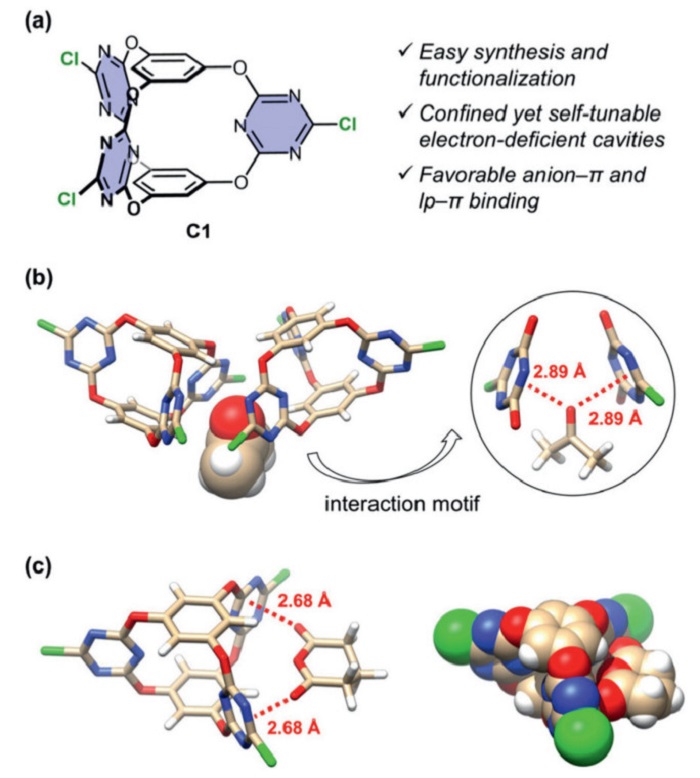
Building on previous efforts to harness π-acidic surfaces for supramolecular catalysis, Wang and co-workers designed a bis(tetraoxacalix[2]arene[2]triazine) cage (C1) as a cooperative anion−π catalytic platform (Fig. 1a) [5]. This cage features three V-shaped electron-deficient cavities that are readily accessible, synthetically tunable, and particularly suited for multidentate anionic guests. Prior work demonstrated its utility in catalyzing asymmetric Mannich-type reactions via cooperative anion−π binding. In this study, the authors extended this concept to carbonyl activation, targeting neutral electrophiles such as anhydrides. Crystallographic analysis revealed that a single acetone molecule can be clamped between two cage units via dual lone pair–π (lp−π) interactions (Fig. 1b). Computational studies further showed that a dicarbonyl guest like glutaric anhydride fits snugly within a single cage cavity via cooperative lp−π binding (Fig. 1c), with a substantial binding energy (−10.2 kcal/mol). These findings suggest a mechanistic shift from lp−π interaction in the ground state to anion−π stabilization of the transition state.
Figure 1
Figure 1.
(a) Chemical structure and key features of cage C1. (b) Single-crystal X-ray structure of C1·acetone, and (c) DFT-optimized structure of C1·glutaric anhydride (M06–2X/6–31G(d) level of theory). Reproduced with permission [5]. Copyright 2025, American Chemical Society.
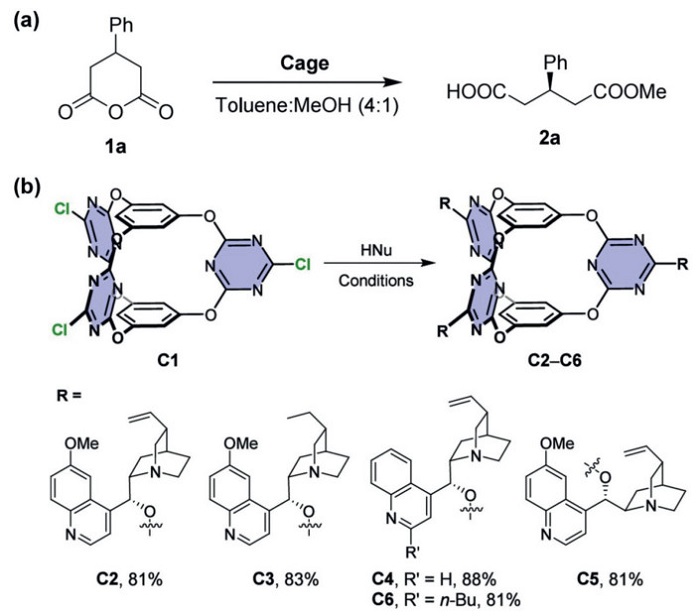
The asymmetric methanolytic desymmetrization of meso cyclic anhydrides was pursued using chiral π-acidic cages as catalysts (Fig. 2a). These cages, bearing cinchona alkaloid-derived base units, were synthesized in one step via nucleophilic substitution, affording O-linked variants (C2–C6) in > 80% yield (Fig. 2b). The quinuclidyl group is proposed to intramolecularly activate the hydroxyl nucleophile, facilitating efficient transformation. Under optimized conditions (2 mol% catalyst, toluene/MeOH (4:1), 10 ℃), cages catalyzed the reaction of 3-phenylglutaric anhydride with methanol to give product 2a in high yields and enantioselectivities up to 66% ee. Improved solubility via n–butyl substitution on the quinoline ring (C6) further enhanced selectivity. Lowering the temperature to −40 ℃ and increasing the loading to 20 mol% boosted enantioselectivity to 84% ee. Cage C6 also performed well across a broad substrate scope, including substituted phenyl, naphthyl, thienyl, and alkyl analogues, achieving 72%–94% ee. Control experiments with non-cage analogues revealed significantly reduced reactivity and selectivity, underscoring the importance of the cage's electron-deficient, V-shaped cavity in facilitating cooperative anion−π interactions. Collectively, the crystal structure analysis, substrate binding studies, and DFT modeling consistently highlights the unique capability of the cage to promote selective carbonyl activation through π-surface binding, thereby enabling high-yielding and stereoselective transformations.
Figure 2
Figure 2.
(a) Evaluation of cages in catalyzing methanolytic desymmetrization of meso anhydride. Reaction conditions: 1a (0.2 mmol), toluene/MeOH (4:1, v/v, 8 mL). (b) Synthesis of chiral molecular cage catalysts. Conditions: for C2−C5, HNu (9 equiv.), 4-methylmorpholine (3.3 equiv.), DIPEA (3.3 equiv.), THF, r.t., 0.5 h; for C6, HNu (9 equiv.), THF, r.t., 2 d. Reproduced with permission [5]. Copyright 2025, American Chemical Society.
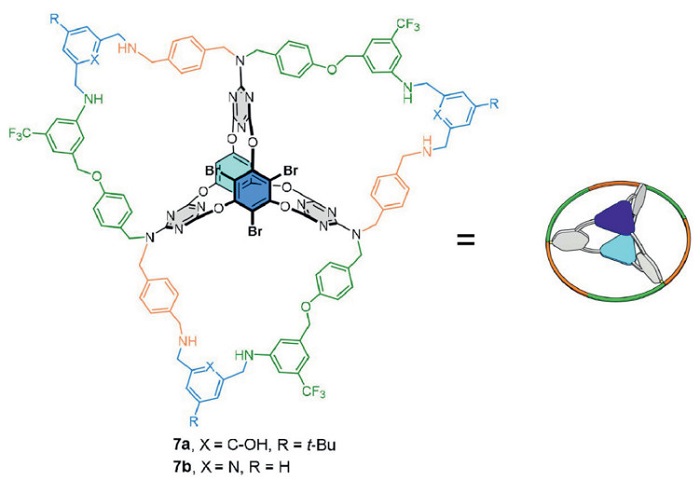
Structurally complex organic cages have attracted broad interest due to their tunable binding sites, unique cavity environments, and versatile potential applications. Introducing chirality into these architectures expands their functionality, enabling chiral recognition, asymmetric catalysis, and chiroptical behavior. Recently, Wang and co-workers developed inherently chiral molecular barrels based on bis(tetraoxacalix[2]arene[2]triazine) using a one-pot directional cascade hooping strategy (Fig. 3) [6]. By attaching three asymmetric arms to a C3v-symmetric cage precursor, two possible connection pathways emerged from bidirectional arm flipping via C–N bond rotation, yielding a pair of C3-symmetric enantiomeric barrels (7a and 7b). This efficient method avoids multi-step synthesis, allowing rapid access to highly complex chiral structures. The barrels were fully characterized by NMR and HRMS and feature a 72-membered macrocyclic loop forming three fan-shaped, chiral cavities enriched with inward-oriented functionalities. Variable-temperature NMR and DFT analyses confirmed the presence of multiple diastereomeric conformers, arising from restricted conformational dynamics. This work establishes a versatile synthetic platform for inherently chiral, topologically complex systems, paving the way for applications in chiral molecular recognition, functional materials, and supramolecular catalysis.
Figure 3
Figure 3.
Chemical structure of inherently chiral molecular barrels and the cartoon picture. The drawing shows only one of the pair of enantiomers. Reproduced with permission [6]. Copyright 2025, Elsevier Publisher.
In summary, this editorial highlights recent advances in supramolecular catalysis driven by anion−π interactions and chiral cage architectures. Wang and co-workers have demonstrated how bis(tetraoxacalix[2]arene[2]triazine)-based cages can efficiently promote enantioselective carbonyl activation through cooperative anion−π and lone pair−π interactions. Their application in asymmetric desymmetrization of meso anhydrides showcases the power of π-acidic cavities for selective catalysis under mild conditions. Furthermore, the construction of inherently chiral molecular barrels via a one-pot cascade hooping strategy greatly expands the structural and functional diversity of complex supramolecular systems. Together, these advances offer powerful tools for designing next-generation chiral materials and catalysts with broad potential in molecular recognition, sensing, and sustainable synthesis.
Declaration of competing interest
The authors declare that they have no known competing financial interests or personal relationships that could have appeared to influence the work reported in this paper.
Y. Zhao, Y. Domoto, E. Orentas, et al., Angew. Chem. Int. Ed. 52 (2013) 9940–9943. doi: 10.1002/anie.201305356
[5]
M.S. Yue, N. Luo, X.D. Wang, et al., J. Am. Chem. Soc. 147 (2025) 2303–2308. doi: 10.1021/jacs.4c15978
[6]
H. Zhou, X.D. Wang, Y.F. Ao, D.X. Wang, Q.Q. Wang, Chin. Chem. Lett. (2025), doi: 10.1016/j.cclet.2025.111443.
Figure 1
(a) Chemical structure and key features of cage C1. (b) Single-crystal X-ray structure of C1·acetone, and (c) DFT-optimized structure of C1·glutaric anhydride (M06–2X/6–31G(d) level of theory). Reproduced with permission [5]. Copyright 2025, American Chemical Society.
Figure 3
Chemical structure of inherently chiral molecular barrels and the cartoon picture. The drawing shows only one of the pair of enantiomers. Reproduced with permission [6]. Copyright 2025, Elsevier Publisher.


 DownLoad:

 下载:
下载:


 下载:
下载:

