Covalent organic framework ionomers enable synergistic efficient transport of protons and oxygen in medium-temperature proton exchange membrane fuel cells
Citation:
Zijie Lin, Qing Li. Covalent organic framework ionomers enable synergistic efficient transport of protons and oxygen in medium-temperature proton exchange membrane fuel cells[J]. Chinese Chemical Letters,
2026, 37(1): 111784.
doi:
10.1016/j.cclet.2025.111784
Covalent organic framework ionomers enable synergistic efficient transport of protons and oxygen in medium-temperature proton exchange membrane fuel cells
English
Covalent organic framework ionomers enable synergistic efficient transport of protons and oxygen in medium-temperature proton exchange membrane fuel cells
State Key Laboratory of Materials Processing and Die & Mould Technology, School of Materials Science and Engineering, Huazhong University of Science and Technology, Wuhan 430074, China
Covalent organic framework ionomers enable synergistic efficient transport of protons and oxygen in medium-temperature proton exchange membrane fuel cells
Proton exchange membrane fuel cells (PEMFCs), as clean and efficient energy technologies, are constrained in their performance enhancement by the sluggish oxygen reduction reaction (ORR) kinetics at the cathode, anode CO poisoning (e.g., from methanol crossover) and intricate water management dilemmas [1]. Elevating the operating temperature of PEMFCs can considerably break through these limitations. In this case, medium-temperature proton exchange membrane fuel cells (MT PEMFCs, 100–120 ℃) have attracted increasing attention due to their enhanced catalytic kinetics, simplified thermohydraulic management, and improved fuel tolerance. However, rapid water loss in traditional ionomers results in a decrease in both dry proton accessibility and conductivity, while the competition between water and oxygen transport diminishes the transport efficiency of these species, thereby collectively limiting the widespread application of MT PEMFCs [2].
In order to enhance the proton accessibility between 100 ℃ and 120 ℃, the introduction of short-side-chain perfluorosulfonic acid (PFSA)-based, sulfonated polyphenylenes-based, or sulfo-phenylated polyphenylene-based proton conduction ionomers or materials into the catalyst layer (CL) have been gradually investigated. Notwithstanding these endeavors, mitigating the significant drop in proton accessibility arising from dehydration and upgrading MT PEMFC performance continues to pose substantial challenges. In addition, evaporation of most water elevates water vapor partial pressure upon reaching 100 ℃, which suppresses oxygen partial pressure and thereby induces local oxygen transport limitation in the CL. Therefore, it is significant to investigate and rationally design innovative CL/ionomers with accelerated proton or oxygen transport ability. Compared to the traditional ionomer, recent researches focus on the covalent organic frameworks (COFs), which have been regarded as the promising candidates for enhancing oxygen transport efficiency in low-temperature PEMFCs (LT PEMFCs, ≤80 ℃). COFs are a class of crystalline porous polymers constructed by topologically linking organic building units, which exhibit remarkable potential in mass transport owing to their atomically pre-designable architecture, high specific surface area, and tunable functionalization (e.g., grafting hydrophilic groups like -C6H4(OH)2) [3]. Specifically, these hydrophilic moieties facilitate Grotthuss proton hopping through the formation of hydrogen-bond networks, while the distribution of ordered pore channels synergistically enables efficient co-transport of protons and oxygen. Inspired by these works, incorporating some COFs (e.g., DhaTab-COF) into Nafion as composite ionomers may offer effective solutions for optimizing the interfacial structures of CL/membrane and enhancing proton/oxygen transport efficiency of MT PEMFCs [4].
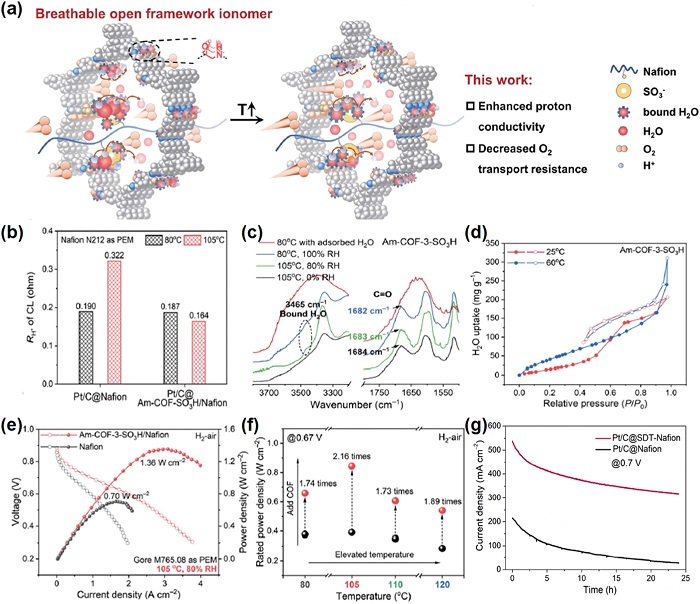
Recently, inspired by hyperthermophiles that maintain cell membrane hydration and gas exchange via α-aminoketone linkages osmolytes to thrive at 80 ℃ to 125 ℃, prof. Bo Wang et al. designed an interpenetrating network of α-amino ketone-linked COF (Am-COF) and Nafion, constructing a "breathable" conduction system, which allows oxygen to permeate freely through its porous structure while retaining water molecules necessary for proton conduction (Fig. 1a) [5]. Through a linker exchange method, imine-bonded COFs were transformed into α-amino ketone-bonded Am-COFs, introducing ordered one-dimensional nanochannels (e.g., Am-COF-3 with 2.8 nm pore diameter), and sulfonic acid groups were grafted onto the pore walls (Am-COF-3-SO3H), thereby achieving synergistic distribution of hydrophilic sites and pores. The proton transport resistance (RH+) of the CL with this Am-COF-3-SO3H and Nafion (Am-COF-3-SO3H/Nafion) decreases to 0.164 Ω at 105 ℃, representing a 49% reduction compared to pure Nafion (Fig. 1b). In addition, the carbonyl groups (C = O) of Am-COF and sulfonic acid groups (-SO3H) of Nafion collaboratively anchor water molecules via hydrogen bond networks, which can be comfirmed in-situ diffuse reflectance FT-IR spectroscopy (DRIFTS) at ~3450 cm−1 (Fig. 1c). As evidenced by the water sorption isotherms, the water sorption capacity of Am-COF-3-SO3H/Nafion increased with rising temperature (Fig. 1d). The open framework structure of Am-COF also provides channels for oxygen diffusion, effectively addressing the "water-oxygen competition" bottleneck. The mesoporous structure of Am-COF-3-SO3H/Nafion reduces the oxygen non-pressure-dependent resistance (RNP) from 45.9 S/m in Nafion to 7.6 S/m at 105 ℃, boosting the limiting current density by 2.16-fold.
Figure 1
Figure 1.
(a) Proton and oxygen transport within a breathable open framework ionomer in LT and MT PEMFCs. (b) RH+ within the CL of Pt/C@Nafion and Pt/C@Am-COF-3-SO3H/Nafion. (c) Spectra of Am-COF-3-SO3H/Nafion under different conditions. (d) H2O sorption isotherms of Am-COF-3-SO3H at 25 and 60 ℃. (e) H2-air fuel cell I-V polarization and power density plots with Pt/C@Nafion and Pt/C@Am-COF-3-SO3H/Nafion (1:3) measured at 105 ℃ and 80% RH under 200 kPaBP (Gore M765.08 as PEM, cathode loading: 0.1 mgPt/cm2, anode loading: 0.1 mgPt/cm2). (f) Comparison of the rated power densities of MEAs evaluated under H2-air conditions at 80 ℃ (100% RH), 105 ℃ (80% RH), and 110 ℃ (70% RH) (Cathode loading: 0.1 mgPt/cm2, anode loading: 0.1 mgPt/cm2). (g) The curve of current density to time for the 24-h continuous working tests for Pt/C@ Am-COF-3-SO3H/Nafion and Pt/C@Nafion without scheduled refreshing. Reprinted with permission [5]. Copyright 2024, the American Association for the Advancement of Science.
During the performance tests in H2-air (200 kPaBP), the MEA integrated with COF exhibited a peak power density of 1.36 W/cm2 (Fig. 1e). Compared to the control MEA without COF, its rated power density at 0.67 V was 1.74-, 2.16-, 1.73-, and 1.89-fold higher at 80, 105, 110, and 120 ℃, respectively (Fig. 1f). Open-circuit voltage (OCV) tests at 90 ℃ and 30% RH demonstrated that after 120 h, the voltage retention stabilized at 80% of the initial value, with hydrogen crossover current density remaining below 15 mA/cm2 (Fig. 1g). CO tolerance was evaluated using a 50 ppm CO/H2 mixture, revealing that peak power density reduction at 105 ℃ was significantly lower than at 80 ℃, thereby confirming enhanced CO tolerance at higher operating temperatures, which arises from elevated temperatures weakening CO adsorption and promoting desorption, coupled with the "breathable" conduction system's improved water retention and optimized three-phase microenvironment enhancing O2 accessibility to Pt sites and reducing CO competitive adsorption.
To further investigate the reaction mechanism, density functional theory (DFT) and molecular dynamics (MD) calculations incorporating water molecules were performed. The computed binding energy (ΔE) of the Am-COF-3-SO3H/Nafion composite was −3.67 eV, with enthalpy (ΔH) and free energy (ΔG) changes of −3.34 and −0.81 eV at 105 ℃. All these values are more negative than those of Nafion (−2.76, −2.47, and −0.04 eV for ΔE, ΔH, and ΔG, respectively). A polygon-structured Am-COF-3-SO3H/Nafion model was constructed for molecular dynamics (MD) simulations, revealing that proton conduction primarily occurs via the Grotthuss mechanism along water chains bridging Am-COF-3-SO3H and Nafion. The combined experimental and theoretical results demonstrate that Nafion segments penetrating COF channels, stabilizing water molecules through multiple hydrogen bonds to maintain proton transport pathways under medium-temperature conditions.
Prospectively, the development of MT PEMFCs can be advanced collaboratively from three dimensions: material design, system integration, and process standardization. In terms of intrinsic material property optimization, it is necessary to design COF ionomers or porous materials (e.g., metal oxides) with micro–meso–macroporous hierarchical structures, thus enhancing mass transport efficiency by regulating pore connectivity. Meanwhile, thermo-responsive functional groups should be introduced to dynamically adjust the hydrogen bond network density at elevated operating temperatures, addressing the medium-temperature dehydration challenge. At the system functional integration level, coupled devices such as "MT PEMFC-methanol reforming" can be designed to improve energy efficiency. Simultaneously, exploring the medium-temperature proton conduction mechanism and in-situ monitoring the dynamic evolution of ionomer hydration layers will provide theoretical supports for system optimization. Regarding process and standard system construction, specialized performance testing standards need to be established, and practical synthesis processes should be developed to achieve scalable manufacturing of MT PEMFCs, driving the technology from laboratory research to engineering applications.
Declaration of competing interest
The authors declare that they have no known competing financial interests or personal relationships that could have appeared to influence the work reported in this paper.
Figure 1
(a) Proton and oxygen transport within a breathable open framework ionomer in LT and MT PEMFCs. (b) RH+ within the CL of Pt/C@Nafion and Pt/C@Am-COF-3-SO3H/Nafion. (c) Spectra of Am-COF-3-SO3H/Nafion under different conditions. (d) H2O sorption isotherms of Am-COF-3-SO3H at 25 and 60 ℃. (e) H2-air fuel cell I-V polarization and power density plots with Pt/C@Nafion and Pt/C@Am-COF-3-SO3H/Nafion (1:3) measured at 105 ℃ and 80% RH under 200 kPaBP (Gore M765.08 as PEM, cathode loading: 0.1 mgPt/cm2, anode loading: 0.1 mgPt/cm2). (f) Comparison of the rated power densities of MEAs evaluated under H2-air conditions at 80 ℃ (100% RH), 105 ℃ (80% RH), and 110 ℃ (70% RH) (Cathode loading: 0.1 mgPt/cm2, anode loading: 0.1 mgPt/cm2). (g) The curve of current density to time for the 24-h continuous working tests for Pt/C@ Am-COF-3-SO3H/Nafion and Pt/C@Nafion without scheduled refreshing. Reprinted with permission [5]. Copyright 2024, the American Association for the Advancement of Science.


 DownLoad:

 下载:
下载:


 下载:
下载:

