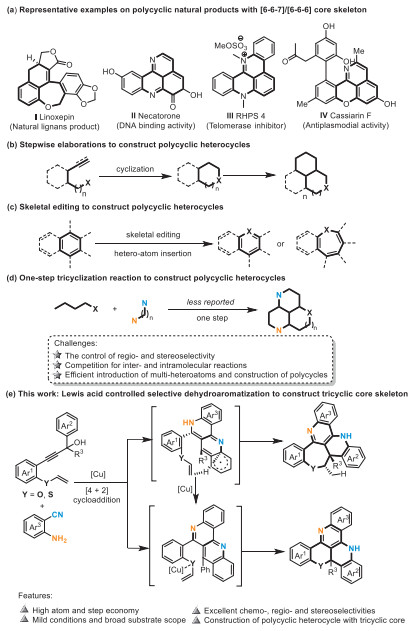
Figure 1.
Background and motivation for the synthesis of polycyclic heterocycles.

Selective synthesis of [6-6-7]/[6-6-6] core polycyclic heterocycles via Lewis acid-mediated cascade annulation of 1,6-enynols with aminonitriles
Zan Chen , Yi Wang , Yuxuan Zhou , Yunlang Li , Rong Xiong , Wenting Huang , Huanfeng Jiang , Wanqing Wu


Polycyclic heterocycles exist in many natural products, agrochemicals, drug molecules, and materials [1-6]. Among them, nitrogen and oxygen-containing functionalized heterocycles have attracted significant attention due to their high pharmaceutical value and role as efficient building blocks of functional materials [7-11]. In particular, incorporation of heteroatoms increases the diversity of drug discovery libraries by adding key pharmacophores [12-17]. These heterocyclic core structures show significant biological activities, including roles as natural lignan products [12], DNA binders [13], telomerase inhibitors [14], anti-tumor agents, and antiplasmodial agents (Fig. 1a) [15]. Thus, it is necessary to develop concise and convenient methods to construct structurally novel polycyclic heterocycles.
Building polycyclic heterocycles is generally based on stepwise processes, including Diels-Alder cycloadditions [18-21], dehydrogenative cyclizations [22-24], oxidative C-H annulations [25-27], and cross-couplings [28-31]. Furthermore, multi-step assembly and cyclization of heteroatom-containing alkenyl or alkynyl substrates represent an effective construction method for polycyclic heterocycles, but suffer from poor atom and step economy (Fig. 1b) [32-40]. Recently, single-atom skeletal editing has emerged as a powerful tool for modifying individual carbocyclic skeletons in monocycles or fused rings into heterocyclic structures (Fig. 1c) [41-56]. Despite the elegant work already done, methods for incorporating multiple heteroatoms into polycyclic compounds is less developed. Designing simple, readily accessible acyclic functionalized substrates for the one step construction of polycyclic heterocycles containing tricyclic cores and multiple heteroatoms represents an ideal approach (Fig. 1d). However, there are challenges with this approach: (ⅰ) Controlling regio- and stereoselectivity; (ⅱ) competitive inter- and intra-molecular reactions; (ⅲ) efficiently introducing multiple heteroatoms while constructing the polycycles.
Propargyl alcohol derivatives are widely used important synthons in organic synthesis due to their versatile reactivity, allowing the construction of diverse functionalized acyclic and cyclic compounds [57-61]. Additionally, electron-rich olefins serve as useful synthetic feedstocks for high value products [62-74]. The strong electronegativity of the nitrogen, oxygen or sulfur atoms in electron-rich olefins and their lone pairs of electrons can influence reaction sites by coordinating with transition metals or Lewis acids, thereby controlling insertion reactivity and selectivity. We envisioned that a novel enyol substrate containing both propargyl alcohol and electron-rich alkenyl groups would have enhanced reactivities under Lewis acid activation. The propargyl alcohol moiety could react with a nucleophile to form a functionalized allene intermediate, followed by a cascade cyclization to generate polycyclic alkenyl heterocycles [75-80]. At the same time, the electron-rich moiety could participate in ring formation facilitated by Lewis acids. Herein, we report a Lewis acid-mediated cascade cyclization of 1,6-enynols with o-aminobenzonitriles for the chemodivergent synthesis oxepino[3,4,5-de][1,6]naphthyridine and chromeno[2,3,4-de][1,6]naphthyridine derivatives. In this reaction, o-aminobenzonitrile serves as both a nucleophile and the sole nitrogen source (Fig. 1e). This strategy enabled the first synthesis of novel polycyclic heterocycles containing [6-6-7] and [6-6-6] tricyclic cores bearing three heteroatoms by selectively controlling the construction of multiple carbon-hetero bonds and carbon-carbon bonds. This reaction features high atom economy, high chemoselectivity, high stereoselectivity and high regioselectivity, as well as mild conditions and a broad substrate scope.
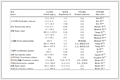
Our investigation began with 1,1-diphenyl-3-(2-(vinyloxy)phenyl)prop-2-yn-1-ol (1a) and o-aminobenzonitrile (2a) as the model substrates to establish the optimal reaction conditions (Table 1). Initially, the reaction was carried out with 20 mol% Cu(OTf)2 catalyst in DCE at 80 ℃ which provided the oxepino[3,4,5-de][1,6]naphthyridine product 3a in 33% yield with a diastereomeric ratio (dr) > 20:1. A series of Lewis acids, Zn(OTf)2, Al(OTf)3, AgOTf, ZnCl2, B(C6F5)3 and BF3·Et2O, were investigated (Table 1, entries 2-6). The results show that only the amount of Cu(OTf)2 did not improve the yield (Table 1, entries 7 and 8). Optimizing the reaction temperatures showed AgOTf showed catalytic activity delivering 3a in 8% yield, whereas all the others failed to promote the reaction. Adjusting the maximum yield of 3a (63%) was obtained at 110 ℃ (Table 1, entries 9 and 10). Solvent screening showed that THF gave the maximum yield of 3a (75%) (Table 1, entries 11-15). Interestingly, when increasing the amount of Cu(OTf)2 at 80 ℃ in dichloroethane, the yield of product 4a significantly increased accompanied by a decrease in the yield of 3a (Table 1, entries 16-18). The highest yield of 4a (83%) was formed when 1 equiv. of Cu(OTf)2 was present (Table 1, entry 18; see Supporting information for details).
 DownLoad:
CSV
DownLoad:
CSV
 |
|||||
| Entry | Lewis acid (equiv.) | Solvent | T (℃) | Yield (%) | |
| 3a b | 4a c | ||||
| 1 | Cu(OTf)2 (0.2) | DCE | 80 | 33 | Trace |
| 2 | Zn(OTf)2 (0.2) | DCE | 80 | n.d. | n.d. |
| 3 | Al(OTf)3 (0.2) | DCE | 80 | n.d. | n.d. |
| 4 | AgOTf (0.2) | DCE | 80 | 8 | Trace |
| 5 | B(C6F5)3 (0.2) | DCE | 80 | n.d. | n.d. |
| 6 | BF3·Et2O (0.2) | DCE | 80 | n.d. | n.d. |
| 7 | Cu(OTf)2 (0.1) | DCE | 80 | 20 | Trace |
| 8 | Cu(OTf)2 (0.3) | DCE | 80 | 30 | 12 |
| 9 | Cu(OTf)2 (0.2) | DCE | 70 | 24 | Trace |
| 10 | Cu(OTf)2 (0.2) | DCE | 110 | 63 | Trace |
| 11 | Cu(OTf)2 (0.2) | DCM | 110 | 30 | Trace |
| 12 | Cu(OTf)2 (0.2) | MeCN | 110 | n.d. | n.d. |
| 13 | Cu(OTf)2 (0.2) | DMSO | 110 | Trace | n.d. |
| 14 | Cu(OTf)2 (0.2) | Dioxane | 110 | 32 | Trace |
| 15 | Cu(OTf)2 (0.2) | THF | 110 | 75 | Trace |
| 16 | Cu(OTf)2 (0.4) | DCE | 80 | 25 | 32 |
| 17 | Cu(OTf)2 (0.5) | DCE | 80 | 8 | 51 |
| 18 | Cu(OTf)2 (1.0) | DCE | 80 | Trace | 83 |
| a All reactions were performed with 1a (0.10 mmol), 2a (0.11 mmol), Lewis acid (20 mol%), solvent (1 mL). n.d. = not detected. b Isolated yield. The dr was determined by 1H NMR, and all dr > 20:1. c Isolated yield. | |||||
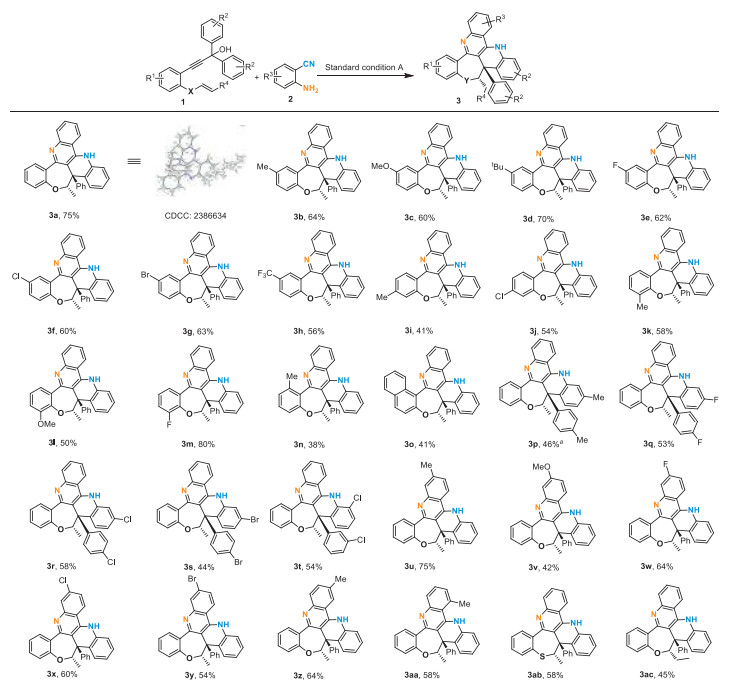
After establishing the optimum conditions, the substrate scope was investigated using a broad range of 1,6-enynols 1 and various substituted o-aminobenzonitriles 2 for the synthesis of oxepino[3,4,5-de][1,6]naphthyridine derivatives 3 (Scheme 1). Phenol-linked 1,6-enynols 1a-t with different substituents were tested, and the corresponding products 3a-t obtained inmoderate to good yields. The relative configuration of 3a was determined by X-ray diffraction analysis (XRD; see Supporting information for details). Phenol skeletons substituted at the 4-position with either electron-donating (-Me, -tert-Bu, -OMe) or electron-withdrawing groups (-F, -Cl, -Br, -CF3) were well tolerated, providing the [6-6-7] polycyclic-heterocycle products 3b-3h in 56%-75% yields. Notably, substrates with electron-donating groups exhibited higher reactivity than those with electron-withdrawing groups, indicating that the electronic effects played an important role in this process. In addition, 1,6-enynols with the phenol skeleton substituted at the 3-, 5- and 6-positions reacted smoothly providing the desired products 3i-n in 38%-80% yields. Comparing the yields of 3b, 3i, 3k and 3n reveals that 3n yield was the lowest, suggesting that steric hindrance substantially effects the naphthyridine ring formation, whereas the impacton oxepane construction was considerably less pronounced. Additionally, the reaction with naphthol-linked 1,6-enynol provided the corresponding product 3o (41%). The 1,6-enynols (1p-1t) containing the propargyl alcohol moiety with two equivalently substituted aromatic rings were efficiently converted to the target products (3p-3t) in moderate yields. Investigating the scope of substituted o-aminobenzonitriles 2, led to the formation of [6-6-7] polycyclic heterocyclic products 3u-3aa in moderate to good yields. Of particular interest, the thiophenol-linked 1,6-enynol 1ab was a suitable substrate forming the corresponding product 3ab in 58% yield. It should be noted that the 1,6-enynol 1ac with a methyl substituted alkenyl terminus was transformed to the the desired product 3ac in moderate yield. However, 1,6-enynols having asymmetric aliphatic alkyl chains at the α-positon of the alcohol were incompatible with this reaction system.
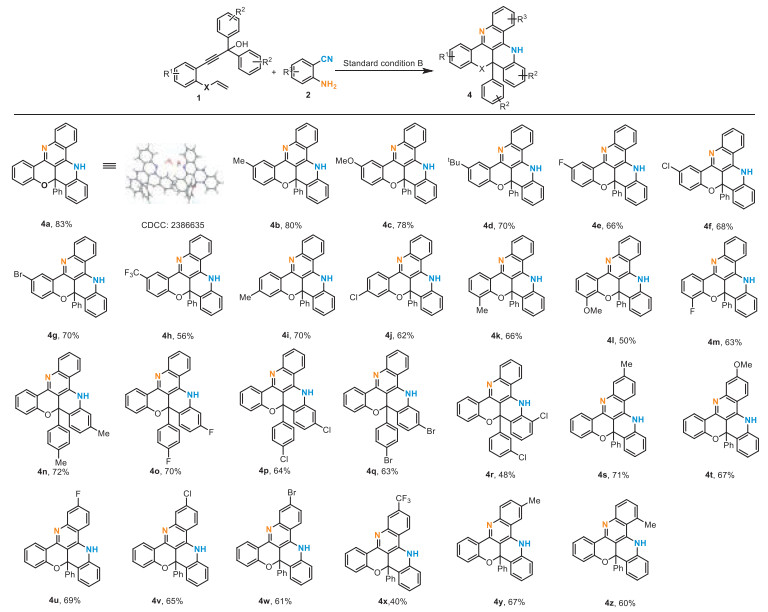
The suitability of substrates for synthesizing chromeno[2,3,4-de][1,6]naphthyridine derivatives 4 was examined (Scheme 2). The 1,6-enynols containing monosubstituted phenol skeletons (-Me, -tert-Bu, -OMe, -F, -Cl, -Br, and -CF3), were excellent substrates for the transformation, yielding the corresponding products 4a-4m in good yields. The structure of product 4a was confirmed by XRD (see Supporting information for details). In addition, 1,6-enynols 1n-1r containing a para- or meta-substituted aromatic ring attached to the α-positon of the alcohol were converted into the desired products 4n-4r, in yields ranging from 48% to 72%. Furthermore, substrates with various substituents attached to the o-aminobenzonitriles 2 led to the [6-6-6] heterocyclic products 4s-4z in moderate to good yields. However, the 3-Me substituted, naphthol-linked and thiophenol-linked 1,6-enynols did not provide the target products, likely due to spatial and electronic effects.
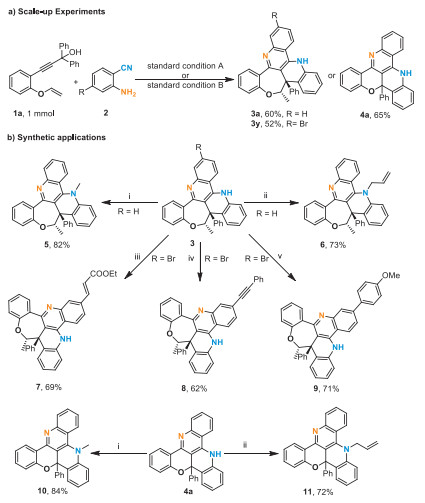
To demonstrate the efficiency and practicality of this approach, the reaction was carried out on a 1 mmol scale and the corresponding products 3a, 3y and 4a were obtained in the yields of 60%, 52% and 65% respectively (Scheme 3a). A series of product decorations were then explored (Scheme 3b). For example, the amino group of 3a was replaced by different substituents in the presence of K2CO3, providing the methylated product 5 in 82% yield and the acrylated product 6 in 73% yield. Additionally, 3y readily underwent the Heck, Sonogashira and Suzuki-Miyaura cross-coupling reactions to afford the conjugated products 7-9 in good yields, suggesting potential applications in materials science. Furthermore, when the [6-6-6] polycyclic heterocycle 4a was substituted with methyl or alkenyl groups, it efficiently transformed to the desired products 10 or 11, thus providing a handle for future modification of these complex nitrogen heterocycles.
To gain more insight into the reaction mechanism, several control experiments were conducted (Scheme 4). Isotope labeling and kinetic experiments were performed (Schemes 4a-c). When the 1,6-enynol 1a-D bearing fully deuterated aromatic rings α to the alcohol reacted with 2a under standard conditions A, the deuteration rate of the methyl group in product 3a-D exceeded 99%, indicating that the methyl protons originate from the substrate's aryl hydrogen. The parallel experiments of 1a and 1a-D found that the kH/kD value was 1.07, while no kinetic isotope effect was observed in the intermolecular competitive experiment (kH/kD = 1.0), suggesting that the capture of aryl hydrogens by the alkenyl group is not the reaction's rate-determining step. Moreover, no deuterated product 3a was detected when D2O was added to the reaction system, which indicates H2O is not involved in the formation of 3a.
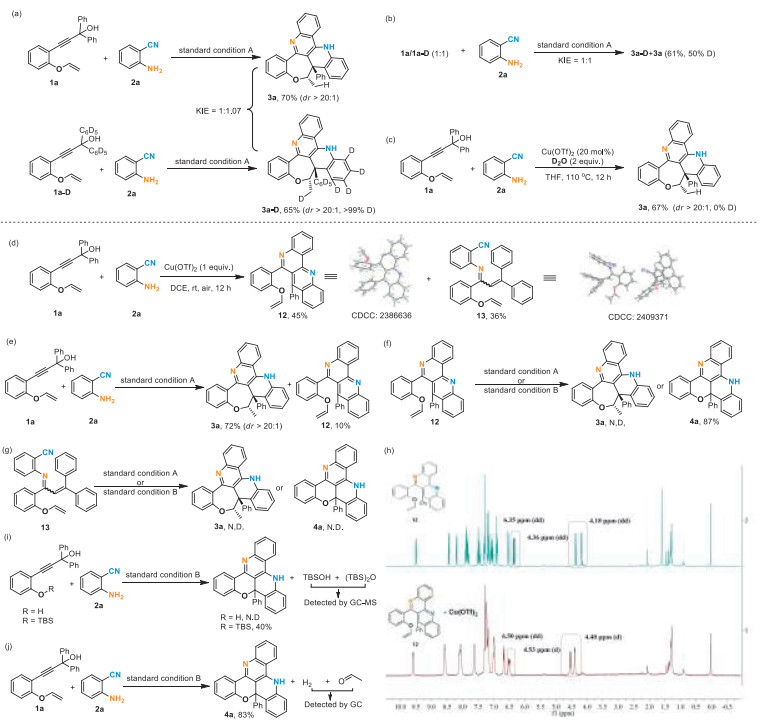
An attempt to capture the reaction intermediates resulted in the isolation of two compounds, 12 (45% yield) and 13 (36% yield) (Scheme 4d), whose structures were confirmed by XRD (see Supporting information for details). Compound 12 was also obtained in 10% yield under standard conditions A (Scheme 4e). When 12 was used as the substrate under conditions A or B, product 3a was not detected but 4a was afforded in 87% yield (Scheme 4f). However, when using 13 as the reaction partner, neither product 3a nor 4a was made (Scheme 4g). These results imply that 12 is an important intermediate in the formation of 4a, while 13 is not involved in either process. 1H nuclear magnetic resonance (NMR) of 12 revealed that the addition of 1.0 equiv. of Cu(OTf)2 increased 12's alkenyl hydrogen chemical shift indicating the alkenyl group's electron density decreases, thus corroborating Cu(OTf)2's preferential coordination to 12's enol ether oxygen (Scheme 4h). When the 1,6-enynol alkenyl group was replaced by hydrogen, product 4a was not detected under standard conditions B. However, when the alkenyl group was substituted with TBS, 4a was produced, and TBSOH and (TBS)2O were detected via GC-MS (Scheme 4i). Of note, when the reaction of 1a and 2a was conducted under standard conditions B, both hydrogen and acetaldehyde gases were detected by GC (Scheme 4j). This indicates that the substrate undergoes dehydrogenation to produce hydrogen during the reaction, while acetaldehyde is generated from the alkenyl groups dissociation.
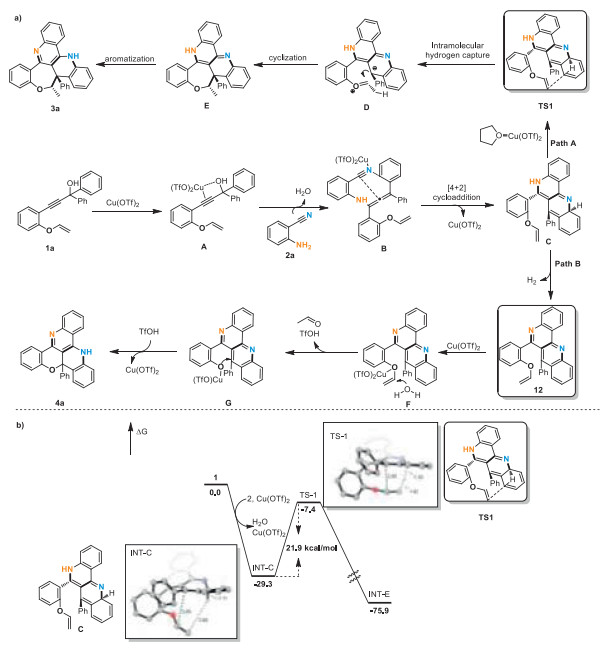
Based on these results and previous reports [62-74,81-86], a plausible reaction mechanism is proposed in Scheme 5. First, 1,6-enynol 1a and o-aminobenzonitrile 2a undergo a Cu(OTf)2 activated cationic rearrangement to form an allene cationic intermediate A. This is then attacked by the nucleophilic amino group of 2a to give intermediate B, and the release of one H2O molecule. Next, the Cu(OTf)2 activated intermediate B undergoes an intramolecular [4 + 2] cycloaddition reaction to afford intermediate C. The oxygen heterocycle formation is selectively controlled by the amount of copper salt and the solvent. In Path A, under the treatment of catalytic copper salt, intermediate C undergoes an intramolecular dehydroaromatization, to form intermediate D. Density functional theory (DFT) calculations of TS1 indicate that the alkenyl group in intermediate C and the aryl hydrogen, are in close proximity (1.42 Å). This alkenyl group serves as the hydrogen receptor, facilitating the completion of dehydroaromatization. The energy requirement for dehydroaromatization is 21.9 kcal/mol, a crucial factor that significantly impacts the reaction's temperature and product's high diastereoselectivity (see Supporting information for details). The solvent, tetrahydrofuran (THF), can also coordinate with copper, weakening the copper's effect on the electron-rich alkenyl group in intermediate C. Intermediate D subsequently cyclizes to produce intermediate E, which is aromatized to yield product 3a. Alternatively, in the presence of a full equivalent amount of Cu(OTf)2, the Lewis acid coordinates with intermediate C's alkenyl ether's oxygen atom, as shown in Path B. This interaction weakens the alkenyl group's electron-donating ability, prompting the intramolecular dehydrogenative aromatization of C to form 12, which can be isolated. Then the intermediate F formed by the coordination of 12 with Cu(OTf)2 is hydrolyzed, resulting in a molecule of acetaldehyde and intermediate G. Finally, protonation of G affords the [6-6-7] cyclization product 4a.
In conclusion, we have developed a novel methodology for the copper-mediated reaction of 1,6-enynols with o-aminobenzonitriles to chemoselectively synthesize oxepino[3,4,5-de][1,6]naphthyridine and chromeno[2,3,4-de][1,6]naphthyridine derivatives. These transformations efficiently construct polycyclic heterocycles containing [6-6-7] or [6-6-6] core skeletons, while providing high selectivity, efficiency, and atom economy. The reaction conditions are mild, and the substrate scope is broad. Control experiments and DFT calculations suggest that the key to the reaction's high stereoselectivity and chemoselectivity lies in the Lewis acid's control of the substrate's active site. This approach offers a new design concept to construct novel heterocyclic compounds, thereby inspiring further innovative synthetic designs of polycyclic heterocycles.
The authors declare that they have no known competing financial interests or personal relationships that could have appeared to influence the work reported in this paper.
Zan Chen: Writing – review & editing, Writing – original draft, Methodology, Investigation, Formal analysis. Yi Wang: Writing – review & editing, Investigation, Data curation. Yuxuan Zhou: Methodology, Investigation. Yunlang Li: Methodology, Data curation. Rong Xiong: Investigation, Data curation. Wenting Huang: Investigation, Data curation. Huanfeng Jiang: Writing – review & editing, Formal analysis. Wanqing Wu: Writing – review & editing, Writing – original draft, Supervision, Funding acquisition, Formal analysis, Data curation, Conceptualization.
The authors thank the National Youth Talent Support Program, Guangdong Basic and Applied Basic Research Foundation (No. 2024B1515040027) and Guangzhou Science and Technology Projects (No. 2024A04J6248) for financial support.
Supplementary material associated with this article can be found, in the online version, at doi:
C. Schultz, A. Link, M. Leost, et al., J. Med. Chem. 42 (1999) 2909-2919. doi: 10.1021/jm9900570
A.N. de Groot, P.W. van Dongen, T.B. Vree, Y.A. Hekster, J. van Roosmalen, Drugs 56 (1998) 523-535. doi: 10.2165/00003495-199856040-00002
A. Mishra, P. Bäuerle, Angew. Chem. Int. Ed. 51 (2012) 2020-2067. doi: 10.1002/anie.201102326
W. Liu, B. Hong, J. Wang, X. Lei, Acc. Chem. Res. 53 (2020) 2569-2586. doi: 10.1021/acs.accounts.0c00531
H. Xin, B. Hou, X. Gao, Acc. Chem. Res. 54 (2021) 1737-1753. doi: 10.1021/acs.accounts.0c00893
Y. Jiang, R.E. McNamee, P.J. Smith, et al., Chem. Soc. Rev. 50 (2021) 58-71. doi: 10.1039/d0cs00768d
E. Delfourne, J. Bastide, Med. Res. Rev. 23 (2003) 234-252. doi: 10.1002/med.10032
K.M. Marshall, L.R. Nat. Prod. Rep. 21 (2004) 731. doi: 10.1039/b401662a
M.D. Burke, S.L. Schreiber, Angew. Chem. Int. Ed. 43 (2004) 46-58. doi: 10.1002/anie.200300626
B. Liu, D. Shi, Y. Yang, et al., Eur. J. Org. Chem. 2018 (2018) 869-873. doi: 10.1002/ejoc.201701386
H.I. Boshoff, N. Malhotra, C.E. Barry, S. Oh, Pharmaceuticals 17 (2024) 211. doi: 10.3390/ph17020211
L.F. Tietze, S.C. Duefert, J. Clerc, et al., Angew. Chem. Int. Ed. 52 (2013) 3191-3194. doi: 10.1002/anie.201209868
J. Stanslas, D.J. Hagan, M.J. Ellis, et al., J. Med. Chem. 43 (2000) 1563-1572. doi: 10.1021/jm9909490
A. Rizzo, S. Iachettini, P. Zizza, et al., J. Exp. Clin. Cancer Res. 33 (2014) 81-88. doi: 10.1186/s13046-014-0081-x
J. Deguchi, T. Hirahara, S. Oshimi, et al., Org. Lett. 13 (2011) 4344-4347. doi: 10.1021/ol201674a
A.R.O. Cousins, D. Ritson, P. Sharma, et al., Chem. Commun. 50 (2014) 15202-15205. doi: 10.1039/C4CC07487D
M. Menna, E. Fattorusso, C. Imperatore, Molecules. 16 (2011) 8694-8732. doi: 10.3390/molecules16108694
A. Narita, X. Wang, X. Feng, K. Mullen, Chem. Soc. Rev. 44 (2015) 6616-6643.
H. Ito, K. Ozaki, K. Itami, Angew. Chem. Int. Ed. 56 (2017) 11144-11164. doi: 10.1002/anie.201701058
S. Zhu, R. Zhang, T. Xia, et al., Org. Lett. 26 (2024) 10746-10751. doi: 10.1021/acs.orglett.4c03692
W.W. Zhao, M.Y. Tian, Y.L. Zhou, et al., Angew. Chem. Int. Ed. 63 (2024) e202318887. doi: 10.1002/anie.202318887
K. Fukuzumi, Y. Nishii, M. Miura, Angew. Chem. Int. Ed. 56 (2017) 12746-12750. doi: 10.1002/anie.201707515
J. Zhang, M. Qiao, L. Chen, et al., Org. Chem. Front. 6 (2019) 2844-2849. doi: 10.1039/c9qo00554d
I. Kamiyoshi, Y. Kojima, S. Xu, et al., Chem. Sci. 15 (2024) 20413-20420. doi: 10.1039/d4sc05657d
J. Yin, J. You, Angew. Chem. Int. Ed. (2019) 302-306. doi: 10.1002/anie.201811023
H. Ito, Y. Segawa, K. Murakami, K. Itami, J. Am. Chem. Soc. 141 (2019) 3-10. doi: 10.1021/jacs.8b09232
Y. Zhang, S.H. Pun, Q. Miao, Chem. Rev. 122 (2022) 14554-14593. doi: 10.1021/acs.chemrev.2c00186
A. Narita, X. Wang, X. Feng, K. Mullen, Chem. Soc. Rev. 44 (2015) 6616-6643. doi: 10.1039/C5CS00183H
M. Ball, Y. Zhong, Y. Wu, et al., Acc. Chem. Res. 48 (2015) 267-276. doi: 10.1021/ar500355d
X. Yang, R. Sun, Adv. Synth. Catal. 365 (2023) 124-141. doi: 10.1002/adsc.202201172
G.E. Clarke, J.D. Firth, L.A. Ledingham, et al., Nat. Commun. 15 (2024) 3968. doi: 10.1038/s41467-024-47939-5
P. Chauhan, S. Mahajan, D. Enders, Acc. Chem. Res. 50 (2017) 2809-2821. doi: 10.1021/acs.accounts.7b00406
W.J. Kong, Z. Shen, L.H. Finger, L. Ackermann, Angew. Chem. Int. Ed. 59 (2020) 5551-5556. doi: 10.1002/anie.201914775
R. Liang, Y. Jia, Acc. Chem. Res. 55 (2022) 734-745. doi: 10.1021/acs.accounts.1c00781
T.G. Fan, X.L. Ding, B.X. Sun, et al., Adv. Synth. Catal. 365 (2023) 579-583. doi: 10.1002/adsc.202201368
J. Han, Y. Yang, Y. Gong, et al., Nat. Commun. 14 (2023) 5148. doi: 10.1038/s41467-023-40801-0
A. Luo, Y. Bao, X. Liu, et al., J. Am. Chem. Soc. 146 (2024) 6240-6251. doi: 10.1021/jacs.3c14297
Z. Wang, X. Fu, Q. Li, et al., Molecules. 29 (2024) 2481. doi: 10.3390/molecules29112481
P. Langer, Eur. J. Org. Chem. 27 (2024) e202400153.
Y. Fei, Z. Zhou, Z. Ni, et al., Angew. Chem. Int. Ed. 64 (2025) e202414726. doi: 10.1002/anie.202414726
B.D. Dherange, P.Q. Kelly, J.P. Liles, M.S. Sigman, M.D. Levin, J. Am. Chem. Soc. 143 (2021) 11337-11344. doi: 10.1021/jacs.1c06287
J.C. Reisenbauer, O. Green, A. Franchino, P. Finkelstein, B. Morandi, Science (1979) 377 (2022) 1104-1109. doi: 10.1126/science.add1383
S. Liu, X. Cheng, Nat. Commun. 13 (2022) 425.
C. Ren, B. Han, H. Guo, et al., Angew. Chem. Int. Ed. 63 (2024) e202407222. doi: 10.1002/anie.202407222
L. Wu, H. Xia, J. Bai, et al., Nat. Chem. 16 (2024) 1951-1959. doi: 10.1038/s41557-024-01668-w
Z. Liu, P. Sivaguru, Y. Ning, Y. Wu, X. Bi, Chem. Eur. J. 29 (2023) e202301227. doi: 10.1002/chem.202301227
S. Liu, Y. Yang, Q. Song, et al., Nat. Commun. 15 (2024) 9998.
S. Liu, Y. Yang, Q. Song, et al., Nat. Chem. 16 (2024) 988-997. doi: 10.1038/s41557-024-01468-2
X. Zhang, Q. Song, S. Liu, et al., Nat. Chem. 17 (2025) 215-225.
T.J. Pearson, R. Shimazumi, J.L. Driscoll, et al., Science (1979) 381 (2023) 1474-1479. doi: 10.1126/science.adj5331
P.Q. Kelly, A.S. Filatov, M.D. Levin, Angew. Chem. Int. Ed. 61 (2022) e202213041.
S.C. Patel, N.Z. Burns, J. Am. Chem. Soc. 144 (2022) 17797-17802. doi: 10.1021/jacs.2c08464
J. Wang, H. Lu, Y. He, C. Jing, H. Wei, J. Am. Chem. Soc. 144 (2022) 22433-22439. doi: 10.1021/jacs.2c10570
H. Li, N. Li, J. Wu, et al., J. Am. Chem. Soc. 145 (2023) 17570-17576. doi: 10.1021/jacs.3c07640
Y. He, J. Wang, T. Zhu, Z. Zheng, H. Wei, Chem. Sci. 15 (2024) 2612-2617. doi: 10.1039/d3sc05367a
H. Lu, Y. Zhang, X. Wang, et al., Nat. Commun. 15 (2024) 3772.
Y. Zhu, L. Sun, P. Lu, Y. Wang, ACS Catal. 4 (2014) 1911-1925. doi: 10.1021/cs400922y
J. Li, F. Yang, W. Hu, et al., Chem. Commun. 56 (2020) 9154-9157. doi: 10.1039/d0cc03285a
X. Li, D. Xu, Z. Niu, et al., Org. Lett. 23 (2021) 832-836. doi: 10.1021/acs.orglett.0c04070
X. Li, X. Kong, C. Wang, et al., Org. Lett. 23 (2021) 9457-9462. doi: 10.1021/acs.orglett.1c03621
Dattatri, M.K.R. Singam, S. Vavilapalli, J.B. Nanubolu, M.S. Reddy, Angew. Chem. Int. Ed. 62 (2023) e202215825.
W. Chen, Y. Li, Y. Chen, C.Y. Ho, Angew. Chem. Int. Ed. 57 (2018) 2677-2681. doi: 10.1002/anie.201712693
C. Chen, C. Shi, Y. Yang, B. Zhou, Chem. Sci. 11 (2020) 12124-12129. doi: 10.1039/d0sc04007j
M. Slivka, M. Onysko, Synthesis 53 (2021) 3497-3512. doi: 10.1055/s-0040-1706036
Q. Huang, S.R. Suravarapu, P. Renaud, Chem. Sci. 12 (2021) 2225-2230. doi: 10.1039/d0sc06341j
H. Jiang, X. Yu, C.G. Daniliuc, A. Studer, Angew. Chem. Int. Ed. 60 (2021) 14399-14404. doi: 10.1002/anie.202101775
M. Luo, Q. Xiao, J. Li, Chem. Soc. Rev. 51 (2022) 726-7237. doi: 10.3390/land11050726
Y. Gao, S. Yang, M. She, et al., Chem. Sci. 13 (2022) 2105-2114. doi: 10.1039/d1sc06565c
L. Ouyang, J. Li, J. Zheng, et al., Angew. Chem. Int. Ed. 56 (2017) 15926-15930. doi: 10.1002/anie.201709285
F. Zhou, M. Li, H. Jiang, W. Wu, Adv. Synth. Catal. 363 (2021) 4841-4855. doi: 10.1002/adsc.202100585
Z. Wu, M. Hu, Y. Jin, et al., Sci. Adv. 7 (2021) eabh4088.
F. Zhou, C. Li, M. Li, et al., Chem. Commun. 57 (2021) 4799-4802. doi: 10.1039/d1cc00709b
Z. Chen, W. Huang, Y. Su, H. Jiang, W. Wu, Chem. Commun. 59 (2023) 4523-4526. doi: 10.1039/d3cc00787a
Y. Zheng, Y. Wu, J. Li, et al., Green Chem. 27 (2025) 1018-1022. doi: 10.1039/d4gc05771f
L.J. Du, Y.P. Han, H.Y. Zhang, et al., Adv. Synth. Catal. 362 (2020) 1399-1404. doi: 10.1002/adsc.201901409
X.Y. Liu, Y.L. Liu, L. Chen, Adv. Synth. Catal. 362 (2020) 5170-5195. doi: 10.1002/adsc.202000930
X.R. Song, R. Yang, Q. Xiao, Adv. Synth. Catal. 363 (2021) 852-876. doi: 10.1002/adsc.202001142
M. Shankar, K.C.K. Swamy, Org. Lett. 25 (2023) 3397-3401. doi: 10.1021/acs.orglett.3c00925
X. Ren, X. Feng, H. Zhang, et al., J. Org. Chem. 88 (2023) 16007-16017. doi: 10.1021/acs.joc.3c01813
S. De, C. Chowdhury, Chem. Eur. J. 29 (2023) e202203993.
X. You, X. Xie, H. Chen, Y. Li, Y. Liu, Chem. Eur. J. 21 (2015) 18699-18705. doi: 10.1002/chem.201503374
T. Wang, R.R. Naredla, S.K. Thompson, T.R. Hoye, Nature 532 (2016) 484-488. doi: 10.1038/nature17429
Z.Y. Tian, Q. Cui, C.H. Liu, Z.X. Yu, Angew. Chem. Int. Ed. 57 (2018) 15544-15548. doi: 10.1002/anie.201805908
S.K. Thompson, T.R. Hoye, J. Am. Chem. Soc. 141 (2019) 19575-19580. doi: 10.1021/jacs.9b11243
Q. Xu, T.R. Hoye, Angew. Chem. Int. Ed. 61 (2022) e202207510.
N. Kraemer, R.R. Naredla, T.R. Hoye, Org. Lett. 24 (2022) 2327-2331. doi: 10.1021/acs.orglett.2c00491

Scheme 1 Standard conditions A: 1 (0.1 mmol), 2 (0.15 mmol), Cu(OTf)2 (20 mol%), THF (1 mL), under air at 110 ℃ for 12 h. Isolated yield. The dr was determined by 1H NMR, and all dr > 20:1. a Cu(OTf)2 (5 mol%), 24 h.

Scheme 2 Standard conditions B: 1 (0.1 mmol), 2 (0.11 mmol), Cu(OTf)2 (0.1 mmol), DCE (1 mL), under air at 80 ℃ for 12 h. n.d. = not detected. Isolated yield.

Scheme 3 The scale-up experiments and synthetic applications: (ⅰ) MeI, K2CO3, DMF, 60 ℃, 12 h; (ⅱ) 3-bromoprop-1-ene, K2CO3, DMF, 60 ℃, 12 h; (ⅲ) ethylacrylate, Pd(PPh3)2Cl2, Et3N, DMF, N2, 90 ℃, 24 h; (ⅳ) ethynylbenzene, PdCl2(PPh3)2, CuI, THF/Et3N (1:1), N2, 100 ℃, 30 h; (v) (4-methoxyphenyl)-boronic acid, Pd(PPh3)4, K2CO3 (2.0 mol/L in H2O), toluene, N2, 110 ℃, 24 h. See Supporting information for details.

Scheme 4 (a) H/D transfer experiments. (b) Intermolecular KIE experiments. (c) H source experiment. (d) Synthesis of compounds 12 and 13. (e) Isolation of compound 12 in standard conditions A. (f) Conversion of compound 12 in standard conditions A or B. (g) Conversion of compound 13 in standard conditions A or B. (h) Intermediate 12 with copper coordination effect. (i) The alkenyl group of substrate 1 was replaced with hydrogen or TBS reacts with 2a under standard conditions B. (j) Detection of gas by-products of the reaction between 1a and 2a under standard conditions B.

Scheme 5 (a) Proposed mechanism. (b) Density functional theory (DFT) calculation of TS1.
Table 1. Screening of reaction conditions.a
|
|||||
| Entry | Lewis acid (equiv.) | Solvent | T (℃) | Yield (%) | |
| 3a b | 4a c | ||||
| 1 | Cu(OTf)2 (0.2) | DCE | 80 | 33 | Trace |
| 2 | Zn(OTf)2 (0.2) | DCE | 80 | n.d. | n.d. |
| 3 | Al(OTf)3 (0.2) | DCE | 80 | n.d. | n.d. |
| 4 | AgOTf (0.2) | DCE | 80 | 8 | Trace |
| 5 | B(C6F5)3 (0.2) | DCE | 80 | n.d. | n.d. |
| 6 | BF3·Et2O (0.2) | DCE | 80 | n.d. | n.d. |
| 7 | Cu(OTf)2 (0.1) | DCE | 80 | 20 | Trace |
| 8 | Cu(OTf)2 (0.3) | DCE | 80 | 30 | 12 |
| 9 | Cu(OTf)2 (0.2) | DCE | 70 | 24 | Trace |
| 10 | Cu(OTf)2 (0.2) | DCE | 110 | 63 | Trace |
| 11 | Cu(OTf)2 (0.2) | DCM | 110 | 30 | Trace |
| 12 | Cu(OTf)2 (0.2) | MeCN | 110 | n.d. | n.d. |
| 13 | Cu(OTf)2 (0.2) | DMSO | 110 | Trace | n.d. |
| 14 | Cu(OTf)2 (0.2) | Dioxane | 110 | 32 | Trace |
| 15 | Cu(OTf)2 (0.2) | THF | 110 | 75 | Trace |
| 16 | Cu(OTf)2 (0.4) | DCE | 80 | 25 | 32 |
| 17 | Cu(OTf)2 (0.5) | DCE | 80 | 8 | 51 |
| 18 | Cu(OTf)2 (1.0) | DCE | 80 | Trace | 83 |
| a All reactions were performed with 1a (0.10 mmol), 2a (0.11 mmol), Lewis acid (20 mol%), solvent (1 mL). n.d. = not detected. b Isolated yield. The dr was determined by 1H NMR, and all dr > 20:1. c Isolated yield. | |||||
 下载: 导出CSV

 扫一扫看文章


扫一扫关注我们

 下载:
下载: