Key Laboratory of Polyoxometalate and Reticular Material Chemistry of Ministry of Education at Universities of Jilin Province Faculty of Chemistry Northeast Normal University, Changchun 130024, China
b.
School of Chemistry and Environmental Engineering, Changchun University of Science and Technology, Changchun 130022, China
c.
Key Laboratory of Bionic Engineering of the Ministry of Education, College of Biological and Agricultural Engineering, Jilin University, Changchun 130022 China
zanghy100@nenu.edu.cn (H.-Y. Zang). 1 These authors contributed equally to this work.
Received Date:
08 July 2025 Accepted Date:
09 August 2025 Revised Date:
02 August 2025 Available Online:
15 November 2026
Abstract:
As an important branch of polyoxometalates (POMs), polyoxothiometalates (POTMs) exhibit significant proton enrichment capabilities due to their high negative charge density and strong hydrophilicity. Their oxygen-rich surfaces provide an ideal platform for constructing long-range ordered hydrogen-bond networks, demonstrating unique advantages in proton conductor design. In this work, two novel POTM clusters based on [Mo2O2S2]2+ building blocks were synthesized via an in situ strategy. Ligand and anionic template coordination modes critically direct structural assembly. Utilizing the AsO43- template, with glyphosine (Gly) and 4,4′-sulfonyldibenzoic acid (H2SDB) serving as bridging ligands to form dimeric structures: H11K4[(Co3(AsO4)2(Mo2O2S2)6(OH)6O3(Gly)3(H2O)5]·35H2O (compound 1) and H16K4[(AsO4)4(Mo2O2S2)12(OH)12O4(H2SDB)6(H2O)2]·36H2O (compound 2), with the latter exhibiting an edge-interlocking polyhedral architecture. Crystallography studies have shown that the rigid ligand H2SDB in compound 2 significantly expands the framework porosity by geometrically fitting the {AsMo6} unit, which has an inherent bending angle. To release the structural stress, two dimer construction units are vertically cross-linked after being rotated 180°, forming a unique edge-interlocking structure. Proton conduction measurements demonstrated that under conditions of 85 °C and 80% relative humidity, Compounds 1 and 2 exhibit proton conductivities of 9.64 × 10⁻³ and 2.18 × 10⁻² S/cm, respectively, highlighting their significant potential as proton-conductive materials. This work provides a new strategy for the structure-oriented design of POM-based proton conductors.
Proton exchange membrane fuel cells (PEMFCs) represent a core development focus in the new energy sector due to their ultra-low emissions, ultra-high energy conversion efficiency, and environmentally friendly characteristics [1-6]. As the core component of PEMFCs, proton exchange membranes (PEMs) must simultaneously meet stringent requirements, including high proton conductivity, excellent chemical stability, and mechanical durability [7-11]. At present, although commercial perfluorosulfonic acid membranes (e.g., Nafion) have a relatively high proton conductivity, they have problems such as high price, unsatisfactory alcohol blocking performance, and unclear proton transport mechanism caused by amorphous structure [12-14]. Therefore, scientists are actively exploring new types of proton conductors that have lower costs, better performance, and more stable structures. Promising candidates include metal-organic frameworks (MOFs) [15,16], coordination polymers (CPs) [17,18], covalent-organic frameworks (COFs) [19,20], hydrogen-bonded organic frameworks (HOFs) [21,22], and polyoxometalates (POMs) [23,24]. Unlike polymers, these crystalline proton conductors possess well-defined structures amenable to direct characterization via single-crystal X-ray diffraction, solid-state nuclear magnetic resonance spectroscopy, and neutron scattering measurements [25-27]. This structural clarity facilitates in-depth investigation of conduction pathways, elucidation of proton conduction mechanisms, and understanding of structure-property relationships, providing valuable guidance for designing novel materials and advancing the field.
Among the potential proton conductor candidates mentioned above, polyoxometalates (POMs) have become the key research objects of proton conducting materials due to their unique atomic-level precise structure, strong Brønsted acidity, and modifiable oxygen-rich surface [28-40]. Polyoxothiometalates (POTMs), as an important branch of POMs, exhibit outstanding proton enrichment capabilities due to their high negative charge and strong hydrophilicity [41-45]. The feasibility of utilizing POTMs as stable building blocks for constructing high-dimensional molecular assemblies with tailored structures and functionalities has been demonstrated through rationally designed and controllable self-assembly reactions. To enhance material performance, particularly proton conductivity, researchers commonly incorporate organic components into the design. These organic moieties can be grafted onto the POM framework or serve as counterions, forming electrostatic composites with polymeric matrices [46-54].
Motivated by these considerations, this paper employs an AsO43- ion-templation strategy using stable [Mo2O2S2]2+ building blocks, which follow topological rules and efficiently and controllably synthesize two novel molecular assemblies. Both of these clusters adopt the same building unit [AsO4(Mo2O2S2)3(OH)3] {AsMo6}. The selection of ligands and the synergistic induction of the [Mo2O2S2]2+ building blocks’ self-assembly through anion templates are the keys to forming these specific structures. Based on the multiple proton-donating characteristics and strong coordination capability of glyphosine (Gly), combined with the sulfonyl group-induced electrostatic enhancement of carboxyl acidity and framework construction merits of 4,4′-sulfonyldibenzoic acid (H2SDB), H11K4[(Co3(AsO4)2(Mo2O2S2)6(OH)6O3(Gly)3(H2O)5]·35H2O (compound 1) and H16K4[(AsO4)4(Mo2O2S2)12(OH)12O4(H2SDB)6(H2O)2]·36H2O (compound 2), we have deliberately designed and synthesized two novel polyoxometalate-based compounds exhibiting significant potential for enhanced proton conductivity.
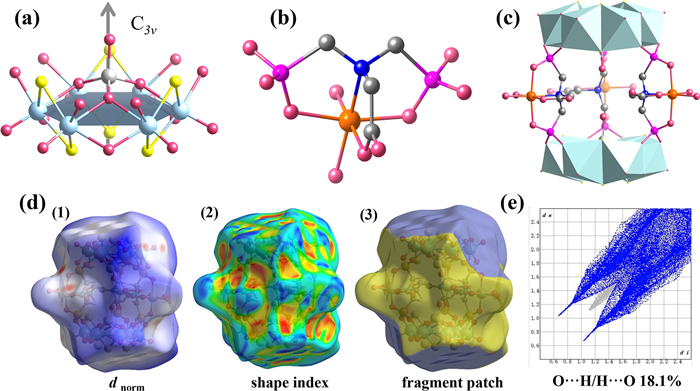
The [Mo2O2S2]2+ building block is formed by the cooperative bonding of two equivalent pentavalent molybdenum (MoV) centers through a disulfide bridge (Mo-S ≈ 2.3 Å) and a metal-metal bond (Mo-Mo ≈ 2.8 Å) to create a highly stable structure. In this study, both cluster compounds were synthesized based on the C3v-symmetric building unit [AsO4(Mo2O2S2)3(OH)3] (referred to as {AsMo6}). This unit is triggered for assembly using {AsMo6} as the template and is composed of three [Mo2O2S2]2+ building blocks surrounding the central template. The central atom bridges the {AsMo6} unit via three μ3-O ligands, positioning slightly above the basal plane of the molybdenum framework (Fig. 1a). The coordination unsaturated sites of the three bridged oxygen in {AsMo6} can combine with non-planar polydentate ligands to achieve the directional expansion of the planar ring structure. Compound 1 crystallizes in the triclinic crystal system, with a space group of P-1. To suppress the conformational disorder of the Gly flexible chain, the Co2+ ion is introduced as a “structural lock”. The Co2+ center adopts an octahedral coordination geometry, binding to two phosphonate oxygen atoms, one carboxylate oxygen, one nitrogen atom, and two water molecules within the Gly ligand, forming the {Co(Gly)(H2O)2} structural unit (Fig. 1b). Three Gly ligands bridge two C3v-symmetric {AsMo6} units in the form of molecular pillars, causing them to overlap and face each other (Fig. 1c). Among them, the phosphonic acid group (-PO3H2) is covalently bonded to the two Mo atoms on {AsMo6} through a bidentate μ2-O mode bond, forming a dimer [(Co3(AsO4)2(Mo2O2S2)6(OH)6(Gly)3] unit (denoted as 1), as shown in Fig. 1c. The framework exhibits significantly enhanced structural stability and crystallinity. As shown in Fig. S1a (Supporting information), within the {Co(Gly)(H2O)2} unit, phosphonate groups ({PO3}) of the Gly ligand and coordinated water molecules collaboratively establish an extensive hydrogen-bonding network through intermolecular interactions. Adjacent dimeric units further interconnect via K-O bonds, generating a corrugated 2D network extending along the bc-plane (Fig. S1b in Supporting information). Figs. 1d and e show the Hirschfeld surface analysis results of compound 1. Its two-dimensional fingerprint diagram indicates that the ratio of O···H/H···O is 18.1%, suggesting that there is a certain hydrogen bond network between the molecules.
Figure 1
Figure 1.
(a) Ball-and-stick representation of {AsMo6}. (b) Coordination environment diagram of Co atom. (c) Structure diagram of the dimer 1 unit. (d) Hirshfeld surface of 1, dnorm map (1), shape index map, (2) fragment patch map, and (3) on the Hirshfeld. (e) The 2D fingerprint plots of 1.
To precisely match the triangular plane angle of the C3ᵥ symmetric {AsMo6} units and avoid the conformational entropy penalty of flexible ligands, the rigid ligand 4,4′-sulfonyldibenzoic acid (H2SDB) with a certain bending angle was selected for geometric fitting. The sulfonyl moiety functions as a multifunctional structural platform: (1) Directing the assembly of edge-interlocking architectures through its pseudo-tetrahedral geometry; (2) Stabilizing extended frameworks via high-dipole-induced edge-sharing π-π stacking; and (3) Synergistically enhancing both coordination bond strength and proton conduction through electron-withdrawing effects.
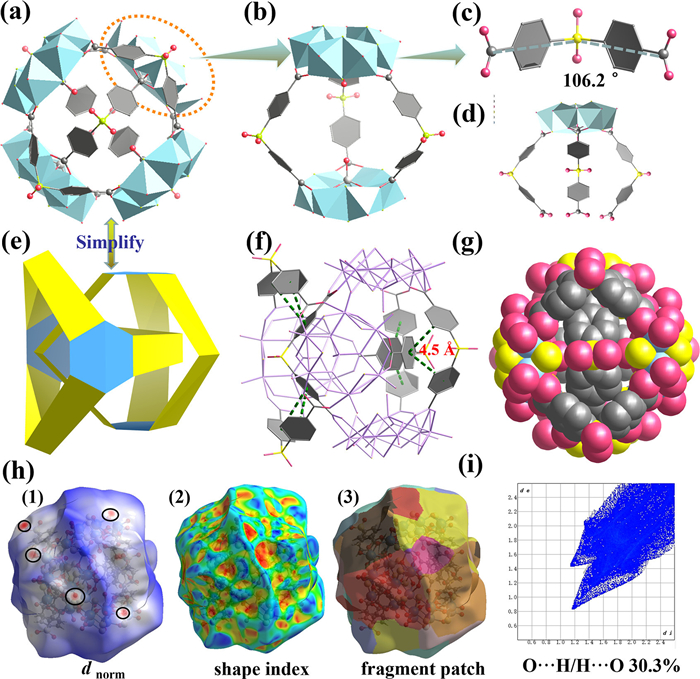
Single-crystal X-ray diffraction revealed that compound 2 crystallized in the Cmc21 space group (Table S1 in Supporting information). As shown in Fig. 2a, the structure features a pseudo-tetrahedral assembly formed by four vertex-sharing {AsMo6} units. Three H2SDB ligands bridge adjacent {AsMo6} units through their carboxyl group (-COOH), generating dimeric building blocks [(AsO4)2(Mo2O2S2)6(OH)6(H2SDB)3] (Fig. 2b). As evidenced in Figs. 2c and d, the three edges of each {AsMo6} units are raised, and the ligand angle between them is 106.20°, which expands the interior space. To release the excess energy generated by this configuration, two such dimers undergo vertical cross-linking after being rotated 180°, forming a unique edge-interlocking mode [(AsO4)4(Mo2O2S2)12(OH)12(H2SDB)6] (denoted as 2) (Fig. 2e). In this interlocking structure, the edge of one {AsMo6} unit involved in the interlocking is embedded in the cavity of the other {AsMo6} unit enclosed by two non-locked connectors and is stabilized through four sets of π···π interactions (Fig. 2f). Ultimately, the overall framework consists of 30 sulfur atoms, 24 molybdenum atoms, 84 carbon atoms, 60 hydrogen atoms, 88 oxygen atoms and 4 arsenic atoms (Fig. 2g). Interlocking molecules coordinate with K1 and K2 atoms respectively through terminal oxygen on {AsMo6}, and K1 and K2 are linked into a two-dimensional layered structure by two μ2-O (O5 and O52) (Fig. S2a in Supporting information). In addition, the sulfonyl groups on the protruding part of the H2SDB ligand can serve as proton-hopping sites, providing a basis for the construction of high-proton conductive materials. To gain a deeper understanding of the intermolecular interactions, we conducted Hirschfeld surface analysis. As shown in Fig. 2h, the surface of compound 2 displays dnorm, shape index, and fragment patch maps. The concave regions circled in the dnorm map correspond to strong hydrogen-bonding interactions. The 2D fingerprint plot of compound 2 indicates that O···H/H···O interactions account for 30.3% of all intermolecular contacts, providing strong evidence for an extensive hydrogen-bonding network (Fig. 2i). This is highly consistent with the function of sulfonyl groups as proton hopping sites and becomes a key driving force for their potential proton conductivity. The oxygen on the sulfonyl groups of the two H2SDB and the oxygen on the coordination water of H2SDB and the K ion all interact intermolecularly to form a hydrogen bond network (Fig. S2b in Supporting information).
Figure 2
Figure 2.
(a) The polyanionic skeleton of 2. (b) Structure diagram of the dimer [(AsO4)2(Mo2O2S2)6(OH)6(H2SDB)3] unit. (c) H2SDB bending angle. (d) The polyhedral/ball-and-stick representation of [AsO4(Mo2O2S2)3(OH)3(H2SDB)3] subunit. (e) The simplification of the polyanionic skeleton in 2. (f) X-ray crystal structure diagram showing the between phenyl groups π···π interactions. (g) Spatial fill view of compound 2. (h) Hirshfeld surface of 2, dnorm map (1), shape index map (2) and fragment patch map (3) on the Hirshfeld surface. (i) The 2D fingerprint plots of 2. Color code: Mo, light blue; As, O, rose red; C, grayish black.
Understanding its assembly process is challenging, and using ligands of different configurations to influence the structure provides a new perspective for self-assembly. We verified the phase purity, chemical structure, and thermal stability of compounds 1 and 2 through extensive powder X-ray diffraction (PXRD), Fourier transform infrared spectroscopy (FT-IR), scanning electron microscopy (SEM), and thermogravimetric analysis (TGA) (Figs. S3-S7 in Supporting information). The good match between the simulated and measured PXRD confirmed the high phase purity of the two compounds.
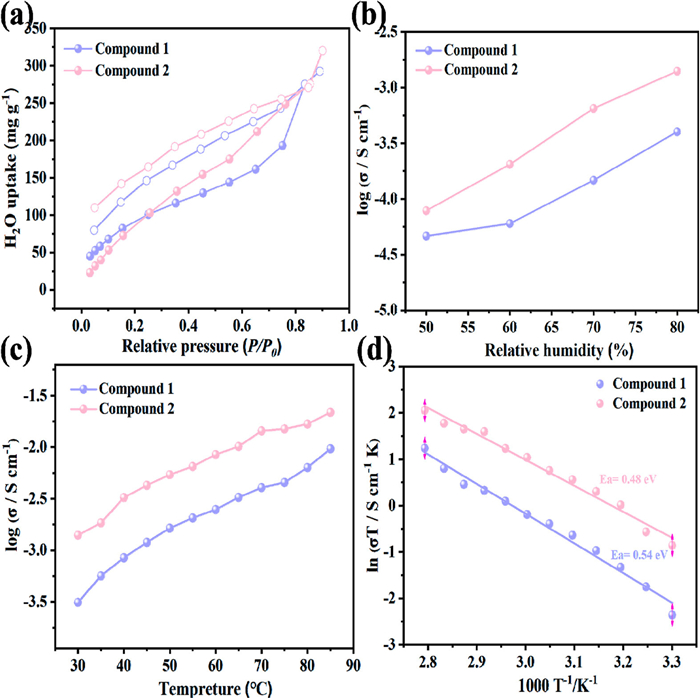
The oxygen-rich surface of the compound can form an effective hydrogen bond network with guest molecules and water molecules, and the proton jump sites and proton transfer binding sites on the ligand make it an ideal molecular matrix conductor [55]. Given the critical role of moisture content and transfer mechanisms in proton conduction studies, we evaluated compounds 1 and 2 through water vapor adsorption experiments. The results show that under the conditions of 30 ℃ and P/P0 = 0.90, the maximum water adsorption capacities of these two materials are 292.73 and 320.30 mg/g, respectively (Fig. 3a). This result provides strong support for the compound's higher proton conduction capacity in a high relative humidity environment. In order to further study their proton conduction characteristics, the proton conductivity (σ) of these two compounds was measured using alternating current impedance spectroscopy. At a constant temperature of 30 ℃, the proton conductivity of both compounds 1 and 2 showed a significant increase from 4.65 × 10⁻⁵ and 7.83 × 10⁻⁵ S/cm to 4.00 × 10⁻⁴ and 1.40 × 10⁻³ S/cm, respectively (Fig. 3b and Fig. S8 in Supporting information). The proton conduction performance of compound 2 is slightly higher than that of compound 1, which may be due to the fact that the water molecule provides more proton transfer sites, which is consistent with the water adsorption test results. To investigate the effect of temperature on proton conductivity, proton conductivity tests were performed on compounds 1 and 2 at a gradient temperature of 30-85 ℃ at 80% relative humidity (RH). As shown in Fig. 3c and Fig. S9 (Supporting information), the measured resistance decreases as the temperature increases, while the proton conductivity increases gradually, indicating that the proton conduction performance is significantly temperature-dependent. At 85 ℃, the maximum proton conductivity of the two compounds reached 9.64 × 10⁻³ and 2.18 × 10⁻² S/cm, respectively. This increase in conductivity is attributed to the acceleration of the movement of water molecules at high temperatures [56]. Both compounds exhibit excellent proton conductivity, under similar test conditions, surpassing many recent POMs (Fig. S10 and Table S4 in Supporting information), enhancing the potential for POM-based conductive materials.
Figure 3
Figure 3.
(a) Water uptake isotherms of compounds 1 and 2 are measured at 30 ℃. (b) Humidity-dependent proton conductivity at 30 ℃. (c) Temperature-dependent proton conductivity of both clusters. (d) Arrhenius plots of the proton conductivity of both clusters.
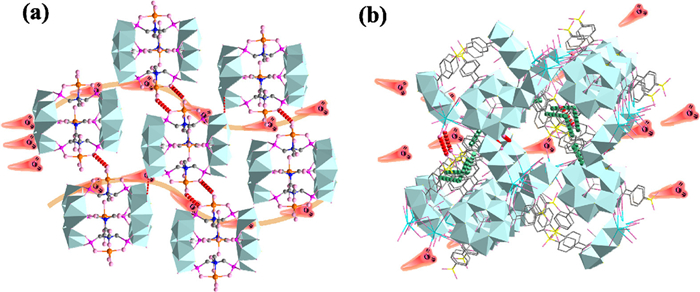
To further explore the proton conduction mechanism, we calculated the proton conduction activation energy (Ea) of the two compounds using the Arrhenius equation [σT = σexp(-Ea/kbT)]. The results showed that the activation energies of compounds 1 and 2 were 0.54 and 0.48 eV, respectively, suggesting that the proton conduction behavior of both compounds was consistent with vehicular mechanisms (Fig. 3d) because Ea > 0.4 eV [57,58]. The higher activation energy indicates that proton transport mainly relies on the diffusion of hydrated ions (H3O+). In this mechanism, the number of carriers and the speed of transmission become the key factors that determine the conductivity. The high temperature environment accelerates the migration of protons, and the fast proton transport carried by the carriers and the hydrogen bonding network-assisted transport combine to create excellent proton conductivity for these two compounds. As shown in Fig. 4, compared to compound 1, compound 2 possesses a larger cavity that can accommodate more water molecules, more molybdenum nuclei, and coordinated organic ligands, which results in the expansion of bridging oxygen, terminal oxygen, and sulfonyl groups. Moreover, the π···π stacking in compound 2 not only stabilizes the structure but also further enhances the construction of H-bonding motifs [59], resulting in a more complex proton migration network and improved proton conductivity. Even after 10 h of continuous testing, there was no significant decrease in the proton conductivity of the two compounds, indicating that they were highly stable in terms of proton conductivity (Fig. S11 in Supporting information). The PXRD and FT-IR of the samples after the test were compared with the samples before the test, and the results showed that the pattern changed very little (Fig. S12 in Supporting information). This finding shows that the structure of the sample remains stable in a high temperature and humidity environment. Furthermore, the time-dependent current characteristics of 1 and 2 were investigated by using the Hebb-Wagner direct current polarization method [60]. At a constant voltage of 0.1 V, the resistances of the two compounds are 3.22 × 10⁸ and 4.16 × 10⁹ Ω, respectively (Fig. S13 in Supporting information). The research results show that these two compounds mainly conduct protons rather than other ions. We conducted detailed impedance spectrum analyses on compounds 1 and 2 and fitted their electrochemical behaviors through an equivalent circuit model (Fig. S14 in Supporting information).
Figure 4
Figure 4.
Possible proton conduction mechanisms for compounds 1 and 2 (red dotted line represents hydrogen bonds, and the green dotted line represents π···π interaction).
In summary, we successfully synthesized two polynuclear non-planar clusters through anion-templated self-assembly using AsO43-, with Gly and H2SDB serving as bridging ligands. The distinct coordination modes of these ligands to the {AsMo6} unit result in structural variations that directly govern their divergent proton conduction behaviors. Both architectures were fully characterized by single-crystal X-ray diffraction, and their proton conductivity was systematically investigated. Both compounds exhibited high proton conductivity at 85 ℃ under 80% RH, with σ values of 9.64 × 10⁻³ and 2.18 × 10⁻² S/cm, respectively. Structural analysis reveals that configuration differences govern proton conductivity, demonstrating the significant potential of [Mo2O2S2]2+-based clusters as proton-conductive. Building on this work, we will employ structurally rigid ligands to enable the precise design and controlled assembly of diverse polynuclear clusters based on the [Mo2O2S2]2+ building blocks.
The authors declare that they have no known competing financial interests or personal relationships that could have appeared to influence the work reported in this paper.
Acknowledgments
This work was supported by the National Natural Science Foundation of China (No. 22322102), the Fundamental Research Funds for the Central Universities-Excellent Youth Team Program (No. 2412023YQ001), the Natural Science Foundation of Jilin Province (No. 20200201083JC), the Natural Science Foundation of the Department of Education of Jilin Province (No. JJKH20201169KJ).
Supplementary materials
Supplementary material associated with this article can be found, in the online version, at doi:10.1016/j.cclet.2025.111698.
B. Wang, R.B. Lin, Z.J. Zhang, et al., J. Am. Chem. Soc. 142 (2020) 14399-14416. doi: 10.1021/jacs.0c06473
[60]
T. Miruszewski, K. Dzierzgowski, P. Winiarz, et al., J. Mater. Chem. A 10 (2022) 7218-7227. doi: 10.1039/d1ta10916b
Figure 1
(a) Ball-and-stick representation of {AsMo6}. (b) Coordination environment diagram of Co atom. (c) Structure diagram of the dimer 1 unit. (d) Hirshfeld surface of 1, dnorm map (1), shape index map, (2) fragment patch map, and (3) on the Hirshfeld. (e) The 2D fingerprint plots of 1.
Figure 2
(a) The polyanionic skeleton of 2. (b) Structure diagram of the dimer [(AsO4)2(Mo2O2S2)6(OH)6(H2SDB)3] unit. (c) H2SDB bending angle. (d) The polyhedral/ball-and-stick representation of [AsO4(Mo2O2S2)3(OH)3(H2SDB)3] subunit. (e) The simplification of the polyanionic skeleton in 2. (f) X-ray crystal structure diagram showing the between phenyl groups π···π interactions. (g) Spatial fill view of compound 2. (h) Hirshfeld surface of 2, dnorm map (1), shape index map (2) and fragment patch map (3) on the Hirshfeld surface. (i) The 2D fingerprint plots of 2. Color code: Mo, light blue; As, O, rose red; C, grayish black.
Figure 3
(a) Water uptake isotherms of compounds 1 and 2 are measured at 30 ℃. (b) Humidity-dependent proton conductivity at 30 ℃. (c) Temperature-dependent proton conductivity of both clusters. (d) Arrhenius plots of the proton conductivity of both clusters.
Figure 4
Possible proton conduction mechanisms for compounds 1 and 2 (red dotted line represents hydrogen bonds, and the green dotted line represents π···π interaction).


 DownLoad:

 下载:


 下载:

