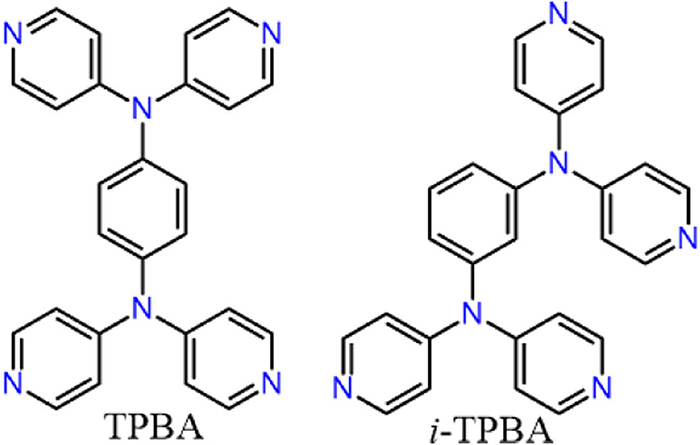
Scheme 1.
Isomeric ligands used for the synthesis of cluster-based SCO MOF.

Self-assembly of spin crossover Fe(Ⅱ) framework materials with new topologies using tetra(pyridinyl)benzenediamine ligand
Guang Yang , Lu Yu , Ze-Yu Ruan , Ai-Qi Jian , Yan-Ru Chen , Yan-Cong Chen , Zhao-Ping Ni , Ming-Liang Tong


Spin crossover (SCO) compounds are classic bistable materials that can reversibly switch between high-spin (HS) and low-spin (LS) states under external stimuli such as temperature, light and pressure. These materials hold significant potential for applications in data storage, displays, switches, actuators and sensors [1-4]. As a collective phenomenon, gradual, abrupt, hysteretic, step and incomplete SCO behaviors can be observed in the solid state. To achieve hysteretic SCO properties, strategies involving effective intermolecular interactions and covalent linker have been proposed [5,6]. Consequently, coordination polymers, including one-dimensional (1D) Fe(Ⅱ)-triazole chains, two-dimensional (2D) [Fe(NCX)2(L)2] families (X = S, Se or BH3, L = bispyridyl ligands) and three-dimensional (3D) Hofmann-type metal-organic frameworks (MOFs) [4,7-10], have been extensively studied in the SCO field. Owing to their inherent porosity, MOFs are particularly noteworthy for their potential applications in gas storage, separation and catalysis [11-14], thereby enhancing the multifunctionality of SCO MOFs [15,16]. Most Hofmann-type MOFs have been confined to fsc and pcu topologies [17,18], limiting the expansion of their functional diversity. However, designing SCO MOFs with novel topologies remains a significant challenge.
Cluster-based MOFs are renowned for their diverse topologies and unique physicochemical properties [19-21]. Recently, we serendipitously synthesized the first example of cluster-based SCO MOFs [22], [Fe3{Ag8X8(CN)6}(TPBA)3]·nDMF (X = Br, n = 9 and X = I, n = 8, TPBA = N,N,N’,N’-tetra(pyridine-4-yl)benzene-1,4-diamine, Scheme 1), by reacting FeX2 with TPBA and K[Ag(CN)2] in MeOH/DMF solution. The hexatopic cluster anions [Ag8X8(CN)6]6−, tetratopic ligands TPBA and hexatopic Fe(Ⅱ) ions are interconnected to form the urk topology. Most intriguingly, the reaction of Fe(ClO4)2·6H2O with TPBA and K[Ag(CN)2] in MeOH/DMF solution led to the formation of another cluster-based SCO MOF [23], [Fe3{Ag4(CN)6(H2O)}2(TPBA)3](ClO4)2·7DMF. In this structure, the Fe(Ⅱ) ions are axially bridged by the double interlocking [Ag{Ag(CN)2}3(H2O)]2− clusters, forming inorganic connectivity with 2D→3D n-fold Borromean entangled topology. Furthermore, the Fe(Ⅱ) ions are equatorially linked by the tetratopic TPBA ligands, generating a 3D framework with the extremely rare 3,4,6-T108 topology. Clearly, the self-assembly of these products is highly dependent on the nature of the anions.
Here, instead of TPBA, the isomeric tetrapyridyl ligand N1,N1,N3,N3-tetra(pyridin-4-yl)benzene-1,3-diamine (i-TPBA, Scheme 1) was employed to construct novel SCO MOFs. The reactions of i-TPBA and K[Ag(CN)2] with FeBr2 and Fe(ClO4)2·6H2O in EtOH/DEF solution yielded distinct MOFs: [FeⅡ3{Ag8Br8(CN)6}(i-TPBA)3]·4DEF (1, DEF = N,N-diethylformamide) featuring the urk topology and [FeⅡ{Ag(CN)2}(i-TPBA)]ClO4·2H2O·0.5DEF (2) exhibiting a previously unreported topology. Furthermore, thiophene guest molecules were incorporated to form [FeⅡ3{Ag8Br8(CN)6}(i-TPBA)3]·9thiophene (1_thio) and [FeⅡ{Ag(CN)2}(i-TPBA)]ClO4·4thiophene (2_thio), respectively. Consequently, the SCO behavior can be effectively modulated by the guest molecules, leading to a scan rate-dependent hysteretic SCO behavior observed in 2_thio.
Yellow single crystals of 1 or 2 were obtained by the slow diffusion of K[Ag(CN)2] and i-TPBA ligand into solutions of FeBr2 or Fe(ClO4)2 in EtOH/DEF, respectively. This process resulted in the formation of crystals with distinct compositions and topologies. A thiophene solution was added to the mother liquor containing single crystals of 1 or 2 for 3 days, resulting in the deep yellow crystals of 1_thio or 2_thio, respectively. Although the crystal quality of 1_thio was poor, its composition was confirmed via thermogravimetric analysis (Fig. S2 in Supporting information) and elemental analysis.
Single-crystal X-ray diffraction (SC-XRD) analysis reveals that 1 crystallizes in the trigonal R
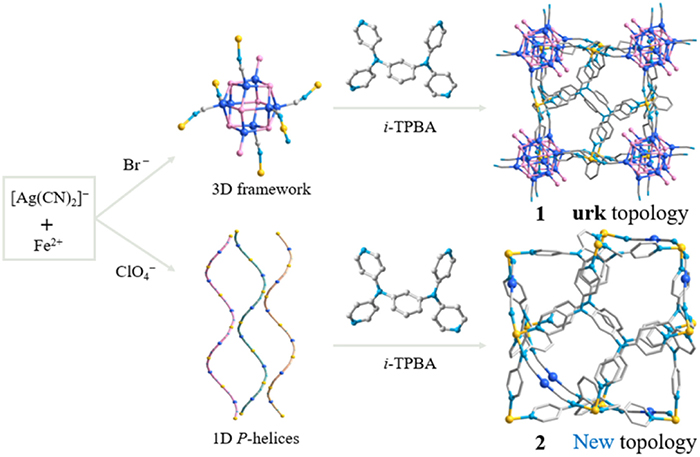
Each Fe2+ ion is axially coordinated by two cyanide ligands from two [Ag8Br8(CN)6]6− clusters. The [Ag8Br8(CN)6]6− clusters serves as hexatopic nodes to axially connect six Fe2+ ions, forming a 3D inorganic network with pcu topology (Fig. S11 in Supporting information). Each Fe2+ ion is further equatorially coordinated by four tetradentate i-TPBA ligands, resulting in a [FeN6] coordination environment. The average Fe−N bond length is 2.182Å at 240K, corresponding to the HS state. Since the benzene ring of i-TPBA ligand is disordered in two positions, the whole i-TPBA ligand has an inversion center in the crystal structure. The i-TPBA ligands act as tetratopic nodes to equatorially connect four Fe2+ ions, resulting in a 3D organic connectivity with nbo topology. Consequently, the integration of the 3D pcu inorganic connectivity and the 3D nbo organic connectivity results in an I3O3 hybrid inorganic-organic framework characterized by the urk topology (Fig. 2 and Fig. S12 in Supporting information) [22-25]. The DEF guest molecules are highly disordered and were omitted from the structure using the solvent mask in OLEX2 [26].
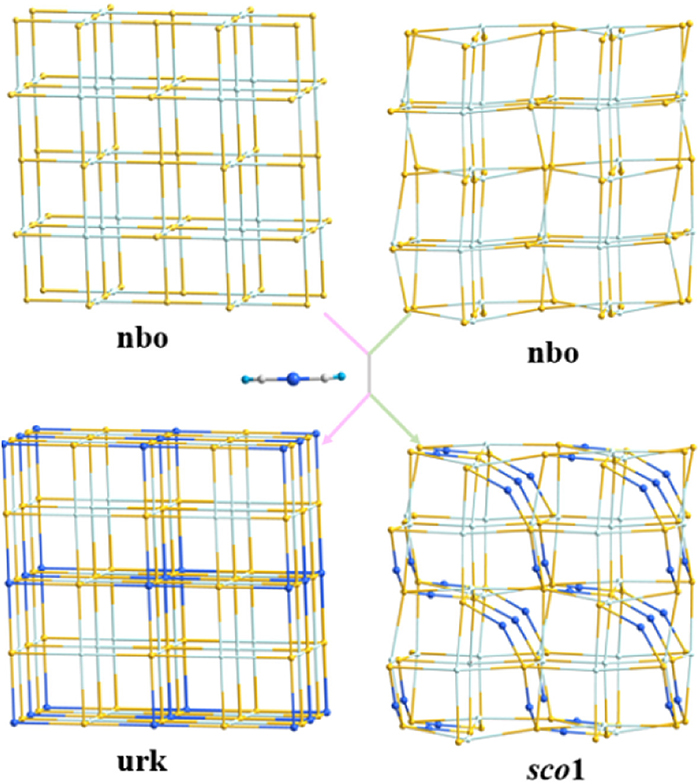
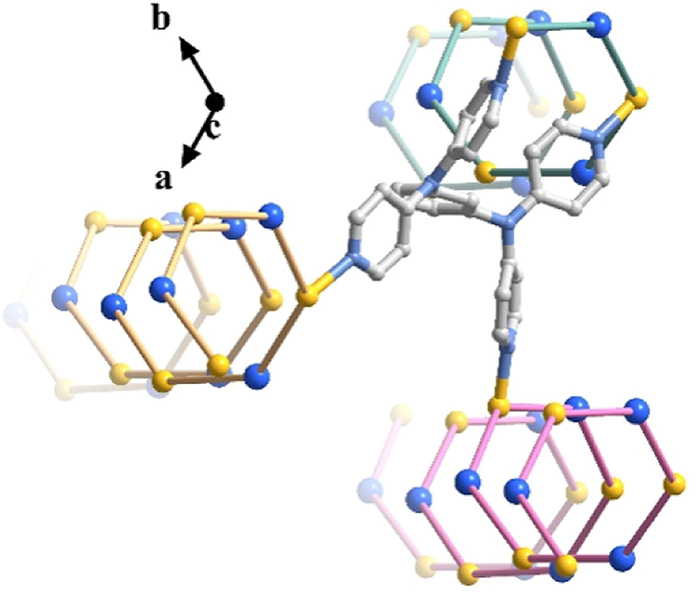
Compound 2 crystalizes in the trigonal R32 space group at 100K (Tables S3 and S4 in Supporting information). The asymmetric unit consists of two unique Fe(Ⅱ) ions with half occupancy, one [Ag(CN)2]− linker, one i-TPBA ligand, one DEF molecule with half occupancy, two ClO4− anions with one-third occupancy and one ClO4− anion with one-sixth occupancy (Fig. S13 in Supporting information). The remaining ClO4− anions and solvent molecules exhibit high disorder and were excluded from the structural refinement using a solvent mask in OLEX2 [26]. Each Fe(Ⅱ) ion is coordinated by four i-TPBA ligands in the equatorial plane and by two [Ag(CN)2]− linkers in the apical positions, forming a distorted octahedral [FeN6] coordination environment. The average Fe1−N bond length is 2.051Å at 100K, which is close to the LS state. In contrast, the average Fe2−N bond length is 2.164Å, corresponding to the HS state. Notably, the [Ag(CN)2]− units axially bridge the Fe1 and Fe2 ions to construct a 1D right-handed 31 helical chain along the c axis (Fig. S14 in Supporting information), with the average bond angles of C−Ag−C = 168.47°, Ag−C≡N = 170.32°, C≡N−Fe = 163.39° and Fe1···Ag···Fe2 = 147.87°, respectively. This structure contrasts sharply with the 1D linear inorganic connectivity observed in the inverse-Hofmann-type MOF [Fe(TPB){Au(CN)2}]I·4H2O·4DMF (TPB = 1,2,4,5-tetra(pyridine-4-yl)benzene) (Fig. 3) [27]. The twisted tetradentate pyridyl ligand i-TPBA exhibits order in 2, precluding the inversion center observed in 1. Each i-TPBA ligand coordinates with four Fe(Ⅱ) ions (Fe1, x, y, z; −y, x−y, z and Fe2, x, y, z; 1−x+y, 1−x, z) at the equatorial positions, generating a 3D M-Ligand-M connectivity with nbo topology (Fig. S15 in Supporting information). Consequently, each i-TPBA links three 1D right-handed helical chains, resulting in a 3D chiral framework (Fig. 3, Figs. S16 and S17 in Supporting information). The integration of the 1D chiral helical chain with the 3D nbo organic connectivity yields a I1O3 hybrid inorganic-organic framework. We define this unreported topology as sco1, which has been formally registered in the ToposPro program with the point symbol {3.53.62}{32.55.66.72} (Fig. 2 and Fig. S20 in Supporting information) [28-31].
Compound 2_thio, crystallizing in the R32 space group at 100 and 290K, is obtained by soaking 2 in thiophene solution for 3 days (Tables S5 and S6 in Supporting information). The composition of the cationic framework in the asymmetric unit of 2_thio at 100 and 290K remains identical to that of 2 (Fig. S21 in Supporting information). At 100K, three ClO4− anions with one-third occupancy are resolved, exhibiting positional disorder around a C3 rotation axis along the c-axis. Additionally, four thiophene guest molecules with the occupancies of 0.5, 1, 0.6 and 0.4 are identified at 100K. This indicates that one and a half thiophene are too disordered to be solved. Only one thiophene molecule participates in the C-H···π interaction with the i-TPBA ligand, reflecting a weak host-guest interaction (Fig. S22 in Supporting information). Upon increasing the temperature to 290K, the ClO4− anions and thiophene guest molecules exhibit high disorder and were excluded from the structural refinement using a solvent mask in OLEX2 [26]. The presence of thiophene is further confirmed by infrared (IR) spectroscopy and scanning electron microscopy (SEM) and energy dispersive spectrometer (EDS) (vide infra). The average Fe1−N bond lengths are 1.984Å at 100K and 2.190Å at 290K, corresponding to the LS and HS states, respectively, suggesting a spin transition process. The average Fe2−N bond lengths are 2.169Å at 100K and 2.207Å at 290K, consistent with the HS state. Meanwhile, the unit cell volumes of 2_thio increase by 5.2% during the SCO process.
The IR spectra were collected at room temperature to assist in identifying the molecular composition (Figs. S23−S26 in Supporting information). The presence of the counter anion ClO4− is confirmed by its characteristic ν(Cl−O) peaks, which appear at 1083 and 1090 cm−1 for 2 and 2_thio, respectively. Upon loading thiophene guest molecules, broad bands at 3080 and 3090 cm−1 emerge in 1_thio and 2_thio, respectively, and can be attributed to the C-H stretching vibrations. Additionally, sharp peaks at 1432 and 1434 cm−1 are observed in 1_thio and 2_thio, respectively, corresponding to the thiophene ring stretching vibrations.
The existence of the ClO4− anion and thiophene guest molecule was further verified through SEM and EDS analyses (Figs. S27−S29 in Supporting information). Notably, the detection of the S element confirms the successful incorporation of thiophene guest molecules in 1_thio and 2_thio. Furthermore, the presence of the Cl element indicates the inclusion of the ClO4− anion in 2_thio.
Variable-temperature magnetic susceptibility data revealed the guest-dependent SCO behaviors (Fig. 4 and Figs. S30−S35 in Supporting information). For 1, the χMT value per Fe(Ⅱ) unit gradually decreases from 3.33 cm3 K mol−1 at 300K to 1.54 cm3 K mol−1 at 10K, indicating a gradual and incomplete SCO behavior. The subsequent warming curve overlaps with the cooling one, ruling out hysteretic SCO behavior. The first-order derivative of the magnetic data reveals a spin transition temperature (T1/2) of 146K. Upon incorporation of thiophene guest molecules, the χMT values of 1_thio are consistently higher than those of 1. The χMT value per Fe(Ⅱ) unit slightly decreases from 3.64 cm3 K mol−1 at 300K to 2.28 cm3 K mol−1 at 10K. Consequently, 1_thio exhibits a gradual and incomplete SCO behavior with a higher HS fraction compared to that of 1.
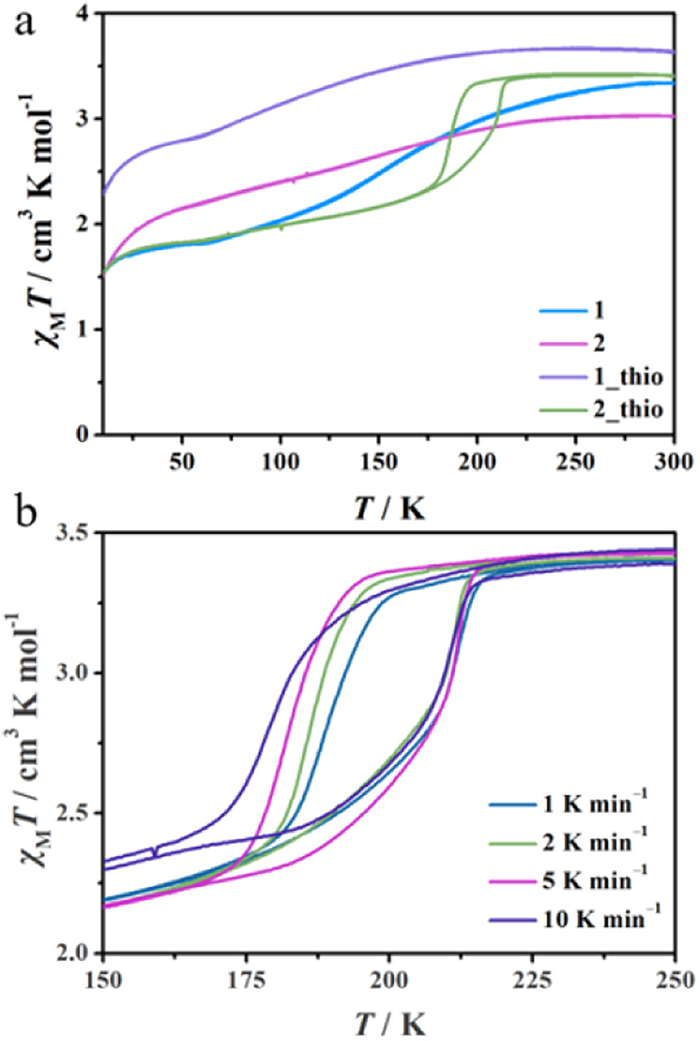
For 2, the χMT values per Fe(Ⅱ) unit exhibit a decrease from 3.02 cm3 K mol−1 at 300K to 1.51 cm3 K mol−1 at 10K, reflecting to an incomplete and gradual SCO property. At 100K, the χMT value based on the formula with one Fe(Ⅱ) ion is measured as 2.41 cm3 K mol−1. This value is consistent with the near LS Fe1 and HS Fe2 ions, each with half occupancy, as revealed from the crystallographic data. The spin transition temperature for 2 is determined to be 147K, which is comparable to that of 1. However, the spin transition process in 2 is more gradual compared to that of 1. This difference may be attributed to the higher octahedral distortion parameters
When the thiophene guest molecules are introduced in 2, a hysteresis SCO behavior is observed with a sweep rate of 2K/min in 2_thio. As shown in Fig. 4a, the χMT value is 3.40 cm3 K mol−1 at 300K, which is consistent with the HS Fe1 and Fe2 ions with half occupancy. It remains almost constant until 200K, and quickly decreases to 2.34 cm3 K mol−1 at 175K and then gradually decreases to 1.77 cm3 K mol−1 at 30K. The crystallographic data reveal that the Fe1 ions switch from the HS to LS states while the Fe2 ion remain the HS state, which is consistent with the above incomplete SCO behavior. At lower temperature, the χMT value decreases slightly faster to 1.53 cm3 K mol−1 at 10K, which may be attributed to the zero-field splitting and/or the weak antiferromagnetic interactions among HS Fe(Ⅱ) ions. Upon heating, the magnetic curve moves to the high temperature region. The differential magnetic curves exhibit one peak at 186 and 211K in the cooling and heating modes, respectively, illustrating a 25K hysteresis loop. Obviously, the host-guest interactions contribute to the SCO cooperativity. The
Notably, the hysteretic SCO behavior of 2_thio exhibits a dependence on the scan rate. Magnetic data were systematically collected at scan rates of 1, 2, 5 and 10K/min (Fig. 4b). The magnetic curves in the cooling mode shift to the lower temperatures as the scan rates increases, indicating that the high-temperature phase is partially trapped upon rapid cooling. Conversely, the magnetic curves in the heating mode exhibit only minor changes. Consequently, the width of hysteresis loop increases from 23K to 31K as the scan rates rises from 1K/min to 10K/min. Four distinct types of scan rate dependence for thermal hysteresis have been reported in the literature: (1) Negligible scan rate dependence, (2) scan rate dependence observed exclusively in the cooling mode, (3) scan rate dependence observed exclusively in the heating mode, (4) scan rate dependence evident in both cooling and heating modes [32-34]. In this context, 2_thio corresponds to type Ⅱ. The HS molecule possesses a larger molecule size, unit cell volume and more distorted coordination environment compared to the LS molecule. Additionally, host-guest interactions in the high-temperature phase are weaker than those in the low-temperature phase, leading to reduced SCO cooperativity that fails to match the rapid decrease in temperature. Consequently, the HS state can be kinetically trapped at increasing rates during the cooling branch. Conversely, the nucleation of the larger HS molecules requires additional thermal energy to surmount the activation barrier in the heating mode and then rapidly grows to the thermodynamically favored HS state [35].
In summary, two distinct SCO MOFs were successfully self-assembled by reacting FeBr2 and Fe(ClO4)2·6H2O with K[Ag(CN)2] and the tetrapyridyl ligand i-TPBA. In 1, the hexatopic [Ag8Br8(CN)6]6− clusters, tetratopic organic ligands, and octahedral Fe(Ⅱ) ion cooperatively assemble into a rare I3O3 hybrid inorganic-organic framework featuring urk topology. In contrast, the bent [Ag(CN)2]− units in 2 axially coordinate to the Fe(Ⅱ) ions, forming a 1D right-handed 31 helical chain. The tetratopic i-TPBA ligands further interconnect three such helix chains, resulting in a homochiral I1O3 hybrid framework with a previously unreported topology designated as sco1. Both compounds 1 and 2 exhibit gradual and incomplete SCO behaviors. However, upon incorporation of thiophene guest molecules, 2_thio displays a rare hysteretic and incomplete SCO behavior, where scan rate dependence is exclusively observed in the cooling mode. Notably, the width of the thermal hysteresis loop increases from 23K to 31K as the scan rates rises from 1K/min to 10K/min. This study demonstrates that SCO MOFs with novel topologies can be effectively self-assembled using multidentate ligands, providing a versatile platform for exploring multifunctional SCO materials.
Guang Yang: Writing – original draft, Methodology, Investigation, Formal analysis, Data curation, Conceptualization. Lu Yu: Writing – original draft, Methodology, Formal analysis, Data curation. Ze-Yu Ruan: Formal analysis, Data curation. Ai-Qi Jian: Formal analysis, Data curation. Yan-Ru Chen: Formal analysis, Data curation. Yan-Cong Chen: Formal analysis, Data curation. Zhao-Ping Ni: Writing – review & editing, Funding acquisition, Formal analysis, Conceptualization. Ming-Liang Tong: Writing – review & editing, Supervision, Funding acquisition, Conceptualization.
The authors declare that they have no known competing financial interests or personal relationships that could have appeared to influence the work reported in this paper.
This work was supported by the National Natural Science Foundation of China (NSFC, Nos. 22488101, 22271322), the Fundamental Research Funds for the Central Universities, Sun Yat-sen University (No. 24xkjc003), and the Graduate Student Scientific Research Innovation Project of Sun Yat-sen University (No. 02300–12240001).
Supplementary material associated with this article can be found, in the online version, at doi:
E. Resines-Urien, E. Fernandez-Bartolome, A. Martinez-Martinez, et al., Chem. Soc. Rev. 52 (2023) 705–727. doi: 10.1039/d2cs00790h
M.K. Javed, A. Sulaiman, M. Yamashita, et al., Coord. Chem. Rev. 467 (2022) 214625. doi: 10.1016/j.ccr.2022.214625
K.S. Kumar, M. Ruben, Angew. Chem. Int. Ed. 60 (2021) 7502–7521. doi: 10.1002/anie.201911256
E. Coronado, Nat. Rev. Mater. 5 (2020) 87–104.
B. Weber, Coord. Chem. Rev. 253 (2009) 2432–2449. doi: 10.1016/j.ccr.2008.10.002
M.A. Halcrow, Chem. Soc. Rev. 40 (2011) 4119–4142. doi: 10.1039/c1cs15046d
O. Kahn, C.J. Martinez, Science 279 (1998) 44–48. doi: 10.1126/science.279.5347.44
J.A. Real, E. Andrés, M.C. Munoz, et al., Science 268 (1995) 265–267. doi: 10.1126/science.268.5208.265
G.J. Halder, C.J. Kepert, B. Moubaraki, et al., Science 298 (2002) 1762–1765. doi: 10.1126/science.1075948
Z.P. Ni, J.L. Liu, M.N. Hoque, et al., Coord. Chem. Rev. 335 (2017) 28–43. doi: 10.1016/j.ccr.2016.12.002
N. Sun, S.S.A. Shah, Z. Lin, et al., Chem. Rev. 125 (2025) 2703–2792. doi: 10.1021/acs.chemrev.4c00664
I.E. Khalil, J. Fonseca, M.R. Reithofer, et al., Coord. Chem. Rev. 481 (2023) 215043. doi: 10.1016/j.ccr.2023.215043
W. Zhou, Y. Tang, X. Zhang, et al., Coord. Chem. Rev. 477 (2023) 214949. doi: 10.1016/j.ccr.2022.214949
X. Li, K. Chen, R. Guo, et al., Chem. Rev. 123 (2023) 10432–10467. doi: 10.1021/acs.chemrev.3c00248
G.Z. Huang, Y.S. Xia, F. Yang, et al., J. Am. Chem. Soc. 145 (2023) 26863–26870. doi: 10.1021/jacs.3c09513
E. Coronado, M. Giménez-Marqués, G.Mínguez Espallargas, et al., J. Am. Chem. Soc. 135 (2013) 15986–15989. doi: 10.1021/ja407135k
L. Piñeiro-López, M. Seredyuk, M.C. Muñoz, et al., Eur. J. Inorg. Chem. 2020 (2020) 764–769. doi: 10.1002/ejic.201901347
M. Meneses-Sánchez, L. Piñeiro-López, T. Delgado, et al., J. Mater. Chem. C 8 (2020) 1623–1633. doi: 10.1039/c9tc06422b
J. Troyano, F. Zamora, S. Delgado, Chem. Soc. Rev. 50 (2021) 4606–4628. doi: 10.1039/d0cs01470b
F. Saraci, V. Quezada-Novoa, P.R. Donnarumma, et al., Chem. Soc. Rev. 49 (2020) 7949–7977. doi: 10.1039/d0cs00292e
G. Cai, P. Yan, L. Zhang, et al., Chem. Rev. 121 (2021) 12278–12326. doi: 10.1021/acs.chemrev.1c00243
G. Yang, S.G. Wu, Z.Y. Ruan, et al., Angew. Chem. Int. Ed. 62 (2023) e202312685. doi: 10.1002/anie.202312685
G. Yang, Z.Y. Ruan, Y.C. Chen, et al., Angew. Chem. Int. Ed. 64 (2025) e202414330. doi: 10.1002/anie.202414330
A.K. Cheetham, C.N.R. Rao, R.K. Feller, Chem. Comm. (2006) 4780–4795.
M.F. Wu, T.T. Shen, S. He, et al., CrystEngComm 17 (2015) 7473–7476. doi: 10.1039/C5CE01347J
O.V. Dolomanov, L.J. Bourhis, R.J. Gildea, et al., J. Appl. Crystallogr. 42 (2009) 339–341. doi: 10.1107/S0021889808042726
S.G. Wu, L.F. Wang, Z.Y. Ruan, et al., J. Am. Chem. Soc. 144 (2022) 14888–14896. doi: 10.1021/jacs.2c06313
V.A. Blatov, A.P. Shevchenko, D.M. Proserpio, Cryst. Growth Des. 14 (2014) 3576–3586. doi: 10.1021/cg500498k
E.V. Alexandrov, V.A. Blatov, A.V. Kochetkov, et al., CrystEngComm 13 (2011) 3947–3958. doi: 10.1039/c0ce00636j
F. Aman, A.M. Asiri, W.A. Siddiqui, et al., CrystEngComm 16 (2014) 1963–1970. doi: 10.1039/C3CE42218F
C. Bonneau, M. O’Keeffe, D.M. Proserpio, et al., Cryst. Growth Des. 18 (2018) 3411–3418. doi: 10.1021/acs.cgd.8b00126
R. Kulmaczewski, J. Olguín, J.A. Kitchen, et al., J. Am. Chem. Soc. 136 (2014) 878–881. doi: 10.1021/ja411563x
H.Y. Sun, Y.S. Meng, L. Zhao, et al., Angew. Chem. Int. Ed. 135 (2023) e202302815. doi: 10.1002/anie.202302815
Z.Y. Li, Y.Y. Wu, Y. Li, et al., CCS Chem. 5 (2023) 412–422. doi: 10.31635/ccschem.022.202101721
S. Brooker, Chem. Soc. Rev. 44 (2015) 2880–2892. doi: 10.1039/C4CS00376D

Figure 1 Reaction scheme for the synthesis of 1 and 2. Color codes: Fe, golden yellow; C, gray; Br, pink; Ag, blue; N, sky blue. Hydrogen atoms, solvent molecules and disordered components are omitted for clarity.

Figure 2 The topological networks of the organic connectivity (up) and the overall framework (down) in 1 (left) and 2 (right). Color codes: Fe, golden yellow; i-TPBA, cyan; [Ag8Br8(CN)6]6− cluster, blue; Ag(CN)2−, blue.

Figure 3 View of the 1D helical chains interconnected via the i-TPBA ligands in 2. Color codes: Fe, golden yellow; C, gray; N, sky blue; Ag, blue.

 扫一扫看文章


扫一扫关注我们
 DownLoad:

 下载:
下载:

 下载:
下载: