Citation:
Bo Chen, Peiyu Duan, Ying Zhang, Lianhui Wang. Boosting the intermittent alkaline seawater electrolysis stability up to 10,000 h via in-situ formation of dynamically passivating structures[J]. Chinese Chemical Letters,
2026, 37(1): 111638.
doi:
10.1016/j.cclet.2025.111638
Boosting the intermittent alkaline seawater electrolysis stability up to 10,000 h via in-situ formation of dynamically passivating structures
English
Boosting the intermittent alkaline seawater electrolysis stability up to 10,000 h via in-situ formation of dynamically passivating structures
State Key Laboratory of Flexible Electronics & Jiangsu Key Laboratory of Smart Biomaterials and Theranostic Technology, Institute of Advanced Materials (IAM), School of Chemistry and Life Sciences, Nanjing University of Posts and Telecommunications, Nanjing 210023, China
b.
College of Electronic and Optical Engineering & College of Flexible Electronics (Future Technology), Nanjing University of Posts and Telecommunications, Nanjing 210023, China
With the in-depth implementation of sustainable development strategies, hydrogen energy as a clean energy source is receiving increasing attention [1,2]. Among the various methods of hydrogen production, the electrocatalytic decomposition of abundant seawater into hydrogen utilizing renewable energy has emerged as a green and promising approach. However, natural seawater contains complex components, such as halide ions, which lead to the corrosion of catalysts or the occurrence of competitive side reactions during the electrolysis process [3]. Moreover, renewable energy is characterized by intermittency, fluctuations, and instability [4]. Continuous frequent start-shutdown reduces the activity and service life of catalysts, thereby limiting the large-scale application of this technology. This has become a pressing challenge that must be addressed.
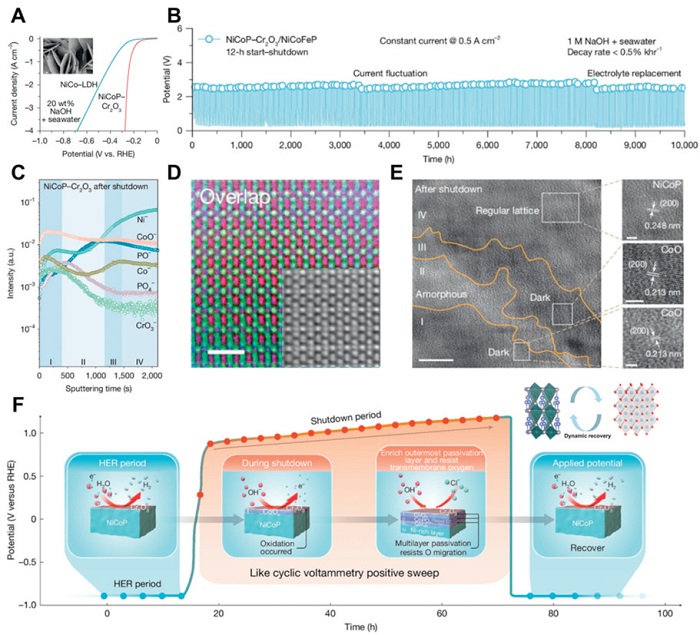
Prior research has primarily targeted the development of protective coatings on the anode during seawater electrolysis, with limited attention to cathode corrosion. Furthermore, once damaged, such coatings typically lack self-healing capability, resulting in compromised protection. Significantly and encouragingly, in a recent outstanding work published in Nature, Prof. Xiaoming Sun, Prof. Bin Liu, Prof. Daojin Zhou, and colleagues developed a novel strategy for the in-situ formation of a dynamic passivation layer coupled with phosphate and chromium oxide (Cr2O3) on the surface of NiCo-LDH catalysts, which directly utilize the electrostatic repulsion to block halide ion intrusion in a cost-effective manner and can be reactivated during electrolysis, enables the catalyst to achieve long-term stability in alkaline seawater electrolysis [5]. Specifically, in this study, a strategy combining wet chemical deposition and thermal transformation was employed. After phosphatization, a dynamically passivating heterostructure combining phosphate and chromium oxide was formed on the catalyst surface. Microscopic morphology is shown in the inset of Fig. 1A. In this design, nanosheets are interconnected to construct a superhydrophobic array structure, which first reduces direct contact with seawater. As a result, the exposure time to corrosive media is minimized, leading to enhanced corrosion resistance. Ultimately, this structural strategy effectively improves morphological stability during intermittent seawater electrolysis under complex marine conditions, demonstrating its high potential for practical applications in industrial production. As shown in Fig. 1A, in an alkaline electrolyte, compared to the untreated NiCo-LDH catalyst, NiCoP-Cr2O3 can achieve a higher current density (4 A/cm2) at a lower overpotential (275 mV), significantly enhancing the HER catalytic performance. Moreover, this catalyst not only exhibits high performance under laboratory conditions, but also achieves excellent reproducibility in tests under industrial conditions, for instance, considering the complexity of practical application environments, researchers conducted frequent start-shutdown stability tests under harsh conditions (Fig. 1B). The results are exciting, after a long-term cyclic test of up to 10,000 h, the catalytic activity of the electrode remained at a high level, with an extremely low voltage increase rate of only 0.5% k/hr. When at a higher current density (10 A/cm2), it can also be stably operated for 4500 h during 10-min start-shutdown cycles. As shown in Table S1 (Supporting information), these results and related comparisons illustrate that its electrochemical performance far exceeds those of the common electrocatalysts reported earlier, addressing the issue of poor stability of catalysts at high current densities.
Figure 1
Figure 1.
(A) Comparison of polarization curves of NiCoP-Cr2O3 and NiCo-LDH in a 20 wt% NaOH + seawater environment. The inset shows a scanning electron microscopy (SEM) image of NiCoP-Cr2O3. Scale bar: 200 nm. (B) Intermittent stability test of NiCoP-Cr2O3. (C) TOF-SIMS spectra of multiple components. (D) An overlapped elemental mapping of NiCoP-Cr2O3 after HER. The inset shows the corresponding HAADF-STEM image. Scale bar: 5 nm. (E) HRTEM images after shutdown. Scale bars: 10 nm (main) and 2 nm (insets). (F) Schematic illustration of the formation and dynamic recovery of the passivation layer during intermittent electrolysis. Reproduced with permission [5]. Copyright 2025, Springer Nature.
Sun et al. insightfully analyzed the reasons and mechanisms underlying the stable catalytic activity of the catalyst during intermittent seawater electrolysis. The authors utilized time-of-flight secondary ion mass spectrometry (TOF-SIMS) to detect changes in the distribution of elements on the catalyst surface immediately after the hydrogen evolution reaction (HER) process and following a 24-h shutdown period (Fig. 1C). Based on the test results, it was inferred that after the shutdown, cobalt (Co) segregated to both the interior and surface regions, forming a dense oxide layer in conjunction with the nickel-rich surface and Cr2O3. Meanwhile, phosphorus (P) migrated to the sublayer, forming a phosphate-rich layer. Ultimately, a multilayer passivation structure consisting of CoOx–CoPOx–CoOx was formed, effectively blocking OH⁻ penetration and protecting the active nickel (Ni) sites from excessive oxidation. During shutdown, phosphate ions adsorb onto the electrode surface, providing additional protection against chloride ion corrosion through electrostatic repulsion. Notably, the phosphate passivation layer exhibits dynamic recoverability: upon reactivation, the phosphate and CoO components are reduced, re-exposing the highly active Ni sites. Meanwhile, Ar+ X-ray photoelectron spectroscopy (XPS) and nonlinear least squares fitting (NLLSF) further confirmed the changes in the electronic structure and oxidation states of NiCoP-Cr2O3 during intermittent electrolysis. After the shutdown, the oxidation state of Co significantly increased, while the number of Ni0 active sites increased, which is consistent with the conclusions drawn from TOF-SIMS. This indicates that Co and P donate electrons to Ni during the shutdown process, maintaining most of the Ni in a reduced state to ensure a high HER activity upon reactivation. The changes in the surface structure of the catalyst under start-shutdown conditions were monitored using Raman spectroscopy. The reappearance of the P-O vibration peak after shutdown can be attributed to the formation of a phosphorus-rich oxide layer, which disappeared during the subsequent HER process. This demonstrates the dynamic recovery of the phosphate oxide layer during intermittent electrolysis. On this basis, the authors used high-angle annular dark-field scanning transmission electron microscopy (HAADF-STEM) to analyze and discuss the composition of NiCoP-Cr2O3 after HER and in the shutdown state. As shown in the elemental mapping in Fig. 1D, the catalyst exhibited a regular NiCoP lattice structure after HER. In contrast, after shutdown, the sample showed the formation of a passivation layer (Fig. 1E), comprising CoO, Cr2O3, an amorphous phosphate layer, and an Ni-rich inner layer. In summary, the results are shown in Fig. 1F, where the dynamic passivation and recovery mechanism of NiCoP-Cr2O3 play a crucial role in ensuring long-term stability in seawater electrolysis.
To elucidate the oxidation process of NiCoP-Cr2O3 during shutdown, Sun et al. employed density functional theory (DFT) calculations to evaluate the oxidation propensities of different atomic sites. Their findings further confirm that Ni is the least susceptible to oxidation, owing to the protective effects of Co and P. Based on these insights, the authors constructed three multilayer structural models to simulate the stratified passivation structure observed in their experiments and investigate the dynamic process of oxygen diffusion from the bulk phase to the interface. Additionally, they explored the energy changes associated with chloride ion adsorption on the phosphate ions generated on the surface of NiCoP-Cr2O3 during shutdown. Their results indicated that the phosphate layer could effectively repel chloride ions through electrostatic repulsion, thereby protecting the catalytically active Ni sites from corrosion.
In summary, this work proposes a cathode protection strategy that ensures self-protection during shutdown and rapid recovery during operation, providing an effective solution from a materials design perspective. Under conditions of high current densities and frequent start-stop cycles, the system exhibits performance that markedly outperforms other state-of-the-art catalysts. In addition, Sun et al. conducted an in-depth analysis of the passivation layer formation mechanism. The concept of introducing a dynamic passivation structure could potentially be extended to other cathode materials, offering a promising approach to reducing AEM electrolyser maintenance costs and prolonging operational lifetimes, thereby contributing significantly to the large-scale realization of green hydrogen production.
Declaration of competing interests
The authors declare that they have no known competing financial interests or personal relationships that could have appeared to influence the work reported in this paper.
This work was financially supported by the Natural Science Research Start-up Foundation of Recruiting Talents of Nanjing University of Posts and Telecommunications (No. NY223016), Qinglan Project of Jiangsu Province of China, 2024 Nanjing Science and Technology Innovation Program (No. NJKCZYZZ2024–06).
Supplementary materials
Supplementary material associated with this article can be found, in the online version, at doi:10.1016/j.cclet.2025.111638.
Figure 1
(A) Comparison of polarization curves of NiCoP-Cr2O3 and NiCo-LDH in a 20 wt% NaOH + seawater environment. The inset shows a scanning electron microscopy (SEM) image of NiCoP-Cr2O3. Scale bar: 200 nm. (B) Intermittent stability test of NiCoP-Cr2O3. (C) TOF-SIMS spectra of multiple components. (D) An overlapped elemental mapping of NiCoP-Cr2O3 after HER. The inset shows the corresponding HAADF-STEM image. Scale bar: 5 nm. (E) HRTEM images after shutdown. Scale bars: 10 nm (main) and 2 nm (insets). (F) Schematic illustration of the formation and dynamic recovery of the passivation layer during intermittent electrolysis. Reproduced with permission [5]. Copyright 2025, Springer Nature.


 DownLoad:

 下载:
下载:


 下载:
下载:

