Facile and regioselective B–H bond functionalization of carboranes via cage···Ⅰ(Ⅲ) interaction

Ping Zhang Hongyuan Ren Zhaofeng Sun Hou-Ji Cao Deshuang Tu Chang-Sheng Lu Jordi Poater Miquel Solà Hong Yan

Citation:  Ping Zhang, Hongyuan Ren, Zhaofeng Sun, Hou-Ji Cao, Deshuang Tu, Chang-Sheng Lu, Jordi Poater, Miquel Solà, Hong Yan. Facile and regioselective B–H bond functionalization of carboranes via cage···Ⅰ(Ⅲ) interaction[J]. Chinese Chemical Letters, 2026, 37(5): 111617. doi: 10.1016/j.cclet.2025.111617 shu

Facile and regioselective B–H bond functionalization of carboranes via cage···Ⅰ(Ⅲ) interaction

English

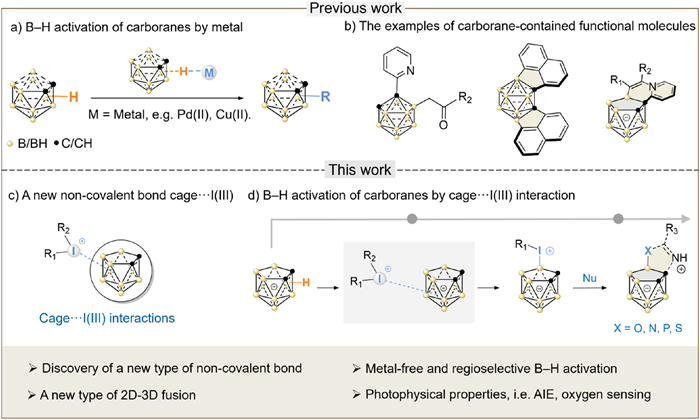
  • Boron clusters, such as carboranes, possess three-dimensional (3D) aromaticity and hold immense potentials in materials [115], catalysis [1619], drug design [2031], and organometallic complexes [3240]. Hence, the functionalization of boron clusters is of vital importance. However, the presence of multiple inert B–H bonds in similar chemical environments poses a considerable challenge for the synthesis of carborane derivatives [41]. Until now the selective and efficient B–H bond functionalization of carboranes has received tremendous research interest [4282]. Over the past decades, metal-mediated B–H bond activation has become a prevalent strategy for the functionalization of carboranes owing to the robust capability of the metal that enables weakening of a B–H bond through the formation of a B–M bond for further transformations (Fig. 1a) [4266]. This approach has facilitated the synthesis of carborane-based functional molecules with distinctive physicochemical properties, such as boron cluster-extended heterocycles (Fig. 1b) [6466]. Despite the effectiveness of this approach, external ligands, additives or harsh reaction conditions are generally required [4266]. In contrast, metal-free tactics are capable of overcoming these limitations, therefore being highly attractive [6783].

    Figure 1

    Figure 1.  (a) Classical metal-induced B–H bond activation. (b) The selected carborane-based functional molecules accessed through metal-mediated B–H bond activation. (c) A boron cluster-based non-covalent bond between the 3D aromatic nido-carborane and the iodine(Ⅲ)-containing unit. (d) The B–H functionalization via cage···Ⅰ(Ⅲ) interaction.

    It is well recognized that favorable non-covalent interactions play a critical role in synthetic chemistry, particularly in controlling regioselectivity or site-selectivity. Given the established significance of halogen bonding in activating inert bonds [8489], this study explores metal-free B–H bond functionalization through non-covalent interactions with halogen-containing molecular motifs. In doing so, we identified a type of boron cluster-based non-covalent bond, defined as the cage···Ⅰ(Ⅲ) interaction, arising from the interaction between a nido-boron cluster and a hypervalent iodine unit (Fig. 1c). Single-crystal X-ray diffraction (SCXRD) studies and spectral data indicated the formation of a well-defined electron donor-acceptor complex between the nido-carborane and the hypervalent iodine unit.

    Further theoretical calculations demonstrated that this bonding involves significant charge transfer, which reduces the negative charge on the B(9)–H of nido-carborane, thus facilitating subsequent B–H bond functionalization and transformations. Finally, the metal-free and site-selective B–H functionalization of carboranes has been achieved to lead to the facile formation of B–N, B–P, B–O, and B–S bonds (Fig. 1d). Additionally, a new category of boron cluster-extended skeleton in the form of 2D-3D fused hetero-polycyclic structure has been generated (Fig. 1d). Such an advanced framework enables the facile construction of novel functional molecules that show aggregation-induced emission (AIE) or oxygen sensing.

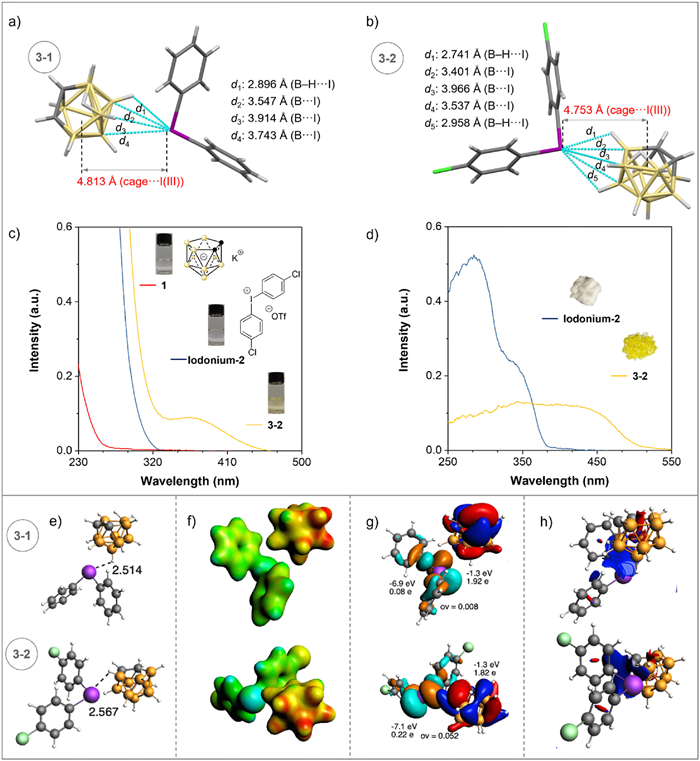
    Carboranes are boron cluster species featuring three-dimensional aromaticity [41,90], which differs from planar aromatic rings. Recently, we have demonstrated that the nido-carborane cluster can serve as a novel bonding unit for the construction of non-covalent interactions, such as the cage···π interaction [91]. Given the fact that the research on non-covalent interactions involving boron clusters remains limited [9193], we are interested in the continuous exploration of new types of boron cluster-based non-covalent interactions. On the other hand, iodine is an important element, which has been extensively involved in functional molecules [9497]. Notably, the manipulation of the bonding type of iodine would influence the electronic structures of iodine-containing compounds. To investigate the possible cage···Ⅰ(Ⅲ) interaction between a boron cluster and an iodine-containing unit, the nido-carborane was chosen to interact with an electrophilic iodine compound. Along this line, the hypervalent iodine-supported nido-carborane derivatives of 3–1 and 3–2, as shown in Figs. 2a and b, were synthesized through ion exchange reactions (see Supporting information for synthesis details).

    Figure 2

    Figure 2.  (a, b) The crystal structures of 3–1 and 3–2. (c) UV–vis spectra of 1, iodonium-2, and 3–2 (c = 5 × 10⁻⁴ mol/L) in methanol. (d) UV–vis spectra of iodonium-2 and 3–2 in the crystalline state. Insets are the photographs of iodonium-2 and 3–2 in the methanol and crystalline state. (e) Geometries of systems 3–1 and 3–2 in V conformations. (f) Molecular electrostatic potential isosurface (electronic density isovalue = 0.03 a.u.). (g) HOMO of nido cage and LUMO of iodine molecule. Red and blue isosurfaces represent positive and negative phases for HOMO, whereas orange and turquoise for LUMO. Energies of the fragment molecular orbitals (in eV), gross Mulliken populations representing charge transfer in the complex (in e) and HOMO|LUMO overlaps (ov) are also enclosed. (h) NCI isosurface (isovalue = 0.5) of systems. Computed at ZORA-BLYP-D3(BJ)/TZ2P level of theory.

    With these compounds in hand, we began to analyze the crystal structures to shed light on the structural characteristics of the cage···Ⅰ(Ⅲ) interaction as depicted in Figs. 2a and b. The nido-carborane anion is surrounded by several hypervalent iodine cations in both 3–1 and 3–2 due to the electrostatic interactions, as shown in the packing structures (Figs. S18 and S19 in Supporting information) with the carborane cage oriented towards the backside of the V-shaped organoiodine(Ⅲ) moieties. Moreover, various intermolecular contacts such as C–H···B–H are observed in the crystal structures, collectively endowing a robust non-covalent bonding network for the formation of the cage···Ⅰ(Ⅲ) interaction. With careful inspection, the cage···Ⅰ(Ⅲ) interaction with a bonding distance of 4.813 Å is identified for 3–1 (measured from the centroid of the boron cage to the iodine atom), alongside B–H···I and B···I contacts with distances of 2.896 and 3.547 Å (Fig. 2a), respectively. A shorter cage···Ⅰ(Ⅲ) bonding distance of 4.753 Å is detected for 3–2, with B–H···I interactions at 2.741 and 2.958 Å, and B···I interactions at 3.401 and 3.966 Å (Fig. 2b), respectively. These indicate that the cage···Ⅰ(Ⅲ) interaction can be influenced by the substituents of the aryl hypervalent iodine derivatives.

    To further confirm the electronic interaction between the nido-carborane and the hypervalent iodine unit, we investigated the UV–vis absorption spectra of 3–2 in both methanol and the crystalline state (Figs. 2c and d). The potassium salt of nido-carborane (1) and diphenyliodonium trifluoromethanesulfonate (iodonium-2) were selected as control compounds. As shown in Fig. 2c, no absorption peak over 250 nm was detected for 1 in methanol. In contrast, the absorption peaks around 260 nm for iodonium-2 and 3–2 were observed, which correspond to the ππ∗ transitions of the phenyl substituents. Notably, 3–2 exhibits a new charge transfer absorption band in the 320–400 nm due to the electron donating-accepting interaction between nido-carborane and hypervalent iodine groups (Fig. 2c). The charge transfer absorption band is more clear for 3–2 in the crystalline state (Fig. 2d). The spectral results were further validated by the theoretical calculations using the time-dependent density functional theory (TD-DFT) methods (Fig. S24 in Supporting information). Moreover, results from Job's plot indicates a 1:1 stoichiometric association between the iodonium ion and nido-carborane anion under the experimental conditions (Fig. S13 in Supporting information). These observations indicate efficient electronic communication between the nido-carborane and the hypervalent iodine cation. Due to the unique electronic structures of boron clusters [98102], further theoretical calculations are conducted to gain a deeper understanding of these intermolecular interactions.

    The interactions between the boron cage and the hypervalent iodine moiety for 3–1 and 3–2 have been analyzed by means of the ZORA-BLYP-D3(BJ)/TZ2P dispersion-corrected functional (see Supporting information for computational details). In particular, the two conformations taken from the X-ray structure correspond to the vertex of the V-shaped iodine cation interacts with the cage, depicted in Fig. 2e. Energy decomposition analysis (EDA) reveals that the interaction between nido-carborane and hypervalent iodine is mainly electrostatic (Table S6 in Supporting information), with ∆Velstat much larger than ∆Eoi in all cases (%elstat = 67–73 and%oi = 10–21). The nature of the interaction in terms of%elstat and%oi is very similar to that found in systems showing non-covalent cage···π interaction [91]. It has to be considered a non-covalent interaction despite the presence of a certain percentage of orbital (covalent) interactions. In vacuo, this positive charge is favored by directly interacting with the cage, thus avoiding certain repulsion between the boron cage and the negatively charged aromatic phenyl substituents of iodine fragment. This is further supported by the molecular electrostatic potential isosurfaces depicted in Fig. 2f. On the other hand, this bonding structure is also favored by the attractive orbital interactions. The most relevant interaction is between the highest occupied molecular orbital (HOMO) orbital of the nido-cage and the lowest unoccupied molecular orbital (LUMO) of the cationic iodine molecule (Fig. 2g). As a consequence of this interaction, we observed certain charge transfer from the nido-cage to the iodine unit in 3–1 and 3–2. For completeness, the non-covalent interactions (NCI) isosurfaces [103] depicted in Fig. 2h allow us to better see the interactions for systems 3–1 and 3–2.

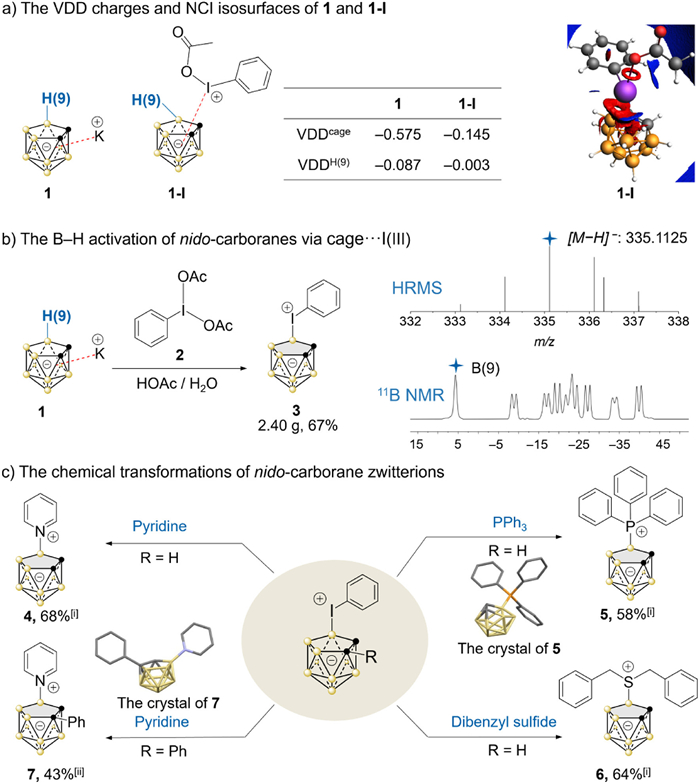
    The above results indicate the cage···I(Ⅲ) interaction-induced charge transfer, which can modulate the electronic structure of carborane, thus might be useful for B–H bond functionalization. In light of this, we chose the hypervalent iodine reagent PhI(OAc)2, which can dissociate in solution to generate the (PhIOAc)+ species [104,105], to both promote the formation of the cage···Ⅰ(Ⅲ) interaction and control the strength of a cage···Ⅰ(Ⅲ) interaction. Theoretical calculations support the presence of a cage···Ⅰ(Ⅲ) interaction between the (PhIOAc)+ group and nido-carborane group, as shown in the NCI isosurfaces (Fig. 3a). Notably, the charge transfer leads to a significant decrease of the charge in the carborane cage from −0.575 to −0.145, and from −0.087 to −0.003 for the H (B(9)) atom (Fig. 3a and Fig. S8a in Supporting information). The electronic effect can be utilized for further B–H bond functionalization and the formation of the B–I(Ⅲ) bond, which is similar to the classic concerted metalation-deprotonation (CMD) in metal-mediated B–H functionalization [4266]. Along this line, we investigated the reaction of nido-carborane and PhI(OAc)2 in a solution of acetic acid and water. As a result, the B–I coupled product 3 was generated as confirmed by nuclear magnetic resonance (NMR) and high-resolution mass spectroscopy (HRMS) (Fig. 3b). This species is stable at a lower temperature and its preparation can be easily scaled up to a gram scale in a rapid manner (Fig. 3b). The subsequent substitution of B–I coupled products by nucleophiles, such as pyridine (4), triphenylphosphine (5), and dibenzyl sulfide (6), gave rise to the corresponding carborane derivatives in moderate to excellent yields under mild conditions (Fig. 3c). The compound 5 was further characterized by single-crystal X-ray diffraction, which unambiguously confirms the B(9) selectivity. Moreover, when a phenyl group is grafted on the carbon vertex of nido-carborane, the reaction preferentially occurs at the B(11)–H site. As exemplified by the crystal structure of 7, the B(11)–H site is substituted, which is distant from the phenyl substituent. This should be attributed to the steric hindrance. The result differs from the oxidation coupling of nido-carborane in our previous report [74], which gave rise to a mixture of B(9)- and B(11)-functionalized products. For comparison, here the exclusive selectivity has been realized. Hence, the B–I coupled species could be used as a diverse reagent for further transformations.

    Figure 3

    Figure 3.  (a) The selected VDD charges (in a.u.) and NCI isosurface (isovalue = 0.5) of 1 and 1-I. Computed at ZORA-BLYP-D3(BJ)/TZ2P level of theory. (b) The B–H bond activation of nido-carborane via cage···Ⅰ(Ⅲ); the NMR and HRMS spectra of 3. Reaction conditions: 1 (1.0 equiv., 10.0 mmol), PhI(OAc)2 (1.0 equiv., 10.0 mmol), HOAc (20.0 mL), H2O (12.0 mL), 0 ℃, 30 min. (c) The chemical transformations of 3. Reaction conditions: [ⅰ] 3 (1.0 equiv., 0.1 mmol), the nucleophiles (1.5 equiv., 0.15 mmol), methanol (1.0 mL), room temperature, 10 min. [ⅱ] 7-Ph-7,8-C2B9H11- (1.0 equiv., 0.1 mmol), PhI(OAc)2 (2.0 equiv., 0.2 mmol), pyridine (1.5 equiv., 0.15 mmol), methanol (1.0 mL), room temperature, 10 min. The hydrogen atoms of crystal structures 5 and 7 are omitted for clarity.

    Furthermore, theoretical calculations were conducted to elucidate the possible reaction pathway (Figs. S7 and S9 in Supporting information). The formation of the cage···Ⅰ(Ⅲ) interaction in the complex (1-I) is thermodynamically favorable, as indicated by an exergonic change of −6.0 kcal/mol. As the formation of the cage···Ⅰ(Ⅲ) interaction significantly reduces the negative charge of the carborane cage and the B(9)–H bond (Fig. S7), the B(9)–H bond functionalization is much more favored to form a B–I bond (compound 3), accompanied by a further energy drop of 45.7 kcal/mol (Fig. S7). The further nucleophilic substitution by pyridine leads to a continued energy drop of 32.5 kcal/mol (Fig. S9). The calculations support the B–I containing compound as an intermediate or a reagent for subsequent synthetic applications. In addition, the intramolecular charge transfer effect from the carborane (HOMO) to the cationic substituent (LUMO) for compounds 37 has been demonstrated by theoretical calculations (Fig. S28 in Supporting information).

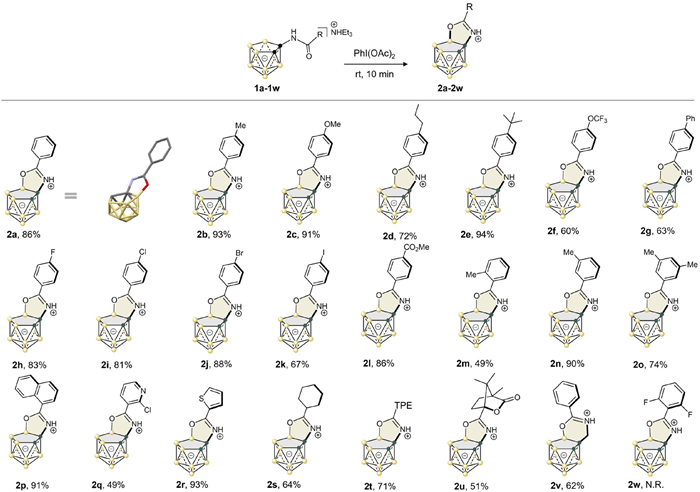
    It is well known that benzoxazole is a crucial structural motif extensively utilized in the fields of biomedicine and photoelectric materials [106,107]. Given the distinctive electronic structure and enhanced physical properties exhibited by boron cage extension systems [6466] compared to 2D aromatic ring-extended molecular structures, we attempted to construct the carborane-incorporated benzoxazole analogs with 2D-3D fused structures by the cage···Ⅰ(Ⅲ) interaction-mediated synthetic protocol. Despite the challenges associated with the direct B–O cross-coupling of boron cluster [4283], the aforementioned synthetic objective might be reached by the cage···Ⅰ(Ⅲ) interaction-induced B–H bond functionalization and subsequent intramolecular cyclization. To our delight, the boron cage extended structure was achieved by using the amide-bearing nido-carborane 1a as the sole starting material, PhI(OAc)2 as the organoiodine(Ⅲ) reagent and MeOH as the solvent at room temperature for 10 min, affording 2a in 86% isolated yield (Fig. 4). The molecular structure of 2a was confirmed by SCXRD analysis to show an expected 3D carborane-fused benzoxazole. With the optimized conditions (Table S1 in Supporting information), we proceeded to explore the substrate scope. We were pleased to find that the nido-carborane substrates bearing para-substituted phenyl groups with various electron-donating substituents such as methyl (2b, 2n, and 2o), methoxy (2c), n-propyl (2d), tertbutyl (2e), trifluoromethoxy (2f) were well-tolerated, affording the desired products in excellent yields. In comparison, the electron-withdrawing substituents including halogen (2h2k) and the ester group (2l) led to slightly decreased yields (67%–83%), which is attributed to the reduced nucleophilicity of the amide oxygen. Steric hindrance also affects the production, as indicated by a lower yield of 2m. The substrates containing polycyclic and heteroaryl substituents, such as naphthyl (2p), pyridyl (2q), and thienyl (2r), are well tolerated. If the phenyl group is replaced by an alkyl substituent, the reaction also proceeds smoothly in a synthetically useful yield (2s). Additionally, the reaction is compatible with substrates bearing a chromophore like TPE (2t) or a pharmacophore derived from camphanic acid (2u). Moreover, a new 2D-3D fused structure with a six-membered heterocyclic ring (2v) was successfully synthesized by using the substrate bearing an embedded carbon atom. However, such cyclization does not occur when two electron-withdrawing substituents of fluorine appear in the ortho-substitution of phenyl (2w), indicating the electronic effect of the substituent on this reaction. Thus, a possible mechanism of the 5-exo-type annulation was proposed (Fig. S12 in Supporting information), which involves the cage···Ⅰ(Ⅲ) interaction-induced B–H bond activation, the formation of the crucial iodonium intermediate and intramolecular nucleophilic substitution. In contrast to our previous metal-catalyzed annulation to yield 2D-3D fusion [6466], here the B–O closure is achieved by using a cheap organic compound of PhI(OAc)2 instead of a noble metal catalyst.

    Figure 4

    Figure 4.  Boron cage extension for the construction of 2D-3D fused molecular systems. Reaction conditions: 1a-1w (1.0 equiv. 0.1 mmol), PhI(OAc)2 (1.0 equiv., 0.1 mmol), MeOH (1.0 mL), room temperature, 10 min, affording 2a-2w in 49%−94% isolated yields (see Supporting information for details). TPE = 4-(1,2,2-triphenylvinyl)phenyl.

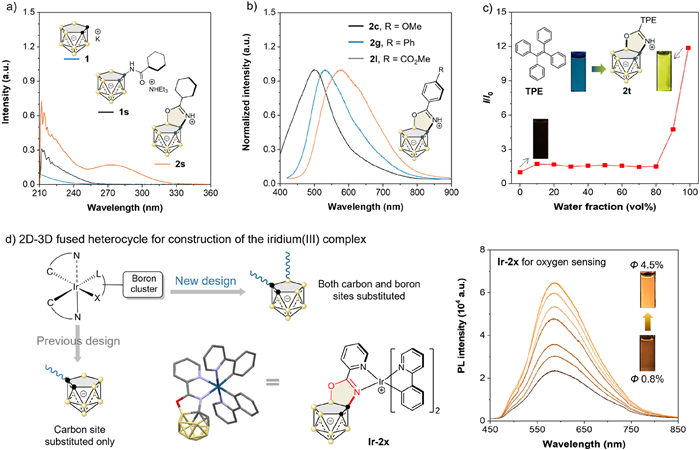
    The photophysical properties of the cyclized products were investigated for potential applications. To avoid the influence of the phenyl unit, 2s was selected as a model for UV–vis spectral analysis (Fig. 5a). In contrast to compounds 1 and 1s, the cyclized molecule of 2s shows a new absorption peak around 270 nm, which arises from the charge transfer in the 2D-3D fused structure. The photoluminescence (PL) spectra of 2c, 2g and 2l reveal that the substituent of the new molecular skeleton is able to evidently tune the energy level of the excited state. Specifically, the electron-donating substituents on the phenyl ring leads to a blueshift of the emission (as exemplified by 2c, λem = 500 nm) in comparison to 2gem = 531 nm), whereas the electron-withdrawing substituent induces a redshift of emission (as exemplified by 2l, λem = 579 nm) (Fig. 5b). In addition, the TPE-derived compound 2t not only displays the AIE property [108,109] but also exhibits yellow emission in the aggregate state (Fig. 5c), distinct from the blue emission of TPE. Furthermore, to illustrate the versatility and practicality of our methodology, we synthesized a new type of iridium(Ⅲ) complex (Ir-2x) by using the carborane-based 2D-3D fused compound 2x as a new ligand. The complex also shows oxygen sensing (Fig. 5d). Therefore, the molecular design described here significantly broadens the range of carborane-based phosphorescent iridium(Ⅲ) complexes [110,111].

    Figure 5

    Figure 5.  (a) The UV–vis absorption spectra of 1, 1s, and 2s in THF (c = 100 µmol/L). (b) The normalized PL spectra of compounds 2c, 2g, and 2lex = 365 nm). (c) Relative emission intensities of compound 2t in THF/H2O mixtures with increasing water volume fraction to 99% (c = 100 µmol/L, λex = 365 nm). (d) Molecular and crystal structures of the iridium(Ⅲ) complex Ir-2x constructed by the new ligand 2x. The PL spectra of Ir-2x in degassed THF solution. Each curve was measured after 20 s nitrogen bubbling into the solution. Insets are the corresponding photographs upon excitation by a UV lamp.

    We have developed a new boron cluster-based cage···Ⅰ(Ⅲ) interaction between nido-carborane anion and hypervalent iodine cation. This interaction significantly modifies the electronic structure of the boron cluster, thus facilitating selective B–H functionalization to generate a reactive and isolable B–I(Ⅲ) coupled intermediate. Here, the cage···I(Ⅲ) interaction in the intermediate is reminiscent of the B–M bond observed in transition metal-mediated B–H bond activation. Furthermore, the B–I(Ⅲ) containing intermediate is the crucial synthon to be used for construction of B–X (X = N, P, O, S) bonds. More importantly, using this reaction protocol, a new type of carborane-fused hetero-polycyclic compounds featuring a B–O bond has been synthesized. These unprecedented 2D-3D fused structures demonstrate distinct photophysical properties with application potentials.

    The authors declare that they have no known competing financial interests or personal relationships that could have appeared to influence the work reported in this paper.

    Ping Zhang: Writing – original draft, Methodology, Formal analysis, Data curation, Conceptualization. Hongyuan Ren: Writing – review & editing, Visualization. Zhaofeng Sun: Software. Hou-Ji Cao: Data curation. Deshuang Tu: Writing – review & editing, Funding acquisition. Chang-Sheng Lu: Writing – review & editing, Funding acquisition. Jordi Poater: Writing – review & editing, Funding acquisition. Miquel Solà: Writing – review & editing, Funding acquisition. Hong Yan: Writing – review & editing, Funding acquisition.

    This work is supported by the National Natural Science Foundation of China (Nos. 92261202, 92461308, W2412072, 22201067 and 22401141), the Natural Science Foundation of Jiangsu Province (Nos. BZ2022007 and BK20241229), the Fundamental Research Funds for the Central Universities (No. 2024300362), Henan Normal University, TaiShan Industrial Experts Programme, the high-performance computing center of Nanjing University, the Spanish Ministerio de Ciencia, Innovación y Universidades (MCIN/AEI/10.13039/501100011033) (Nos. PID2022–138861NB-I00, PID2023-147424NB-I00, and CEX2021–001202-M), and the Generalitat de Catalunya (Nos. 2021SGR623 and 2021SGR224, and 2024 ICREA Academia prize for M.S.).

    Supplementary material associated with this article can be found, in the online version, at doi:10.1016/j.cclet.2025.111617.


    1. [1]

      Y. Zhu, A.T. Peng, K. Carpenter, et al., J. Am. Chem. Soc. 127 (2005) 9875–9880.

    2. [2]

      R. Nuñez, M. Tarrés, A. Ferrer-Ugalde, et al., Chem. Rev. 116 (2016) 14307–14378. doi: 10.1021/acs.chemrev.6b00198

    3. [3]

      E.A. Qian, A.I. Wixtrom, J.C. Axtell, et al., Nat. Chem. 9 (2017) 333–340. doi: 10.1038/nchem.2686

    4. [4]

      Y. Zhu, N.S. Hosmane, Angew. Chem. Int. Ed. 57 (2018) 14888–14890. doi: 10.1002/anie.201808352

    5. [5]

      A.B. Buades, V.S. Arderiu, D. Olid-Britos, et al., J. Am. Chem. Soc. 140 (2018) 2957–2970. doi: 10.1021/jacs.7b12815

    6. [6]

      X. Wei, M.J. Zhu, Z. Cheng, et al., Angew. Chem. Int. Ed. 58 (2019) 3162–3166. doi: 10.1002/anie.201900283

    7. [7]

      J. Ochi, K. Tanaka, Y. Chujo, Angew. Chem. Int. Ed. 59 (2020) 9841–9855. doi: 10.1002/anie.201916666

    8. [8]

      Z. Wu, J. Nitsch, J. Schuster, et al., Angew. Chem. Int. Ed. 59 (2020) 17137–17144. doi: 10.1002/anie.202007610

    9. [9]

      K. Tanaka, M. Gon, S. Ito, et al., Coord. Chem. Rev. 472 (2022) 214779. doi: 10.1016/j.ccr.2022.214779

    10. [10]

      Y. Sha, Z. Zhou, M. Zhu, et al., Angew. Chem. Int. Ed. 61 (2022) e202203169. doi: 10.1002/anie.202203169

    11. [11]

      L. Ji, S. Riese, A. Schmiedel, et al., Chem. Sci. 13 (2022) 5205–5219. doi: 10.1039/d1sc06867a

    12. [12]

      J. Krebs, A. Häfner, S. Fuchs, et al., Chem. Sci. 13 (2022) 14165–14178. doi: 10.1039/d2sc06057d

    13. [13]

      M. Zhu, Q. Zhou, H. Cheng, et al., Angew. Chem. Int. Ed. 62 (2023) e202213470. doi: 10.1002/anie.202213470

    14. [14]

      N. Ding, Y.C. Liao, G. Wang, et al., CCS Chem. 5 (2023) 2922–2932. doi: 10.31635/ccschem.023.202202664

    15. [15]

      R. Huang, T. Liu, H. Peng, et al., Chem. Soc. Rev. 53 (2024) 6960–6991. doi: 10.1039/d4cs00347k

    16. [16]

      I. Guerrero, C. Viñas, I. Romero, et al., Green Chem. 23 (2021) 10123–10131. doi: 10.1039/d1gc03119h

    17. [17]

      Y. Liu, W. Dong, Z.H. Li, et al., Chem 7 (2021) 1843–1851. doi: 10.1016/j.chempr.2021.03.010

    18. [18]

      X. Tan, X. Wang, Z.H. Li, et al., J. Am. Chem. Soc. 144 (2022) 23286–23291. doi: 10.1021/jacs.2c12151

    19. [19]

      Y. Xu, Y. Yang, Y. Liu, et al., Nat. Catal. 6 (2023) 16–22. doi: 10.3390/biomedicines12010016

    20. [20]

      N.S. Hosmane, J.A. Maguire, Y. Zhu, M. Takagaki, Boron and Gadolinium Neutron Capture Therapy For Cancer Treatment, Ch. 9, World Scientific Publishers, Singapore, 2011, pp. 165–170.

    21. [21]

      M.F. Hawthorne, A. Maderna, Chem. Rev. 99 (1999) 3421–3434. doi: 10.1021/cr980442h

    22. [22]

      V.I. Bregadze, I.B. Sivaev, S.A. Glazun, Anticancer. Agents Med. Chem. 6 (2006) 75–109. doi: 10.2174/187152006776119180

    23. [23]

      P. Stockmann, M. Gozzi, R. Kuhnert, et al., Chem. Soc. Rev. 48 (2019) 3497–3512. doi: 10.1039/c9cs00197b

    24. [24]

      M. Couto, C. Alamón, S. Nievas, et al., Chem. Eur. J. 26 (2020) 14335–14340. doi: 10.1002/chem.202002963

    25. [25]

      A. Marfavi, P. Kavianpour, L.M. Rendina, Nat. Rev. Chem. 6 (2022) 486–504. doi: 10.1038/s41570-022-00400-x

    26. [26]

      J. Li, Q. Sun, C. Lu, et al., Nat. Commun. 13 (2022) 2143. doi: 10.3724/sp.j.1042.2022.02143

    27. [27]

      A.G. Beck-Sickinger, D.P. Becker, O. Chepurna, et al., Cancer Biother. Radiopharm. 38 (2023) 160–172. doi: 10.1089/cbr.2022.0060

    28. [28]

      Y. Shi, Z. Guo, Q. Fu, et al., Nat. Commun. 14 (2023) 1884. doi: 10.1038/s41467-023-37253-x

    29. [29]

      C. Alamón, B. Dávila, M.F. García, et al., Mol. Pharm. 20 (2023) 2702–2713. doi: 10.1021/acs.molpharmaceut.3c00152

    30. [30]

      W. Ma, Y. Wang, Y. Xue, et al., Chem. Sci. 15 (2024) 4019–4030. doi: 10.1039/d3sc06222h

    31. [31]

      J. Chen, M. Xu, Z. Li, et al., Angew. Chem. Int. Ed. 64 (2025) e202413249. doi: 10.1002/anie.202413249

    32. [32]

      E.L. Hoel, M.F. Hawthorne, J. Am. Chem. Soc. 97 (1975) 6388–6395. doi: 10.1021/ja00855a017

    33. [33]

      V.I. Bregadze, V. Ts. Kampel, N.N. Godovikov, J. Organomet. Chem. 112 (1976) 249. doi: 10.1016/S0022-328X(00)87107-7

    34. [34]

      R. Zhang, L. Zhu, G. Liu, et al., J. Am. Chem. Soc. 134 (2012) 10341–10344. doi: 10.1021/ja303334t

    35. [35]

      Z. Wang, H. Ye, Y. Li, et al., J. Am. Chem. Soc. 135 (2013) 11289–11298. doi: 10.1021/ja4047075

    36. [36]

      Y.F. Han, G.X. Jin, Acc. Chem. Res. 47 (2014) 3571–3579. doi: 10.1021/ar500335a

    37. [37]

      A.R. Popescu, F. Teixidor, C. Viñas, Coord. Chem. Rev. 269 (2014) 54–84.

    38. [38]

      P.F. Cui, Y.J. Lin, Z.H. Li, et al., J. Am. Chem. Soc. 142 (2020) 8532–8538. doi: 10.1021/jacs.0c03176

    39. [39]

      S.T. Guo, P.F. Cui, X.R. Liu, et al., J. Am. Chem. Soc. 144 (2022) 22221–22228. doi: 10.1021/jacs.2c10201

    40. [40]

      J. Jiao, P. He, T. Yang, et al., Org. Chem. Front. 10 (2023) 5965–5970. doi: 10.1039/d3qo01528a

    41. [41]

      R.N. Grimes, Carboranes, Elsevier Science, Amsterdam, 2016.

    42. [42]

      N.S. Hosmane, R.D. Eagling, Handbook of boron science: with applications in organometallics, catalysis, materials and medicine, World Scientific, London, 2018, pp. 135–155.

    43. [43]

      T.B. Marder, Ph.D. Thesis, University of California, 1981.

    44. [44]

      J.D. Hewes, C.W. Kreimendahl, T.B. Marder, et al., J. Am. Chem. Soc. 106 (1984) 5757–5759. doi: 10.1021/ja00331a072

    45. [45]

      M.G.L. Mirabelli, L.G. Sneddon, J. Am. Chem. Soc. 110 (1988) 449–453. doi: 10.1021/ja00210a023

    46. [46]

      V.I. Bregadze, Chem. Rev. 92 (1992) 209–223. doi: 10.1021/cr00010a002

    47. [47]

      Z.Z. Qiu, Y.J. Quan, Z. Xie, J. Am. Chem. Soc. 135 (2013) 12192–12195. doi: 10.1021/ja405808t

    48. [48]

      D. Olid, R. Núñez, C. Viñas, et al., Chem. Soc. Rev. 42 (2013) 3318–3336. doi: 10.1039/c2cs35441a

    49. [49]

      Y. Quan, Z. Xie, J. Am. Chem. Soc. 136 (2014) 7599. doi: 10.1021/ja503489b

    50. [50]

      X. Zhang, H. Zheng, J. Li, et al., J. Am. Chem. Soc. 139 (2017) 14511–14517. doi: 10.1021/jacs.7b07160

    51. [51]

      F. Lin, J.L. Yu, Y. Shen, et al., J. Am. Chem. Soc. 140 (2018) 13798–13807. doi: 10.1021/jacs.8b07872

    52. [52]

      Z. Qiu, Z. Xie, Acc. Chem. Res. 54 (2021) 4065–4079. doi: 10.1021/acs.accounts.1c00460

    53. [53]

      R.F. Cheng, J. Zhang, H.F. Zhang, et al., Nat. Commun. 12 (2021) 7146.

    54. [54]

      P.F. Cui, X.R. Liu, S.T. Guo, et al., J. Am. Chem. Soc. 143 (2021) 5099–5105. doi: 10.1021/jacs.1c00779

    55. [55]

      K. Cao, T.T. Xu, J. Wu, et al., Inorg. Chem. 60 (2021) 1080–1085. doi: 10.1021/acs.inorgchem.0c03203

    56. [56]

      H.J. Cao, X. Wei, F. Sun, et al., Chem. Sci. 12 (2021) 15563–15571. doi: 10.1039/d1sc05296a

    57. [57]

      Y.N. Ma, Y. Gao, Y. Ma, et al., J. Am. Chem. Soc. 144 (2022) 8371–8378. doi: 10.1021/jacs.2c03031

    58. [58]

      C. Sun, J.Y. Lu, J. Lu, Inorg. Chem. 61 (2022) 9623–9630. doi: 10.1021/acs.inorgchem.2c00993

    59. [59]

      Z. Yang, C. Sun, X. Wei, et al., ChemCatChem 14 (2022) e202101571. doi: 10.1002/cctc.202101571

    60. [60]

      P.F. Cui, X.R. Liu, G.X. Jin, J. Am. Chem. Soc. 145 (2023) 19440–19457. doi: 10.1021/jacs.3c05563

    61. [61]

      H.C. Noh, C.E. Kim, K. Lee, et al., Org. Lett. 25 (2023) 6643–6648. doi: 10.1021/acs.orglett.3c02410

    62. [62]

      M. Sun, L. Feng, J.Y. Lu, Org. Lett. 26 (2024) 3697–3702. doi: 10.1021/acs.orglett.4c00489

    63. [63]

      J. Wu, K. Cao, Org. Biomol. Chem. 23 (2025) 3701–3711. doi: 10.1039/d4ob01778a

    64. [64]

      Z. Sun, J. Zong, H. Ren, et al., Nat. Commun. 15 (2024) 7934–7945.

    65. [65]

      M. Zhu, P. Wang, Z. Wu, et al., Chem. Sci. 15 (2024) 10392–10401. doi: 10.1039/d4sc02214a

    66. [66]

      Z. Wang, J. Yu, J. Zhang, et al., Chem. Sci. 16 (2025) 3705–3712. doi: 10.1039/d4sc08496a

    67. [67]

      D.C. Young, D.V. Howe, M.F. Hawthorne, J. Am. Chem. Soc. 91 (1969) 859–862. doi: 10.1021/ja01032a011

    68. [68]

      O. Tutusaus, F. Teixidor, R. Núñez, et al., J. Organomet. Chem. 657 (2002) 247–255.

    69. [69]

      M.Y. Stogniy, E.N. Abramova, I.A. Lobanova, et al., Collect. Czech. Chem. Commun. 72 (2007) 1676–1688. doi: 10.1135/cccc20071676

    70. [70]

      R. Frank, A.K. Adhikari, H. Auer, et al., Chem. Eur. J. 20 (2014) 1440–1446. doi: 10.1002/chem.201303762

    71. [71]

      P. Kaszynski, B. Ringstrand, Angew. Chem. Int. Ed. 54 (2015) 6576–6581. doi: 10.1002/anie.201411858

    72. [72]

      D. Zhao, Z. Xie, Angew. Chem. Int. Ed. 55 (2016) 3166–3170. doi: 10.1002/anie.201511251

    73. [73]

      M.Y. Stogniy, S.A. Erokhina, K.Y. Suponitsky, et al., New J. Chem. 42 (2018) 17958–17967. doi: 10.1039/c8nj04192j

    74. [74]

      Z.M. Yang, W.J. Zhao, W. Liu, et al., Angew. Chem. Int. Ed. 58 (2019) 11886–11892. doi: 10.1002/anie.201904940

    75. [75]

      H.A. Mills, J.L. Martin, A.L. Rheingold, et al., J. Am. Chem. Soc. 142 (2020) 4586–4591. doi: 10.1021/jacs.0c00300

    76. [76]

      L. Yang, B.B. Jei, A. Scheremetjew, et al., Angew. Chem. Int. Ed. 60 (2021) 1482–1487. doi: 10.1002/anie.202012105

    77. [77]

      M. Chen, D.S. Zhao, J.K. Xu, et al., Angew. Chem. Int. Ed. 60 (2021) 7838–7844. doi: 10.1002/anie.202015299

    78. [78]

      W. Guo, C. Guo, Y.N. Ma, et al., Inorg. Chem. 61 (2022) 5326–5334. doi: 10.1021/acs.inorgchem.2c00074

    79. [79]

      S. Li, Z. Xie, J. Am. Chem. Soc. 144 (2022) 7960–7965. doi: 10.1021/jacs.2c02329

    80. [80]

      Y.N. Ma, H. Ren, Y. Wu, et al., J. Am. Chem. Soc. 145 (2023) 7331–7342. doi: 10.1021/jacs.2c13570

    81. [81]

      H. Ren, P. Zhang, J. Xu, et al., J. Am. Chem. Soc. 145 (2023) 7638–7647. doi: 10.1021/jacs.3c01314

    82. [82]

      W. Lu, Y. Wu, Y.N. Ma, et al., Inorg. Chem. 62 (2023) 885–892. doi: 10.1021/acs.inorgchem.2c03694

    83. [83]

      Y. Sun, J. Zhang, Y. Zhang, et al., Chem. Eur. J. 24 (2018) 10364–10371. doi: 10.1002/chem.201801602

    84. [84]

      B. Yao, Z.L. Wang, H. Zhang, et al., J. Org. Chem. 77 (2012) 3336–3340. doi: 10.1021/jo300152u

    85. [85]

      H. Wang, W. Wang, W.J. Jin, Chem. Rev. 116 (2016) 5072–5104. doi: 10.1021/acs.chemrev.5b00527

    86. [86]

      S. Li, X.D. Wang, Q.Q. Wang, et al., Cryst. Growth Des. 16 (2016) 5460–5465. doi: 10.1021/acs.cgd.6b00916

    87. [87]

      J. Cao, X. Yan, W. He, et al., J. Am. Chem. Soc. 139 (2017) 6605–6610. doi: 10.1021/jacs.6b13171

    88. [88]

      S.Y. Zhuang, Y. Cheng, Q. Zhang, et al., Angew. Chem. Int. Ed. 59 (2020) 23716–23723. doi: 10.1002/anie.202008997

    89. [89]

      D.X. Wang, M.X. Wang, Acc. Chem. Res. 53 (2020) 1364–1380. doi: 10.1021/acs.accounts.0c00243

    90. [90]

      M. Solà, Nat. Chem. 14 (2022) 585–590. doi: 10.1038/s41557-022-00961-w

    91. [91]

      D. Tu, H. Yan, J. Poater, et al., Angew. Chem. Int. Ed. 59 (2020) 9018–9025. doi: 10.1002/anie.201915290

    92. [92]

      X. Zhang, H. Dai, H. Yan, et al., J. Am. Chem. Soc. 138 (2016) 4334–4337. doi: 10.1021/jacs.6b01249

    93. [93]

      S. Xu, H. Zhang, J. Xu, et al., J. Am. Chem. Soc. 146 (2024) 7791–7802. doi: 10.1021/jacs.4c00550

    94. [94]

      E.A. Merritt, B. Olofsson, Angew. Chem. Int. Ed. 48 (2009) 9052–9070. doi: 10.1002/anie.200904689

    95. [95]

      B. Zhou, M.K. Haj, E.N. Jacobsen, et al., J. Am. Chem. Soc. 140 (2018) 15206–15218. doi: 10.1021/jacs.8b05935

    96. [96]

      B. Ye, J. Zhao, K. Zhao, et al., J. Am. Chem. Soc. 140 (2018) 8350–8356. doi: 10.1021/jacs.8b05962

    97. [97]

      A. Yoshimura, V.V. Zhdankin, Chem. Rev. 124 (2024) 11108–11186. doi: 10.1021/acs.chemrev.4c00303

    98. [98]

      H.-J. Zhai, B. Kiran, J. Li, et al., Nat. Mater. 2 (2003) 827–833.

    99. [99]

      S. Erhardt, G. Frenking, Z. Chen, et al., Angew. Chem. Int. Ed. 44 (2005) 1078–1082. doi: 10.1002/anie.200461970

    100. [100]

      H.J. Zhai, Q. Chen, H. Bai, et al., Acc. Chem. Res. 47 (2014) 2435–2445. doi: 10.1021/ar500136j

    101. [101]

      H.J. Zhai, Y.F. Zhao, W.L. Li, et al., Nat. Chem. 6 (2014) 727–731. doi: 10.1038/nchem.1999

    102. [102]

      T. Jian, X. Chen, S.D. Li, et al., Chem. Soc. Rev. 48 (2019) 3550–3591. doi: 10.1039/c9cs00233b

    103. [103]

      E.R. Johnson, S. Keinan, P. Mori-Sánchez, et al., J. Am. Chem. Soc. 132 (2010) 6498–6506. doi: 10.1021/ja100936w

    104. [104]

      A. Varvoglis, Chem. Soc. Rev. 10 (1981) 377–407.

    105. [105]

      R.M. Moriarty, O. Prakash, Org. React. 54 (1999) 273–418. doi: 10.1002/0471264180.or054.02

    106. [106]

      C.Y. Zhang, K. Cao, T.T. Xu, et al., Chem. Commun. 55 (2019) 830–833. doi: 10.1039/c8cc07728b

    107. [107]

      R. Varkhedkar, F. Yang, R. Dontha, et al., ACS Cent. Sci. 8 (2022) 322–331. doi: 10.1021/acscentsci.1c01132

    108. [108]

      F.Y. Zhu, L.J. Mei, R. Tian, et al., Chem. Soc. Rev. 53 (2024) 3350–3383. doi: 10.1039/d3cs00698k

    109. [109]

      K. Wang, H. Si, X. Du, et al., Adv. Funct. Mater. 35 (2025) 2412856.

    110. [110]

      J.C. Axtell, K.O. Kirlikovali, P.I. Djurovich, et al., J. Am. Chem. Soc. 138 (2016) 15758–15765. doi: 10.1021/jacs.6b10232

    111. [111]

      Y.X. Zhu, R.Z. Yuan, H.N. Zhang, et al., Chem. Eur. J. 30 (2024) e202401154.

  • Figure 1  (a) Classical metal-induced B–H bond activation. (b) The selected carborane-based functional molecules accessed through metal-mediated B–H bond activation. (c) A boron cluster-based non-covalent bond between the 3D aromatic nido-carborane and the iodine(Ⅲ)-containing unit. (d) The B–H functionalization via cage···Ⅰ(Ⅲ) interaction.

    Figure 2  (a, b) The crystal structures of 3–1 and 3–2. (c) UV–vis spectra of 1, iodonium-2, and 3–2 (c = 5 × 10⁻⁴ mol/L) in methanol. (d) UV–vis spectra of iodonium-2 and 3–2 in the crystalline state. Insets are the photographs of iodonium-2 and 3–2 in the methanol and crystalline state. (e) Geometries of systems 3–1 and 3–2 in V conformations. (f) Molecular electrostatic potential isosurface (electronic density isovalue = 0.03 a.u.). (g) HOMO of nido cage and LUMO of iodine molecule. Red and blue isosurfaces represent positive and negative phases for HOMO, whereas orange and turquoise for LUMO. Energies of the fragment molecular orbitals (in eV), gross Mulliken populations representing charge transfer in the complex (in e) and HOMO|LUMO overlaps (ov) are also enclosed. (h) NCI isosurface (isovalue = 0.5) of systems. Computed at ZORA-BLYP-D3(BJ)/TZ2P level of theory.

    Figure 3  (a) The selected VDD charges (in a.u.) and NCI isosurface (isovalue = 0.5) of 1 and 1-I. Computed at ZORA-BLYP-D3(BJ)/TZ2P level of theory. (b) The B–H bond activation of nido-carborane via cage···Ⅰ(Ⅲ); the NMR and HRMS spectra of 3. Reaction conditions: 1 (1.0 equiv., 10.0 mmol), PhI(OAc)2 (1.0 equiv., 10.0 mmol), HOAc (20.0 mL), H2O (12.0 mL), 0 ℃, 30 min. (c) The chemical transformations of 3. Reaction conditions: [ⅰ] 3 (1.0 equiv., 0.1 mmol), the nucleophiles (1.5 equiv., 0.15 mmol), methanol (1.0 mL), room temperature, 10 min. [ⅱ] 7-Ph-7,8-C2B9H11- (1.0 equiv., 0.1 mmol), PhI(OAc)2 (2.0 equiv., 0.2 mmol), pyridine (1.5 equiv., 0.15 mmol), methanol (1.0 mL), room temperature, 10 min. The hydrogen atoms of crystal structures 5 and 7 are omitted for clarity.

    Figure 4  Boron cage extension for the construction of 2D-3D fused molecular systems. Reaction conditions: 1a-1w (1.0 equiv. 0.1 mmol), PhI(OAc)2 (1.0 equiv., 0.1 mmol), MeOH (1.0 mL), room temperature, 10 min, affording 2a-2w in 49%−94% isolated yields (see Supporting information for details). TPE = 4-(1,2,2-triphenylvinyl)phenyl.

    Figure 5  (a) The UV–vis absorption spectra of 1, 1s, and 2s in THF (c = 100 µmol/L). (b) The normalized PL spectra of compounds 2c, 2g, and 2lex = 365 nm). (c) Relative emission intensities of compound 2t in THF/H2O mixtures with increasing water volume fraction to 99% (c = 100 µmol/L, λex = 365 nm). (d) Molecular and crystal structures of the iridium(Ⅲ) complex Ir-2x constructed by the new ligand 2x. The PL spectra of Ir-2x in degassed THF solution. Each curve was measured after 20 s nitrogen bubbling into the solution. Insets are the corresponding photographs upon excitation by a UV lamp.

  • 加载中
计量
  • PDF下载量:  0
  • 文章访问数:  125
  • HTML全文浏览量:  9
文章相关
  • 发布日期:  2026-05-15
  • 收稿日期:  2025-05-06
  • 接受日期:  2025-07-19
  • 修回日期:  2025-06-24
  • 网络出版日期:  2025-07-21
通讯作者: 陈斌, bchen63@163.com
  • 1. 

    沈阳化工大学材料科学与工程学院 沈阳 110142

  1. 本站搜索
  2. 百度学术搜索
  3. 万方数据库搜索
  4. CNKI搜索

/

返回文章