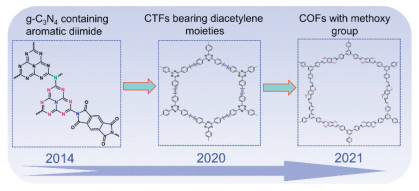
Figure 1.
Development of representative metal-free-based photocatalysts for photocatalytic overall H2O2 production.

Recent advances in photocatalytic overall production of hydrogen peroxide from metal-free photocatalysts
Congxu Wang , Xuan Xie , Feng Qiu , Lei Zhu , Imran Shakir , Yuxi Xu


The increasing of the global energy crisis and environmental pollution issues caused by excessive consumption of fossil fuel necessitate the development of low-carbon and clean energy technologies [1–8]. Hydrogen peroxide (H2O2) has gained much attention as a promising candidate to address these issues due to its green, environmentally friendly and sustainable nature [9–12]. H2O2 is irreplaceable in water treatment applications as it is a clean oxidant that decomposes into water and oxygen without producing harmful byproducts. Additionally, H2O2 is widely used in chemical synthesis, medicine, semiconductor manufacturing, the military, aerospace and other industries [13–15]. Moreover, it has been proposed an alternative energy carrier in fuel cells due to its safety and comparable power density as compressed hydrogen. Currently, over 90% of industrial H2O2 is produced via the traditional industrial anthraquinone (AQ) method [16,17]. However, this process involves multiples steps-hydrogenation, oxidation, extraction, purification and concentration-resulting in significant energy loss and the generation of toxic byproducts [18–20]. Furthermore, AQ method relies on precious metals catalysts, increasing the production costs. Therefore, developing an efficient, safe, green, and sustainable method for H2O2 preparation is an urgent task. Semiconductor based photocatalytic technology emerged as an economically viable method for utilizing solar energy to synthesize H2O2 by mimicking natural photosynthesis [21–23]. The sunlight-driven O2 reduction and H2O oxidation is considered a feasible strategy for replacing AQ oxidation process [24–28]. However, most photocatalytic H2O2 synthesis research and reviews primarily on the oxygen reduction reaction (ORR), while studies on the water oxidation reaction (WOR) remain limited [13,29,30]. This review focuses on photocatalytic overall H2O2 generation, which involves both O2 reduction and H2O oxidation. The choice of photocatalyst plays a crucial role in enhancing the efficiency of the photocatalytic process.
For a long time, the research on photocatalytic H2O2 synthesis has predominantly centered on inorganic photocatalysts, such as TiO2, BiVO4, WO3, ZnS and CdS-based materials [4,29,31,32]. However, these materials suffer from inherent drawbacks, including a narrow absorption range, low sunlight utilization efficiency (particularly in the ultraviolet region), and limited variability, which restricts their widespread application in photocatalytic H2O2 generation field [9,10,14]. Various strategies-such as micro/nano structuring, surface defect engineering and heterojunctions formation-have been proposed to improve the optoelectronic properties of inorganic semiconductors. However, the efficiency of H2O2 production with these materials remain unsatisfactory.
Recently, metal-free organic polymers-including covalent organic frameworks (COFs), covalent triazine frameworks (CTFs), and carbon nitrile (g-C3N4) have attracted significant attention due to their unique optical and electrical properties [21,33–37]. These materials offer notable advantages, such as facile designability, tunable functionality, large specific surface area, and porosity, which enhance interaction between O2/H2O molecules and catalytic active centers, thereby improving the photocatalytic efficiency [38–41]. Moreover, the extended π-conjugation of organic polymers broadens the visible absorption range and promotes photoinduced charge separation, thereby suppressing electron-hole recombination and maximizing solar energy utilization [42–44]. In addition, the designable modular structure and versatile functionalities of organic polymers provides huge potential for the applications of photocatalysis in regulating photocatalyst composition, optoelectronic characteristics, and inter-facial properties at the atomic and molecular level [15,45,46]. So that conduction band (CB) and valence band (VB) potential of metal-free photocatalysts to simultaneously meet the requirements of redox reaction of O2 and H2O. These unique characteristics have received much attention and led to the rapid development of metal-free based photocatalysts with interesting structures features, but there is an urgent need to summarize and highlight the research status of metal-free photocatalytic systems for photocatalytic overall H2O2 generation. This review aims to summarize the process of metal-free organic photocatalysts in photocatalytic overall H2O2 generation and provides in-depth insight into the synthetic strategy of metal-free photocatalysts to improve photocatalysis performance (Fig. 1). First, the fundamental principles of photocatalytic overall H2O2 generation were explicated. Then, we discuss various strategies for designing and synthesizing metal-free based photocatalysts including g-C3N4, CTFs, and COF to enhance their photocatalytic performance. The reaction mechanism is also analyzed to promote a deeper understanding of photocatalytic overall H2O2 production. Additionally, we explore the structure-activity relationships that guide the development of high-performance metal-free photocatalytic systems. Ultimately, this review aims to provide readers with a comprehensive understanding of the critical role of metal-free photocatalysts in the overall H2O2 generation and offer strategic insights for further improving their photocatalytic performance.
Artificial photosynthesis on semiconductors can be divided four typically steps: light absorption inducing excitation formation, carrier separation, carrier transfer to surface of photocatalysts, and subsequent surface redox reactions (Fig. 2a) [37,47–53]. Together, these four steps determine the photocatalytic efficiency. Under illumination of light, semiconductor absorbs photons with energies greater than its band-gap, upon which generating photo-excited electrons and holes at the CB and VB, which subsequently migrate to the surface of photocatalyst for initiate the redox reaction [22,24,54,55]. To realize excellent performance, photocatalysts should keep efficient in all these four steps. In principle, photocatalysts with narrow band-gap can maximize the utilization of photons. On the other hand, to drive surface redox reactions, the minimum band-gap value should be satisfied, so that the conduction and valence band edges pass through the potential of the target redox reactions, respectively [23,26,40,56]. Therefore, when adjusting the band-gap of photocatalysts materials, the delicate balance between light absorption and band edges should be kept in mind. In addition, charge separation and transfer also play a vital role in determining the final photocatalytic performance.
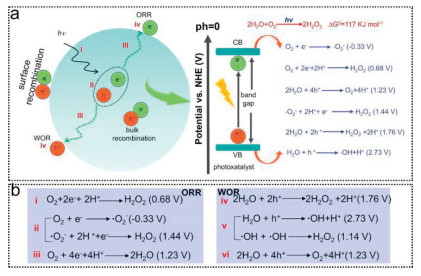
As for photocatalytic overall H2O2 synthesis, it mainly includes ORR and WOR processes [13,30,57]. Fig. 2b showed the reaction energy barrier of ORR and WOR, vs. normal hydrogen electrode (NHE). The ORR reaction process contains two ways, which is direct one-step 2e– ORR (ⅰ) and indirect two-step 1e– ORR (ⅱ), respectively. And the one-step 2e– ORR process exhibits a more favorable energy level than indirect two-step 1e– ORR. The generated ·O2– from two-step 1e– ORR not only has a more negative energy level (−0.33 V) than one-step 2e– process but also is rather to involve in other redox reactions [4,9,10,13]. Therefore, the efficiency and selectivity of the two-step 1e– pathway for producing H2O2 are much lower than one-step 2e– ORR. Optimization the composition and structure of semiconductor photocatalysts to enhance the efficiency and selectivity of the one-step 2e– ORR pathway is an effective guidance for photosynthesis H2O2. Similarly to the ORR process, the direct WOR also include several different reaction pathways, such as direct one-step 2e– WOR, indirect one-step 2e– WOR and 4e– WOR processes [14]. Likewise, the direct WOR is thermodynamically more advantageous, while the indirect WOR is kinetically more favorable [21,37]. The direct one-step 2e– WOR is carried out by oxidation photo-generated holes (ⅳ), with an oxidation potential of up to 1.76 V. Indirect two-step 1e– WOR can be used for photosynthesis of H2O2 (ⅴ), but the production of H2O2 from the coupled ·OH induced by hole requires a high concentration of ·OH, which is almost not limited to increasing the yield of photosynthesis H2O2 [31,48]. Besides, the competitive reaction of converting H2O to O2 and H+ by a one-step 4e– process (1.23 V, ⅵ) inevitably happens simultaneously, resulting in a reduced H2O2 formation efficiency and selectivity for semiconductor photocatalysts [31,49,50]. To achieve efficient photosynthesis H2O2 without sacrificing reagents, it is necessary to simultaneously carry out O2 reduction and H2O oxidation reactions. Obviously, ORR process is theoretically easier to achieve than WOR process for photocatalytic synthesis of H2O2. Therefore, how to realize high-efficient WOR process is the key to achieve photocatalytic overall H2O2 synthesis [30,58–60].
The generation intermediates during ORR and WOR process can be measured by different in situ experimental characterizations, including in-situ Raman and diffuse reflectance infrared Fourier transform spectroscopy (DRIFTS) due to in situ characterization technology allows us to real-time observation the redox reaction process. Thus, in situ characterization is gradually developing to an advanced research strategy in materials, catalysis, and energy [4,34]. Additionally, the reaction barrier of ORR and WOR can be calculated by theoretical calculations. Currently, the theoretical calculations is a powerful method to clarify the reaction process in detail [2,11].
Based on the above result, metal-free photocatalysts have shown significant potential in the field of photocatalytic overall H2O2 production and have become an indispensable component in this field. Although some research on metal-free organic polymer for H2O2 generation has been reported, there is still a lack of related reviews to summarize the photocatalytic overall H2O2 generation of metal-free organic polymer for. Based on this, we will introduce the research process of representative metal-free organic polymer photocatalysts mainly including COFs, CTFs and g-C3N4 in overall H2O2 generation in recent years in the next section.
Compared with traditional inorganic photocatalysts, organic polymers possess the simple synthesis methods, strong designability, and excellent response to visible light, therefore, it holds great promise in photocatalytic overall H2O2 production [61–67]. Based on the abundant synthesis methods of organic polymers, their pho-toelectrochemical properties can be highly modulate by adjusting their structure at molecular level [68–71]. Currently, the chemical design synthesis of organic photocatalysts is mainly divided into intrinsic molecular structure and heterostructure design [44,72–75]. The intrinsic molecular structure design mainly relies on deliberately selecting suitable building blocks and linkages for modulating photoelectric properties of the polymers, thereby improving photocatalytic efficiency. Metal-free-based photocatalysts can be designed to harvest wide range light when showing exceptional stability under various operational conditions. Single-component photocatalysts usually face a fundamental contradiction: a narrow bandgap enables wide solar absorption but exacerbates rapid electron-hole recombination due to strong coulomb interactions [76,77]. Therefore, it is necessary to design the photocatalyst to decrease the recombination rate of photo-excited carriers and widen the range of light absorption. Two types of semiconductors with different staggered band structures to form heterojunctions can not only broaden the absorption range of light, but also adjust the band-gap structure. To promote the separation and transfer of carriers, the construction of heterojunction is an effective way to solve the sunlight absorption and the electron-hole pairs recombination [71,78]. Of course, there are many other efficient strategies for photocatalytic overall H2O2 production, such as microenvironment regulation, spin state regulation as well as amorphous 2D layered materials. These strategies could effective regulation the electronic band structures, microtopograph and physicochemical properties of photocatalysts.
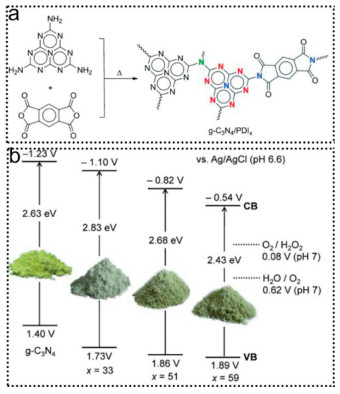
g-C3N4 have shown promising in photocatalysis overall H2O2 filed due to its unique characteristics, such as band structure, easily manufactured, excellent chemical and thermal stability, and environmental friendliness [56,79–81]. The highly delocalized π-conjugated system is formed by sp2 hybridization of C and N resulting in a typical semiconductor property of g-C3N4. It can be synthesized by simple sintering of nitrogen-rich precursors, such as melamine, cyan-amide, thiourea, and urea. The optical band gap of g-C3N4 at 2.7 V, with CB −1.3 V, which is more negative than the potential of O2 reduction to H2O2. And the VB is located at +1.4 V, which meets the potential energy requirement of 4e- H2O oxidation. Thus, recent research has highlighted the potential of g-C3N4 in photocatalytic overall H2O2 generation from pure water and O2 under visible light irradiation [60,80,82]. Table 1 summarizes some typical examples of photocatalytic overall H2O2 generation of recent g-C3N4-based photocatalysts [83–99]. In 2014, Hirai's group first reported photocatalytic overall H2O2 production using g-C3N4 (Fig. 3a) [83]. They found incorporating pyromellitic diimide (PDI) into g-C3N4 could positively shift the oxidation and reduction potentials due to the strong electron affinity of PDI. As shown in Fig. 3b, the CB and VB of g-C3N4/PDIx all become more positive after incorporate PDI, thus resulting in the enhanced photocatalytic water oxidation performance. Notably, g-C3N4/PDIx not only showed a decreased narrowed band gap for extended light response range but also had a deeper VB position than g-C3N4 which possessed enough thermodynamic driving force to enhance photocatalytic water oxidation ability. The apparent quantum yield (AQY) test was consistent with the energy band structure of g-C3N4/PDIx, indicating that the optimized band-gap structure could promote water oxidation and O2 reduction. After that, various methods for preparing highly active g-C3N4 for photocatalytic overall H2O2 evolution have been developed, including construction of single-atom doped, heterostructures and functionalization. In this part, the research process on photocatalytic overall H2O2 generation over g-C3N4-based photocatalysts are systemically summarized. And we introduce the different strategies in details to review photocatalytic overall H2O2 production over g-C3N4.

 DownLoad:
CSV
DownLoad:
CSV
| Photocatalyst | SCC (%) | AQY (%) | Ref. |
| g-C3N4/PDI | – | – | [83] |
| g-CN-MI-40 | – | – | [84] |
| Ni-CAT-CN60 | 0.1 | 0.96@420 nm | [85] |
| ORP/GCN | – | – | [86] |
| AQ/U-POCN | – | – | [87] |
| SCN5 | – | – | [88] |
| CN/CML | – | – | [89] |
| NiSAPs-PuCN | 0.82 | 10.9@420 nm | [90] |
| CNIO-GaSA | 0.4 | 9.1@459 nm | [91] |
| homo-CN | 0.19 | 25.7@420 nm | [92] |
| CoOx-NvCN | 0.47 | 5.73@420 nm | [93] |
| 40%K+/I−-CN/CdSe-D | – | – | [94] |
| TA-CN-3 | 0.34 | 1.7@420 nm | [95] |
| MOC-AuNP/g-C3N4 | – | – | [96] |
| CN-DMAP-GLU | – | 0.792@420 nm | [97] |
| pH-MCN | – | – | [98] |
| HCP-24 | – | 2.38@420 nm | [99] |
Single-atom has high active centers, such that unique properties exist for the ideal design of new photocatalysts with high activities, low-cost and stability [100,101]. Therefore, given the photocatalytic overall H2O2 generation, some optimal design of single-atom doped have been prepared and display exceptional performance in overall H2O2 production. Guo's group designed Ga-doped g-C3N4 (CNIO-GaSA) with Ga-N4 sites, where Ga3+ acts as a Lewis acid to polarize adsorbed O2, facilitating 2e− reduction to *OOH. Density functional theory (DFT) calculations revealed that the Ga-doped site lowers the *OOH formation barrier by 0.3 eV compared to pristine g-C3N4 [91].
In situ DRIFTS spectra confirmed the presence of *OOH intermediates, validating the dominant 2e− ORR pathway. However, the sluggish water oxidation kinetics (4e− WOR) limits the overall efficiency, suggesting the need for cocatalysts to improve O2 evolution. The synthetic process of CNIO-GaSA was shown in Fig. 4a. It was prepared by combining Ga(NO3)3 and dicyandiamide as the precursor and silica opal as template with subsequent removal strategies. Partial density of states (PDOS) reveals the formation hybridized Ga 4p and N 2p states could enhance the conductivity of CN contribute to reduce the transfer resistance of charge carriers. The transmission electron microscopy (TEM) (Fig. 4b) image show that obtained CNIO-GaSA has the periodic pore structure with an average diameter of ~250 nm. CNIO-GaSA presents a significantly enhanced H2O2 production rate (368.5 µmol/h), which is about 4.0 and 7.8 times, respectively higher than that of CNIO and CN. In addition, CNIO-GaSA exhibits the highest catalytic activity compare to other previously reported photocatalysts. Significantly, CNIO-GaSA also shows the excellent 100% efficiency for kill bacteria, thereby offering promising potential practical application. Although the CNIO-GaSA shows excellent photocatalytic activity toward overall H2O2 generation, the Ga is rare metals, which is not fit for practical application. On this basis, Zhang's group reported a high-loading Ni single-atom photocatalyst for efficient overall H2O2 synthesis with an AQY and solar-to-chemical conversion (SCC) up to 10.9% and 0.82%, respectively (Fig. 4c) [90].
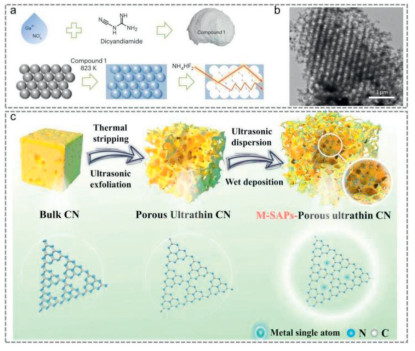
They found that Ni-N3 sites transform into high-valent O1-Ni-N2 sites using different in-situ characterizations. And the PDOS of Ni confirm that Ni 3d orbitals contribute to both CB and VB, suggesting Ni single atoms exceedingly optimize the electronic structure. Extensive experiments and detailed calculations prove that the development of the sites structure decreases the energy barrier of *OOH and inhibits the O=O bond dissociation resulting in improved H2O2 production activity. As shown in the proposed synthesis process, the high-loading M-SAPs can be divided into modulating the microtopography and optimizing the loading process. PuCN showed a higher overall H2O2 generation rate (41.1 µmol L-1 h-1) than of BCN (16.5 µmol L-1 h-1) due to the porous ultra-thin structure improved the contact range of O2. Apparently, the NiSAPs-PuCN showed highest H2O2 generation rate up to 342.2 µmol L-1 h-1, which was about 20.7 and 8.3 times higher than that of BCN and PuCN, respectively. Furthermore, the H2O2 generation activity of NiSAPs-PuCN can be improved to 640.1 µmol L-1 h-1 under AM 1.5 G irradiation. The AQY was tested owing to the AQY value is generally recognized as one of more reliable factors for assessing the photocatalytic property. Experiment demonstrated that the introduction of Ni active sites can greatly facilitate the O2 adsorption compared to pure BCN (decreased from 1.1 eV to −0.83 eV). It is essential that format the core intermediate *OOH for overall H2O2 generation via 2e− ORR. The calculation result suggest that improvement O2 adsorption capacity can promote intermediate formation, thus improving the conversion efficiency of H2O2. Charge density difference calculation result showed the charge redistribution of NiSAPs-PuCN is more remarkable than BCN, suggesting the Ni sites can promote the *OOH formation. Liu's group reported atomically dispersed Au on potassium-incorporated g-C3N4 (AuKPCN) that could simultaneously improve photocatalytic production of ·OH and H2O2 (Fig. 5) [102]. Details experiments and theoretical calculations proved that the low-valent Au changed the materials' band gap structure to trap localized holes produced under photo-excitation. Fig. 5a showed the 1e− WOR has the highest efficiency for ·OH production owing to one h+ can produce one ·OH. The in-situ Raman and DRIFTS testing result confirm that one-electron WOR could produce ·OH and unleash proton to accelerate ORR. The Au element has s orbital and d10 orbitals of Au element was filled by one electron and fully electron resulting in formation a highly concentrated hole under excited state (Fig. 5b). And the AuKPCN exhibited a remarkable AQY of around 85% at the wavelength range of 400–420 nm in different organic electron donor system (Fig. 5c). To further study the oxidation half reaction of AuKPCN, Ag+ and DMPO were added. The electron spin resonance (ESR) test result suggests the ·OH can be detected in the presence of AuKPCN without found O2 and H2O2, indicating the WOR process can produce the ·OH over AuKPCN (Fig. 5d). Significantly, the generation amount of ·OH and H2O2 is close to 2:1 (Fig. 5e), which consistent with the theoretical proportion based on 1e− WOR. As we have seen yet, AuKPCN showed the highest AQY, which was larger than previously reported photocatalysts for produce ·OH via 1e− and 2e− WOR. This outstanding work first reports on 1e− WOR generation ·OH and released the proton for enhancing the H2O2 production rate. But the ·OH can dissociation H2O2 owing to the its strong oxidizing properties.

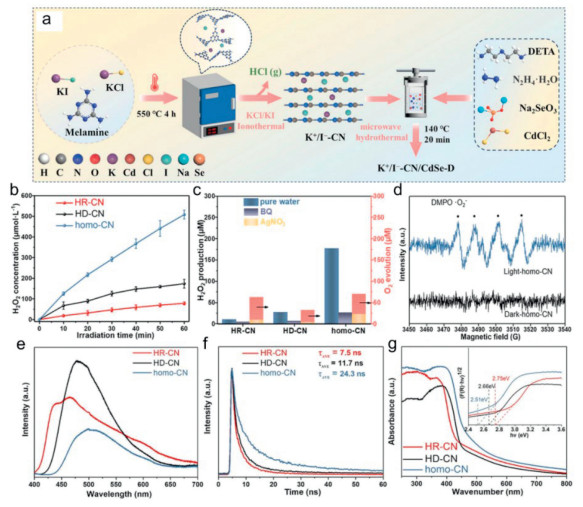
As well known, the single-component photocatalyst often cannot satisfy all the requirements for photocatalytic overall H2O2 production due to the fast photo-generated charge recombination and insatiable redox capacity [103–107]. Therefore, to decrease the recombination rate of photo-excited carriers and raise redox capacity, it is necessary to reform the photocatalyst. The construction of heterojunction by combining two kinds of semiconductors with interleaving band structure can not only decrease the recombination rate of photo-excited electron and hole, but also adjust redox capacity for fulfillment different photocatalysis requirements. Fan's group reported a binary semiconductors photocatalytic system for photocatalytic overall H2O2 generation [94]. Extensive experiments and calculation revealed that heterojunction can enhance light absorption capabilities and reduce interlayer charge transfer distance. They used X-ray absorption fine structure and in situ XPS to study coordination environment and charge transfer mechanism of heterojunction. Fig. 6a illustrated the synthesis route for K+/I−-CN/CdSe-D heterojunction. The I− and K+ ion intercalation into g-C3N4 was achieved by the assistance of KCl/KI salt. And the composite was formed by the in situ modified CdSe onto K+/I−-CN nanosheets using a microwave hydrothermal method. The photocatalytic overall H2O2 production activity of obtained samples was assessed under visible light irradiation. The photocatalytic performance of heterojunction surpassed that of the individual CdSe-D and K+/I−-CN. The 40% K+/I−-CN/CdSe-D exhibited the highest photocatalytic activity (448.63 µmol/L), which exceeded that most metal-free photocatalysts. They also tested the photocatalytic overall H2O2 generation with different mass loading. The results showed a significant linear relationship between catalyst amount and the yields of H2O2, further suggesting the reliability of the photocatalytic activity. Further the continuous irradiation experiment demonstrated excellent photocatalytic stability of heterojunction. Remarkably, the K+/I−-CN/CdSe-D not only exhibited the excellent photocatalytic stability, but also showed higher overall H2O2 generation rate than the other photocatalysts, which make it very promising photocatalyst considering its easy preparation. This study emphasizes the significance of interface chemical and ionic intercalation for enhancing the photocatalytic overall H2O2 generation. Tao et al. prepared g-C3N4 homojunction with functional surface for efficient photocatalytic overall H2O2 generation [92]. Kelvin probe force microscopy (KPFM) and calculations results suggest that surface hydroxyls of g-C3N4 can extract electron from the bulk to the surface. The photocatalytic overall H2O2 production performance of homojunction is assessed under visible light irradiation. As shown in Fig. 6b, homo CN showed a highest H2O2 yield (508.4 µmol/L), which was about 2.9 and 6.6 times higher than HD-CN and HR-CN respectively. To demonstrate the H2O2 synthesis route, photocatalytic H2O2 generation was tested under different measurement conditions for 2 h. As shown in Fig. 6c, 177 µmol/L of H2O2 yield was produced in pure water by homo-CN, while HD-CN and HR-CN almost have no H2O2 yield. When benzoquinone (BQ) added in the reaction system, all the samples show that H2O2 yields reduce sharply. This result suggests that obtained samples synthesize H2O2 via two step single-electron route. Electron paramagnetic resonance (EPR) characterization results further confirm that the two step single-electron process (Fig. 6d). The steady state PL and fluorescence lifetime measurement result proved that homojunction can improve charge separation and transfer (Figs. 6e and f). UV-vis diffuse reflectance spectra (UV-vis DRS) characterization revealed that homojunction extends the visible light absorption range that is beneficial to photocatalytic overall H2O2 production (Fig. 6g).
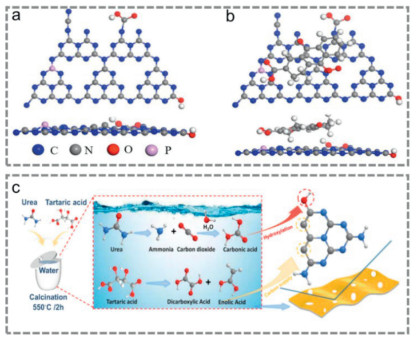
In addition to the reported heterojunction and single-atom doped strategies, functionalization and defects are also effective strategy for photocatalytic overall H2O2 generation. Ouyang's group reported an elaborately modified g-C3N4 (U-POCN and AQ/U-POCN) photocatalyst for overall H2O2 generation (Figs. 7a and b) [87]. The AQ/U-POCN exhibited the highest catalytic efficiency (75 µmol L−1 h−1) ever reported without using any additives. Calculations and experiments revealed that P, O-co-doping could improve the water oxidation ability of the g-C3N4, which was capable of oxidation H2O to H2O2 directly. Similarly, Shi's group reported tartaric acid-modified g-C3N4 (TA-CN) by introducing hydrophilic hydroxyl groups into the g-C3N4 (Fig. 7c) [95]. They found π-electron-rich can effectively reduce exciton binding energy result in increasing the transfer rate of photo-excited electrons, enabling faster migration from the production site to the active sites, thereby enhancing photocatalytic overall H2O2 generation efficiency. Besides, the hydroxyl groups modulate reaction kinetics by enhancing the adsorption ability of intermediates by their hydrophilic intrinsic, which favors the overall reaction efficiency.
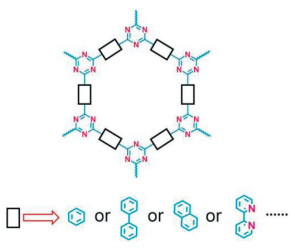
CTFs are a class of organic porous materials formed by covalent bonding with a triazine ring as the structural unit, typically obtained from nitrogen-rich aromatic precursors by polymerization reaction (Fig. 8) [58]. While CTFs are a branch of the COFs family, their unique triazine ring structure endows them with exceptional physicochemical properties and remarkable stability [63,108,109]. In 2008, Kuhn et al. successfully obtained the first CTFs material (CTF-1) under ionothermal conditions [110]. This pioneering work not only established the foundation for the exploration and development of CTFs but also opened the door to their extensive applications across energy, catalysis and adsorption and separation.
In recent years, CTFs have gradually become a promising catalytic platform for the photocatalytic overall H2O2 generation by virtue of their unique photophysical properties [111,112]. Their advantages for overall H2O2 production can be attributed to several key factors, including (1) abundant N atoms, high specific surface area and ordered pore structure that can promote oxygen adsorption, activation, and transport; (2) structural tunability provides remarkable flexibility to enhance the selectivity and yield of H2O2 production; (3) unique π-conjugated structure in the triazine ring facilitates efficient long-range migration of photo-generated electrons; (4) highly stable C≡N bonds endow the catalyst with excellent durability under acidic, basic and complex reaction conditions. Nevertheless, CTFs still face some key challenges in the photocatalytic production of H2O2, such as the rapid recombination of photo-generated charge carriers, sluggish reaction kinetics, and the inherently high impedance and low electrical conductivity characteristic of organic semiconductors, which greatly limit the further enhancement of photocatalytic efficiency [113–115]. To address these challenges, recent research has introduced a range of innovative strategies, including the modulation of the framework structure, the introduction of heterojunction and the optimization of the electron transfer pathway, which provide new ideas and directions to achieve a breakthrough in the photocatalytic production of H2O2 by CTFs [116–118].
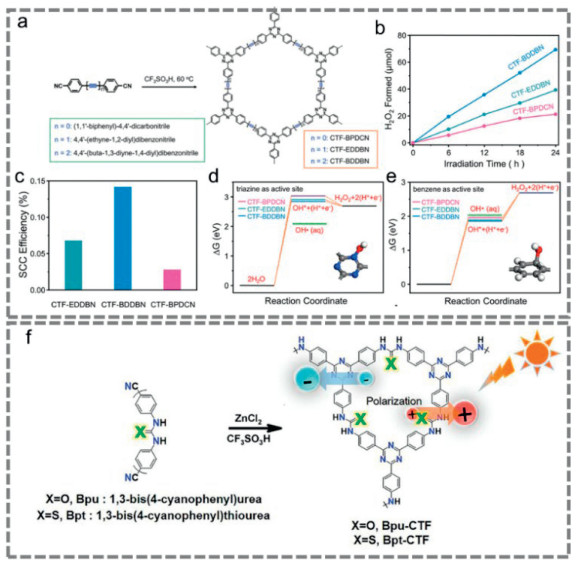
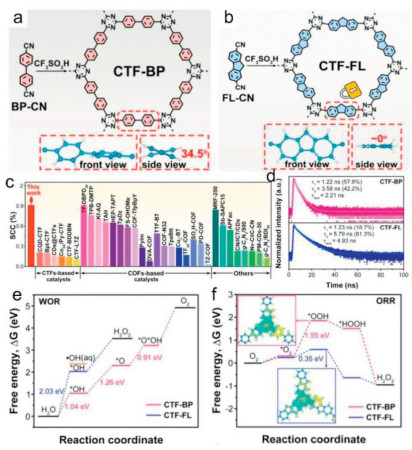
In 2019, Xu's group first reported photocatalytic overall H2O2 production using functionalized CTFs [30]. They found that introducing acetylene or diacetylene groups into CTFs (CTF-BPDCN, CTF-EDDBN, and CTF-BDDBN) can significantly enhance photocatalytic H2O2 production rate due to the reduced energy associated with OH* formation and thus enable a new 2e- oxidation route toward overall H2O2 generation. As shown in Fig. 9a, CTFs with acetylene and diacetylene are prepared from their corresponding nitrile precursors. They tested the photocatalytic overall H2O2 generation performances of different samples in pure water under visible light irradiation. The average H2O2 generation rate of the CTF-BDDBN was calculated to be 79 µmol, which was about 2 and 3.8 times higher than that of CTF-BPDCN and CTF-EDDBN (Fig. 9b). Moreover, the SCC efficiency of the best-performing CTF-BDDBN is measured to be 0.14% (Fig. 9c), which was larger than previously reported organic photocatalysts. Further theoretical calculations revealed alkynyl groups can develop a new 2e− oxidation route toward overall H2O2 production (Figs. 9d and e). After that, Han et al. developed a thiourea-functionalized CTF (Bpt-CTF) through a polarization engineering strategy, effectively addressing the sluggish kinetics of H2O2 production during 2e− oxygen photoreduction (Fig. 9f) [119]. Photocatalytic performance tests showed that the Bpt-CTF greatly enhanced H2O2 production by 2e− ORR from water and O2. The H2O2 production rate reached 3268.1 µmol h−1 g−1 of Bpt-CTF without the use of any sacrificial agents or co-catalysts, which was more than an order of magnitude improvement compared to Dc-CTF. Mechanistic studies revealed that the superior photocatalytic activity of Bpt-CTF was attributed to the incorporation of the (thio)urea functional group, which greatly enhanced the polarization of the CTFs, thereby significantly promoting charge separation and optimizing the electron transfer dynamics. Previously reported on functionalized CTFs are widely limited by the amorphous or weakly crystalline structure. Generally, improved the crystallinity of organic materials can accelerate charge transport and separation in the skeleton, which is conducive to their photocatalytic application. In view of this, Xu's group successfully synthesized two high-crystalline CTFs with 1,1′-biphenyl-4,4′-dicarbonitrile (BP-CN) and 9H-fluorene-2,7-dicarbonitrile (FL-CN) as the building blocks (Figs. 10a and b) [37]. Notably, the exfoliated CTF-FL exhibited an exceptional H2O2 production rate of 5007 µmol g−1 h−1 from O2 and pure water under sacrificial agent-free conditions, significantly surpassing all previously reported CTF-based photocatalysts and establishing itself among the most efficient metal-free H2O2 photocatalytic systems to date. And femtosecond-transient absorption (fs-TA) spectroscopy characterization results confirm the locked-in molecular architecture suppress rapid recombination of photoexcited carriers. Time-resolved photoluminescence (TRPL) analysis demonstrated spatially locked structure could extended π-electron delocalization and enhance strong intermolecular interaction (Fig. 10d). Structural characterization and theoretical calculations further reveal that the outstanding photocatalytic performance of CTF-FL stems from its spatially locked structure, which not only enhances the efficiency of separation and transfer of photo-excited charge-carriers, but also regulates the local electronic structure, leading to a shift of the WOR pathway to shift from the 4e− to the 2e− process, and ultimately achieves 100% atom utilization efficiency. And the overall H2O2 generation test was performed under AM 1.5 G one-sun illumination. Remarkably, the SCC efficiency of exfoliated CTF-FL reached up to 0.91%, which exceed the most metal-free photocatalysts ever reported (Fig. 10c). Total density of states (TDOS) results suggest agreement with the experimental results of band gaps for CTF-FL (2.41 eV) and CTF-BP (2.52 eV). The reaction barrier is calculated to further understand the photocatalytic overall H2O2 production mechanism. The calculation result suggests that the spatially locked can reduce the barrier of ORR and WOR resulting in boosting efficient overall H2O2 production (Figs. 10e and f).
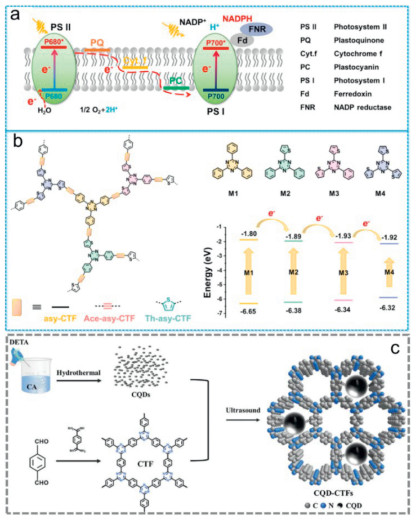
Inspired by the stepwise energy- and charge transfer processes in natural photosynthesis, Zhang and co-worker designed and synthesized three CTFs with stepwise charge transfer functionality (asy-CTF, Ace-asy-CTF and Th-asy-CTF) (Figs. 11a and b) [120]. Without the presence of a sacrificial agent, the Ace-asy-CTF showed the highest photocatalytic overall H2O2 generation performance compare to asy-CTF and Th-asy-CTF. The AQY of Ace-asy-CTF was determined under different monochromatic wavelengths. The AQY of Ace-asy-CTF reached 4.4% at 420 nm wavelength. Furthermore, Ace-asy-CTF showed a SCC efficiency up to 0.48% under AM 1.5 G simulated sunlight illumination. The long-term recycling tests suggests that Ace-asy-CTF possessed excellent photocatalysis stability. In situ characterization and theoretical calculations revealed that the acetylene units in Ace-asy-CTF as key site for efficient charge separation and exciton transport through a stepwise charge transfer mechanism, thus enhancing the photocatalytic activity of the Ace-asy-CTF. The inherent high impedance and suboptimal electrical conductivity of CTFs still limit their charge transfer ability during photocatalysis. For this reason, Zhou et al. successfully prepared bonded CQD-CTF photocatalysts by embedding carbon quantum dots (CQDs) into the pores of CTFs (Fig. 11c) [55]. The optimized 0.5% CQD-CTF exhibited excellent H2O2 production activity in a pure water system without sacrificial agent, achieving a generation rate as high as 1036 µmol g−1 h−1, which was 4.6 times higher than that of the original CTF. Theoretical calculations and in situ characterization further elucidated the incorporation of CQDs not only improved the electrical conductivity of CTFs but also strengthened their proton affinity and oxidative capability, thereby markedly boosting the catalytic performance of 0.5% CQD-CTF in both the ORR and WOR.
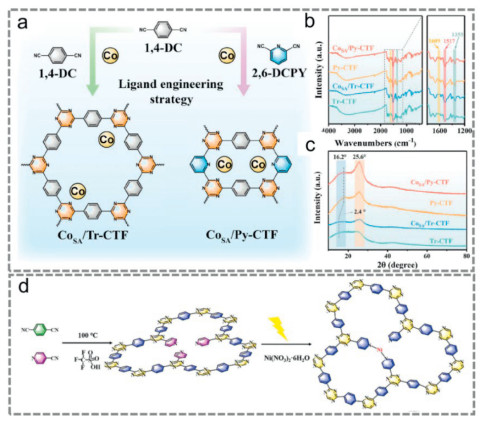
In addition to the reported heterojunction and functionalization strategies, single-atom doped in CTFs for photocatalytic overall H2O2 production has also been extensive studied. Shen's group prepared a high-density Co single-atom-loaded pyridine modified CTF (CoSA/Py-CTF) for photocatalytic overall H2O2 generation (Fig. 12a) [121]. The obtained CoSA/Py-CTF exhibited a remarkable photocatalytic overall H2O2 evolution rate of 2898.3 µmol g−1 h−1 under visible light irradiation with an AQY and SCC up to 13.2% at 420 nm and 0.15% under AM 1.5, respectively, which exceed most metal-free photocatalysts ever reported. The FT-IR and XRD demonstrated the single-atom-loaded CTF was prepared successfully (Figs. 12b and c). This research provides perceptive observations into the intricate dynamic behavior and catalytic mechanism of SACs. After that, Shen's group further study photocatalytic overall H2O2 evolution using Ni single-atom doped CTFs (Fig. 12d) [122]. They found dual-pathway synergistically promoting photocatalytic overall H2O2 evolution by ORR and WOR. Dual active site CTFs loading single-atom Ni and pyridine N (d-CTF-Ni) presented excellent overall H2O2 evolution rate of 869.1 µmol g−1 h−1. This study offers a new insightful on the dual active site catalytic mechanism for photocatalytic overall H2O2 generation.
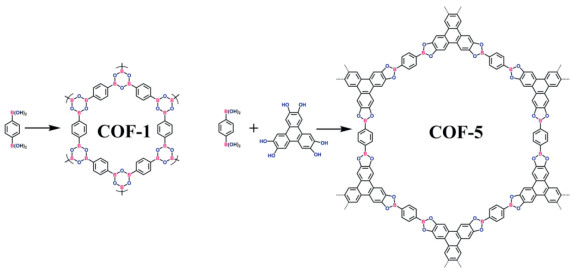
COFs are a classic representative of porous organic polymers with high crystallinity and periodic structures. The COFs usually are synthesized using reversible chemical reactions, such as boroxine, boronate-ester, imide, and imidazole, thus, leading to highly crystallinity [123–125]. In 2005, Yaghi's research group first successfully prepared COF-1 and COF-5 by reversible boronate-ester reaction (Fig. 13) [123]. Over the past few years, the COFs materials with different linkages develop rapidly due to their exactly structural characteristics and great potential in various field, such as energy storage and conversion, separation and photo/electron catalysis (Fig. 14) [126–132]. The COFs with semiconductor characteristics are one of the promising candidate materials for overall H2O2 production due to their large surface area, structural designability, high chemical stability, light weight, extensive π-conjugation, flexible synthetic strategy. The extensive π-conjugation in COFs extended covalent systems promotes the absorbance of visible light. The π-π stacking interaction of framework benefit the migration and transport of carriers, which can prevent the recombination of photo-excited carriers and maximize photocatalytic overall H2O2 production efficiency. The larger surface area can expose abundant active sites and promote contact between water and COFs frameworks. It is the synthesis link-ages modules provide rich options for design production with different photo-electric and physical properties for various application. Given these unique properties, COFs have shown satisfactory employment in photocatalytic overall important that H2O2 production, and many of them have exhibited better performance than inorganic semiconductors [133]. However, the COF's photocatalytic overall H2O2 production was not achieved until 2021, which is far behind other photocatalytic applications such as water splitting, CO2 reduction, and organic degradationc [134–136]. In 2021, Yu's group first reported photocatalytic overall H2O2 production using triphenylbenzene-dimethoxyterephthaldehyde-COF (TPB-DMTP-COF) at gas–liquid–solid interface (Fig. 15a) [134].
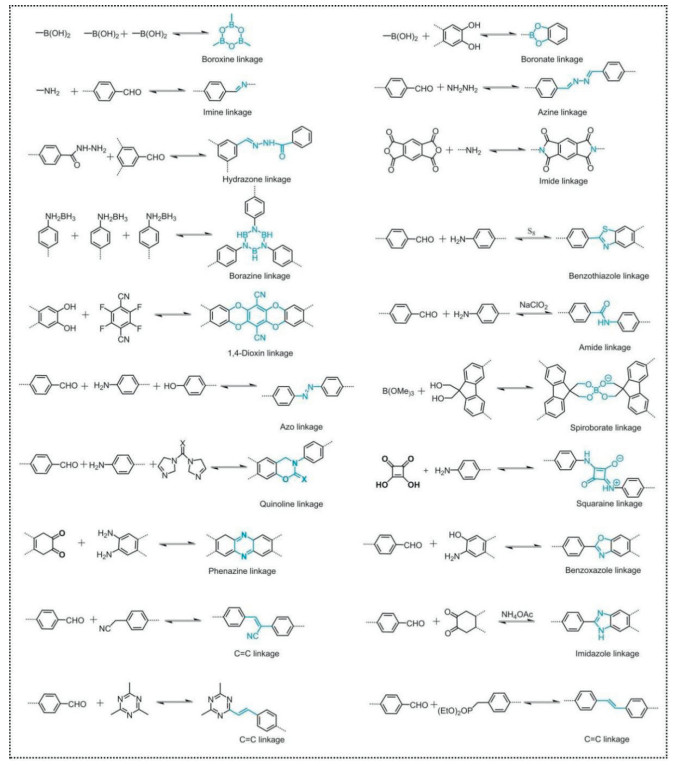

The reported TPB-DMTP-COF can efficient reduce O2 to H2O2 in a wide pH range and pure water condition (Fig. 15b). TPB-DMTP-COF showed a high H2O2 generation rate of 2882 µmol g−1 h−1 under visible light irradiation due to the high crystallinity and large specific surface area as high as 2747 m2/g (Fig. 15c). More importantly, a solar-to-chemical conversion of 0.76% is achieved for H2O2 generation surpassing most of the metal-free photocatalysts ever reported. This study provides fundamental insights into the reasonable designed synthesis of highly efficient metal-free photocatalysts for overall H2O2 generation by precise control over photocatalytic reaction pathways. Since then, the continuous efforts have been devoted to design COFs resulting in rapid development of COFs-based photocatalytic systems with various structure and properties preference through different strategies. In this section, the research advance on photocatalytic overall H2O2 generation over COFs and COF-based heterojunction for enhancing photocatalytic performance are systematic summarized and discussed in detail. Some typical examples of photocatalytic overall H2O2 generation by COFs are summarized in below Table 2 [13,18,19,43,57,134,137–147]. And we present the differently strategies, such as functional group modification, introducing donor-acceptor, and COFs nanohybrids, to review photocatalytic overall H2O2 production over COFs and its heterojunction.
DownLoad:
CSV
| Photocatalyst | SCC (%) | AQY (%) | Ref. |
| TPB-DMTP | 0.76 | 18.4@420 nm | [134] |
| TF50-COF | 0.17 | 5.1@400 nm | [18] |
| COF-TfBpy | 1.08 | 13.6@420 nm | [19] |
| TTF-BT-COF | 0.49 | 11.9@420 nm | [137] |
| TD-COF | 0.15 | – | [138] |
| HEP-TAPT | 0.65 | 15.35@420 nm | [139] |
| COF-N32 | 0.31 | 6.2@459 nm | [43] |
| TpDz | 0.62 | 11.9@420 nm | [140] |
| Py-Da-COF | 0.09 | 4.5@420 nm | [141] |
| TaptBtt | 0.296 | – | [142] |
| TZ-COF | 0.036 | 0.6@475 nm | [143] |
| Kf-AQ | 0.7 | 15.8@400 nm | [131] |
| TB-COF | 1.08 | – | [144] |
| TPB-COF-OH | 0.84 | 9.61@420 nm | [57] |
| DVA-COF | 0.08 | 2.84@420 nm | [130] |
| COF-2CN | 0.6 | 6.8@459 nm | [129] |
| TBD-COF | 1.04 | – | [145] |
| QH—HPTP-COF | 1.41 | – | [13] |
| TAH—COF | 0.66 | 7.72@420 nm | [146] |
| DHAA | 0.23 | 4.6@380 nm | [147] |
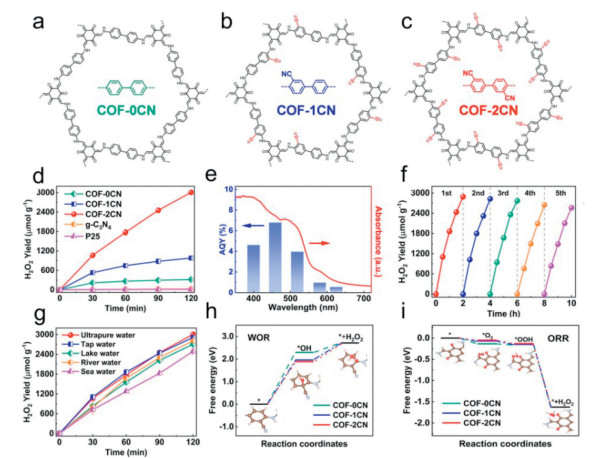
Introducing functional groups into organic semiconductors is well known as an effective strategy to endow semiconductors with unique characteristic [54,135,136,148–150]. Firstly, the well design functional groups can modulate the photo-electronic properties of COFs, enhance visible light response and improve the photo-excited carriers separation efficiency [148]. Additionally, the modified special groups can change the stability of COFs under different environment, holding the catalytic stability over long time testing. Importantly, incorporation the functional groups can optimize the efficiency of charges transfer, decrease the recombination of electron-hole pairs and improve the yield of H2O2 [75]. Hou and co-authors reported a simple and efficient strategy for the synthesis a class of COFs photocatalysts with multiple charge transfer channels by introducing dicyano-functional group (Figs. 16a-c) [151]. As a result, COF-2CN with multiple charge transfer channels exhibits the significantly higher H2O2 generation rate (1601 µmol g−1 h−1) than other samples (Fig. 16d). This suggests that dicyano-functional group in COFs can greatly improve the overall generation efficiency of H2O2. Moreover, the AQY and SCC efficiency of COF-2CN are determined to be 6.8% and 0.6% respectively under visible-light irradiation, which is significantly higher than other organic polymer (Fig. 16e). COF-2CN also presents excellent photocatalytic stability in long time test (Fig. 16f). And the COF-2CN also showed the excellent stability in different pH (from 3 to 11), suggesting COF-2CN can be used in different pH conditions. Importantly, COF-2CN exhibits similar photocatalytic production rates of H2O2 in different water environment compare to ultrapure water conditions (Fig. 16g). Fs-TA spectroscopy reveals that photo-excited carriers generated by COF-2CN can be dissociated more efficiently compare to COF-0CN and COF-1CN owing to COF-2CN possess four channels for charge transfer. To better understand the mechanism of dicyano group in increasing the charge transfer channels, DFT calculations were carried out. The results suggest that dicyano-functional group as electron acceptor in COF-2CN can accept more photo-excited electrons comparing with other samples, which is contribute to the rapidly charge transfer and resulting in efficient ORR process. In the 2e− WOR process, the energy barrier of rate-determining step of COF-2CN is apparent lower than that by COF-0CN and COF-1CN (Fig. 16h), which suggests that the introduction of dicyano groups into COFs can possess superior H2O dehydrogenation property. In ORR process, COF-2CN still exhibits the same result further suggesting dicyano groups can enhance photocatalytic over H2O2 production rate (Fig. 16i). This work not only open a new way to synthesize COF-based photocatalyst for efficient overall H2O2 photosynthesis by introducing the dicyano groups into COFs, but also develops a new way for the practical application of organic photocatalysts in H2O2 photosynthesis. The PDOS demonstrates that the C 2p orbital contributed by valence band top and conduction band bottom of all COFs, confirming the well π-delocalization for all COFs. The results are beneficial for the efficient charge transfer of ORR process. In his work, author tests the photocatalytic activity using differentwater quality (such as tap water, river water, and lake water), which contribute to practical application. But this work is deficient in the sustainable production of H2O2. Chen's group report vinyl modified COFs (DVA-COF) for improving the photocatalytic H2O2 generation efficiency (Fig. 17a) [152].
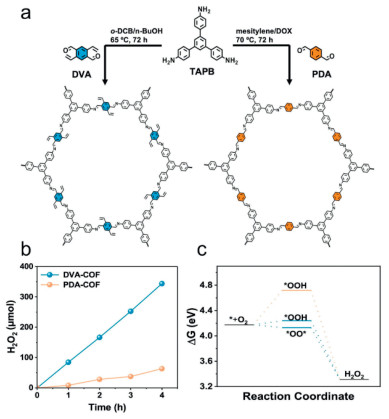
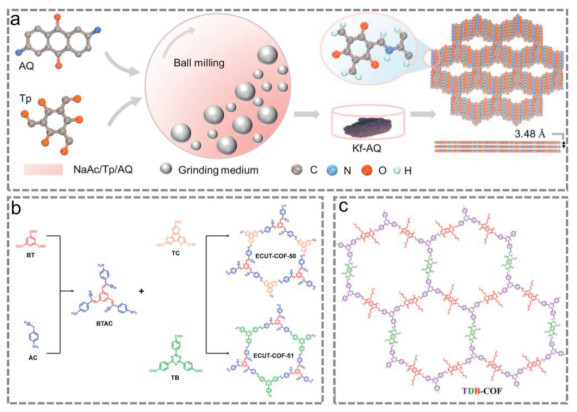
This research suggested that the anchored vinyl groups in DVA-COF not only extended the light response range but also improve carrier separation and transfer efficiency that facilitate H2O2 production rate by a 2e− ORR pathway. Therefore, DVA-COF with vinyl group produced H2O2 much more (84.5 µmol/h) than PDA-COF (8.6 µmol/h), which is also superior to most reported COFs-based photocatalysts (Fig. 17b). Moreover, DFT calculations showed that the introduction of vinyl groups improves the O2 adsorption and affects the catalytic efficiencies, which decreases the barrier energy of O2 adsorption affinity toward O2, thereby optimizing the photocatalytic activity of DVA-COF (Fig. 17c). EPR characterization results suggest •O2– is a significant intermediate in the photocatalytic overall H2O2 production process using PDA-COF. Additionally, Zhang et al. introduced kfto-form anthrahydroquinone into COFs (kf-AQ) by mechanochemical synthesis (Fig. 18a) [153]. Kfto-form anthraquinone containing COF showed efficient H2O2 photosynthesis in alkaline water, with a record H2O2 production rate of 4784 µmol h−1 g−1 under visible light irradiation without reagents. The keto-form structure in Kf-AQ can enhance the water adsorption through the formation of OH− clusters with weakened hydrogen bonds according to the dehydrogenation of water and efficient H2O2 photosynthesis. Luo et al. reported a COFs with cyanide group for highly efficient overall H2O2 generation from air and water through photocatalytic ORR and WOR (Fig. 18b) [154]. Without using any sacrificial agent, the synthesized COF is found to enable a H2O2 production rate as high as 4742 µmol h−1 g−1 from water and air and O2 utilization and the SCC up to 0.68, which is bigger than most reported COFs and other organic photocatalysts. This study inspires a rational design of efficiency COF photocatalyst for high-performance artificial photocatalysis. Shen's group designed and developed thioether-decorated triazine-based COF (TDB-COF) for efficient overall H2O2 photosynthesis. TDB-COF exhibits an excellent photocatalytic H2O2 production rate of 723.5 µmol h−1 g−1 without any sacrificial agents and presents remarkable cyclic stability (Fig. 18c) [155]. The modification of thioether groups extended the light absorption range of TDB-COF and narrowed its energy band gap. Experimental and theoretical analysis revealed that this method can not only effectively optimize the band structure and improve visible-light absorption for 2e− WOR but also enhance the photo-excited carriers transfer and separate for 2e− ORR process to generate H2O2, thus resulting ultimately boosting the overall H2O2 photosynthesis. This work provides deeply suggestions for the development of the functional COFs towards overall H2O2 photosynthesis.
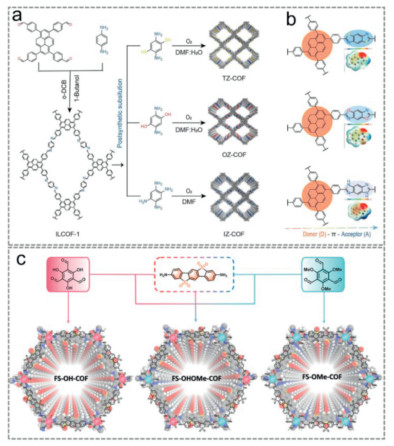
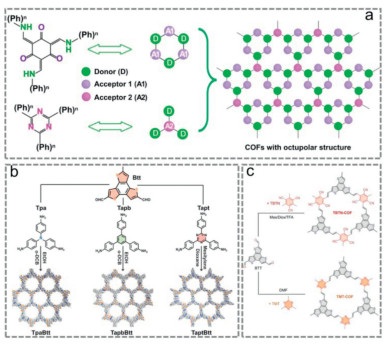
Enhancing the photocatalytic efficiencies necessitates a key stage of separation and rapid migration of photo-excited carriers. D-A structures offer several advantages for photosynthesis owing to the construction of internal electric field that facilitate carrier separation and transfer, also wide light response ranges, enabling them to absorb a broad zone of the solar spectrum [142,156–158]. In addition, D-A system can effectively reduce the exciton binding energy based on previous theoretical studies and experiments. The COFs with various D-A building blocks can be selected to meet O2 reduction and water oxidation band structures and energy band requirements. Therefore, the energy levels of D−A materials can be customized for optimal alignment with the redox potentials of photocatalytic overall H2O2 production. Further, COFs with the large specific surface area and high porosity can offer more active sites for O2 adsorption, subsequently increase the local O2 concentration of catalyst surface, and capture photo-excited electrons. To explore these properties, Mou and co-workers reported three kinds of azoles-linked COFs including thiazole-linked TZ-COF, oxazole-linked OZ-COF and imidazole-linked IZ-COF for photocatalytic overall H2O2 generation (Fig. 19a) [143]. They demonstrated that electron-rich pyrene building block server as electron donor and the azole linkage acts as an acceptor leading to the electron directional transfers from pyrene block to azole fragments. Additionally, light absorption, energy levels and photo-excited carrier transfer can be modulated easily by constructing D-π-A structure. TZ-COF displayed the highest SCC value of 0.036% and AQY of 0.6% at 475 nm among all of them due to the more accessible channels of charge transfer were constructed in TZ-COF via the donor-π-acceptor structure. Fs-TA spectroscopy was carried out to study photoexcited carrier dynamics. And the results demonstrated TZ-COF has a longer-lived excited state absorption decay than OZ-COF and IZ-COF, which is agreement with the high efficiency of photoexcited carrier separation and transfer. DFT calculations and partial density of states (PDOS) were carried out (Fig. 19b). The computational results suggested that the benzene ring fragment between pyrene unit and azole linkage can absorb O2 efficient by donor-acceptor complex reaction, which combine the photo-excited electrons to generate *O2. And it further integrates with the proton to generate *OOH intermediate for the formation of H2O2. Moreover, the O2 can be generated by H2O oxidation through photoinduced h+, which is benefit to liberation O2 for H2O2 generation under the condition of low or no O2 concentration. Zhai et al. presented a mixed-linker strategy to construct a donor-acceptor-acceptor (D–A–A) type COF photocatalyst, FS-OHOMeCOF (Fig. 19c) [159]. The FS-OHOMe-COF structure characteristics widen π–π conjugation that enhances charge mobility, while the introduction of sulfone groups not only as active sites facilitates the reactions rate between water and surface of catalyst but also increases stability through improved inter-layer forces. The test results of temperature-dependent PL spectroscopy demonstrated that electron donating TpOMe group in COFs can facilitate delocalized charge transfer. They investigated photocatalytic overall H2O2 generation for these samples, initially by suspending these COFs in pure water under visible light irradiation. The FS-OHOMe-COF possessed the highest overall H2O2 production rate than FS-OH—COF and FS-OMe-COF. The external quantum efficiency (EQE) and SCC was tested and determined to be 9.6% and 0.58%, which is higher than the most reported polymer photocatalysts. It was worth noting that the EQE and the SCC were superior to most metal-free photocatalysts ever reported which make it very appealing photocatalyst for photocatalytic overall H2O2 production. Liu et al. prepared another type of D-A COF with optimal intramolecular polarity by introducing phenyl functional groups as electron donors for modulating exciton separation and transfer to boost the direct photocatalytic overall H2O2 generation from water, air and sunlight (Fig. 20a) [43]. They find that weak intramolecular polarity in D-A COFs constrains excitons dissociation in D-A COFs was constrained by weak intramolecular polarity, yet excessive strong intramolecular polarity suppresses excitons formation and lowers photo-stability of COFs by weakened π-conjugated effect. The optimal intramolecular polarity in COFs (named COF-N32) can promote exciton formation and dissociation, resulting in the high and stable H2O2 yield with SCC efficiency of 0.31%, which is superior to solar-to-biomass efficiency by plants (~0.1%). Wang's group report benzotrithiophene (Btt)-based D-A COFs with spatially separated redox centers for the photocatalytic production of H2O2 from water and oxygen without any sacrificial agents (Fig. 20b) [142]. They revealed the concept of a uniport "atom spot-molecular area" by a D-A strategies in CTFs to directly elucidate the differences of the energy band levels, charge transfer direction, and O2 adsorption. The photocatalytic overall H2O2 about higher than that of TpaBtt (252 µmol g−1 h−1) and TapbBtt (557 µmol g−1 h−1), also exceeded most of the previously reported metal-free photocatalysts. The efficiency of SCC was further tested under 1 sun illumination and measured to be 0.297%, which was larger than natural synthetic plants. Wang's group successfully synthesized cyanide-COFs (TBTN—COFs) including 2,4,6-trimethylbenzene-1,3,5-tricarbonitrile (TBTN) and benzotrithiophene-2,5,8-tricarbaldehyde (BTT) building blocks with water-affinity and charge-transfer (Fig. 20c) [160]. The TBTN—COF exhibits excellent overall H2O2 production with the highest H2O2 yield of 11,013 µmol g−1 h−1, which was about double higher than that of TMT-COF (6392.3 µmol g−1 h−1). The TBTN—COF shows a AQY value of 7.59% at 420 nm wavelength, which exceeded most reported COFs photocatalysts.
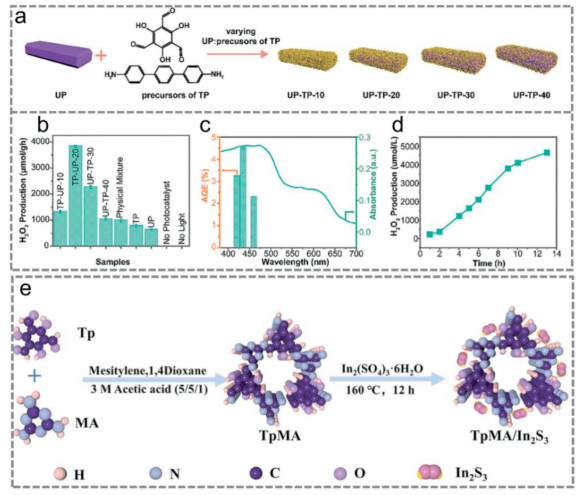
COFs offer a diverse array of functional groups like hydroxyl, amino, and aldehyde for construction the heterojunction photocatalysts [161–163]. These groups, when combined with another semiconductor, can form stable heterojunctions photocatalysts that effectively separation electrons and holes. Huang's research group reported a heterostructure composed by covalent bonded COFs and perylene diimide polymers for photocatalytic overall H2O2 production from water and oxygen under visible light irradiation (Fig. 21a) [164]. Detail experimental and theoretical calculations analysis has revealed formation an interfacial electric field (IEF) between COFs and perylene diimide polymers, which creates an internal driving force to improve the separation rate of photo-excited electron and hole. Moreover, mechanistic studies suggest that the H2O2 generation accompany a simultaneous 2e− ORR and 4e− OER process. The photocatalytic overall H2O2 generation of the heterostructure has been tested in an O2-saturated seawater. The H2O2 production is only 782, 641, and 996 µmol g−1 h−1 for single COFs and perylene diimide polymers, respectively. After formation the heterojunctions between COFs and perylene diimide polymers, the overall H2O2 production rate sharply raised to 3846 µmol g−1 h−1 with the suitable composition (Fig. 21b), suggesting the enhancement in photocatalytic overall H2O2 production rate owing to creation of IET. The AQE of heterostructure was tested and determined to be 3.24%, 4.52%, and 2.29% at the wavelength of 420, 435, and 460 nm have in seawater, respectively (Fig. 21c). The SCC efficiency of heterostructure was measured to be 0.24%, which is larger than the typical photosynthetic efficiency of plants. The heterostructure showed excellent photocatalytic stability with no obvious performance decay when it was continuously irradiated (Fig. 21d). This study provides a universal approach for rational design heterostructure to enhance the electron-hole separation rate and activity of catalytic centers simultaneously. Functional groups provided by COF can also form stable heterojunctions when combined with an inorganic semiconductor. Bi's group reported construction of heterojunctions by combing indium sulfide (In2S3) and COFs, namely TpMA, for photocatalytic overall H2O2 production (Fig. 21e) [104]. TpMA/In2S3 heterojunctions with different In2S3 loading amount were prepared via a hydrothermal method. The optical characteristics of samples were investigated in detailed by UV–vis DRS, electrochemical impedance spectroscopy (EIS) and photocurrent. The In2S3 showed decreased band gap of 1.97 V compared with TpMA (2.36 V). Therefore, the optical absorption properties of TpMA/In2S3 heterojunctions were accompanied by a red-shift in the absorption edge. This result suggests that the heterojunction could extend light absorption range. EIS and photocurrent results confirmed the heterojunctions strategy could apparently enhance the generation, separation and transportation of light-excited carriers. The single TpMA and In2S3 showed poorly activity, generating about 237.14 and 31.76 µmol/L H2O2, respectively. It is obvious that the heterojunction samples presented apparently higher activity than single samples. TpMA and heterojunctions showed decreased activity in dark or within an Argon atmosphere suggesting that O2 is an important component in the photocatalytic overall H2O2 generation.
The photocatalytic overall H2O2 generation from H2O and O2 under sunlight irradiation is a promising way to alleviate energy crisis and environmental pollution. This review systemically summarizes recent advances in photocatalytic overall H2O2 production using metal-free photocatalysts, including g-C3N4, COFs and CTFs. Additionally, we discuss the primary research strategies for enhancing overall H2O2 generation. Despite recent progress, the photocatalytic overall H2O2 generation performance remains low, with the highest reported SCC efficiency reaching only 1.41%. The low photocatalytic activity can be attributed to the inherent drawbacks of metal-free photocatalysts, particularly their limited charge separation and transfer efficiency, insufficient thermodynamic driving force for water oxidation, and restricted visible-light absorption. To improve the efficiency of metal-free photocatalysts for overall H2O2 generation, the following key aspects should be addressed:
(1) Photoexcited charge separation and transfer serve as a crucial link between light absorption and surface redox reactions, significantly affecting SCC efficiency. Photogenerated charge carriers, including electrons and holes, must efficiently migrate to the photocatalyst surface to drive the WOR and ORR for H2O2 production. Metal-free photocatalysts typically generate Frenkel exciton with strong binding energies under light illumination, making charge separation relatively difficult. Therefore, reducing exciton binding energy is a promising strategy for improving carrier separation. Various approaches, including doping, heterojunction engineering, and the introduction of functional groups, have been explored to lower exciton binding energy in metal-free photocatalysts. Although these strategies have led to some reductions in exciton binding energy, the improvements remain insufficient for achieving significantly higher SCC efficiency. Therefore, further efforts should focus on developing new molecular structures to better regulate exciton binding energy. Efficient charge transfer is equally important for improving overall H2O2 generation. Current strategies aimed at enhancing the transfer rate of charge transfer strategies, such as reducing migration distance and doped, still fail to satisfy the practical application. Compared to inorganic semiconductors, organic photocatalyst generally contain substantial defects that promote charge recombination and hinder carrier mobility. To fundamentally improve charge transport efficiency, it is essential to minimize intrinsic defects in metal-free photocatalysts. In this regard, the development of innovative synthesis strategies to reduce defect density is urgently needed to enhance the overall performance of photocatalytic H2O2 generation.
(2) Novel strategies should be developed to extend the light response range of metal-free photocatalysts. Light absorption is the first step in photocatalytic reactions, and is a prerequisite for achieving subsequent reactions of photocatalytic overall H2O2. To extend the light absorption range, only a few methods have been developed, such as doped and heterojunctions. However, these strategies remain ineffective in significantly improve light absorption. For metal-free materials, enhancing crystallinity and conjugation can generally enhance improve light absorption and charge transport within the skeleton, which is beneficial for increasing the efficiency of SCC conversion process. Additionally, other strategies, such as introducing electron donor groups and photosensitizer into metal-free photocatalysts, should also be explored. The effectiveness of these approaches in enhancing light absorption has already been demonstrated in previous studies.
(3) Compared to ORR progress, the WOR reaction requires a higher redox potential to overcome thermodynamics barrier. Therefore, the design and development of new metal-free photocatalysts with sufficient thermodynamic driving force is crucial for achieving efficient overall H2O2 production. Various strategies have been reported for regulating the WOR thermodynamic driving force in metal-free photocatalysts, including single-atom doped, introducing acetylene and leveraging topological effects. Among them, most methods primarily focus on direct 2e− WOR, which is thermodynamically more favorable than 1 e− WOR. However, the 1e− WOR exhibits superior kinetics compared to the 2e− WOR due to the larger potential difference between the reaction and photo-excited holes. Additionally, on the oxidation side, the 1e− WOR can release more protons from H2O, significantly enhancing the hydrogenation rate during the 2e− ORR process. Therefore, a promising strategy for achieving highly efficient photocatalytic overall H2O2 generation is the development of new metal-free photocatalysts with an efficient 1e⁻ WOR capability. Here we could study carefully the effective strategy from electrocatalysis and thermal catalysis to improve the WOR thermodynamic driving force of photoctalysis.
(4) Machine learning (ML) is an important area of artificial intelligence that produces different models and resolves various challenging issues. The ML has been widely used in electrocatalysis to help researchers better understand the mechanism of electrocatalytic reactions. In recent years, ML techniques also develop rapidly in accelerating the synthesis and discovery of efficient photocatalysts for H2O2 generation. Training model to predict active solar photocatalysts with available knowledge could subsequently lead toward rationally synthesizable photocatalysts for overall H2O2 generation. The combination of ML and photocatalysis overall H2O2 production learning might pave the road toward open of efficient catalyst screening platform significant benefiting photocatalysis H2O2 generation community. Thus, given a basic description about photocatalysis overall H2O2 production, such as light harvesting, photoexcited separation and transfer, redox reaction, and training them to discovery of efficient photocatalysts is a future crucial research paradigm.
(5) The poor stability of metal-free photocatalysts should be carefully addressed. To improve the stability of metal-free photocatalysts, the robust chemical bond should be considered, such as polyimide and polyetherether. And the improvement the crystallinity of metal-free photocatalysts is an also effective strategy to enhance the stability. Another feasible method is protection mechanisms, such as coating protective layer at the surface of metal-free photocatalysts.
In summary, significant challenges remain, and substantial efforts are needed to overcome the low SCC efficiency in overall H2O2 generation. Nevertheless, metal-free photocatalysts remain promising materials for efficient, green and sustainable overall H2O2 generation due to their unique physical chemistry characteristics. In recent years, remarkable progress has been made, with metal-free photocatalysts achieving an SCC of up to 1.41% for overall H2O2 production. It is therefore highly possible that the utilization of metal-free photocatalysts for overall H2O2 generation could help bridge the gap toward achieving industrial application.
The authors declare that they have no known competing financial interests or personal relationships that could have appeared to influence the work reported in this paper.
Congxu Wang: Writing – original draft. Xuan Xie: Writing – original draft. Feng Qiu: Supervision. Lei Zhu: Writing – original draft. Imran Shakir: Writing – review & editing. Yuxi Xu: Supervision, Project administration.
This work was supported by the National Natural Science Foundation of China (No. 22409038, 52473221), Zhejiang Province Postdoctoral Science Foundation (No. ZJ2024021), Hubei Provincial Natural Science Foundation of China (Nos. 2024DJC032, 2025AFB889), Key Project of Science and Technology Research of Hubei Provincial Department of Education (Nos. D20232701, D20232702). I. Shakir acknowledges the research grant funded by the Research, Development, and Innovation Authority (RDIA) - Kingdom of Saudi Arabia (No. 12615-iu-2023-IU-R-2-1-EI-).
Y.X. Fang, Y.D. Hou, X.Z. Fu, X.C. Wang, Chem. Rev. 122 (2022) 4204–4256. doi: 10.1021/acs.chemrev.1c00686
J. Quílez-Bermejo, S. García-Dalí, A. Daouli, et al., Adv. Funct. Mater. 33 (2023) 2300405. doi: 10.1002/adfm.202300405
M.Z. Rahman, M.G. Kibria, C.B. Mullins, Chem. Soc. Rev. 49 (2020) 1887–1931. doi: 10.1039/c9cs00313d
P.Y. Du, L. Yuan, T. Bao, et al., Chin. Chem. Lett. 36 (2025) 110472. doi: 10.1016/j.cclet.2024.110472
M.Y. Qi, M. Conte, M. Anpo, Z.R. Tang, Y.J. Xu, Chem. Rev. 121 (2021) 13051–13085. doi: 10.1021/acs.chemrev.1c00197
Z.S. Huang, Y.F. Wang, M.Y. Qi, et al., Angew. Chem. Int. Ed. 63 (2024) e202412707. doi: 10.1002/anie.202412707
L.X. Zhang, Z.R. Tang, M.Y. Qi, Y.J. Xu, J. Mater. Chem. A 12 (2024) 19029–19038. doi: 10.1039/d4ta01996b
H.J. Song, L.Y. Luo, S.Y. Wang, G. Zhang, B.J. Jiang, Chin. Chem. Lett. 35 (2024) 109347. doi: 10.1016/j.cclet.2023.109347
X.H. Xu, Y. Sui, W.T. Chen, et al., Appl. Catal. B: Environ. 34 (2024) 123271.
J.M. Li, N. Xu, Y.F. Zhang, H.J. Dong, C.M. Li, Chin. Chem. Lett. 36 (2025) 110470. doi: 10.1016/j.cclet.2024.110470
L.Y. Qin, C.D. Ma, J. Zhang, T.H. Zhou, Adv. Funct. Mater. 34 (2024) 2401562. doi: 10.1002/adfm.202401562
J.Y. Wang, J.J. Wang, S.J. Zuo, et al., Chin. Chem. Lett. 34 (2023) 108157. doi: 10.1016/j.cclet.2023.108157
J. Cheng, Y.T. Wu, W. Zhang, et al., Adv. Mater. 37 (2024) 2410247.
A. Alam, B. Kumbhakar, A. Chakraborty, et al., ACS Mater. Lett. 6 (2024) 2007–2049. doi: 10.1021/acsmaterialslett.4c00418
Y.N. Zhang, C.S. Pan, G.M. Bian, et al., Nat. Energy 8 (2023) 361–371. doi: 10.1038/s41560-023-01218-7
Y. Luo, B.P. Zhang, C.C. Liu, et al., Angew. Chem. Int. Ed. 62 (2023) e202305355. doi: 10.1002/anie.202305355
J.N. Lu, J.J. Liu, L.Z. Dong, et al., Angew. Chem. Int. Ed. 62 (2023) e202308505. doi: 10.1002/anie.202308505
H.Z. Wang, C. Yang, F.S. Chen, G.F. Zheng, Q. Han, Angew. Chem. Int. Ed. 61 (2022) e202202328. doi: 10.1002/anie.202202328
M.P. Kou, Y.Y. Wang, Y.X. Xu, et al., Angew. Chem. Int. Ed. 61 (2022) e202200413. doi: 10.1002/anie.202200413
Y. Ding, S. Maitra, S. Halder, et al., Matter. 5 (2022) 2119–2167. doi: 10.1016/j.matt.2022.05.011
Z.Y. Teng, Q.T. Zhang, H.B. Yang, et al., Nat. Catal. 4 (2021) 374–384. doi: 10.1038/s41929-021-00605-1
H. Cheng, H.F. Lye, J. Cheng, et al., Adv. Mater. 34 (2021) e2107480.
X.L. Chen, Y. Kondo, S.J. Li, et al., J. Mater. Chem. A 9 (2021) 26371–26380. doi: 10.1039/d1ta08036a
L. Chen, C. Chen, Z. Yang, et al., Adv. Funct. Mater. 20 (2021) 2105731.
H. Che, X. Gao, J. Chen, et al., Angew. Chem. Int. Ed. 60 (2021) 25546–25550. doi: 10.1002/anie.202111769
S. Wu, H.T. Yu, S. Chen, X. Quan, ACS Catal. 10 (2020) 14380–14389. doi: 10.1021/acscatal.0c03359
J.X. Wang, J.C. Li, Z.N. Li, et al., Nano Res. 17 (2024) 5956–5964. doi: 10.1007/s12274-024-6623-4
S. Kou, S. Lian, X.D. Xie, et al., Nano Res. 17 (2024) 8036–8044. doi: 10.1007/s12274-024-6837-5
T. Liu, Z.H. Pan, J.J.M. Vequizo, et al., Nat. Commun. 13 (2022) 1034. doi: 10.1038/s41467-022-28686-x
L. Chen, L. Wang, Y.Y. Wan, et al., Adv. Mater. 32 (2019) 1904433.
H.P. Peng, H.C. Yang, J.J. Han, et al., J. Am. Chem. Soc. 145 (2023) 27757–27766. doi: 10.1021/jacs.3c10390
C. Liu, T. Bao, L. Yuan, et al., Yu, Adv. Funct. Mater. 32 (2021) 2111404.
R.M. Zhu, Y. Liu, W.K. Han, et al., Angew. Chem. Int. Ed. 64 (2025) e202412890. doi: 10.1002/anie.202412890
M.Q. Zhang, R.C. Liu, F.L. Zhang, et al., Colloid. Interface. Sci. 678 (2025) 1170–1180. doi: 10.1016/j.jcis.2024.09.189
J. Zhou, J.Y. Chen, N. Li, et al., Small. 21 (2024) e2409006.
C.S. Zhou, L. Tao, J. Gao, et al., J. Environ. Chem. Eng. 12 (2024) 113370. doi: 10.1016/j.jece.2024.113370
L. Zhang, C.X. Wang, Q.K. Jiang, P.B. Lyu, Y.X. Xu, J. Am. Chem. Soc. 146 (2024) 29943–29954. doi: 10.1021/jacs.4c12339
S.D. Wang, Z.P. Xie, D. Zhu, Nat. Commun. 14 (2023) 6891. doi: 10.1038/s41467-023-42720-6
W. Zhao, L. Luo, M.Y. Cong, et al., Nat. Commun. 15 (2024) 6482. doi: 10.1038/s41467-024-50839-3
Y.X. Liu, L. Li, Z.Y. Sang, et al., Nat. Synth. 4 (2024) 134–141. doi: 10.1038/s44160-024-00644-z
R.Y. Liu, Y.Z. Chen, H.D. Yu, et al., Nat. Catal. 7 (2024) 195–206. doi: 10.1038/s41929-023-01102-3
Y.Z. Chen, R.Y. Liu, Y.Y. Guo, et al., Nat. Synth. 3 (2024) 998–1010. doi: 10.1038/s44160-024-00542-4
F.Y. Liu, P. Zhou, Y.H. Hou, et al. Nat. Commun. 14 (2023) 4344. doi: 10.1038/s41467-023-40007-4
T.W. He, H.C. Tang, J. Wu, et al., Nat. Commun. 15 (2024) 7833. doi: 10.1038/s41467-024-52162-3
Y.B. Zhao, P. Zhang, Z.C. Yang, Nat. Commun. 12 (2021) 3701. doi: 10.1038/s41467-021-24048-1
W.J. Fan, B.Q. Zhang, X.Y. Wang, et al., Energy Environ. Sci. 13 (2020) 238–245. doi: 10.1039/c9ee02247c
C.H. Chu, Q.H. Zhu, Z.H. Pan, et al., Proc. Natl. Acad. Sci. U. S. A. 117 (2020) 6376–6382. doi: 10.1073/pnas.1913403117
P. Ren, T. Zhang, N. Jain, et al., J. Am. Chem. Soc. 145 (2023) 16584–16596. doi: 10.1021/jacs.3c03785
Y. Shiraishi, M. Matsumoto, S. Ichikawa, S. Tanaka, T. Hirai, J. Am. Chem. Soc. 143 (2021) 12590–12599. doi: 10.1021/jacs.1c04622
L.J. Liu, M.Y. Gao, H.F. Yang, et al., J. Am. Chem. Soc. 143 (2021) 19287–19293. doi: 10.1021/jacs.1c09979
S. Zhao, X. Zhao, H. Zhang, J. Li, Y.F. Zhu, Nano Energy 35 (2017) 405–414. doi: 10.1016/j.nanoen.2017.04.017
T. Yang, D. Zhang, A.G. Kong, et al., Angew. Chem. Int. Ed. 136 (2024) e202404077. doi: 10.1002/anie.202404077
Z.F. Li, Z.M. Dong, Z.B. Zhang, et al., Angew. Chem. Int. Ed. 64 (2025) e202420218. doi: 10.1002/anie.202420218
D.M. Tan, R. Zhuang, R.C. Chen, et al., Adv. Funct. Mater. 34 (2023) 2311655.
Y. Yang, Q.Y. Guo, Q.W. Li, et al., Adv. Funct. Mater. 34 (2024) 2400612. doi: 10.1002/adfm.202400612
X. Zhang, P.J. Ma, C. Wang, et al., Energy Environ. Sci. 15 (2022) 830–842. doi: 10.1039/d1ee02369a
S.F. Feng, H. Cheng, F. Chen, et al., ACS Catal. 14 (2024) 7736–7745. doi: 10.1021/acscatal.4c01411
Q. He, B. Viengkeo, X. Zhao, et al., Nano Res. 16 (2021) 1–7.
S. Hu, Sustain. Energ. Fules 3 (2019) 101–114. doi: 10.1039/c8se00329g
Q.Q. Zhang, X. Chen, Z.S. Yang, et al., ACS Appl. Mater. Interfaces 14 (2022) 3970–3979. doi: 10.1021/acsami.1c19638
C.X. Wang, P.B. Lyu, Z. Chen, Y. Xu, J. Am. Chem. Soc. 145 (2023) 12745–12754. doi: 10.1021/jacs.3c02874
T. Sun, S. Li, L. Zhang, Y. Xu, Angew. Chem. Int. Ed. 62 (2023) e202301865. doi: 10.1002/anie.202301865
T. Sun, Y. Liang, Y. Xu, Angew. Chem. Int. Ed. 61 (2022) e202113926. doi: 10.1002/anie.202113926
J.Q. Li, W. Lyu, X.J. Mi, et al., Adv. Sci. 11 (2024) 2401966. doi: 10.1002/advs.202401966
X.J. Mi, J.Q. Li, W. Lyu, et al., Appl. Catal. B: Environ. 378 (2025) 125530. doi: 10.1016/j.apcatb.2025.125530
Q.R. Zeng, Z.H. Cheng, C. Yang, et al., Chin. J. Poly. Sci. 39 (2021) 1004–1012. doi: 10.1007/s10118-021-2574-3
W.S. He, J. Duan, H. Liu, et al., Prog. Polym. Sci. 148 (2024) 101770. doi: 10.1016/j.progpolymsci.2023.101770
W.W. Zhang, L.J. Chen, S. Dai, Nature 604 (2022) 72–79. doi: 10.1038/s41586-022-04443-4
M.D. Wang, P.H. Zhang, X. Liang, Nat. Sustain. 5 (2022) 518–526. doi: 10.1038/s41893-022-00870-3
Y.Z. Liu, Y.H. Ma, Y.B. Zhao, Science 351 (2016) 365–369. doi: 10.1126/science.aad4011
D.M. Zhao, Y.Q. Wang, C.L. Dong, Nat. Energy 6 (2021) 388–397. doi: 10.1038/s41560-021-00795-9
C.S. Diercks, O.M. Yaghi, Science 355 (2017) eaal1585. doi: 10.1126/science.aal1585
Y.W. Zeng, P. Gordiichuk, T. Ichihara, Nature 602 (2022) 91–95. doi: 10.1038/s41586-021-04296-3
X.D. Zhang, D.D. Gao, B.C. Zhu, et al., Nat. Commun. 15 (2024) 3212. doi: 10.1097/js9.0000000000001287
J.R. Wang, K.P. Song, T.X. Luan, et al., Nat. Commun. 15 (2024) 1267. doi: 10.1108/heswbl-08-2023-0216
S.S. Chen, T. Takata, K. Domen, Nat. Rev. Mater. 2 (2017) 1–17.
Z. Wang, C. Li, K. Domen, Chem. Soc. Rev. 48 (2019) 2109–2125. doi: 10.1039/C8CS00542G
L. Wang, X.S. Zhang, L. Chen, Y.J. Xiong, H.X. Xu, Angew. Chem. Int. Ed. 57 (2018) 3454–3458. doi: 10.1002/anie.201710557
Q. Zhang, K.Y. Gu, C.R. Dong, et al., Angew. Chem. Int. Ed. 64 (2024) e202417591.
J. Ma, C. Peng, X.X. Peng, et al., J. Am. Chem. Soc. 146 (2024) 21147–21159. doi: 10.1021/jacs.4c07170
B.Y. Zhai, H.G. Li, G.Y. Gao, et al., Adv. Funct. Mater. 32 (2022) 2207375. doi: 10.1002/adfm.202207375
T. Mahvelati-Shamsabadi, H. Fattahimoghaddam, B.K. Lee, H. Ryu, J.I. Jang, Chem. Eng. J. 423 (2021) 130067. doi: 10.1016/j.cej.2021.130067
Y. Shiraishi, S. Kanazawa, Y. Kofuji, et al., Angew. Chem. Int. Ed. 53 (2014) 13454–13459. doi: 10.1002/anie.201407938
S. Samanta, R. Yadva, A. Kumar, A.K. Sinha, R. Srivastava, Appl. Catal. B: Environ. 259 (2019) 118054. doi: 10.1016/j.apcatb.2019.118054
Y.J. Zhao, Y. Liu, Z.Z. Wang, et al., Appl. Catal. B: Environ. 289 (2021) 120035. doi: 10.1016/j.apcatb.2021.120035
J.Z. Zhang, J.Y. Lang, Y. Wei, et al., Appl. Catal. B: Environ. 298 (2021) 120522. doi: 10.1016/j.apcatb.2021.120522
Y.X. Ye, C. Wen, J.H. Pan, et al., Appl. Catal. B: Environ. 285 (2021) 119726. doi: 10.1016/j.apcatb.2020.119726
C.C. Chu, W. Miao, Q.J. Li, et al., Chem. Eng. J. 428 (2022) 132531. doi: 10.1016/j.cej.2021.132531
T.S. Shan, J.S. Li, S.Y. Wu, et al., Chem. Eng. J. 478 (2023) 147509. doi: 10.1016/j.cej.2023.147509
X. Zhang, H. Su, P.X. Cui, et al., Nat. Commun. 14 (2023) 7115. doi: 10.1038/s41467-023-42887-y
H. Tan, P. Zhou, M.X. Liu, et al., Nat. Synth. 2 (2023) 557–563. doi: 10.1038/s44160-023-00272-z
Q.C. Chen, C.J. Lu, B.Y. Ping, et al., Appl. Catal. B: Environ. 324 (2023) 122216. doi: 10.1016/j.apcatb.2022.122216
J.X. Hou, K.W. Wang, X. Zhang, et al., ACS Catal. 14 (2024) 10893–10903. doi: 10.1021/acscatal.4c00334
H.W. He, Z.L. Wang, J.F. Zhang, et al., Adv. Funct. Mater. 34 (2024) 2315426. doi: 10.1002/adfm.202315426
Y. Shen, J.Q. Shi, Y.H. Wang, et al., Chem. Eng. J. 498 (2024) 155774. doi: 10.1016/j.cej.2024.155774
M. Fu, J.H. Luo, B. Shi, et al., Angew. Chem. Int. Ed. 63 (2024) e202316346. doi: 10.1002/anie.202316346
Y. Liu, W. Miao, Z. Chen, et al., Chem. Eng. J. 496 (2024) 153871. doi: 10.1016/j.cej.2024.153871
P.P. Sun, K. Zhong, X.H. Huang, et al., Appl. Catal. B: Environ. 366 (2025) 124998. doi: 10.1016/j.apcatb.2024.124998
L.F. Li, F. Ye, Q.R. Li, et al., Appl. Catal. B: Environ. 363 (2025) 124802. doi: 10.1016/j.apcatb.2024.124802
Z.H. Xue, D.Y. Luan, H.B. Zhang, X.W. Lou, Joule 6 (2022) 92–133. doi: 10.1016/j.joule.2021.12.011
B. Yu, Y. Zhao, G. Li, et al., CCS Chem. 7 (2025) 3308–3319. doi: 10.31635/ccschem.024.202404694
Z.Y. Teng, H.B. Yang, Q.T. Zhang, et al., Nat. Chem. 16 (2024) 1250–1260. doi: 10.1038/s41557-024-01553-6
Y.P. Yang, Y. Li, X.Q. Ma, et al., Catal. Sci. Technol. 13 (2023) 5599–5609. doi: 10.1039/d3cy00878a
H.Y. Chen, S.J. Gao, G.C. Huang, et al., Appl. Catal. B: Environ. 343 (2024) 123545. doi: 10.1016/j.apcatb.2023.123545
P. Bika, I. Papailias, T. Giannakopoulou, et al., Catalysts. 13 (2023)1331. doi: 10.3390/catal13101331
Z.F. Qian, Z.J. Wang, K.A.I. Zhang, Chem. Mater. 33 (2021) 1909–1926. doi: 10.1021/acs.chemmater.0c04348
H.W. He, Z.L. Wang, J.F. Zhang, et al., Adv. Funct. Mater. 34 (2024) 2315426. doi: 10.1002/adfm.202315426
C.X. Wang, H.L. Zhang, W.J. Luo, T. Sun, Y.X. Xu, Angew. Chem. Int. Ed. 60 (2021) 25381–25390. doi: 10.1002/anie.202109851
Z. Yang, H. Chen, S. Wang, et al., J. Am. Chem. Soc. 142 (2020) 6856–6860. doi: 10.1021/jacs.0c00365
P. Kuhn, M. Antonietti, A. Thomas, Angew. Chem. Int. Ed. 47 (2008) 3450–3453. doi: 10.1002/anie.200705710
S.J. Ren, M.J. Bojdys, R. Dawson, et al., Adv. Mater. 24 (2012) 2357–2361. doi: 10.1002/adma.201200751
L.Y. Li, W. Fang, P. Zhang, et al., J. Mater. Chem. A 4 (2016) 12402–12406. doi: 10.1039/C6TA04711D
Z. Cheng, W. Fang, T.S. Zhao, et al., ACS Appl. Mater. Interfaces 10 (2018) 41415–41421. doi: 10.1021/acsami.8b16013
M.Y. Liu, Q. Huang, S.L. Wang, et al., Angew. Chem. Int. Ed. 57 (2018) 11968–11972. doi: 10.1002/anie.201806664
H. Duan, P. Lyu, J. Liu, Y. Zhao, Y. Xu, ACS Nano 13 (2019) 2473–2480.
H. Wang, L.T. Shi, Z. Qu, et al., ACS Appl. Mater. Interfaces 16 (2024) 2296–2308. doi: 10.1021/acsami.3c15536
W.J. Zhang, Z.Z. Deng, J.Y. Deng, et al., J. Mater. Chem. A 10 (2022) 22419–22427. doi: 10.1039/d2ta06479k
R.X. Sun, B.E. Tan, Chem. Res. Chin. U 38 (2022) 310–324. doi: 10.1007/s40242-022-1468-4
C.B. Wu, Z.Y. Teng, C. Yang, et al., Adv. Mater. 34 (2022) e2110266. doi: 10.1002/adma.202110266
H. Zhang, W.X. Wei, K. Chi, et al., ACS Catal. 14 (2024) 17654–17663. doi: 10.1021/acscatal.4c05328
C. Zhu, Y.C. Yao, Q.L. Fang, et al., ACS Catal. 14 (2024) 2847–2858. doi: 10.1021/acscatal.3c04439
S.S. Liu, C. Zhu, J.J. Xu, et al., Appl. Catal B: Environ. 344 (2024) 123629. doi: 10.1016/j.apcatb.2023.123629
A.P. Cote, A.I. Benin, N.W. Ockwig, et al., Science (1979) 310 (2005) 1166–1170. doi: 10.1126/science.1120411
J.W. Colson, A.R. Woll, A. Mukherjee, et al., Science (1979) 332 (2011) 228–231. doi: 10.1126/science.1202747
S. Lin, C.S. Diercks, Y.B. Zhang, et al., Science (1979) 349 (2015) 1208–1213. doi: 10.1126/science.aac8343
X.Y. Guan, H. Li, Y.C. Ma, et al., Nat. Chem. 11 (2019) 587–594. doi: 10.1038/s41557-019-0238-5
S. Bi, F.C. Meng, D.Q. Wu, F. Zhang, J. Am. Chem. Soc. 144 (2022) 3653–3659. doi: 10.1021/jacs.1c12902
Z.X. Zhang, S. Bi, F.C. Meng, et al., J. Am. Chem. Soc. 145 (2023) 16704–16710. doi: 10.1021/jacs.3c04410
X. Chi, Z.X. Zhang, M.Q. Li, et al., Angew. Chem. Int. Ed. 64 (2025) e202418895. doi: 10.1002/anie.202418895
J. Zhang, X. Fei, Z.G. Wang, Angew. Chem. Int. Ed. 64 (2025) e202425617. doi: 10.1002/anie.202425617
M.H. Liu, Y.C. Xu, Y.X. Liu, et al., Angew. Chem. Int. Ed. (2025) e202505491. doi: 10.1002/anie.202505491
Y.H. Hou, F.Y. Liu, J.L. Liang, et al., Angew. Chem. Int. Ed. 64 (2025) e202505621. doi: 10.1002/anie.202505621
K. Yu, L. Gong, Z. Huang, Z. Yu, F. Luo, CCS Chem. 7 (2025) 2731–2741. doi: 10.31635/ccschem.024.202405109
L.J. Li, L.P. Xu, Z.F. Hu, J.C. Yu, Adv. Funct. Mater. 31 (2021) 2106120. doi: 10.1002/adfm.202106120
L.C. Guo, Z.C. Huang, L.L. Gong, F. Luo, CCS Chem. 7 (2025) 3146–3159. doi: 10.31635/ccschem.024.202405043
H. Chen, H. Zhang, K. Chi, Y. Zhao, Nano Res. 17 (2024) 9498–9506. doi: 10.1007/s12274-024-6897-6
J.N. Chang, Q. Li, J.W. Shi, et al., Angew. Chem. Int. Ed. 135 (2023) e202218868. doi: 10.1002/anie.202218868
J.Y. Yue, L.P. Song, Y.F. Fan, et al., Angew. Chem. Int. Ed. 62 (2023) e202309624. doi: 10.1002/anie.202309624
D. Chen, W.B. Chen, Y.T. Wu, et al. Angew. Chem. Int. Ed. 135 (2023) e202217479. doi: 10.1002/anie.202217479
Q.B. Liao, Q.N. Sun, H.C. Xu, et al., Angew. Chem. Int. Ed. 62 (2023) e202310556. doi: 10.1002/anie.202310556
J.M. Sun, H.S. Jena, C. Krihnaraj, et al., Angew. Chem. Int. Ed. 62 (2023) e202216719. doi: 10.1002/anie.202216719
C. Qin, X. Wu, L. Tang, et al., Nat. Commun. 14 (2023) 5238. doi: 10.1038/s41467-023-40991-7
Y. Mou, X. Wu, C. Qin, et al., Angew. Chem. Int. Ed. 62 (2023) e202309480. doi: 10.1002/anie.202309480
J.Y. Yue, L.P. Song, Z.X. Pan, et al., ACS Catal. 14 (2024) 4728–4737. doi: 10.1021/acscatal.4c00278
J.Y. Yue, J.X. Luo, Z.X. Pan, et al., Angew. Chem. Int. 136 (2024) e202405763. doi: 10.1002/anie.202405763
T. Xu, Z.Q. Wang, W.W. Zhang, et al., J. Am. Chem. Soc. 146 (2024) 20107–20115. doi: 10.1021/jacs.4c04244
S. Yang, Z. Gao, Z.Y. Hu, et al., Macromolecules. 57 (2024) 2039–2047. doi: 10.1021/acs.macromol.3c01634
X.Y. Wang, L.J. Chen, S.Y. Chong, Nat. Chem. 10 (2018) 1180–1189. doi: 10.1038/s41557-018-0141-5
R.F. Chen, Y. Wang, Y. Ma, et al., Nat. Commun. 12 (2021) 1354. doi: 10.1038/s41467-021-21527-3
C.Z. Li, J.L. Liu, H. Li, et al., Nat. Commun. 13 (2022) 2357. doi: 10.1038/s41467-022-30035-x
Y. Hou, P. Zhou, F. Liu, et al., Angew. Chem. Int. Ed. 63 (2024) e202318562. doi: 10.1002/anie.202318562
H. Yu, F.T. Zhang, Q. Chen, et al., Angew. Chem. Int. Ed. 63 (2024) e202402297. doi: 10.1002/anie.202402297
X.C. Zhang, S.L. Cheng, C. Chen, et al., Nat. Commun. 15 (2024) 2649. doi: 10.3390/ma17112649
P.P. Sun, K. Zhong, X.H. Huang, et al., Appl. Catal B: Environ. 366 (2025) 124998. doi: 10.1016/j.apcatb.2024.124998
S.W. Guan, Z.H. Hou, J. Tan, et al., Appl. Catal B: Environ. 334 (2023) 122826. doi: 10.1016/j.apcatb.2023.122826
Y.M. Wang, H. Zhao, P.K. Li, et al., Chem. Eng. J. 491 (2024) 151825. doi: 10.1016/j.cej.2024.151825
M.J. Deng, L.Y. Wang, Z.L. Wen, et al., Green. Chem. 26 (2024) 3239–3248. doi: 10.1039/d3gc04045c
R.C. Chen, C.M. Wu, L.H. Chung, et al., Chem. Mater. 36 (2024) 9928–9938. doi: 10.1021/acs.chemmater.4c02147
C. Shu, X.J. Yang, L.J. Liu, et al., Angew. Chem. Int. Ed. 63 (2024) e202403926. doi: 10.1002/anie.202403926
E.B. Zhou, F.T. Wang, X. Zhang, Y.D. Hui, Y.B. Wang, Angew. Chem. Int. Ed. 63 (2024) e202400999. doi: 10.1002/anie.202400999
Z.P. Li, T.Q. Deng, S. Ma, et al., J. Am. Chem. Soc. 15 (2023) 8364–8374. doi: 10.1021/jacs.2c11893
Z. Shan, M.M. Wu, D. Y et al., J. Am. Chem. Soc. 144 (2022) 5728–5733. doi: 10.1021/jacs.2c01037
L.X. Li, Q.B. Yun, C.Z. Zhu, et al., J. Am. Chem. Soc. 144 (2022) 6475–6482. doi: 10.1021/jacs.2c01199
X.Y. Shi, Y. You, L. Huang, et al., Adv. Funct. Mater. 2024 (2023) 202414755.

Figure 1 Development of representative metal-free-based photocatalysts for photocatalytic overall H2O2 production.

Figure 2 Schematic of the processes involved in (a) photocatalytic overall H2O2 generation and (b) corresponding redox potentials.

Figure 3 (a) Synthesis process for g-C3N4/PDIx. (b) Electronic band structures of g-C3N4 and g-C3N4/PDIx. Copied with permission [83]. Copyright 2014, Wiley-VCH Verlag GmbH & Co. KGaA, Weinheim.


Figure 5 (a) Schematic diagram showing the intermediates in the multielectron-transfer processes of WOR. (b) Excited properties of group 11 elements at different chemical states. (c) Average AQY of AuKPCN for photocatalytic H2O2 with different sacrificial agent. (d) ESR spectra of AuKPCN recorded in 0.1 mol/L AgNO3 solution. (e) Generation amount of ·OH and H2O2 in SA with saturated O2. Copied with permission [102]. Copyright 2024, Springer Nature.

Figure 6 (a) Schematic diagram of the synthesis K+/I−-CN/CdSe-D. Copied with permission [94]. Copyright 2024, Wiley-VCH GmbH. (b) The H2O2 yield of HR-CN, HD-CN and homo-CN. (c) H2O2 yield of obtained samples under different conditions. (d) EPR signal of DMPO •O2- of homo-CN. (e) Steady-state photoluminescence spectra and (f) fluorescence lifetime decay curves. (g) UV–vis DRS and energy band gap plots. Copied with permission [92]. Copyright 2023, Elsevier.


Figure 9 (a) Scheme of the synthesis of samples from their precursors. (b) Typical time course of H2O2 production using different samples. (c) The SCC efficiencies measured under simulated AM1.5 G. Calculated free energy different active sites: (d) Triazine structure in all CTFs, (e) benzene group in all CTFs. Copied with permission [30]. Copyright 2019, Wiley-VCH GmbH. (f) Rational synthesis of samples with different charge separation and transfer ability. Copied with permission [119]. Copyright 2022, Wiley-VCH GmbH.

Figure 10 Schematic diagram for synthesizing of (a) CTF-BP and (b) CTF-FL. (c) Comparison of the SCC efficiency for CTF-NSs with the reported representative metal-free photocatalysts; (d) Time-resolved PL spectra of CTF-BP (pink) and CTF-FL (blue); Gibbs free energy diagrams of (e) ORR and (f) WOR steps on CTF-BP and CTF-FL. Copied with permission [37]. Copyright 2024, American Chemical Society.

Figure 11 (a) Natural photosynthesis charge separation processes. (b) Schematic illustration of the stepwise charge transfer within the CTFs. Copied with permission [120]. Copyright 2024, American Chemical Society. (c) Scheme of the synthetic route of CQD-CTFs. Copied with permission [55]. Copyright 2024, Wiley-VCH GmbH.


Figure 15 (a) Structure model of TPB-DMTP-COF. (b) Visible light-driven H2O2 production in pure water. (c) Photocatalysis stability testing of TPB-DMTP-COF. Copied with permission [134]. Copyright 2021, Wiley-VCH GmbH.

Figure 16 Chemical structure of COF-0CN (a), COF-1CN (b) and COF-2CN (c). (d) Time-dependent H2O2 photogeneration using visible light for fabricated samples. (e) The AQY of COF-2CN at selected wavelength. (f) Long-term testing of COF-2CN for H2O2 photosynthesis. (g) Photocatalytic H2O2 production by COF-2CN in ultrapure water, tap water, river water, lake water and sea water under visible-light irradiation. Calculated energy profile for oxidation of water into H2O2 (h) and reduction of oxygen into H2O2 (i) on three COFs at U = 0 V vs. SHE at pH 7. Copied with permission [151]. Copyright 2024, Wiley-VCH GmbH.

Figure 17 (a) Synthetic routes used to prepare samples. (b) Photocatalytic performance curves over obtained samples. (c) Free energy diagram of ORR pathways for PDA-COF (orange) and DVA-COF (blue). Copied with permission [30]. Copyright 2024, Wiley-VCH GmbH.

Figure 18 (a) a Schematic of Kf-AQ condensation. Reprinted with permission [153]. Copyright 2024, Springer Nature. (b) The synthetic route of cyanide-functionalized D-A-π-D ECUT-COF-50 and D-A-π-A ECUT-COF-51. Reprinted with permission [154]. Copyright 2025, Elsevier. (c) Chemical structure of TDB-COF. Reprinted with permission [155]. Copyright 2023, Elsevier.

Figure 19 Synthetic routes (a) of TZ-COF, OZ-COF and IZ-COF. (b) D-π-A model and differences of COFs (the inset is the local charge distribution). Copied with permission [143]. Copyright 2023, Wiley-VCH GmbH. (c)The synthetic routes and chemical structures of the different samples. Copied with permission [159]. Copyright 2024, Wiley-VCH GmbH.

Figure 20 The schematic illustration of the octupolar structure in different samples. Copied with permission [43]. Copyright 2023, Springer Nature. (b) Synthesis of TpaBtt, TapbBtt and TaptBtt. Copied with permission [137]. Copyright 2024, Springer Nature. (c) Synthetic routes of TBTN—COF and TMT-COF. Copied with permission [140]. Copyright 2024, Wiley-VCH GmbH.

Figure 21 (a) Schematic illustration the synthesis process of the UP-TP. (b) Photocatalytic overall H2O2 generation of various photocatalysts. (c) Wavelength-dependent AQE of H2O2 generation over UP-TP and the corresponding DRS spectrum. (d) Continuous H2O2 production over long-time testing. Copied with permission [164]. Copyright 2024, Wiley-VCH GmbH. (e) Schematic illustration of the synthesis process for TpMA/In2S3. Copied with permission [104]. Copyright 2024, Elsevier.
Table 1. Summary of the reported g-C3N4 based photocatalysts for photocatalytic overall H2O2 production.
| Photocatalyst | SCC (%) | AQY (%) | Ref. |
| g-C3N4/PDI | – | – | [83] |
| g-CN-MI-40 | – | – | [84] |
| Ni-CAT-CN60 | 0.1 | 0.96@420 nm | [85] |
| ORP/GCN | – | – | [86] |
| AQ/U-POCN | – | – | [87] |
| SCN5 | – | – | [88] |
| CN/CML | – | – | [89] |
| NiSAPs-PuCN | 0.82 | 10.9@420 nm | [90] |
| CNIO-GaSA | 0.4 | 9.1@459 nm | [91] |
| homo-CN | 0.19 | 25.7@420 nm | [92] |
| CoOx-NvCN | 0.47 | 5.73@420 nm | [93] |
| 40%K+/I−-CN/CdSe-D | – | – | [94] |
| TA-CN-3 | 0.34 | 1.7@420 nm | [95] |
| MOC-AuNP/g-C3N4 | – | – | [96] |
| CN-DMAP-GLU | – | 0.792@420 nm | [97] |
| pH-MCN | – | – | [98] |
| HCP-24 | – | 2.38@420 nm | [99] |
 下载: 导出CSV
Table 2. Some examples of photocatalytic H2O2 generation by COFs.
| Photocatalyst | SCC (%) | AQY (%) | Ref. |
| TPB-DMTP | 0.76 | 18.4@420 nm | [134] |
| TF50-COF | 0.17 | 5.1@400 nm | [18] |
| COF-TfBpy | 1.08 | 13.6@420 nm | [19] |
| TTF-BT-COF | 0.49 | 11.9@420 nm | [137] |
| TD-COF | 0.15 | – | [138] |
| HEP-TAPT | 0.65 | 15.35@420 nm | [139] |
| COF-N32 | 0.31 | 6.2@459 nm | [43] |
| TpDz | 0.62 | 11.9@420 nm | [140] |
| Py-Da-COF | 0.09 | 4.5@420 nm | [141] |
| TaptBtt | 0.296 | – | [142] |
| TZ-COF | 0.036 | 0.6@475 nm | [143] |
| Kf-AQ | 0.7 | 15.8@400 nm | [131] |
| TB-COF | 1.08 | – | [144] |
| TPB-COF-OH | 0.84 | 9.61@420 nm | [57] |
| DVA-COF | 0.08 | 2.84@420 nm | [130] |
| COF-2CN | 0.6 | 6.8@459 nm | [129] |
| TBD-COF | 1.04 | – | [145] |
| QH—HPTP-COF | 1.41 | – | [13] |
| TAH—COF | 0.66 | 7.72@420 nm | [146] |
| DHAA | 0.23 | 4.6@380 nm | [147] |
下载: 导出CSV

 扫一扫看文章


扫一扫关注我们


 下载:
下载: