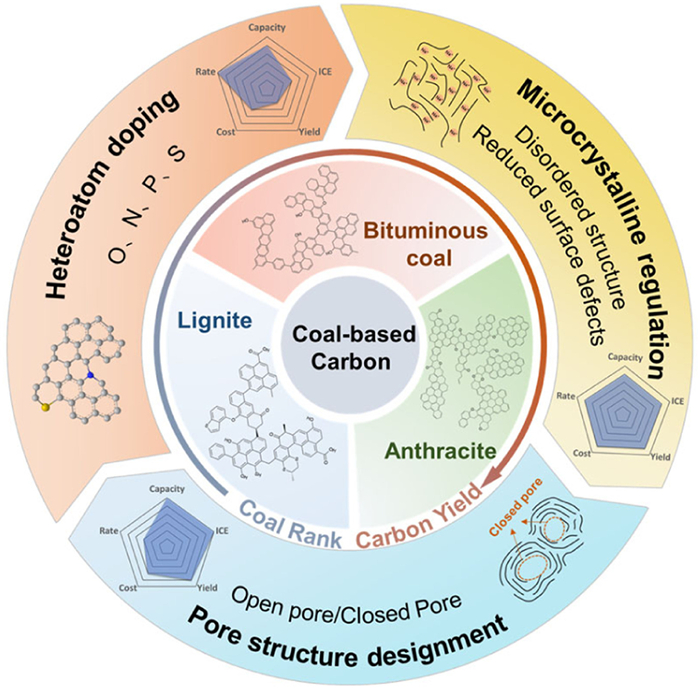
Figure 1.
Schematic diagram of various coal-based carbon materials, including the structure characteristics and electrochemical Na-storage properties.

Recent progress of advanced coal-based carbon anode for sodium-ion batteries
Hongxiang Yin , He Chen , Ning Sun , Xuyang Jian , Anwen Chen , Ben Guo , Lei Ji , Zhen Yang , Yang Liu , Bin Xu


The rapid consumption of fossil fuels has increased interests in the development of clean and renewable energy sources, such as wind and solar energy, highlighting the demand for sustainable and affordable electrochemical energy storage technologies. Since their commercialization in 1991, rechargeable lithium-ion batteries (LIBs) have been the primary energy storage technology for portable electronic devices and electric vehicles [1]. However, the limited availability and inconsistent distribution of lithium (Li) minerals on Earth have constrained the further application of LIBs. As a result, sodium-ion batteries (SIBs) are emerging as promising alternatives due to the abundant supply of sodium, lower costs, and competitive electrochemical performance [2,3]. Sodium, belonging to the same group of elements as lithium, has a less negative standard reduction potential than lithium (−2.7 V vs. −3.04 V). This characteristic reduces the likelihood of electrolyte decomposition, indicating improved safety. Additionally, inexpensive aluminum foil can be utilized as a current collector instead of copper foil, highlighting the low-cost advantage of SIBs [4–6].
As one of the most promising anode materials for SIBs, hard carbon (HC) exhibits enhanced interlayer spacing, and an amorphous microcrystalline structure, which provides numerous sodium ion insertion sites [7,8]. HC can be synthesized through the carbonization of various precursor materials under inert conditions, including biomass [9,10], carbohydrates [11,12], organic polymers [13–15], coal, petroleum [16–18], and their derivatives [19,20]. The direct pyrolysis of biomass and carbohydrates can provide impressive capacities beyond 300 mAh/g [7–9] however, these materials frequently exhibit poor carbon yields (below 20%) due to their elevated oxygen content, which considerably increases their practical cost [21,22]. Moreover, biomass-derived hard carbon encounters issues with consistency, mostly attributable to quality variations and significant reliance on seasonal and geographical influences [23,24]. Conversely, coal and petroleum demonstrate high carbon content and low cost, rendering them appropriate precursors for carbon materials [25,26].
Coal is a heterogeneous sedimentary rock formed from ancient plant debris through the prolonged process of coalification [27–29]. It is primarily composed of polynuclear aromatic rings with an extremely high molecular weight. Coal can be classified into three categories based on its rank [30]: Lignite, bituminous coal, and anthracite. Anthracite, which holds the highest rank among these types, displays an exceptionally high carbon content exceeding 90 wt%, along with lower volatile matter, fewer active oxygen groups, and higher molecular weight than both bituminous coal and lignite [31]. Bituminous coal features a degree of aromatic nuclear condensation with a lower molecular weight, exhibiting a carbon content ranging from 60 wt% to 80 wt% and volatile matter between 10% and 37%. The functional groups in bituminous coal are mostly oxygen-containing, largely including hydroxyl groups, with a notable percentage of phenolic hydroxyl groups [32]. Lignite coal, on the other hand, possesses the lowest level of coalification and contains the highest volatile matter, making it readily liquefiable or gasifiable [33,34]. Its molecular structure is characterized by a limited number of aromatic rings within the aromatic core. The oxygen-containing functional groups in lignite mainly include hydroxyl and carboxyl groups and a small amount of ether bonds.
The carbon derived from pyrolytic coal precursors exhibits an amorphous microcrystalline structure that shows promise as an anode material in SIBs [35,36]. However, the polynuclear aromatic structure of the coal precursor generally contributes to the formation of relatively regular and long-range graphene layers during carbonization, resulting in a lower sodium storage capacity [37]. During coal pyrolysis, numerous defects emerge in the coal-based carbon, which leads to a significantly lower initial coulombic efficiency (ICE). The type of coal utilized significantly influences the electrochemical performance of the carbonized products. For example, anthracite, noted for its extensive coalification and carbon content, yields carbonized products with significant crystallite order and minimal interlayer spacing, hence restricting the sodium storage capacity. Conversely, lignite, characterized by the lowest level of coalification, possesses a reduced number of aromatic rings, with a high prevalence of surface oxygen-containing functional groups and slightly enhanced cross-linking reactivity [38].
Although coal-based carbon materials exhibit inadequate sodium storage capacity and suboptimal ICE value, their high carbon yield and low cost demonstrate significant potential for producing carbon anodes in SIBs [39]. Recent studies have extensively explored the possibilities to improve the Na-storage performance utilizing methods like the development of porous structures [40,41], oxidation treatment [42–44], and heteroatom doping [45–47], etc. This review provides a comprehensive overview of the recent progress of advanced coal-based carbon anodes for SIBs (Fig. 1). It examines the fundamental principles that govern their morphologies, structures, and electrochemical behaviors. Key factors influencing performance are emphasized, along with strategies for enhancing electrochemical properties through structural modifications and the underlying mechanisms involved. These insights highlight the potential of coal-based carbon materials in SIBs, presenting a sustainable pathway for the broader adoption of advanced energy storage technologies.
Coal is typically categorized into anthracite, bituminous, and lignite, based on their volatile content and heating energy. The unique chemical structures of these coal types significantly influence the microstructure of coal-based carbons. The most commonly utilized method for regulating microcrystalline structure is adjusting the pyrolysis temperature. Hu et al. [48] synthesized anthracite-based carbon materials (PA) through the direct pyrolysis of anthracite at temperatures of 1000, 1200, and 1400 ℃. The interlayer spacing of PA showed a progressive decrease from 0.387 nm to 0.369 nm (Fig. 2a), while the BET-specific surface area (Fig. 2b) reduced from 7.07 m2/g to 1.25 m2/g as the temperature increased. Among these materials, PA1200 demonstrated a reversible sodium storage capacity of 222 mAh/g at 0.1 C and an ICE of 81%, due to its most optimized microstructure and less formation of SEI. It also exhibited superior cycling and rate performance, retaining a capacity of 135 mAh/g at 1 C (Fig. 2c). Furthermore, the sodium-ion full cell, utilizing Na0.9[Cu0.22Fe0.30Mn0.48]O2 as the cathode, exhibited remarkable electrochemical performance, achieving capacity retention of 90% after 200 cycles at 0.5 C, highlighting its potential for cost-effective energy storage solutions (Figs. 2d-f).
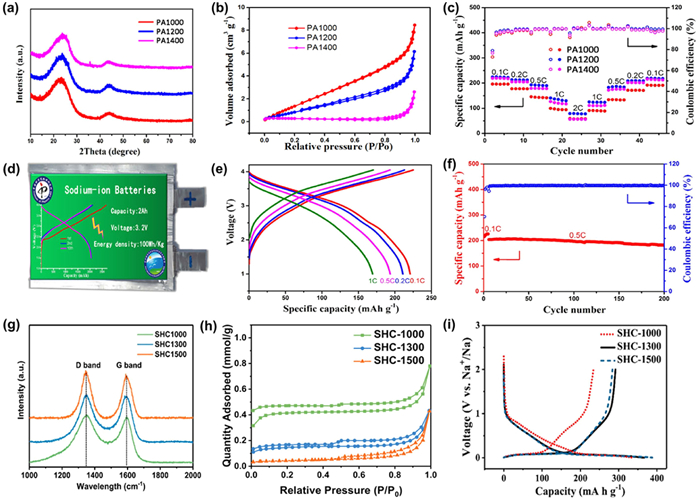
In comparison to anthracite, bituminous and subbituminous coals with shorter aging periods exhibit a reduced hydroaromatic structure and an increased presence of small molecular organic materials, which enhances their potential for efficient sodium ion storage. Cao et al. [49] synthesized carbon from subbituminous coal using a straightforward one-step carbonization process at temperatures of 1000, 1300, and 1500 ℃. The ID/IG ratio obtained from Raman spectroscopy for SHC-1000 and SHC-1300 decreased from 1.92 to 1.48 (Fig. 2g), suggesting the development of a more integrated hexacyclic carbon structure and a reduction in structural defects as the temperature rises. Additionally, the BET-specific surface area declined from 35.3 m2/g to 3.14 m2/g with increasing temperature (Fig. 2h). The SHC-1300 demonstrated a high sodium storage capacity of 291 mAh/g at 20 mA/g, along with a notable ICE of 79.5% (Fig. 2i), indicating its potential as a promising alternative anode for cost-effective and high-performance SIBs.
Ghamouss et al. [50] conducted a comparison of bituminous coal and semi-anthracite coal with varying volatile matter contents, demonstrating that pyrolyzed carbon from semi-anthracite exhibits a lower sodium storage capacity than that from bituminous coal despite the higher carbonization yield associated with semi-anthracite coal. The greater volatile matter content in lower-rank coal typically leads to an increased degree of disorder in its microcrystalline structure following carbonization treatment. The carbonization temperature significantly influences the microstructure of coal-derived carbons, whereas parameters such as interlayer spacing and microcrystalline sizes, La and Lc, can be effectively adjusted by optimizing carbonization temperature.
The regulation of microcrystalline structure for coal-based carbon focuses on optimizing its sodium ion storage sites through the adjustment of crystal size, interlayer spacing, defect density, and surface chemical characteristics [51,52]. By introducing other specific precursors or optimizing coal composition, one can tailor the interlayer spacing and structural ordering of microcrystals [53]. This enhancement boosts sodium-ion storage performance while minimizing capacity loss associated with irreversible reactions. Additionally, this regulation improves the material's mechanical stability, reduces the risk of structural collapse during cycling, and ultimately extends the lifespan of the battery [54].
Coal's molecular structure typically consists of abundant aliphatic and aromatic components. The separation and modification of coal components will influence the pyrolysis behavior of coal-based precursors, thereby optimizing microcrystalline structures to enhance sodium-storage performance. Using Xinjiang bituminous coal as the raw material, Zhao et al. successfully obtained vitrinite-rich and inertinite-rich coal samples through density separation (Fig. 3a) [55]. The vitrinite-rich sample, characterized by a high abundance of aliphatic structures, demonstrated greater oxidative reactivity, whereas the inertinite-rich sample, predominantly composed of aromatic structures, resulted in lower oxidative reactivity. Following air oxidation at 300 ℃, the vitrinite-rich sample, characterized by its aliphatic structure, exhibits an increased presence of carboxyl and ester groups, resulting in a higher proportion of cross-linked structures (Fig. 3b). As a result, the vitrinite-derived hard carbon (PCBC125) demonstrated an interlayer spacing of 0.377 nm and a significant presence of ultra-micropores (pore size < 1 nm), leading to exceptional sodium storage capabilities with a reversible capacity of 330.2 mAh/g and an ICE of 89.7%. Additionally, it exhibited notable rate performance, maintaining a capacity of 157.4 mAh/g at 2000 mA/g (Figs. 3c and d). In contrast, the inertinite-rich sample exhibited diminished reactivity due to its aromatic structures, resulting in a lower capacity of 260.1 mAh/g for the derived carbon (PCBC140).
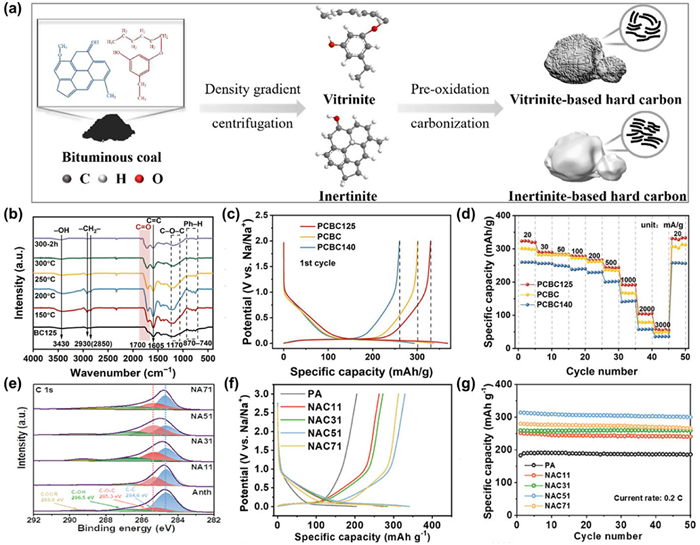
Mechanical ball-milling is an effective strategy to disrupt the polycyclic aromatic hydrocarbon structure in coal-based molecules. Chen et al. successfully achieved the microcrystalline engineering of anthracite-based carbon materials through NaCl-assisted ball milling of anthracite [56]. Matrix-assisted laser desorption ionization-time of flight mass spectrometry (MALDI-TOFMS) confirmed the structural transformation of anthracite, with the average relative molecular mass distribution reduced from 498 to 241 after ball milling treatment. Additionally, the formation of C–O–C bonds during the ball-milling process can alter the pyrolysis behavior of anthracite and reduce the creation of surface defects (Fig. 3e). As a result, the modified carbon exhibits enhanced structural disordering, with interlayer spacing increasing from 0.342 nm for pristine anthracite-based carbon to 0.375 nm for NAC51, alongside a decrease in surface defects, as evidenced by the SBET value dropping from 120.4 m2/g to ~10 m2/g. When used as an anode for SIBs, the NAC51 demonstrated a significantly improved sodium storage capacity of 332.1 mAh/g and an ICE of 82% (Fig. 3f). It also showed excellent cycle and rate performance (Fig. 3g), maintaining a capacity of 196.0 mAh/g at 1 C after 1000 cycles. The work provides a straightforward and effective method for modifying the microcrystalline structure in coal-derived carbons, offering valuable perspectives to advancing high-performance anode materials for SIBs.
Liu et al. designed the precursor structure by facilitating the self-assembly of melamine-cyanuric acid (MCA) molecules on the anthracite surface through hydrogen bonding [57]. The MCA molecules transform into g-C3N4 during thermal polymerization process, which then decomposes to release a nitrogen source and form a defect-rich carbon fiber skeleton on the surface of coal-based carbon. The carbon nanofibers encapsulate anthracite-derived carbon particles characterized by numerous defects and enhanced interlayer spacing, exhibit a sodium storage capacity of 371.3 mAh/g and an ICE of 74.2%. In contrast, pristine anthracite-derived carbon only delivered a capacity of 260.0 mAh/g. This composite also exhibited superior rate capability and cycling performance, maintaining a capacity of 295.8 mAh/g at a current density of 10 A/g, with a notable capacity retention of 91.5% after 3000 cycles. It is found that the graphite sheets' angle significantly influences sodium ions' storage and migration, offering new insights into the sodium-ion storage mechanism of hard carbons.
The highly ordered microstructure and narrow interlayer spacing of coal-based carbon present challenges for sodium ion storage. The construction of heterostructures has emerged as a critical strategy for optimizing microstructure and enhancing the electrochemical performance of coal-based carbon [58,59]. This structural regulation is accomplished via molecular cross-linking among various precursors, including hard-soft, hard-hard carbon combinations. The interaction of functional groups during molecular cross-linking between different carbon precursors can alter the thermal pyrolysis behavior, impede microcrystalline orderly growth during carbonization and enhance structural disorder in coal-based heterostructure carbon, thus improving the electrochemical Na-storage performance [60,61].
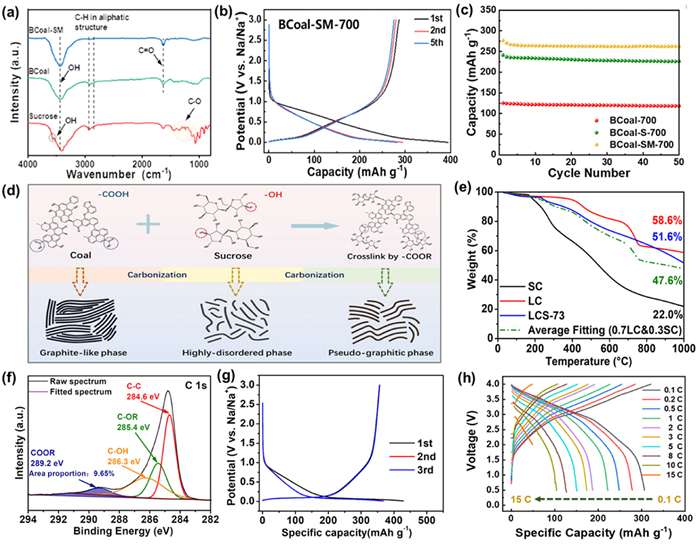
Sucrose, a typical carbohydrate precursor, is rich in oxygen-containing functional groups. Zhang et al. proposed a KCl/LiCl molten salt-assisted strategy to facilitate the cross-linking of functional groups from coke coal and sucrose, thereby improving the structural stability of the precursor molecule. This approach led to the construction of a microcrystalline heterostructure (BCoal-SM-700) characterized by increased structural disorder and additional active sites for sodium ion storage (Figs. 4a and b) [62]. Compared to the pristine coke coal-based carbon (BCoal-700), the BCoal-SM-700 demonstrated a significant enhancement in structural disorder, with the interlayer spacing expanding from 0.365 nm to 0.378 nm. As a result, the initial reversible capacity increased from 125.4 mAh/g for BCoal-700 to 286.5 mAh/g for BCoal-SM-700 (Fig. 4c), along with outstanding cycling and rate performance. The molten salt method provides a straightforward and environmentally friendly approach for synthesizing coal-based heterostructure carbon materials, significantly improving their sodium storage capabilities.
Similarly, Zhu et al. [63] synthesized soft/hard carbon hybrids through the ball milling of sucrose and anthracite in an alcoholic environment, followed by a pretreatment at 400 ℃, decontamination with KOH&HCl, and carbonization at 1200 ℃. It was discovered that KOH&HCl treatment effectively modulated the microcrystalline disorder of the intermediates, as indicated by the increase in interlayer spacing from 0.36 nm to 0.37 nm and the rise in the ID/IG value from 1.94 to 3.07. The obtained ZT3WYM7 demonstrates a reversible specific capacity of 272 mAh/g at 0.1 C and a notable rate performance of 229 mAh/g at 10 C, in addition to maintaining 80% of its capacity after 1300 cycles, indicating excellent cycling stability.
The incorporation of a second carbon precursor has proven as effective way to alter the pyrolysis behavior of coal-based molecules. Chen et al. [64] conducted a systematic investigation into the interaction between sucrose and lignite coal, successfully creating carbon-based hybrid microcrystalline phases predominantly characterized by pseudo-graphitic structures (Fig. 4d). The carbon yield for LCS-73 at a temperature of 1000 ℃ was 51.6%, exceeding the theoretical value of 47.6%, which confirms the cross-linking interaction between lignite coal and sucrose (Fig. 4e). XPS reveals that LCS-73 has the highest proportion of ester groups (-COOR) (Fig. 4f), which is conductive to the formation of a more disordered microcrystalline structure. Additionally, the cross-linked molecular structure restricts the release of small gas molecules during high-temperature treatment, significantly reducing surface defects evidenced by a decrease in the BET surface area from 169.52 m2/g to 1.48 m2/g. Consequently, the optimized sample LCS-73, featuring the highest proportion of pseudo-graphitic phases at 71.38% and reduced surface defects, demonstrates a high reversible capacity of 356 mAh/g with ICE of 82.9% (Fig. 4g). Furthermore, the assembled O3-NaNi1/3Fe1/3Mn1/3O2//LCS-73 full cell achieves an energy density of 240 Wh/kg with an impressive rate capability of 106 mAh/g at 10 C (Fig. 4h), highlighting that microcrystalline hybridization is a promising approach for developing advanced coal-based carbon anode materials.
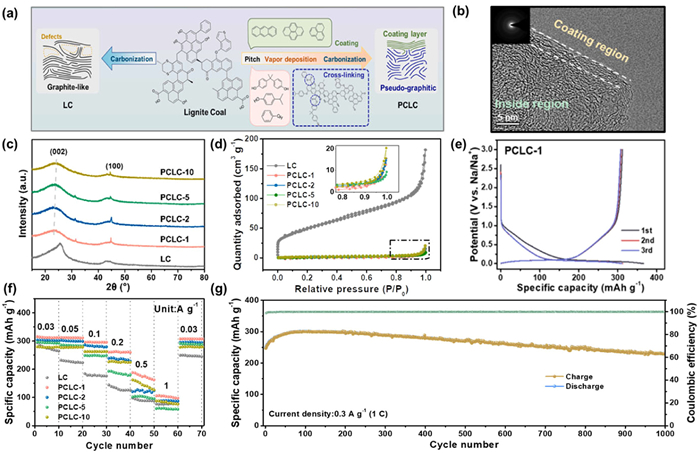
Subsequently, Chen et al. presented a novel vapor deposition technique to regulate the microcrystalline structure of lignite coal-based carbon and meanwhile realize defect engineering with the assistance of pitch [16]. Fig. 5a illustrates that the decomposition of pitch-derived hydroxyl–containing volatiles allows for an efficient cross-linking with oxygen-rich groups in lignite coal, resulting in a disordered microcrystalline structure with a dominant pseudo-graphitic phase. Meanwhile, the polynuclear aromatic compounds from pitch can deposit on the surface of coal-derived intermediate products, forming a uniform carbon coating that reduces surface defects and increases electrical conductivity (Fig. 5b). In comparison to pristine lignite coal pyrolytic carbon, the coal-based carbons coated with a pitch-based soft carbon layer (PCLC) demonstrate a significant increase in active sites for sodium ion storage and a notable decrease in surface defects with an exceptionally low specific surface area (SBET) of 5.95 m2/g (Figs. 5c and d). Electrochemical testing indicates that the PCLC-1 electrode achieves a reversible capacity of 312.2 mAh/g, accompanied by an ICE of 85.3%, and demonstrates superior cycling and rate performance (Figs. 5e-g). This work offers a distinctive perspective on synergistically controlling the microcrystalline structure and surface chemistry of coal-based carbon anodes for enhanced sodium ion storage.
The pore structure of coal-based carbon anodes, encompassing both open and closed pore configurations, plays a significant role in determining their sodium storage performance. Open pores created through physical/chemical activation or template strategy provide sites for sodium ion adsorption, thereby contributing to the sloping capacity [41]. However, the presence of open pores greatly increases the specific surface area and introduces defects, which may lead to a decrease in ICE [65]. In contrast, closed pore structures facilitate sodium ion filling while maintaining a lower specific surface area, resulting in higher plateau capacity and improved ICE [66,67]. Therefore, strategically designing the pore structure is crucial for enhancing the electrochemical sodium storage performance, aiming for significantly higher sloping or plateau capacities in coal-based carbon anodes.
The design of porous structures is widely recognized as an effective approach to boost ion transport and create active sites for coal-based carbon anodes. Micropores offer a substantial surface area and numerous adsorption sites for Na ion storage, thereby improving the contribution of surface capacitance. Mesopores and macropores enhance electrolyte accessibility and create pathways for efficient ion transport and diffusion, leading to the improvement of rate capability. Jiang et al. [68] prepared anthracite-based expanded graphite (AEG) via a liquid-phase oxidation intercalation-rapid thermal reduction method, which was realized by subjecting the anthracite to a liquid-phase oxidative intercalation reaction with concentrated sulfuric acid, sodium nitrate, and potassium permanganate and then reduction at 900 ℃. The obtained AEG shows a developed pore structure with a BET surface area of 389 m2/g and a pore volume of 0.884 cm3/g (Figs. 6a and b). In addition, it also contained high oxygen content of about 13 at% and enlarged interlayer spacing of 0.38 nm, which can provide more active sites and facilitate the transfer of Na+ in the interlayers. Benefitting from the synergistic effects of expanded layer spacing, 3D porous structure, and abundant defects, the AEG electrode demonstrates an initial reversible capacity of 326 mAh/g at 30 mA/g but with a low ICE of 20.7% (Fig. 6c). The surface capacitive adsorption mechanism endows the electrode an impressive rate capability with a maintained a capacity of 91 mAh/g at 10 A/g. Additionally, it also presents excellent long-cycle stability, retaining a reversible specific capacity of 146 mAh/g after 200 cycles at 500 mA/g with a capacity retention of 92%.
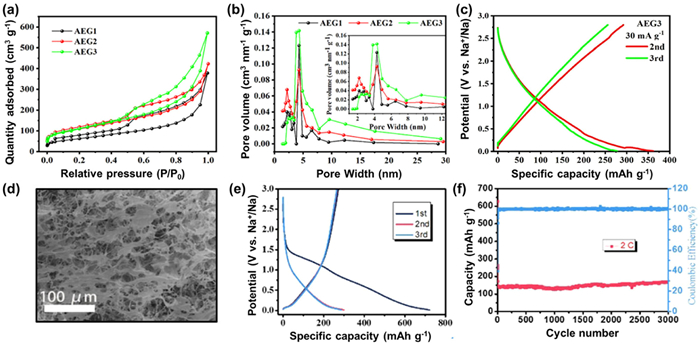
Chitosan is a renewable biopolymer that has attracted significant interest in the energy storage sector due to its three-dimensional framework and elevated nitrogen content. Shen et al. [69] developed three-dimensional porous coal-based materials (CGC–CS) by carbonizing the hydrogel consisted of anthracite-derived graphite microcrystals and chitosan at a temperature of 600 ℃. The 3D conductive network exhibits a BET-specific surface area of 116.2 m2/g, which enhances electrolyte infiltration and promotes the transfer of ions and electrons. Fig. 6d demonstrates that the coal-based carbon exhibits a highly porous and conductive 3D network with abundant surface active sites, thereby improving the efficiency of sodium adsorption and desorption. The CGC–CS, when employed as an anode in SIBs, exhibited a specific capacity of 272.7 mAh/g at a rate of 0.1 C, alongside an ICE of 37.8% (Fig. 6e). It also demonstrated a specific capacity of 170 mAh/g at 2 C after 3000 cycles (Fig. 6f), underscoring the positive impact of its 3D porous network on enhancing electrochemical performance.
Coal is an organic complex with a cross-linked macromolecular network filled with relatively small molecules. Strong solvents can extract some parts of the small molecular compounds to leave a three-dimensional macromolecular network. Here, Xiao et al. [70] adopted a solvent extraction method to dissolve the soluble small molecules from bituminous coal, leaving macromolecular network to prepare porous coal-based anode materials. In comparison to the raw coal-derived carbon (CC-1100), the modified carbon ECC-1100 exhibits additional macropores, with the pore volume increasing from 0.270 cm3/g to 0.481 cm3/g (Figs. 7a and b), highlighting the pore-forming effect of the thermal extraction process. Concurrently, the reversible sodium-storage capacity rises from 215 mAh/g to 306 mAh/g at 100 mA/g. However, a significant initial irreversible capacity loss occurs due to the formation of the solid electrolyte interphase (SEI) film, leading to a low ICE of 54.3% (Fig. 7c).
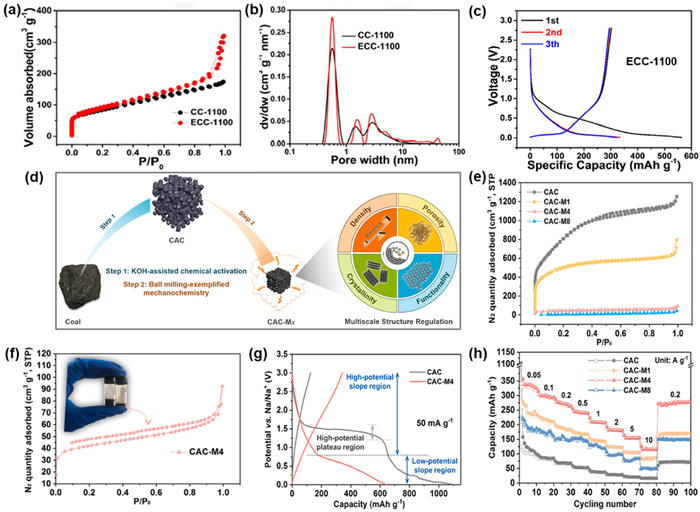
Chemical activation is the common strategy to construct a microporous structure in carbon materials. However, the excessively high specific surface area caused by overly developed micropores is not conducive to the ICE. Wang et al. [71] prepared densified carbon with an optimized multi-scale porous structure via KOH-assisted chemical activation and subsequent ball milling process (Fig. 7d). The specific surface area of coal-based carbon (CAC) reached 2947 m2/g after the KOH-assisted chemical activation process. However, subsequent ball milling treatment resulted in significantly reduced N2 adsorption capabilities across all CAC-M samples, indicating substantial alterations to the pore structures. The mechanochemical treatment process appears to disrupt the loosely arranged graphene-like structure of CAC, transforming it into short-range carbon microcrystallites under mechanical shear force. Consequently, the specific surface area of the material decreased progressively from 1353 m2/g to 4.8 m2/g with the duration of ball milling (Figs. 7e and f). Notably, the CMC-M4 sample, with a specific surface area of 108 m2/g and a pore volume of 0.11 cm3/g, demonstrates a capacity of 341 mAh/g with an ICE under 70% (Fig. 7g). Additionally, it exhibits excellent rate performance, maintaining a specific capacity of 152 mAh/g at a current density of 10 A/g (Fig. 7h).
The molten salt also has the potential to etch the dense coal when acting as a chemical activator at elevated temperatures, facilitating the diffusion and transport of sodium ions. Wang et al. employed a molten salt-assisted strategy utilizing a complex molten salt composed of KCl and CaCl2 to synthesize coal-based hard carbon featuring a layered interpenetrating porous structure [72]. This method enabled the generation of small carbon fragments upon reaching the melting point of molten salt, which further form ultra-thin and graphene-like nanosheets. Additionally, it enlarged the interlayer spacing of the carbon sheets to 0.389 nm (CHC-2), thereby optimizing the diffusion performance of sodium ions. The optimal CHC-2 sample demonstrated a capacity of 303.6 mAh/g at a current density of 0.03 A/g and retained 82.1 mAh/g at 0.5 A/g, with a capacity retention of 54.5% after 1000 cycles.
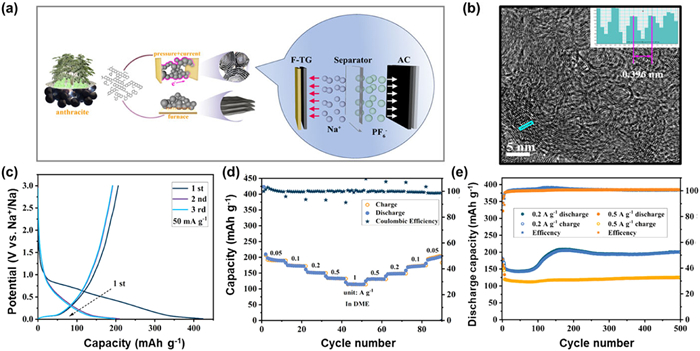
Dong et al. [73] recently synthesized anthracite-based carbon materials featuring a porous structure through a novel flash joule heating (FJH) strategy with a charging voltage of 150 V and a flash joule time of <0.1s (Fig. 8a). After a single FJH reaction, the resulting FA1 sample displayed short and curly carbon layers, with many regions retaining an amorphous structure. While after three FJH reactions, the FA3 sample exhibited an increased degree of graphitization, characterized by a turbostructure of carbon layers (Fig. 8b). Compared to anthracite, FA3 showed an increase in the proportion of sp2 carbon from 28% to 53%, while sp3 carbon decreased from 60% to 42%. When tested as the SIBs' anode, the optimized FA3 sample achieved a reversible capacity of 209 mAh/g at a current density of 0.05 A/g, with an ICE of under 50% (Fig. 8c). Additionally, FA3 demonstrated excellent rate and cycling performance, maintaining a capacity of 115 mAh/g at 1 A/g, with no decline in capacity after 500 cycles (Figs. 8d and e). The flash joule heating method presents a remarkable ultrafast pyrolysis capability, enabling rapid thermal processing and achieving high experimental throughput. Despite its efficiency in generating high-temperature conditions for coal-derived carbon anodes, this approach induces significant structural defects during the transformation process. Consequently, the resulting anode materials exhibit enhanced capacity but at the expense of reduced ICE, highlighting the need for further optimization to mitigate these limitations.
Recent studies on coal-derived carbon materials have focused on the modulation of closed-pore structures to enhance their electrochemical Na-storage performance [74,75]. Unlike open pores, closed pores effectively restrict the entrance of solvent molecules and limit electrolyte decomposition within the pores. The closed pores can accommodate a significant amount of Na ions, thereby enhancing the reversible capacity in the low-potential plateau region [76,77]. In this regard, the fabrication and regulation of closed pores have garnered considerable attention, resulting in notable advancements.
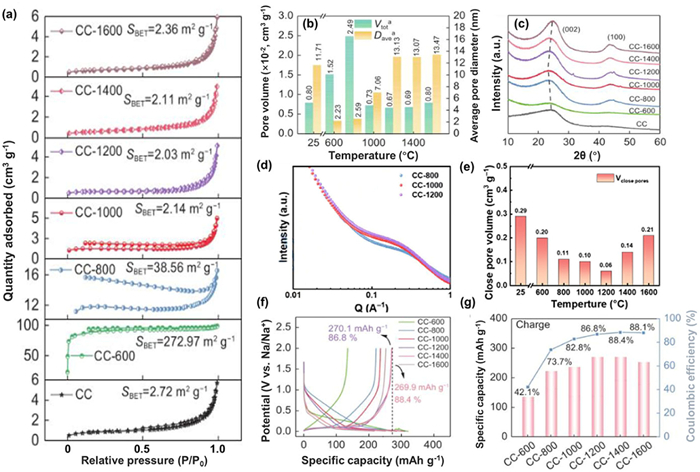
The carbonization temperature plays a crucial role in establishing the porosity of coal-based carbon. Tian et al. [78] examined the alterations in chemical composition, microcrystalline structure, and pore characteristics of bituminous coal throughout the carbonization process, spanning temperatures from 600 ℃ to 1600 ℃. The BET surface area increases significantly from 2.72 m2/g for ultralow-ash coal (CC) to 272.97 m2/g for CC-600 pyrolyzed at 600 ℃ (Fig. 9a), indicating that the release of small molecules facilitates micropore formation. Subsequently, the BET surface area significantly decreases to 38.56 m2/g for CC-800 and further to 2.14 m2/g for CC-1000, while the pore size increases from 2.23 nm for CC-600 to 7.06 nm for CC-1000 (Fig. 9b), confirming the collapse of pores during carbonization. The XRD pattern (Fig. 9c) indicates that d002 of coal-derived carbon initially increases from 0.369 nm to 0.382 nm for CC-1000, followed by a gradual decrease to 0.359 nm for CC-1600. The SAXS results (Figs. 9d and e) demonstrate the existence of closed pores, and the closed pore volume progressively increases within the temperature range of 1200–1600 ℃. The results suggest that the pore structure transitions from an open-pore configuration to an "ink bottle" shaped pore when temperature came to 1200 ℃, and ultimately to a closed-pore structure. As a result, the CC-1200 exhibited enhanced sodium storage capabilities, achieving a reversible capacity of 270.1 mAh/g and an ICE of 86.8% (Figs. 9f and g). The work elucidates the pore transformation mechanism of bituminous coal-derived carbon materials as carbonization temperature increases.
Using high-alkali coal as the carbon precursor, Wu et al. investigated the role of salt on the porosity structure of coal-based carbon by the sequence arranging of acid-washing [79]. The salt acted as a template or activating agent for the generation of open pores during the primary pyrolysis but prevented the closure of pores during the second carbonization. When the acid washing is performed to the intermediate before further carbonization at 1200 ℃, the resulting hard carbon (CWC) exhibits a significant number of closed pores with a pore volume of 0.076 cm3/g and a high specific surface area of 1998.98 m2/g (Figs. 10a-c). This closed pore structure reduces the contact area between the electrolyte and the carbon material, effectively suppressing irreversible reactions and enhancing the ICE to 80%. Furthermore, as illustrated in Fig. 10d, the CWC sample delivers an impressive reversible capacity of 322.4 mAh/g, with a plateau capacity of 192 mAh/g, demonstrating that the closed pores created through high-temperature carbonization significantly improve storage capabilities in the low-voltage range.
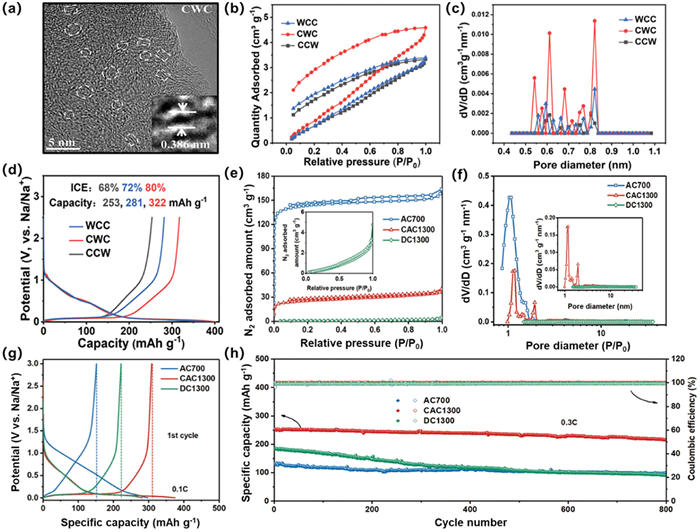
Wang and his coworkers conducted a KOH-assisted chemical activation process to introduce extensive open nanopores in coal-based carbon materials. Then, the subsequent high-temperature carbonization process induces the reorganization of pre-formed open pores and disordered carbon structures, resulting in a large number of closed nanopores in the carbon framework [80]. The optimized sample, CAC1300, exhibited a developed closed pore with a specific surface area of 341.7 m2/g and pore volume of 0.12 cm3/g (Figs. 10e and f), as well as expanded lattice spacing of 0.386 nm. These structural features significantly enhanced the plateau capacity in the low-voltage region (<0.1 V). Electrochemical testing revealed that the optimized sample delivered a high capacity of 308.4 mAh/g at 0.1 C (Fig. 10g) and retained 215.5 mAh/g at 0.3 C after 800 cycles (Fig. 10h). Further in situ XRD and ex situ XPS tests revealed that sodium ions are primarily stored through surface adsorption in the high voltage region, while the low voltage region is related to the pore filling mechanism in the developed closed pores.
Apart from high-temperature carbonization, coating treatment is also an efficient strategy to convert the open pores into closed pores. Wang et al. [81] fabricated closed-pore-rich coal-based carbon (CABC-P-2.5) via alkali activation followed by pitch-assisted coating treatment. The open micropores generated by alkali activation transform into closed pores by the pitch-derived carbon layer, providing effective active sites for Na-ion storage (Fig. 11a). The obtained CABC-P-2.5 electrode with an optimal coating content shows high Sclosed-pores of 886.3 m2/g and demonstrates an outstanding Na-storage capacity of 290.0 mAh/g. When paired with an O3-NaNi1/3Fe1/3Mn1/3O2 cathode, the assembled Na ion full cell achieves a high energy density of 251.2 Wh/kg (Fig. 11b).
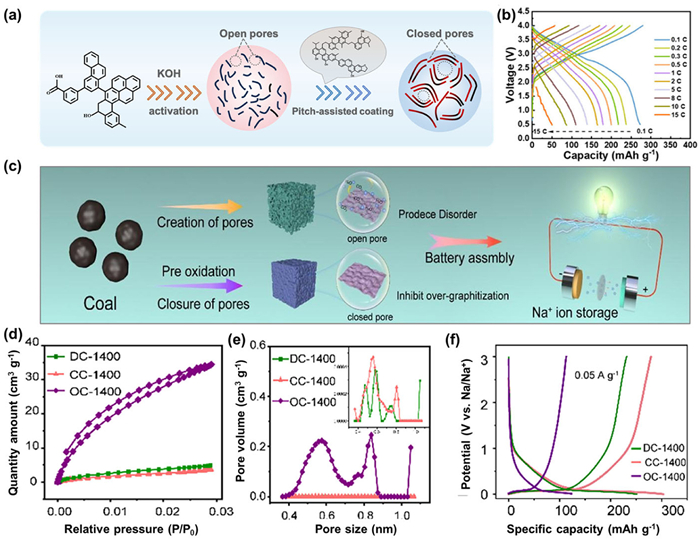
Classical chemical etching to produce open pores does not enhance pore-filling capacity; rather, it only increases non-relevant pores' specific surface area. To investigate diverse strategies for creating closed-pore structures and their effects on sodium-ion storage, Ma et al. adopted a strategy combining gas-phase pre-oxidation and high-temperature carbonization to control closed-pore formation (Fig. 11c) [82]. The investigation revealed that the pre-oxidation process introduces C=O functional groups, which inhibit the graphitization tendency of carbon layers and facilitate the formation of closed pores during the subsequent carbonization process. CO2 adsorption studies (Figs. 11d and e) indicate that CC-1400 exhibits lower adsorption and lacks pores larger than 1 nm, thereby confirming that oxygen effectively promotes the creation of closed pores in coal-based hard carbon. True density tests show that CC-1400 has a larger closed-pore volume of 0.081 cm3/g. Additionally, the CC-1400 sample demonstrated a high sodium storage capacity of 303.1 mAh/g (Fig. 11f), further validating the role of closed pores in enhancing sodium-ion filling capacity in the low-voltage region.
In summary, open pores and closed pores are both efficient active sites for Na ion storage, however, their Na-storage properties are significantly distinct. The open pores with large surface area can facilitate Na ions adsorption, and the capacitive adsorption mechanism displays faster kinetics, which is favorable for the rate capability of hard carbon anodes, but usually at the expense of ICE value and pack density. In contrast, the Na ion storage within closed pores via pore filling mechanism, generating the low potential plateau capacity in the charge/discharge curve. More importantly, the existence of closed pores can restrict the decomposition of electrolyte, contributing to an exceptional ICE value, which is highly desired for the practical utilization of coal-based hard carbon anodes in SIBs.
Introducing heteroatoms to carbon materials, such as O, N, P, and S, is recognized as an efficient method to improve electrochemical performance [83–86]. For coal with high carbon content, the introducing of oxygen and the corresponding functional groups is important for microcrystalline regulation and defect introduction [87]. While N, P, S heteroatoms could improve the conductivity, increase the defects and expand interlayer spacing [45]. Hence, the doping strategy has been widely reported to modify coal-based carbon materials for SIBs.
The incorporation of oxygen-containing functional groups, such as ester, carboxyl, hydroxyl and carbonyl groups, can significantly boost the reactivity and ion transport efficiency of electrode materials, thereby enhancing the electrochemical performances [88–90]. Moreover, the oxygen-containing functional groups can improve the interfacial stability between the electrode and the electrolyte, reducing the occurrence of side reactions [91].
A pre-oxidation strategy can facilitate molecular cross-linking during pyrolysis process, effectively regulating the microcrystalline structure. Su et al. [92] treated bituminous coal through a simple pre-oxidation and post-carbonization process, allowing the formation of -COOH during processing to crosslink with -OH and the generation of -COOR groups (Fig. 12a). The prepared carbon BOC-2 displayed an expanded layer spacing of 0.392 nm and the highest C=O content of 26.9%, which provides more active sites for sodium ion storage. Due to the formation of extra defects, the BOC-2 exhibited a BET surface area of 77.1 m2/g and a pore volume of 0.059 cm3/g with micropores and mesopores distributions. Electrochemical test demonstrates that the optimal BOC-2 sample exhibited a high reversible capacity of 306.3 mAh/g at 0.03 A/g (Fig. 12b). In this work, the side chains in coal are oxidized to form oxygen-containing functional groups through the pre-oxidation process, which ultimately affects the material's structure and performance.
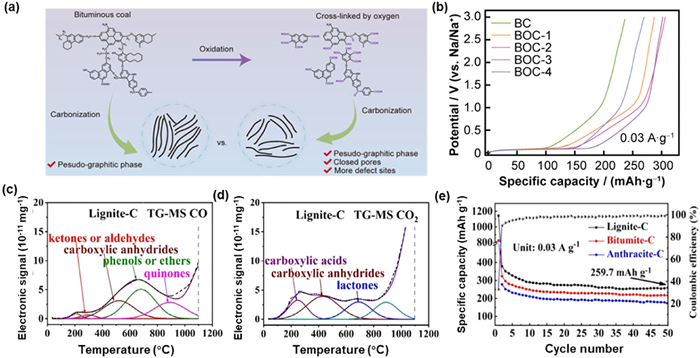
Zhao et al. [93] pre-oxidized three representative metamorphic-grade coals, including lignite, bituminous coal, and anthracite by H2SO4 and KMnO4, and the oxygen concentration on the surface are 28.4, 22.6, and 13.6 at%, respectively. The TG-MS spectrometry measurements and DFT calculations reveal that oxygen-containing functional groups, such as quinones, carboxylic anhydrides, and lactones, are more prone to form near defects (Figs. 12c and d). Given the high levels of defects and the presence of C=O functional groups, lignite-derived carbon demonstrates the highest initial reversible capacity of 345.4 mAh/g, maintaining a capacity of 259.7 mAh/g after 50 cycles (Fig. 12e). Some oxygen-containing functional groups undergo irreversible structural changes and cannot fully revert to their original state during charging, leading to capacity loss and a decreased ICE. Instead, it has been reported that quinones, carboxylic anhydrides, and lactones are more inclined to form near defects compared to other groups, which contributes to a stable sodium storage capacity for coal-based carbon anodes.
Precise doping of specific oxygen-containing functional groups with considerable content in the carbon framework is highly desirable to accurately unveil and strengthen the role of oxygen-containing functional groups in the Na+ storage process. Sun et al. [94] proposed a post-engineering approach through a CO2-participated balling milling mechanochemical process (Fig. 13a) to attain precise doping of carboxyl groups (20.12 at%) within the coal-based carbon framework (Figs. 13b and c). The precisely grafted carboxyl groups not only serve as active sites for the capacitive adsorption of Na+ via suitable electrostatic interactions, but also progressively increase the d-spacing by generating repulsive forces between the pre-adsorbed carbon layers. The developed carbon anode C1600-M demonstrates a significant enhancement in Na+ storage performance, achieving a large reversible capacity of 382 mAh/g at 30 mA/g, alongside notable rate capability and excellent cycling stability, with a retained capacity of 141 mAh/g after 2000 cycles at 1.5 A/g (Fig. 13d). However, the increased porosity from the mechanochemical treatment leads to an ICE of only 47.7% for the C1600-M anode. Carefully controlling the mechanochemical intensity, such as time and rotation speed, is critical for balancing porosity and the oxygen-doping environment, thus optimizing capacity and ICE value.
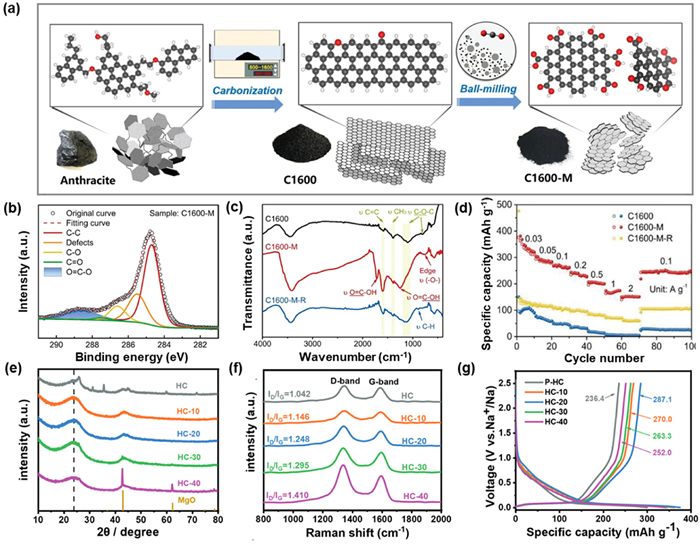
Liu and his coworkers proposed a multieffect preoxidation strategy to introduce oxygen-containing functional groups into bituminous coal using Mg(NO3)2·6H2O, which can inhibit the rearrangement of carbon layers [95]. Meanwhile, the residue solid decomposition product MgO would react with carbon to create surface-active sites. Compared to the pristine bituminous coal-derived carbon, the modified carbon HC-40 showed an increased content of oxygen-containing functional groups from 2.3 at% to 9.8 at%, which could offer more active sites for Na+ within the pseudo-graphitic structure (Figs. 13e and f). As a result, the modified bituminous coal-based carbon with expanded interlayer spacing and ample Na+ adsorption active sites showed an enhanced capacity of 287.1 mAh/g at 20 mA/g with ICE of 76.5% (Fig. 13g) and a capacity retention of 96.1% after 200 cycles at 50 mA/g.
Introducing heteroatoms like N, S, P, and B has also become an important strategy to improve the electrochemical performance of coal-based carbon. Numerous studies indicate that heteroatom doping considerably increases interlayer spacing, promotes sodium-ion intercalation, and improves electrical conductivity and ion diffusion kinetics [96–98]. In the past few years, the impact of various heteroatoms and doping techniques on essential performance indicators, such as specific capacity, ICE, and cycling stability, has received considerable attention [47,99].
In 2022, Gao et al. [100] achieved pore regulation and pyridinic nitrogen doping of anthracite-derived carbon through a mechanochemical-assisted nitrogen doping strategy. The mixtures of melamine and anthracite at various mass ratios were pyrolyzed at 600 ℃, and the retained nitrogen content increased from 12.6 at% for NA-1-M to 29.4 at% for NA-4-M. Notably, NA-3-M, which exhibited the highest proportion of pyridinic nitrogen at 58.6% (Figs. 14a and b), demonstrated a reversible capacity of 320.9 mAh/g at a current density of 0.03 A/g, with an ICE of 44.9% (Fig. 14c), and maintained a capacity of 194.4 mAh/g after 1000 cycles at 1 A/g. In 2024, the authors further explored the effects of various metamorphic-grade coal precursors, i.e., lignite, bituminous coal, and anthracite, on the electrochemical performance of the nitrogen-doped coal-based carbon materials [101]. The mechanochemical pretreatment significantly disrupted the aromatic structures, leading to a substantially disordered microcrystalline structure (Figs. 14d and e). It was observed that the extent of defect formation induced by the mechanochemical pretreatment increased with the metamorphic grade of the coal. Concurrently, the N-6 content rose from 52.5% to 54.7%, while the N-5 content increased from 24.5% to 27.2%, corresponding with the coal ranks (Fig. 14f). This process generated more edge defects and functional groups on the surface of high-rank anthracite after mechanochemical treatment. Consequently, the nitrogen-doped anthracite-based carbon materials achieved the highest reversible capacity of 323 mAh/g and excellent cycle stability, retaining a capacity of 225 mAh/g after 1200 cycles at 1.0 A/g.
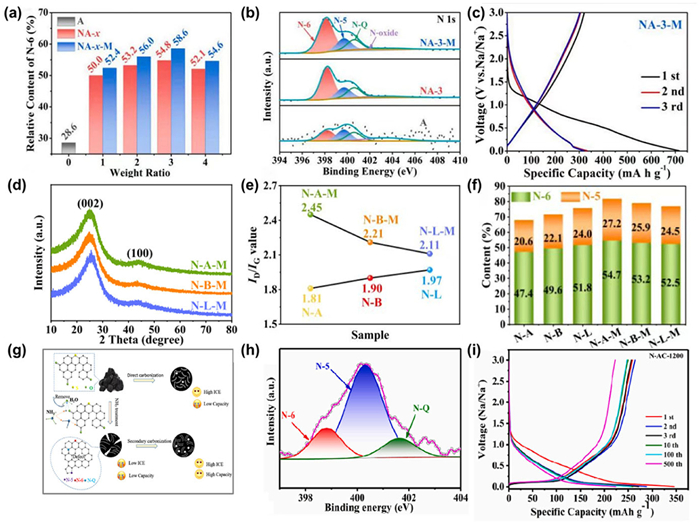
Li et al. [102] employed NH3 treatment to introduce nitrogen atoms while regulating the microcrystalline structure of anthracite-based hard carbon, effectively enhancing the Na-storage performance (Fig. 14g). The contents of N-6, N-5, and N-Q in N-AC-1200 in N-AC-1400 were 25.8%, 57.3%, and 16.9%, respectively. The introduction of N atoms (Fig. 14h) can also enlarge the carbon layer spacing, which is conducive to facilitating the Na+ storage. Consequently, the N-AC-1200 with an interlayer spacing of 0.385 nm delivered a high capacity of 253 mAh/g at 0.1 A/g and maintained 220 mAh/g after 500 cycles (Fig. 14i). The existence of inorganics impurities in coal could seriously affect the properties of hard carbon during direct pyrolysis process. Song et al. [103] adopted a mild pretreatment method to prepare subbituminous coal-based P-doped carbon (P-HC) with co-activation of NaNO3 and H3PO4, achieving the purification of coal-based carbon and homogeneous P-doping simultaneously. The obtained P-HC with a P content of 0.25 wt% exhibited an expanded interlayer spacing of 0.385 nm and developed porosity with a BET surface area of 362.2 m2/g, thereby providing additional sites for Na+ storage. When configured into SIBs, the P-HC exhibited a capacity of 284.4 mAh/g with ICE of 48.1% at 20 mA/g, along with excellent cycling stability.
Apart from single heteroatom doping, dual-elements co-doping can also improve the electrochemical Na-storage performance via synergic effect. Niu et al. [104] have successfully synthesized nitrogen and sulfur co-doped coal-based hard carbon material through a two-step carbonization process. The process utilized long-flame coal as the carbon source, thiourea as the dual-source of nitrogen and sulfur, and NaCl as a templating agent. The XPS tests indicated that NSPC1200 displayed elemental contents of C, N, O, and S at 88.35%, 3.25%, 7.80%, and 0.60%, respectively. The presence of pyridinic nitrogen in NSPC1200 contributes to forming additional external defects, thereby enhancing the specific capacity and overall electrochemical performance. Meanwhile, the formation of C-SOx-C during the sulfur doping process improves the wettability of the electrolyte, facilitating a more rapid kinetic process for coal-based carbon materials. The NSPC1200 material demonstrated a remarkable sodium storage capacity of 314.2 mAh/g at a current of 20 mA/g with an ICE of 50.82%. Additionally, it maintained a capacity of 224.4 mAh/g after 200 cycles, highlighting its potential for application in SIBs. While the co-doping of nitrogen and sulfur in NSPC1200 increases the number of active sites, it may also induce certain irreversible chemical changes that consume sodium ions during the initial charging process, potentially impacting the ICE.
Coal offers notable benefits as a carbon precursor for commercial SIBs, such as its widespread availability, cost-effectiveness, and high carbon yield. A significant challenge arises from its regular structure and limited sodium storage active sites, which restrict its electrochemical performance. The direct pyrolysis of various coal ranks demonstrates a relationship between coal type and the resultant carbon characteristics. Anthracite, as the highest-rank coal, demonstrate a significant level of carbonization yield (exceeding 90%) and possess a more ordered structure, which is unfavorable for Na ion storage. In contrast, carbon derived from bituminous coals and lignite demonstrate more disordered microcrystalline, enabling enhanced sodium storage capacities of approximately 250 mAh/g. These findings underscore the critical influence of coal rank and structural features on the ultimate Na-storage performance of coal-based carbon anode materials.
To enhance the sodium storage performance of coal-based carbon materials, existing strategies focus on morphological and structural modifications to increase active sites and promote ion diffusion. Microcrystalline regulation has proven to be effective to enhance sodium storage performance through increased structural disorder and expanded interlayer spacing. This method facilitates the enhancement of the low-potential plateau capacity benefitted from the improved sodium-ion intercalation/de-intercalation property. The straightforward fabrication process and the significant improvement in sodium storage performance, particularly in terms of increased plateau region capacity and enhanced ICE, render it highly advantageous for large-scale applications.
Pore structure regulation is also a significant structural optimization method, which consists of open pores and closed pores. The presence of open pores increases electrochemical activity by augmenting active sites, enhancing capacitive contributions, and reducing the diffusion distances for ions and electrons. However, excessive open porosity results in an increased surface area and a greater number of defect sites, intensifying irreversible reactions and diminishing ICE. Conversely, sodium storage in closed pores contributes the low-voltage plateau region in the charge/discharge curves. Additionally, the existence of closed pores with extremely low surface area could limit the electrolyte decomposition, corresponding to a satisfactory ICE value. Therefore, the closed pore structure engineering will be critical for the future development of high-performance coal-based carbon anode for SIBs. However, due to the limitations in current characterization technique, the Na ion filling process within closed pore remains unclear, and the structure-activity relationship requires further investigation.
Heteroatom doping can increase the active sites by introducing defects, and enhance the conductivity, which is beneficial for the improvement of Na-storage capacity and rate performance for coal-based carbon material. The incorporation of oxygen-containing functional groups can improve the hydrophilicity as well as the interfacial stability between the electrode and electrolyte. For N-doping, the presence of pyrrolic-N and pyridinic-N could boost electrochemical activity for sodium storage, highlighting the importance of selectively enhancing these nitrogen species as a key area of investigation. S- and P-doping could efficiently expand the interlayer spacing of the carbons and enhance the ion diffusion kinetics. However, the doping level and content are usually very low, unfavorable for the significant improvement of the Na-storage performance. In addition, dual-elements co-doping can facilitate the enhancement of electrochemical performance via synergic effect, which is rarely reported in the coal-based carbon materials.
Coal-derived carbons hold significant promise as anode materials for the large-scale and economical manufacturing of SIBs. However, the inherent compositional complexity and macromolecular architecture of coal present substantial challenges in designing efficient, cost-effective pretreatment approach to enhance sodium storage efficiency. Therefore, future research must prioritize a deeper understanding of coal's structural properties, composition, and pyrolysis mechanism to develop more effective modification strategies that bridge the gap between cost efficiency and high electrochemical performance. With continuous progress in enhancing sodium storage performance, the low-cost coal-derived carbons are increasingly recognized as promising anode candidates for large-scale application in next-generation SIBs technology.
Hongxiang Yin: Writing – original draft, Methodology, Investigation, Data curation. He Chen: Writing – original draft, Methodology, Investigation, Formal analysis, Data curation. Ning Sun: Writing – original draft, Visualization, Supervision, Methodology, Conceptualization. Xuyang Jian: Visualization, Resources, Investigation, Data curation. Anwen Chen: Writing – review & editing, Validation, Resources, Project administration, Conceptualization. Ben Guo: Writing – original draft, Resources, Project administration. Lei Ji: Writing – review & editing, Resources, Methodology. Zhen Yang: Resources, Investigation. Yang Liu: Resources, Investigation. Bin Xu: Writing – review & editing, Supervision, Project administration, Methodology, Conceptualization.
The authors declare that they have no known competing financial interests or personal relationships that could have appeared to influence the work reported in this paper.
This work was financially supported by the China Academy of Railway Sciences Corporation Limited (No. 2023YJ319), National Natural Science Foundation of China (NSFC, Nos. 22479006 and 22005023), Guizhou Provincial Major Scientific and Technological Program (No. [2024]020), and the Fundamental Research Funds for the Central Universities (No. buctrc202141).
B.K. Biswal, B. Zhang, P.T.M. Tran, J. Zhang, R. Balasubramanian, Chem. Soc. Rev. 53 (2024) 5552–5592. doi: 10.1039/d3cs00898c
W. Zhao, H. Dong, Z. Xing, et al., Adv. Energy Mater. 14 (2024) 2402720. doi: 10.1002/aenm.202402720
S. Lin, H. Zhang, C. Shu, et al., Adv. Funct. Mater. 34 (2024) 2409628. doi: 10.1002/adfm.202409628
J. Liu, L. Huang, H. Wang, et al., Electrochem. Energy Rev. 7 (2024) 34. doi: 10.1007/s41918-024-00234-9
J. Hu, L. Xu, X. Li, et al., J. Mater. Chem. A 13 (2024) 3206–3235.
K. Cui, R. Hou, H. Zhou, S. Guo, Adv. Funct. Mater. 35 (2024) 2419275.
L. Cheng, J. Quan, H. Li, Chin. Chem. Lett. 36 (2025) 110685. doi: 10.1016/j.cclet.2024.110685
Y. Tong, Y. Wu, Z. Liu, et al., Chin. Chem. Lett. 34 (2023) 107443. doi: 10.1016/j.cclet.2022.04.041
Z. Huang, J. Huang, L. Zhong, W. Zhang, X. Qiu, Small 20 (2024) 2405632. doi: 10.1002/smll.202405632
B. Zhong, C. Liu, D. Xiong, et al., ACS Nano 18 (2024) 16468–16488. doi: 10.1021/acsnano.4c03484
E.O. Eren, E. Senokos, Z. Song, et al., Mater. Horiz. 3 (2024) 886–898.
Y.V. Sultanova, M.O. Apostolova, M.T. Maidan, et al., J. Electrochem. Soc. 171 (2024) 120533. doi: 10.1149/1945-7111/ada069
Q. Fang, X. Wang, P. Chen, D. Ruan, Z. Qiao, ChemistrySelect 9 (2024) e202402294. doi: 10.1002/slct.202402294
J. Yan, X.L. Chen, Y. Cui, et al., ACS Appl. Mater. Interfaces 14 (2022) 49641–49649. doi: 10.1021/acsami.2c11132
H.W. Kim, H.J. Kim, H. Byeon, et al., J. Mater. Chem. A 8 (2020) 17980–17986. doi: 10.1039/d0ta04526h
H. Chen, N. Sun, Y. Wang, R.A. Soomro, B. Xu, Energy Storage Mater. 56 (2023) 532–541. doi: 10.1016/j.ensm.2023.01.042
M. Jiang, N. Sun, R.A. Soomro, B. Xu, J. Energy Chem. 55 (2021) 34–47. doi: 10.1016/j.jechem.2020.07.002
A.R. Ferdous, S.S. Shah, S.N.A. Shah, et al., Molecules 29 (2024) 29092081.
X. Chen, C. Liu, Y. Fang, et al., Carbon Energy 4 (2022) 1133–1150. doi: 10.1002/cey2.196
L.F. Zhao, Z. Hu, W.H. Lai, et al., Adv. Energy Mater. 11 (2021) 2002704. doi: 10.1002/aenm.202002704
S. Huang, X.Q. Qiu, C.W. Wang, et al., New Carbon Mater. 38 (2023) 40–72. doi: 10.1016/S1872-5805(23)60718-8
J. Zhou, S. Zhang, Y.N. Zhou, et al., Electrochem. Energy Rev. 4 (2021) 219–248. doi: 10.1007/s41918-020-00090-3
H. Hou, X. Qiu, W. Wei, Y. Zhang, X. Ji, Adv. Energy Mater. 7 (2017) 1602898. doi: 10.1002/aenm.201602898
Z. Chen, H. Lin, Y. Tan, L. Niu, H. Li, Adv. Funct. Mater. 34 (2024) 2407653. doi: 10.1002/adfm.202407653
Y. Zhang, X. Lin, W. Xi, et al., ChemCatChem 16 (2024) e202401167. doi: 10.1002/cctc.202401167
C. Li, L. Yan, M. Wang, et al., Chem. Rec. 23 (2023) e202200216. doi: 10.1002/tcr.202200216
J. Tang, Y. Guo, Y. Han, Energy Sci. Eng. 12 (2024) 1356–1368. doi: 10.1002/ese3.1660
K. Li, G. Liu, L. Zheng, et al., New Carbon Mater. 36 (2021) 133–149. doi: 10.1016/S1872-5805(21)60010-0
F. Gao, Y. Zang, Y. Wang, et al., New Carbon Mater. 36 (2021) 34–45. doi: 10.1117/12.2601108
J.M.K. O'Keefe, A. Bechtel, K. Christanis, et al., Int. J. Coal Geol. 118 (2013) 58–87. doi: 10.1016/j.coal.2013.08.007
Y. Xia, R. Zhang, Y. Cao, Y. Xing, X. Gui, Fuel 262 (2020) 116535. doi: 10.1016/j.fuel.2019.116535
W. Xia, G. Xie, Y. Peng, Powder Technol. 277 (2015) 206–221. doi: 10.1016/j.powtec.2015.03.003
M.J. Kotarba, M.D. Lewan, Org. Geochem. 35 (2004) 615–646. doi: 10.1016/j.orggeochem.2003.12.001
J.C. Hower, R.B. Finkelman, C.F. Eble, B.J. Arnold, Int. J. Coal Geol. 263 (2022) 104120. doi: 10.1016/j.coal.2022.104120
J. Wang, L. Xi, C. Peng, et al., Adv. Energy Mater. 26 (2024) 2302063.
Y. Chu, J. Zhang, Y. Zhang, et al., Adv. Mater. 35 (2023) 2212186. doi: 10.1002/adma.202212186
Z. Zhuang, Y. Cui, H. Zhu, Y. Shi, Q. Zhuang, J. Electrochem. Soc. 165 (2018) A2225–A2232. doi: 10.1149/2.0981810jes
Y. Wang, F. Sun, H. Wang, et al., ACS Sustainable Chem. Eng. 12 (2024) 15044–15055. doi: 10.1021/acssuschemeng.4c04116
H. Zhang, X. Liu, T. Ji, et al., Chin. Chem. Lett. 37 (2026) 110790. doi: 10.1016/j.cclet.2024.110790
Q. Li, F. Zhao, X. Xuan, et al., Diam. Relat. Mater. 147 (2024) 111341. doi: 10.1016/j.diamond.2024.111341
S. Chen, K. Tang, F. Song, et al., Nanotechnology 33 (2022) 055401. doi: 10.1088/1361-6528/ac317d
Y. Chen, H. Sun, X.X. He, et al., Small 20 (2024) 2307132. doi: 10.1002/smll.202307132
Y. Sun, P. Lu, X. Liang, C. Chen, H. Xiang, J. Alloys Compd. 786 (2019) 468–474. doi: 10.1111/apm.12944
Y. Lu, C. Zhao, X. Qi, et al., Adv. Energy Mater. 8 (2018) 1800108. doi: 10.1002/aenm.201800108
Y. Yuan, Z. Chen, H. Yu, et al., Energy Storage Mater. 32 (2020) 65–90. doi: 10.1016/j.ensm.2020.07.027
S. Alvin, C. Chandra, J. Kim, Chem. Eng. J. 391 (2020) 123576. doi: 10.1016/j.cej.2019.123576
W. Chen, M. Wan, Q. Liu, et al., Small Methods 3 (2019) 1800323. doi: 10.1002/smtd.201800323
Y. Li, Y.S. Hu, X. Qi, et al., Energy Storage Mater. 5 (2016) 191–197. doi: 10.1016/j.ensm.2016.07.006
H. Lu, S. Sun, L. Xiao, et al., ACS Appl. Energy Mater. 2 (2019) 729–735. doi: 10.1021/acsaem.8b01784
J. Abou-Rjeily, N.A. Laziz, C. Autret-Lambert, et al., Sci. Rep. 10 (2020) 15871. doi: 10.1038/s41598-020-72759-0
A. Beda, P.L. Taberna, P. Simon, C.M. Ghimbeu, Carbon 139 (2018) 248–257. doi: 10.1016/j.carbon.2018.06.036
H. Zhou, N. Sun, J. Yu, et al., Inorg. Chem. Front. 10 (2023) 2404–2413. doi: 10.1039/d3qi00052d
M. Zhang, X. Liu, J. Gu, et al., Chin. Chem. Lett. 34 (2023) 108471. doi: 10.1016/j.cclet.2023.108471
R. Zhao, N. Sun, B. Xu, Small Struct. 2 (2021) 2100132. doi: 10.1002/sstr.202100132
G. Zhao, T. Xu, Y. Zhao, et al., Energy Storage Mater. 67 (2024) 103282. doi: 10.1016/j.ensm.2024.103282
H. Chen, N. Sun, Y. Wang, R.A. Soomro, B. Xu, Small 21 (2024) 2406497.
Y. Zhao, Z. Hu, W. Zhou, et al., Adv. Funct. Mater. 34 (2024) 2405174. doi: 10.1002/adfm.202405174
X. Zhang, Z. Yi, Y. Tian, et al., Carbon 226 (2024) 119165. doi: 10.1016/j.carbon.2024.119165
D. Sun, B. Luo, H.Y. Wang, et al., Nano Energy 64 (2019) 103937. doi: 10.1016/j.nanoen.2019.103937
H.M. Zhang, H. Ming, W.F. Zhang, G.P. Cao, Y.S. Yang, ACS Appl. Mater. Interfaces 9 (2017) 23766–23774. doi: 10.1021/acsami.7b05687
Y.Q. Zhang, N. Zhang, W.L. Chen, et al., Energy Technol. 7 (2019) 1900779. doi: 10.1002/ente.201900779
W. Zhang, N. Sun, H. Chen, R.A. Soomro, B. Xu, Inorg. Chem. Front. 10 (2023) 5117–5126. doi: 10.1039/d3qi01118f
D. Mou, Y. Lin, X. Zhu, J. Power Sources 628 (2025) 235924. doi: 10.1016/j.jpowsour.2024.235924
H. Chen, N. Sun, Q. Zhu, R.A. Soomro, B. Xu, Adv. Sci. 9 (2022) 2200023. doi: 10.1002/advs.202200023
C. Wang, J. Huang, J. Li, et al., J. Electroanal. Chem. 860 (2020) 113924. doi: 10.1016/j.jelechem.2020.113924
J. Zheng, W. Liu, S. Li, Y. Lai, J. Li, Z. Zhang, Energy Storage Mater. 73 (2024) 103835. doi: 10.1016/j.ensm.2024.103835
Z. Tang, R. Liu, D. Jiang, et al., ACS Appl. Mater. Interfaces 16 (2024) 47504–47512. doi: 10.1021/acsami.4c08082
Z. Jiang, B. Xing, X. Qu, et al., J. Energy Storage 83 (2024) 110667. doi: 10.1016/j.est.2024.110667
H. Shen, H. Zhao, M. Kang, et al., ChemElectroChem 6 (2019) 4541–4544. doi: 10.1002/celc.201901176
N. Xiao, Y. Wei, H. Li, et al., Carbon 162 (2020) 431–437. doi: 10.1016/j.carbon.2020.02.015
H. Wang, F. Sun, J. Dong, et al., Electrochim. Acta 475 (2024) 143579. doi: 10.1016/j.electacta.2023.143579
X.Y. Wang, K.Y. Zhang, M.Y. Su, et al., Carbon 229 (2024) 119526. doi: 10.1016/j.carbon.2024.119526
S. Dong, Y. Song, Y. Fang, et al., ACS Appl. Energy Mater. 7 (2024) 11288–11296. doi: 10.1021/acsaem.3c02975
X. Li, N. Sun, S. Zhang, R.A. Soomro, B. Xu, J. Mater. Chem. A 12 (2024) 12015–12025. doi: 10.1039/d4ta01375a
S. Zhang, N. Sun, X. Li, R.A. Soomro, B. Xu, Energy Storage Mater. 66 (2024) 103183. doi: 10.1016/j.ensm.2024.103183
T. Zhao, L. Yan, L. Song, et al., J. Energy Storage 102 (2024) 114209. doi: 10.1016/j.est.2024.114209
C. Qiu, A. Li, D. Qiu, et al., ACS Nano 18 (2024) 11941–11954. doi: 10.1021/acsnano.4c02046
Q.Q. Tian, X.M. Li, L.J. Xie, et al., New Carbon Mater. 38 (2023) 939–953. doi: 10.1016/S1872-5805(23)60759-0
R. Wu, J. Yin, Y. Liu, et al., Small 21 (2024) 2409116.
K. Wang, F. Sun, H. Wang, et al., Adv. Funct. Mater. 32 (2022) 2203725. doi: 10.1002/adfm.202203725
Y. Wang, W. Zhang, N. Sun, et al., ACS Appl. Mater. Interfaces 17 (2025) 15436–15445. doi: 10.1021/acsami.4c21541
R. Ma, Y. Chen, Q. Li, et al., Chem. Eng. J. 493 (2024) 152389. doi: 10.1016/j.cej.2024.152389
X. Feng, F. Wu, Y. Fu, et al., Small 21 (2025) 2409120. doi: 10.1002/smll.202409120
Q. Zhu, J. Chen, Z. Yuan, et al., Ceram. Int. 48 (2022) 36264–36272. doi: 10.1016/j.ceramint.2022.08.185
Y. Tan, H. Lin, Z. Chen, L. Niu, H. Li, J. Energy Chem. 99 (2024) 365–374. doi: 10.1016/j.jechem.2024.07.054
Y. Tan, F. Mo, H. Li, Nano-Micro Lett. 17 (2025) 126. doi: 10.26689/ssr.v7i8.11972
H. Wang, F. Sun, Z. Qu, et al., ACS Sustain. Chem. Eng. 7 (2019) 18554–18565. doi: 10.1021/acssuschemeng.9b04676
X. Shi, C. Zhou, Y. Gao, et al., Carbon Energy 6 (2024) e534. doi: 10.1002/cey2.534
L. Fan, X. Zhang, L. Fan, et al., ACS Appl. Energy Mater. 4 (2021) 11436–11446. doi: 10.1021/acsaem.1c02214
H. Zhao, G. Chang, X. Gao, C. Huang, Z. Li, Carbon 203 (2023) 68–75. doi: 10.1016/j.carbon.2022.11.049
D. Luo, P. Han, L. Shi, et al., Appl. Surf. Sci. 462 (2018) 713–719. doi: 10.1016/j.apsusc.2018.08.106
M.Y. Su, K.Y. Zhang, E.H. Ang, et al., Rare Met. 43 (2024) 2585–2596. doi: 10.1007/s12598-023-02607-3
H. Zhao, D. Zhao, J. Ye, et al., Energy Environ. Mater. 5 (2022) 313–320. doi: 10.1002/eem2.12178
F. Sun, H. Wang, Z. Qu, et al., Adv. Energy Mater. 11 (2021) 2002981. doi: 10.1002/aenm.202002981
G. Liu, J. Yuan, H. Li, et al., ACS Appl. Mater. Interfaces 16 (2024) 46226–46236. doi: 10.1021/acsami.4c07654
H. Luo, Y. Feng, L. Lin, ChemCatChem 15 (2023) e202300303. doi: 10.1002/cctc.202300303
Y. Li, X. Liu, T. Ji, et al., Chin. Chem. Lett. 36 (2025) 109551. doi: 10.1016/j.cclet.2024.109551
Y. Rangraz, M.M. Heravi, A. Elhampour, Chem. Rec. 21 (2021) 1985–2073. doi: 10.1002/tcr.202100124
L. Yang, X. Zeng, W. Wang, D. Cao, Adv. Funct. Mater. 28 (2018) 1704537. doi: 10.1002/adfm.201704537
X. Gao, Z. Shen, G. Chang, Z. Li, H. Zhao, Diam. Relat. Mater. 130 (2022) 109481. doi: 10.1016/j.diamond.2022.109481
X. Gao, G. Chang, C. Huang, Z. Li, H. Zhao, Appl. Surf. Sci. 658 (2024) 159868. doi: 10.1016/j.apsusc.2024.159868
R. Li, B. Yang, A. Hu, et al., Carbon 215 (2023) 118489. doi: 10.1016/j.carbon.2023.118489
W. Song, Y. Tang, J. Liu, et al., J. Alloy. Compd. 946 (2023) 169384. doi: 10.1016/j.jallcom.2023.169384
H.Z. Niu, H.H. Wang, L.Y. Sun, et al., New Carbon Mater. 39 (2024) 297–307. doi: 10.1016/S1872-5805(24)60842-5

Figure 1 Schematic diagram of various coal-based carbon materials, including the structure characteristics and electrochemical Na-storage properties.

Figure 2 (a) XRD patterns of PA with different carbonization temperatures. (b) N2 adsorption-desorption isothermal curves of PA. (c) Rate capability at various current rates from 0.1 C to 2 C. (d) The digital photos of pouch cell. (e) Charge-discharge profiles from 0.1 C to 1 C. (f) Cycling performance at a current rate of 0.5 C. Reproduced with permission [48]. Copyright 2016, Elsevier. (g) Raman spectra of the SHCs with different temperatures. (h) N2 adsorption-desorption isothermal curves of SHCs. (i) The initial galvanostatic discharge and charge curves of the SHC samples at 20 mA/g. Reproduced with permission [49]. Copyright 2019, American Chemical Society.

Figure 3 (a) The preparation process of coal-derived hard carbons. (b) Ex-situ FTIR spectra of BC125. (c) Initial charge-discharge curve at 20 mA/g. (d) Rate performance. Reproduced with permission [55]. Copyright 2024, Elsevier. (e) C 1s for NA precursors. (f) The comparison of initial charge-discharge curves of PA and NAC electrodes. (g) Cycle performances of the NAC electrodes. Reproduced with permission [56]. Copyright 2024, Wiley-VCH.

Figure 4 (a) FTIR of BCoal and sucrose. (b) Charge-discharge profiles of BCoal-SM-700 and (c) cyclic performance at 0.1 C. Reproduced with permission [62]. Copyright 2023, Royal Society of Chemistry. (d) Schematic diagram for the fabrication of microcrystalline hybrid coal-based carbon. (e) TGA curve of lignite coal, sucrose, and the mixture of lignite coal and sucrose. (f) High-resolution C 1s spectra of LCS-73. (g) Galvanostatic charge/discharge curves at 0.03 A/g for LCS-73. (h) Galvanostatic charge/discharge profiles of the O3-NaNi1/3Fe1/3Mn1/3O2//LCS-73 full cell at different current densities. Reproduced with permission [64]. Copyright 2022, Wiley-VCH.

Figure 5 (a) The schematic diagram for the fabrication of coal-derived carbons coated with pitch-derived carbon layer (PCLC). (b) HRTEM images of PCLC-1. (c) XRD pattern of carbon samples. (d) Nitrogen adsorption-desorption isothermal curves of the carbons. (e) Galvanostatic charge/discharge curves at 0.03 A/g for PCLC-1. (f) Rate performance of PCLC samples. (g) Cyclic performance of PCLC-1 at 1 C. Reproduced with permission [16]. Copyright 2023, Elsevier.

Figure 6 (a) Nitrogen adsorption-desorption isotherms and (b) pore size distribution images of AEG-X. (c) Charge-discharge curves of AEG3. Reproduced with permission [68]. Copyright 2024, Elsevier. (d) SEM image. (e) Charge/discharge curves of CGC–CS 7 at 0.1 C. (f) Long cycling properties of CGC–CS at 2 C. Reproduced with permission [69]. Copyright 2019, Wiley-VCH.

Figure 7 (a) Nitrogen adsorption-desorption isotherms and (b) pore size distribution curves of CC-1100 and ECC-1100. (c) Charge-discharge profiles of initial three cycles for the ECC-1100 at 100 mA/g. Reproduced with permission [70]. Copyright 2020, Elsevier. (d) Schematic illustration of the mechanochemical transformation process. (e) N2 adsorption-desorption isotherms of CAC and CAC-M. (f) The enlarged N2 adsorption-desorption isotherm of CAC-M4. (g) The initial charge/discharge curves of CAC and CAC-M4 anodes at 50 mA/g. (h) Rate performances of CAC and CAC-M anodes. Reproduced with permission [71]. Copyright 2024, Elsevier.

Figure 8 (a) Scheme of the reaction mechanisms in the FJH process for anthracite. (b) HRTEM images of FA3. (c) Charge/discharge curves at 0.05 A/g, (d) rate performance, and (e) cycling performance of FA3. Reproduce with permission [73]. Copyright 2024, American Chemical Society.

Figure 9 (a) N2 adsorption-desorption isotherms. (b) Total pore volume and average pore diameter of CC and coal-derived disordered carbon material. (c) XRD patterns of CC and coal-derived disordered carbon materials. (d) SAXS patterns with the corresponding (e) closed pores volume. (f) GCD curves at 0.1 C. (g) Variation curve of specific capacity and ICE. Reproduced with permission [78]. Copyright 2023, Elsevier.

Figure 10 (a) HRTEM images of CWC. (b) CO2 adsorption-desorption isotherms of WCC, CWC, and CCW with the corresponding (c) pore size distribution. (d) The GCD of 1st cycle measured at 0.02 A/g. Reproduced with permission [79]. Copyright 2024, Wiley-VCH. (e) N2 adsorption–desorption isotherms of AC700, CAC1300, and DC1300 with the corresponding (f) pore size distribution curve. (g) The initial discharge-charge curves of AC700, CAC1300, and DC1300 at 0.1 C. (h) Cycling performance of at 0.3 C. Reproduced with permission [80]. Copyright 2022, Wiley-VCH.

Figure 11 (a) Schematic illustration for the preparation of coal-based carbon with rich closed pore (CABC-P-2.5). (b) Charge/discharge curves for full cell. Reproduced with permission [81]. Copyright 2025, American Chemical Society. (c) Schematic illustration of the route to fabricate CC-1400. (d) CO2 adsorption isotherms of DC-1400, CC-1400, and OC-1400, and (e) corresponding pore size distributions. (f) Galvanostatic discharge–charge curves at 0.05 A/g. Reproduced with permission [82]. Copyright 2024, Elsevier.

Figure 12 (a) Schematic illustration depicting preparation process of BC and BOCs. (b) Galvanostatic charge profiles at 0.03 A/g of BC and BOCs samples. Reproduced with permission [92]. Copyright 2024, Elsevier. TG-MS of (c) CO and (d) CO2 evolution spectra of lignite-C. (e) Cycling performance at 0.03 A/g. Reproduced with permission [93]. Copyright 2021, Wiley-VCH.

Figure 13 (a) Schematic illustration of preparation process of C1600-M. (b) High-resolution C 1s spectrum of C1600-M. (c) FTIR spectra of C1600, C1600-M, and C1600-M-R. (d) Rate performances of C1600, C1600-M, and C1600-M-R. Reproduced with permission [94]. Copyright 2020, Wiley-VCH. (e) XRD patterns and (f) Raman spectra of all samples. (g) Initial charge-discharge curves of the prepared carbons at 20 mA/g. Reproduced with permission [95]. Copyright 2024, American Chemical Society.

Figure 14 (a) N-6 content of A, NA, and NA-M; (b) N 1s spectra of A, NA-3, and NA-3-M. (c) Charge/discharge curves of NA-3-M electrode. Reproduced with permission [100]. Copyright 2022, Elsevier. (d) Raman spectra of N-A-M, N-B-M and N-L-M. (e) Comparisons of ID/IG values. (f) Contents of N-6 and N-5 from N 1s spectra. Reproduced with permission [101]. Copyright 2024, Elsevier. (g) Schematic illustration of the synthesis process of AC and N-AC. (h) N 1s spectra of N-AC-1200. (i) charge-discharge profiles of the N-AC-1200 at 0.1 A/g. Reproduced with permission [102]. Copyright 2023, Elsevier.

 扫一扫看文章


扫一扫关注我们
 DownLoad:
 下载:
 下载: