Single-crystallization regeneration of spent cathode materials via sub-molten state thermodynamic regulation and fast ionic conductor interface construction
Citation:
Xiaohui Zhao, Haigang Dong, Zitong Fei, Qi Meng, Peng Dong. Single-crystallization regeneration of spent cathode materials via sub-molten state thermodynamic regulation and fast ionic conductor interface construction[J]. Chinese Chemical Letters,
2026, 37(12): 111565.
doi:
10.1016/j.cclet.2025.111565
Single-crystallization regeneration of spent cathode materials via sub-molten state thermodynamic regulation and fast ionic conductor interface construction
English
Single-crystallization regeneration of spent cathode materials via sub-molten state thermodynamic regulation and fast ionic conductor interface construction
National and Local Joint Engineering Research Center for Lithium-ion Batteries and Materials Preparation Technology, Key Laboratory of Advanced Battery Materials of Yunnan Province, Faculty of Metallurgical and Energy Engineering, Kunming University of Science and Technology, Kunming 650093, China
b.
Sino-Platinum Metals Co., Ltd., Kunming 650000, China
c.
Tsinghua Shenzhen International Graduate School, Tsinghua University, Shenzhen 518055, China
d.
Key Laboratory of the Ministry of Education for Advanced Catalysis Materials, College of Chemistry and Materials Science, Zhejiang Normal University, Jinhua 321004, China
Received Date:
21 May 2025 Accepted Date:
08 July 2025 Revised Date:
08 July 2025 Available Online:
15 December 2026
Abstract:
The development of green and scientific recycling of spent lithium-ion batteries is closely intertwined with the sustained advancement of the new energy industry chain. However, direct regeneration has emerged as a superior alternative owing to its streamlined processes and high added-value advantages. In response to the pronounced grain boundary effects, poor structural stability, and severe interfacial side reactions in regenerated polycrystalline particles, this work proposes a synergistic strategy of thermodynamic regulation in sub-molten state and in situ self-formed modification with fast ionic conductor Li3N phases for single-crystallization regeneration of spent LiNi0.8CoxMn0.2-xO2 materials. Based on thermodynamic regulation, the decomposition product NH3 reacts with a lithium compensation agent, forming the fast ionic conductor Li3N interface on the surface of regenerated single-crystal particles. Through the regulation of urea's thermodynamic behavior, urea penetrates along grain boundaries in the sub-molten state, thereby weakening the grain boundary bonding strength and inducing directional fracture. This process enables the fragmentation of spent polycrystalline materials into submicron-sized particles, ultimately achieving single-crystallization regeneration. This strategy has effectively restored and optimized the crystal structure of ternary materials, recovered their electrochemical performance, and enhanced the conductivity of regenerated materials while suppressing transition metal dissolution. Electrochemical tests demonstrate that the regenerated material delivers an initial capacity of 194.42 mAh/g and retains a discharge specific capacity of 158.9 mAh/g after 200 cycles. This effective strategy provides valuable insights into the single-crystallization regeneration of spent NCM cathodes from lithium-ion batteries
Ternary polycrystalline high-nickel layered cathode material LiNi0.8CoxMn0.2-xO2 has gained popularity due to its high energy density, impressive theoretical specific capacity of over 200 mAh/g, and elevated voltage plateau. It is rapidly emerging as one of the most promising layered cathode materials to meet the demands of electric vehicles and energy storage systems [1,2]. The anisotropic expansion of polycrystalline materials during prolonged cycling triggers grain boundary microcracking. These microstructural defects, synergizing with surface rock-salt phase reconstruction and irreversible lithium inventory loss, exacerbate structural degradation and cationic disorder, ultimately culminating in severe deterioration of electrochemical performance [3]. Current hydrometallurgical (high-acid leaching) and pyrometallurgical (high-temperature melting) regeneration technologies can effectively recover nickel (Ni), cobalt (Co), and manganese (Mn) metal resources but face bottlenecks such as high energy consumption ( > 800℃) and secondary pollution (e.g., heavy metal wastewater and fluorinated exhaust gases) [4,5].
Direct regeneration methodology employs preprocessing-based cathode material separation followed by lithium compensation mechanisms for spent cathodes [6-8]. The regenerated cathode materials exhibit high specific capacity, superior rate capability, and stable cycling performance, enabling their direct reuse in fresh battery assemblies [9]. This approach fundamentally preserves the original crystalline architecture of layered oxide cathodes (e.g., NCM/NCA) through defect remediation and lithium compensation mechanisms, thereby circumventing irreversible phase transformations associated with conventional high-temperature calcination or acid leaching processes [10-12]. In addition, researchers have discovered that single-crystallization of ternary materials can eliminate grain boundary defects, alleviate lithium-deintercalation-induced stress, and facilitate the formation of a dense passivation layer. Collectively, these effects mitigate microcrack propagation, suppress electrolyte decomposition, and delay lattice distortion induced by high mechanical strain. As a result, these mechanisms significantly enhance structural stability, cycle life, and safety performance, while also extending the operating voltage window to achieve a significant improvement in energy density [13,14]. Existing methods for single-crystal synthesis primarily include molten salt synthesis, hydrothermal synthesis, and ball-milling synthesis. The composite molten salt method operates at elevated temperatures, where the molten salt forms a low-melting-point liquid-phase environment. This environment enhances atomic diffusion and structural rearrangement within the material while suppressing polycrystalline grain boundary formation, ultimately enabling the growth of single-crystal particle. Qin et al. developed a composite molten salt strategy to directly regenerate spent polycrystalline LiNi0.8Co0.1Mn0.1O2 cathodes into single-crystal materials using a LiOH—NaCl molten salt system. The process comprised high-temperature sintering at 850℃ for 15 h to eliminate residual lithium salts, followed by oxygen-atmosphere annealing with excess LiOH at 800℃ for 10 h [15]. This methodology enabled effective phase reconstruction and surface modification while maintaining structural integrity. However, the residual molten salt necessitates multiple washing steps for effective post-reaction removal. Furthermore, the inhomogeneous mass transfer rate within the molten salt environment can lead to size polydispersity in single-crystal particles. This situation requires precise optimization of the molten salt composition, temperature gradients, and other process parameters. Researchers have developed a methodology where a molten salt medium is first employed to lower atomic diffusion energy barriers, thereby accelerating grain coalescence and grain boundary elimination at elevated temperatures. This process is subsequently followed by high-temperature solid-state sintering, ultimately achieving the transformation of polycrystalline particles into single-crystal structures. For example, Huang et al. mixed the spent polycrystalline LiNi0.6Co0.2Mn0.2O2 (NCM622) cathode material with lithium molten salt (LiOH:LiNO3with a molar ratio of 2:3), followed by calcination at 500℃ for 5 h and subsequent air annealing at 850℃ for 11 h. After natural cooling, the excess lithium salt was removed via deionized water washing. Subsequently, the product underwent secondary annealing in air at 750℃ for 5 h to obtain single-crystal particles [16]. Molten salt-assisted high-temperature solid-phase sintering simplifies the process by short-term high-temperature treatment, but still faces significant lithium losses due to high temperatures and needs to be improved in terms of reducing energy consumption. The hydrothermal method employs a high-temperature, high-pressure aqueous environment to promote the dissolution of polycrystalline materials and their directional recrystallization, ultimately leading to the formation of structurally uniform single-crystal cathode materials. Gou et al. successfully synthesized single-crystal LiNi0.8Co0.1Mn0.1O2 cathode materials through a hydrothermal-solid-phase-coupled strategy. Specifically, nickel acetate and cobalt acetate were initially prepared as precursors via a hydrothermal reaction at 180℃ for 12 h. These precursors were then subjected to multi-step sintering processes using LiOH·H2O and Mn(NO3)2 [17]. Hydrothermal methods enable precise control of crystal morphology and yield highly crystalline materials; however, the high equipment complexity and low production efficiency pose significant challenges for large-scale applications. The ball-milling process employs high-energy mechanical forces to fracture polycrystalline particles and promote grain boundary bonding, followed by annealing to eliminate lattice defects, ultimately yielding a single-crystal cathode material with enhanced structural homogeneity. Huang et al. utilized a ball-milling approach to disintegrate large secondary particles into discrete primary particles. The resulting powder was subjected to a LiOH-LiNO3 flux treatment under an oxygen atmosphere. This process comprised three sequential stages: multi-step, high-temperature calcination, lithium salt rinsing, and secondary calcination, ultimately achieving single-crystal transformation of recycled polycrystalline LiNi0.8Co0.1Mn0.1O2 [16]. However, mechanical stresses readily introduce lattice defect, leading to compromised structural integrity in single-crystal materials. Therefore, the strategic design of single-crystallization regeneration methods featuring low-temperature processing, high-efficiency conversion, and controllable-structural-dispersion represents a paradigm shift in the upgraded recycling of high-nickel ternary layered materials.
Hence, we propose a synergistic strategy of thermodynamic regulation in sub-molten state and in situ self-formed modification with fast ionic conductor Li3N interphases for single-crystallization regeneration of spent LiNi0.8CoxMn0.2-xO2 materials. Under vacuum conditions, gas generated by CH4N2O decomposition rapidly accumulates in confined micro-regions (e.g., particle pores), resulting in localized high-pressure zones. This pressurized gas preferentially migrates to grain boundary junctions of polycrystalline materials. Consequently, the synergistic effects of gas-induced crystalline expansion and chemical etching cause a progressive reduction in grain boundary cohesive strength. Meanwhile, stress accumulation at grain boundaries accelerates interfacial fracture, while sustained gas pressurization within crystalline grains initiates directional grain boundary fracture, ultimately fragmenting polycrystalline particles into submicron-sized primary particles. Furthermore, the vacuum environment significantly enhances the free gas evolution, providing dynamic high-pressure burst forces at grain boundaries of spent polycrystalline ternary cathode materials. This process effectively suppresses re-agglomeration of fractured primary particles while ensuring monodispersity of single-crystal particulates. Adopting the sub-molten vacuum thermodynamic regulation strategy significantly enhances the kinetic process of single-crystallization pyrolysis. Simultaneously, an in situ self-formed modification with fast ionic conductor Li3N phases was achieved through the synergistic combination of pyrolysis-derived NH3 and lithium salts within the system. The interface fast ionic conductor Li3N phases decomposes under high-voltage conditions to release Li+ ions, dynamically compensating lithium loss in the electrolyte while anchoring cathode oxygen vacancies to suppress transition metal dissolution. Furthermore, its high ionic conductivity (~10–3 S/cm) synergistically enhances lithium-ion transport kinetics, promoting the formation of a uniform and compact cathode-electrolyte interphase (CEI). Under this strategy, our regenerated Ni-rich NCM cathode material delivers a first-cycle discharge capacity of 194.42 mAh/g at a rate of 1 C, demonstrating 81.8% capacity retention over 200 cycles and exhibiting excellent electrochemical performance. Life cycle cost analysis (LCCA) demonstrates that this process achieves lower energy consumption, reduced greenhouse gas (GHG) emissions, and enhanced profitability. This work is expected to provide innovative solutions for industrial-scale regeneration of spent lithium-ion batteries (LIBs).
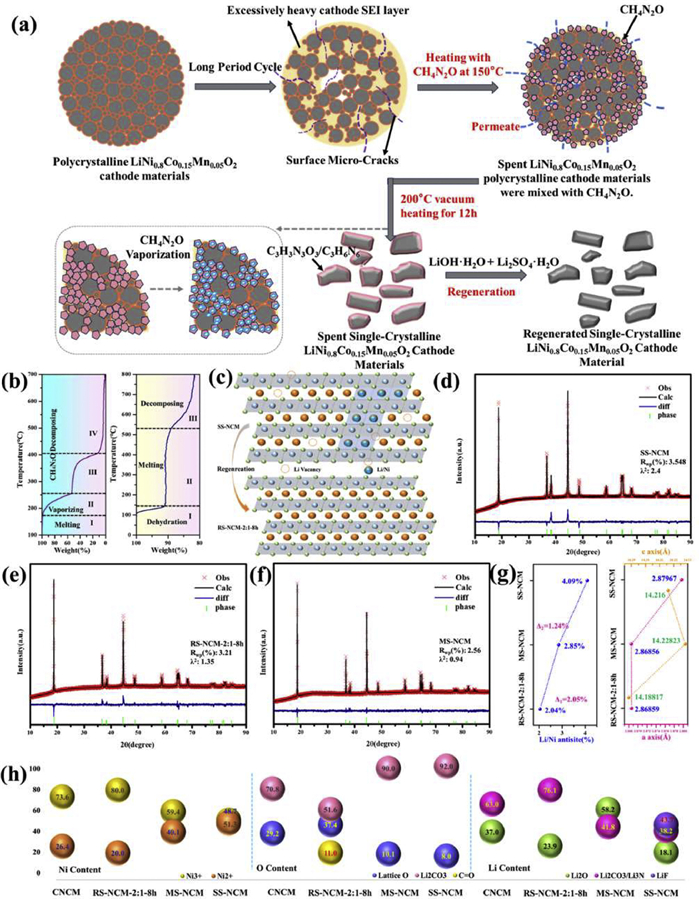
The spent polycrystalline LiNi0.8CoxMn0.2-xO2 cathode material undergoes anisotropic lattice expansion within its layered structure and inhomogeneous grain boundary stress during prolonged cycling, which leads to the formation of microcracks. Simultaneously, irreversible phase transitions induce structural collapse, coupled with interfacial side reactions, ultimately resulting in capacity degradation. This strategy involves the infiltration of molten CH4N2O through surface cracks and polycrystalline grain boundaries into the SS-NCM secondary particles. Under thermodynamically driven conditions, the rapid accumulation of NH3 and CO2 gases within intragranular pores generates localized high pressure, inducing crystalline expansion. The resulting stress concentration at grain boundaries accelerates intergranular fracture, ultimately leading to the cleavage of secondary particles (Fig. 1a and Eqs. S1-S4 in Supporting information). Additionally, residual melamine (C3H6N6) and cyanuric acid (C3H3N3O3) decompose and react with lithium salts under high-temperature conditions, achieving in situ self-formed modification of the interface fast ionic conductor Li3N phases on single-crystal particle surfaces (Eqs. S5-S8 in Supporting information).
Figure 1
Figure 1.
(a) Schematic illustration of single-crystal reconstruction from spent polycrystalline NCM Cathodes. (b) Thermogravimetric diagrams of the CH4N2O and LiOH/Li2SO4 molten salt system. (c) Schematic diagrams depicting the structural restoration of SS-NCM. (d-f) X-ray diffraction (XRD) refinement maps for SS-NCM, RS-NCM-2:1–8 h, and MS-NCM. (g) Variation of the a and c lattice parameters. (h) CNCM, SS-NCM, RS-NCM-2:1–8 h, and MS-NCM analyses for nickel (Ni) content, oxygen (O) content, and lithium (Li) content.
Thermogravimetric analysis (TGA) analysis elucidated the thermal decomposition kinetics and phase transition enthalpy characteristics of the material. At 130–150℃, CH4N2O undergoes intermolecular condensation to form the highly viscous intermediate biuret (NH2CONHCONH2) (Eqs. S11–S15 in Supporting information). This reaction concurrently facilitates the release of NH3 and forms a sub-molten state solid-liquid mixture with SS-NCM [18]. Undecomposed CH4N2O and its intermediates, driven by their low surface energy, permeate the grain boundary triple junctions of polycrystalline materials through interconnected surface cracks and grain boundary junctions. This process establishes the kinetic foundation of the reaction for subsequent single-crystal synthesis. Additionally, the LiOH-Li2SO4 binary eutectic system achieves the eutectic point at 355.89℃, enabling lithium-ion intercalation and structural restoration of the material (Fig. 1b). After the regeneration treatment, the chemical composition and lattice defects of the SS-NCM material were restored (Fig. 1c). Within the regeneration system, the low-temperature vacuum conditions suppress high-temperature phase transitions and lower the activation energy for cation migration, thereby achieving synergistic repair of lattice distortion and cation site defects. Within the regeneration system, low-temperature vacuum conditions suppress high-temperature phase transitions and lower the activation energy for cation migration, thereby achieving synergistic repair of lattice distortion and cation site defects.
Specifically, the XRD patterns of the RS-NCM-2:1–8 h material exhibited significantly enhanced splitting of the diffraction peaks between the (006)/(012) and (108)/(110) crystallographic planes (Fig. S1 in Supporting information), while the peak intensity at the (104) plane showed a notable increase (Figs. 1d-f). This observation confirms the effective filling of lithium-ion vacancies during the regeneration process. Due to the similar ionic radii of Ni2+ and Li+ (0.83 Å vs. 0.76 Å), Ni2+ tends to migrate into the lithium layers and occupy Li+ sites, resulting in Li+/ Ni2+ cation mixing. This cationic disorder destabilizes the layered structure, promotes the formation of a rock-salt phase, and blocks Li+ diffusion pathways, ultimately leading to irreversible capacity degradation [19]. Further Rietveld refinement revealed that the cationic mixing degree decreased to 2.04%, with a contracted c-axis lattice constant of 14.188(3) Å and a restored I003/I104 intensity ratio of 1.305, which collectively demonstrated the recovery of crystallographic ordering in the regenerated material (Fig. 1g and Table S1 in Supporting information). In comparison, the cationic mixing degree of 2.85% in NS-NCM indicates its limited effectiveness in restoration. Further analysis of Ni 2p XPS spectra reveals the critical role of surface nickel valence state modulation in stabilizing the material structure (Fig. 1h and Fig. S3 in Supporting information). The high Ni2+ content (51%) in SS-NCM induces severe cationic mixing between Li+ and Ni2+, driving the irreversible structural transformation of the surface region from a layered to a rock-salt phase. After regeneration, the RS-NCM-2:1–8 h material exhibits a significantly elevated Ni3+ content of 80% (vs. 73.6% in CNCM), effectively suppressing cationic mixing, retarding rock-salt phase formation, and restoring the layered structural integrity. In comparison, the MS-NCM material with a Ni3+ content of 59% exhibits only partial oxidation of Ni2+, which aligns with the higher cationic mixing degree derived from Rietveld refinement of XRD patterns, demonstrating limited recovery of the layered structure. Additionally, the characteristic peaks in the Li 1s spectra at 54, 55, and 56 eV correspond to Li2O, Li2CO3, and LiF, respectively. Specifically, Li2O originates from solid-state reactions during the oxidative sintering process, while Li2CO3 is formed through surface side reactions between Li2O and CO2 under an O2 atmosphere. In the Co 2p spectra, the characteristic peaks of Co3+ for all samples remained unchanged, indicating that the regeneration process did not alter the oxidation state of cobalt [20]. The O 1s spectra revealed that the structural collapse of SS-NCM resulted in a reduced lattice oxygen content of 8% [21]. In contrast, RS-NCM-2:1–8 h exhibited a significantly enhanced lattice oxygen content of 37.4%, demonstrating the restoration of its layered structure. However, the lattice oxygen content of MS-NCM increased slightly to 10.1%, further indicating that single-crystallization of polycrystalline materials via the molten salt method had a minimal effect on structural restoration. Notably, ICP analysis of metallic elements in all regenerated materials revealed that the Li/TM molar ratio was restored to 1, confirming effective Li+ replenishment (Table S2 in Supporting information). Therefore, our proposed synergistic strategy of thermodynamic regulation in sub-molten state and in situ self-formed modification with fast ionic conductor Li3N phases achieves concurrent restoration of SS-NCM through Li+ vacancy filling and Ni2+-to-Ni3+ oxidation. This approach effectively restores the layered structure while suppressing irreversible phase transitions, demonstrating structural recovery performance that significantly outperforms conventional molten salt methods [22].
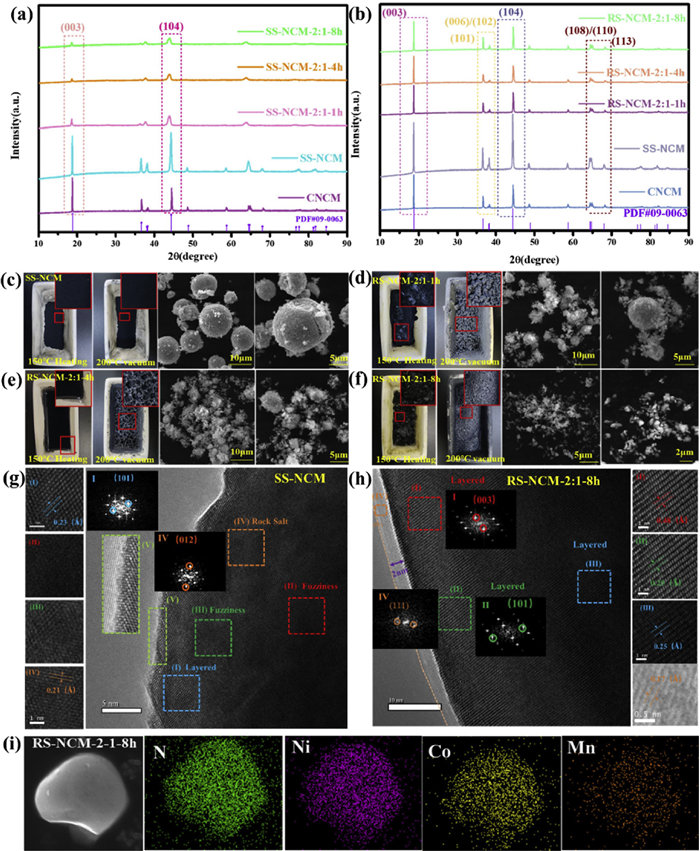
We systematically investigated the impact of sub-molten state thermodynamic regulation strategy on the Single-Crystallization regeneration process via multi-scale structural characterization. As the heating duration and CH4N2O mass ratio increased, the (003) and (104) peak intensities of the spent single-crystal materials progressively decreased with concurrent low-angle shifts (most pronounced at 8 h). This behavior originates from prolonged thermal treatment and elevated urea ratios under sub-molten state vacuum conditions, which intensify NH3/CO2 gas infiltration into interlayers and grain boundaries of polycrystalline materials (Fig. 2a and Fig. S21 in Supporting information). The resulting internal pressure induces lattice expansion and distortion (Figs. S3–S10 in Supporting information). However, the materials overall retained the characteristic layered α-NaFeO2-type structure. Notably, all regenerated materials exhibited the layered α-NaFeO2-type structure following regeneration treatment, as evidenced by the structural characterization data (Fig. 2b and Figs. S10–S13 in Supporting information) [23]. The distinct splitting of the (006)/(102) and (108)/(110) characteristic peaks with absence of shift, combined with an I(003)/I(104) intensity ratio exceeding 1.2 (Fig. S14), confirms the restoration of layered structural ordering. Further studies revealed that the cleavage degree of SS-NCM was synergistically controlled by the CH4N2O-to-SS-NCM mass ratio and heating duration Figs. 2c-f). At lower urea ratios (1:4, 1:2, 1:1) or shorter durations (1, 4 h), secondary particles were only partially fragmented into primary particles, exhibiting rough surfaces with abundant cracks (Figs. S15-S17 in Supporting information). In contrast, short-term treatment (1 h) with a high CH4N2O ratio (2:1) led to the formation of a surface passivation layer composed of residual CH4N2O and its excessive decomposition products (e.g., NH2CONHCONH2) (Fig. 2d). This layer suppressed the grain boundary penetration of decomposition products, thereby inhibiting cleavage. However, when the heat treatment duration was increased to 8 h, the penetration of CH3N2O and NH2CONHCONH2 into the grain interiors increased, and the continuous gas pressurization inside the grains led to the complete cleavage of secondary particles into single-crystalline particles with smooth surfaces and well-defined grain boundaries (~2 μm) (Fig. 2f and Fig. S18 in Supporting information). Elemental distribution analysis indicated that the regenerated materials maintained uniform distributions of Ni, Co, Mn, O, and N (Figs. S19 and S20 in Supporting information). Notably, materials regenerated with short durations (1 and 4 h) exhibited a loose and porous structure, whereas the smooth surface and dense crack-free single-crystalline structure of RS-NCM-2:1–8 h effectively suppressed electrolyte-interfacial side reactions, providing the structural basis for improved electrochemical performance (Fig. S22 in Supporting information and Fig. 2i). Additionally, heating SS-NCM at followed by vacuum pyrolysis did not convert polycrystalline particles into single-crystalline particles (Fig. 2c). Therefore, the cleavage degree of polycrystalline particles is governed by the penetration kinetics of CH4N2O and NH2CONHCONH2 under sub-molten state vacuum conditions. Synergistic optimization of the mass ratio and processing duration enables achieving ideal grain cleavage outcomes.
Figure 2
Figure 2.
XRD patterns of (a) spent single-crystal materials and (b) regenerated single-crystal materials. (c-f) Experimental snapshots and SEM images of SS-NCM with a mass ratio of 2:1 under different heat treatment durations. (g) HRTEM images and FFT patterns of SS-NCM and (h) RS-NCM-2:1–8 h. (i) SEM and EDS patterns of RS-NCM-2:1–8 h.
Further analysis was conducted using high-resolution transmission electron microscopy (HRTEM) and inverse fast Fourier transform (IFFT) on primary particles that exhibited distinct lattice fringes. Comparative analysis revealed that in SS-NCM, Li+ loss combined with transition metal (TM) cation disordering induces the formation of a rock-salt phase at boundary region Ⅳ. The lattice spacing of 0.21 Å corresponds to the (102) plane of NiO. Furthermore, the blurred FFT diffraction spots and lattice fringes in regions Ⅰ and Ⅲ indicate severe structural defects (Fig. 2g and Fig. S25 in Supporting information). Under sub-molten state thermodynamic regulation, RS-NCM-2:1–8 h exhibited uniformly oriented lattice fringes (Fig. 2h). Three distinct regions displayed well-defined lattice fringes with interplanar spacings of 0.48, 0.25, and 0.48 Å, corresponding to the (003), (101), and (003) crystallographic planes, respectively. Notably, a dense ~2 nm-thick surface coating was observed. Rapid inverse fast Fourier transform (IFFT) analysis revealed a lattice spacing of 0.17 Å matching the (111) crystallographic plane of Li3N, confirming the in situ self-formed interfacial modification with fast ionic conductor Li3N phases. The experimental results confirm that NH3 generated during pyrolysis combines with lithium salts in the system, achieving in situ self-formed modification of interface fast ionic conductor Li3N phases. This phenomenon is corroborated by thermodynamic analysis (Fig. S25 and Eqs. S5-S8 in Supporting information). The ternary cathode material RS-NCM-2:1–8 h, regenerated through a synergistic strategy of thermodynamic regulation in sub-molten state and in situ self-formed modification with fast ionic conductor Li3N interphases, not only eliminates transition metal (TM) cation disordering and rock-salt phase defects but also constructs a stabilized ionic superconducting interface (Fig. 2i). In contrast, the conventionally molten-salt-regenerated MS-NCM exhibits well-defined lattice fringes and diffraction spots in regions Ⅰ and Ⅱ, consistent with a layered structure. However, regions Ⅲ and Ⅳ show localized lattice disorder and lack a protective coating layer. SEM-EDS analysis further reveals edge cracks in the material, which are indicative of incomplete lattice restoration (Figs. S23–S25 in Supporting information).
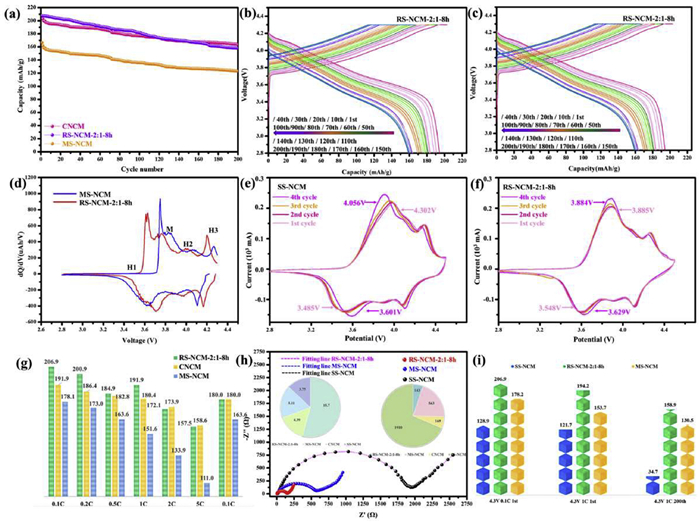
The regenerated material RS-NCM-2:1–8 h, based on the aforementioned structural optimization, demonstrated significantly superior electrochemical performance compared to SS-NCM and other regenerated samples. Specifically, SS-NCM exhibited an initial discharge capacity of only 121.7 mAh/g at a rate of 1 C, which sharply dropped to 34.7 mAh/g after 200 cycles. In contrast, RS-NCM-2:1–8 h demonstrated a significantly higher initial capacity of 194.42 mAh/g at 1 C, along with minimal voltage fade. In contrast, the regenerated materials treated with short heating durations or low urea ratios (e.g., RS-NCM-1:1–1 h and RS-NCM-2:1–1 h) exhibited significantly inferior electrochemical performance due to the presence of extensive cracks and loosely packed secondary particles. These samples delivered initial discharge capacities of 149.4 and 154.4 mAh/g at a rate of 1 C, respectively, with capacity retention rates of only 60.9% and 71.0% after 200 cycles, accompanied by significant median voltage decay (Figs. S26–S28 and Table S3 in Supporting information). The superior performance of RS-NCM-2:1–8 h can be attributed to sub-molten state thermodynamic tuning, which increases the proportion of single-crystal particles, eliminates grain boundary defects, and facilitates the formation of continuous conductive networks. These structural optimizations collectively enhance its cycling stability and increase voltage retention.
The electrochemical performance of RS-NCM-2:1–8 h was superior to that of MS-NCM and SS-MCM. RS-NCM-2:1–8 h exhibited an initial discharge capacity of up to 207.2 mAh/g at a rate of 0.1 C. After 200 cycles at 1 C, the specific discharge capacity of RS-NCM-2:1–8 h was measured at 158.9 mAh/g, resulting in a retention rate of 81.8% (Figs. 3a-c). This can be attributed to the structural homogeneity of single-crystal particles, which lack grain boundaries, thereby effectively suppressing microcrack formation. The shorter and more uniform Li+ diffusion paths reduce polarization and stabilize the charge/discharge plateaus [24]. Additionally, the interface fast ionic conductor Li3N phases undergoes electrochemical decomposition during high-voltage charging, releasing Li+ into the electrolyte. These Li+ subsequently re-intercalate into the cathode material during discharge, which suppresses lattice collapse and lithium loss caused by transition metal ion dissolution during the initial cycle activation process. This synergistic mechanism significantly enhances the initial discharge capacity [25]. Additionally, the electrolyte undergoes gradual consumption due to oxidative decomposition during prolonged cycling, leading to a reduction in the concentration of lithium salts (e.g., LiPF6). Li3N gradually decomposes during prolonged cycling, continuously releasing a small amount of Li+ ions, which compensates for lithium loss in the electrolyte and maintains sufficient ionic concentration. It is noteworthy that even under high-voltage conditions, Li3N preferentially participates in surface oxidation reactions (over the cathode material itself), thereby delaying oxygen evolution (O2) and lattice oxygen loss. This mechanism effectively mitigates bulk structural collapse and irreversible phase transitions, ensuring exceptional capacity retention, reduced polarization voltage, and enhanced reversibility after prolonged cycling (Figs. S29 and S31, Table S4 in Supporting information). In contrast, the SS-MCM material demonstrates an initial discharge-specific capacity of only 121.7 mAh/g, primarily due to significant Li+ ion loss, degradation of the crystal structure, and the presence of surface microcracks. This results in a capacity retention of only 28.5% after 200 cycles (Table S5 in Supporting information). Conversely, the MS-NCM material, which is sintered exclusively via the conventional high-temperature molten salt method, exhibits a higher initial discharge-specific capacity of 153.7 mAh/g. However, it still does not meet commercial requirements.
Figure 3
Figure 3.
Electrochemical performance of CNCM, SS-NCM, MS-NCM, and RS-NCM-2:1–8 h: (a) Long-term cycling performance. (b, c) Charge/discharge curves from the 1st to 200th cycles. (d) dQ/dV profiles. (e, f) Cyclic voltammetry (CV) curves. (g) Rate capability. (h) EIS spectra. (i) Performance summary.
Compared to the dQ/dV curves of MS-NCM, RS-NCM-2:1–8 h exhibited higher symmetry in redox peaks, narrower peak widths, and reduced voltage hysteresis. These characteristics indicate improved reaction kinetics, enhanced reversibility of Li+ de/intercalation, suppressed polarization, and greater bulk structural stability (Fig. 3d and Fig. S30 in Supporting information). However, SS-NCM and MS-NCM exhibit significant shifts in their redox peaks attributed to structural degradation coupled with irreversible phase transitions. Specifically, the oxidation peaks shift toward higher voltage regions, whereas the reduction peaks migrate to lower voltage regions. The phase transitions of the cathode materials can be observed in the cyclic voltammetry (CV) curves of SS-NCM, RS-NCM-2:1–8 h, and MS-NCM. Notably, the CV curves of RS-NCM-2:1–8 h exhibit highly consistent peak shapes, positions, and currents, indicating a stable chemical environment for Li+ ions and enhanced structural stability of the crystal structure. Meanwhile, RS-NCM-2:1–8 h exhibits enhanced reversibility of redox reactions. This enhancement is attributed to the high lithium-ion conductivity of Li3N, which reduces both electrochemical and concentration polarization during lithium-ion deintercalation and intercalation, resulting in a smaller potential difference between the oxidation and reduction reactions (Fig. 3f) [26]. In contrast, SS-NCM and MS-NCM showed significant shifts in the redox peaks, along with larger potential differences, attributed to structural degradation and irreversible phase transitions (Fig. 3e and Fig. S30).
Owing to the growing demand for fast charging, the electrochemical performance of the regenerated cathode materials was systematically evaluated under varied C-rates (Fig. 3g). During high-rate charging-discharging, Li+ ions must rapidly traverse the cathode surface to enter the electrolyte. The high Li+ conductivity of Li3N shortens the ion migration pathways, thereby enhancing reaction kinetics. Concurrently, it reduces direct contact between the cathode material and the electrolyte, thereby minimizing side reactions induced by intense electrochemical activity at high rates [27]. This mechanism enables the material to maintain a high discharge specific capacity of 157.5 mAh/g even at 5 C. However, MS-NCM exhibits localized high current density due to uneven ion transport under high-rate conditions, triggering lattice stress concentration and resulting in a discharge specific capacity of only 111.0 mAh/g at 5 C. Using electrochemical impedance spectroscopy (EIS), we further elucidated the reasons for the superior electrochemical performance of RS-NCM-2:1–8 h (Fig. 3h). Although a small amount of Li3N decomposes during cycling, a significant portion of the interface fast ionic conductor Li3N phases persists, serving as highly efficient Li+ transport channels. This effectively reduces the interfacial charge transfer resistance (Rct) and ensures long-term stability [28]. Therefore, after 200 cycles, RS-NCM-2:1–8 h still exhibits low charge transfer resistance (Rct = 143 Ω). Additionally, the regenerated RS-NCM-2:1–8 h material demonstrates superior discharge capacity retention under varying charge-discharge conditions compared to SS-NCM and MS-NCM (Fig. 3i).
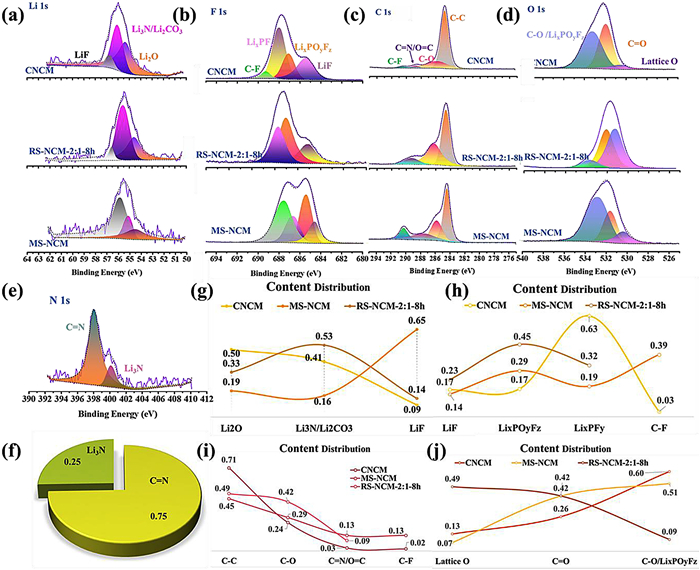
The composition of the cathode electrolyte interphase (CEI) layer on the surfaces of RS-NCM-2:1–8 h, MS-NCM, and CNCM electrodes after 200 cycles was analyzed using X-ray photoelectron spectroscopy (XPS). Due to its high mechanical modulus, the Li3N coating layer acts as a structural framework to reinforce the CEI, thereby enhancing its mechanical strength [29]. Additionally, Li3N exhibits ultrahigh lithium-ion conductivity, which facilitates uniform Li+ intercalation/deintercalation during charge-discharge processes, prevents localized high current density, and promotes homogeneous CEI growth [30]. The Li3N-rich fast ionic conductor layer plays a crucial role in facilitating the formation of a robust and conductive CEI. The Li 1s XPS spectrum displays distinct peaks at 56, 55, and 54 eV (Fig. 4a), corresponding to the signals from LiF, Li3N /Li2CO3, and Li2O, respectively. The intensity of the Li3N/Li2CO3 peaks in RS-NCM-2:1–8 h is significantly greater than that in MS-NCM and CNCM, which represent 53% of the total spectral area. Furthermore, the characteristic peak of Li3N at 401.5 eV in the N 1s spectrum confirms the presence of stable Li3N (Figs. 4e and f). Although partial decomposition of Li3N during cycling continuously releases a small amount of Li+ to compensate for lithium loss, a significant amount remains, providing efficient lithium-ion conduction pathways [31].
Figure 4
Figure 4.
XPS spectra of (a) Li 1s, (b) F 1s, (c) C 1s, (d) O 1s, and (e) N 1s for CNCM, RS-NCM-2:1–8 h, and NS-NCM, along with (f-j) the corresponding content variations in panels.
Notably, the characteristic peaks of LiF exhibit synchronized enhancement, accounting for 14% of the total (Fig. 4g). During cycling, Li3N preferentially forms a LiF/Li3N -rich passivation layer via a reductive interfacial reaction (Li3N + HF → LiF + NH3↑). The trace LiF content optimizes lithium-ion diffusion kinetics, reduces interfacial resistance, and minimizes active lithium loss and electrolyte consumption, thereby significantly enhancing cycle life [32]. This suppression mechanism inhibits β → α phase transition-induced C-F bond cleavage. The appearance of the LixPOyFz and LixPFy peaks is related to the decomposition of both the LiPF6 salt and the solvent. The weakening of the LixPOyFz signal at 534 eV in the O 1s spectrum can be attributed to the preferential consumption of reactive fluorine species (e.g., PF5) in the electrolyte by Li3N, leading to suppressed decomposition of LiPF6 (Figs. 4d and j). These results demonstrate that the in situ self-formed modification of the fast ionic conductor Li3N phases achieves precise coordination among the composition, structure, and functionality of the cathode electrolyte interphase. This synergy significantly enhances the material's electrochemical performance while maintaining the structural integrity of the CEI layer. F 1s spectrum exhibits four peaks corresponding to LiF (685 eV), LixPOyFz (686 eV), LixPFy (687 eV), and C-F (689 eV) (Figs. 4b and h) [33-35]. The concurrent disappearance of the C-F bond signal at 685 eV and the absence of the C-F bond signal at 290 eV in the C 1s spectrum synergistically confirm that the dense Li3N layer (~2 nm in thickness) prevents direct contact between the PVDF binder and the electrolyte through its physical barrier effect, even after prolonged cycling (Figs. 4c and i). This suppression mechanism inhibits β → α phase transition-induced C-F bond cleavage. The appearance of the LixPOyFz and LixPFy peaks is related to the decomposition of both the LiPF6 salt and the solvent. The weakening of the LixPOyFz signal at 534 eV in the O 1s spectrum can be attributed to the preferential consumption of reactive fluorine species (e.g., PF5) in the electrolyte by Li3N, leading to suppressed decomposition of LiPF6 (Figs. 4d and j). These results demonstrate that the in situ self-formed modification of the fast ionic conductor Li3N phases achieves precise coordination among the composition, structure, and functionality of the CEI layer. This synergy significantly enhances the material's electrochemical performance while maintaining the structural integrity of the CEI layer.
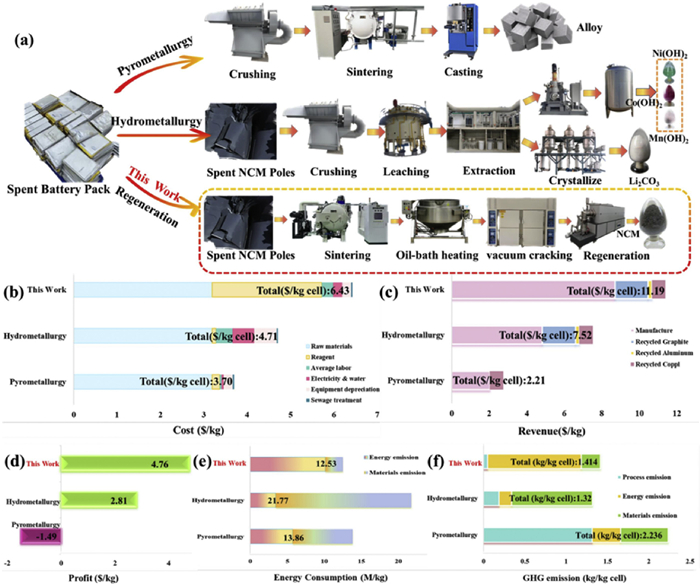
Fig. 5a illustrates the process flows for different treatment methods of spent lithium-ion battery (LIB) cathode materials, including pyrometallurgy, hydrometallurgy, and direct regeneration. It is important to note that conventional pyrometallurgical and hydrometallurgical processes, although capable of recovering certain metal elements, do not effectively regenerate NCM cathode materials. Compared with conventional processes, our proposed synergistic strategy of thermodynamic regulation in sub-molten state and in situ self-formed modification with fast ionic conductor Li3N interphases for regenerating ternary single-crystal cathode materials significantly reduces reaction temperatures and processing duration while simplifying both process flow and equipment requirements. This innovative approach avoids the use of corrosive reagents (strong acids and alkalis) typically required in traditional methodologies.
Figure 5
Figure 5.
Economic comparative analysis of different recycling methods: (a) Flowcharts of pyrometallurgy, hydrometallurgy, and pyrolytic single-crystallization regeneration methods. (b) Cost. (c) Total recovery. (d) Profit evaluation. (e) Energy consumption. (f) Greenhouse gas emissions.
Market economic analysis was conducted using the EverBatt model based on potential economic and environmental benefits [36]. The economic analysis model for the three recycling methods assumed treatment of 1.0 kg of SS-NCM material. Pyrometallurgy, hydrometallurgy, and our novel direct regeneration method cost $3.70, $3.70, $4.71, and $6.43 (Fig. 5b). EverBat calculated process data for pyrometallurgy and hydrometallurgy (Tables S6, S11 and S12 in Supporting information) to enhance the reader's understanding. Process data for our novel direct regeneration method were calculated using laboratory parameters as a basis (Table S13 in Supporting information) [37]. However, the product values of pyrometallurgy, hydrometallurgy, and our new direct regeneration method vary considerably, at $2.21, $7.52, and $11.19, respectively. The costs and benefits were modeled (Figs. 5a and b) [38]. Additionally, the aluminum, copper, and graphite recovered during the process can be sold to compensate for some of the costs [39]. However, the costs of pyrometallurgical processes cannot be offset because of the low value of the recovered alloy product (Fig. 5c and Table S7 in Supporting information). In addition, pyrometallurgical methods are no longer viable for recovering spent LIB cathode materials in modern industrial applications due to expensive equipment and high energy consumption. Compared with the hydrometallurgical method, the regenerated cathode materials obtained by our novel direct regeneration method can be directly reused by battery manufacturers without the need for further re-synthesis, which has an objective product value and leads to considerable profits (Fig. 5d, Tables S8 and S14-S16 in Supporting information). In addition, environmental modeling was conducted for the three processes [40]. Data on energy consumption and carbon emissions for the pyrometallurgical and hydrometallurgical processes were supplied by EverBatt, while the data for our novel direct regeneration method were calculated based on our laboratory parameters (Tables S9 and S10 in Supporting information). Our proposed process utilizing a synergistic strategy of thermodynamic regulation in sub-molten state and in situ self-formed modification with fast ionic conductor Li3N interphases for regenerating ternary single-crystal cathode materials exhibits significantly reduced energy consumption and carbon emissions, demonstrating substantial environmental benefits (Figs. 5e and f) [41].
In summary, we propose a synergistic strategy of thermodynamic regulation in sub-molten state and in situ self-formed modification with fast ionic conductor Li3N interphases. This methodology enables structural optimization of spent polycrystalline LiNi0.8CoxMn0.2-xO2 particle systems, ultimately enhancing their electrochemical performance. Leveraging the permeation dynamics of molten CH4N2O into surface cracks and grain boundaries of SS-NCM, localized hyperpressure generated via thermodynamically driven gas accumulation induces crystalline lattice expansion and controlled fragmentation of secondary particles. Concurrently, the coupled reaction between high-temperature decomposition residues and lithium salts enables in situ self-formed modification with fast ionic conductor Li3N phases on single-crystal surfaces. This synergistic protocol enhances the mechanical integrity of the CEI while facilitating its conformal growth, thereby achieving comprehensive restoration of the material’s chemical stoichiometry, crystallographic configuration, and electrochemical performance metrics. The regenerated single-crystalline cathode material delivers an initial discharge capacity of 207.2 mAh/g at 0.1 C and retains a specific discharge capacity of 158.9 mAh/g after 200 cycles, corresponding to a capacity retention of 81.8% at 1C. Furthermore, the regenerated material exhibits exceptional cycling stability under high-voltage operation at 4.5 V. Based on an economic viability assessment, our novel single-crystalline regeneration method demonstrates enhanced profit margins through cost competitiveness enhancement and value-added product optimization. This work proposes a simple single-crystalline regeneration strategy for spent polycrystalline materials, offering a novel solution to efficiently and readily prepare ternary single-crystalline cathode materials with high specific capacity and long-term cycling stability.
The authors declare that they have no known competing financial interests or personal relationships that could have appeared to influence the work reported in this paper.
Acknowledgments
The Basic Research Plan of Yunnan Province (No. 202501AW070007), the Yunnan Precious Metals Laboratory Technology Plan Project (No. YPML-20240502049), the Yunnan Province Xingdian Talent Support Program (No. XDYC-QNRC-2023–0092), the High-level Talent Introduction Scientific Research Start Project of KUST (No. 20190015), the Kunming University of Science and Technology Analysis Test Fund (No. 2024T20180052) are gratefully acknowledged and the Kunming University of Science and Technology Graduate Program for Top Innovative Talents (No. 20212202024).
Supplementary materials
Supplementary material associated with this article can be found, in the online version, at doi:10.1016/j.cclet.2025.111565.
Figure 1
(a) Schematic illustration of single-crystal reconstruction from spent polycrystalline NCM Cathodes. (b) Thermogravimetric diagrams of the CH4N2O and LiOH/Li2SO4 molten salt system. (c) Schematic diagrams depicting the structural restoration of SS-NCM. (d-f) X-ray diffraction (XRD) refinement maps for SS-NCM, RS-NCM-2:1–8 h, and MS-NCM. (g) Variation of the a and c lattice parameters. (h) CNCM, SS-NCM, RS-NCM-2:1–8 h, and MS-NCM analyses for nickel (Ni) content, oxygen (O) content, and lithium (Li) content.
Figure 2
XRD patterns of (a) spent single-crystal materials and (b) regenerated single-crystal materials. (c-f) Experimental snapshots and SEM images of SS-NCM with a mass ratio of 2:1 under different heat treatment durations. (g) HRTEM images and FFT patterns of SS-NCM and (h) RS-NCM-2:1–8 h. (i) SEM and EDS patterns of RS-NCM-2:1–8 h.
Figure 4
XPS spectra of (a) Li 1s, (b) F 1s, (c) C 1s, (d) O 1s, and (e) N 1s for CNCM, RS-NCM-2:1–8 h, and NS-NCM, along with (f-j) the corresponding content variations in panels.
Figure 5
Economic comparative analysis of different recycling methods: (a) Flowcharts of pyrometallurgy, hydrometallurgy, and pyrolytic single-crystallization regeneration methods. (b) Cost. (c) Total recovery. (d) Profit evaluation. (e) Energy consumption. (f) Greenhouse gas emissions.


 DownLoad:

 下载:


 下载:

