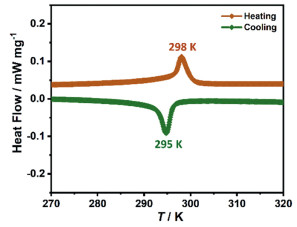
Figure 1.
DSC curves as a function of temperature for 1.

Large vertical spontaneous polarization and strong second harmonic generation in a layered perovskite ferroelectric
Qian-Jun Gu , Run-Zhi Zhang , Rao Ma , Ya-Juan Li , Peng-Peng Gong , Yi Guo , Bo Huang , Ai-Xin Zhu


Ferroelectrics, as a kind of attractive multifunctional materials, have a wide range of potential applications in sensors, actuators, photovoltaics, displays, energy conversion, and high-density memory devices, attributing to their remarkable dielectric, piezoelectric, pyroelectric, second harmonic generation (SHG), and ferroelectric properties [1-9]. The current trends in miniaturizing smart devices have promoted the development of low-dimensional materials, particularly atomically thick materials with superior ferroelectric performance, which was considered as promising candidates for replacing silicon as future basic materials for electronics [10]. The conventional ferroelectric thin films could be an excellent option, but such thin film frequently experiences quantum tunneling and depolarization frustration effect [11].
Recently, the emergence of two-dimensional organic–inorganic metal hybrids (OIMHs) provides a new opportunity [12-17]. These materials consist of alternating organic cations and inorganic layers, which could incorporate diverse flexible organic molecules and metal ions, providing a broad platform for the preparation and development of new ferroelectric materials [18-23]. Many outstanding examples can be found for the last few years, such as the unusual triple-state switching in (NMCA)2[PbCl4] (NMCA = N-methylcyclohexylammonium) [24], the inversion of molecular chirality associated with ferroelectric switching in CystaH2[CuCl4] (CystaH2 = NH3(CH2)2SS(CH2)2NH3) [25], the clearly magneto-electric correlation in a soft ferromagnet (S)/(R)-(MPA)2CuCl4 (MPA = β-methylphenethylammoniumion) [26], and the coexistence of ferroelectricity and ferromagnetism in (DFCBA)2[CrCl4] (DFCBA = 3,3-difluorocyclobutylammonium) [27]. These discoveries have been significantly promoted the potential applications in the fields of multifunctional ferroelectric devices [28-30]. On the other hand, to obtain a miniaturized device based on the two-dimensional ferroelectric materials, the most attractive model would be the vertical-sandwich-type, which requires a vertical spontaneous polarization [31]. Specifically, the vertical polarization, namely out-of-plane polarization, refers to the spontaneous polarization formed on the vertical direction of the two-dimensional ferroelectric materials. Such polarization can be maintained against depolarizing field, rendering high-density data storage possible [32]. However, the two-dimensional ferroelectrics with vertical polarization are still scarce, which may ascribe to the interlayer cations are perpendicular to the inorganic layers and tending to cancel net vertical polarization, thus resulting in parallel or in-plane polarization [33-37]. Therefore, it is essential to discover new ferroelectrics with large vertical spontaneous polarization.
For the applications of temperature-controlled sensors and switches, the anomalies of physical properties (such as dielectric and non-linear optics) appear at near room temperature are highly desirable, for they can benefit from temperature fluctuation of the ambient environment, which could provide a cost-effective and environmentally friendly solution. In our previous studies on organic–inorganic metal hybrids, we found the flexible organic cation (C6H5CH2CH2NH3+) is very susceptive to stimulus of temperature, thus may provide structural phase transitions [38,39].
In general, a lower symmetric organic cation could give rise to a larger dipole moment, which may generate a more remarkable ferroelectric spontaneous polarization. Follow this strategy, we synthesized a new organic–inorganic hybrid compound, (2-F-C6H4CH2CH2NH3)2[CdCl4] (1). By the techniques of differential scanning calorimetry (DSC), single-crystal X-ray diffraction analyses, dielectric properties, second harmonic generation (SHG), ferroelectric hysteresis loop, and piezoresponse force microscopy (PFM), we investigated its frequency-dependent dielectric behavior, strong SHG intensity, and large vertical spontaneous polarization.
The structural phase transition of 1 was detected by DSC, which exhibits a distinct pair of thermal anomalies at about 295/298 K (TC) during the cooling/heating cycles, indicating a reversible structural phase transition at near room temperature (Fig. 1). For convenience, we label the phase below TC as the low temperature phase (LTP), and above TC as the high temperature phase (HTP). From the Boltzmann equation, ΔS = Rln(N) (ΔS is the change in entropy, R is the gas constant, and N denotes the orientations in HTP), we obtained N ≈ 2.4, which suggests an order–disorder-type structural phase transition in 1.
To elucidate the structural phase transitions, single-crystal X-ray diffraction analyses were performed at 310 K (HTP) and 200 K (LTP), respectively. At 310 K, compound 1 crystallizes in a centrosymmetric monoclinic space group of A2/m (nonstandard setting of prototypical C2/m, for comparison with the LTP), with cell parameters a = 5.2345(3) Å, b = 5.2341(3) Å, c = 39.146(3) Å, β = 86.883(5)°, and V = 1070.9(1) Å3. The asymmetric unit contains one 2-F-C6H4CH2CH2NH3+ (0.5 occupied) moiety and one [CdCl4]2– moiety (0.25 occupied). At 200 K, 1 crystallizes in a polar monoclinic space group of Cc, with cell parameters of a = 10.4977(3) Å, b = 10.4951(3) Å, c = 37.626(1) Å, β = 92.286(3)°, and V = 4142.1(2) Å3. The asymmetric unit contains one [CdCl4]24– moiety and four independent 2-F-C6H4CH2CH2NH3+ cations.
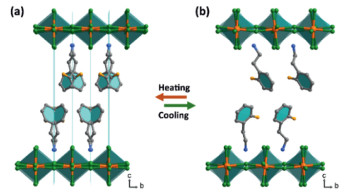
As shown in Fig. 2, compound 1 features typical layered perovskite structure, which consists of two-dimensional infinite [CdCl4]n2n– inorganic layers made up by corner-sharing CdCl6 octahedra, and these inorganic layers are separated by bilayers of 2-F-C6H4CH2CH2NH3+ cations. Such hybrid structure is stabilized by the Coulomb interactions, van der Waals forces, and N–H···Cl hydrogen bonds (Fig. S4 in Supporting information). The structural phase transition from HTP to LTP can be ascribed to the disorder–order change of the organic cations and inorganic layers, as well as the tilting of the CdCl6 octahedra. At 310 K, the organic cations and Cl– anions exhibit disorder about the crystallographic mirror planes (shown in aqua planes in Fig. 2a). When cooling to 200 K, they become ordered and lost the mirror planes, leading to the symmetric elements decrease from four (E, C2, i, σh) to two (E, σh) with an Aizu notation of 2/mFm (Fig. S5 in Supporting information), indicating that the structural phase transition should be a ferroelectric one with two equivalent polarization directions.
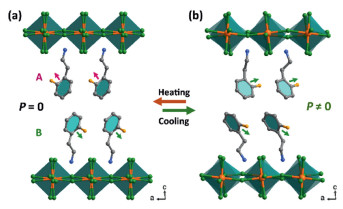
The origin of ferroelectric polarization can be illustrated by Fig. 3. In the paraelectric phase, the dipole moments cancel each other out in the direction along the a-axis and c-axis (shown in red and green arrows in Fig. 3a). Unexpectedly, triggering by the reorientation of the organic cations, half of them flip to the opposite direction approximately along the a-axis (marked as A in Fig. 3a), and the remaining half (mark as B in Fig. 3a) only show twisted motion. Specifically, the flipping of the A-type organic cations induce all –F groups arranged along the a-axis (Fig. S6a in Supporting information), while the twisting of the B-type organic cations induce the 2-F-C6H4– groups tilting to the c-axis (Fig. S6 in Supporting information). These changes generate an alternately and tilted arrangement of the organic cations between the inorganic layers, resulting in net dipole moments along the a-axis and c-axis (shown in green arrows in Fig. 3b). Such unusual structural phase transition mechanism induced by the 2-F-C6H4CH2CH2NH3+ cations, which is apparently different from the non-ferroelectric analogs such as (C6H5CH2CH2NH3)2CdCl4, (3-F-C6H4CH2CH2NH3)2CdCl4 and (4-F-C6H4CH2CH2NH3)2CdCl4 (the organic cations are perpendicular to the inorganic layers with up and down arrangements, resulting in centrosymmetric space groups) [40], but is similar to (6-bromohexylammonium)2CdBr4 (the cations are oriented alternately between the inorganic layers, which promotes spontaneous ferroelectric polarization along the [100] and [001] directions) [41]. In this sense, fine tuning a flexible organic cation could be a promising approach to design novel organic–inorganic hybrid ferroelectrics.
The temperature-dependent complex dielectric permittivities (ε = ε′ – iε′′) were measured for 1. For the powder-pressed sample in the cooling process (Fig. 4), prominent dielectric anomalies (ε′) induced by the structural phase transition were observed at around 295 K. Interestingly, the anomalies of ε′ exhibit unusual frequency-dependent behaviour, i.e., the peak-like dielectric anomalies at low frequencies (from 1 kHz to 100 kHz) revealing a proper ferroelectric transition, but slowly turn into step-like anomalies at high frequencies (from 100 kHz to 1000 kHz) which suggest an improper one. Such rare and complicated dielectric phenomenon may attribute to the different disorder–order and distorted process of the organic cations and inorganic layers of 1. For the low frequency of 1 kHz, the ε′ obeys the Curie–Weiss law, ε′ = Cferro/(T0 – T) (when T < TC) or ε′ = Cpara/(T – T0′) (when T > TC), where C is the Curie constant, T is the temperature, and T0 is the Curie-Weiss temperature. A fit of the reciprocal dielectric constant (1/ε′) vs. T plot (inset of Fig. 4a) afforded Cferro = 199 K and Cpara = 258 K. The Cferro value is smaller than those of typical displacive-type (C ≈ 105 K) ferroelectrics such as BaTiO3 (1.5 × 10⁵ K), but close to the order–disorder-type (C ≈ 103 K) ferroelectrics such as bromocholine bromide (396 K) [42], which is agreement with the analyses of variable-temperature crystal structures.
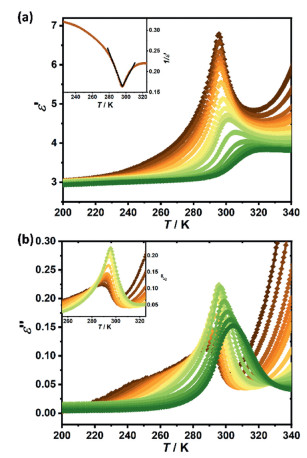
Correspondingly, the peak maximum of the imaginary part (ε′′) increase from 0.11 at 1 kHz to the maximum value of 0.22 at 100 kHz (inset of Fig. 4b), then decrease to 0.15 at 1000 kHz, with the temperature of the peak maximum shifts from 288 K (1 kHz) to 304 K (1000 kHz), resulting in a thermal hysteresis of about 16 K induced by frequencies. Such behaviour may ascribe to the slowly freezing processes of the organic cations and inorganic layers. Moreover, this behaviour of dielectric properties can be repeated in the heating process of the powder-pressed sample (Fig. S7 in Supporting information) and single crystal samples measured along the a-axis, b-axis, and c-axis (Fig. S8 in Supporting information), which may find potential applications in temperature and frequency-controlled sensors near room temperature.
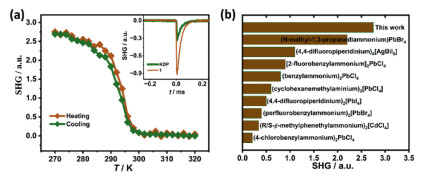
The signal of SHG is sensitive to the lack of inversion symmetry. To detect the symmetry breaking induced by the structural phase transition, temperature dependent of SHG for heating and cooling process were carried out on 1. As shown in Fig. 5a, the reversible SHG signals are inactive above TC, but show a step-like increase as temperature decreases, and reach about 2.75 relative to KH2PO4 (KDP) at about 270 K, which is in agreement with the change from a centrosymmetric phase (A2/m) to the non-centrosymmetric one (Cc). Among the organic–inorganic hybrid ferroelectrics, the SHG intensity of 1 is smaller than NH2(CH3)2GeI3 (12) [3], and (3-hydroxypyrrolidinium)2RbBiBr6 (3.8) [43], but larger than most molecule-based ferroelectrics such as (3-F-BTAB)PbBr3 (3-F-BTAB = 3-fluorobenzyltrimethylammonium) (1.5) [44], (AMP)2SbBr5 (AMP = 2-amino-2-methyl-1-propanol) (1.3) [45], (R-3P)2KBiCl6 (R-3P = R-3-hydroxypyrrolidinium) (0.6) [46], [(R)-β-MPA]2CdCl4 (MPA = methylphenethylammonium) (0.35) [47]. Remarkably, to our knowledge, the SHG signal of 1 is among the largest one in the well-known two-dimensional organic-inorganic hybrid perovskite ferroelectrics (Fig. 5b, for more details of comparison of SHG, see Table S4 in Supporting information). Such outstanding changes of SHG signals in 1 appear at around 295 K, which could regard as “SHG off” and “SHG on” at near room temperature, suggesting a promising cost-effective and environmentally friendly application as a temperature-responsive nonlinear optical sensor and switch.
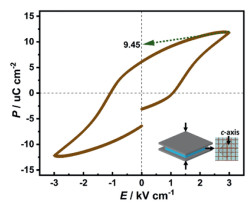
The ferroelectric property of 1 was confirmed by the well-shaped hysteresis loop recorded on a crystal along the c-axis (vertical) at 280 K (1 Hz). As shown in Fig. 6, a large spontaneous polarization (Ps) of about 9.45 μC/cm2 was obtained, with a remnant polarization (Pr) and a low coercive field (Ec) of about 6.20 μC/cm2 and 1.07 kV/cm, respectively. Among the two-dimensional hybrid ferroelectrics, the Ps of 1 is only smaller than few lead-based ferroelectrics, such as (4-CBZA)2PbCl4 (4-CBZA = 4-chlorobenzylammonium) (23.3 μC/cm2) [48], (CHMA)2PbCl4 (CHMA = cyclohexanemethylaminium) (15.4 μC/cm2) [36], and (BZA)2PbCl4 (BZA = benzylammonium) (13 μC/cm2) [49], comparable to (AA)2[CsGe2I7] (AA = amylammonium) (10.55 μC/cm2) [34], (DFPIP)4[AgBiI8] (DFPIP = 4,4-difluoropiperidinium) (10.5 μC/cm2) [50], (4,4-DFPD)2PbI4 (DFPD = difluoropiperidinium) (10 μC/cm2) [37], and larger than most two-dimensional hybrid ferroelectrics (For more details of comparison of Ps and Ec, see Table S4 in Supporting information). The quite small Ec of 1, belonging to the smallest ones in the two-dimensional ferroelectrics, which is highly desirable for energy-saving operations in applications, signifying a promising way to miniaturize smart devices based on the two-dimensional ferroelectrics.
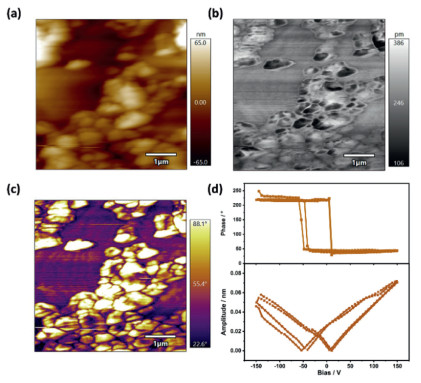
Moreover, the ferroelectric behavior was further corroborated by the PFM measurements for a single crystal of 1. As illustrated in Figs. 7a–c, the amplitude and phase diagrams of 1 show distinct non-180° domains and are separated by domain walls. At the same time, the amplitude‒voltage curve displays a characteristic butterfly loop, and the phase‒voltage curve manifests a distinct hysteresis loop (Fig. 7d), confirming that 1 has good ferroelectric switching properties.
In conclusion, we presented a near room temperature two dimensional organic–inorganic hybrid layered perovskite ferroelectric, i.e., (2-F-C6H4CH2CH2NH3)2[CdCl4]. Triggered by the reorientation of the organic cations and inorganic layers, an unusual flipping and twisting ferroelectric mechanism was demonstrated. Moreover, the prominent frequency-dependent dielectric anomalies, strong SHG responds, and large vertical spontaneous polarization in 1, demonstrating its potential application in optoelectronic devices.
Qian-Jun Gu: Writing – original draft, Investigation, Formal analysis, Data curation. Run-Zhi Zhang: Validation, Investigation. Rao Ma: Validation, Investigation. Ya-Juan Li: Validation, Data curation. Peng-Peng Gong: Validation, Data curation. Yi Guo: Validation, Data curation. Bo Huang: Writing – review & editing, Supervision, Funding acquisition. Ai-Xin Zhu: Writing – review & editing, Funding acquisition.
The authors declare that they have no known competing financial interests or personal relationships that could have appeared to influence the work reported in this paper.
This work was supported by the National Natural Science Foundation of China (Nos. 22361055 and 22161052), the Yunnan Fundamental Research Projects (No. 202401AT070113), and the Xingdian Talent Support Program of Yunnan Province of China.
CCDC 2426029 and 2426030 contain the supplementary crystallographic data for this paper. These data can be obtained free of charge from The Cambridge Crystallographic Data Centre via www.ccdc.cam.ac.uk/data_request/cif. Supplementary material associated with this article can be found, in the online version, at doi:
Q. Pan, Z.X. Gu, R.J. Zhou, et al., Chem. Soc. Rev. 53 (2024) 5781–5861. doi: 10.1039/d3cs00262d
X.G. Chen, X.J. Song, Z.X. Zhang, et al., J. Am. Chem. Soc. 142 (2020) 1077–1082. doi: 10.1021/jacs.9b12368
K. Ding, H. Ye, C. Su, et al., Nat. Commun. 14 (2023) 2863. doi: 10.1038/s41467-023-38590-7
W.X. He, C.J. Chen, S.Y. Wu, et al., J. Am. Chem. Soc. 147 (2025) 811–820. doi: 10.1021/jacs.4c13604
Y.Y. Zhang, J.Q. Luo, Y. Han, et al., Chin. Chem. Lett. 36 (2025) 109690. doi: 10.1016/j.cclet.2024.109690
Z.Y. Du, M. Xie, W. Qiu, et al., Angew. Chem. Int. Ed. 64 (2025) e202508902. doi: 10.1002/anie.202508902
Z.Y. Yue, H.K. Li, N. Wang, et al., Chin. Chem. Lett. 35 (2024) 109355. doi: 10.1016/j.cclet.2023.109355
L. Ye, Z.L. Fang, M.Y. Guo, et al., Chin. Chem. Lett. 37 (2026) 110826. doi: 10.1016/j.cclet.2025.110826
H.F. Ni, J.H. Lin, G. Teri, et al., Chin. Chem. Lett. 36 (2025) 109530. doi: 10.1016/j.cclet.2024.109530
Z. Guan, H. Hu, X. Shen, et al., Adv. Electron. Mater. 6 (2020) 1900818. doi: 10.1002/aelm.201900818
P. Man, L.L. Huang, J. Zhao, et al., Chem. Rev. 123 (2023) 10990–11046. doi: 10.1021/acs.chemrev.3c00170
C.R. Huang, X. Luo, X.G. Chen, et al., Natl. Sci. Rev. 8 (2020) nwaa232.
C. Ji, S. Wang, Y. Wang, et al., Adv. Funct. Mater. 30 (2020) 1905529. doi: 10.1002/adfm.201905529
L.N. Li, X.T. Liu, Y.B. Li, et al., J. Am. Chem. Soc. 141 (2019) 2623–2629. doi: 10.1021/jacs.8b12948
W.J. Wei, H.Q. Gao, M. Fang, et al., Sci. China Chem. 66 (2023) 466–474. doi: 10.1007/s11426-022-1446-3
Z.Y. Wu, C.M. Ji, L.N. Li, et al., Angew. Chem. Int. Ed. 130 (2018) 8272–8275. doi: 10.1002/anie.201803716
Y. Gong, X. Chen, B. Zhao, et al., Chin. Chem. Lett. 34 (2023) 108282. doi: 10.1016/j.cclet.2023.108282
C. Shi, L. Ye, Z.X. Gong, et al., J. Am. Chem. Soc. 142 (2019) 545–551. doi: 10.1145/3338906.3338925
P.P. Shi, S.Q. Lu, X.J. Song, et al., J. Am. Chem. Soc. 141 (2019) 18334–18340. doi: 10.1021/jacs.9b10048
J.Q. Wang, Y. Ma, Z.J. Wang, et al., Matter, 5 (2022) 194–205. doi: 10.1016/j.matt.2021.10.020
Z. Wu, S. Li, Y.M. Yousry, et al., Nat. Commun. 13 (2022) 3104. doi: 10.1038/s41467-022-30822-6
C.K. Yang, W.N. Chen, Y.T. Ding, et al., Adv. Mater. 31 (2019) 1808088. doi: 10.1002/adma.201808088
H.Y. Zhang, Z.X. Zhang, X.J. Song, et al., J. Am. Chem. Soc. 142 (2020) 20208–20215. doi: 10.1021/jacs.0c10686
Y. Ma, B.B. Wang, W.J. Li, et al., J. Am. Chem. Soc. 146 (2024) 27287–27292. doi: 10.1021/jacs.4c10415
W.F. Deng, Y.X. Li, Y.X. Zhao, et al., J. Am. Chem. Soc. 145 (2023) 5545–5552. doi: 10.1021/jacs.3c00634
K. Taniguchi, M. Nishio, N. Abe, et al., Angew. Chem. Int. Ed. 60 (2021) 14350–14354. doi: 10.1002/anie.202103121
Y. Ai, R. Sun, W.Q. Liao, et al., Angew. Chem. Int. Ed. 61 (2022) e202206034. doi: 10.1002/anie.202206034
Z.Y. Wu, W.C. Zhang, H. Ye, et al., J. Am. Chem. Soc.143 (2021) 7593–7598. doi: 10.1021/jacs.1c00459
C.S. Yang, Y.H. Jiang, P.P. Yu, et al., Chin. Chem. Lett. 36 (2025) 110218. doi: 10.1016/j.cclet.2024.110218
H.Y. Zhang, Z.X. Zhang, X.G. Chen, et al., J. Am. Chem. Soc. 143 (2021) 1664–1672. doi: 10.1021/jacs.0c12907
C.C. Fan, C.D. Liu, B.D. Liang, et al., Inorg. Chem. 62 (2023) 12634–12638. doi: 10.1021/acs.inorgchem.3c02057
Q. Yang, W. Xiong, L. Zhu, et al., J. Am. Chem. Soc. 139 (2017) 11506–11512. doi: 10.1021/jacs.7b04422
C.C. Fan, X.B. Han, B.D. Liang, et al., Adv. Mater. 34 (2022) 2204119. doi: 10.1002/adma.202204119
X. Li, J. Bie, Q. Wang, et al., Angew. Chem. Int. Ed. 64 (2025) e202424058. doi: 10.1002/anie.202424058
M.Y. Wan, Y.Z. Tang, Y.H. Tan, et al., Inorg. Chem. 62 (2023) 12525–12533. doi: 10.1021/acs.inorgchem.3c01762
Q.Q. Jia, G. Teri, J.Q. Luo, et al., J. Am. Chem. Soc. 146 (2024) 21120–21128. doi: 10.1021/jacs.4c06929
H.Y. Zhang, X.J. Song, X.G. Chen, et al., J. Am. Chem. Soc. 142 (2020) 4925–4931. doi: 10.1021/jacs.0c00371
B. Huang, L.Y. Sun, S.S. Wang, et al., Chem. Commun. 53 (2017) 5764–5766. doi: 10.1039/C7CC02408H
P. Wang, Y.Q. Tong, S.Q. Yin, et al., Chem. Commun. 59 (2023) 13651–13654. doi: 10.1039/d3cc04186g
Z.Y. Yue, W. Luo, N. Wang, et al., CrystEngComm 25 (2023) 1270–1275. doi: 10.1039/d2ce01390h
J. Yao, Z.J. Feng, Z. Hu, et al., Adv. Funct. Mater. 34 (2024) 2314790. doi: 10.1002/adfm.202314790
S.S. Wang, X.X. Chen, B. Huang, et al., J. Mater. Chem. C. 6 (2018) 2221–2224. doi: 10.1039/c8tc00419f
L. He, K. Xu, P.P. Shi, et al., Sci. China Mater. 65 (2022) 2879–2883. doi: 10.1007/s40843-022-2030-x
J.Y. Liu, M.M. Lun, Z.J. Wang, et al., Chem. Sci. 15 (2024), 16612–16617. doi: 10.1039/d4sc03571b
B. Zhuang, L. Pan, Z.L. Li, et al., ACS Mater. Lett. 7 (2025) 1540–1546. doi: 10.1021/acsmaterialslett.5c00400
M.L. Ren, Z.J. Xu, H.K. Li, et al., Inorg. Chem. Front. 12 (2025) 4623–4628. doi: 10.1039/d5qi00399g
Y.K. Li, T.T. Ying, H. Zhang, et al., Dalton Trans. 51 (2022) 6860–6867. doi: 10.1039/d2dt00592a
N. Wang, N. Ding, Z.J. Xu, et al., Small 20 (2024), 2306502. doi: 10.1002/smll.202306502
W.Q. Liao, Y. Zhang, C.L. Hu, et al., Nat. Commun. 6 (2015) 7338. doi: 10.1038/ncomms8338
C.F. Wang, H. Li, M.G. Li, et al., Adv. Funct. Mater. 31 (2021) 2009457. doi: 10.1002/adfm.202009457

Figure 2 Crystal structures of 1 at (a) 310 K and (b) 200 K. Cd, Cl, F, N, and C are shown in orange, green, light orange, light blue, and gray, respectively. The organic cations show 2-fold disorder about the crystallographic mirror (shown in aqua planes) at 310 K. The H atoms are omitted for clarity.

Figure 3 The origin of ferroelectric polarization of 1 from (a) paraelectric phase to (b) ferroelectric phase. Cd, Cl, F, N, and C are shown in orange, green, light orange, light blue, and gray, respectively. A and B represent two different types of organic cations. The red and green arrows represent the orientation of the organic cations. The H atoms are omitted for clarity.

Figure 4 (a) Temperature dependence of (a) real part and (b) imaginary part of the dielectric properties of 1 for various frequencies from 1 kHz (brown) to 1000 kHz (green) in a cooling process. Inset of (a): plot of 1/ε′ vs. T for 1 kHz. Inset of (b): Imaginary part of 1 from 1 kHz (brown) to 100 kHz (yellow green).

Figure 5 (a) Temperature dependence of SHG intensities of 1 in a cooling–heating circle. Inset: SHG signals as a function of time for 1 and KDP at 280 K. (b) Comparison of SHG intensity between reported well-known two-dimensional organic–inorganic hybrid ferroelectrics.

Figure 6 Ferroelectric hysteresis loops of 1. Inset: schematic diagram of the measurement of ferroelectric hysteresis loop along the c-axis and single crystal of 1.

 扫一扫看文章


扫一扫关注我们
 DownLoad:

 下载:

 下载: