Received Date:
06 June 2025 Accepted Date:
02 July 2025 Revised Date:
26 June 2025 Available Online:
15 October 2026
Abstract:
The conjugation of metal-organic architectures with metal nanoparticles into a multicomponent system is an attractive route for designing myriad materials with structural complexity, integrated properties, and important applications. Herein, we report a single-crystal to single-crystal transition from the thiacalixarene-based octahedral coordination cage Co24-Na to Co24-Ag and the construction of nanohybrids (Co24-Ag@Ag-NPs) by combining Co24-Ag with silver nanoparticles (Ag NPs) for photothermal conversion. The multicomponent Co24-Ag@Ag-NPs not only combined and enhanced the light absorption effect of Co24-Ag and the plasmon effect of Ag NPs but also offered the Mott-Schottky heterojunction. Benefiting from the improved photo-response ability and the protective effect of calixarene in preventing heat loss, Co24-Ag@Ag-NPs exhibited significant visible light photothermal conversion performance.
Metal-organic coordination cages (MOCCs) [1,2] formed by the self-assembly of metal/metal-cluster nodes and organic spokes are being explored for various applications in catalysis [3-5], biological applications [6,7], separation [8,9], energy conversion [10,11], etc. [12,13]. Generally, the properties and functionalities of such MOCCs depend on the components used in their construction as well as their spatial arrangement [14,15]. As indispensable components of MOCCs, metal centers are vital for dictating their structural diversity and functionality. In this context, tailoring specific metal nodes is immensely valuable for the function modulation of MOCCs, but it remains challenging in terms of synthesis. On the other hand, combining multiple components into nanohybrids allows materials to exhibit compositional complexity, multiple integrated functionalities, and various applications beyond their constituents [16-18]. MOCCs featuring well-defined cage structures are ideal platforms for the synthesis of various multicomponent systems owing to their guest-accessible pores, modularity, and versatile chemistry. The integration of MOCCs with special components, such as metal complexes [19], metal-organic frameworks (MOFs) [20], polyoxometalates (POMs) [21], and metal nanoparticles (MNPs) [22], has been recognized as an effective strategy for producing hybrids with multi-functionality and high performance.
Thiacalixarenes, especially p-tert-butylthiacalix[4]arene (H4TC4A) and its derivative p-tert-butylsulfonylcalix[4]arene (H4TC4A-SO2), have been documented for the construction of metal-organic architectures with high thermal/chemical stability and strong structural rigidity because their multiple pre-organized coordination sites easily bind metal ions to form modular polynuclear secondary building units (PSBUs) [23-26]. In recent years, significant efforts and achievements have been made in the fields of thiacalixarene-based porous coordination cages [27-31], high-nuclearity metal clusters [32-35], and multi-dimensional networks [36,37]. Very recently, thiacalixarene-based metal clusters, especially Cu and Ag clusters, have been recognized as promising photothermal materials owing to their enhanced light absorption effect and nonradiative migration-triggered photothermal conversion behaviour [38-40]. In addition, plasmonic MNPs can produce a local surface plasmon resonance effect under specific irradiation, leading to strong light absorption, thus demonstrating remarkable photothermal and photoelectronic responses [41-43]. Therefore, the conjugation of thiacalixarene-based metal clusters with plasmonic MNPs may promote the construction of hybrids in addition to their photothermal conversion ability.
Motivated by the above prospects, a concept that integrates a thiacalixarene-based metal cluster (Co24-Ag) with Ag NPs was implemented in this study to boost the photothermal conversion performance. The nanohybrid Co24-Ag@Ag-NPs was constructed by post-synthetic metalation of a pre-synthesized thiacalixarene-based Co24-Na cluster undergoing a single-crystal to single-crystal transition, followed by illumination. Taking advantage of the enhanced light adsorption effect of Co24-Ag, the local surface plasmon resonance effect of Ag NPs, as well as the Mott-Schottky heterojunction from Co24-Ag and Ag NPs, Co24-Ag@Ag-NPs exhibit superior photothermal conversion ability both in solid state and in organic solution.
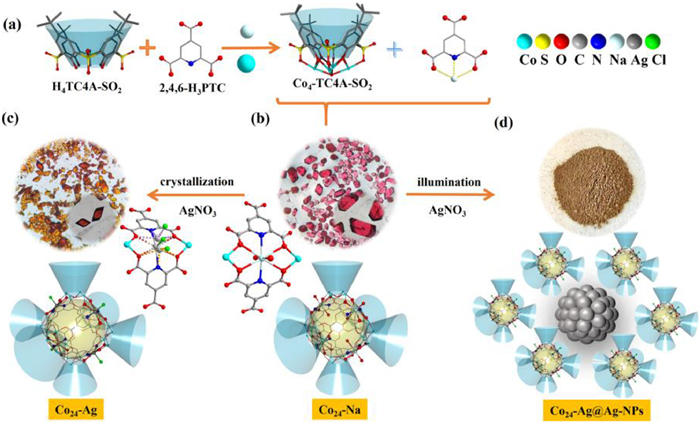
As illustrated in Fig. 1, the Co24-Na cluster was successfully self-assembled via the solvothermal reaction of Co(Ac)2·4H2O, H4TC4A-SO2, pyridine-2,4,6-tricarboxylic acid (2,4,6-H3PTC), and NaCl in a mixed solvent of CH3OH-DMF at 130 ℃ for 72 h. The Co24-Ag cluster was obtained when a CH2Cl2 solution of Co24-Na was treated with AgNO3 in CH3CH2OH at ambient conditions for 12 h (Scheme S1 in Supporting information).
Figure 1
Figure 1.
Schematic illustration of the synthesis strategy for Co24-Na, Co24-Ag, and Co24-Ag@Ag-NPs. (a, b) Co24-Na (red crystals) self-assembled from H4TC4A-SO2, 2,4,6-H3PTC, and Co2+, in the presence of Na+. (b, c) Single-crystal-to-single-crystal transition from Co24-Na to Co24-Ag (brown crystals). (b, d) Co24-Ag@Ag-NPs (brown powder) obtained from ion exchange of Co24-Na with AgNO3 accompanied by illumination.
Single-crystal X-ray diffraction (SCXRD) analysis revealed that Co24-Na has an octahedral cluster structure [44], wherein six Co4-(TC4A-SO2) PSBUs are connected by eight 2,4,6-PTC auxiliary linkers (Fig. S1 in Supporting information) and four Na+ ions are fixed on the surface by two carboxyl oxygen donors and two head-to-head nitrogen atoms (Fig. 1b). Co24-Ag is consistent with the crystal structure of Co24-Na, except for the axial coordination sites (Fig. 1c). In Co24-Na, two water molecules occupy the two axial coordination sites of Na+ (Fig. 1b), whereas each Ag+ is disordered into three parts (Fig. S1e in Supporting information) in Co24-Ag bonds to the in situ generated Cl- anion (C—Cl bond cleavage of CH2Cl2) in the axial direction (Fig. 1c) [38,45-47]. The capped oxygen atoms at the bottom of the PSBU were assigned to four OH- (O18*) and two H2O (O19*) in Co24-Na and transferred to six H2O (O21*) in Co24-Ag after the ion exchange experiment. The assignment of these species is based on symmetry considerations, BVS calculations (Tables S2 and S3 in Supporting information), and overall charge balance considerations, which are also familiar in TC4A-SO2-based coordination cages/clusters [26,48]. Powder X-ray diffraction (PXRD) investigations indicated that bulk Co24-Na and Co24-Ag crystal patterns matched well with those simulated from SCXRD (Figs. S2 and S3 in Supporting information). Fourier transform infrared (FT-IR) spectra illustrated that the functional groups showed no significant changes (Fig. S4 in Supporting information), suggesting that the ion exchange process did not disturb the original structure. Matrix-assisted laser desorption ionization time-of-flight mass spectroscopy (MALDI-MS) was used further to verify the formation of Co24-Na and Co24-Ag clusters. The MALDI-MS spectra of Co24-Na in CH3OH and Co24-Ag in CH2Cl2 show the prominent peak located at 8808.74 and 8999.27 Da, which can be assigned to [Co24(H2O)2(OH)4(TC4A-SO2)6(2,4,6-PTC)8Na4(H2O)8] +(CH3OH)10 and [Co24(H2O)6(TC4A-SO2)6(2,4,6-PTC)8Ag4Cl4] +(CH2Cl2)2 species, respectively (Fig. S5 in Supporting information). The thermal stabilities of Co24-Na and Co24-Ag and the residual species after thermogravimetric (TG) experiments were analyzed by TG and PXRD, respectively (Figs. S6-S9 in Supporting information). TG analysis revealed that both Co24-Na (Fig. S6 in Supporting information) and Co24-Ag (Fig. S8 in Supporting information) contain additional disordered solvents besides SCXRD determination, whose contributions were identified by the SQUEEZE method in PLATON (see Supporting information for details). The PXRD data showed definite Ag species in the thermogravimetric residue of Co24-Ag (Fig. S9 in Supporting information) compared with that of Co24-Na (Fig. S7 in Supporting information).
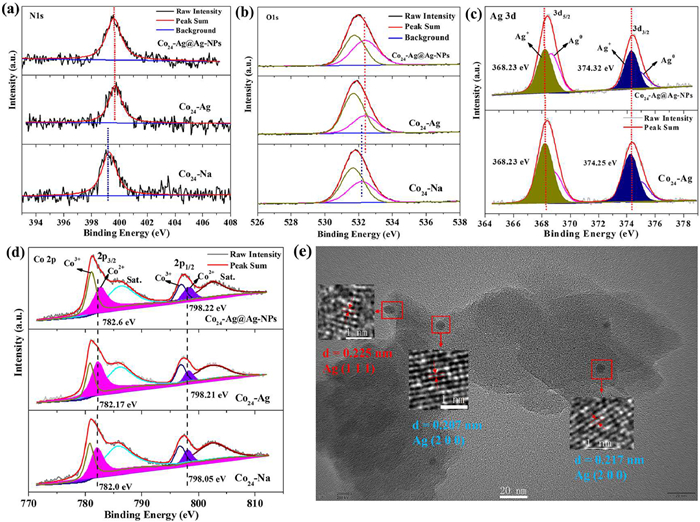
X-ray photoelectron spectroscopy (XPS) measurements were performed to analyze the differences in the coordination environment of the metal ions in the obtained Co24—Na and Co24-Ag clusters (Figs. 2a-d). In the acquired N 1s spectra, the binding energy of Na-N and Ag-N were 399.2 eV and 399.6 eV (Fig. 2a), respectively. In the high-resolution O 1s spectra (Fig. 2b), Na-O and Ag-O bonds were observed at 532.1 eV and 532.4 eV, respectively. Notably, both Ag-N and Ag-O shifted to higher binding energies compared to those of Na-N and Na-O, respectively. The different metal-nitrogen and metal-oxygen interactions highlight the different coordination environments of Na+ and Ag+. These results demonstrated the successful transformation of Co24-Na into Co24-Ag via a single-crystal to single-crystal process.
Figure 2
Figure 2.
(a) N 1s, (b) O 1s, (c) Ag 3d, and (d) Co 2p high-resolution XPS spectra of Co24-Na, Co24-Ag, and Co24-Ag@Ag-NPs. (e) TEM and HAADF-STEM image of Co24-Ag@Ag-NPs.
The Co24-Ag@Ag-NPs nanohybrid was constructed by the post-synthetic conversion of as-synthesized Co24-Na to Co24-Ag, followed by illumination (Fig. 1d and Scheme S1 in Supporting information). It is worth noting that Co24-Ag and Co24-Ag@Ag-NPs were obtained from the same reactants while undergoing crystallization and light irradiation, respectively. Inductively coupled plasma atomic emission spectroscopy (ICP-AES) indicated that the Co:Ag ratios in Co24-Ag and Co24-Ag@Ag-NPs are constant with the theoretical values (Table S4 in Supporting information). TG analysis showed that the final residues (Co9S8 and Ag) of Co24-Ag (Figs. S8 and S9 in Supporting information) and Co24-Ag@Ag-NPs (Figs. S10 and S11 in Supporting information) are 37% and 48%, respectively, with the latter having a higher residue ratio, indicating the successful incorporation of additional Ag species beyond coordination. Transmission electron microscopy (TEM) characterization of Co24-Ag@Ag-NPs showed that the Ag NPs with ca. 3.15 nm statistical average size were randomly distributed (Fig. S12 in Supporting information). High-angle annular dark-field scanning TEM (HAADF-STEM) images (Fig. 2e) of the species in Co24-Ag@Ag-NPs showed lattice spacings indexed to the (111) and (200) planes of reduced Ag (PDF #87–0720). X-ray energy dispersive spectroscopy (EDS) mapping images of Co24-Ag and Co24-Ag@Ag-NPs (Figs. S13 and S14 in Supporting information) displayed that Co, S, O, N, and C were homogeneously distributed over their entire architectures, while Ag and Cl were concentrated on the specific area of the architectures. Compared with Co24-Ag (Fig. S13), the Ag element dispersed on the cages and originating from the NPs was observed for Co24-Ag@Ag-NPs (Fig. S14). The high-resolution Ag 3d XPS spectra of Co24-Ag@Ag-NPs (Fig. 2c) disclosed the presence of Ag+ and Ag0. By integral calculations, the ratios of Ag0/Ag+ in Ag 3d3/2 and Ag 3d5/2 of Co24-Ag@Ag-NPs were estimated to be 0.69 and 1.00, both of which are higher than those of Co24-Ag (0.51 and 0.60). The high-resolution N 1s and O 1s spectra of Co24-Ag@Ag-NPs (Figs. 2a and b) show characteristic peaks similar to those of Co24-Ag, suggesting an identical Ag+ coordination environment in the two samples. These results suggest that the Ag+ species observed in Co24-Ag and Co24-Ag@Ag-NPs originated from the contribution of Ag+ coordinated to the octahedral cages. The Ag 3d3/2 XPS peaks of Co24-Ag@Ag-NPs correlated to Ag+ slightly shifted to higher energy regions compared to those of Co24-Ag (Fig. 2c). In contrast, the high-resolution Co 2p3/2 peaks associated with Co2+ significantly shifted to higher binding energies (Fig. 2d), indicating that a partial electron could be transferred from Co2+ to Ag+via coordination bonds (carboxyl µ2-O), and then transferred to Ag-NPs under a stimulus [35,44,49]. The high-resolution Cl 2p, S 2p, and C 1s peaks were almost identical for Co24-Ag and Co24-Ag@Ag-NPs (Fig. S15 in Supporting information), indicating the overall consistency of the cage framework.
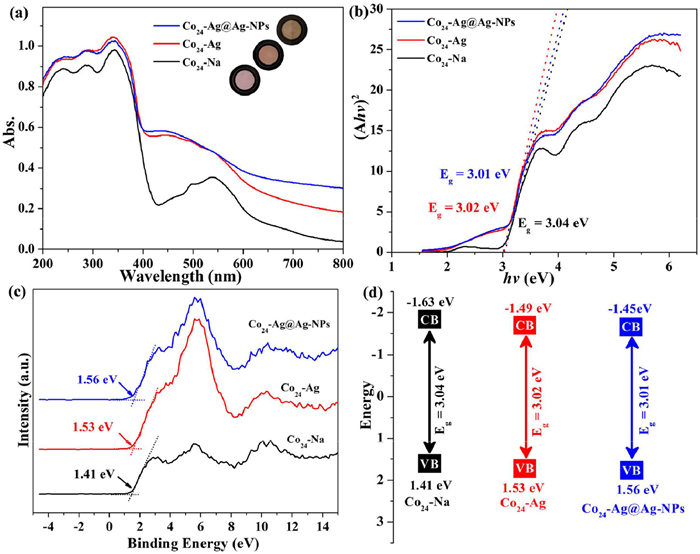
It has been demonstrated that thiacalixarene-based metal clusters are potential photothermal materials because their mechanism of energy release is dominated by nonradiative migration [11,38-40] ,50,51]. Furthermore, Ag NPs possess a noble plasmon feature with a striking photothermal effect [41-43]. Inspired by the above advantages of thiacalixarene-based metal clusters and Ag NPs, we explored the photothermal conversion properties of the obtained samples. First, we investigated the photo-responsive behaviors of Co24-Na, Co24-Ag, and Co24-Ag@Ag-NPs. Solid-state ultraviolet-visible (UV–vis) spectra of the samples were recorded at room temperature. As shown in Fig. 3a, all samples displayed the same absorption peak at 340 nm in the UV region, which was attributed to the absorption of thiacalixarene ligands. Co24-Ag exhibited higher light absorption in the range of 400–800 nm than Co24-Na, indicating that the ion exchange of Na+ with Ag+ enabled enhanced visible light absorption. The conjugation of Co24-Ag with Ag NPs (Co24-Ag@Ag-NPs) exhibited more significant absorption in the 550–800 nm range, resulting in remarkably enhanced visible light-harvesting abilities. This result is consistent with the color changes of the samples (inset of Fig. 3a). Notably, Co24-Ag@Ag-NPs showed an enhanced absorption band at ~400 nm owing to the surface plasmonic resonance of Ag NPs, which was also observed in the UV–vis absorption spectra of Co24-Ag@Ag-NPs in CH2Cl2 (Fig. S16 in Supporting information) [52]. The band gaps (Eg, Fig. 3b) of Co24-Na, Co24-Ag, and Co24-Ag@Ag-NPs were calculated to be 3.04, 3.02, and 3.01 eV from Kubelka-Munk function and Tauc plot, respectively. XPS analysis (Fig. 3c) revealed that the valence band (VB) potentials of Co24-Na, Co24-Ag, and Co24-Ag@Ag-NPs were 1.41, 1.53, and 1.56 eV, respectively. According to the Eg and VB potentials, the conduction band (CB) potentials (Fig. 3d) of Co24-Na, Co24-Ag, and Co24-Ag@Ag-NPs were calculated to be −1.63, −1.49, and −1.45 eV, respectively. The narrow bandgap of Co24-Ag@Ag-NPs allows more free-charge carriers to be promoted from the VB to the CB. From these results, we supposed that Co24-Ag@Ag-NPs exhibited significantly improved visible light adsorption and electron separation efficiency owing to its narrowed bandgap, which was induced by the Mott-Schottky heterojunction [52-54].
Figure 3
Figure 3.
Photo-responsive behavior analyses of Co24-Na, Co24-Ag, and Co24-Ag@Ag-NPs. (a) Solid state UV–vis spectra. (b) Tauc plots. (c) Valence-band spectra. (d) The estimated VB and CB levels.
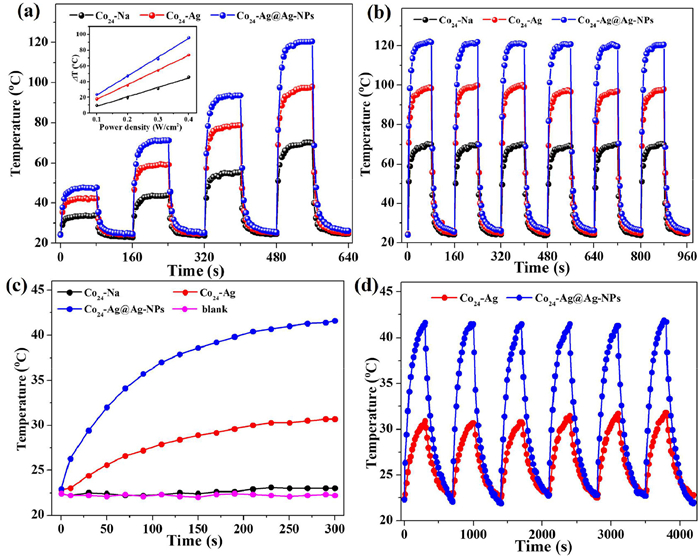
Photothermal tests of Co24-Na, Co24-Ag, and Co24-Ag@Ag-NPs in the solid state were performed under a 660 nm lamp irradiation. Fig. 4a shows the time-temperature relationship of the samples. The temperatures of Co24-Na, Co24-Ag, and Co24-Ag@Ag-NPs elevated with the increase of lamp power density and reached their maximum temperatures of 70.3, 97.5, and 120.4 ℃ at a power density of 0.4 W/cm2, respectively. It can be observed that Co24-Ag@Ag-NPs displayed the most significant temperature change, with an obvious temperature rise of ~100 ℃ in 1 min, followed by Co24-Ag and Co24-Na. No obvious decay was observed in the six on/off cycles (160 s per cycle) for the three samples under 0.4 W/cm2 irradiation (Fig. 4b). Benefitting from its improved light capture ability and electron separation efficiency, Co24-Ag@Ag-NPs exhibited superior photothermal conversion performance in the solid state.
Figure 4
Figure 4.
(a) Time-temperature curves and (b) light on-off cycles for Co24-Na, Co24-Ag, and Co24-Ag@Ag-NPs in the solid state. (c) Photothermal conversion curves of blank (CH2Cl2), Co24-Na, Co24-Ag, and Co24-Ag@Ag-NPs in CH2Cl2, respectively. (d) Light on-off cycles of Co24-Ag and Co24-Ag@Ag-NPs in CH2Cl2.
We further performed photothermal tests of Co24-Na, Co24-Ag, and Co24-Ag@Ag-NPs in CH2Cl2 solution under a 660 nm irradiation, respectively (Fig. 4c and Fig. S17 in Supporting information). As shown in Fig. 4c, no obvious temperature fluctuation was observed for blank CH2Cl2, demonstrating that it did not disturb the temperature response of the systems. Co24-Ag exhibited an obvious temperature rise of 8.8 ℃ in 5 min, obviously higher than that of Co24-Na (ΔT = 0.6 ℃) (Fig. 4c), indicating that the ion exchange of Na+ with Ag+ by post-modification can improve the photothermal conversion performance, which is attributed to the improved visible light absorption ability (Fig. 3a). In contrast, a distinct temperature increase of Co24-Ag@Ag-NPs was detected, reaching approximately 41.7 ℃ (Fig. 4c). In particular, the temperature of Co24-Ag@Ag-NPs at each point was higher than that of the others during the heating process, suggesting its superior photothermal conversion ability. The photothermal performance of the Co24-Ag@Ag-NPs demonstrated that the Mott-Schottky junction generated by the elaborate integration of Co24-Ag and Ag NPs could boost the thermal conversion performance. The photothermal stability was evaluated by reversibly irradiating and naturally cooling CH2Cl2 solutions of Co24-Ag and Co24-Ag@Ag-NPs in the light-on-off experiments. The maximum temperatures of both samples remained nearly unchanged over six cycles, demonstrating their high photothermal conversion stability (Fig. 4d). The photothermal conversion efficiency (Fig. S18 in Supporting information) of Co24-Ag@Ag-NPs was calculated to be 50.2%, which is higher than that of Co24-Ag (21.6%) and comparable with other pure Ag-based coordination complexes under similar conditions (Table S5 in Supporting information), for example, Ag30 and Ag34 [11], Ag72b and Ag28a [38], Ag16(Ⅰ-Ⅳ) [55], and Ag14 and Ag43 [56]. It should be emphasized that the overall photothermal conversion performance of Co24-Ag@Ag-NPs is also comparable to the representative Ag102 coordination clusters [57] if considering the lower Ag content (7.17% vs. 46.75%). Additionally, the visible light photothermal conversion efficiency of Co24-Ag@Ag-NPs is also close to that of the bimetallic (AgCu)31 coordination cluster [58], which makes the nanohybrid an advanced photo-responsive material, for example, used for visible light photothermal catalysts.
The Co24-Ag@Ag-NPs showed high photothermal conversion efficiencies, for which the rationales could be concluded. First, Co24-Ag exhibits nonradiative migration-triggered photothermal conversion behaviour. Second, Ag NPs possess inherent plasmonic localized heating characteristics. Thus, nonradiative migration and plasmonic localized heating work coordinatively to contribute to the energy release [59]. Through structural analysis, band gap measurements, and photothermal conversion tests of these samples, we derived a clear rule of thumb where Ag ion substitution (Co24-Na to Co24-Ag) can effectively regulate the band gap structure to enhance light absorption. The introduction of Ag NPs with inherent plasma thermal effect can form a synergistic effect with metal-thiacalixarene cage clusters (Co24-Ag to Co24-Ag@Ag-NPs) to increase the photothermal conversion efficiency. Therefore, the hybrid Co24-Ag@Ag-NPs exhibited excellent photothermal conversion properties both in the solid state and in organic solution. It should be additionally emphasized that Co24-Ag and Co24-Ag@Ag-NPs were synthesized from the same starting materials, but the yield of the latter was nearly 100%, almost double that of Co24-Ag, and the photothermal conversion efficiency is also promoted by more than 2 times. From the atomic economy consideration, the preparation strategy (post-synthetic metalation) of Co24-Ag@Ag-NPs has important guiding significance for the synthesis of photothermal catalyst materials, especially for the synthesis of coordination-related complexes.
In summary, the different properties of the MOCC and MNPs in the nanohybrids were cascaded to synergistically boost the photothermal conversion. Co24-Ag@Ag-NPs was synthesized by ion exchange of as-synthesized thiacalixarene-based Co24-Na with AgNO3, followed by illumination. Co24-Ag@Ag-NPs exhibited improved photothermal performance in both the solid state and organic solution. The superior photothermal performance should be ascribed to the following factors: (1) Thiacalixarene-based Co24-Ag exhibited enhanced light absorption and nonradiative migration, which can trigger photothermal conversion; (2) The plasmon nature endowed Ag NPs with notable photothermal effect; (3) The Mott-Schottky heterojunction of thiacalixarene-based Co24-Ag with Ag NPs resulted in the narrow bandgap, which was responsible for the improved light capture and carrier separation efficiency, thus affecting the photothermal response; (4) The significant protective effect of thiacalixarene on the periphery of the cage clusters can effectively decrease the heat loss in the photothermal conversion process. This work highlights the significance of post-modulation involving metal substitution and the insertion of plasmonic Ag NPs on a thiacalixarene-supported Co24 coordination cluster to enhance photothermal performance. This study provides new insights into the design of photothermal materials visible-light applications.
The authors declare that they have no known competing financial interests or personal relationships that could have appeared to influence the work reported in this paper.
Acknowledgment
This work was supported by the National Natural Science Foundation of China (Nos. 91961110, 22171122, 21901222).
Supplementary materials
Supplementary material associated with this article can be found, in the online version, at doi:10.1016/j.cclet.2025.111534.
Figure 1
Schematic illustration of the synthesis strategy for Co24-Na, Co24-Ag, and Co24-Ag@Ag-NPs. (a, b) Co24-Na (red crystals) self-assembled from H4TC4A-SO2, 2,4,6-H3PTC, and Co2+, in the presence of Na+. (b, c) Single-crystal-to-single-crystal transition from Co24-Na to Co24-Ag (brown crystals). (b, d) Co24-Ag@Ag-NPs (brown powder) obtained from ion exchange of Co24-Na with AgNO3 accompanied by illumination.
Figure 2
(a) N 1s, (b) O 1s, (c) Ag 3d, and (d) Co 2p high-resolution XPS spectra of Co24-Na, Co24-Ag, and Co24-Ag@Ag-NPs. (e) TEM and HAADF-STEM image of Co24-Ag@Ag-NPs.
Figure 4
(a) Time-temperature curves and (b) light on-off cycles for Co24-Na, Co24-Ag, and Co24-Ag@Ag-NPs in the solid state. (c) Photothermal conversion curves of blank (CH2Cl2), Co24-Na, Co24-Ag, and Co24-Ag@Ag-NPs in CH2Cl2, respectively. (d) Light on-off cycles of Co24-Ag and Co24-Ag@Ag-NPs in CH2Cl2.


 DownLoad:

 下载:
下载:


 下载:
下载:

