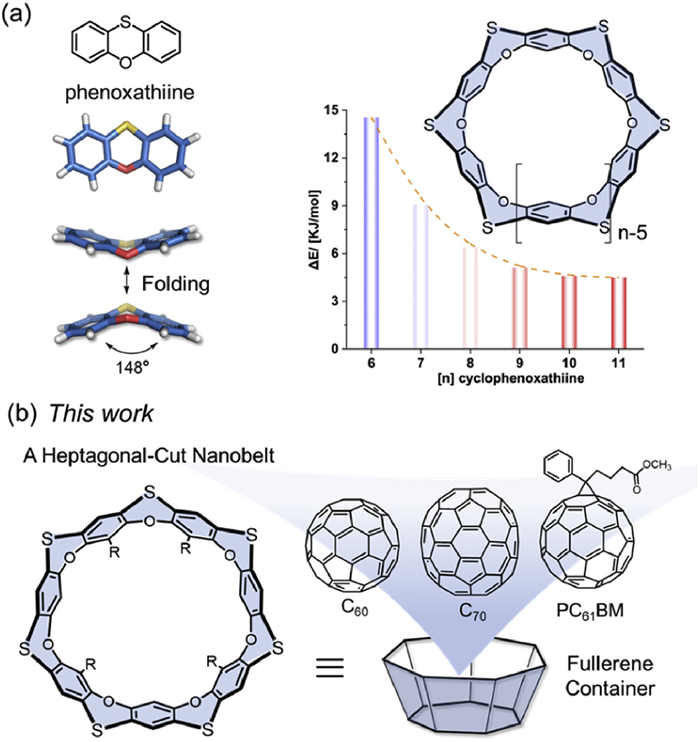
Figure 1.
(a) Structure of phenoxathiin and the ring strain diagram of [n]cyclophenoxathiin (n = 6~11); (b) the [7]cyclophenoxathiin ([7]CP) and its host-guest chemistry towards fullerenes reported in this work.

[7]Cyclophenoxathiin: A heptagonal frustum-shaped nanobelt container for fullerenes
Zhenglin Du , Weijie Zhang , Yisong Tang , Xia Li , Jialin Xie , Kelong Zhu


Nanobelts, such as cyclacenes [1–8] and beltarenes [9], along with their partially or fully hydrogenated analogs [10–14], have emerged as prominent subjects in both synthetic and supramolecular chemistry due to their intriguing molecular structure and promising applications in supramolecular containers, nanomaterials, and organic semiconductors [15]. More importantly, nanobelts can also serve as template molecules for the bottom-up construction of nanotubes [16,17]. Despite the growing interest in this field, the development of nanobelts has been slow, primarily due to synthetic challenges. Specifically, inducing high tension in these ribbon-like structures can often leads to low synthetic yields, which significantly hinder further derivatization and broader application. Therefore, the development of nanobelts with diverse structures remains a significant challenge.
To address the strain issues associated with the synthesis of nanobelts, carbon atoms could be partially replaced by heteroatoms to create a hybrid belt structure. In addition to relieving ring strain through geometric adjustments, the incorporation of heteroatoms introduces new functionalities, ultimately yielding multifunctional macrocyclic materials with enhanced properties. Benefiting from such a structural design, significant progress has been made in the construction of those highly strained nanobelts [18–21]. For example, three N-doped nanobelts have been successfully prepared by Miao [22], Chen [23], and Wu et al. [24], respectively. Tanaka et al. demonstrated the successful construction of oxygen-embedded nanobelts by intra-molecular alkyne cyclotrimerization [25]. Subsequently, oxygen-doped belt[8]arene and belt[12]arene were reported by Wang [26] and Tiefenbacher et al. [27], respectively. More recently, sulfur-doped zigzag nanobelts consisted of phenoxathiin, a foldable building block bridged by oxygen and sulfur that favors a bent configuration, were also successfully accomplished (Fig. 1) [28]. The fusion of eight phenoxathiin units results in an octagonal bowl-shaped nanobelt, [8]cyclophenoxathiin ([8]CP), which serves as an excellent molecular container for fullerene guests [28,29]. Following this, two [8]CP analogues, incorporating naphthalene [30] or thianthrene [31] moieties, were successfully synthesized, further demonstrating the advantages of applying the foldable subunit in the construction of zigzag nanobelts. Despite the progress with [8]CP, the synthesis of [n]cyclophenoxathiins ([n]CP) with a number of repeating oxathiin units (n) greater or smaller than eight has not met success yet. Moreover, theoretical calculations demonstrate that synthesizing smaller belts is more challenging than constructing larger ones (Fig. 1 and Table S2 in Supporting information) [32]. In addtion, the synthesis of cyclophenoxathiins with odd numbers of repeating units poses an even greater challenge, as it usually requires a more tedious synthetic approach to yield the double-stranded nanobelts [33]. Therefore, we report here the synthesis of a novel C2-symmectric [7]cyclophenoxathiin ([7]CP) and its host-guest chemistry towards three fullerenes.
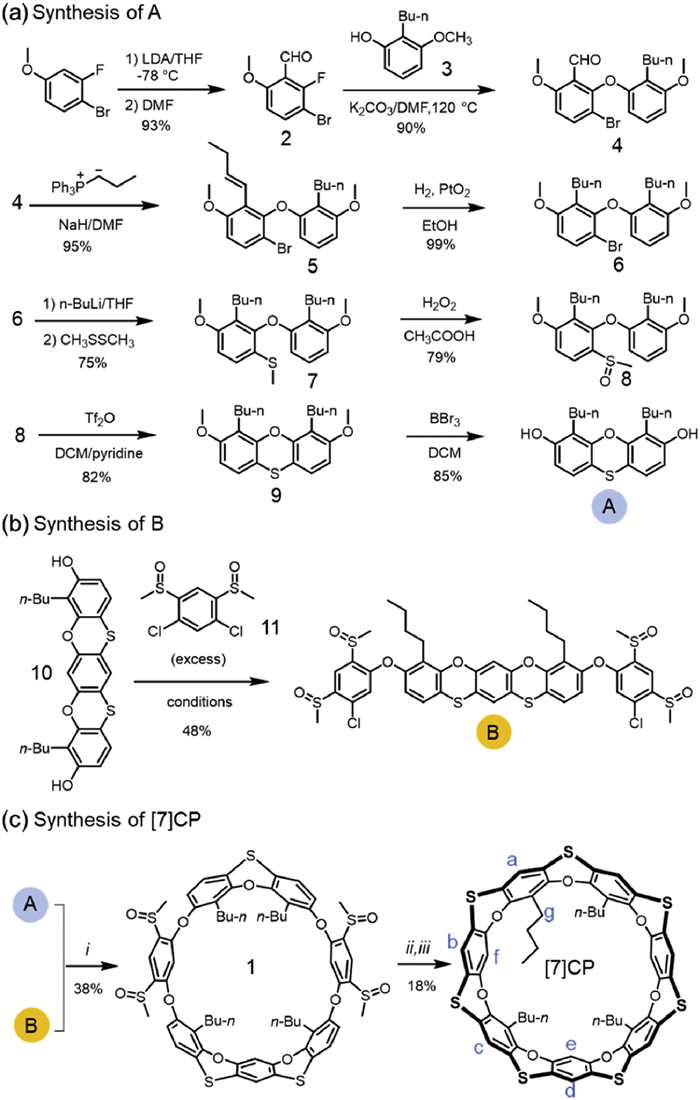
As outlined in Scheme 1, to obtain the C2-symmetric belt skeleton composed of seven laterally fused phenoxathiin units, a multi-step synthesis was employed, involving the preparation of two key building blocks, A and B. Initialed from the 4-bromo-3-fluoro-methoxybenenze, the diphenolic A can be obtained in 8 steps with a conbinded yield of 29%. A features a phenoxathiin skeleton with two substituted n-butyl groups, which serve not only to block the reaction sites between the methoxy and aryloxy groups but also to ensure the solubility of the final product. Treatment of the previously reported intermediate 10 [28] with an excess amount of 11 affords the second building block B in a moderate yield of 48%. Finally, a cyclization-followed-by-bridging approach was employed to construct [7]CP. The '1+1′ cyclization between A and B, via the Ullmann coupling reaction, generates the oxo-bridged macrocyclic intermediate 1, which serves as the precursor to [7]CP in a 38% yield. The subsequent intramolecular Friedel-Crafts reaction on intermediate 1 completes the bridging step, yielding [7]CP with an isolated yield of 18%. The correct structure of [7]CP was confirmed through NMR, mass spectrometry, and single crystal X-ray diffraction analysis.
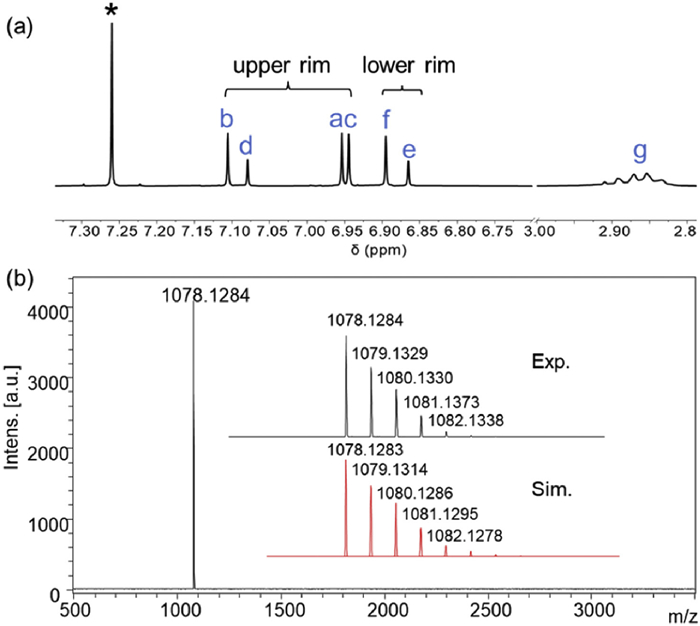
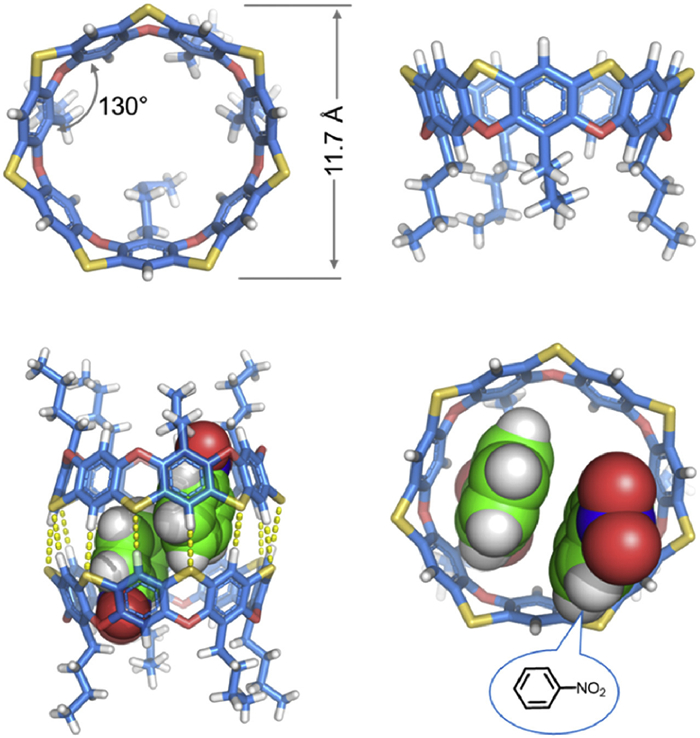
The 1H NMR spectrum of [7]CP exhibits six singlets in the aromatic region with an integration ratio of 2:1:2:2:2:1, confirming a C2-symmetric structure (Fig. 2a). The resonance peaks at 7.11, 7.08, 6.95, and 6.94 ppm were assigned to the upper-rim protons Hb, Hd, Ha, and Hc, respectively, while the signals at 6.90 and 6.87 ppm corresponded to the lower-rim protons Hf and He (Fig. S30 in Supporting information). MALDI-TOF-MS analysis showes a prominent peak at m/z of 1078.1284, further confirming the expected structure of [7]CP (Fig. 2b). Suitable single crystals of [7]CP were obtained through vapor diffusion of ethanol into a nitrobenzene solution of [7]CP. X-ray crystallography analysis revealed that [7]CP adopts a hepta-cut bowl-shaped geometry, with a cavity diameter of 11.7 Å measured from the upper rim (Fig. 3). This represents a decrease of 1.4 Å from the 13.1 Å cavity diameter observed for [8]CP [28]. The bending angles of the phenoxathiin units are approximately 130°, reduced by 7°, indicating a strained ring structure for [7]CP compared to that of [8]CP, consistent with theoretical studies (Fig. 1 and Table S2). Interestingly, the crystal packing structure of [7]CP shows a head-to-head dimeric capsule-like assembly, stabilized by C‒H···S hydrogen bonds between the upper rims. Two nitrobenzenes are encapsulated in the cavity of the supramolecular capsule, forming a 2:2 complex, which highlights the potential of [7]CP as a molecular container.
Previously, we explored the host-guest chemistry between [8]CP and fullerenes. Due to their excellent size complementarity, two [8]CP units can bind one fullerene molecule, such as C60 or C70, to form a ternary complex with strong affinity through π−π and CH−π interactions (Fig. 4a) [28,29]. Building on this, it is straightforward to investigate the binding capabilities of the relatively smaller [7]CP towards fullerene guests. To this end, the host-guest interactions between [7]CP and three selected fullerenes (C60, C70, and PC61BM) were evaluated using UV–vis absorption, 1H NMR, and X-ray crystallography analyses.
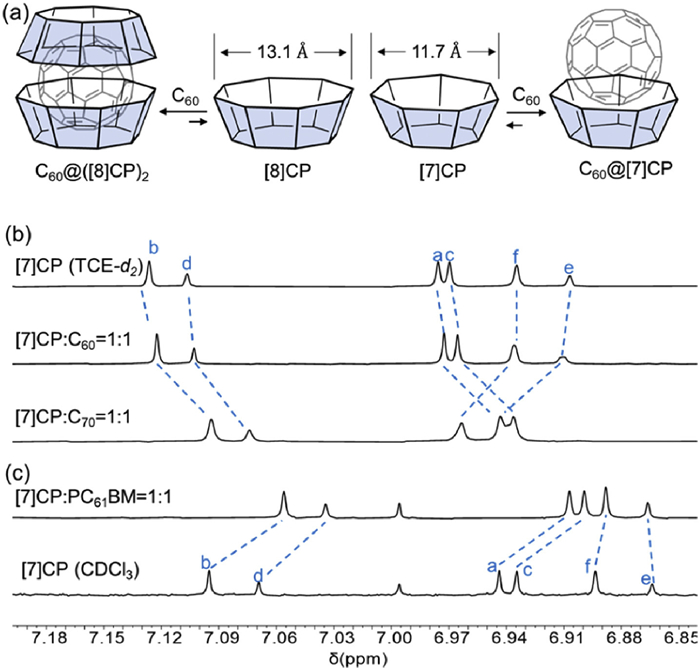
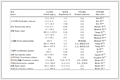
The UV–vis absorption analysis revealed a binding stoichiometry of 1:1 for all complexes formed between [7]CP and C60, C70, or PC61BM (Figs. S1, S3 and S5 in Supporting information). Subsequently, 1H NMR analysis of the equimolar mixture of [7]CP with C60, C70, or PC61BM was performed to further probe their complexation (Figs. 4b and c). The chemical shift of [7]CP changes upon complexing fullerenes (Table 1). All three complexes exhibit similar resonance shift trends, with the upper-rim protons Ha, Hb, Hc, and Hd shifting upfield, while the lower-rim protons He and Hf shift downfield. These results indicate a similar binding mode, with π−π interactions likely occurring between the phenylene moieties and C60, consistent with the behavior observed for the complexation of a methylated [8]CP with C60 [29]. A more pronounced chemical shift change was observed for the complexation of [7]CP with C70 compared to [7]CP with C60, suggesting a stronger binding affinity for the C70@[7]CP complex than for C60@[7]CP. Indeed, fitting the 1H NMR titration data in deuterated 1,1,2,2-tetrachloroethane afforded association constants (Ka) of 1638 and 2534 L/mol for C60@[7]CP and C70@[7]CP, respectively (Table 1 and Figs. S2 and S4 in Supporting information), confirming the inference from the NMR studies. The fullerene C60 derivative PC61BM retains the conjugated carbon sphere structure of C60 but features a larger substituent attached to its surface (Fig. 1). Therefore, it is expected to poess a similar binding hehavior for the complexation of PC61BM by [7]CP. A Ka of 3682 L/mol was determined for the PC61BM@[7]CP complex in deuterated chloroform (Fig. S6 in Supporting information). Thus, all these [7]CP complexes exhibit similar binding affinities, ranging from −4.3 to −4.8 kcal/mol, which are about two orders of magnitude lower than those of reported [8]CP complexes [28–31]. This can be attributed to the reduced cavity size of [7]CP, which prevents the formation of dimeric capsule-like complexes with fullerenes, as observed for [8]CP. Nevertheless, [7]CP has demonstrated its potential to function as a molecular container for fullerenes, exhibiting a 1:1 binding stoichiometry.
 DownLoad:
CSV
DownLoad:
CSV
| Fullerene | ΔδH (ppm) | Ka (L/mol) a | ΔG (kcal/mol) | |||||
| a | b | c | d | e | f | |||
| C60 | −0.006 | −0.008 | −0.008 | −0.007 | +0.006 | +0.002 | 1638 | −4.3 |
| C 70 | −0.032 | −0.032 | −0.034 | −0.033 | +0.036 | +0.029 | 2534 | −4.5 |
| PC61BM | −0.037 | −0.040 | −0.035 | −0.035 | +0.002 | −0.006 | 3682b | −4.8 |
| a Determined by 1H NMR titration at 298 K in deturated 1,1,2,2-tetrachloroethane. b Measured in chloroform- d. | ||||||||
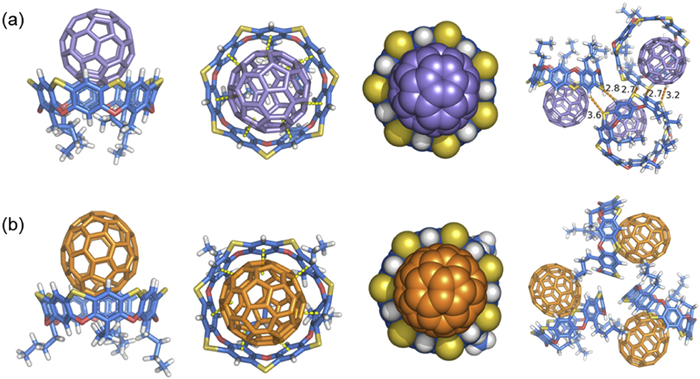
To further investigate the supramolecular chemistry of [7]CP with fullerenes, single crystals of the C60@[7]CP and C70@[7]CP complexes were successfully prepared and analyzed by X-ray crystallography (Table S1 in Supporting information). As shown in Fig. 5a, the crystal structure of C60@[7]CP unambiguously confirms the formation of a 1:1 complex, consistent with the results obtained from UV–vis absorption and 1H NMR analysis. Although [7]CP is predicted to be unable to fully accommodate a C60 molecule, partial insertion of the fullerene into the cavity of [7]CP occurs due to their retained convex−concave geometric complementarity, as evidenced by π−π interactions with measured centroid-to-centroid distances of 3.8−4.1 Å. Multiple C−H···S hydrogen bonds (with CH···S distances of 2.7−3.6 Å) between adjacent nanobelts further stabilize the complex and extend the structure into a three- dimensional network. As revealed by 1H NMR analysis, the crystal structure of the [7]CP and C70 complex confirms identical binding behavior, forming a 1:1 complex (Fig. 5b). C70 partially resides within the cavity of [7]CP, optimizing π−π interactions, with centroid-to-centroid distances ranging from 3.7 Å to 4.3 Å. In contrast to the spherical C60, C70 adopts an elongated, rugby ball shape, resulting in a more anisotropic electron density distribution. This curvature induces a slight polarization along its long axis, which leads to the shielding of the equatorial region and deshielding of the apical pentagons [34]. As a result, the larger chemical shift changes observed for [7]CP upon complexation with C70 can be attributed to the structure of their complex, where the upper-rim protons are located near C70's equatorial region, while the lower-rim protons are positioned closer to the deshielding apical pentagons. Such a complex structure likely contributes to the enhanced binding affinity of C70 compared to C60.
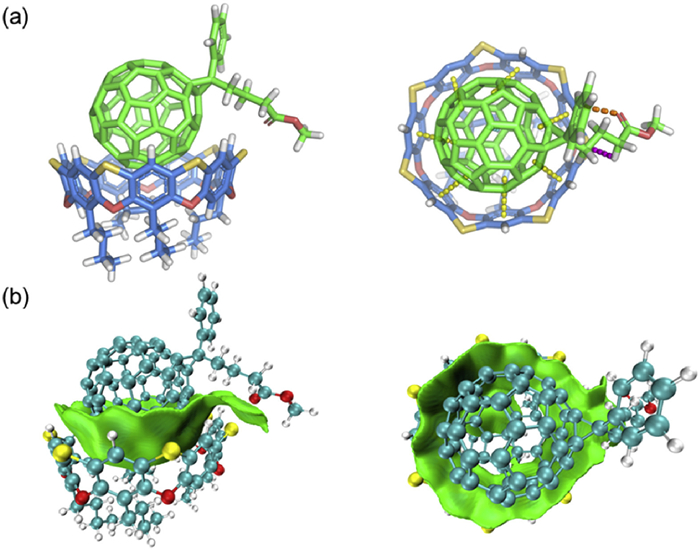
Since attempts to obtain single crystals of the PC61BM@[7]CP complex were unsuccessful, its structure was optimized using density functional theory (DFT) calculations (Fig. S7 in Supporting information) and compared with C60@[7]CP and C70@[7]CP. As shown in Fig. 6a, the calculated structure of PC61BM@[7]CP exhibits a similar binding mode, with PC61BM partially inserted into the cavity of [7]CP. This interaction is primarily driven by convex−concave π−π interactions, with optimized centroid-to-centroid distances ranging from 3.6 Å to 4.0 Å, as confirmed by independent gradient model (IGM) analysis (Fig. 6b) [35].
In conclusion, we successfully synthesized [7]cyclophenoxathiin ([7]CP), a nanobelt with a heptagonal frustum-shaped structure, using a multi-step approach. Host-guest interactions with fullerenes (C60, C70, and PC61BM) revealed that [7]CP forms sTable 1:1 complexes. While the reduced cavity size prevents the formation of dimeric complexes seen with [8]CP, [7]CP still acts as an effective molecular container for fullerenes. This work enhances our understanding of smaller nanobelt host-guest chemistry and paves the way for multifunctional material design in organic electronics and nanotechnology. A comprehensive study of its host–guest chemistry towards small molecular guests and other physical properties is currently ongoing.
The authors declare that they have no known competing financial interests or personal relationships that could have appeared to influence the work reported in this paper.
Zhenglin Du: Investigation. Weijie Zhang: Investigation. Yisong Tang: Investigation. Xia Li: Investigation. Jialin Xie: Writing – review & editing, Data curation, Investigation. Kelong Zhu: Validation, Project administration, Writing – review & editing, Supervision, Conceptualization.
We thank the National Natural Science Foundation of China (Nos. 22171295, 22471300, 22401064), the Fundamental Research Funds for the Central Universities (No. 23xkjc006), Science and Technology Projects in Guangzhou (No. 2024A04J6423), the Program for Guangdong Introducing Innovative and Entrepreneurial Teams (No. 2017ZT07C069) and Innovational Fund for Scientific and Technological Personnel of Hainan Province (No. KJRC2023D34) for financial support.
Supplementary material associated with this article can be found, in the online version, at doi:
K. Tahara, Y. Tobe, Chem. Rev. 106 (2006) 5274–5290. doi: 10.1021/cr050556a
Z.F. Chen, D. Jiang, X. Lu, et al., Org. Lett. 9 (2007) 5449–5452. doi: 10.1021/ol7023339
M.A. Majewski, M. Stępień, Angew. Chem. Int. Ed. 58 (2019) 86–116. doi: 10.1002/anie.201807004
K.Y. Cheung, S.J. Gui, C.F. Deng, et al., Chem 5 (2019) 838–847. doi: 10.1016/j.chempr.2019.01.004
K.Y. Cheung, Y. Segawa, K. Itami, Chem. Eur. J. 26 (2020) 14791–14801. doi: 10.1002/chem.202002316
E.S. Hirst, F. Wang, R. Jasti, Org. Lett. 13 (2011) 6220–6223. doi: 10.1021/ol202670x
R. Gleiter, B. Esser, S.C. Kornmayer, Acc. Chem. Res. 42 (2009) 1108–1116. doi: 10.1021/ar9000179
B. Esser, M. Hermann, Nat. Chem. 13 (2021) 209–211. doi: 10.1038/s41557-021-00642-0
E. Heilbronner, Helv. Chim. Acta 37 (1954) 921. doi: 10.1002/hlca.19540370336
P.R. Ashton, N.S. Isaacs, F.H. Kohnke, et al., Angew. Chem. Int. Ed. 27 (1988) 966–969. doi: 10.1002/anie.198809661
Y.M. Li, Y. Segawa, A. Yagi, J. Am. Chem. Soc. 142 (2020) 12850–12856. doi: 10.1021/jacs.0c06007
X.S. Du, D.W. Zhang, Y. Guo, et al., Angew. Chem. Int. Ed. 60 (2021) 13021–13028. doi: 10.1002/anie.202102701
T.H. Shi, S. Tong, M.X. Wang, Angew. Chem. 132 (2020) 7774–7779. doi: 10.1002/ange.202002827
T.H. Shi, M.X. Wang, CCS Chem. 3 (2021) 916–931. doi: 10.31635/ccschem.020.202000287
R. Zhang, D.Y. An, J.Y. Zhu, et al., Adv. Funct. Mater. 33 (2023) 2305249.
T. Liu, L.X. Zhu, K. Liu, et al., J. Am. Chem. Soc. 146 (2024) 32445–32451. doi: 10.1021/jacs.4c08536
G. Povie, Y. Segawa, T. Nishihara, et al., Science 356 (2017) 172–175. doi: 10.1126/science.aam8158
M. Iyoda, J. Yamakawa, M.J. Rahman, Angew. Chem. Int. Ed. 50 (2011) 10522–10553. doi: 10.1002/anie.201006198
T.H. Shi, Q.H. Guo, S. Tong, et al., J. Am. Chem. Soc. 142 (2020) 4576–4580. doi: 10.1021/jacs.0c00112
Q. Zhang, Y.E. Zhang, S. Tong, et al., J. Am. Chem. Soc. 142 (2020) 1196–1199. doi: 10.1021/jacs.9b12181
H. Chen, Q. Miao, J. Phys. Org. Chem. 33 (2020) e4145. doi: 10.1002/poc.4145
J.L. Wang, Q. Miao, Org. Lett. 21 (2019) 10120–10124. doi: 10.1021/acs.orglett.9b04116
F. Zhang, X.S. Du, D.W. Zhang, et al., Angew. Chem. Int. Ed. 60 (2021) 15291–15295. doi: 10.1002/anie.202104259
J. Zhu, Y. Han, Y. Ni, et al., J. Am. Chem. Soc. 143 (2021) 2716–2721. doi: 10.1021/jacs.1c00409
S.H. Nishigaki, Y. Shibata, A. Nakajima, et al., J. Am. Chem. Soc. 141 (2019) 14955–14960. doi: 10.1021/jacs.9b06197
M.L. Tan, Q.H. Guo, X.Y. Wang, Angew. Chem. Int. Ed. 59 (2020) 23649–23658. doi: 10.1002/anie.202013149
J. Pfeuffer-Rooschüz, L. Schmid, A. Prescimone, et al., JACS Au 1 (2021) 1885–1891. doi: 10.1021/jacsau.1c00343
J.L. Xie, X. Li, S.H. Wang, et al., Nat. Commun. 11 (2020) 3348. doi: 10.1038/s41467-020-17134-3
J.L. Xie, X. Li, Z.L. Du, et al., CCS Chem. 5 (2023) 958–970. doi: 10.31635/ccschem.022.202202019
Z.L. Du, J.L. Xie, Y.D. Liu, et al., Chem. Commun. 60 (2024) 6387. doi: 10.1039/d4cc01966k
Y.D. Liu, S.H. Wang, J.L. Xie, et al., Chem. Asian J. 18 (2024) e202400626.
S.C. Kornmayer, B. Esser, R. Gleiter, Org. Lett. 11 (2009) 725–728. doi: 10.1021/ol8028115
S.H. Wang, J. Yuan, J.L. Xie, et al., Angew. Chem. Int. Ed. 60 (2021) 18443–18447. doi: 10.1002/anie.202104054
T. Iwamoto, Y. Watanabe, H. Takaya, et al., Chem. Eur. J. 19 (2013) 14061–14068. doi: 10.1002/chem.201302694
T. Lu, Q.X. Chen, J. Comput. Chem. 43 (2022) 539–555. doi: 10.1002/jcc.26812

Figure 1 (a) Structure of phenoxathiin and the ring strain diagram of [n]cyclophenoxathiin (n = 6~11); (b) the [7]cyclophenoxathiin ([7]CP) and its host-guest chemistry towards fullerenes reported in this work.

Scheme 1 Synthesis of building blocks A and B and the nanobelt [7]CP. Conditions: (ⅰ) Cs2CO3, DMAC, 150 ℃ for 48 h; (ⅱ) CF3SO3H, 80 ℃ for 60 h; (ⅲ) pyridine/H2O, 105 ℃ for 15 h.

Figure 2 Partial 1H NMR (400 MHz, 298 K, CDCl3) spectrum (a) and MALDI-TOF mass spectrometry (b) of [7]CP. * CHCl3.

Figure 3 X-rayed crystal structure of [7]CP. Color code: S = yellow, O = red, C = light blue or green, N = blue, H = white. C − H···S hydrogen bonds are highlighted in yellow lines.

Figure 4 (a) Schematic representation of complexation of C60 with [8]CP or [7]CP. (b, c) Partial 1H NMR (400 MHz, 298 K) spectra of free [7]CP and its 1:1 mixture with C60, C70, and PC61BM.

Figure 5 X-rayed crystal structure of complex C60@[7]CP (top) and C70@[7]CP (bottom). Color code: S yellow, O red, C light blue, H white, C60 purple and C70 orange. π−π interactions, and C−H···S hydrogen bonds are highlighted in yellow and orange lines, respectively.

Figure 6 DFT caculation optimized structure (a) and IGM (δginter = 0.001) analysis (b) of the complex PC61BM@[7]CP. Color code: S yellow, O red, C light blue or green, H white. π−π interactions, C−H···O and C−H···S hydrogen bonds are highlighted in yellow, orange and purple lines, respectively.
Table 1. Chemical shift changes (ΔδH) of [7]CP upon complexing with one equivalent of fullerene and binding constant (Ka) and free energy (ΔG) of the corresponding host-guest complexes.
| Fullerene | ΔδH (ppm) | Ka (L/mol) a | ΔG (kcal/mol) | |||||
| a | b | c | d | e | f | |||
| C60 | −0.006 | −0.008 | −0.008 | −0.007 | +0.006 | +0.002 | 1638 | −4.3 |
| C 70 | −0.032 | −0.032 | −0.034 | −0.033 | +0.036 | +0.029 | 2534 | −4.5 |
| PC61BM | −0.037 | −0.040 | −0.035 | −0.035 | +0.002 | −0.006 | 3682b | −4.8 |
| a Determined by 1H NMR titration at 298 K in deturated 1,1,2,2-tetrachloroethane. b Measured in chloroform- d. | ||||||||
 下载: 导出CSV

 扫一扫看文章


扫一扫关注我们
 下载:
下载: