
Scheme 1.
Evaluation of the Se/C catalysts fabricated from different carbohydrates.

Sustainable Se/C catalysts from carbohydrates: Unlocking oxidative deoximation reaction with high turnover numbers via free radical mechanisms
Kuanhong Cao , Sainan Chu , Yuanhua Ding , Shanming Lu , Lei Yu , Juan Du


Selenium catalysis as a unique research topic is just unfolding in recent years [1-6]. It has attracted broad cross-disciplinary interest. Although some inorganic selenium compounds may be toxic when they are absorbed, the organoselenium compounds are less toxic and even non-toxic [7-9]. In addition, compared with transition metals, Se as a required trace element of human beings can be metabolized in the body [10-12]. This feature leads to the higher tolerance of the residue of Se than that of the transition metals in medicine synthesis [13]. The organoselenium-catalyzed reactions usually employ H2O2 as the green oxidant, which generates no waste other than the water. During the past ten years, we have reported a series of organoselenium-catalyzed green reactions to produce the useful chemical intermediates such as 1,2-diols [14-16], carbonyls [17,18], organonitriles [19,20], vinyl esters [21,22], epoxides [23]. However, these reactions typically require 1–10 mol% of Se, resulting in low catalyst turnover numbers (TONs) below 100. To maximize resource utilization, developing more active catalysts with high TONs is crucial for addressing the remaining challenges in Se-catalyzed reactions from an industrial perspective.
Carbohydrates are inexpensive and abundant biomasses produced globally on a large scale each year. Beyond their traditional use in the food industry, carbohydrates serve as bulk starting materials for the production of numerous industrially important chemicals, such as ethanol, glycerol, sorbitol, succinic acid, and diformylfurans. These compounds are widely utilized as solvents, fuels, synthetic intermediates, and monomers for polyester fiber production [24,25]. As renewable resources, carbohydrates hold significant potential for industrial applications, making the development of technologies for their utilization a key focus in sustainable chemistry research. It has been reported that, by treating carbohydrates with NaHSe and calcining the obtained selenized carbohydrates at over 500 ℃, a novel biomaterial Se/C could be fabricated [26-28]. Recently, we discovered that this material can effectively catalyze oxidative deoximation reactions, a critical transformation in the total synthesis of natural products like erythronolide A [29] and fine chemicals such as the spice carvone [30]. Unlike conventional organoselenium-catalyzed systems [14-23], this catalyst operates via unique free radical mechanisms, delivering remarkable reactivity and achieving turnover numbers (TONs) surpassing 104. Herein, we wish to report our findings.
Se2-, as the strong nucleophilic species, is easily generated by treating Se powders with the reductant NaBH4 in ethanol. It can attack the carbonyls in carbohydrates to form Se-C bond [31] and the following calcination of the Se-substituted carbohydrates leads to the Se-doped carbon materials. By using this protocol, we initially prepared a series of Se/C catalysts from different carbohydrates with the Se contents at 0.07%–0.11% (determined by ICP-MS analysis). 30 mg of Se/C was then employed as catalyst for each 1 mmol-scale of deoximation reaction of benzophenone oxime 1a with equivalent H2O2 as oxidant to produce benzophenone 2a (Scheme 1). The reaction with Se/C catalyst fabricated from glucose afforded 2a in 86% yield (Scheme 1, entry 1). Using sucrose as the carbon source led to Se/C with decreased catalytic activity (Scheme 1, entry 2). The materials fabricated from polysaccharides such as chitosan, potato amylum and willow sawdust were also catalytically effective for the deoximation reaction, but the product yields were very low (Scheme 1, entries 3–5). Thus, as shown in Scheme 1, glucose should be the preferable starting material to fabricate the Se/C catalyst for deoximation reaction.
Effects of the Se/glucose molar feeding ratio on the prepared catalyst activity were further evaluated. Catalyzed by Se/C fabricated with the Se/glucose molar feeding ratio at 10%, the deoximation reaction of 1a with H2O2 as oxidant produced 2a in 47% yield and the catalyst TON was calculated to be 138 (Table 1, entry 1). Preparing Se/C with reduced Se/glucose molar feeding ratio enhanced the catalyst activity on the contrary, and the product yields of the deoximation reactions and the catalyst TONs increased dramatically (Table 1, entries 2 and 3). The Se/C catalyst fabricated with Se/glucose at 1% was found to be the favorable catalyst, affording 2a in 86% yield and the TON increased to as high as 2.5 × 10³ (Table 1, entries 4 vs. 1–3,5,6). The catalyst TONs further elevated with decreased Se feeding ratio, but the product yields in deoximation reactions gradually decreased (Table 1, entries 5 and 6).
 DownLoad:
CSV
DownLoad:
CSV
 |
|||||
| Entry | Se usage (%)b | Se content (%)c | Se loading (%)d | 2a yield (%)e | TON |
| 1 | 10 | 0.9 | 0.3400 | 47 | 138 |
| 2 | 5 | 0.3 | 0.1100 | 58 | 509 |
| 3 | 3 | 0.16 | 0.0610 | 66 | 1.1 × 10³ |
| 4 | 1 | 0.09 | 0.0340 | 86 | 2.5 × 10³ |
| 5 | 0.5 | 0.02 | 0.0076 | 79 | 1.0 × 10⁴ |
| 6 | 0.2 | 0.005 | 0.0019 | 68 | 3.6 × 10⁴ |
| a 1 mmol of 1a, 1 mmol of H2O2, 30 mg of Se/C and 3 mL of EtOH were heated in a sealed tube charged with air for 48 h. b Feeding molar ratio of Se powder vs. glucose during the catalyst fabrication process. c Weight content of Se in Se/C catalysts determined by ICP-MS analysis. d Se molar ratio versus 1a according to the ICP-MS-determined weight content of Se in Se/C. e Isolated yield of 2a based on 1a. |
|||||
Parallel experiments were performed to examine the impact of catalyst quantity on the reaction. When the Se/C amount was reduced to 20 mg for a 1 mmol-scale reaction, the product yield remained unchanged, while the catalyst TON significantly elevated (Table 2, entry 2 vs. 1). Further investigations on the reactions with reduced Se/C amount (Table 2, entries 3 and 4) revealed that using 5 mg of Se/C was preferable, leading to the highest yield of 2a (89%) with a TON at 1.6 × 10⁴ (Table 2, entries 4 vs. 1−3,5,6). The 1 mmol scale reaction could occur even with only 1 mg of Se/C, and it gave 2a in 75% yield, accompanied by an exceptionally high TON of 6.8 × 10⁴ (Table 2, entry 6).
DownLoad:
CSV
 |
||||
| Entry | Se/C amount (mg)b | Se loading (%)c | 2a yield (%)d | TON |
| 1 | 30 | 0.0340 | 86 | 2.5 × 10³ |
| 2 | 20 | 0.0230 | 87 | 3.8 × 10³ |
| 3 | 10 | 0.0110 | 86 | 7.8 × 10³ |
| 4 | 5 | 0.0057 | 89 | 1.6 × 10⁴ |
| 5 | 2.5 | 0.0028 | 80 | 2.8 × 10⁴ |
| 6 | 1 | 0.0011 | 75 | 6.8 × 10⁴ |
| a 1 mmol of 1a, 1 mmol of H2O2, Se/C (fabricated with the Se/glucose molar feeding ratio at 1%) and 3 mL of EtOH were heated in a sealed tube charged with air for 48 h. b Weight of the used Se/C amount. c Se molar ratio versus 1a according to the ICP-MS-determined weight content of Se in Se/C (see Table 1, entry 4). d Isolated yield of 2a based on 1a. |
||||
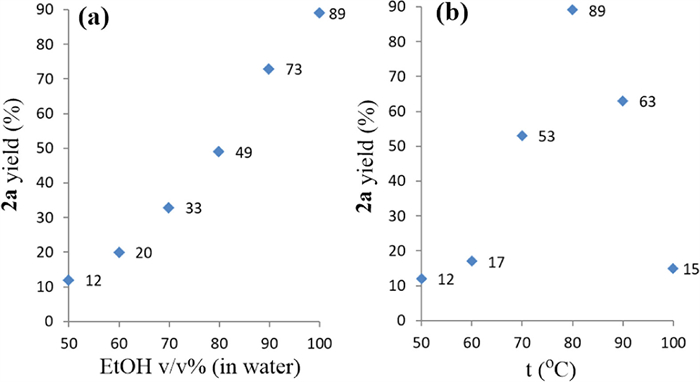
Subsequent investigations focused on the influence of reaction solvent and temperature (Fig. 1). Catalyzed by Se/C (5 mg for the 1 mmol-scale reaction, see Table 2, entry 4), the reaction in 50% aqueous EtOH (volume concentration) produced 2a in only 12% yield (Fig. 1a). The yield of 2a gradually increased with higher EtOH concentrations, and the reaction in pure EtOH led to the highest yield of 2a at 89% (Fig. 1a). As shown in Fig. 1b, the reaction at 50–60 ℃ produced 2a in very low yield. The product yield increased significantly to 53% at a higher reaction temperature. The reaction at 80 ℃ resulted in the highest product yield, while further increases in temperature reduced the yield and led to the formation of numerous unidentified by-products being observed in the thin-layer chromatography (TLC) analysis.
Since the catalytic Se species might be oxidized by molecular oxygen in open air, we explored reducing the amount of H2O2 to lower the reaction cost. Interestingly, the product yield slightly improved with less H2O2 (Eq. 1, entry 2 vs. 1). The optimal condition was identified as using 0.5 equiv. of H2O2, with air potentially acting as a partial oxidant during the process (Eq. 1, entry 2 vs. 1,3). Reducing the H2O2 amount not only lowers down the costs but also enhances the safety of the reaction, particularly during post-reaction processing. Tests with starch potassium iodide (SSKI oral solution) paper confirmed that no peroxide residues left after reaction for the cases using insufficient H2O2. This makes the subsequent product isolation procedure safer, especially for large-scale preparations. Conversely, excess H2O2 led to the formation of numerous by-products, significantly reducing the yield of the desired ketone (Eq. 1, entry 4).
|
|
(1) |
Thus, as shown in the above Table 1, Table 2 as well as the Fig. 1 and Eq. 1, heating the oximes with 0.5 equiv. of H2O2 and Se/C with 5.7 × 10⁻³ mol% Se loading in EtOH at 80 ℃ in open air should be the preferable reaction conditions. A series of oximes were then employed as substrates to examine the application scope of the reaction. Both electron-enriched and -deficient ketoximes were applicable substrates for the reaction (Table 3, entries 1−11). It was difficult to improve the reaction of electron-deficient oxime substrate by elevating the reaction temperature and extending the reaction time (Table 3, entry 4 vs. 3). The isolated product yields of the reactions of (E)-1-phenylethan-1-one oxime 1d and (E)-1-phenylpropan-1-one oxime 1k decreased due to the product volatility (Table 3, entries 5 and 12). The reactions of (E)-1-phenylbutan-1-one oxime 1l and (E)-1-phenylpentan-1-one oxime 1m afforded the related ketones in excellent yields (Table 3, entries 13 and 14). The product yield decreased with the extension of the carbon chain in substrate, probably due to the increased steric hindrance in substrate that prohibited the attack of the catalytic Se species from the backside (Table 3, entries 15−17). Reaction of (E)-1-phenylheptan-1-one oxime 1o led to (E)-1-phenylheptan-1-one 2o in 51% yield and optimization by using elevated reaction temperature and extended reaction time was completely ineffective (Table 3, entry 16 vs. 17). The reaction of (E)-cyclohexyl(phenyl)methanone oxime 1p produced (E)-cyclohexyl(phenyl)methanone 2p in 74% yield, but for cyclohexyl-fused substrate 1q, the product yield decreased dramatically due to the rise of the substrate hindrance (Table 3, entry 18 vs. 19). Elevated reaction temperature and prolonged reaction time led to decreased product yield on the contrary (Table 3, entries 20 vs. 19). This was probably due to the deactivation of the catalyst at high temperature, since the conversion ratio of 1q reduced from 55% to 46%. Octan-2-one oxime (1r), as the example of aliphatic substrate, was employed and its reaction afforded the desired ketone 2r in 75% yield (Table 3, entry 21). The method was not applicable for aldoxime deoximation, and the reaction of benzaldehyde oxime 1s led to benzaldehyde 2s in only 14% yield, while most of the substrate was unconverted (Table 3, entry 22). Introducing an electron-donation group such as MeO-might enhance the substrate activity and the yield of aldehyde 2t was enhanced to 50%, but the organonitrile 3t were generated in 38% yield as the dehydration by-product (Table 3, entry 23) [19,20]. The reaction could be magnified to gram scale. Treating 19.7 g of 1a (100 mmol) under standard conditions led to 2a in 95% yield.
DownLoad:
CSV
 |
||||
| Entry | 1 | R1, R2 | Product | Yield (%)b |
| 1 | 1a | Ph, Ph | 2a | 91 |
| 2 | 1b | 4-MeC6H4, 4-MeC6H4 | 2b | 70 |
| 3 | 1c | 4-FC6H4, 4-FC6H4 | 2c | 37c |
| 4 | 41c,d | |||
| 5 | 1d | Ph, Me | 2d | 62 (78)e |
| 6 | 1e | 4-MeC6H4, Me | 2e | 71 |
| 7 | 1f | 3-MeC6H4, Me | 2f | 60 |
| 8 | 1g | 4-MeOC6H4, Me | 2g | 57 |
| 9 | 1h | 4-ClC6H4, Me | 2h | 67c |
| 10 | 1i | 2-ClC6H4, Me | 2i | 63c |
| 11 | 1j | 4-NO2C6H4, Me | 2j | 69c |
| 12 | 1k | Ph, Et | 2k | 60 (75)e |
| 13 | 1l | Ph, n-C3H7 | 2l | 97 |
| 14 | 1m | Ph, n-C4H9 | 2m | 98 |
| 15 | 1n | Ph, n-C5H11 | 2n | 71c |
| 16 | 1o | Ph, n-C6H13 | 2o | 51c |
| 17 | 51c,d | |||
| 18 | 1p | Ph, c-C6H11 | 2p | 74c |
| 19 | 1q |  |
2q | 48c |
| 20 | 40c,d | |||
| 21 | 1r | C6H13, Me | 2r | (75) |
| 22 | 1s | Ph, H | 2s | 14 (32)c,e |
| 23 | 1t | 4-MeOC6H4, H | 2t | (50), 3t: (38) |
| a Without special instruction, 1 mmol of 1, 0.5 mmol of H2O2, 5 mg of Se/C (fabricated with the Se/glucose molar feeding ratio at 1%) and 3 mL of EtOH were heated at 80 ℃ in a sealed tube charged with air for 48 h. b Isolated yield based on 1 outside the parenthesis; GC yield inside the parenthesis. c Reaction uncompleted. d Reaction performed at 120 ℃ for 96 h. e Isolated yield decreased due to the product volatility. |
||||
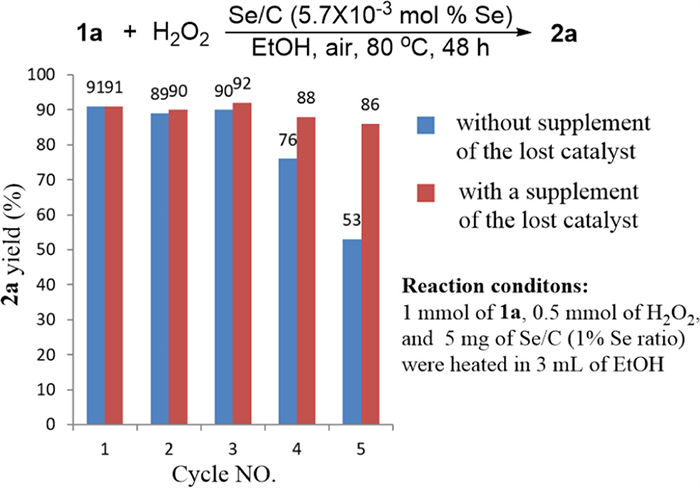
As a heterogeneous catalyst, Se/C could be removed from the reaction mixture via centrifuge separation. The recycled catalyst was tested in the next turn of the oxidative deoximation reaction of 1a (Fig. 2, blue bars). Its catalytic activity was well retained in the first 3 runs of reaction, while the product yield began to decrease in the fourth turn of reaction. 2a was obtained in only 53% yield in the fifth turn. Fortunately, it was found that after an addition of the lost weight of catalyst, the decrease of the product yield was obviously relieved (Fig. 2, red bars), indicating that the declines of the product yield were mainly caused by the loss of ca. 10% of Se/C during the centrifuge separation process.
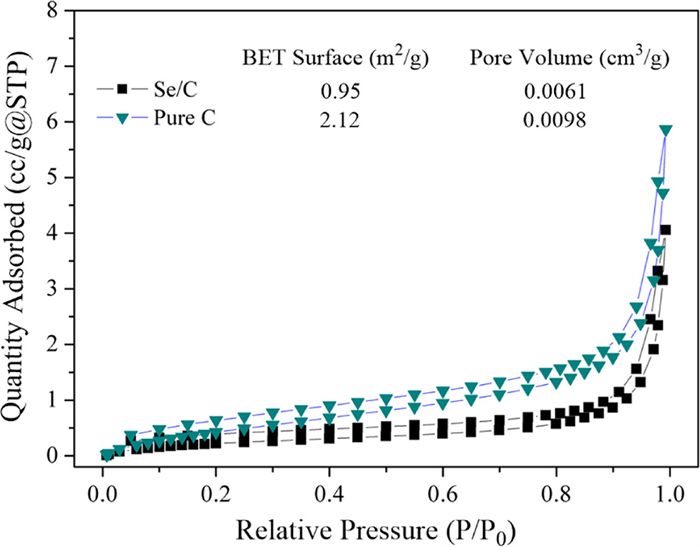
Typically, the number of activated sites was probed by specific surface area measurement. As given in Fig. 3, N2 adsorption-desorption isotherms of Se/C and pure C both indicated type Ⅲ isotherm curve due to the weak adsorbent-adsorbent interaction and the N2 uptake at high P/P0 relative pressures (0.70–1.00) featuring a H3-type hysteresis loop is the characteristic of stacked porosity, similar to some reported delaminated materials [32,33]. Intriguingly, compared with pure C, the specific surface area and pore volume of Se/C sample displayed almost twofold reduction. Therefore, the high catalytic activity of Se/C for the oxidative deoximation reactions in this study only derived from the intrinsic catalytic activity of incorporated selenium in carbon matrix rather than the promotion of specific surface area.
The mechanism of this interesting reaction was our next concern. Control experiments were performed to get more information for mechanism study (Table 4). The oxidative deoximation reaction of 1a was well restrained by adding 2,2,6,6-tetramethylpiperidine-1-oxyl (TEMPO) as the free radical scavenger (Table 4, entry 1), indicating that it might occur via a novel free radical mechanism [34-36], which was different to the organoselenium-catalyzed deoximation reactions [17,18].
DownLoad:
CSV
 |
||
| Entry | Reaction conditions | 2a yield (%)b |
| 1 | Se/C, H2O2 (0.5 equiv.), TEMPO (1.0 equiv.), air, 80 ℃ | Trace |
| 2 | Se/C, H2O2 (0.5 equiv.), N2, 80 ℃ | 45 |
| 3 | Se/C, without H2O2, air, 80 ℃ | 43 |
| 4 | Se/C, without H2O2, N2, 80 ℃ | 19 |
| 5 | Se/C, H2O2 (0.5 equiv.), air, hv | 9 |
| 6 | SeO2, H2O2 (0.5 equiv.), air, 80 ℃ | 21 |
| 7 | H2SeO3, H2O2 (0.5 equiv.), air, 80 ℃ | 28 |
| a 1 mmol of 1a, 5 mg of Se/C (fabricated with the Se/glucose molar feeding ratio at 1%) and 3 mL of EtOH were employed. b Isolated yield of 2a based on 1a. |
||
Although the reactions of supported Se catalytic species with oximes were generally less favorable due to the significant steric hindrance imposed by the bulky carbon support (Eq. 2), they could still proceed through free radical mechanisms. This is because the intermediate free radicals exhibited higher reactivity compared to the corresponding anions. For example, quantitative calculations revealed that the addition of the PhSeO3- anion to ketoxime 1a released 16 kJ/mol of energy. In contrast, the analogous reaction involving free radicals released 120 kJ/mol of energy, providing a significantly stronger driving force for the transformation (Eqs. 3 vs. 4).
|
|
(2) |
|
|
(3) |
|
|
(4) |
Moreover, air was found to be a necessary oxidant, since the product yield decreased to 45% when performing the reaction under N2 protection (Table 4, entry 2). However, it was crucial to use H2O2 as an additional oxidant, otherwise the product yield decreased to 43% (Table 4, entry 3). Reaction without H2O2 and performed under N2 protection led to 2a in 19% yield (Table 4, entry 4). All the above results showed that the reaction required H2O2 and air as the mixed oxidants, while a non-oxidation process might also occur to produce 2a, but was not the major reaction path. Although selenium-contained chemical bonds are sensitive to visible light and the photo-promoted free radical reactions of organoselenium compounds have been widely reported [37,38], this oxidative deoximation reaction should be a thermally driven process and it afforded 2a in only 9% yield under LED white irradiation conditions at room temperature (Table 4, entry 5). Using SeO2 or H2SeO3 containing the same dosage of selenium as catalyst led to poor product yield (Table 4, entries 6 and 7), showing that carbon support was crucial to enhance the catalytic activity of selenium sites. This could also well explain why glucose is a preferable carbon source. As a monosaccharide, the steric hindrance of the positive carbon in glucose is low, allowing the suffient nucleophilic addition of SeH- to form C-Se bond. About 87% of selenium in Se/C prepared from glucose was anchored on carbon via C-Se bond, higher than that of the Se/C prepared from sucrose, chitosan, potato amylum and willow sawdust (12%–28%, for details, please see Table S1 in Supporting information).
Based on the above experimental results as well as reference reports, a plausible mechanism of this Se/C-catalyzed oxidative deoximation reaction was supposed (Scheme 2). Se in Se/C was initially oxidized by H2O2 into Se(Ⅵ) species 3 [39]. The reaction of 3 with free radicals, such as the hydroxyl radical generated via the thermal homo-cleavage of H2O2, might afford the active free radical 4, which soon reacted with the oximes 1 to produce the intermediate 5 [40,41]. The decomposition of 5 resulted in the removal of the oxime group, releasing HNO as a by-product, while transferring oxygen from the catalytic Se species to the carbon, ultimately forming the carbonyl group in 2 [40,41]. Simultaneously, Se(Ⅵ) in catalyst was reduced into the Se(Ⅳ) species 6 [39]. As attested by XPS analysis in our previous works, the HNO by-product could be oxidized into the stable nitrate after reaction [40,41]. The highly active Se(Ⅳ) species 6 reacted with aldoxime 1 to form 7 quickly and restarted another deoximation process to produce carbonyl 2 [17,18], while the Se(Ⅳ) was further reduced to the free radical 8. Oxidation of 8 by H2O2 or air regenerated the catalytic species 3, which participated the next turn of catalysis circle. The Se/C-catalyzed reactions occurred via a free radical mechanism instead of the previously reported ionic reaction (Table 4, entry 1) [17,18]. The high reactivity of the free radical species enabled their efficient addition to oximes (4 to 5, 6 to 7 in Scheme 2), which underscores the high catalytic activity of Se/C, as evidenced by its impressive turnover numbers (TONs).
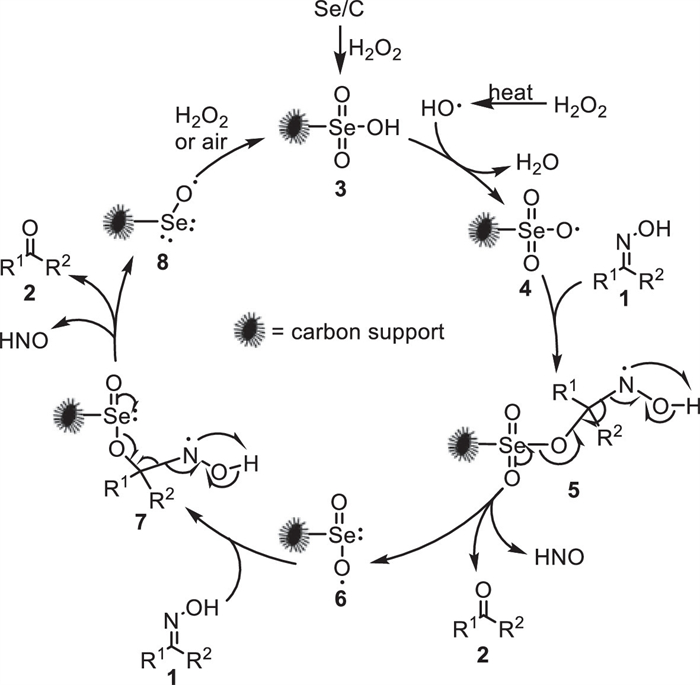
In conclusion, Se/C materials were prepared using carbohydrates as the biomass starting materials. Owing to the oxygen carrier features of Se [42], the materials could be used as catalysts for the oxidative deoximation reactions, which are significant transformations in both pharmaceutical industry and fine chemical production [43]. In comparison with the organoselenium-catalyzed reactions including the deoximation reactions [17,18], the Se/C-catalyzed deoximation reactions occurred via free radical mechanisms other than the ionic reaction routes, endowing the intermediate Se species high reactivity [41,44-46]. From the perspective of element transfer reaction (ETR) theory [47,48], the high reactivity of free radical species provides additional driving force for the reaction, as demonstrated by the remarkably high catalyst turnover numbers (TONs) exceeding 104. This feature reduces the catalyst cost and made the method practical for industrial grade preparation. This work, as a transition metal-free catalysis technique, is in line with the developing trend of sustainable chemistry. Further investigations on the applications of Se/C materials in medicine developments are ongoing in our laboratory.
The authors declare that they have no known competing financial interests or personal relationships that could have appeared to influence the work reported in this paper.
Kuanhong Cao: Writing – original draft, Investigation, Data curation. Sainan Chu: Investigation. Yuanhua Ding: Data curation. Shanming Lu: Writing – review & editing, Supervision, Funding acquisition. Lei Yu: Writing – review & editing, Supervision, Funding acquisition, Conceptualization. Juan Du: Writing – review & editing, Supervision, Funding acquisition.
This work was financially supported by the Hospital University United Fund of the Second Affiliated Hospital, School of Medicine, The Chinese University of Hong Kong, Shenzhen (Nos. AIE2202, HUUF-ZD-202302), Longgang Medical Discipline Construction Fund, Cooperation Project of Yangzhou City with Yangzhou University (No. YZ2023209), and Priority Academic Program Development of Jiangsu Higher Education Institutions (PAPD) for financial support.
Supplementary material associated with this article can be found, in the online version, at doi:
G. Yuan, X. Zhang, L. Yu, J. Org. Chem. 90 (2025) 3117–3122. doi: 10.1021/acs.joc.4c03035
X. Xiao, C. Guan, J. Xu, et al., Green Chem. 23 (2021) 4647–4655. doi: 10.1039/d1gc00961c
H. Cao, R. Qian, L. Yu, Catal. Sci. Technol. 10 (2020) 3113–3121. doi: 10.1039/d0cy00400f
F.V. Singh, T. Wirth, Catal. Sci. Technol. 9 (2019) 1073–1091. doi: 10.1039/c8cy02274g
L. Shao, Y. Li, J. Lu, X. Jiang, Org. Chem. Front. 6 (2019) 2999–3041. doi: 10.1039/c9qo00620f
R. Guo, L. Liao, X. Zhao, Molecules 22 (2017) 835. doi: 10.3390/molecules22050835
F.C. Meotti, V.C. Borges, G. Zeni, J.B.T. Rocha, C. W. Toxicol. Lett. 143 (2003) 9–16. doi: 10.1016/S0378-4274(03)00090-0
X. Mao, P. Li, T. Li, et al., Chin. Chem. Lett. 31 (2020) 3276–3278. doi: 10.1016/j.cclet.2020.06.033
L. Xian, Q. Li, T. Li, L. Yu, Chin. Chem. Lett. 34 (2023) 107878. doi: 10.1016/j.cclet.2022.107878
M.P. Rayman, Lancet 379 (2012) 1256–1278. doi: 10.1016/S0140-6736(11)61452-9
W. Ding, S. Wang, J. Gu, L. Yu, Chin. Chem. Lett. 34 (2023) 108043. doi: 10.1016/j.cclet.2022.108043
J. Gu, J. Gu, L. Yu, Chin. Chem. Lett. 36 (2025) 110727. doi: 10.1016/j.cclet.2024.110727
US Pharmacopeial Convention (USP). USP <232>elemental impurities-limits. 40–NF 35, first supplement, 2017.
D. Yong, G. Yuan, Y. Liu, X. Zhang, Chin. J. Org. Chem. 45 (2025) 2767–2772. doi: 10.6023/cjoc202501008
J. Huang, R. Qian, S. Wang, H. Cao, Chin. J. Org. Chem. 41 (2021) 1639–1645. doi: 10.6023/cjoc202008032
L. Yu, J. Wang, T. Chen, K. Ding, Y. Pan, Chin. J. Org. Chem. 33 (2013) 1096–1099. doi: 10.6023/cjoc2012012049
X. Jing, D. Yuan, L. Yu, Adv. Synth. Catal. 359 (2017) 1194–1201. doi: 10.1002/adsc.201601353
C. Chen, X. Zhang, H. Cao, et al., Adv. Synth. Catal. 361 (2019) 603–610. doi: 10.1002/adsc.201801163
X. Jing, T. Wang, Y. Ding, L. Yu, Appl. Catal. A: Gen. 541 (2017) 107–111. doi: 10.1016/j.apcata.2017.05.007
X. Zhang, J. Sun, Y. Ding, L. Yu, Org. Lett. 17 (2015) 5840–5842. doi: 10.1021/acs.orglett.5b03011
L. Yu, J. Ye, X. Zhang, Y. Ding, Q. Xu, Catal. Sci. Technol. 5 (2015) 4830– 4838. doi: 10.1039/C5CY01030F
X. Zhang, J. Ye, L. Yu, et al., Adv. Synth. Catal. 357 (2015) 955–960. doi: 10.1002/adsc.201400957
L. Yu, Z. Bai, X. Zhang, et al., Catal. Sci. Technol. 6 (2016) 1804–1809. doi: 10.1039/C5CY01395J
F. Zheng, L. Chen, P. Zhang, et al., Carbohyd. Polym. 230 (2020) 115637. doi: 10.1016/j.carbpol.2019.115637
A. Bayu, A. Abudula, G. Guan, Fuel Process. Technol. 196 (106162) (2019).
Y. Yang, X. Fan, H. Cao, et al., Catal. Sci. Technol. 8 (2018) 5017–5023. doi: 10.1039/c8cy01413b
H. Cao, Y. Yang, X. Chen, et al., Chin. Chem. Lett. 31 (2020) 1887–1889. doi: 10.1016/j.cclet.2020.01.027
H. Cao, R. Ma, S. Chu, et al., Chin. Chem. Lett. 32 (2021) 2761–2764. doi: 10.1016/j.cclet.2021.03.029
E.J. Corey, P.B. Hopkins, S. Kim, et al., J. Am. Chem. Soc. 101 (1979) 7131– 7134. doi: 10.1021/ja00517a088
E.E. Royals, S.E. Horne Jr., J. Am. Chem. Soc. 73 (1951) 5856–5857. doi: 10.1021/ja01156a119
W. Zhou, P. Li, J. Liu, L. Yu, Ind. Eng. Chem. Res. 59 (2020) 10763–10767. doi: 10.1021/acs.iecr.0c01147
D.J. Martin, K. Qiu, S.A. Shevlin, et al., Angew. Chem. Int. Ed. 53 (2014) 9240–9245. doi: 10.1002/anie.201403375
G. Liu, P. Niu, C. Sun, et al., J. Am. Chem. Soc. 132 (2010) 11642–11648. doi: 10.1021/ja103798k
Y. Zhang, W. Li, Z. Hu, X. Jing, L. Yu, Chin. Chem. Lett. 35 (2024) 108938. doi: 10.1016/j.cclet.2023.108938
X. Li, H. Zhou, R. Qian, X. Zhang, L. Yu, Chin. Chem. Lett. 36 (2025) 110036. doi: 10.1016/j.cclet.2024.110036
X.R. Xiao, Y. Chen, F.L. Chen, et al., cMat 2 (2025) e35. doi: 10.1002/cmt2.35
A. Nomoto, Y. Higuchi, Y. Kobiki, A. Ogawa, Mini-Rev. Med. Chem. 13 (2013) 814–823. doi: 10.2174/1389557511313060004
L. Yu, X. Huang, Synlett 17 (2006) 2136–2138.
Y. Wang, L. Yu, B. Zhu, L. Yu, J. Mater. Chem. A 4 (2016) 10828–10833. doi: 10.1039/C6TA02566H
X. Deng, H. Cao, C. Chen, H. Zhou, L. Yu, Sci. Bull. 64 (2019) 1280–1284. doi: 10.1016/j.scib.2019.07.007
X. Deng, Q. Qian, H. Zhou, L. Yu, Chin. Chem. Lett. 32 (2021) 1029–1032. doi: 10.1016/j.cclet.2020.09.012
W. Hou, H. Xu, J. Med. Chem. 65 (2022) 4436–4456. doi: 10.1021/acs.jmedchem.1c01859
Y. Zheng, A. Wu, Y. Ke, H. Cao, L. Yu, Chin. Chem. Lett. 30 (2019) 937–941. doi: 10.1016/j.cclet.2019.01.012
D. Yong, T. Zuo, Q. Wu, X. Zhang, Chin. J. Org. Chem. 44 (2024) 3392–3398. doi: 10.6023/cjoc202404022
D. Yong, J. Tian, R. Yang, Q. Wu, X. Zhan, Chin. J. Org. Chem. 44 (2024) 1343–1347. doi: 10.6023/cjoc202310020
F. Liu, J. Zhan, Y. Sun, X. Jing, Chin. J. Org. Chem. 41 (2021) 2099–2104. doi: 10.6023/cjoc202011012
H. Cao, X. Xiao, X. Zhang, Y. Yang, L. Yu, Chin. Chem. Lett. 36 (2025) 110924. doi: 10.1016/j.cclet.2025.110924
C. Chen, Y. Cao, X. Wu, et al., Chin. Chem. Lett. 31 (2020) 1078–1082. doi: 10.1016/j.cclet.2019.12.019

Figure 3 N2 adsorption-desorption isotherms of Se/C and pure C (fabricated by calcining glucose under the same conditions).
Table 1. Fabrication and catalytic activity evaluation of the Se/C catalysts with different Se contents.a
|
|||||
| Entry | Se usage (%)b | Se content (%)c | Se loading (%)d | 2a yield (%)e | TON |
| 1 | 10 | 0.9 | 0.3400 | 47 | 138 |
| 2 | 5 | 0.3 | 0.1100 | 58 | 509 |
| 3 | 3 | 0.16 | 0.0610 | 66 | 1.1 × 10³ |
| 4 | 1 | 0.09 | 0.0340 | 86 | 2.5 × 10³ |
| 5 | 0.5 | 0.02 | 0.0076 | 79 | 1.0 × 10⁴ |
| 6 | 0.2 | 0.005 | 0.0019 | 68 | 3.6 × 10⁴ |
| a 1 mmol of 1a, 1 mmol of H2O2, 30 mg of Se/C and 3 mL of EtOH were heated in a sealed tube charged with air for 48 h. b Feeding molar ratio of Se powder vs. glucose during the catalyst fabrication process. c Weight content of Se in Se/C catalysts determined by ICP-MS analysis. d Se molar ratio versus 1a according to the ICP-MS-determined weight content of Se in Se/C. e Isolated yield of 2a based on 1a. |
|||||
 下载: 导出CSV
Table 2. Test of Se/C catalyst amount for the oxidative deoximation reaction.a
|
||||
| Entry | Se/C amount (mg)b | Se loading (%)c | 2a yield (%)d | TON |
| 1 | 30 | 0.0340 | 86 | 2.5 × 10³ |
| 2 | 20 | 0.0230 | 87 | 3.8 × 10³ |
| 3 | 10 | 0.0110 | 86 | 7.8 × 10³ |
| 4 | 5 | 0.0057 | 89 | 1.6 × 10⁴ |
| 5 | 2.5 | 0.0028 | 80 | 2.8 × 10⁴ |
| 6 | 1 | 0.0011 | 75 | 6.8 × 10⁴ |
| a 1 mmol of 1a, 1 mmol of H2O2, Se/C (fabricated with the Se/glucose molar feeding ratio at 1%) and 3 mL of EtOH were heated in a sealed tube charged with air for 48 h. b Weight of the used Se/C amount. c Se molar ratio versus 1a according to the ICP-MS-determined weight content of Se in Se/C (see Table 1, entry 4). d Isolated yield of 2a based on 1a. |
||||
下载: 导出CSV
Table 3. Substrate extension for the reaction.a
|
||||
| Entry | 1 | R1, R2 | Product | Yield (%)b |
| 1 | 1a | Ph, Ph | 2a | 91 |
| 2 | 1b | 4-MeC6H4, 4-MeC6H4 | 2b | 70 |
| 3 | 1c | 4-FC6H4, 4-FC6H4 | 2c | 37c |
| 4 | 41c,d | |||
| 5 | 1d | Ph, Me | 2d | 62 (78)e |
| 6 | 1e | 4-MeC6H4, Me | 2e | 71 |
| 7 | 1f | 3-MeC6H4, Me | 2f | 60 |
| 8 | 1g | 4-MeOC6H4, Me | 2g | 57 |
| 9 | 1h | 4-ClC6H4, Me | 2h | 67c |
| 10 | 1i | 2-ClC6H4, Me | 2i | 63c |
| 11 | 1j | 4-NO2C6H4, Me | 2j | 69c |
| 12 | 1k | Ph, Et | 2k | 60 (75)e |
| 13 | 1l | Ph, n-C3H7 | 2l | 97 |
| 14 | 1m | Ph, n-C4H9 | 2m | 98 |
| 15 | 1n | Ph, n-C5H11 | 2n | 71c |
| 16 | 1o | Ph, n-C6H13 | 2o | 51c |
| 17 | 51c,d | |||
| 18 | 1p | Ph, c-C6H11 | 2p | 74c |
| 19 | 1q | |
2q | 48c |
| 20 | 40c,d | |||
| 21 | 1r | C6H13, Me | 2r | (75) |
| 22 | 1s | Ph, H | 2s | 14 (32)c,e |
| 23 | 1t | 4-MeOC6H4, H | 2t | (50), 3t: (38) |
| a Without special instruction, 1 mmol of 1, 0.5 mmol of H2O2, 5 mg of Se/C (fabricated with the Se/glucose molar feeding ratio at 1%) and 3 mL of EtOH were heated at 80 ℃ in a sealed tube charged with air for 48 h. b Isolated yield based on 1 outside the parenthesis; GC yield inside the parenthesis. c Reaction uncompleted. d Reaction performed at 120 ℃ for 96 h. e Isolated yield decreased due to the product volatility. |
||||
下载: 导出CSV
Table 4. Control experiments.a
|
||
| Entry | Reaction conditions | 2a yield (%)b |
| 1 | Se/C, H2O2 (0.5 equiv.), TEMPO (1.0 equiv.), air, 80 ℃ | Trace |
| 2 | Se/C, H2O2 (0.5 equiv.), N2, 80 ℃ | 45 |
| 3 | Se/C, without H2O2, air, 80 ℃ | 43 |
| 4 | Se/C, without H2O2, N2, 80 ℃ | 19 |
| 5 | Se/C, H2O2 (0.5 equiv.), air, hv | 9 |
| 6 | SeO2, H2O2 (0.5 equiv.), air, 80 ℃ | 21 |
| 7 | H2SeO3, H2O2 (0.5 equiv.), air, 80 ℃ | 28 |
| a 1 mmol of 1a, 5 mg of Se/C (fabricated with the Se/glucose molar feeding ratio at 1%) and 3 mL of EtOH were employed. b Isolated yield of 2a based on 1a. |
||
下载: 导出CSV

 扫一扫看文章


扫一扫关注我们


 下载:
下载: