
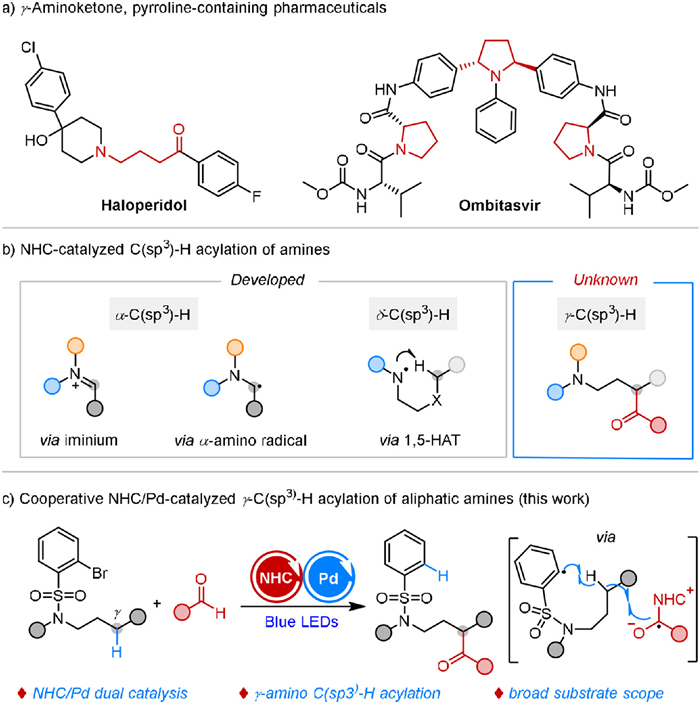
Scheme 1.
NHC-catalyzed C(sp3)-H acylation of amines.


An updated analysis of U.S. FDA-approved small-molecule drugs in the past 11 years (2013–2023) reveals that >82% of drugs contain at least a nitrogen heterocycle or an amine moiety [1]. In this context, the continuous development of new methods for the precise synthesis of amine derivatives has emerged as a crucial research field in organic synthesis and medicinal chemistry. Among them, selective C(sp3)-H functionalization of readily available aliphatic amines could streamline the synthesis of nitrogen-containing heterocycles and complex amine architectures. For example, different strategies for the α-C(sp3)-H functionalization of aliphatic amines have been well developed via oxidative process [2–7] or hydrogen atom transfer (HAT) [8–13]. In addition, δ-C(sp3)-H functionalization based on amidyl radical-mediated 1,5-HAT has been proven to be a robust strategy to access remote functionalized amines and the related nitrogen-containing heterocycles [14–17]. In contrast, γ-amino C(sp3)-H functionalization of aliphatic amines remains challenging. Current successful γ-amino C–H functionalization methods mainly rely on directing group-assisted transition metal catalysis [18–27]. Alternatively, radical C(sp3)-H functionalization of amines via γ-selective HAT process has enabled a new approach to the synthesis of amine derivatives [28–33]. However, γ-C(sp3)-H acylation of aliphatic amines remains unaccessible, while the products will simplify the synthesis of γ-aminoketones, δ-amino alcohols, and pyrrolidines of interest in medicinal chemistry (Scheme 1a) [34–37].
In the past decades, N-heterocyclic carbene (NHC) catalysis has emerged as a powerful strategy for the synthesis of structurally diverse molecules [38–49]. In 2012, Rovis and co-workers developed cooperative NHC and photocatalysis for asymmetric acylation of α-C(sp3)-H bond in N-aryl tetrahydroisoquinoline via nucleophilic addition of Breslow intermediate to the oxidatively generated iminium (Scheme 1b) [50]. Driven by the development of radical NHC catalysis [51–58], the direct acylation of C(sp3)-H bonds has aroused great interest [59]. Limited successful examples mainly focus on α- or δ-C(sp3)-H acylation of amines. For example, the NHC-catalyzed α-C(sp3)-H acylation of amines has been established through a cascade generation of α-amino radical via HAT process and the following coupling with ketyl radical [60–63]. On the other hand, the remote δ-C(sp3)-H acylation has been achieved via amidyl radical-mediated 1,5-HAT [64]. However, γ-amino C(sp3)-H acylation is highly desirable but still unexplored to date.
Herein, we report the γ-selective C(sp3)-H acylation of aliphatic amines with aldehydes as acyl source under cooperative NHC and photoinduced palladium catalysis (Scheme 1c). 2-Bromophenyl sulfone is used as γ-selective HAT auxiliary and amino-protecting group [28,65]. The photoinduced Pd-promoted generation of aryl radical and the subsequent 1,7-HAT is the key to the success of this methodology. This approach enables direct conversion of a wide array of readily available aliphatic amines to γ-aminoketones in moderate to good yields with excellent and predictable regioselectivity. The easy conversion of the products to δ-aminoalcohols and pyrrolidines of interest to medicinal chemists further demonstrates the potential application of the developed method in drug discovery campaigns.
Initially, the model reaction of 2-bromophenyl sulfonamide 1a and commercially available picolinaldehyde 2a was investigated under photoredox cooperative NHC/Pd catalysis (Table 1). We were pleased to find that the reaction gave the desired product 3a in 62% yield when carried out in the presence of 20 mol% thioazolium preNHC N1, 10 mol% of Pd(OAc)2 with tBu-Xantphos L1 (15 mol%) as ligand and Cs2CO3 (2.0 equiv.) as base in PhCl under blue LED irradiation at room temperature (entry 1). The screening of preNHC catalysts revealed that N-benzyl and N-aryl substituted thioazolium preNHC N2-N4 resulted in some loss of yields (entries 2 and 3), while triazolium preNHC N5 did not work for this reaction (entry 4). Other palladium catalysts such as PdCl2 and Pd(PPh3)4 were less effective (entries 5 and 6). The use of ligand Xantphos resulted in decreased yield (entry 7), and PCy3 was ineffective (entry 8). Solvent screening revealed that the reaction in PhCF3, THF or DCM did not give better yields (entries 9 and 10). Evaluation of bases showed that other inorganic bases, such as K2CO3 and CsF, and organic base led to decreased yields (entries 11 and 12). The improvement of the yield was achieved by reducing reaction concentration to 0.05 mol/L (entry 13). The reaction with other photocatalysts, such as 4CzIPN, fac-Ir(ppy)3, Ru(phen)3(PF6)2, gave the desired product in <7% yield (entries 14–16).

 DownLoad:
CSV
DownLoad:
CSV
 |
||
| Entry | Variation from standard conditions | Yield (%)b |
| 1 | None | 62 |
| 2 | N2, N3 instead of N1 | 48, 52 |
| 3 | N4 instead of N1 | 57 |
| 4 | N5 instead of N1 | Trace |
| 5 | Pd(PPh4)3 instead of Pd(OAc)2 | 35 |
| 6 | PdCl2 instead of Pd(OAc)2 | ND |
| 7 | L2 instead of L1 | 16 |
| 8 | PCy3 instead of L1 | ND |
| 9 | PhCF3 instead of PhCl | 51 |
| 10 | THF, DCM instead of PhCl | Trace |
| 11 | K2CO3, CsF instead of Cs2CO3 | 54, 53 |
| 12 | DBU instead of Cs2CO3 | 22 |
| 13 | 0.05 mol/L instead of 0.1 mol/L | 74 (71)c |
| 14 | 4CzIPN instead of Pd(OAc)2/L1 | Trace |
| 15 | fac-Ir(ppy)3 instead of Pd(OAc)2/L1 | 7 |
| 16 | Ru(phen)3(PF6)2 instead of Pd(OAc)2/L1 | Trace |
| a Reaction conditions: 1a (0.2 mmol), 2a (0.3 mmol), preNHC (0.04 mmol), Pd(OAc)2 (0.02 mmol), tBu-Xantphos (0.03 mmol), Cs2CO3 (0.4 mmol) and PhCl (2 mL), 36 W blue LED at room temperature for 48 h under N2. b Yields of 3a determined by 1H NMR using 1,3,5-trimethoxybenzene as internal standard. ND = not detected. c Isolated yield in parenthesis. |
||
With the optimized reaction conditions in hand, the scope of aldehydes was evaluated (Scheme 2). It was found that picolinaldehydes bearing electron-donating or electron-withdrawing groups such as OMe, Me, F, and Cl at various positions of pyridine ring all worked well to afford desired ketones 3b−3k in moderate to good yields. Picolinaldehyde bearing 9-anthracenyl at 5-position was compatible for this reaction giving the desired product 3l in 55% yield. The reactions of other heteroaromatic aldehydes such as quinoline-2-carbaldehyde, isoquinoline-3-carbaldehyde, quinoxaline-2-carbaldehyde and thiazole-2-carbaldehyde all went smoothly to furnish the desired ketones 3m−3p. However, the reaction of benzaldehyde gave no desired product which promoted us reoptimized the conditions of the reaction (see Supporting information for details). It was found that the use of preNHC N4 afforded the desired ketone 3q in 65% yield. The scope of benzaldehydes was then examined. Benzaldehydes bearing electron-donating (Me) or electron-withdrawing groups (F, Cl, and Br) on the para-position all worked well, leading to ketones 3r−3u in moderate yields. It is worth noting that functional groups, such as internal alkyne, acetyl, carbomethoxy, cyano, pinacol boronic ester (Bpin), trimethylsilyl (TMS) and methylsulfonyl, were all tolerable to afford the corresponding ketones 3v−3ab. meta-Substituted benzaldehyde bearing Me or CF3 groups gave the products 3ac−3ad in good yields. Besides, the reaction of furfural and 2-thenaldehyde also proceeded smoothly to give ketones 3ae−3af in good yields. The structure of the product 3ae was confirmed by single crystal X-ray diffraction analysis. However, cinnamaldehyde and aliphatic aldehydes, such as pivaldehyde and benzenepropanal, did not work for this reaction under current reaction conditions.
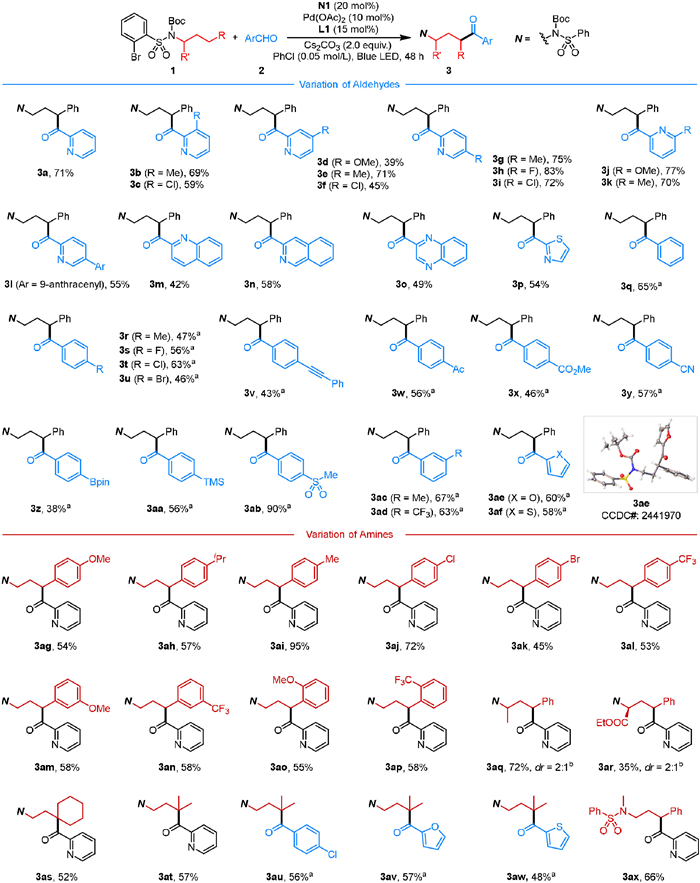
Then, various amines were examined. 3-Phenylpropylamines bearing OMe, iPr, Me, Cl, Br, and CF3 on the para-position afforded corresponding ketones 3ag-3al in moderate to good yields. The reaction of 3-phenylpropylamines bearing OMe and CF3 at meta- or ortho-position all worked well, leading to products 3am-3ap in moderate yields. 3-Phenylpropylamines bearing Me and ester at amino α-position were also tolerable (3aq-3ar). Besides acylation of benzyl C(sp3)-H bond, acylation of unactivated aliphatic C(sp3)-H bond with various (hetero)aromatic aldehydes could also be achieved on this catalytic platform (3as−3aw). The protecting group Boc could be replaced by methyl without affecting the reaction efficiency (3ax). However, unsubstituted substrate 1 did not work for this reaction under current reaction conditions.
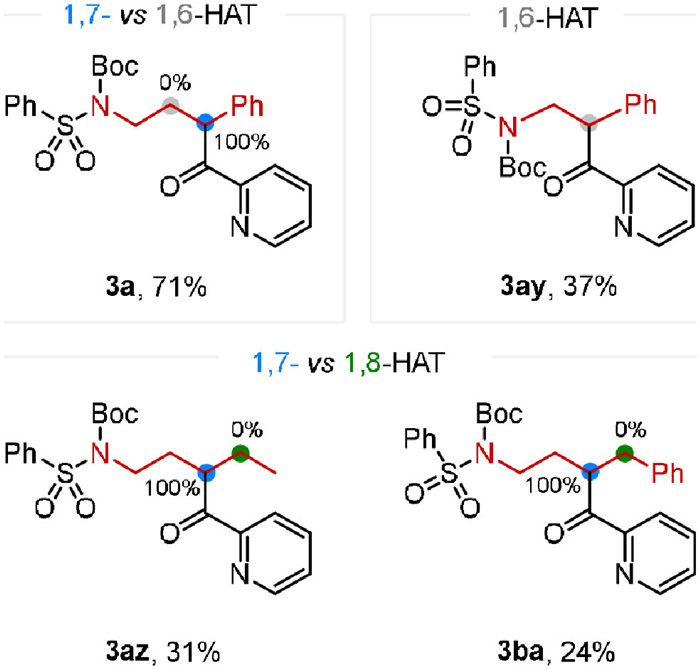
The excellent γ-selectivity observed in these reactions led us to further investigate the limits of the regioselectivity in the key HAT step (Scheme 3). β-C(sp3)-H acylation occurs via 1,6-HAT to furnish β-aminoketones 3ay in moderate yield, when no γ-C(sp3)-H is present in the substrate. The reaction of n-amylamine exhibits exclusive γ-regioselectivity, and β- and δ-C(sp3)-H are untouched (3az). The γ-C(sp3)-H acylation of aliphatic amine bearing benzyl δ-C(sp3)-H further confirms 1,7-HAT is highly favored over 1,8-HAT (3ba). The excellent regioselectivity may be attribute to the rigid sulfonamide tether, which makes 1,7-HAT favored over the corresponding 1,5-, 1,6- or 1,8-HAT [28,66,67].
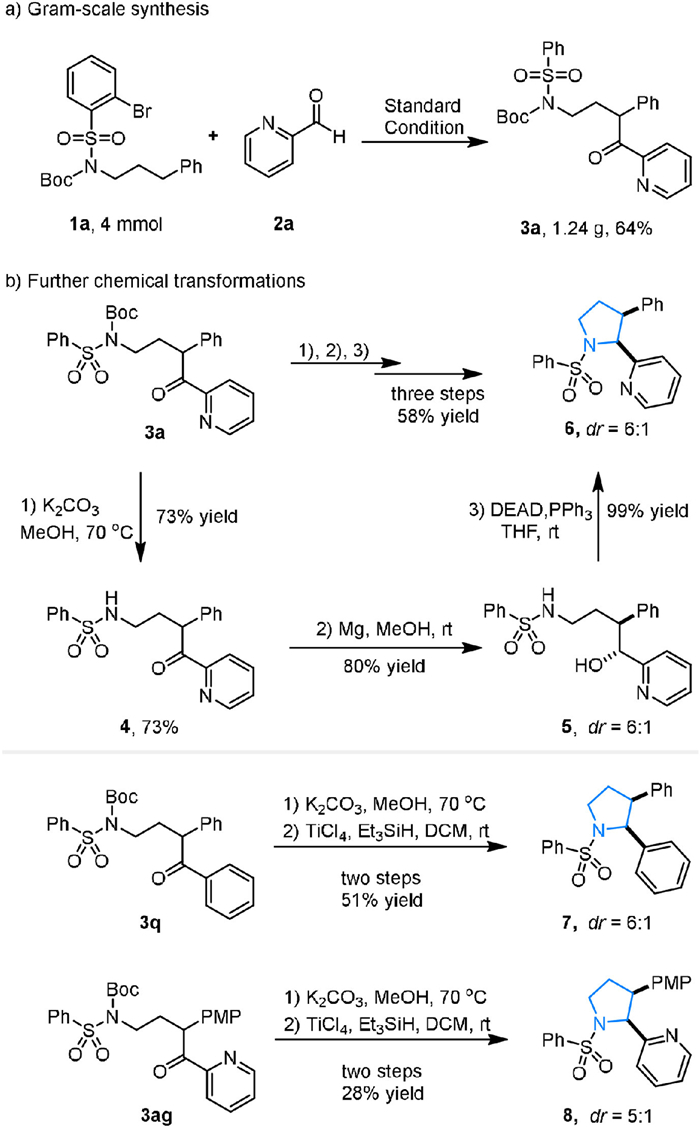
To further demonstrate the synthetic potential of this method, gram-scale synthesis and synthetic transformations were carried out (Scheme 4). The efficiency of this reaction was maintained in gram-scale synthesis, affording 1.24 g of ketone 3a in 64% yield. The removal of the Boc protective group of ketone 3a gave sulfonamide 4, which was reduced to afford δ-aminoalcohol 5. Pyrrolidine 6 was obtained via the following intramolecular Mitsunobu reaction. Similar deprotection of ketone 3q and the following reductive amination afforded pyrrolidine 7 in good yield with 6:1 dr. Similarly, ketone 3ag could be converted into pyrrolidine 8, which is the key intermediate for the synthesis of BIRZ227, a potentially useful therapeutic agent for treating inflammatory disorders [68].
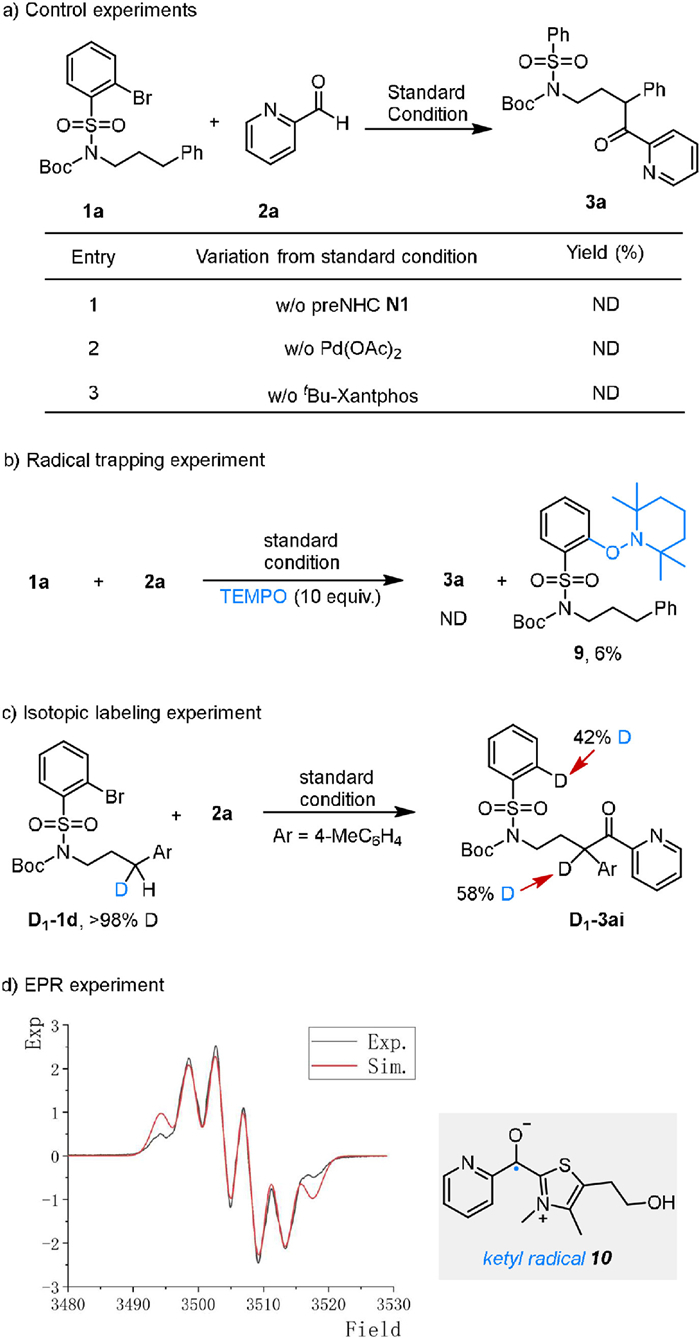
To go insight into the mechanism, a series of control experiments were carried out (Scheme 5). It is found that preNHC, palladium and ligand are all crucial for the reaction (Scheme 5a). The light on/off experiments reveals that light is essential (see Supporting information for details). When the radical scavenger TEMPO was added, the reaction was completely inhibited and the adduct 9 of aryl radical with TEMPO could be isolated in 6% yield (Scheme 5b). When introducing a deuterium at benzyl position, only the benzene ring of sulfonyl group was partially deuterated, demonstrating the 1,7-HAT between aryl radical and γ-C(sp3)-H (Scheme 5c). The in situ electron paramagnetic resonance (EPR) analysis of the model reaction mixture suggests the generation of ketyl radical 10 (Scheme 5d). In addition, Stern-Volmer quenching studies demonstrated that 1a quenched the excited palladium catalyst (see Supporting information for details).
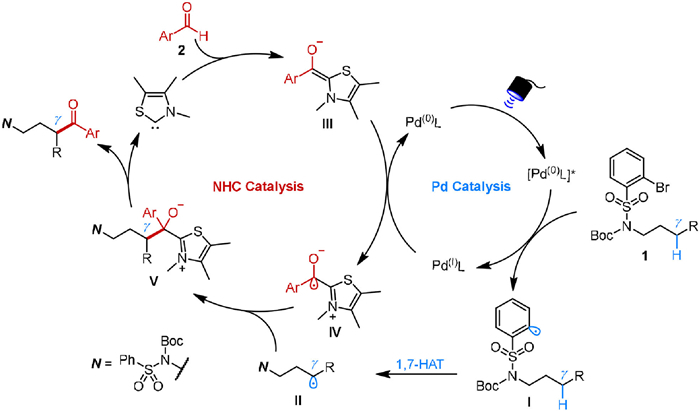
Based on the mechanistic experiments and previous reports [69–71], a plausible catalytic cycle is shown in Fig. 1. An inner-sphere single electron transfer from photo-excited Pd(0)L species to aryl bromide 1 produces aryl radical Ⅰ and Pd(Ⅰ)L complex. Site-selective γ-C(sp3)-H activation through aryl radical-mediated 1,7-HAT affords transient alkyl radical Ⅱ. Meanwhile, single electron oxidation of the Breslow enolate intermediate Ⅲ by Pd(Ⅰ)L complex gives persistent ketyl radical Ⅳ and regenerates Pd(0)L complex. The radical/radical coupling of ketyl radical Ⅳ and alkyl radical Ⅱ furnishes the adduct Ⅴ, which is fragmented to afford γ-amino C(sp3)-H acylation products and release the NHC catalyst.
In conclusion, we have developed a practical acylation of γ-amino C(sp3)-H bonds with aldehydes as acyl source through cooperative photoredox NHC/Pd catalysis. This approach enables direct conversion of a variety of readily available aliphatic amines to γ-aminoketones in moderate to good yields with excellent and predictable regioselectivity. Mechanistic studies of the γ-amino C(sp3)-H acylation are consistent with a radical/radical coupling process that entails (a) photoinduced Pd-promoted formation of aryl radical, (b) generation of transient γ-amino alkyl radical through aryl radical-mediated 1,7-HAT, (c) single-electron oxidation of Breslow enolate intermediate to persistent ketyl radical, and (d) radical/radical coupling of γ-amino alkyl radical with ketyl radical. Additionally, we have shown that the γ-aminoketones are easily manipulated to enable access to pyrrolines and δ-amino alcohols of interest in medicinal chemistry, thus highlighting the synthetic potential of this methodology.
The authors declare that they have no known competing financial interests or personal relationships that could have appeared to influence the work reported in this paper.
Xin-Han Wang: Methodology, Investigation. Ying Huang: Investigation. Chun-Lin Zhang: Writing – review & editing, Writing – original draft, Supervision. Song Ye: Writing – review & editing, Project administration.
Financial support from the National Natural Science Foundation of China (Nos. 22271292; 21831008) and Beijing National Laboratory for Molecular Sciences (No. BNLMS-CXXM-202003), National Key R&D Program of China (No. 2023YFF0723900) and the Ministry of Science and Technology of China is greatly acknowledged.
Supplementary material associated with this article can be found, in the online version, at doi:
C.M. Marshall, J.G. Federice, C.N. Bell, et al., J. Med. Chem. 67 (2024) 11622–11655. doi: 10.1021/acs.jmedchem.4c01122
S.I. Murahashi, N. Komiya, H. Terai, et al., J. Am. Chem. Soc. 125 (2003) 15312–15313. doi: 10.1021/ja0390303
A.G. Condie, J.C. González-Gómez, C.R.J. Stephenson, J. Am. Chem. Soc. 132 (2010) 1464–1465. doi: 10.1021/ja909145y
J.M. Allen, T.H. Lambert, J. Am. Chem. Soc. 133 (2011) 1260–1262. doi: 10.1021/ja109617y
Y. Pan, S. Wang, C.W. Kee, et al., Green Chem. 13 (2011) 3341–3344. doi: 10.1039/c1gc15865a
A. McNally, C.K. Prier, D.W.C. MacMillan, Science 334 (2011) 1114–1117. doi: 10.1126/science.1213920
K. Nakajima, Y. Miyake, Y. Nishibayashi, Acc. Chem. Res. 49 (2016) 1946–1956. doi: 10.1021/acs.accounts.6b00251
D.P. Curran, H. Liu, J. Chem. Soc., Perkin Trans. 1 (1994) 1377–1393.
J.W. Beatty, C.R.J. Stephenson, Acc. Chem. Res. 48 (2015) 1474–1484. doi: 10.1021/acs.accounts.5b00068
J. Ye, I. Kalvet, F. Schoenebeck, et al., Nat. Chem. 10 (2018) 1037–1041. doi: 10.1038/s41557-018-0085-9
S. Das, K. Murugesan, G.J. Villegas Rodríguez, et al., ACS Catal. 11 (2021) 1593–1603. doi: 10.1021/acscatal.0c05694
J. Kaur, J.P. Barham, Synthesis 54 (2022) 1461–1477 (Mass).
S. Sarkar, S. Wagulde, X. Jia, et al., Chem 8 (2022) 3096–3108.
W. Guo, Q. Wang, J. Zhu, Chem. Soc. Rev. 50 (2021) 7359–7377. doi: 10.1039/d0cs00774a
Z. Zhang, X. Zhang, D.A. Nagib, Chem 5 (2019) 3127–3134. doi: 10.1016/j.chempr.2019.09.010
C. Martínez, K. Muñiz, Angew. Chem. Int. Ed. 54 (2015) 8287–8291. doi: 10.1002/anie.201501122
E.A. Wappes, S.C. Fosu, T.C. Chopko, et al., Angew. Chem. Int. Ed. 55 (2016) 9974–9978. doi: 10.1002/anie.201604704
V.G. Zaitsev, D. Shabashov, O. Daugulis, J. Am. Chem. Soc. 127 (2005) 13154–13155. doi: 10.1021/ja054549f
H. Chen, W. Fan, X.A. Yuan, et al., Nat. Commun. 10 (2019) 4743. doi: 10.1002/ange.201814143
J. Calleja, D. Pla, T.W. Gorman, et al., Nat. Chem. 7 (2015) 1009–1016. doi: 10.1038/nchem.2367
Y. Wu, Y.Q. Chen, T. Liu, et al., J. Am. Chem. Soc. 138 (2016) 14554–14557. doi: 10.1021/jacs.6b09653
Y. Xu, M.C. Young, C. Wang, et al., Angew. Chem. Int. Ed. 55 (2016) 9084–9087. doi: 10.1002/anie.201604268
Y. Liu, H. Ge, Nat. Chem. 9 (2017) 26–32. doi: 10.1038/nchem.2606
Y.Q. Chen, Z. Wang, Y. Wu, et al., J. Am. Chem. Soc. 140 (2018) 17884–17894. doi: 10.1021/jacs.8b07109
M. Nappi, C. He, W.G. Whitehurst, et al., Angew. Chem. Int. Ed. 57 (2018) 3178–3182. doi: 10.1002/anie.201800519
Z. Li, J.Q. Yu, J. Am. Chem. Soc. 145 (2023) 25948–25953. doi: 10.1021/jacs.3c09340
G. He, G. Chen, Angew. Chem. Int. Ed. 50 (2011) 5192–5196. doi: 10.1002/anie.201100984
P. Chuentragool, M. Parasram, Y. Shi, et al., J. Am. Chem. Soc. 140 (2018) 2465–2468. doi: 10.1021/jacs.8b00488
D. Bafaluy, Z. Georgieva, K. Muñiz, Angew. Chem. Int. Ed. 59 (2020) 14241–14245. doi: 10.1002/anie.202004902
M.A. Short, M.F. Shehata, M.A. Sanders, et al., Chem. Sci. 11 (2020) 217–223. doi: 10.1039/c9sc03428e
K. Kiyokawa, K. Jou, S. Minakata, Chem. Eur. J. 27 (2021) 13971–13976. doi: 10.1002/chem.202102635
J.H. Herbort, T.N. Bednar, A.D. Chen, et al., J. Am. Chem. Soc. 144 (2022) 13366–13373. doi: 10.1021/jacs.2c05266
H. Li, X. Qiu, X. Zhang, et al., Org. Lett. 25 (2023) 8814–8818. doi: 10.1021/acs.orglett.3c03401
B. Tewes, B. Frehland, D. Schepmann, et al., Biorg. Med. Chem. 18 (2010) 8005–8015.
K. Pal, S. Pore, S. Sinha, et al., J. Med. Chem. 54 (2011) 2378–2390. doi: 10.1021/jm101530j
J.I. Perlmutter, L.T. Forbes, D.J. Krysan, et al., J. Med. Chem. 57 (2014) 8540–8562. doi: 10.1021/jm5010682
W.C. Chen, Y. Simanjuntak, L.W. Chu, et al., J. Med. Chem. 63 (2020) 1313–1327. doi: 10.1021/acs.jmedchem.9b01779
M.N. Hopkinson, C. Richter, M. Schedler, et al., Nature 510 (2014) 485–496. doi: 10.1038/nature13384
D.M. Flanigan, F. Romanov-Michailidis, N.A. White, et al., Chem. Rev. 115 (2015) 9307–9387. doi: 10.1021/acs.chemrev.5b00060
M.H. Wang, K.A. Scheidt, Angew. Chem. Int. Ed. 55 (2016) 14912–14922. doi: 10.1002/anie.201605319
C. Zhang, J.F. Hooper, D.W. Lupton, ACS Catal. 7 (2017) 2583–2596. doi: 10.1021/acscatal.6b03663
S. Mondal, S.R. Yetra, S. Mukherjee, et al., Acc. Chem. Res. 52 (2019) 425–436. doi: 10.1021/acs.accounts.8b00550
X. Chen, H. Wang, Z. Jin, et al., Chin. J. Chem. 38 (2020) 1167–1202. doi: 10.1002/cjoc.202000107
X.Y. Chen, Z.H. Gao, S. Ye, Acc. Chem. Res. 53 (2020) 690–702.
P. Bellotti, M. Koy, M.N. Hopkinson, et al., Nat. Rev. Chem. 5 (2021) 711–725. doi: 10.1038/s41570-021-00321-1
J. Wang, C. Zhao, J. Wang, ACS Catal. 11 (2021) 12520–12531. doi: 10.1021/acscatal.1c03459
T. Li, Z. Jin, Y.R. Chi, Sci. China Chem. 65 (2022) 210–223. doi: 10.1007/s11426-021-1133-5
Y. Nakano, J.T. Maddigan-Wyatt, D.W. Lupton, Acc. Chem. Res. 56 (2023) 1190–1203. doi: 10.1021/acs.accounts.3c00063
Z.F. Zhang, C.L. Zhang, S. Ye, Chem. Eur. J. 30 (2024) e202402259.
D.A. DiRocco, T. Rovis, J. Am. Chem. Soc. 134 (2012) 8094–8097. doi: 10.1021/ja3030164
T. Ishii, K. Nagao, H. Ohmiya, Chem. Sci. 11 (2020) 5630–5636. doi: 10.1039/d0sc01538e
J. Liu, X.N. Xing, J.H. Huang, et al., Chem. Sci. 11 (2020) 10605–10613. doi: 10.1039/d0sc03595e
K.Q. Chen, H. Sheng, Q. Liu, et al., Sci. China Chem. 64 (2021) 7–16. doi: 10.1007/s11426-020-9851-8
L. Dai, S. Ye, Chin. Chem. Lett. 32 (2021) 660–667.
Q.Z. Li, R. Zeng, B. Han, et al., Chem. Eur. J. 27 (2021) 3238–3250. doi: 10.1002/chem.202004059
K. Liu, M. Schwenzer, A. Studer, ACS Catal. 12 (2022) 11984–11999. doi: 10.1021/acscatal.2c03996
X. Wang, S. Wu, R. Yang, et al., Chem. Sci. 14 (2023) 13367–13383. doi: 10.1039/d3sc03274d
H. Cai, X. Yang, S.C. Ren, et al., ACS Catal. (2024) 8270–8293. doi: 10.1021/acscatal.4c01973
F. Lu, F. Su, S. Pan, et al., Chem. Eur. J. 30 (2024) e202401811.
Y. Matsuki, N. Ohnishi, Y. Kakeno, et al., Nat. Commun. 12 (2021) 3848.
X. Wang, B. Zhu, Y. Liu, et al., ACS Catal. 12 (2022) 2522–2531. doi: 10.1021/acscatal.1c05815
J.L. Zhu, C.R. Schull, A.T. Tam, et al., J. Am. Chem. Soc. 145 (2023) 1535–1541. doi: 10.1021/jacs.2c12845
F. Su, J. Zou, X. Lv, et al., Angew. Chem. Int. Ed. 62 (2023) e202303388.
Q.Z. Li, R. Zeng, Y. Fan, et al., Angew. Chem. Int. Ed. 61 (2022) e202116629.
N. Radhoff, A. Studer, Angew. Chem. Int. Ed. 60 (2021) 3561–3565. doi: 10.1002/anie.202013275
A.F. Voica, A. Mendoza, W.R. Gutekunst, et al., Nat. Chem. 4 (2012) 629–635. doi: 10.1038/nchem.1385
F.W. Friese, C. Mück-Lichtenfeld, A. Studer, Nat. Commun. 9 (2018) 2808.
N.K. Yee, Tetrahedron Lett. 38 (1997) 5091–5094.
H.Y. Wang, X.H. Wang, B.A. Zhou, et al., Nat. Commun. 14 (2023) 4044. doi: 10.3390/s23084044
Y.F. Han, Y. Huang, H. Liu, et al., Nat. Commun. 13 (2022) 5754.
Y. Huang, Y.F. Han, C.L. Zhang, et al., ACS Catal. 13 (2023) 11033–11040. doi: 10.1021/acscatal.3c02844

Scheme 2 NHC/Pd-catalyzed γ-C(sp3)-H acylation of amines. Reaction conditions: 1 (0.2 mmol), 2 (0.3 mmol), preNHC N1 (0.04 mmol), Pd(OAc)2 (0.02 mmol), L1 (0.03 mmol), Cs2CO3 (0.4 mmol) and PhCl (4 mL), 36 W blue LED at room temperature for 48 h under N2. Isolated yields. a preNHC N4 was used. b Diastereomeric ratio was determined by 1H NMR.
Table 1. Optimization of the reaction conditions.a
|
||
| Entry | Variation from standard conditions | Yield (%)b |
| 1 | None | 62 |
| 2 | N2, N3 instead of N1 | 48, 52 |
| 3 | N4 instead of N1 | 57 |
| 4 | N5 instead of N1 | Trace |
| 5 | Pd(PPh4)3 instead of Pd(OAc)2 | 35 |
| 6 | PdCl2 instead of Pd(OAc)2 | ND |
| 7 | L2 instead of L1 | 16 |
| 8 | PCy3 instead of L1 | ND |
| 9 | PhCF3 instead of PhCl | 51 |
| 10 | THF, DCM instead of PhCl | Trace |
| 11 | K2CO3, CsF instead of Cs2CO3 | 54, 53 |
| 12 | DBU instead of Cs2CO3 | 22 |
| 13 | 0.05 mol/L instead of 0.1 mol/L | 74 (71)c |
| 14 | 4CzIPN instead of Pd(OAc)2/L1 | Trace |
| 15 | fac-Ir(ppy)3 instead of Pd(OAc)2/L1 | 7 |
| 16 | Ru(phen)3(PF6)2 instead of Pd(OAc)2/L1 | Trace |
| a Reaction conditions: 1a (0.2 mmol), 2a (0.3 mmol), preNHC (0.04 mmol), Pd(OAc)2 (0.02 mmol), tBu-Xantphos (0.03 mmol), Cs2CO3 (0.4 mmol) and PhCl (2 mL), 36 W blue LED at room temperature for 48 h under N2. b Yields of 3a determined by 1H NMR using 1,3,5-trimethoxybenzene as internal standard. ND = not detected. c Isolated yield in parenthesis. |
||
 下载: 导出CSV

 扫一扫看文章


扫一扫关注我们


 下载:
下载: