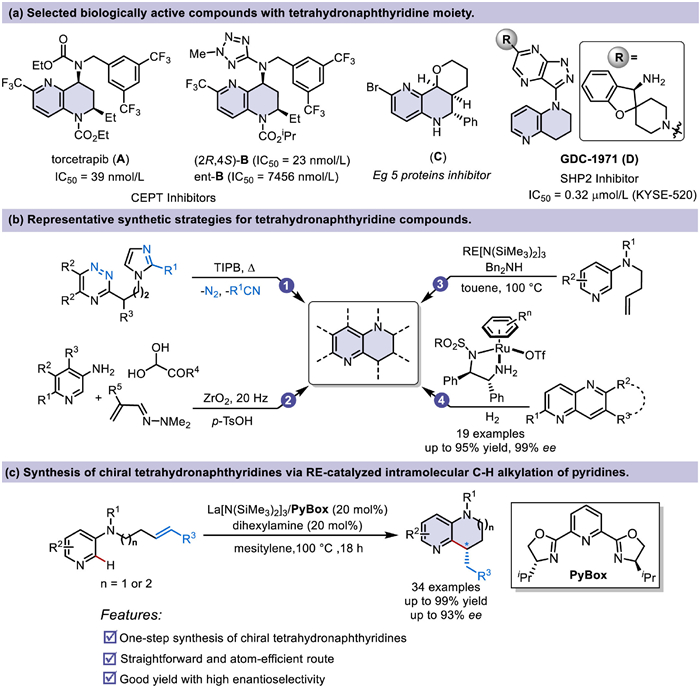
Scheme 1.
Representative bioactive compounds with 1,2,3,4-tetrahydro-1,5-naphthyridine skeleton and their synthesis.

Enantioselective intramolecular C–H alkylation of pyridine derivatives with alkene by rare-earth catalysts: Facile synthesis of chiral tetrahydro-1,5-naphthyridines
Jing Zhang , Lichao Ning , Yong Qiu , Minghui Ji , Shiyu Wang , Yuji Wang , Fei Wang , Xiaoming Feng , Shunxi Dong


1,2,3,4-Tetrahydro-1,5-naphthyridine motif is present in a wide range of important bioactive compounds (Scheme 1a) [1–6]. Importantly, the stereogenic configuration shows considerable influence on their biological activities. For instance, the in vitro human plasma CETP inhibitory activity of (2R, 4S)-B exceeds that of its enantiomer by >320 times (IC50 = 21 nmol/L and 7456 nmol/L, respectively) [3]. In addition, 1,2,3,4-tetrahydro-1,5-naphthyridine framework is amenable to transform into other important compounds, for example 1,5-diaza-cis-decalin, further enhancing its versatility and utility in synthetic chemistry [7–12]. Therefore, the development of efficient methods for the synthesis of 1,2,3,4-tetrahydro-1,5-naphthyridines has attracted considerable attention in the past several decades. Snyder et al. disclosed the construction of 1,2,3,4-tetrahydro-1,5-naphthyridines by an intramolecular inverse-electron-demand Diels-Alder reaction between imidazoles and 1,2,4-triazines (Scheme 1b, route 1) [13,14]. Aza-vinylogous Povarov reaction of aromatic amines, α-ketoaldehydes and α,β-unsaturated dimethylhydrazones under mechanochemical conditions was reported by the group of Menéndez, a number of tetrahydro-1,5-naphthyridines were produced in moderate to high yield (Scheme 1b, route 2) [15]. Shao, Zhang, Chen and coworkers reported a rare-earth metal-catalyzed synthesis of 1,2,3,4-tetrahydro-1,5-naphthyridines via C–H cyclization of functionalized pyridines (Scheme 1b, route 3) [16]. The direct hydrogenation of 1,5-naphthyridine to afford such architecture has been extensively studied by Fan, Khusnutdinova, and others (Scheme 1b, route 4) [17,18]. Nevertheless, the asymmetric construction of enantioenriched tetrahydro-1,5-naphthyridines was relatively rare. In 2016, Fan and coworkers described an elegant catalytic synthesis of optically active 1,2,3,4-tetrahydro-1,5-naphthyridines via enantioselective hydrogenation of 1,5-naphthyridine (Scheme 1b, route 4), up to 95% yield with 99% ee was achieved [18]. Nevertheless, the development of new routes and catalyst systems to access chiral 1,2,3,4-tetrahydro-1,5-naphthyridines with different product distribution is still in high demand.
Organo rare-earth (RE) catalysis has been emerging as one of powerful platforms for a number of chemical transformations [19–25]. In the context of rare-earth-mediated C–H functionalizations, significant advances have been achieved with cationic rare-earth alkyl complexes as the catalysts probably due to their relatively stronger Lewis acidity and less steric hindrances around rare-earth metal center than their neutral analogues [26–31]. In contrast, neutral rare-earth complexes are much less popular during the past decade [32–37]. As part of our continuous efforts [38–44] in organo rare-earth catalysis and motivated by previous work [16] by Shao, Zhang, Chen et al., we envisioned that chiral bis(oxazolinato) rare-earth amido complex catalyst [45–47] was a potential promoter for the titled reaction. The reaction was proposed to be initiated by site-selective deprotonation [48–51] with the assistance of bis(oxazolinato) rare-earth amido complex, followed by an enantioselective alkene insertion into the resulting RE-aryl bond to generate the chiral rare-earth alkyl species. The σ-bond metathesis of rare-earth alkyl intermediate with another substrate afforded the RE-aryl complex, closing the catalytic cycle. Herein, we would like to disclose our effort along this line. La[N(SiMe3)2]3/PyBox was eventually identified to be the competent catalyst for the enantio-selective intramolecular C–H alkylation of pyridine derivatives with alkene. A number of chiral 1,2,3,4-tetrahydro-1,5-naphthyridines were obtained in an atom-economical and efficient manner with moderate to good yields and high enantioselectivity (34 examples, up to 99% yield, 93% ee).
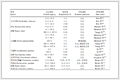
To begin with, N-(but-3-en-1-yl)-N-phenylpyridin-3-amine (1a) was chosen as the model substrate for the optimization of the reaction conditions. As depicted in Table 1, different types of oxazoline ligands and various rare-earth metals were investigated.
 DownLoad:
CSV
DownLoad:
CSV
 |
||||
| Entry | Metal | Ligand | Yield (%)b | ee (%)c |
| 1d | La[N(SiMe3)2]3 | – | Trace | – |
| 2 | La[N(SiMe3)2]3 | – | 99 | – |
| 3 | La[N(SiMe3)2]3 | L1 | 67 | 23 |
| 4 | La[N(SiMe3)2]3 | L2 | 27 | 86 |
| 5 | La[N(SiMe3)2]3 | L3 | 31 | 26 |
| 6 | La[N(SiMe3)2]3 | L4 | 8 | 20 |
| 7 | La[N(SiMe3)2]3 | L5 | 19 | 84 |
| 8 | La[N(SiMe3)2]3 | L6 | 8 | 38 |
| 9 | La[N(SiMe3)2]3 | L7 | 48 | −6 |
| 10 | Ce[N(SiMe3)2]3 | L2 | 20 | 84 |
| 11 | Sm[N(SiMe3)2]3 | L2 | 21 | 50 |
| 12 | Y[N(SiMe3)2]3 | L2 | 11 | 10 |
| 13e | La[N(SiMe3)2]3 | L2 | 68 | 86 |
| 14e, f, g | La[N(SiMe3)2]3 | L2 | 78 | 90 |
| 15e, g, h | La[N(SiMe3)2]3 | L2 | 89 | 90 |
| a Conditions: all reactions were performed with in-situ generated catalyst metal/ligand (1/1, 10 mol%), Bn2NH (10 mol%), 1a (0.1 mmol) in toluene (1.0 mL) at 100 ◦C for 24 h under argon atmosphere. b Isolated yield. c Determined by HPLC analysis on a chiral stationary phase. d Run without Bn2NH. e Prepared catalyst (20 mol%). f Mesitylene (1 mL) instead of toluene. g Dihexylamine (20 mol%) was used instead of Bn2NH. h Carried out in mesitylene (0.8 mL) for 18 h. |
||||
When the reaction was carried out with La[N(SiMe3)2]3 in toluene at 100 ℃, no reaction occurred (Table 1, entry 1). The addition of Bn2NH as the additive led to the generation of the desired 1,2,3,4-tetrahydro-1,5-naphthyridine product 2a in 99% yield via 6-exo-trig cyclization (entry 2). Based on our previous works [40–41], La[N(SiMe3)2]3/L1 was employed as the chiral catalyst, the corresponding product 2a was afforded in 67% yield with 23% ee (entry 3). The subsequent examination of chiral oxazoline ligands suggested that pyridine-based bisoxazoline ligand L2 was a better choice, product 2a was isolated in 27% yield with 86% ee (entry 4, PS8 in Supporting information for more details). The variation of pyridine-based bisoxazoline ligands indicated that decreasing or increasing the steric hindrance of substitution at stereogenic center led to inferior results (entries 5 and 6, methyl substituted L3: 31% yield, 26% ee, tert-butyl substituted L4: 8% yield, 20% ee). Chiral ligand L5 with cyclohexyl group provided comparable enantioselectivity (entry 7, 84% ee), while lower yield and ee value were afforded by phenyl substituted L6 (entry 8, 8% yield, 38% ee). The use of pyridine-based mono-oxazoline ligand L7 resulted into poor results (entry 9, 48% yield, 6% ee). Next, the influence of rare-earth ion radius was tested (PS7 in Supporting information for more details). It was found that the enantioselectivity was closely associated with rare-earth ion radius [52–58]. La[N(SiMe3)2]3 and Ce[N(SiMe3)2]3, with larger ionic radii (six-coordinate La3+, 1.032 Å; Ce3+, 1.010 Å) providing superior ee values (86% ee and 84% ee, respectively) compared to Sm[N(SiMe3)2]3 (0.958 Å, 50% ee) and Y[N(SiMe3)2]3 (0.900 Å, 10% ee) (entries 4 and 10–12). When the reaction was run with 20 mol% catalyst loading, the yield of 2a was increased to 68% yield with maintained ee value (entry 13). Switching the solvent to mesitylene and changing the additive to dihexylamine led to 2a in 78% yield and 90% ee (entry 14). Performing the reaction at higher concentration provided a better yield with maintained enantioselectivity after 18 h (entry 15, 89% yield, 90% ee).
Therefore, the optimal reaction conditions were established as 1a (0.1 mmol), La[N(SiMe3)2]3/L2 (20 mol%, 1:1), dihexylamine (20 mol%) in mesitylene (0.8 mL) at 100 ℃ for 18 h.
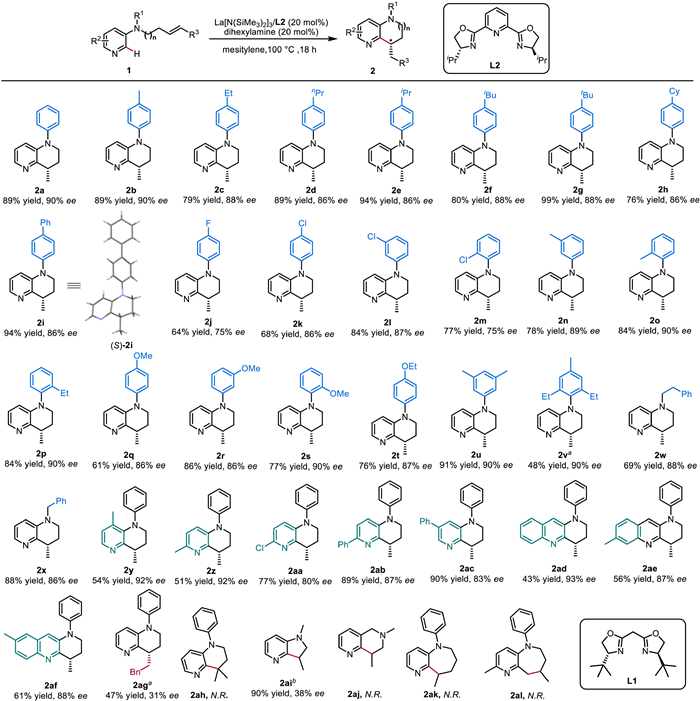
With the optimized reaction conditions in hand, the substrate scope was investigated (Scheme 2). Firstly, the protecting group on the nitrogen atom was examined. Regardless of the substituent pattern and the electronic property of the aryl moiety, all of the reactions underwent smoothly, the corresponding products 2a–2t were obtained in moderate to good yield with high enantioselectivity (61%–99% yield, 75%–90% ee). The substrate 1a–1k with para-substituted aryl group transformed into the products with relatively high ee value (86%–90% ee) except 4-F substituted one (75% ee). The position of substitutions on the phenyl group displayed a limited effect on the outcomes (2l–2t, 61%–86% yield, 86%–90% ee). The reaction of substrate 1u bearing 3,5-dimethylphenyl group afforded the related product 2u in 91% yield, 90% ee. In contrast, 48% yield with 90% ee was obtained for 2,6-diethyl-4-methylphenyl substituted 1v with L5 as the ligand. Switching N-aryl group to N-Bn and N–CH2Bn were feasible, the desired tetrahydro-1,5-naphthyridines were generated in good yield with high ee value (2w: 69% yield, 88% ee, 2x: 88% yield, 86% ee, respectively). Next, the substitutions on the pyridine moiety were tested. All of the reaction took place well, delivering the desired adducts 2y–2ac in 51%–90% yield with 80%–92% ee. Notably, the reaction was compatible with quinoline-derived substrates 1ad–1af, moderate yield with high enantioselectivity were obtained (43%–61% yield, 87%–93% ee). Moderate yield and lower stereoselectivity were obtained for the reaction of styrene-derived substrate 1ag (47% yield, 31% ee). The attempts to synthesize 2ah, 2aj, 2ak and 2al were unsuccessful. In addition, 2ai was generated in 90% yield and 38% ee in the presence of Y[N(SiMe3)2]3/L1. The absolute configuration of adduct 2i was determined to be (S) by X-ray diffraction analysis.
To demonstrate the potential utility of the current methodology, a scale-up synthesis of product 2a was conducted (Scheme 3a). Under the optimal reaction conditions, 5 mmol of 1a (1.12g) converted into the corresponding chiral product 2a in 85% yield (0.95g) with 87% ee. then, the further transformations of 2a were carried out. Utilizing the [Sc] catalyst developed by our research group, we successfully achieved C–H alkylation at C6 position of the pyridine ring with styrene, the desired product was obtained in 80% yield with 85% ee (Scheme 3b). Olefin derived from estradiol were also amenable to the reaction, delivering the related adduct in 71% yield with 92.5/7.5 dr.
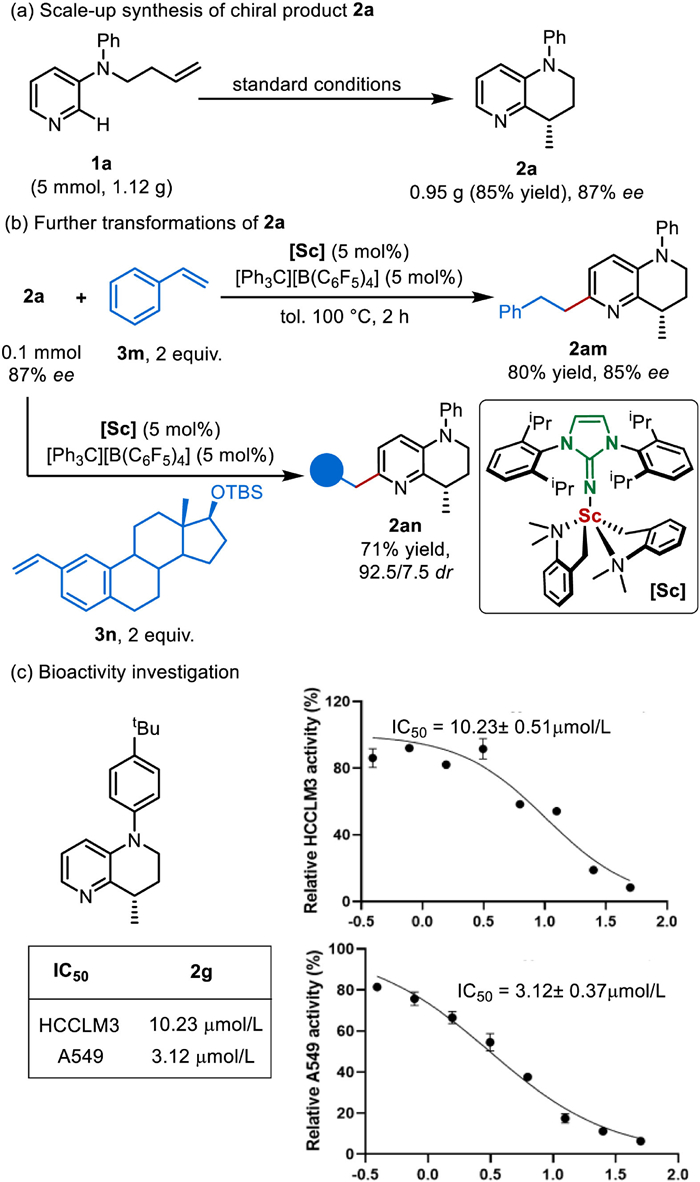
Motivated by the diverse bioactivity of 1,2,3,4-tetrahydro-1,5-naphthyridines, we tested the bioactivity of products 2. The in vitro cytotoxicity against the human hepatocellular carcinoma (HCCLM3) cell and lung cancer cell (A549) were investigated (see Supporting information for details). The outcomes implied that compound 2 g displayed an obvious inhibitory effect on the viability of HCCLM3 and A549 (Scheme 3c). IC50 values of 2 g toward HCCLM3 and A549 were 10.23 and 3.12 µmol/L, respectively.
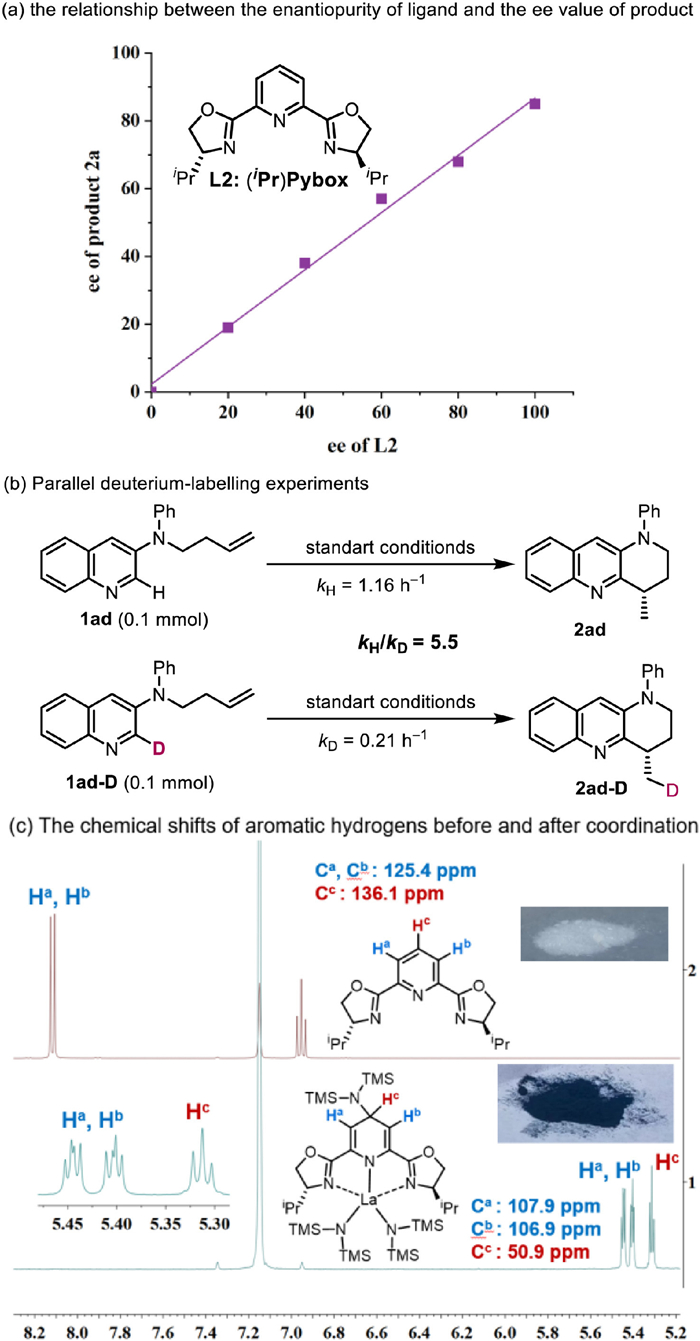
To gain a deeper insight into the reaction mechanism, a series of mechanistic experiments were conducted (see Supporting information for more details). As illustrated in Scheme 4a, the relationship between the enantiopurity of chiral ligand and the ee value of product was a linear effect, suggesting that one ligand molecule is contained in each reactive La(Ⅲ) complex. Furthermore, parallel kinetic experiments were performed (Scheme 4b), a kinetic isotope effect value of 5.5 was observed, implying that C(sp2)−H bond cleavage of pyridine might be involved in the turnover limiting step. The dark blue colour of La[N(SiMe3)2]3/L2 tempered us to probe its structure. As indicated in Scheme 4c, the chemical shift of Ha, Hb and Hc on pyridine ring in chiral ligand moved to from 8.12 ppm (Ha, Hb) and 6.95 ppm (Hc) to 5.44 ppm (Ha), 5.40 ppm (Hb) and 5.31 ppm (Hc). Moreover, after coordination with La[N(SiMe3)2]3, the chemical shift of Cc changed from 136.1 ppm to 50.8 ppm. Three different [N(SiMe3)2] groups were detected as well at 0.39, 0.35 and 0.32 ppm. These observations along with 2D NMR spectra rendered us to proposed that N(SiMe3)2 group underwent nucleophilic addition to C4-position of pyridine ring during the coordination process. The related transformations have been reported by other groups [59–62].
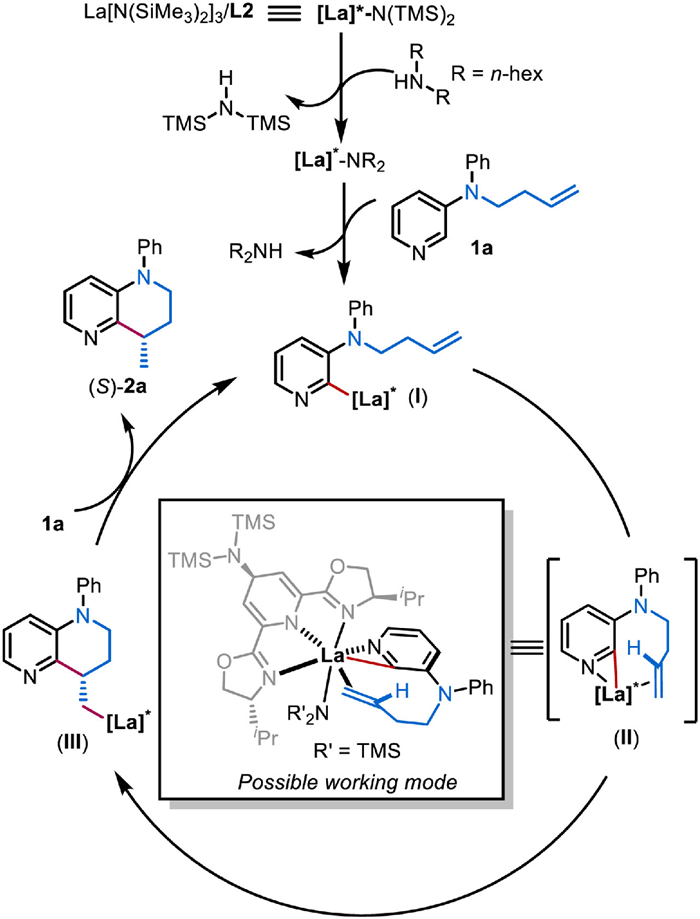
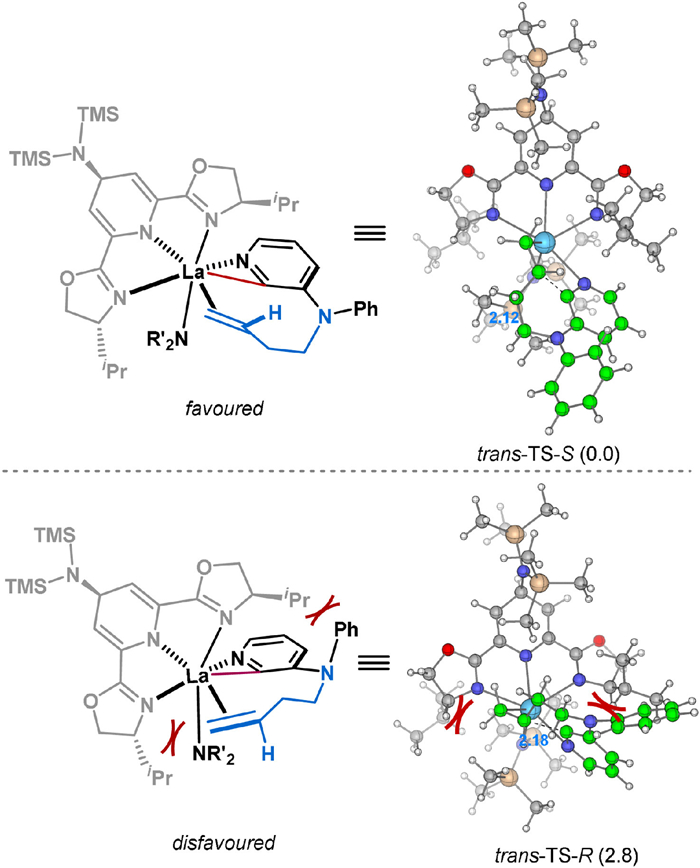
Based on previous work, we proposed a possible catalytic cycle (Fig. 1). In order to elucidate the origin of the enantioselective control, DFT calculations were conducted on the transition states involved in the olefin migratory insertion step. Considering the relative position of the two N(SiMe3)2 groups, four distinct transition states including both cis and trans configurations were identified. As depicted in Fig. 2, the results indicated the S-configuration transition state in the trans form was energetically more favourable (0 kcal/mol vs. 2.8 kcal/mol), aligning well with experimental data. Further structural analysis revealed that the R-configuration transition state experienced considerable steric repulsion between the phenyl group on nitrogen in the substrate and iPr group of the ligand as well the hydrogen of terminal alkene with oxazoline ring, elucidating the preference for the S-configuration. Similar situations were observed for the cis type of transition states (0.9 kcal/mol vs. 3.1 kcal/mol, for more details, see Supporting information).
In conclusion, we have accomplished a highly enantioselective intramolecular C–H alkylation of pyridine derivatives with alkene by La[N(SiMe3)2]3/PyBox complex. This protocol offers a straightforward and atom-economical route to a new family of chiral 1,2,3,4-tetrahydro-1,5-naphthyridines with high stereoselectivity (34 examples, up to 93% yield, 93% ee). The potential utility of the current method in organic synthesis was demonstrated by scale-up synthesis of chiral product and its further transformations. This work provides a new catalyst system for rare-earth-mediated asymmetric C–H functionalization. The further applications of chiral oxazoline-based rare-earth metal complexes in other related asymmetric transformations are in progress.
The authors declare that they have no known competing financial interests or personal relationships that could have appeared to influence the work reported in this paper.
Jing Zhang: Writing – review & editing, Writing – original draft, Methodology, Investigation, Data curation, Conceptualization. Lichao Ning: Data curation, Conceptualization. Yong Qiu: Investigation, Data curation. Minghui Ji: Investigation, Data curation. Shiyu Wang: Investigation, Data curation. Yuji Wang: Investigation. Fei Wang: Investigation, Data curation. Xiaoming Feng: Supervision, Resources, Funding acquisition. Shunxi Dong: Writing – review & editing, Supervision, Resources, Investigation, Funding acquisition, Data curation.
We appreciate the financial support of National Key R&D Program of China (No. 2022YFA1504301), the National Natural Science Foundation of China (Nos. 22271199 and 92256303), Sichuan Science and Technology Program (No. 2023YFSY0063) and Sichuan University (No. 2020SCUNL204). We thank for Dr. Yuqiao Zhou (Sichuan University) for the assistance with X-ray analyses.
Supplementary material associated with this article can be found, in the online version, at doi:
J.A. Sikorski, J. Med. Chem. 49 (2006) 1–22. doi: 10.1021/jm058224l
N.B. Mantlo, A. Escribano, J. Med. Chem. 57 (2014) 1–17. doi: 10.1021/jm400574e
M.C. Fernandez, A. Escribano, A.I. Mateo, S. Parthasarathy, Bio-org. Med. Chem. Lett. 22 (2012) 3056–3062. doi: 10.1016/j.bmcl.2012.03.075
K. Schiemann, S. Anzali, H. Drosdat, et al., Patent, WO2005063735, 2005.
A.M. Taylor, B.R. Williams, F. Giordanetto, E.H. Kelly, J. Med. Chem. 66 (2023) 13384–13399. doi: 10.1021/acs.jmedchem.3c00483
L.E. Sirois, N.A. White, J. Shen, et al., Org. Process Res. Dev. 28 (2024) 2862–2874. doi: 10.1021/acs.oprd.4c00162
G.H.C. Woo, A.B. Beeler, J.K. Snyder, Tetrahedron 63 (2007) 5649–5655. doi: 10.1016/j.tet.2007.04.003
X. Xie, D.A. Freed, M.C. Lozlowski, Tetrahedron Lett. 42 (2001) 6451–6454. doi: 10.1016/S0040-4039(01)01344-2
Y.F. Tan, C.J. Long, Z. Guan, Y.H. He, Green Chem. 24 (2022) 4581–4587. doi: 10.1039/d2gc00162d
X.L. Li, L.B. Schenkel, M.C. Kozlowski, Org. Lett. 2 (2000) 875–878. doi: 10.1021/ol9903133
X.L. Li, J. Yang, M.C. Kozlowski, Org. Lett. 3 (2001) 1137–1140. doi: 10.1021/ol015595x
Z.R. Xu, M.C. Kozlowski, J. Org. Chem. 67 (2002) 3072–3078. doi: 10.1021/jo025503x
C.E. Neipp, P.B. Ranslow, Z.K. Wan, J.K. Snyder, Tetrahedron Lett. 38 (1997) 7499–7502. doi: 10.1016/S0040-4039(97)01800-5
B.R. Lahue, S.M. Lo, Z.K. Wan, G.H.C. Woo, J.K. Snyder, J. Org. Chem. 69 (2004) 7171–7182. doi: 10.1021/jo040193z
J. Clerigué, M.T. Ramos, J.C. Menéndez, Molecules 26 (2021) 1330–1343. doi: 10.3390/molecules26051330
P.Q. Ye, Y.L. Shao, F.J. Zhang, et al., Adv. Synth. Catal. 362 (2020) 851–857. doi: 10.1002/adsc.201901473
A. Dubey, S.M.W. Rahaman, R.R. Fayzulin, J.R. Khusnutdinova, ChemCatChem 11 (2019) 3844–3852. doi: 10.1002/cctc.201900358
J.W. Zhang, F. Chen, Y.M. He, Q.H. Fan, Angew. Chem. Int. Ed. 54 (2015) 4622–4625. doi: 10.1002/anie.201411105
M. Nishiura, Z. Hou, Nat. Chem. 2 (2010) 257–268. doi: 10.1038/nchem.595
J.H. Cheng, Z. Hou, Sci. China Chem. 54 (2011) 2032–2037. doi: 10.1007/s11426-011-4439-z
M. Nishiura, Z. Hou, Acc. Chem. Res. 48 (2015) 2209–2220. doi: 10.1021/acs.accounts.5b00219
Q.L. Sun, X. Xu, ChemCatChem 14 (2022) e202201083.
K. Seth, Org. Chem. Front. 9 (2022) 3102–3141. doi: 10.1039/d1qo01859k
X. Cong, L. Huang, Z. Hou, Tetrahedron 135 (2023) 133323. doi: 10.1016/j.tet.2023.133323
A. Mishra, P. Wu, X.F. Cong, et al., ACS Catal. 12 (2022) 12973–12983. doi: 10.1021/acscatal.2c03681
S. Arndt, J. Okuda, Adv. Synth. Catal. 347 (2005) 339–354. doi: 10.1002/adsc.200404269
S. Lou, Q. Zhuo, M. Nishiura, G. Luo, Z. Hou, J. Am. Chem. Soc. 143 (2021) 2470–2476. doi: 10.1021/jacs.0c13166
Y.W. Guan, K.J. Chang, Y.J. Su, X. Xu, X. Xu, Chem. Asian J. 19 (2024) e202400190. doi: 10.1002/asia.202400190
X. Cong, G. Zhan, Z. Mo, M. Nishiura, Z. Hou, J. Am. Chem. Soc. 142 (2020) 5531–5537. doi: 10.1021/jacs.0c01171
X. Xu, X.Z. Zheng, X. Xu, ACS Catal. 11 (2021) 14995–15003. doi: 10.1021/acscatal.1c04657
J.H. Su, Y.C. Luo, X. Xu, Chem. Commun. 57 (2021) 3688–3691. doi: 10.1039/d1cc00306b
G. Jeske, H. Lauke, H. Mauermann, H. Schumann, T.J. Marks, J. Am. Chem. Soc. 107 (1985) 8111–8118. doi: 10.1021/ja00312a052
Y. Luo, H. Teng, C. Xue, M. Nishiura, Z. Hou, ACS Catal. 8 (2018) 8027–8032. doi: 10.1021/acscatal.8b02405
J.X. Liu, W.F. Chen, J.F. Li, C.M. Cui, ACS Catal. 8 (2018) 2230–2235. doi: 10.1021/acscatal.8b00010
C. Xue, Y. Luo, H. Teng, et al., ACS Catal. 8 (2018) 5017–5022. doi: 10.1021/acscatal.8b01364
Y.C. Luo, S.J. Jiang, X. Xu, Angew. Chem. Int. Ed. 61 (2022) e202117750. doi: 10.1002/anie.202117750
H. Nagae, Y. Shibata, H. Tsurugi, K. Mashima, J. Am. Chem. Soc. 137 (2015) 640–643. doi: 10.1021/ja511964k
D.W. Li, L.C. Ning, Q.L. Luo, et al., Sci. China Chem. 66 (2023) 1804–1813. doi: 10.1007/s11426-023-1588-8
S.Y. Wang, C.H. Zhu, L.C. Ning, et al., Chem. Sci. 14 (2023) 3132–3139. doi: 10.1039/d2sc06725k
C.H. Zhu, Y.Q. Zhou, J. Zhang, et al., CCS Chem. 7 (2025) 148–159. doi: 10.31635/ccschem.024.202403937
C.H. Zhu, Y.Q. Zhou, J. Yang, X.M. Feng, S.X. Dong, Org. Chem. Front. 10 (2023) 1263–1269. doi: 10.1039/d2qo01930b
D. Li, Y.J. Wang, S.Y. Wang, S.X. Dong, Chem. Eur. J. 30 (2024) e202401014. doi: 10.1002/chem.202401014
S.Y. Wang, L.C. Ning, T. Mao, et al., Nat. Commun. 16 (2025) 1423. doi: 10.1038/s41467-025-56602-6
C.H. Zhu, T. Mao, X.M. Feng, S.X. Dong, Synthesis 56 (2024) 3903–3914. doi: 10.1055/a-2443-5060
H.W. Görlitzer, M. Spiegler, R. Anwander, J. Chem. Soc., Dalton Trans. 24 (1999) 4287–4288.
S. Hong, S. Tian, M.V. Metz, T.J. Marks, J. Am. Chem. Soc. 125 (2003) 14768–14783. doi: 10.1021/ja0364672
S. Dagorne, S.B. Laponnaz, A.M. François, Eur. J. Inorg. Chem. 10 (2007) 913–925. doi: 10.1002/ejic.200601127
J.F. Li, D. Pan, H.R. Wang, et al., J. Am. Chem. Soc. 144 (2022) 18810–18816. doi: 10.1021/jacs.2c09306
C.M. Josephitis, H.M. Nguyen, A. McNally, Chem. Rev. 123 (2023) 7655–7691. doi: 10.1021/acs.chemrev.2c00881
Y.C. Luo, S.J. Jiang, X. Xu, Angew. Chem. Int. Ed. 61 (2022) e202117750. doi: 10.1002/anie.202117750
G. Song, W.N.O W, Z. Hou, J. Am. Chem. Soc. 136 (2014) 12209–12212. doi: 10.1021/ja504995f
H. Teng, Y. Luo, M. Nishiura, Z. Hou, J. Am. Chem. Soc. 139 (2017) 16506–16509. doi: 10.1021/jacs.7b10786
Y. Luo, Y. Ma, Z. Hou, J. Am. Chem. Soc. 140 (2018) 114–117. doi: 10.1021/jacs.7b11245
F. Tan, M.P. Pu, J. He, et al., J. Am. Chem. Soc. 143 (2021) 2394–2402. doi: 10.1021/jacs.0c12683
S.X. Dong, X.H. Liu, X.M. Feng, Acc. Chem. Res. 55 (2022) 415–428. doi: 10.1021/acs.accounts.1c00664
Q.C. Lin, S.J. Zheng, L. Chen, et al., Angew. Chem. Int. Ed. 61 (2022) e202203650.
J.X. Xu, Y.J. Song, J. Yang, et al., Angew. Chem. Int. Ed. 62 (2023) e202217887.
Q.L. Luo, T. Mao, Y. Luo, et al., Org. Lett. 26 (2024) 6402–6406. doi: 10.1021/acs.orglett.4c02173
Y. Zhang, J. Zhang, J.Q. Hong, et al., Organometallics 33 (2014) 7052–7058. doi: 10.1021/om500500b
J.O. Rothbaum, A. Motta, Y. Kratish, T.J. Marks, Chem. Sci. 14 (2023) 3247–3256. doi: 10.1039/d2sc06442a
B.J. Motsch, A.H. Quach, J.L. Dutton, D. Wilson, S.E. Wengryniuk, J. Org. Chem. 89 (2024) 13450–13456. doi: 10.1021/acs.joc.4c01593
H. Choi, W.S. Ham, P.V. Bonn, et al., Angew. Chem. Int. Ed. 63 (2024) e202401388.

Scheme 1 Representative bioactive compounds with 1,2,3,4-tetrahydro-1,5-naphthyridine skeleton and their synthesis.

Scheme 2 Substrate scope. Unless otherwise noted, the reactions were carried out with substrate 1 (0.1 mmol), La[N(SiMe3)2]3/L2 (20 mol%, 1:1), dihexylamine (20 mol%) in mesitylene (0.8 mL) at 100 ℃ for 18 h. Yield refers to isolated yields, the ee value was determined by HPLC on a chiral stationary phase. a Run with La[N(SiMe3)2]3/L5 (20 mol%). b Run with Y[N(SiMe3)2]3/L1 (20 mol%) for 26 h.

Scheme 3 Scale-up synthesis of 2a and its further transformations and bioactivity investigation.

Figure 2 DFT calculated relative Gibbs free energies (in kcal/mol) of the transition states in the nucleophilic addition step.
Table 1. Optimization of reaction conditions.a
|
||||
| Entry | Metal | Ligand | Yield (%)b | ee (%)c |
| 1d | La[N(SiMe3)2]3 | – | Trace | – |
| 2 | La[N(SiMe3)2]3 | – | 99 | – |
| 3 | La[N(SiMe3)2]3 | L1 | 67 | 23 |
| 4 | La[N(SiMe3)2]3 | L2 | 27 | 86 |
| 5 | La[N(SiMe3)2]3 | L3 | 31 | 26 |
| 6 | La[N(SiMe3)2]3 | L4 | 8 | 20 |
| 7 | La[N(SiMe3)2]3 | L5 | 19 | 84 |
| 8 | La[N(SiMe3)2]3 | L6 | 8 | 38 |
| 9 | La[N(SiMe3)2]3 | L7 | 48 | −6 |
| 10 | Ce[N(SiMe3)2]3 | L2 | 20 | 84 |
| 11 | Sm[N(SiMe3)2]3 | L2 | 21 | 50 |
| 12 | Y[N(SiMe3)2]3 | L2 | 11 | 10 |
| 13e | La[N(SiMe3)2]3 | L2 | 68 | 86 |
| 14e, f, g | La[N(SiMe3)2]3 | L2 | 78 | 90 |
| 15e, g, h | La[N(SiMe3)2]3 | L2 | 89 | 90 |
| a Conditions: all reactions were performed with in-situ generated catalyst metal/ligand (1/1, 10 mol%), Bn2NH (10 mol%), 1a (0.1 mmol) in toluene (1.0 mL) at 100 ◦C for 24 h under argon atmosphere. b Isolated yield. c Determined by HPLC analysis on a chiral stationary phase. d Run without Bn2NH. e Prepared catalyst (20 mol%). f Mesitylene (1 mL) instead of toluene. g Dihexylamine (20 mol%) was used instead of Bn2NH. h Carried out in mesitylene (0.8 mL) for 18 h. |
||||
 下载: 导出CSV

 扫一扫看文章


扫一扫关注我们


 下载:
下载: