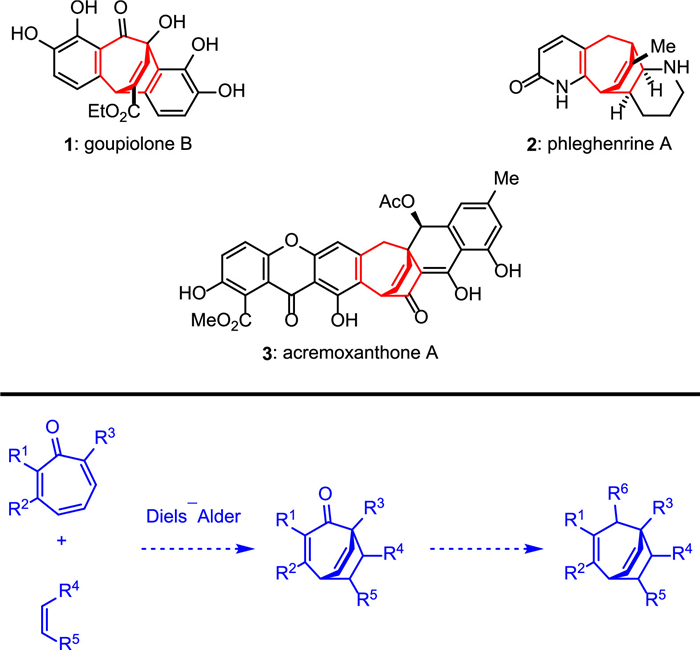
Figure 1.
Selected natural products containing a bicyclo[3.2.2]nonane motif and an envisioned IEDDA approach to such a structural motif.

Inverse-electron-demand Diels–Alder approach to densely substituted bicyclo[3.2.2]nonanes: Discovery of an autophagy regulator
Jiulong Li , Pengxin Ren , Lin Wang , Yuting Zhang , Peng Yang , Weiwei He , Ang Li


The three-dimensional structural motifs of natural products [1] are increasingly recognized for their significance in chemical biology [2,3] and drug discovery [4]. Polycyclic natural products containing a bicyclo[3.2.2]nonane motif (highlighted in red in Fig. 1) [5–7], such as goupiolone B [5], phleghenrine A [6], and acremoxanthone A [7] (1–3, Fig. 1), present a formidable challenge to chemical synthesis. A variety of methods have been developed to construct such a structural motif in natural products and related compounds [8–17]. However, many of them involve multi-step sequences [8–13]. Strategically, the intermolecular Diels–Alder cycloaddition of tropone derivatives and olefins (highlighted in blue in Fig. 1) offers a desirable approach for assembling bicyclo[3.2.2]nonanes [15–17]. Benzo[2,3]tropones [18] would be advantageous substrates for the [4 + 2] cycloaddition [19,20] because they are not prone to undesired [6 + 4] or [8 + 2] cycloaddition [21,22] compared to standard tropones. However, most reported examples are indeed formal [4 + 2] reactions [5,23–25] proceeding via enolate intermediates, which limit the applicability [5,24] and sometimes result in unsatisfactory efficiency [25]. To our knowledge, the inverse-electron-demand Diels–Alder (IEDDA) reaction [26,27] involving benzo[2,3]tropones remains largely unexplored. Following our continued interest in the Diels–Alder cycloaddition for complex molecule synthesis [28–36], we initiated an investigation into the IEDDA reaction of benzo[2,3]tropone-type dienes with electron-rich dienophiles and explored its application in the synthesis of polycyclic natural products and biologically active molecules, particularly autophagy regulators [37,38] and cell cycle inhibitors [39,40]. Herein, we report the assembly of densely substituted bicyclo[3.2.2]nonanes via such a cycloaddition reaction, which leads to the discovery of an autophagy suppressor.
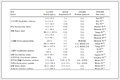
We first explored the cycloaddition of 6-methoxycarbonylbenzo[2,3]tropone (4) and cyclopentadiene (5) (Table 1). Notably, Ghosh and co-workers demonstrated that benzo[2,3]tropone acted as a dienophile in a normal-electron-demand Diels–Alder (NEDDA) reaction with 5 [41]. Introducing the methoxycarbonyl group would not only provide a functional handle for further derivatization of the product(s), but also enhance the dienic reactivity of benzo[2,3]tropone in the IEDDA reaction. To our delight, thermal treatment of 4 and 5 at 80 ℃ afforded the desired cycloadducts (6a and 6b) in a ca. 18:1 ratio (entry 1), with a strong preference for the endo product. The position of the C═C bond within the cyclopentene ring of each product was determined by X-ray crystallographic analysis (Table 1). The excellent endo selectivity may be attributable to secondary orbital interactions [42]. Despite complete suppression of the NEDDA reaction (Table 1), a substantial portion of 4 was recovered, which resulted in reduced efficiency of the IEDDA reaction (entry 1). Thus, we turned to Lewis acids to lower the LUMO energy of 4. As shown in Table 1 (entries 2–4), BF3·OEt2, Me2AlCl, and Bi(OTf)3 significantly increased the dienic reactivity of 4 but concomitantly compromised the endo/exo selectivity. Our experience with lanthanide-mediated Diels–Alder cycloaddition [29,32,36] prompted us to examine europium-based promoters for this reaction. Eu(OTf)3 improved both efficiency and selectivity (entry 5), while Eu(fod)3 rendered the optimal results (92% combined yield, endo: exo > 20:1) (entry 6). Switching the solvent from CH2Cl2 to THF markedly reduced the yield of the desired products (entry 7).
 DownLoad:
CSV
DownLoad:
CSV
 |
|||
| Entry | Conditions a | 6a + 6b | 6a: 6bb |
| 1 | Toluene, 80 ℃ | 29% | 18:1 |
| 2c | BF3·OEt2, CH2Cl2, −20 ℃ | 70% | 9:1 |
| 3c | Me2AlCl, CH2Cl2, 0 ℃ | 66% | 8:1 |
| 4c | Bi(OTf)3, CH2Cl2, 22 ℃ | 79% | 5:1 |
| 5c | Eu(OTf)3, CH2Cl2, 22 ℃ | 81% | 17:1 |
| 6c | Eu(fod)3, CH2Cl2, 22 ℃ | 92% | > 20:1 |
| 7c | Eu(fod)3, THF, 22 ℃ | 32% | > 20:1 |
| a Reactions were performed with substrates 4 (1.0 equiv.) and 5 (3.5 equiv.) at the indicated temperature for 6 h. b Determined by 1H NMR spectroscopic analysis. c 10 mol% Lewis acid. | |||
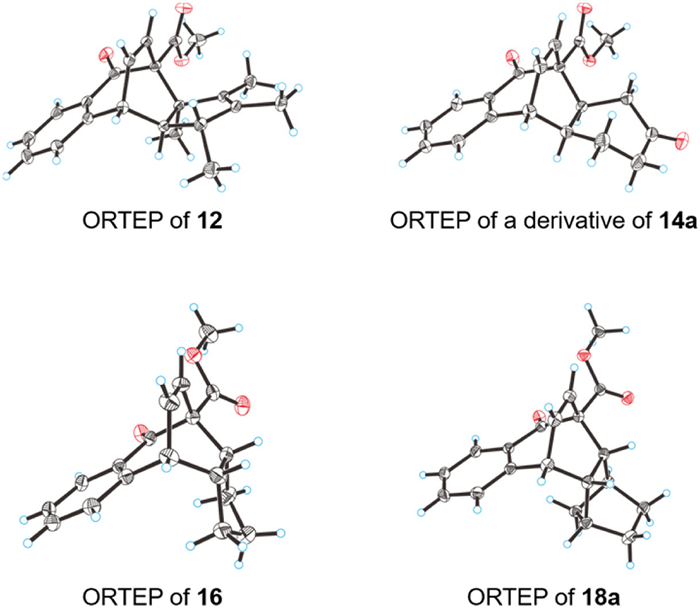
Having established the optimal conditions, we investigated the substrate scope of the IEDDA reaction (Table 2). As shown in entries 1–4, the cycloaddition of 4 with various cyclic dienes demonstrated high endo selectivity. 6,6-Dimethylfulvene (7) performed well in this reaction; cycloadducts 8a and 8b (ca. 10:1) were isolated in 82% combined yield (entry 1). Despite steric hindrance, TMS-cyclopentadiene (9) reacted smoothly with 4 to afford compound 10 as the sole detectable diastereomer in 67% yield (entry 2). Retention of the TMS group in 10 supported a concerted rather than a stepwise mechanism. 1,2,3,4-Tetramethyl-1,3-cyclopentadiene (11) could equilibrate in situ to its positional isomer through a [1,5]-H shift [32,43], which subsequently underwent cycloaddition to form 12, a remarkably crowded tetracyclic compound, in 44% yield (entry 3). The IEDDA reaction between 1-siloxycyclohexadiene 13 and 4 afforded 14a and 14b (ca. 6:1) in 90% combined yield (entry 4). Due to the lower reactivity of mono-alkenes, the stronger promoter Bi(OTf)3 was required for their cycloaddition with 4 (entries 5 and 6). For cyclopentene (15), the exo product (16) was obtained as the single detectable diastereomer in 66% yield (entry 5). For norbornene (17), a mixture of the exo and endo products (18a and 18b; ca. 2:1) was isolated in 68% yield (entry 6). Notably, two analogs of 4 (19 and 20), bearing different substituents on the benzene ring, underwent smooth cycloaddition with 5 to give endo products 21 and 22, respectively, as single diastereoisomers (entries 7 and 8). The structures of 12, 16, 18a, and a derivative of 14a were confirmed by X-ray crystallographic analysis (Fig. 2).
DownLoad:
CSV

|
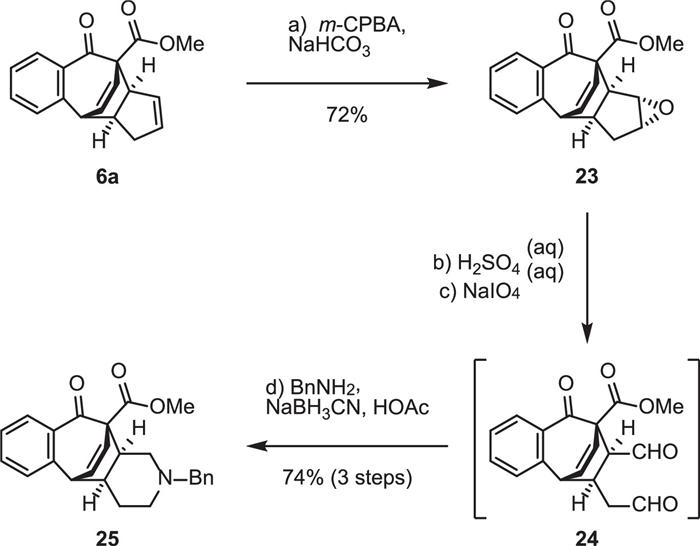
We further derivatized the obtained bicyclo[3.2.2]nonane-containing compounds to identify biologically active candidates. A representative example is illustrated in Scheme 1. Selective epoxidation of 6a with m-CPBA in the presence of NaHCO3 afforded compound 23 in 72% yield. Acidic hydrolysis of the epoxide, followed by oxidative cleavage of the resulting diol with aqueous NaIO4, provided bis-aldehyde 24, which underwent double reductive amination [BnNH2, NaBH3CN, HOAc] to furnish tetracyclic amine 25 in 74% overall yield.
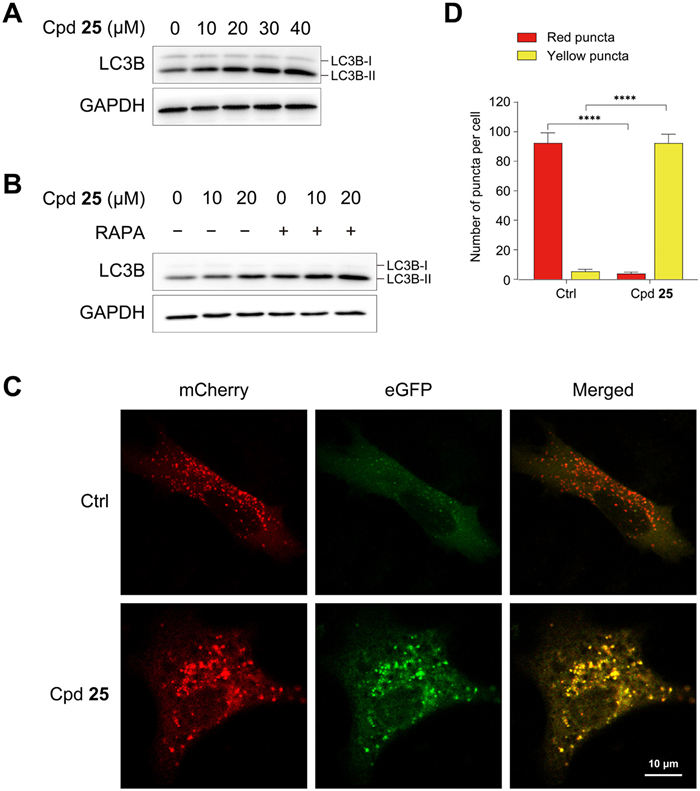
In light of our sustained interest in modulating autophagy with small molecules [37,38], we evaluated the effect of the above compounds on autophagic flux. The autophagy marker microtubule-associated protein light chain 3B (LC3B) [44,45] was analyzed in human lung carcinoma cells (A549) by immunoblotting. As shown in Fig. 3A, compound 25 induced a dose-dependent increase in the levels of LC3B-II, the phosphatidylethanolamine-conjugated form of LC3B, which pointed to this compound as a potential regulator of autophagy. To investigate whether compound 25 stimulates autophagy upstream or inhibits it downstream, we compared LC3B-II levels in A549 cells treated with 25 alone versus those co-treated with 25 and the autophagy inducer rapamycin (RAPA) [44,45]. The co-treatment significantly increased LC3B-II levels (Fig. 3B), which suggested a suppressive role for this compound in downstream autophagy. Autophagic flux was further assessed by using mCherry–eGFP–LC3B [46], a tandem fluorescent protein-tagged LC3 reporter. In A549 cells expressing this reporter, the fluorescence pattern of LC3B-positive puncta revealed that treatment with 25 led to an accumulation of autophagosomes and a reduction in autolysosomes (Fig. 3C), which indicated that this compound inhibits autophagy at a downstream stage. These findings highlight this compound as a promising chemical scaffold for developing autophagy modulators [47].
In conclusion, we developed a facile IEDDA approach to densely substituted bicyclo[3.2.2]nonanes, which enabled the discovery of an autophagy regulator. Exploration of the synthesis of bicyclo[3.2.2]nonane-containing natural products via this method is currently underway in our laboratories.
The authors declare that they have no known competing financial interests or personal relationships that could have appeared to influence the work reported in this paper.
Jiulong Li: Writing – original draft, Investigation. Pengxin Ren: Investigation. Lin Wang: Investigation. Yuting Zhang: Investigation. Peng Yang: Writing – original draft, Supervision. Weiwei He: Writing – original draft, Supervision. Ang Li: Writing – review & editing, Writing – original draft, Supervision, Funding acquisition, Conceptualization.
We thank Yali Wu and Dr. Mengyu Ba for discussion. This work was supported by the National Natural Science Foundation of China (Nos. 22477026, 21931014, 22101268, and U24A20807), Chinese Academy of Sciences (Nos. YSBR-095, XDB1060000, XBZG-ZDSYS-202303), Natural Science Foundation of Henan (No. 242300420180), and Science and Technology Commission of Shanghai Municipality (No. JCYJ-SHFY-2022–005). A.L. is grateful to the New Cornerstone Science Foundation for the Xplorer Prize.
Supplementary material associated with this article can be found, in the online version, at doi:
T.P. Stockdale, C.M. Williams, Chem. Soc. Rev. 44 (2015) 7737–7763. doi: 10.1039/C4CS00477A
G. Karageorgis, D.J. Foley, L. Laraia, S. Brakmann, H. Waldmann, Angew. Chem. Int. Ed. 60 (2021) 15705–15723. doi: 10.1002/anie.202016575
M. Grigalunas, S. Brakmann, H. Waldmann, J. Am. Chem. Soc. 144 (2022) 3314–3329. doi: 10.1021/jacs.1c11270
A.G. Atanasov, S.B. Zotchev, V.M. Dirsch, C.T. Supuran, Nat. Rev. Drug Discov. 20 (2021) 200–216. doi: 10.1038/s41573-020-00114-z
Y. Matsuo, A. Yoshida, Y. Saito, T. Tanaka, Angew. Chem. Int. Ed. 56 (2017) 11855–11859. doi: 10.1002/anie.201706532
L.B. Dong, X.D. Wu, X. Shi, et al., Org. Lett. 18 (2016) 4498–4501. doi: 10.1021/acs.orglett.6b02065
M. Isaka, S. Palasarn, P. Auncharoen, S. Komwijit, E.B.G. Jones, Tetrahedron Lett. 50 (2009) 284–287. doi: 10.1016/j.tetlet.2008.10.146
J.M. Duffault, F. Tellier, Synth. Commun. 28 (1998) 2467–2481. doi: 10.1080/00397919808004298
S.A. Kelly, Y. Foricher, J. Mann, J.M. Bentley, Org. Biomol. Chem. 1 (2003) 2865–2876. doi: 10.1039/b305869g
Y. Hirano, K. Tokudome, H. Takikawa, K. Suzuki, Synlett 28 (2017) 214–220.
M.A. Corsello, J. Kim, N.K. Garg, Nat. Chem. 9 (2017) 944–949. doi: 10.1038/nchem.2801
S.D. Holmbo, S.V. Pronin, J. Am. Chem. Soc. 140 (2018) 5065–5068. doi: 10.1021/jacs.8b03110
Z.H. Shen, S.Y. Lu, J.Y. Zheng, et al., Front. Chem. 10 (2022) 1022533. doi: 10.3389/fchem.2022.1022533
T. Tabuchi, D. Urabe, M. Inoue, Beilstein J. Org. Chem. 9 (2013) 655–663. doi: 10.3762/bjoc.9.74
K.R. Dahnke, L.A. Paquette, J. Org. Chem. 59 (1994) 885–899. doi: 10.1021/jo00083a034
P. Li, H. Yamamoto, Chem. Commun. 46 (2010) 6294–6295. doi: 10.1039/c0cc01619e
P.J. Gritsch, I. Gimennez-Nueno, L. Wonilowicz, R. Sarpong, J. Org. Chem. 84 (2019) 8717–8723. doi: 10.1021/acs.joc.9b00899
A. Dastan, H. Kilic, N. Saracoglu, Beilstein J. Org. Chem. 14 (2018) 1120–1180. doi: 10.3762/bjoc.14.98
H.H. Rennhard, G.D. Modica, W. Simon, E. Heilbronner, A. Eschenmoser, Helv. Chim. Acta 40 (1957) 957–968. doi: 10.1002/hlca.19570400410
A. Hassner, D. Middlemiss, J. Murry-Rust, P. Murry-Rust, Tetrahedron 38 (1982) 2539–2546. doi: 10.1016/0040-4020(82)85089-8
J.H. Rigby, Org. React. 49 (1996) 331–425.
V. Nair, K.G. Abhilash, Top. Heterocycl. Chem. 13 (2008) 173–200.
Y. Sugimura, K. Iino, H. Kuwano, N. Soma, Y. Kishida, Chem. Pharm. Bull. 20 (1972) 2515–2521. doi: 10.1248/cpb.20.2515
Y. Mu, Q. Yao, L. Yin, et al., J. Org. Chem. 86 (2021) 6755–6764. doi: 10.1021/acs.joc.1c00487
F.M. Hauser, H. Yin, Org. Lett. 2 (2000) 1045–1047. doi: 10.1021/ol0055869
Z.M. Png, H. Zeng, Q. Ye, J. Xu, Chem. Asian J. 12 (2017) 2142–2159. doi: 10.1002/asia.201700442
J. Zhang, V. Shukla, D.L. Boger, J. Org. Chem. 84 (2019) 9397–9445. doi: 10.1021/acs.joc.9b00834
J. Deng, B. Zhu, Z. Lu, H. Yu, A. Li, J. Am. Chem. Soc. 134 (2012) 920–923. doi: 10.1021/ja211444m
J. Deng, S. Zhou, W. Zhang, et al., J. Am. Chem. Soc. 136 (2014) 8185–8188. doi: 10.1021/ja503972p
J. Li, P. Yang, M. Yao, J. Deng, A. Li, J. Am. Chem. Soc. 136 (2014) 16477–16480. doi: 10.1021/ja5092563
M. Yang, J. Li, A. Li, Nat. Commun. 6 (2015) 6445. doi: 10.1038/ncomms7445
W. Zhang, M. Ding, J. Li, et al., J. Am. Chem. Soc. 140 (2018) 4227–4231. doi: 10.1021/jacs.8b01681
S. Zhou, R. Guo, P. Yang, A. Li, J. Am. Chem. Soc. 140 (2018) 9025–9029. doi: 10.1021/jacs.8b03712
S. Zhou, K. Xia, X. Leng, A. Li, J. Am. Chem. Soc. 141 (2019) 13718–13723. doi: 10.1021/jacs.9b05818
J. Li, Y. Ma, X. Zhang, et al., Chin. Chem. Lett. 32 (2021) 700–702. doi: 10.1016/j.cclet.2020.06.019
S. Liu, J. Wang, Y. Ma, et al., Chin. Chem. Lett. 33 (2022) 2041–2043. doi: 10.1016/j.cclet.2021.09.030
Y. Wu, S. Wang, Z. Guo, et al., Proc. Natl. Acad. Sci. U. S. A. 121 (2024) e2400809121. doi: 10.1073/pnas.2400809121
S. Wang, Y. Wu, M. Ba, et al., Synlett (2024), doi: 10.1055/a-2325-3938.
J. Pei, S. Zhou, F. Yang, et al., Chem. Asian J. 11 (2016) 2715–2718. doi: 10.1002/asia.201600714
Y. Peng, Y. Zhang, R. Fang, et al., Adv. Sci. 11 (2024) 2305593. doi: 10.1002/advs.202305593
S. Sarkar, G. Saha, S. Ghosh, J. Org. Chem. 57 (1992) 5771–5773. doi: 10.1021/jo00047a038
D. Ginsburg, Tetrahedron 39 (1983) 2095–2135. doi: 10.1016/S0040-4020(01)91928-3
C.W. Spangler, Chem. Rev. 76 (1976) 187–217. doi: 10.1021/cr60300a002
N. Mizushima, L.O. Murphy, Trends Biochem. Sci. 45 (2020) 1080–1093. doi: 10.1016/j.tibs.2020.07.006
D.J. Klionsky, A.K. Abdel-Aziz, S. Abdelfatah, et al., Autophagy 17 (2021) 1–382.
S. Kimura, T. Noda, T. Yoshimori, Autophagy 3 (2007) 452–460. doi: 10.4161/auto.4451
T. Whitmarsh-Everiss, L. Laraia, Nat. Chem. Biol. 17 (2021) 653–664. doi: 10.1038/s41589-021-00768-9

Figure 1 Selected natural products containing a bicyclo[3.2.2]nonane motif and an envisioned IEDDA approach to such a structural motif.

Figure 3 Compound 25 suppresses downstream autophagy in A549 cells. (A) Immunoblot analysis of LC3B in A549 cells treated with 25 at the indicated concentrations for 12 h. (B) Comparison of LC3B levels in A549 cells treated with 25 alone at the indicated concentrations for 12 h versus those co-treated with 25 at the indicated concentrations and RAPA (200 nmol/L) for 12 h. µM = µmol/L. (C) Microscopy analysis of fluorescent puncta in A549 cells expressing mCherry–eGFP–LC3B. Cells were treated with 25 (20 µmol/L) for 12 h. (D) Quantitative analysis of the number of yellow puncta and red puncta per cell in the above experiment. Data are presented as mean ± SEM. ****P < 0.0001 (n = 25, two-tailed Student's t-test). DMSO served as the vehicle control for the compounds.
Table 1. Investigation of the conditions for the IEDDA reaction.
|
|||
| Entry | Conditions a | 6a + 6b | 6a: 6bb |
| 1 | Toluene, 80 ℃ | 29% | 18:1 |
| 2c | BF3·OEt2, CH2Cl2, −20 ℃ | 70% | 9:1 |
| 3c | Me2AlCl, CH2Cl2, 0 ℃ | 66% | 8:1 |
| 4c | Bi(OTf)3, CH2Cl2, 22 ℃ | 79% | 5:1 |
| 5c | Eu(OTf)3, CH2Cl2, 22 ℃ | 81% | 17:1 |
| 6c | Eu(fod)3, CH2Cl2, 22 ℃ | 92% | > 20:1 |
| 7c | Eu(fod)3, THF, 22 ℃ | 32% | > 20:1 |
| a Reactions were performed with substrates 4 (1.0 equiv.) and 5 (3.5 equiv.) at the indicated temperature for 6 h. b Determined by 1H NMR spectroscopic analysis. c 10 mol% Lewis acid. | |||
 下载: 导出CSV

 扫一扫看文章


扫一扫关注我们


 下载:
下载: