

Figure 1.
Examples of bioactive indolo[2,1-a]isoquinolines.


Indoles are one of the most ubiquitous nitrogen-containing heterocycles. Indolo[2,1-a]isoquinolines represent an important class of polycyclic fused indoles, and are present in a variety of bioactive molecules and pharmaceuticals, and materials (Fig. 1) [1–5]. In the past, considerable efforts have been made in constructing indolo[2,1-a]isoquinoline skeletons using various strategies, including radical [6–29] or metal-catalyzed [30–37] cascade cyclization processes. A Pd-catalyzed tandem Heck process also presents a powerful approach to this class of molecules [38–46] particularly for skeletons with additional fused ring(s) [47–50]. An introduction of a fused nitrogen heterocycle like pyrrole fused indolo[2,1-a]isoquinoline (6) would provide new structural diversities for the biological activities, and little has been reported for such type of molecules.
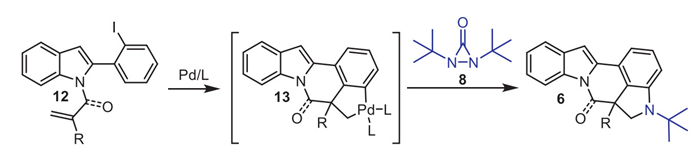
Previously, we have found that a five-membered azacycle can be generated by reacting a pallada(Ⅱ)cycle (7) with di–tert-butyldiaziridinone (8) (Scheme 1) [51,52]. The reaction likely proceeded via four-membered pallada(Ⅳ)cycle 9 with simultaneous formation of two C—N bonds [51–64]. This bisamination process provides unique opportunities for the synthesis of structurally diverse N-heterocycles. Now we report that pyrrole fused indolo[2,1-a]isoquinolines (6) can be efficiently constructed from indole 12 by such reaction process via tandem Heck/C—H activation/amination through pallada(Ⅱ)cycle intermediate 13 (Scheme 2).

Indole 12a was used as the test substrate for initial studies. Various phosphine ligands were examined with 5 mol% Pd(OAc)2, and 2.0 equiv. of di–tert-butyldiaziridinone (8) in toluene at 110 ℃ (Table 1, entries 1–11) (for more details, see Table S1 in Supporting information). The ligand was found to be important to the reaction. The highest yield (58%) was obtained with PPhCy2 (Table 1, entry 7). Further investigation with additional Pd catalysts (Table 1, entries 12–14) and solvents (Table 1, entries 15–18) (for more details, see Table S1) did not lead to any improvement. It appeared that the reaction process was sensitive to the reaction temperature. The reaction went to completion at 130 ℃ while no product was observed at 90 ℃ (Table 1 entry 20 vs. entry 19). At 130 ℃, the reaction was completed within 4 h (Table 1, entry 21).

 DownLoad:
CSV
DownLoad:
CSV
 |
|||
| Entry | [Pd] | Ligand | Yield (%)b |
| 1 | Pd(OAc)2 | PPh3 | 43 |
| 2 | Pd(OAc)2 | (o-MeOPh)3P | 33 |
| 3 | Pd(OAc)2 | (p-FPh)3P | 26 |
| 4 | Pd(OAc)2 | (2-thienyl)3P | 30 |
| 5 | Pd(OAc)2 | (2-furyl)3P | 41 |
| 6 | Pd(OAc)2 | PPh2Cy | 36 |
| 7 | Pd(OAc)2 | PPhCy2 | 58 |
| 8 | Pd(OAc)2 | PCy3 | 33 |
| 9 | Pd(OAc)2 | dppb | 19 |
| 10 | Pd(OAc)2 | dppf | 25 |
| 11 | Pd(OAc)2 | Xantphos | 31 |
| 12 | PdCl2 | PPhCy2 | 35 |
| 13 | PdI2 | PPhCy2 | 23 |
| 14 | Pd(PPh3)4 | PPhCy2 | 26 |
| 15 | Pd(OAc)2 (1,4-dioxane) | PPhCy2 | 47 |
| 16 | Pd(OAc)2 (hexane) | PPhCy2 | 27 |
| 17 | Pd(OAc)2 (DCE) | PPhCy2 | 27 |
| 18 | Pd(OAc)2 (DME) | PPhCy2 | 27 |
| 19 | Pd(OAc)2 (90 ℃) | PPhCy2 | NP |
| 20 | Pd(OAc)2 (130 ℃) | PPhCy2 | 99 |
| 21 | Pd(OAc)2 (130 ℃, 4 h) | PPhCy2 | 99 |
| a All reactions were carried out with indole 12a (0.15 mmol), Pd (0.0075 mmol), ligand (0.015–0.030 mmol, Pd/P = 1/4), di– tert-butyldiaziridinone (8) (0.225 mmol), and Cs 2CO 3 (0.225 mmol) in PhCH 3 (1.5 mL) at 110 ℃ under N 2 for 48 h unless otherwise noted. b The yield was determined by 1H NMR analysis of the crude reaction mixture with 1,1,2,2-tetrachloroethane as internal standard. | |||
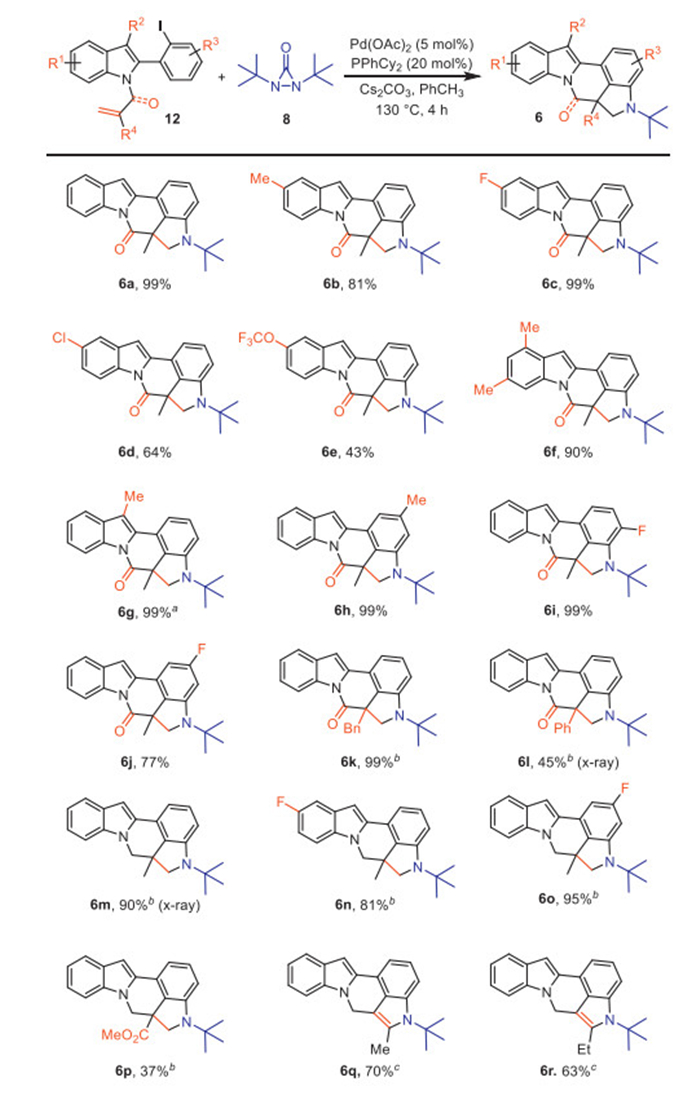
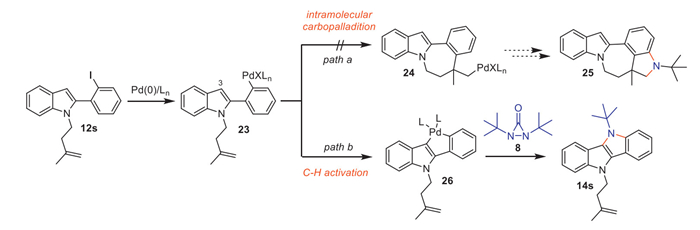
With the optimized reaction conditions, the substrate scope was subsequently investigated with a variety of indole substrates. As shown in Scheme 3, the reaction can be extended to various substituted 1-methacryloyl indoles, giving the corresponding pyrrole fused indolo[2,1-a]isoquinolines 6a-6j in 43%−99% isolated yields. High yield was also obtained with 1-(2-benzylacryloyl)indole (Scheme 3, 6k). A lower yield was obtained in the case of 1-(2-phenylacryloyl) indole (Scheme 3, 6l). 1-(2-Methylallyl) indoles were also effective for the reaction, giving the corresponding pyrrole fused indolo[2,1-a]isoquinolines 6m-6o in 81%−95% yields. Significantly lower yield was obtained when the methyl group on the olefin was replaced with the methyl ester group (Scheme 3, 6p). The reaction can also be applied to propargyl indoles to give the corresponding pyrrole fused indolo[2,1-a]isoquinolines 6q and 6r in 63%−70% yields with modified reaction conditions. The reaction process was not effective to indole 12s tethered with 3-methylbut-3-en-1-yl group (one carbon longer), giving a messy mixture under the reaction conditions. With modified conditions, indolo[3,2-b]indole 14s was isolated in 77% yield (Scheme 4) [65–80]. This reaction process also proceeded well with N-Me, Et, and Bn substituted indoles 12v-x, giving the corresponding indolo[3,2-b]indole 14v-x in 96%−98% yields (Scheme 4). Further studies showed that seven-membered ring product 6y can be isolated in 50% yield when the corresponding indole with a methyl at the indole's C-3 position (12y) used (Scheme 5).


As exemplified with 6m, the reaction proceeded well at gram scale (Scheme 6). Several synthetic transformations were also carried out with 6m. The tert–butyl group can be removed with CF3SO3H/cyclohexane to give compound 15 in 76% yield. The benzylation of 6m with benzaldehyde, I2 and Et3SiH led to compound 16 in 82% yield [81]. The formylation of 6m with 1 equiv. of POCl3 afforded aldehyde 17 in 70% yield [82]. Bisaldehyde 18 can be obtained in 50% yield when excess of POCl3 used.

A precise understanding of the reaction mechanism awaits further study. On the basis of earlier studies [51–57], a plausible catalytic cycle is outlined in Scheme 7 (with 12a as an example). The oxidative addition of Pd(0) to 12a led to Pd intermediate 19, which subsequently underwent an intramolecular carbopalladation to form alkyl Pd species 20. Pallada(Ⅱ)cycle 13 was then generated from 20 via aryl C—H activation [83–101]. The oxidative addition of 13 to di–tert-butyldiaziridinone (8) gave four-membered pallada(Ⅳ)cycle 21, which afforded pallada(Ⅳ)nitrene species 22 upon release of tBuNCO. At the end, pyrrole fused indolo[2,1-a]isoquinoline 6a was formed from 22 via two consecutive reductive eliminations with regeneration of the Pd catalyst.

In the case of 12s (Scheme 8), the formation of a seven-membered ring from Pd intermediate 23 was apparently unfavorable (path a). Instead, 23 could undergo a C—H activation at C-3 under proper reaction conditions to give pallada(Ⅱ)cycle 26 [102–106], which was aminated with di–tert-butyldiaziridinone (8) to form indolo[3,2-b]indole 14s (path b) [53]. The introduction of a methyl group at the indole's C-3 position suppressed path b and shifted the outcome towards the formation of the seven-membered ring product.
In summary, we have developed an efficient Pd-catalyzed sequential Heck/C—H activation/amination reaction process with alkene-tethered indole derivatives and di–tert-butyldiaziridinone, providing a variety of pyrrole fused indolo[2,1-a]isoquinoline polycycles bearing various functional groups. The reaction process provides ready access to structurally diverse indolo[2,1-a]isoquinoline compounds for biologically studies. In addition, indolo[3,2-b]indoles can be efficiently formed by varying N-substituents of indole substrates. The current work further illustrates the versatility of the diaziridinone for the construction of N-heterocycles. Further expansion of its synthetic utility is currently underway.
The authors declare that they have no known competing financial interests or personal relationships that could have appeared to influence the work reported in this paper.
Junhua Li: Writing – review & editing, Writing – original draft, Visualization, Validation, Software, Methodology, Investigation, Formal analysis, Data curation, Conceptualization. Yu Fu: Writing – original draft, Visualization, Validation, Software, Formal analysis, Data curation. Yian Shi: Writing – review & editing, Supervision, Resources, Project administration, Methodology, Investigation, Funding acquisition, Formal analysis, Data curation, Conceptualization.
We are grateful for generous financial support from the National Natural Science Foundation of China (Nos. 22271024, 21632005) and Changzhou University.
Supplementary material associated with this article can be found, in the online version, at doi:
R. Ambros, S. von Angerer, W. Wiegrebe, Arch. Pharm. 321 (1988) 743–747 (Weinheim). doi: 10.1002/ardp.19883211010
R. Ambros, M.R. Schneider, S. von Angerer, J. Med. Chem. 33 (1990) 153–160. doi: 10.1021/jm00163a026
M. Goldbrunner, G. Loidl, T. Polossek, A. Mannschreck, E. von Angerer, J. Med. Chem. 40 (1997) 3524–3533. doi: 10.1021/jm970177c
R. Faust, P.J. Garratt, R. Jones, et al., J. Med. Chem. 43 (2000) 1050–1061. doi: 10.1021/jm980684+
G.A. Kraus, V. Gupta, M. Kohut, N. Singh, Bioorg. Med. Chem. Lett. 19 (2009) 5539–5542. doi: 10.1016/j.bmcl.2009.08.057
N. Fuentes, W. Kong, L.F. Sanchez, E. Merino, C. Nevado, J. Am. Chem. Soc. 137 (2015) 964–973. doi: 10.1021/ja5115858
H. Huang, Y. Li, J. Org. Chem. 82 (2017) 4449–4457. doi: 10.1021/acs.joc.7b00350
Y.L. Wei, J.Q. Chen, B. Sun, P.F. Xu, Chem. Commun. 55 (2019) 5922–5925. doi: 10.1039/c9cc02388g
Y. Yuan, Y. Zheng, B. Xu, et al., ACS Catal. 10 (2020) 6676–6681. doi: 10.1021/acscatal.0c01324
S.S. Jiang, Y.T. Xiao, Y.C. Wu, et al., Org. Biomol. Chem. 18 (2020) 4843–4847. doi: 10.1039/d0ob00877j
K. Sun, G. Li, Y. Li, et al., Adv. Synth. Catal. 362 (2020) 1947–1954. doi: 10.1002/adsc.202000040
X.Y. Hu, H.F. Xu, Q. Chen, Y.L. Pan, J.Z. Chen, Org. Biomol. Chem. 19 (2021) 10376–10384. doi: 10.1039/d1ob01917a
X. Yuan, X. Duan, Y.S. Cui, et al., Org. Lett. 23 (2021) 1950–1954. doi: 10.1021/acs.orglett.1c00476
Y. Luo, T. Tian, Y. Nishihara, L. Lv, Z. Li, Chem. Commun. 57 (2021) 9276–9279. doi: 10.1039/d1cc03907e
F.L. Zeng, H.L. Zhu, X.L. Chen, L.B. Qu, B. Yu, Green Chem. 23 (2021) 3677–3682. doi: 10.1039/d1gc00938a
M.L. Liu, J.L. Wang, X.S. Li, W.H. Sun, X.Y. Liu, Org. Chem. Front. 9 (2022) 2438–2443. doi: 10.1039/d2qo00051b
G.C. Upreti, T. Singh, S. Ranjan, R.K. Gupta, A. Singh, ACS Omega 7 (2022) 29728–29733. doi: 10.1021/acsomega.2c02302
J.Q. Chen, X. Tu, B. Qin, et al., Org. Lett. 24 (2022) 642–647. doi: 10.1021/acs.orglett.1c04082
P. Zhao, Y. Wang, X. Wang, D. Zhuang, R. Yan, J. Org. Chem. 87 (2022) 9056–9068. doi: 10.1021/acs.joc.2c00735
S. Zhai, S. Qiu, S. Yang, et al., Chin. Chem. Lett. 33 (2022) 276–279. doi: 10.1016/j.cclet.2021.06.081
J.Z. Li, L. Mei, X.E. Cai, et al., Adv. Synth. Catal. 364 (2022) 2080–2085. doi: 10.1002/adsc.202200272
X. Yuan, J. Liu, L.Z. Qin, et al., Adv. Synth. Catal. 365 (2023) 555–567. doi: 10.1002/adsc.202201294
X.Q. Liu, Y. Guo, W.Q. Yu, et al., J. Org. Chem. 88 (2023) 9293–9305. doi: 10.1021/acs.joc.3c00863
L. Liu, Y. Zhang, W. Zhao, J. Li, Org. Lett. 25 (2023) 6251–6255. doi: 10.1021/acs.orglett.3c02009
Z. Tan, Y. Jiang, K. Xu, C. Zeng, J. Catal. 417 (2023) 473–480. doi: 10.1016/j.jcat.2022.12.033
D.L. Zhang, Z.Q. Zhu, Z.B. Xie, X.P. Zhang, Z.G. Le, New J. Chem. 47 (2023) 18354–18358. doi: 10.1039/d3nj03172a
Y. Tang, Y. Yang, Q. Zhou, et al., Org. Biomol. Chem. 21 (2023) 5254–5264. doi: 10.1039/d3ob00630a
D. Chen, X. Yang, D. Wang, et al., Org. Chem. Front. 10 (2023) 2482–2490. doi: 10.1039/d3qo00290j
S. Liu, C. Zhao, M. Pan, et al., J. Org. Chem. 88 (2023) 16352–16364. doi: 10.1021/acs.joc.3c01856
A.K. Verma, T. Kesharwani, J. Singh, V. Tandon, R.C. Larock, Angew. Chem. Int. Ed. 48 (2009) 1138–1143. doi: 10.1002/anie.200804427
K. Morimoto, K. Hirano, T. Satoh, M. Miura, Org. Lett. 12 (2010) 2068–2071. doi: 10.1021/ol100560k
L. Ackermann, L. Wang, A.V. Lygin, Chem. Sci. 3 (2012) 177–180. doi: 10.1039/C1SC00619C
A.K. Verma, R.R. Jha, R. Chaudhary, et al., J. Org. Chem. 77 (2012) 8191–8205. doi: 10.1021/jo301572p
S. Borthakur, B. Sarma, S. Gogoi, Org. Lett. 21 (2019) 7878–7882. doi: 10.1021/acs.orglett.9b02871
T.S. Zhang, Q. Zhao, W.J. Hao, S.J. Tu, B. Jiang, Chem. Asian J. 14 (2019) 1042–1049. doi: 10.1002/asia.201900050
C. Wu, J. Lin, X. Tian, Org. Lett. 25 (2023) 158–162. doi: 10.1021/acs.orglett.2c03973
H. Li, M. Mei, D. Wang, L. Zhou, Org. Chem. Front. 10 (2023) 1544–1550. doi: 10.1039/d2qo02008d
L.L. Sun, Z.Y. Liao, R.Y. Tang, C.L. Deng, X.G. Zhang, J. Org. Chem. 77 (2012) 2850–2856. doi: 10.1021/jo3000404
K. Alam, S.W. Hong, K.H. Oh, J.K. Park, Angew. Chem. Int. Ed. 56 (2017) 13387–13391. doi: 10.1002/anie.201705514
H. Lu, X. Yang, L. Zhou, et al., Org. Chem. Front. 7 (2020) 2016–2021. doi: 10.1039/d0qo00492h
J.S. Wang, J. Zhang, S. Wang, et al., J. Catal. 414 (2022) 313–318. doi: 10.1016/j.jcat.2022.09.023
S. Wang, J.S. Wang, J. Ying, X.F. Wu, Chin. Chem. Lett. 34 (2023) 107873. doi: 10.1016/j.cclet.2022.107873
S. Wang, S. Li, L. Liu, J. Ying, X.F. Wu, Org. Lett. 25 (2023) 821–825. doi: 10.1021/acs.orglett.2c04363
C.Y. Hou, H. Ma, R. Zhao, X. Qi, X.F. Wu, J. Catal. 439 (2024) 115765. doi: 10.1016/j.jcat.2024.115765
D. Chi, H. Qi, L. Wang, S. Chen, Chem. Commun. 60 (2024) 8613–8616. doi: 10.1039/d4cc02577f
Y. Xia, W. Li, M. Wei, et al., Org. Chem. Front. 11 (2024) 3491–3496. doi: 10.1039/d4qo00392f
X. Yang, H. Lu, X. Zhu, et al., Org. Lett. 21 (2019) 7284–7288. doi: 10.1021/acs.orglett.9b02541
L. Zhou, S. Qiao, F. Zhou, et al., Org. Lett. 23 (2021) 2878–2883. doi: 10.1021/acs.orglett.1c00493
M. Zhang, F. Zhou, X. Xuchen, et al., Org. Chem. Front. 8 (2021) 5687–5692. doi: 10.1039/d1qo00861g
H. Qi, D. Chi, S. Chen, Org. Lett. 24 (2022) 2910–2914. doi: 10.1021/acs.orglett.2c00882
T.A. Ramirez, Q. Wang, Y. Zhu, et al., Org. Lett. 15 (2013) 4210–4213. doi: 10.1021/ol401935c
H. Zheng, Y. Zhu, Y. Shi, Angew. Chem. Int. Ed. 53 (2014) 11280–11284. doi: 10.1002/anie.201405365
S. Debnath, L. Liang, M. Lu, Y. Shi, Org. Lett. 23 (2021) 3237–3242. doi: 10.1021/acs.orglett.1c00466
J. Li, J. Chen, L. Wang, Y. Shi, Org. Lett. 23 (2021) 3646–3651. doi: 10.1021/acs.orglett.1c01043
J. Wang, X. Sun, D. Hu, Y. Shi, Org. Lett. 23 (2021) 7561–7565. doi: 10.1021/acs.orglett.1c02757
J. Wang, D. Hu, X. Sun, H. Hong, Y. Shi, Org. Lett. 25 (2023) 2006–2011. doi: 10.1021/acs.orglett.3c00189
J. Li, Y. Liu, Y. Shi, Tetrahedron Lett. 147 (2024) 155158. doi: 10.1016/j.tetlet.2024.155158
C. Shao, B. Zhou, Z. Wu, X. Ji, Y. Zhang, Adv. Synth. Catal. 360 (2018) 887–892. doi: 10.1002/adsc.201701039
B. Zhou, Z. Wu, D. Ma, X. Ji, Y. Zhang, Org. Lett. 20 (2018) 6440–6443. doi: 10.1021/acs.orglett.8b02750
X. Sun, Z. Wu, W. Qi, et al., Org. Lett. 21 (2019) 6508–6512. doi: 10.1021/acs.orglett.9b02386
D. Ma, X. Ji, Z. Wu, et al., Adv. Synth. Catal. 361 (2019) 739–746. doi: 10.1002/adsc.201801367
C. Cheng, X. Zuo, D. Tu, B. Wan, Y. Zhang, Org. Lett. 22 (2020) 4985–4989. doi: 10.1021/acs.orglett.0c01513
L. Zhang, J. Chen, T. Zhong, et al., J. Org. Chem. 85 (2020) 10823–10834. doi: 10.1021/acs.joc.0c01365
J. Bajohr, A. Dupeux, D. Schenk, C. Jans, M. Lautens, Org. Lett. 25 (2023) 5361–5365. doi: 10.1021/acs.orglett.3c01941
P. Kaszynski, D.A. Dougherty, J. Org. Chem. 58 (1993) 5209–5220. doi: 10.1021/jo00071a034
M.M. Murray, P. Kaszynski, D.A. Kaisaki, W. Chang, D.A. Dougherty, J. Am. Chem. Soc. 116 (1994) 8152–8161. doi: 10.1021/ja00097a024
Y. Jin, K. Kim, S. Song, et al., Bull. Korean Chem. Soc. 27 (2006) 1043–1047. doi: 10.5012/bkcs.2006.27.7.1043
L. Qiu, C. Yu, N. Zhao, et al., Chem. Commun. 48 (2012) 12225–12227. doi: 10.1039/c2cc36689d
Y.Y. Lai, J.M. Yeh, C.E. Tsai, Y.J. Cheng, Eur. J. Org. Chem. (2013) 5076–5084. doi: 10.1002/ejoc.201300443
Z.R. Owczarczyk, W.A. Braunecker, A. Garcia, et al., Macromolecules 46 (2013) 1350–1360. doi: 10.1021/ma301987p
L. Qiu, X. Wang, N. Zhao, et al., J. Org. Chem. 79 (2014) 11339–11348. doi: 10.1021/jo501402n
L. Qiu, X. Zhuang, N. Zhao, et al., Chem. Commun. 50 (2014) 3324–3327. doi: 10.1039/C3CC49418G
M.J. Jiang, W.J. Xiao, J.C. Huang, W.S. Li, Y.Q. Mo, Tetrahedron 72 (2016) 979–984. doi: 10.1016/j.tet.2015.12.069
H.E. Ho, K. Oniwa, Y. Yamamoto, T. Jin, Org. Lett. 18 (2016) 2487–2490. doi: 10.1021/acs.orglett.6b01067
J. Yu, D. Zhang-Negrerie, Y. Du, Org. Lett. 18 (2016) 3322–3325. doi: 10.1021/acs.orglett.6b01343
J. Hwang, J. Park, Y.J. Kim, et al., Chem. Mater. 29 (2017) 2135–2140. doi: 10.1021/acs.chemmater.6b04745
T. Matsuda, H. Ito, Org. Biomol. Chem. 16 (2018) 6703–6707. doi: 10.1039/c8ob01837e
A. Shoberu, C.K. Li, Z.K. Tao, G.Y. Zhang, J.P. Zou, Adv. Synth. Catal. 361 (2019) 2255–2261. doi: 10.1002/adsc.201900070
Y. Wu, C. Pi, X. Cui, Y. Wu, Org. Lett. 22 (2020) 361–364. doi: 10.1021/acs.orglett.9b03768
X.H. Shan, B. Yang, J.P. Qu, Y.B. Kang, Chem. Commun. 56 (2020) 4063–4066. doi: 10.1039/d0cc01172j
X. Cheng, L. Wang, Y. Liu, et al., Eur. J. Org. Chem. (2022) e202200502.
M.Z. Zhang, N. Mulholland, A. Seville, et al., Tetrahedron 79 (2021) 131835. doi: 10.1016/j.tet.2020.131835
G. Dyker, Angew. Chem. Int. Ed. 38 (1999) 1698–1712. doi: 10.1002/(SICI)1521-3773(19990614)38:12<1698::AID-ANIE1698>3.0.CO;2-6
F. Kakiuchi, N. Chatani, Adv. Synth. Catal. 345 (2003) 1077–1101. doi: 10.1002/adsc.200303094
M. Catellani, Synlett (2003) 298–313.
D. Alberico, M.E. Scott, M. Lautens, Chem. Rev. 107 (2007) 174–238. doi: 10.1021/cr0509760
M. Catellani, E. Motti, N. Della Cá, Chem. Res. 41 (2008) 1512–1522. doi: 10.1021/ar800040u
K. Muñiz, Angew. Chem. Int. Ed. 48 (2009) 9412–9423. doi: 10.1002/anie.200903671
L. Ackermann, R. Vicente, A.R. Kapdi, Angew. Chem. Int. Ed. 48 (2009) 9792–9826. doi: 10.1002/anie.200902996
R. Jazzar, J. Hitce, A. Renaudat, J. Sofack-Kreutzer, O. Baudoin, Chem. Eur. J. 16 (2010) 2654–2672. doi: 10.1002/chem.200902374
L.M. Xu, B.J. Li, Z. Yang, Z.J. Shi, Chem. Soc. Rev. 39 (2010) 712–733. doi: 10.1039/B809912J
P. Sehnal, R.J.K. Taylor, I.J.S. Fairlamb, Chem. Rev. 110 (2010) 824–889. doi: 10.1021/cr9003242
F. Shi, R.C. Larock, Top. Curr. Chem. 292 (2010) 123–164.
L. McMurray, F. O'Hara, M.J. Gaunt, Chem. Soc. Rev. 40 (2011) 1885–1898. doi: 10.1039/c1cs15013h
J. Wencel-Delord, T. Droege, F. Liu, F. Glorius, Chem. Soc. Rev. 40 (2011) 4740–4761. doi: 10.1039/c1cs15083a
H.C. Malinakova, Top. Organomet. Chem. 35 (2011) 85–110.
N. Dastbaravardeh, M. Christakakou, M. Haider, M. Schnürch, Synthesis 46 (2014) 1421–1439. doi: 10.1055/s-0033-1338625
T. Jin, M. Terada, Tetrahedron Lett. 61 (2020) 151514. doi: 10.1016/j.tetlet.2019.151514
F. Zhang, L. Xin, Y. Yu, S. Liao, X. Huang, Synthesis 53 (2021) 238–254. doi: 10.1055/s-0040-1707268
J.R. Alexander, G. Dong, Green Synth. Catal. 2 (2021) 216–227.
X. Luo, W. Li, H. Lu, et al., Chin. Chem. Lett. 32 (2021) 713–716. doi: 10.1016/j.cclet.2020.07.005
L. Wu, G. Deng, Y. Liang, Org. Biomol. Chem. 15 (2017) 6808–6812. doi: 10.1039/C7OB01638G
Y. Yang, B. Zhou, X. Zhu, et al., Org. Lett. 20 (2018) 5402–5405. doi: 10.1021/acs.orglett.8b02310
M. Sun, X. Chen, Z. Feng, et al., Org. Chem. Front. 8 (2021) 6535–6540. doi: 10.1039/d1qo01103k
H.Q. Ni, P. Cooper, S. Yang, et al., Angew. Chem. Int. Ed. 61 (2022) e202114346. doi: 10.1002/anie.202114346
W. Li, Y. Yu, J. Yang, et al., Chem. Asian J. 19 (2024) e202301040. doi: 10.1002/asia.202301040

Scheme 3 The reaction scope. All reactions were carried out with 12 (0.30 mmol), Pd(OAc)2 (0.015 mol), PPhCy2 (0.060 mmol), di–tert-butyldiaziridinone (8) (0.45 mmol), and Cs2CO3 (0.45 mmol) in PhCH3 (2.0 mL) at 130 ℃ under N2 for 4 h unless otherwise noted, the yield was isolated yield. a With 1.0 mL PhCH3. b For 12 h. c With Pd(OAc)2 (0.015 mol), (o-tolyl)3P (0.060 mmol), di–tert-butyldiaziridinone (8) (0.45 mmol), KOPiv (0.15 mmol), and Cs2CO3 (0.45 mmol) in DMF (1.0 mL) at 130 ℃ for 12 h.
Table 1. Studies on the reaction conditions.a
|
|||
| Entry | [Pd] | Ligand | Yield (%)b |
| 1 | Pd(OAc)2 | PPh3 | 43 |
| 2 | Pd(OAc)2 | (o-MeOPh)3P | 33 |
| 3 | Pd(OAc)2 | (p-FPh)3P | 26 |
| 4 | Pd(OAc)2 | (2-thienyl)3P | 30 |
| 5 | Pd(OAc)2 | (2-furyl)3P | 41 |
| 6 | Pd(OAc)2 | PPh2Cy | 36 |
| 7 | Pd(OAc)2 | PPhCy2 | 58 |
| 8 | Pd(OAc)2 | PCy3 | 33 |
| 9 | Pd(OAc)2 | dppb | 19 |
| 10 | Pd(OAc)2 | dppf | 25 |
| 11 | Pd(OAc)2 | Xantphos | 31 |
| 12 | PdCl2 | PPhCy2 | 35 |
| 13 | PdI2 | PPhCy2 | 23 |
| 14 | Pd(PPh3)4 | PPhCy2 | 26 |
| 15 | Pd(OAc)2 (1,4-dioxane) | PPhCy2 | 47 |
| 16 | Pd(OAc)2 (hexane) | PPhCy2 | 27 |
| 17 | Pd(OAc)2 (DCE) | PPhCy2 | 27 |
| 18 | Pd(OAc)2 (DME) | PPhCy2 | 27 |
| 19 | Pd(OAc)2 (90 ℃) | PPhCy2 | NP |
| 20 | Pd(OAc)2 (130 ℃) | PPhCy2 | 99 |
| 21 | Pd(OAc)2 (130 ℃, 4 h) | PPhCy2 | 99 |
| a All reactions were carried out with indole 12a (0.15 mmol), Pd (0.0075 mmol), ligand (0.015–0.030 mmol, Pd/P = 1/4), di– tert-butyldiaziridinone (8) (0.225 mmol), and Cs 2CO 3 (0.225 mmol) in PhCH 3 (1.5 mL) at 110 ℃ under N 2 for 48 h unless otherwise noted. b The yield was determined by 1H NMR analysis of the crude reaction mixture with 1,1,2,2-tetrachloroethane as internal standard. | |||
 下载: 导出CSV

 扫一扫看文章


扫一扫关注我们


