Citation:
Zhi-Kang Duan, Mei-Ya Lian, Shu-Hui Dong, Ming Bai, Xiao-Xiao Huang, Shao-Jiang Song. Rapid discovery and biomimetic syntheses of two unusual hemiterpene-quassinoid adducts from Brucea javanica[J]. Chinese Chemical Letters,
2026, 37(1): 111321.
doi:
10.1016/j.cclet.2025.111321
Rapid discovery and biomimetic syntheses of two unusual hemiterpene-quassinoid adducts from Brucea javanica
English
Rapid discovery and biomimetic syntheses of two unusual hemiterpene-quassinoid adducts from Brucea javanica
Key Laboratory of Computational Chemistry-Based Natural Antitumor Drug Research & Development, Liaoning Province; Engineering Research Center of Natural Medicine Active Molecule Research & Development, Key Laboratory of Natural Bioactive Compounds Discovery & Modification, School of Traditional Chinese Materia Medica, Shenyang Pharmaceutical University, Shenyang 110016, China
Received Date:
19 March 2025 Accepted Date:
14 May 2025 Revised Date:
12 May 2025 Available Online:
15 January 2026
Abstract:
The first hemiterpene-quassinoid adducts, bruquass A and B (1 and 2), were rapidly isolated and identified from Brucea javanica using an integrated analytical strategy. They possessed unusual carbon skeletons formed by the coupling of quassinoids with hemiterpene units via vinylogous aldol reactions. Their structural configurations were determined through comprehensive spectroscopic analysis and electronic circular dichroism (ECD) calculations. Plausible biosynthetic pathways for 1 and 2 were proposed, and guided by these biogenetic insights, the biomimetic synthesis of compound 1 was successfully achieved. Furthermore, compounds 1 and 2 exhibited significant antifeedant activity against Plutella xylostella. The bioactivity assessment results open up the prospects of 1 and 2 as a promising new class of botanical insecticide.
Quassinoids represent a class of nortriterpene compounds, which are commonly recognized as characteristic metabolites of the Simaroubaceae family [1–5]. Structurally, these compounds typically feature a pentacyclic or tetracyclic lactone core and are categorized into six subtypes: C26, C25, C20, C19, C18, and C22 types [6]. To date, approximately 480 naturally occurring quassinoids have been identified, exhibiting a wide range of significant biological activities, such as antifeedant, antitumor, anti-inflammatory, and antimalarial effects [5,7–11]. As a prominent member of the Simaroubaceae family, Brucea javanica has garnered considerable research interest in recent decades for a variety of biologically active quassinoids [12–16]. Using advanced technological tools to help us rapidly and accurately identify quassinoids with novel skeletons in B. javanica, and expand the chemical diversity of quassinoids should be our primary focus.
Interdisciplinary studies crossing the natural sciences and computer science make it possible to effectively discover natural products with novel skeletons by utilizing the advanced technology [17]. Based on the rapid advance of information technology, nuclear magnetic resonance spectroscopy (NMR)-based analytical techniques for complex chemical mixtures have substantially accelerated the identification of new natural products [18–25]. In parallel, tandem mass spectrometry-based molecular networking has also evolved to become a frequently used method. Such tools were indispensable for contemporary phytochemical research to efficiently identify structurally novel natural products with low natural abundance [26–31]. These technological advancements revolutionize natural product discovery, but their comparative advantages and limitations have gradually emerged in practical applications.
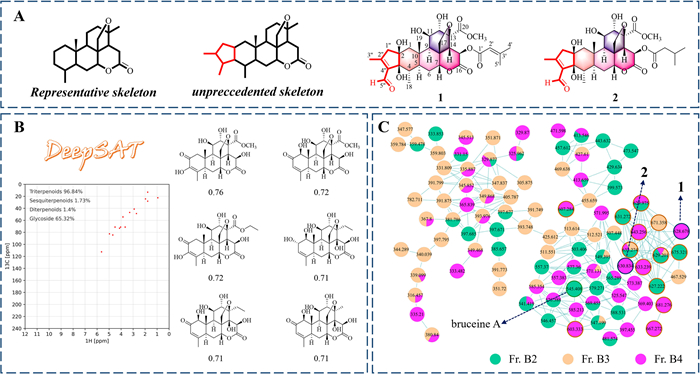
Considering the characteristics of every single strategy, we advance a new integrated analytical strategy based on DeepSAT and molecular networking. DeepSAT accurately extracts the chemical features to achieve structure annotation and scaffold prediction of major constituents but a relatively lower sensitivity in trace compound detection [18]. With MS/MS-based technology, its sensitivity dramatically increased over the DeepSAT method, and it precise localizes target compounds through molecular network mapping. Applying this approach, two novel hemiterpene-quassinoid adducts (bruquassins A and B, 1 and 2) with an unusual 5/6/6/6/6/5 hexacyclic scaffold were successfully identified from B. javanicaas (Fig. 1A). Encouragingly, these two compounds are the first reported examples of hemiterpene-quassinoid adducts. Herein, the guided isolation, structure elucidation, and hypothetical biogenetic pathways of 1 and 2 were described. Furthermore, we accomplished the biomimetic synthesis of 1 and evaluated the antifeedant activities of all these isolates against Plutella xylostella (DBM, the abbreviation of diamondback moth).
Figure 1
Figure 1.
(A) Representative skeleton type of quassinoids and the chemical structures of compounds 1 and 2. (B) DeepSAT-guided prioritization for isolation: (left) HSQC spectrum of Fr. B4; (right) DeepSAT results (top six structures ranked by cosine similarity scores) of Fr. B4. (C) Molecular networks of Fr B1-B4 of B. javanica.
The residual alcohol extract of B. javanica was suspended in H2O, extracted with n-BuOH, and subsequently subjected to multiple chromatography, resulting in the isolation of four fractions (Fr. B1 to B4). The heteronuclear single quantum correlation (HSQC) spectrum and liquid chromatography-tandem mass spectrometry (LC-MS/MS) data of Fr. B1 to B4 from B. javanica were analyzed by the integrated analytical strategy to prioritize the identification of intriguing quassinoids. The HSQC data were formatted into a comma-separated values (CSV) file and subsequently uploaded to the DeepSAT platform (https://deepsat.ucsd.edu/) [18,23]. As shown in Fig. 1B, Fr. B4 has a 96.84% probability of being rich in triterpenoids, and the top six structures ranked by cosine similarity scores were all identified as quassinoids. It is worth noting that the low cosine similarity scores observed in the DeepSAT results suggested the presence of novel quassinoids skeletons in Fr. B4. Nevertheless, it is difficult to determine the location of potential quassinoids in Fr. B4 only by using DeepSAT. Therefore, to rapidly discover the possible novel quassinoids with low abundance, the GNPS workflow was chosen and applied [27,28,32,33]. In the generated molecular network (Fig. 1C), the main ingredient in B. javanica, bruceine A was initially identified [34]. Notably, the molecular network contained several nodes with molecular weights exceeding 600, approximately 100 Da higher than those of reported quassinoids [6], suggesting that these nodes were possible to possess complex quassinoids structures. Accordingly, guided by DeepSAT and molecular networking, two quassinoids with unparalleled skeletons were successfully isolated and characterized (Fig. 1A).
Bruquass A (1) was obtained as white amorphous powder with a chemical formula of C31H40O12 based on its HRESIMS ion peak at m/z 605.2590 [M + H]+ (calcd. for C31H41O12, 605.2593), accounting for twelve degrees of unsaturation. The 1D NMR (Table S1 in Supporting information) together with HSQC spectrum of 1 revealed resonances for six methyl groups, including one methoxy, four singlets, and one doublets; four sp3 methylene, including one oxygenated; eight sp3 methine, including four oxygenated; five sp3 quaternary carbons, including three oxygenated; four olefinic; an aldehyde group; and three ester groups. Based on the double bond equivalents, compound 1 possessed a six-ring framework. The 1H-1H correlation spectroscopy (COSY) correlations of H3-18/H-4/H-5/H2-6/H-7, H-9/H-11/H-12, H-14/H-15, and the heteronuclear multiple bond correlation (HMBC) correlations from H3-18 to C-3, H3-19 to C-1/5/9/10, H2-17 to C-7/8/9, H-7 to C-14, H-11 to C-13, and H-12 to C-20 manifested the presence of quassinoid motif (Fig. 2A). Meanwhile, the existence of ring F and its fusion to ring A via C-2 and C-3 were inferred from the HMBC correlations of 2-OH to C-1/2/1′′, H3-3′′ to C-1′′/2′′/4′′, and H-5′′ to C-2/4′′. The assignment of the angeloyl group was done according to the double bond equivalents and the HMBC correlations from H3-4′/5′ to C-2′/3′. Hence, the planar structure of 1 was unequivocally elucidated.
Figure 2
Figure 2.
(A) Key HMBC (blue) and 1H-1H COSY (black) correlations of compounds 1 and 2. (B) Key NOESY correlations (α: blue, β: red) for compounds 1 and 2. (C) Experimental and calculated ECD spectra for compounds 1 and 2.
The relative configuration of 1 was resolved via the nuclear Overhauser effect spectroscopy (NOESY) correlations. Based on the NOESY correlations (Fig. 2B) between H-5 and H-9, H-9 and H-15, H-9 and H-11, 2-OH and 3-OH, 2-OH and H3-19, H3-19 and H-4, H3-19 and H2-17, H2-17 and H-12, H2-17 and H-14, H2-17 and H-7, the relative configuration was partially assigned as 2R*,3S*,4S*,5S*,7R*,8R*,9R*,10S*,11R*,12S*,13S*,14S*,15R*. The absolute configurations of 1 was confirmed by time-dependent density functional theory (TDDFT)/ECD calculations [4,32,35–38]. Finally, The ECD curves generated for (2R,3S,4S,5S,7R,8R,9R,10S,11R,12S,13S,14S,15R)-1 agreed well with the experimental curves for 1, allowing the assignment of the absolute configuration of 1 as 2R,3S,4S,5S,7R,8R,9R,10S,11R,12S,13S,14S,15R (Fig. 2C). Conclusively, by the systematic analysis above, we could unquestionably determine the compound 1 as an unparalleled adduct of hemiterpene and quassinoid with 5/6/6/6/6/5 hexyclic ring system.
Bruquass B (2) was determined to have a molecular formula of C31H42O12, 2Da more than that of 1, according to its protonated molecular ion at m/z 607.2745 in its HRESIMS data (calcd. for C31H43O12, 607.2749). Comparison of the 1D and 2D NMR spectra of 2 with those of 1 revealed their similarity, expected that the angeloyl group in 1 was replaced by an isovaleric group (Fig. 2A). The relative configurations of 2 was further ascertained by NOESY experiment (Fig. 2B). Furthermore, the absolution configuration of 2 was ascertained to be 2R,3S,4S,5S,7R,8R,9R,10S,11R,12S,13S,14S,15R according to the matched ECD curves between the calculated and experiment one (Fig. 2C).
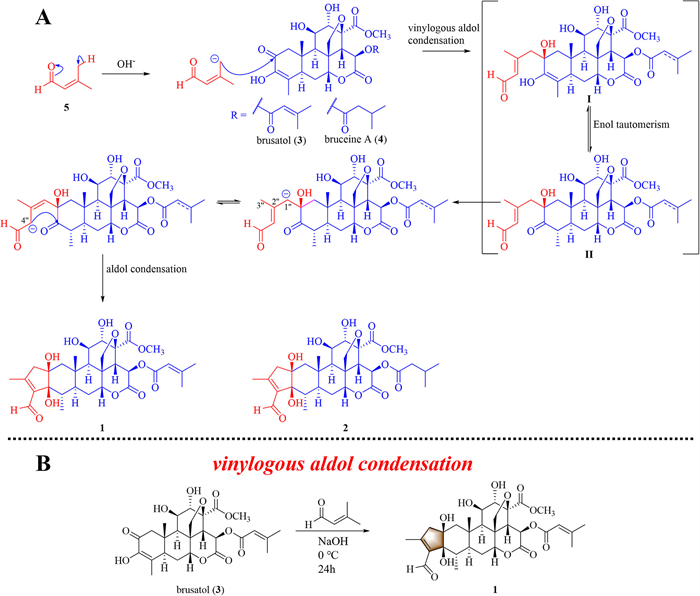
The biosynthetic pathway of 1 can plausibly be traced back to brusatol (3), existing in B. javanica at some level of abundant. As illustrated in Scheme 1A, intermediate Ⅰ was synthesized from brusatol (3) and 3-methyl-2-butenal (5) by aldol condensation [39]. Owing to the inherent instability of the enol structure, intermediate Ⅰ rapidly underwent tautomerization to its keto form (intermediate Ⅱ). Subsequently, the elimination of the γ-hydrogen atom generates a carbanion, with the resulting negative charge delocalized to the α-position [40]. Ultimately, compound 1 was formed via intramolecular Aldol condensation. Similarly, compound 2 was proposed to be biosynthesized through an analogous pathway, with bruceine A (4) serving as the precursor.
Scheme 1
Scheme 1.
(A) Proposed biosynthetic pathways of compounds 1 and 2. (B) Semi-synthesis of 1 from 3via vinylogous aldol condensation.
To provide a sufficient sample of 1 for biological evaluation and further accurate structural validation, a concise and viable biomimetic synthesis starting from brusatol (3) was designed based on the hypothetic biogenetic pathway of 1 (Scheme 1B). Considering that the formation of γ-carbanion was critical in synthesis of 1, we attempted to catalyze the reaction between 3 and 3-methyl-2-butenal (5) under different conditions [41–45]. the expected product 1 was not observed when acidic catalysts were employed (Table S2 in Supporting information, entries 1–4). By comparison, under basic catalytic conditions, the desired product 1 was successfully formed using sodium hydroxide or potassium hydroxide (Table S2, entries 5–8). Due to the presence of multiple ester bonds in the structure of 3, which are susceptible to decomposition under strong alkaline conditions, the subsequent reactions were carried out at 0 ℃ and the product 1 was formed in 16.9% yield (Table S2, entry 9). What is more, among the solvents screened, DMF proved to be the most effective (25.3% yield) for the reaction (Table S2, entry 10). In conclusion, the bionic synthesis of 1 was achieved by alkali-catalyzed vinylogous aldol condensation.
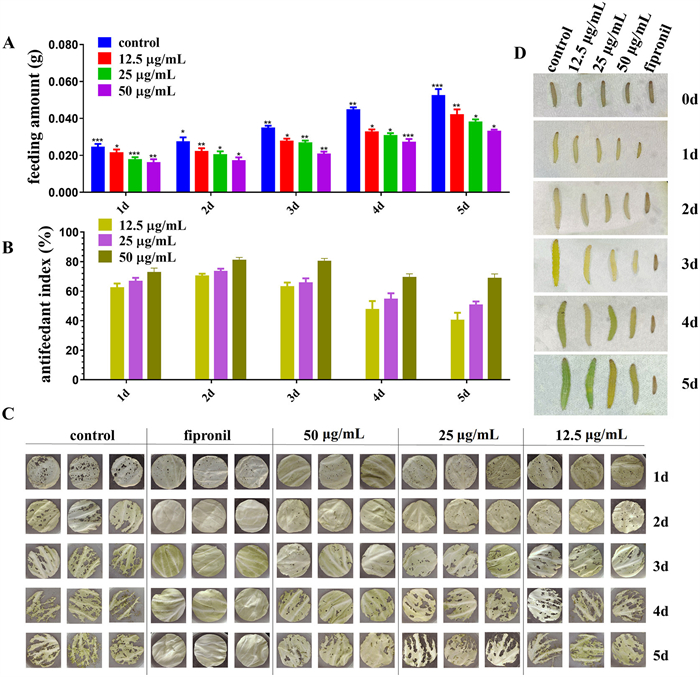
Guided by the biomimetic synthesis, sufficient compounds were prepared and purified to evaluate their antitumor activities. However, compounds 1 and 2 showed no cytotoxicity in HCT116, Caco-2, and HT-29 cell lines. In view of the antifeedant activity of quassinoids in B. javanica [16,46,47], the antifeedant activities against DBM of compounds 1 and 2 was screened by leaf disc method. The bioassay revealed significant concentration dependent antifeedant activity, with compound 1 exhibiting particularly potent effects (the concentration corresponding to 50% antifeedant action (AFC50) = 26.58 µg/mL). Following incubation with seeding of Brassica oleracea L. (Brassicaceae), compound 1 decreased the feeding of the DBM larvae on the leaves (Figs. 3A and C). After a 5-day culture period, the antifeedant index (AFI) remained above 70% after treatment with a high concentration (50 µg/mL) of compound 1 (Fig. 3B). In addition, the body size of the DBM larvae fed with compound 1 was significantly smaller and lighter than that of the control group (Fig. 3D).
Figure 3
Figure 3.
Antifeedant activity of 1 and its inhibitory effect on the growth of the third instar larvae of DBM. (A) Feeding amount, (B) antifeedant index of 1 applied by leaf discs in B. chinensis seedlings against DBM larvae. (C) Leaf discs obtained from B. oleracea seedlings after incubating with three solutions of 1. (D) Body sizes of the DMB larvae after being fed.
In summary, we employed an integrated approach combining DeepSAT with tandem mass spectrometry-based molecular networking to search for novel bioactive quassinoid analogues from B. javanica. Guided by this approach, bruquass A and B (1 and 2), possessing unusual 5/6/6/6/6/5 hexyclic ring system, were identified as the first examples of quassinoid-hemiterpene hybrids. Their structure and absolute configurations were elucidated by comprehensive analysis of spectroscopic data and quantum chemical calculations. Notably, compound 1 was successfully synthesized and the corresponding optimal synthetic conditions were explored, processing sufficient compounds for biological experiments. Results of bioactivity study showed that the isolates exerted potent antifeedant activity on the Plutella xylostella. The discovery of these novel skeletal compounds not only enriches the structural diversity of quassinoids, but also furnishes promising candidates for the development of natural insecticides.
Declaration of competing interest
The authors declare that they have no known competing financial interests or personal relationships that could have appeared to influence the work reported in this paper.
The work was funded by the National Natural Science Foundation Regional Innovation and Development Joint Fund (No. U22A20381), National Key R&D Program of China (No. 2024YFC3506600), Natural Science Foundation of Liaoning Province of China (No. 2024-MS-086), Shenyang City Middle and Young Science and Technology Talents Cultivation Special U40 Outstanding Youth Project (No. RC230803), Science and Technology Planning Project of Liaoning Province (No. 2021JH1/10400049) and Song Shaojiang Expert Workstation of Yunnan Province (No. 202305AF150030).
Supplementary materials
Supplementary material associated with this article can be found, in the online version, at doi:10.1016/j.cclet.2025.111321.
G. Mao, Y. Tian, Z. Sun, et al., Agric. Food Chem. 67 (2019) 4232–4239. doi: 10.1021/acs.jafc.8b06511
[47]
X.H. Yan, J. Chen, Y.T. Di, et al., J. Agric. Food. Chem. 58 (2010) 1572–1577. doi: 10.1021/jf903434h
Figure 1
(A) Representative skeleton type of quassinoids and the chemical structures of compounds 1 and 2. (B) DeepSAT-guided prioritization for isolation: (left) HSQC spectrum of Fr. B4; (right) DeepSAT results (top six structures ranked by cosine similarity scores) of Fr. B4. (C) Molecular networks of Fr B1-B4 of B. javanica.
Figure 2
(A) Key HMBC (blue) and 1H-1H COSY (black) correlations of compounds 1 and 2. (B) Key NOESY correlations (α: blue, β: red) for compounds 1 and 2. (C) Experimental and calculated ECD spectra for compounds 1 and 2.
Figure 3
Antifeedant activity of 1 and its inhibitory effect on the growth of the third instar larvae of DBM. (A) Feeding amount, (B) antifeedant index of 1 applied by leaf discs in B. chinensis seedlings against DBM larvae. (C) Leaf discs obtained from B. oleracea seedlings after incubating with three solutions of 1. (D) Body sizes of the DMB larvae after being fed.


 DownLoad:


 下载:
下载:


 下载:
下载:

