Citation:
Dong Fang, Xiaofan Yang, Fengxin Gao, Chengliang Xiao. Straightforward and versatile construction of phenanthroline-derived diamide ligands for f-block element extraction[J]. Chinese Chemical Letters,
2026, 37(1): 111252.
doi:
10.1016/j.cclet.2025.111252
Straightforward and versatile construction of phenanthroline-derived diamide ligands for f-block element extraction
English
Straightforward and versatile construction of phenanthroline-derived diamide ligands for f-block element extraction
Received Date:
23 August 2024 Accepted Date:
22 April 2025 Revised Date:
24 March 2025 Available Online:
15 January 2026
Abstract:
As an important class of phenanthroline derivatives containing soft N and hard O donor atoms, the laborious syntheses of unsymmetrical 1, 10-phenanthroline-derived diamide ligands (DAPhen) have hindered its extensive study. In this work, we first report a convenient synthetic method for the construction of DAPhen using Friedländer reaction by two facile steps (vs. previous 12 steps). A variety of DAPhen ligands are readily available, especially unsymmetrical ones, which give us a platform to systematically study the substituent effect on f-block elements extraction performance. The performance of unsymmetrical extractants is experimentally confirmed to falls between that of their corresponding symmetrical extractants by extracting UO22+ as the representative f-block element. This work provides a direct and versatile method to synthesize symmetrical and unsymmetrical DAPhen, which paves way for the investigations on their coordination properties with metal ions and other applications.
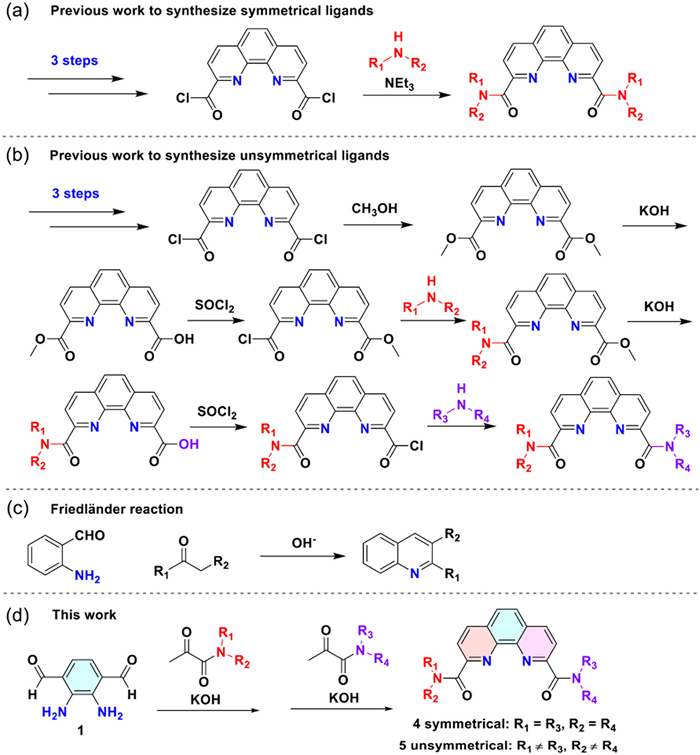
The 1,10-phenanthroline (Phen) scaffold is one of the most representative preorganized ligands due to its unique metal chelating properties, which are widely applied in chemical catalysis [1,2], analytical chemistry [3,4], sensing agents [5] and nuclear waste treatment [6]. Among these, Phen-derived diamide (DAPhen) ligands are important substituted derivatives. The combined soft N and hard O donor atoms endow them with many unique chemical properties and applications, especially in the field of metal ion coordination chemistry [7,8] and selective extraction of actinides over lanthanides in high-level nuclear waste due to its faster extraction rates, greater extraction capacity, and better acid resistance [9–13]. Therefore, a series of diverse DAPhen have been developed to meet various application requirements based on the derivatization of the parent Phen skeleton [10,14–18].
Nowadays, most symmetrical DAPhen ligands are usually obtained by carboxyl group activation and amide reaction through multistep sequential reactions that involve volatile, toxic and expensive reactants (Fig. 1a) [9,19,20], hindering their industrial deployment [15]. Very recently, our group [18] and Guo et al. [21] utilized the stability difference between amide and ester groups in alkaline solution to synthesize unsymmetrical DAPhen by multiple ester hydrolysis and carboxyl activation steps (approx. 10−12 steps, Fig. 1b). Although the unsymmetrical DAPhen exhibit excellent selective separation performance for actinides over lanthanides, their laborious syntheses have hampered their widespread application and comprehensive research [18,21]. To date, a straightforward method to access DAPhen was developed through C-H functionalization of Phen in the presence of a carbamoyl radical precursor [14,16]. However, the 4, 7 and 2, 9 positions of parent Phen possess similar reactivity, leading to non-reactive selectivity. As a result, only 4, 7-substituted symmetrical DAPhen could be obtained [14,16], which also limits the broad application of this method. In addition, the extraction and separation properties of the reported symmetrical DAPhen ligands are significantly affected by their substituent groups [9,12,22,23]. With the increase of alkyl chain, the ability to extract UO22+ increases obviously [22]. Its separation ability of actinides over lanthanides is obviously improved by substitution with ethyl and tolyl group, which is called "anomalous aryl strengthening" [9,12,23]. However, due to the difficulty in synthesizing unsymmetrical DAPhen ligands, the effect of substituents on its extraction properties has not been studied. Therefore, it is highly urgent to explore a versatile approach to construct varied classes of DAPhen ligands, particularly unsymmetrical ones, to stimulate their research in metal ion coordination.
Figure 1
Figure 1.
Previous work to synthesize (a) symmetrical and (b) unsymmetrical DAPhen ligands, respectively. (c) General Friedländer reaction to construct quinoline derivatives. (d) Using Friedländer reaction to synthesize DAPhen ligands in this work.
The Friedländer reaction has been demonstrated as the most general and efficient strategy for producing quinoline core and its derivatives, which is the acid- or base-catalyzed condensation reaction between aromatic 2-amino-substituted aldehydes and enolizable ketones (Fig. 1c) [24]. Moreover, the substrate 1, bearing 2 pairs amino and aldehyde groups, can undergo two consecutive Friedländer reactions to yield the Phen scaffold [25,26]. Herein, we first report a convenient and versatile synthesis of a mass of structurally varied DAPhen ligands using Friedländer condensation reactions between substrate 1 and pyruvic amides (Fig. 1d). Furthermore, we use UO22+ as a probing metal ion to explore the substituent effect of DAPhen ligands on their extractive performance.
We turned our attention to a general and concise method for the synthesis of various DAPhen ligands, taking advantages of Friedländer condensation reactions with pyruvic amides. These condensation reactions have been utilized to the preparation of Phen derivatives [27,28], despite receiving a few interests, demonstrating that the application of pyruvic amides might be a potential method for the syntheses of DAPhen ligands. More importantly, the pyruvic amide 2 are readily accessible intermediates through the acylation of pyruvic acid and amines (Supporting information) [29] and the substrate 1 is a highly stable substance even installed 2 pairs of amino and aldehyde groups [25]. Therefore, we anticipate that our strategy might enable direct access to novel DAPhen ligands to meet diverse application requirements.
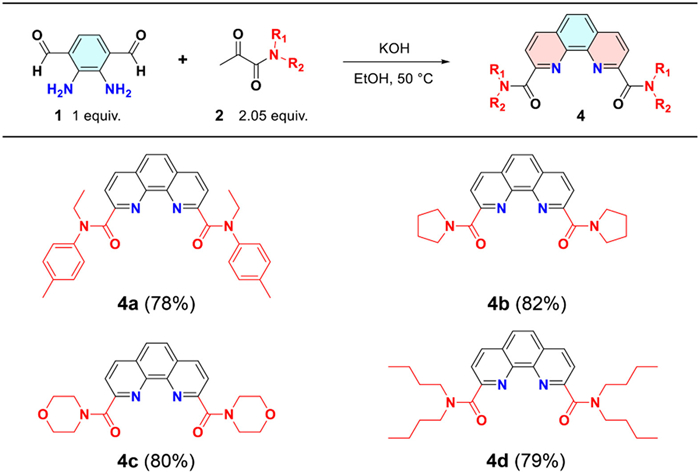
In the initial studies, we focused on the synthesis of symmetrical DAPhen ligands, which have been widely employed in the research of complexation and separation for f-block elements in the past years [10]. In the beginning, the treatment of 1 with 2.0 equiv. 2avia the acid (p-TsOH) catalyst failed to yield the desired product 4a (Table 1), which is consistent with the previous report [25]. As expected, the same treatment using an alkali catalyst (NaOH, KOH, EtONa) afforded the desired product, with KOH exhibiting the best catalytic efficiency. Subsequently, additional optimization of the procedure showed that the yield varied slightly with increasing temperature and equivalents of pyruvic amide. Using 1 equiv. of substrate 1 and 2.05 equiv. of 2a in the presence of KOH at 50 ℃ was found to be the optimal reaction condition, resulting in a 78% yield (Table 1). With optimized conditions in hand, we expanded the scope of pyruvic amide substrates, such as alkyl, cycloalkyl and morpholine, all of which achieved high yields (>75%, Fig. 2). Compared with the previous work [9], these ligands were obtained with a shorter step and higher yield.
Table 1
Table 1.
Selected optimization studies to syntheses of 4a.
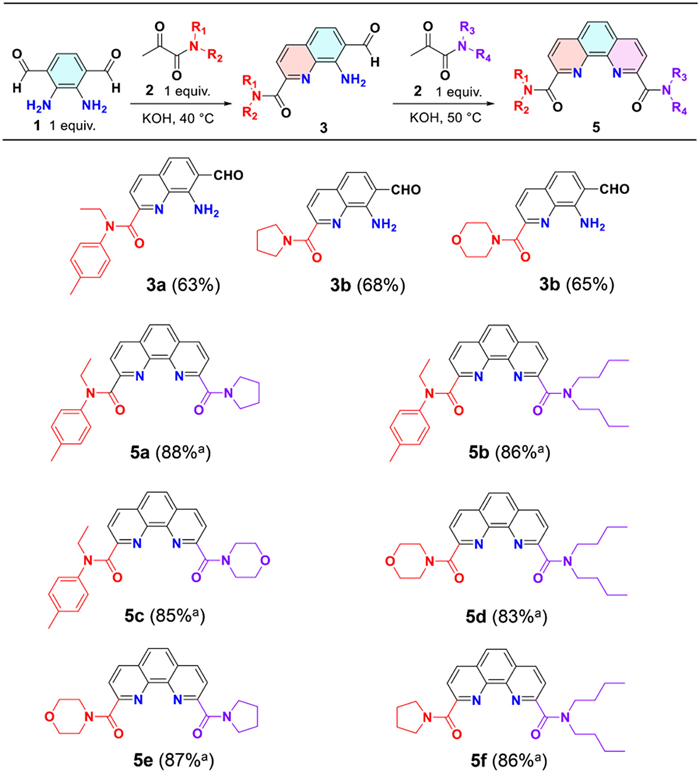
Recently, unsymmetrical DAPhen ligands have also received increased interest [18,21], but they are extensively complicated to synthesize using prior methods (Fig. 1b) [18,21]. Therefore, we attempted to afford the unsymmetrical DAPhen by two sequential Friedländer reactions with diverse pyruvic amides. The condensation reaction between 1 and an equimolar pyruvic amide inevitably produced a double-condensed product of symmetrical DAPhen, so we tried to improve the yield of mono-condensed product by decreasing the concentration of reactants as well as lowering the reaction temperature. Surprisingly, treating 1 with equimolar amounts of diverse pyruvic amides in the presence of KOH obtained the desired mono-condensed product 3 in 65%–68% yield (Fig. 3), along with a small amount of double condensed product (about 5%) at 40 ℃. Subsequently, these mono-condensed products could further react with various pyruvic amides to synthesize a variety of unsymmetrical DAPhen ligands. They all showed extensive substrate tolerance and high yields (> 80%, Fig. 3), providing a solid starting point for investigating the substituent effect of unsymmetrical DAPhen ligands. This method clearly offers the advantages of fewer synthesis steps and higher yield compared to the conventional methods for synthesizing DAPhen ligands.
Figure 3
Figure 3.
Syntheses of representative unsymmetrical DAPhen ligands via two consecutive Friedländer reaction. aIsolated yield of reaction between mono-condensed product and pyruvic amide.
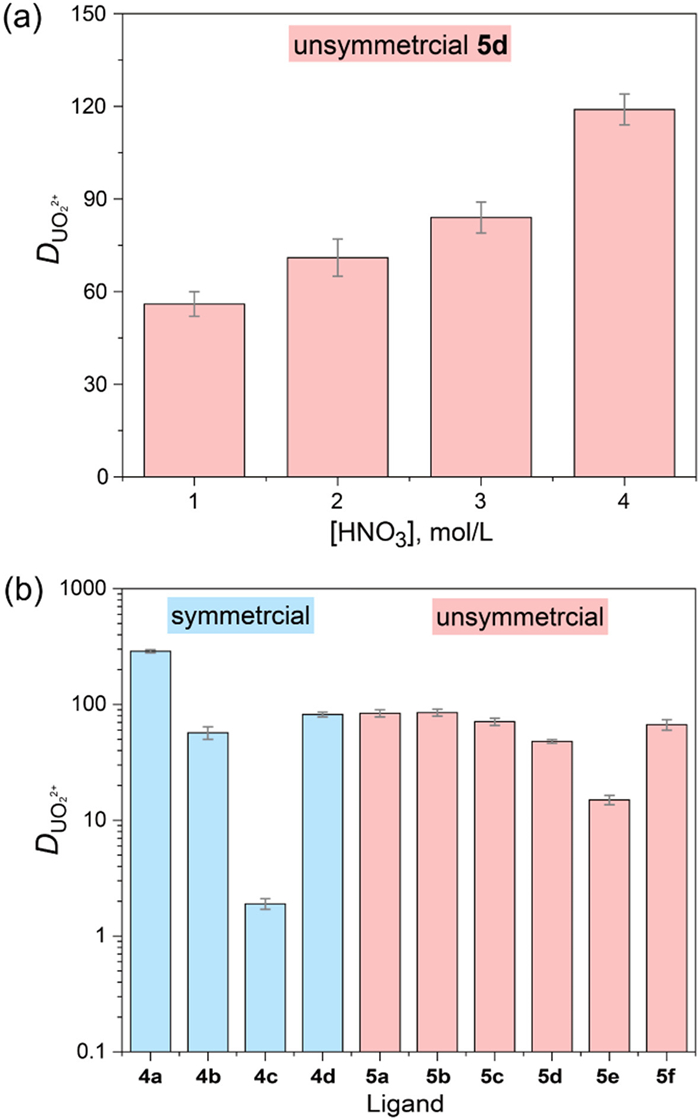
Inspired by recent reports that the change of substituent on amide groups highly affected the extraction performance with f-block elements [9,17,22], we carried out solvent extraction experiments to investigate the effect of substituents on the extraction of UO22+ and compared their extraction performance with the reported DAPhen (Table S1 in Supporting information). For almost all DAPhen ligands, the distribution of UO22+ increased with increasing HNO3 concentration from 1 mol/L to 4 mol/L (Fig. 4a and Fig. S2 in Supporting information), and we carefully analyzed the variation of distribution ratios in 2 mol/L HNO3 (Fig. 4b). The distribution ratios of 4a and 4d determined by our test at 2 mol/L HNO3 were 288 and 82, respectively, which is consistent with previous reports [9,22] and further confirms the reliability of the results. In addition, the distribution ratio of 4c was nearly 150 times smaller than that of 4a, only 1.9, indicating that the substituents possess a significant effect on the extraction performance. Moreover, the distribution ratio of unsymmetrical 5c was 55, which falls between the distribution ratios of their two corresponding symmetrical ligand 4a (288) and 4c (1.9). Unsurprisingly, the same trend was observed in other unsymmetrical 5a to 5f (Fig. 4b). These results further validated the accuracy of the reported theoretical predictions for other unsymmetrical 1, 10-phenanthroline derivatives [30] and provided solid and detailed experimental support for the design of extractants with balanced extraction properties by combining two different substituent groups.
Figure 4
Figure 4.
(a) Distribution rations of 5d in 3-nitrobenzotrifluoride as a function of HNO3 concentration. (b) Distribution ratios of 4a-4d and 5a-5f in 3-nitrobenzotrifluoride at room temperature ([ligand] = 10 mmol/L, [UO22+] = 0.1 mmol/L, [HNO3] = 2 mol/L and contact time = 30 min). Bluish bars: symmetrical ligands, pink: unsymmetrical ligands.
In summary, we have developed a highly efficient methodology to synthesize symmetrical and unsymmetrical 1, 10-phenanthroline-derived diamide ligands via consecutive Friedländer reactions. The convenient syntheses of unsymmetrical ligands 5a-5f in two facile steps (vs. previous 12 steps) clearly demonstrate the utility of this approach. The rapid preparation of a range of DAPhen ligands allows us to systematically investigate the substituent effect on extracting UO22+ that is chosen as a representative f-block element. This study disclosed that substituents have a significant influence on the extraction ability, and the performance of unsymmetrical extractants generally falls between that of their corresponding symmetrical extractants. Subsequent work like complexation behaviors, nuclear waste treatment and other applications are currently under way in our laboratory. This work shed light on constructing the unsymmetrical DAPhen ligands, which can be extend to synthesize other unsymmetrical phenanthroline ligands.
Declaration of competing interest
The authors declare that they have no known competing financial interests or personal relationships that could have appeared to influence the work reported in this paper.
CRediT authorship contribution statement
Dong Fang: Methodology, Investigation, Data curation, Writing – original draft. Xiaofan Yang: Writing – original draft, Validation. Fengxin Gao: Writing – original draft, Data curation. Chengliang Xiao: Writing – review & editing, Supervision, Project administration, Funding acquisition, Conceptualization.
Acknowledgments
We are grateful for financial support from the National Natural Science Foundation of China (Nos. 22476178, U2067213) and Natural Science Foundation of Zhejiang Province (No. LRG25B060002).
Supplementary materials
Supplementary material associated with this article can be found, in the online version, at doi:10.1016/j.cclet.2025.111252.
B. Ma, T. Miao, Y. Sun, et al., Chem. Eur. J. 20 (2014) 9969–9978. doi: 10.1002/chem.201402709
[30]
X. Yang, D. Fang, L. Chen, et al., JACS Au 4 (2024) 4744–4756. doi: 10.1021/jacsau.4c00684
Figure 1
Previous work to synthesize (a) symmetrical and (b) unsymmetrical DAPhen ligands, respectively. (c) General Friedländer reaction to construct quinoline derivatives. (d) Using Friedländer reaction to synthesize DAPhen ligands in this work.
Figure 3
Syntheses of representative unsymmetrical DAPhen ligands via two consecutive Friedländer reaction. aIsolated yield of reaction between mono-condensed product and pyruvic amide.
Figure 4
(a) Distribution rations of 5d in 3-nitrobenzotrifluoride as a function of HNO3 concentration. (b) Distribution ratios of 4a-4d and 5a-5f in 3-nitrobenzotrifluoride at room temperature ([ligand] = 10 mmol/L, [UO22+] = 0.1 mmol/L, [HNO3] = 2 mol/L and contact time = 30 min). Bluish bars: symmetrical ligands, pink: unsymmetrical ligands.


 DownLoad:


 下载:
下载:


 下载:
下载:

