Institutes of Physical Science and Information Technology, Key Laboratory of Structure and Functional Regulation of Hybrid Materials of Ministry of Education, Anhui University, Hefei 230601, China
b.
Department of Chemistry, Key Laboratory of Environmentally Friendly Chemistry and Applications of Ministry of Education, Xiangtan University, Xiangtan 411105, China
mbli@ahu.edu.cn (M.-B. Li). 1 These authors contributed equally to this work.
Received Date:
04 March 2025 Accepted Date:
16 April 2025 Revised Date:
10 April 2025 Available Online:
15 August 2026
Abstract:
We report herein the synthesis, structure and catalysis of a cobalt-kernelled icosahedral gold nanocluster CoAu12, providing an opportunity for the in-depth understanding of rarely reported Co-doped gold nanoclusters. CoAu12 possesses a symmetric and contracted metal kernel compared to the 4d and 5d metal-kernelled MAu12 nanoclusters (M = Pd, Pt, Rh, Ir, Au), thus exhibiting highly structural stability. Meanwhile, CoAu12 demonstrates efficient energy and electron transfer activity toward oxygen, thus endowing this nanocluster with exceptional catalytic activity in converting oxygen to singlet oxygen as well as superoxide. Structural features such as the unpaired electron of CoAu12 have been verified as contributing to its catalytic activity. Efficient organic transformations involving singlet oxygen and superoxide were developed based on the structurally stable and catalytically active CoAu12 nanocluster.
The icosahedral Au13 composed of thirteen gold atoms has been revealed as a basic structure unit in atomically precise gold nanoclusters. Typical examples include Au25(SR)18, Au25(PPh3)10Br5, Au42(SR)32, etc. [1–6]. The investigation based on the Au13 unit triggers the discovery of various metal nanoclusters with intriguing properties [7–21]. On the other hand, the icosahedral Au13 is a stable form of nanoclusters as well [22–25]. This kind of nanoclusters such as Au13(NHC)8Br4 (NHC = N-heterocyclic carbene) and Au13(SbPh3)8Cl4 have also been extensively studied. Apart from the monometallic gold nanoclusters, their doping analogues constitute a versatile platform for precisely modulating properties of the Au13 system at atomic level. In this context, metals that possess the similar atomic radii to Au have been successfully doped into the Au13 system by the methods of in-situ synthesis, anti-galvanic reduction (AGR), etc. [26–33]. The as-obtained metal nanoclusters such as Au24Cd(SR)18, Au24Hg(SR)18 and Au36Pd2(SR)24 demonstrate significantly different properties compared to their gold analogues. In spite of the progress, the successful doping of cobalt into the Au13 system is rarely reported. One of the reasons might be that the cobalt is slightly far away from Au on the periodic table and possesses significantly different atomic radii and properties. Thus, the structural features and property characteristics of Co-doped gold nanoclusters are quite unknown.
Our group focuses on the construction of functional metal nanoclusters with bidentate phosphine ligands. By modifying the chain length and substituents of the bidentate phosphines, we realized the construction of gold and doped nanoclusters with diversified compositions [34–40]. Their atomically precise structures were revealed and practical applications in kinetic resolution, catalysis, chiral recognition, etc., were developed as well. Recently, Tsukuda et al. synthesized a series of 4d and 5d metals doped MAu12 nanoclusters (M = Pd, Pt, Rh, Ir) and systematically investigated and compared their electronic structures, photoluminescence and catalytic performance [41–44]. Inspired by their elegant work, we are very interested in investigating the Co-doped icosahedral gold nanoclusters. Herein, we report this kind of nanocluster and reveal its structural features, electronic properties and photocatalytic activity.
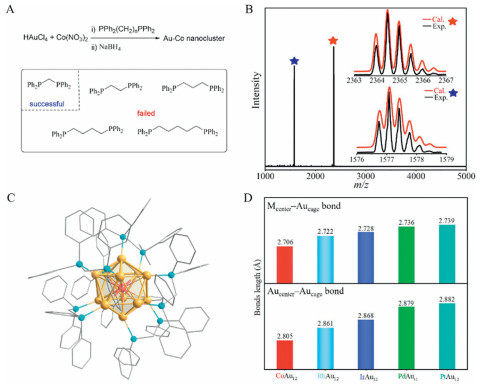
Our attempt for the synthesis of cobalt-doped gold nanoclusters was initiated by following the procedure [43] described by Tsukuda et al. and replacing the 4d or 5d metal precursors by a cobalt precursor. Specifically, 1,2-bis(diphenylphosphino)ethane (dppe) and Co(NO3)2 were used as the ligand and cobalt precursor, respectively. However, a [Au13(dppe)5Cl2]3+ nanocluster [45] was always obtained as the final product no matter how the reaction conditions such as the temperature, solvent and reductant were changed (Fig. S1 in Supporting information). Considering that the atomic radius of cobalt is dramatically smaller than that of 4d and 5d metals, we envisioned that the cobalt-doped gold nanocluster would possess a smaller size and shorter metal–metal distances. Based on this analysis, we tried replacing dppe with bis(diphenylphosphino)methane (dppm), which has a shorter phosphine–phosphine distance and would match with the metal–metal distances of the Co-doped gold nanocluster. Delightedly, this strategy worked, and the replacement of dppe by dppm successfully led to the formation of a Co-doped nanocluster instead of Au13. Similar bidentate phosphines with longer phosphine–phosphine bonds failed to give the desired nanocluster (Fig. 1A, Table S1 and Fig. S2 in Supporting information).
Figure 1
Figure 1.
(A) Synthetic procedure of CoAu12 nanocluster. (B) ESI-MS spectrum of CoAu12 nanocluster. (C) Total structure of CoAu12 nanocluster. Color label: Au = yellow; Co = red; P = cyan; C = gray. H atoms are omitted for clarity. (D) Bonding information comparison of MAu12 nanoclusters (M = Co, Rh, Ir, Pd, Pt).
With optimized reaction conditions, the Co-doped nanocluster was synthesized and purified efficiently (details in Supporting information), enabling its 100 mg-scale preparation and further structural and property investigations. The molecular formula of the nanocluster was determined by electrospray ionization mass spectrometry (ESI-MS) to be CoAu12(dppm)6 (abbreviated as CoAu12). Notably, two dominant peaks on positive mode were observed, which are assigned to [CoAu12(dppm)6]3+ and [CoAu12(dppm)6]2+, respectively (Fig. 1B). Different ESI-MS testing methods were tried and the two peaks always appeared simultaneously (Fig. S3 in Supporting information). Single crystal X-ray diffraction (SCXRD) revealed the atomically precise structure of CoAu12 and further confirmed its composition. This nanocluster crystallizes in the trigonal space group P-31c (crystal data, see Table S2 in Supporting information), possessing a symmetrically icosahedral geometry (Fig. 1C and Fig. S4 in Supporting information). A Co atom is located at the center of the icosahedron, while twelve Au atoms surround the cobalt atom and constitute the twelve vertices of the icosahedron. The average distance from the central Co atom to the twelve Au atoms (Mcenter-Aucage) is 2.706 Å (Fig. 1D). Meanwhile, the average Au-Au distance on the surface of the icosahedron (Aucage-Aucage) is determined to be 2.805 Å. Based on the bond length analysis (Fig. 1D), CoAu12 is more symmetric than 4d and 5d metal-doped MAu12 nanoclusters (M = Rh, Ir, Pd, Pt, Au) [45,46]. We compared the average Mcenter-Aucage (M = doped metal) and Aucage-Aucage distances of CoAu12, RhAu12, IrAu12, PdAu12 and PtAu12. The results indicate that apart from the highest symmetry, CoAu12 possesses the most contracted structure among the reported MAu12 nanoclusters (Fig. S5 in Supporting information). This observation further confirms our envision in the synthesis of CoAu12 that this nanocluster would possess a smaller size and shorter metal–metal distances, and also explains the interesting phenomenon that only dppm with a shorter phosphine–phosphine distance is feasible for the construction of CoAu12 nanocluster.
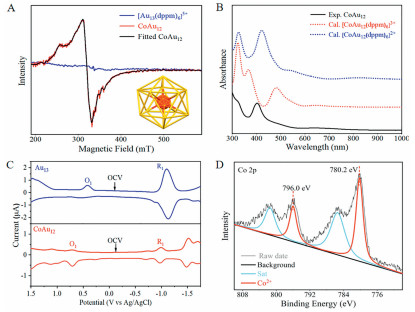
Concerning the valence state of CoAu12, two observed counter ions in the crystal data suggest that this nanocluster is +2 (Fig. S4A). The electron paramagnetic resonance (EPR) result confirms this conclusion, because obvious magnetic signal was observed for CoAu12 (Fig. 2A). Based on the electronic configuration of Au ([Xe]4f145d106s1) and Co ([Ar]3d74s2), CoAu12 shows EPR signal only when it is even-valence charged. Therefore, the [CoAu12(dppm)6]3+ peak observed in ESI-MS is probably due to ionization under ESI conditions, rather than being the native charge. For comparison, we prepared a structurally similar and monometallic [Au13(dppm)6]5+ nanocluster (abbreviated as Au13) based on the previous report (for its synthesis, see Supporting information) [47,48]. This nanocluster possesses a closed-shell electronic structure (13e – 5e = 8e), and showed no signal in the EPR spectrum (Fig. 2A). Apart from the experimental results, density functional theory (DFT) calculations indicate that the simulated absorption spectrum of [CoAu12(dppm)6]2+ matches well with the experimental one (Fig. 2B), while [CoAu12(dppm)6]3+ showed distinct absorption peaks. The theoretical results further suggest the +2 valence of the obtained CoAu12 nanocluster. Notably, we also simulated the UV–vis spectrum of the triplet state of [CoAu12(dppm)6]3+ (Fig. S13 in Supporting information). The distinct simulated absorption peaks from the experimental data also rule out the possibility of +3 valence state of CoAu12 nanocluster. Based on the above evidence, this is the first time we discover a stable icosahedral M13 nanocluster that disobeys the octet rule (8e valence electrons) [49,50].
Figure 2
Figure 2.
(A) EPR spectrum of CoAu12 and Au13 nanoclusters (Inset: the calculated spin density distribution of CoAu12 showing that the red isosurface is mainly distributed at the center of CoAu12). (B) Experimental and simulated UV−vis spectra of CoAu12 nanocluster. (C) DPV spectra of CoAu12 and Au13. (D) Co2p XPS spectrum of CoAu12 nanocluster.
Notably, the cobalt atom in CoAu12 does not contribute electrons, Instead, it accepts one electron to form full-filled d orbitals. Thus, the free electrons of [CoAu12]2+ should be 12 – 1 – 2 = 9. The origin of stability of [CoAu12(dppm)6]2+ (9e) can be explained by three aspects. First, we conducted the differential pulsed voltammetry (DPV) of CoAu12. The DPV spectrum of Au13 was also obtained for comparison. From the spectra (Fig. 2C), the first oxidation potential (O1) of CoAu12 (0.72 V vs. Ag/AgCl) is more positive than that of Au13 (0.48 V vs. Ag/AgCl), indicating that CoAu12 is more difficult to be oxidized. Meanwhile, the first reduction potential (R1) of CoAu12 (−0.97 V vs. Ag/AgCl) is also more positive than that of Au13 (−1.13 V vs. Ag/AgCl), demonstrating that CoAu12 is more easily to be reduced. The redox properties suggest that CoAu12 favors a lower +2 valence state instead of [CoAu12(dppm)6]3+. Second, based on the X-ray photoelectron spectroscopy (XPS) result of CoAu12, the deconvoluted Co 2p XPS spectrum showed intensive Co signals at 796.0 and 780.2 eV (Fig. 2D). The binding energy and satellite peaks (Sat) all suggest a Co2+ in the CoAu12 nanocluster. The calculated spin density distribution (Fig. S14 in Supporting information) of CoAu12 also shows that the red isosurface is mainly distributed at the center of CoAu12, i.e., Co atom (Fig. 3A, inset). In other words, the unpaired electron of CoAu12 comes from the doped Co atom. Therefore, CoAu12 favors holding one excess electron under normal conditions as the relatively stable Co2+ compared to Co3+. Third, based on the SCXRD analysis, [CoAu12(dppm)6]2+ possesses a contracted and symmetric structure. The calculated bond orders of Aucage-Aucage bonds on the Au12 cage of CoAu12 is generally larger than that of Au13 (Fig. S15a in Supporting information), probably due to the smaller radius of the Co atom resulting in a more compact core. The strong Au-Au interactions on the surface also lead to the high stability of [CoAu12(dppm)6]2+. Interestingly, the bond orders of Cocenter-Aucage bonds in CoAu12 are smaller than that of Aucenter-Aucage bonds in Au13 (Fig. S15b in Supporting information), suggesting the relatively weaker Co-Au interactions.
Figure 3
Figure 3.
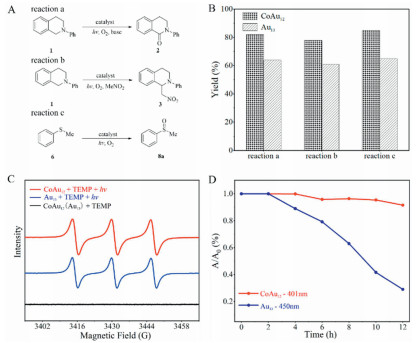
(A) Three model reactions involving singlet oxygen oxidation process. (B) Yield of CoAu12 and Au13 catalyzed model reactions. (C) In-situ EPR spectra for the detection of singlet oxygen (hv: blue LED irradiation). (D) The changes of characteristic UV–vis peaks of CoAu12 at 401 nm and Au13 at 450 nm during catalysis.
The stability of CoAu12 nanocluster under different conditions was then verified by UV–vis spectra. It was shown that the absorption curves of CoAu12 dissolved in dichloromethane kept unchanged even for seven days. Especially, UV–vis results indicate that CoAu12 possesses highly structural stability toward atmospheric oxygen and light irradiation (Figs. S6 and S7 in Supporting information). The high stability of CoAu12 under oxidation and irradiation conditions inspires us to further explore the catalytic performance of CoAu12 in photo-induced oxidation reactions. Previous results have shown that Au13 unit-based nanoclusters have the potential to activate the oxygen molecule under irradiation, generating singlet oxygen that is able to efficiently oxidize the tetrahydroisoquinoline and sulfides [51]. However, stability issue results in their decomposition under light irradiation. The high stability of CoAu12 toward both oxidation and light irradiation conditions is beneficial for its application in photo-induced oxidations.
The catalytic performance of CoAu12 and Au13 in photo-induced oxidations of tetrahydroisoquinoline and sulfide were compared. Three model reactions (Fig. 3A, reactions a-c) involving singlet oxygen oxidation process were selected, and the catalytic results were shown in Fig. 3B. Both CoAu12 and Au13 were catalytically active to the reactions. Interestingly, we found that CoAu12 showed higher efficiency than Au13, leading to the oxidized products in higher yields (Fig. 3B). To gain deeper insight into the catalytic mechanism of CoAu12 and Au13, we conducted in-situ EPR experiments. The generated singlet oxygen by CoAu12 or Au13 were captured by 2,2,6,6-tetramethylpiperidine (TEMP) and detected by EPR (Fig. 3C). Additionally, 1,3-diphenylisobenzofuran (DPBF) was employed as the probe and the catalytic process of CoAu12 and Au13 in O2 activation was monitored (Fig. S8 in Supporting information). DPBF can react with single oxygen and result in the notable absorption change [52]. As shown in Fig. S8, the characteristic absorption peak of DPBF at 413 nm decreased under light irradiation when it was mixed with CoAu12 or Au13 in the presence of O2, while its absorption spectrum kept basically unchanged under the conditions without nanoclusters. The above experimental results demonstrate that both CoAu12 and Au13 are capable of activating O2 under irradiation, producing singlet oxygen. What is the reason for their different catalytic activities? Time-dependent UV–vis spectra of CoAu12 and Au13 under the reaction conditions revealed the origin of their catalytic difference (Fig. 3D). Both CoAu12 and Au13 kept their structures at the early stage of the catalytic process based on their unchanged absorptions in the first 2 h. However, it was found that the characteristic absorption peak of Au13 at 450 nm disappeared rapidly accompanied by the progress of the catalytic reaction. In sharp contrast, the characteristic absorption peak of CoAu12 at 401 nm kept basically unchanged during the reaction. This result indicates that the different catalytic activities of CoAu12 and Au13 are mainly attributed to their different structural durability during catalysis. The robust structure and high O2 activation efficiency of CoAu12 under light irradiation and atmospheric oxygen contributes to its exceptional catalytic performance in oxidation reactions.
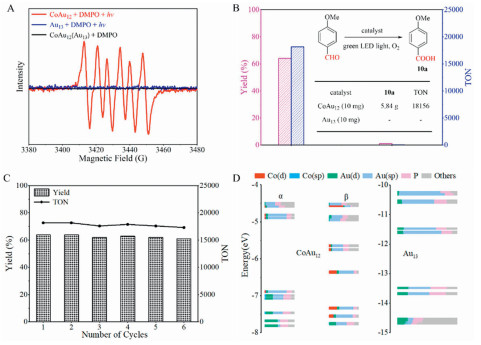
Apart from high stability, CoAu12 showed unique catalytic activity that Au13 does not have. We found that CoAu12 not only facilitated the generation of singlet oxygen, but also activated O2 and produced superoxide under light irradiation. The free radical scavenger 5,5-dimethyl-1-pyrroline-N-oxide (DMPO) was used to identify superoxide. Control experiments were conducted and the typical signals of [DMPO—O2•-] combined with the oxidized DMPO [DMPO—O•] [53] were observed when CoAu12 was used under blue LED irradiation, verifying the catalytic ability of CoAu12 in converting O2 to superoxide. In contrast, Au13 gave negligible signals. This comparison is particularly significant under green LED irradiation. Obvious and exclusive of the superoxide occurred when CoAu12 was employed while none of signal was observed with Au13 (Fig. 4A). This result, combined with the above investigation of nanocluster catalysis in the model oxidation reactions, unambiguously indicate that the excited CoAu12 under light irradiation is able to activate O2 by energy transfer as well as electron transfer, thus producing both singlet oxygen and superoxide. In sharp contrast, the excited Au13 can only undergo energy transfer with O2 and trigger the generation of singlet oxygen. The dual activation pathways of CoAu12 would enable its efficient catalysis in oxidation of aldehydes based on the previous reports [54]. The catalytic oxidation of aldehyde for the formation of carboxylic acid was selected for evaluating the catalytic performance of CoAu12. CoAu12 catalyzed the oxidation of aldehydes efficiently, giving 10a in 84% yield, while Au13 showed negligible catalytic activity under the same reaction conditions (details in Supporting information). Concerning the structural robustness as well as the high catalytic efficiency of CoAu12 nanocluster, a large-scale reaction was then carried out to manifest the practicality of CoAu12 catalysis (Fig. 4B and Fig. S10 in Supporting information). 5.84 g of carboxylic acid 10a were obtained in the presence of only 10.0 mg of CoAu12 catalyst under green light irradiation. Thus, the TON of the large-scale reaction was calculated to be as high as 18,156. Owing to its structural robustness under light irradiation and oxidation conditions, CoAu12 was able to be recovered and recycled for at least 6 times without obvious loss of catalytic activity in the large-scale experiments (Fig. 4C). The recovered CoAu12 demonstrated the identical UV–vis and ESI-MS spectra with that of the freshly prepared one (Fig. S11 in Supporting information), indicating the structural durability of CoAu12 nanocluster during catalysis. Substrate scope investigation further verifies the applicability of CoAu12 catalysis in a broad spectrum of organic transformations (Figs. S16-S18 in Supporting information).
Figure 4
Figure 4.
(A) EPR experiments for the detection of superoxide (hv: green LED irradiation). (B) Yields and TONs of CoAu12 and Au13 catalyzed oxidation of aldehyde 6 for the formation of carboxylic acid 7. (C) Recycling experiments of CoAu12 catalyzed large-scale reaction from 6 to 7. (D) Calculated energies of molecular orbitals of CoAu12 and Au13.
To gain deeper insight into the origin of catalytic capability of CoAu12 in converting O2 to superoxide, we conducted experimental as well as calculated studies. Based on the DPV (Fig. 2C) and emission spectra (Fig. S12 in Supporting information), the oxidation potential of the excited CoAu12 was estimated to be −1.42 V [34]. This value is much lower than the reduction potential from O2 to superoxide radical anion O2•- (−0.91 V) [55,56]. In other words, CoAu12 is able to reduce O2 and generate superoxide under light irradiation. In contrast, the oxidation potential of the excited Au13 was estimated to be about −0.80 V (calculated based on the DPV spectrum in Fig. 3C and emission spectra in Fig. S12), demonstrating that Au13 is difficult to reduce O2 and generate superoxide under light irradiation. Apart from the photo redox studies, it should be noted that CoAu12 has the unpaired electron, which has been confirmed by EPR spectrum (Fig. 2A) and the calculated spin density distribution (Fig. S14). Upon excitation, CoAu12 favors to transfer the unpaired electron to O2, leading to the generation of superoxide, while the electron transfer process between Au13 and O2 is less favorable because of its closed-shell electronic structure. Calculations indicate that the energy level of the single occupied molecular orbital (SOMO) of CoAu12 is −6.36 eV, while the energy level of the highest occupied molecular orbital (HOMO) of Au13 is −13.48 eV (Fig. 4D). Meanwhile, the calculated vertical ionization potential (details in Supporting information) of CoAu12 (7.9 eV) is much lower than that of Au13 (14.4 eV). The theoretical results also suggest that CoAu12 is more favorable than Au13 to transfer an electron to O2 and produce the superoxide radical anion.
In summary, we synthesized the first cobalt-kernelled metal nanocluster CoAu12 in this work. Structural analysis reveals its symmetric and contracted kernel compared to 4d and 5d metal-kernelled MAu12 nanocluster system. CoAu12 possesses unique electronic structure that disobeys the octet rule. Its unpaired electron was discovered and verified based on experimental and theoretical results. CoAu12 features both structural stability and catalytic activity under oxidation and light irradiation conditions, catalyzing oxidation reactions involving singlet oxygen. Especially, CoAu12 demonstrates electron transfer activity with oxygen apart from the energy transfer activity. It was applied for the efficient aldehyde oxidation reaction, which is not accessible by employing structurally similar and undoped Au13 nanocluster. Given that CoAu12 demonstrates structural robustness and high catalytic efficiency with TON up to 18,000 in the light-induced oxidation reactions, this nanocluster is a promising catalyst in photocatalysis. The oxidation products of these types of light-induced catalytic reactions can serve as intermediates in organic synthesis and biopharmaceutical production, driving the application of nanoclusters in the field of photocatalysis. We expect that the work of synthesis, structure, and catalytic investigations of CoAu12 nanocluster would stimulate more research on Co-doped gold nanoclusters and facilitate the discovery of their unique structures and properties.
Declaration of competing interest
The authors declare no competing financial interest.
CRediT authorship contribution statement
Hao Liu: Methodology, Investigation, Formal analysis, Data curation. Kang Li: Software, Resources, Formal analysis, Data curation. Fengyi Li: Formal analysis, Data curation. Yan Zhao: Data curation. Weigang Fan: Data curation. Yong Pei: Writing – review & editing, Methodology, Investigation, Funding acquisition, Formal analysis, Data curation. Man-Bo Li: Writing – review & editing, Writing – original draft, Validation, Supervision, Project administration, Methodology, Funding acquisition, Formal analysis, Data curation, Conceptualization.
Acknowledgments
This work was supported by the National Natural Science Foundation of China (Nos. 22422101, 22371002, 92061110, 22373082, 91961121), the Innovation and Entrepreneurship Project of Overseas Returnees in Anhui Province (No. 2022LCX014), the Science and Technology Innovation Program of Hunan Province (No. 2023RC1055), and the Project of Innovation Team of the Ministry of Education (No. IRT_17R90). We thank the staff members of the Electron Spin Resonance System (https://cstr.cn/31125.02.SHMFF.ESR) at the Steady High Magnetic Field Facility, CAS (https://cstr.cn/31125.02.SHMFF), for providing technical support and assistance in date collection and analysis.
Supplementary materials
Supplementary material associated with this article can be found, in the online version, at doi:10.1016/j.cclet.2025.111230.
[1]
M. Zhu, C. Aikens, M.F.J. Hollander, et al., J. Am. Chem. Soc. 130 (2008) 5883–5885. doi: 10.1021/ja801173r
R.G. Evans, O.V. Klymenko, S.A. Saddoughi, et al., J. Phys. Chem. B 108 (2004) 7878–7886.
Figure 1
(A) Synthetic procedure of CoAu12 nanocluster. (B) ESI-MS spectrum of CoAu12 nanocluster. (C) Total structure of CoAu12 nanocluster. Color label: Au = yellow; Co = red; P = cyan; C = gray. H atoms are omitted for clarity. (D) Bonding information comparison of MAu12 nanoclusters (M = Co, Rh, Ir, Pd, Pt).
Figure 2
(A) EPR spectrum of CoAu12 and Au13 nanoclusters (Inset: the calculated spin density distribution of CoAu12 showing that the red isosurface is mainly distributed at the center of CoAu12). (B) Experimental and simulated UV−vis spectra of CoAu12 nanocluster. (C) DPV spectra of CoAu12 and Au13. (D) Co2p XPS spectrum of CoAu12 nanocluster.
Figure 3
(A) Three model reactions involving singlet oxygen oxidation process. (B) Yield of CoAu12 and Au13 catalyzed model reactions. (C) In-situ EPR spectra for the detection of singlet oxygen (hv: blue LED irradiation). (D) The changes of characteristic UV–vis peaks of CoAu12 at 401 nm and Au13 at 450 nm during catalysis.
Figure 4
(A) EPR experiments for the detection of superoxide (hv: green LED irradiation). (B) Yields and TONs of CoAu12 and Au13 catalyzed oxidation of aldehyde 6 for the formation of carboxylic acid 7. (C) Recycling experiments of CoAu12 catalyzed large-scale reaction from 6 to 7. (D) Calculated energies of molecular orbitals of CoAu12 and Au13.


 DownLoad:

 下载:
下载:


 下载:
下载:

