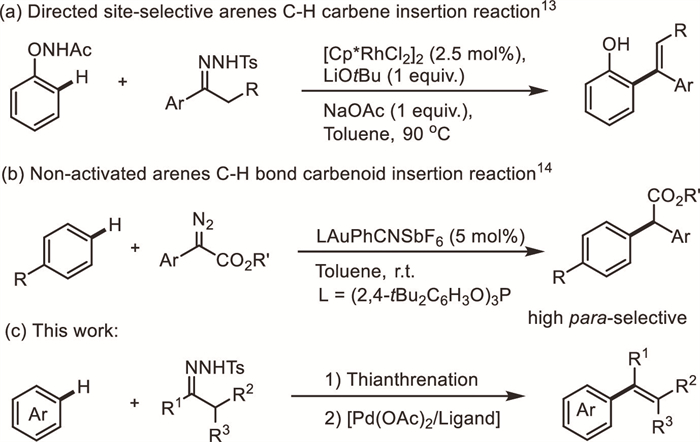
Scheme 1.
Site-selective carbene insertion of aryl C—H bond.

Palladium-catalyzed carbene C-H insertion reaction of non-activated arenes
Shihaozhi Wang , Jia-Hui Shi , Shan Xu , Xue-Jing Zhang , Ming Yan


Carbene insertion into aromatic C—H bonds provides a powerful strategy for functionalizing arenes [1,2]. In recent years, significant progress has been made in carbene insertion into C(sp²)—H bonds of activated or functionalized arenes [3-11]. Notably, Yu [12], Wang [13], and other groups have reported Rh(Ⅲ)-catalyzed aromatic C—H functionalization reactions, offering a versatile and efficient method for regioselective carbene insertion into aromatic C—H bonds (Scheme 1a). However, the reliance on directing groups has limited the broader applicability of these methods. The application of this strategy to non-activated arenes remains underexplored due to challenges arising from their diverse reactivities with carbene sources. Non-activated arenes are particularly prone to competing side reactions, such as the Büchner reaction, or C(sp3)—H insertion. Achieving site-selectivity in such systems further complicates these transformations. In 2017, Zhang, Liu, and coworkers [14] reported a highly para-selective C—H alkylation of toluene and its non-activated derivatives (Scheme 1b). In this transformation, the combination of a gold catalyst featuring a bulky triaryl phosphite ligand and a CF3 group on the ester moiety of the diazo compounds proved critical for achieving high efficiency and regioselectivity. Subsequently, other successful examples have been reported [15-17]. However, these approaches are limited to the use of donor-acceptor carbenes.
The innate C—H functionalization based on natural reactivity, such as electrophilic aromatic substitutions or radical reactions, serves as an alternative approach. In 2019, the Ritter group developed a site-selective C—H functionalization using thianthrenation, which selectively functionalized the most electron-rich and least sterically hindered position of the arene under mild conditions [18]. Subsequent transformations of thianthrenium salts yielded highly site-selective C—H functionalized arenes, with potential applications in late-stage functionalization of bioactive molecules.
In recent years, our group has focused on exploring carbene insertion [19-21] and C—H thianthrenation [22,23] reactions, aiming to develop directed strategies for aromatic C—H bond functionalization. We sought to combine thianthrenation and carbene insertion to achieve highly regioselective functionalization of aromatic C—H bonds. As a design strategy, the in-situ formation of thianthrenium salts addresses site-selectivity challenges and eliminates the need for arene prefunctionalization, making it a highly effective approach for carbene insertion into non-activated aromatic C—H bonds. During the preparation of this manuscript, Ritter group reported a late-stage functionalization of complex arenes via arylthianthrenium salts and diazo compounds under palladium catalysis [24]. Herein, we present a one-pot, two-step strategy for highly site-selective donor-donor carbene C—H insertions of arenes, employing N-tosylhydrazones and non-activated arenes as substrates. This method offers a streamlined and highly regioselective approach for constructing aryl alkenes, providing a convenient route for the olefination of bioactive molecules.
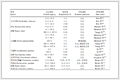
Considering N-tosylhydrazones are readily prepared via a simple condensation reaction with ketones or aldehydes, these compounds were selected as carbene precursors. The reaction employing aryl thianthrenium salt 2a and N-tosylhydrazone 3a as substrates, with Pd(OAc)₂ as the catalyst and PPh3 as the ligand, was initially investigated. Gratifyingly, the olefin 4a was obtained with a 96% NMR yield (Table 1, entry 1). Compared to other olefination reagents, such as vinyl boronic acid derivatives [18,25] and vinyl silanes [26], N-tosylhydrazones can provide terminal alkenes via a β-H elimination pathway [27-30]. Subsequent optimization of the reaction conditions was then conducted. Catalyst screening revealed that the use of Pd(PPh3)4 or PdCl2/PPh3 resulted in lower yields (entries 2 and 3). Other metal catalysts, such as Cu and Co, failed to promote the reaction (entries 4 and 5). Solvent screening indicated that both acetonitrile and toluene led to reduced yields (entries 6 and 7). Reducing the catalyst and ligand loadings to 5 mol% and 10 mol%, respectively, led to a slight improvement in yield (entry 8). However, further reductions in the amounts of catalyst, ligand and base resulted in decreased yields (entries 9 and 10). Screening different bases, adjusting the reaction temperature, or performing the reaction under aerobic conditions all led to reduced yields (entries 11–13). Based on these results, the optimal reaction conditions of the second step were determined as follows: aryl thianthrenium salt 2a (1.0 equiv.), N-tosylhydrazone 3a (1.8 equiv.), Pd(OAc)₂ (5.0 mol%), PPh3 (10.0 mol%), Cs₂CO3 (2.0 equiv.), in 1,4-dioxane (0.10 mol/L), at 100 ℃ for 24 h under an argon atmosphere. To further simplify the procedure, a one-pot approach was then investigated (see details from Section 3.2 in Supporting information). Toluene 1a was first thianthrenated to form the intermediate thianthrenium salt 2a, which was used without purification. The subsequent carbene migratory insertion and β-H elimination reaction of 2a with N-tosylhydrazone 3a afforded product 4a in 92% NMR yield (entry 14), comparable to the stepwise reaction, with no significant loss in efficiency. Additional comparative studies with various sulfoxides demonstrated that thianthrene oxide exhibits superior reactivity in aromatic C—H activation for the preparation of olefin 4a (Section 3.3 in Supporting information).
 DownLoad:
CSV
DownLoad:
CSV
 |
||||
| Entry | Cat. (mol%) | L (mol%) | Base (equiv.) | Yield (%)b |
| 1 | Pd(OAc)2 (10) | PPh3 (20) | Cs2CO3 (2) | 96 |
| 2 | Pd(PPh3)4 (10) | – | Cs2CO3 (2) | 83 |
| 3 | PdCl2 (10) | PPh3 (20) | Cs2CO3 (2) | 88 |
| 4 | CuI (10) | – | Cs2CO3 (2) | 0 |
| 5 | CoBr2 (10) | – | Cs2CO3 (2) | 0 |
| 6c | Pd(OAc)2 (10) | PPh3 (20) | Cs2CO3 (2) | 75 |
| 7d | Pd(OAc)2 (10) | PPh3 (20) | Cs2CO3 (2) | 82 |
| 8 | Pd(OAc)2 (5) | PPh3 (10) | Cs2CO3 (2) | 98 (94) |
| 9 | Pd(OAc)2 (2.5) | PPh3 (5) | Cs2CO3 (2) | 77 |
| 10 | Pd(OAc)2 (5) | PPh3 (10) | Cs2CO3 (1) | 70 |
| 11 | Pd(OAc)2 (5) | PPh3 (10) | Na2CO3 (2) | 69 |
| 12e | Pd(OAc)2 (5) | PPh3 (10) | Cs2CO3 (2) | 86 |
| 13f | Pd(OAc)2 (5) | PPh3 (10) | Cs2CO3 (2) | 83 |
| 14g | Pd(OAc)2 (5) | PPh3 (10) | Cs2CO3 (4) | 92 (88) |
| a Reaction conditions: 2a (0.10 mmol, 1.0 equiv.), 3a (0.18 mmol, 1.8 equiv.), catalyst, ligand, base, and 1,4-dioxane as solvent (1.0 mL) under Ar for 24 h at 100 ℃. b Yield was determined by 1H NMR using 1,3,5-trimethoxybenzene as the internal standard. Isolated yield in parentheses. c Reflux in CH3CN. d Toluene as solvent. e At 80 ℃. f Under aerobic conditions. g One-pot reaction. |
||||
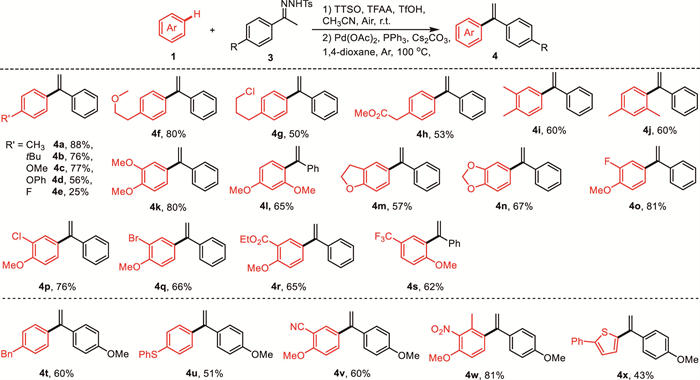
With the optimized reaction conditions in hand, the substrate scope of arenes was evaluated, and the results are summarized in Scheme 2. Using N-tosylhydrazone 3a as substrate, reactions with mono-substituted arenes of varying chain lengths and functional groups produced olefins 4a–4h with excellent para-selectivity and moderate to high yields. Arenes bearing electron-withdrawing groups, such as fluorobenzene, exhibited reduced reactivity, likely due to the lower efficiency of the thianthrenation process (4e). In the case of di-substituted arenes, the desired olefins 4i–4s were obtained with moderate to good yields. Notably, the methodology enabled olefination while retaining halogen substituents (4o–4q), providing halogenated products that could be further functionalized through cross-coupling reactions. To ensure successful product isolation, N-tosylhydrazone 3b, featuring a methoxyphenyl group, was also employed. The reaction demonstrated good tolerance for a variety of functional groups (4t–4v). Tri-substituted substrate afforded the desired product 4w in satisfied yield. Additionally, thiophene was also compatible with this reaction, olefin 4x was obtained with acceptable yield.
The substrate scope of N-tosylhydrazones was also evaluated, and the results are summarized in Scheme 3. Evaluation of N-tosylhydrazones with ortho-, meta-, and para-methyl substitutions revealed that the steric hindrance on the phenyl group of the N-tosylhydrazones significantly influenced the reaction (4y–4z, 4aa). Notably, halogen substituents on the N-tosylhydrazones remained intact during the reaction (4ac–4ae). Additionally, both electron-rich and electron-deficient (hetero)arenes were well-tolerated (4ah–4aj). For N-tosylhydrazones derived from cyclopentyl or cyclohexyl ketones, the reactions proceeded smoothly, yielding alkenes with one cycloalkyl group (4al–4am). Tetra-substituted olefins (4al–4ao) were successfully synthesized in relatively high yields when PCy3 was employed as the ligand in place of PPh3.
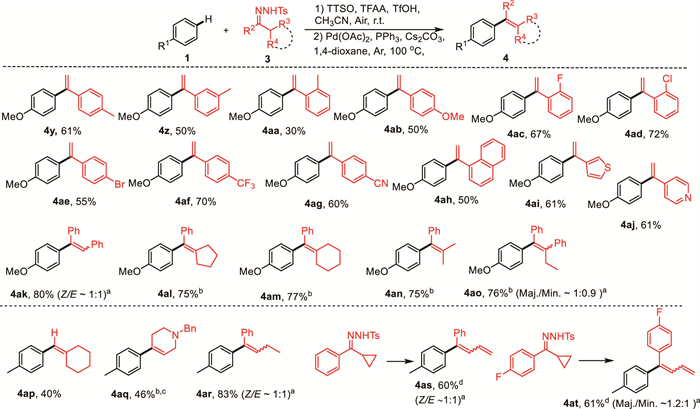
Cyclohexyl aldehyde derived N-tosylhydrazone was transformed into the corresponding tri-substituted alkene, although with moderate yield (4ap). N-Tosylhydrazone synthesized from N-benzyl 4-piperidone shows inferior reactivity due to necessity of higher temperature (4aq). Interestingly, cyclopropyl ketones derived N-tosylhydrazones were converted into 1,3-butadiene derivatives in good yields (4as–4at).
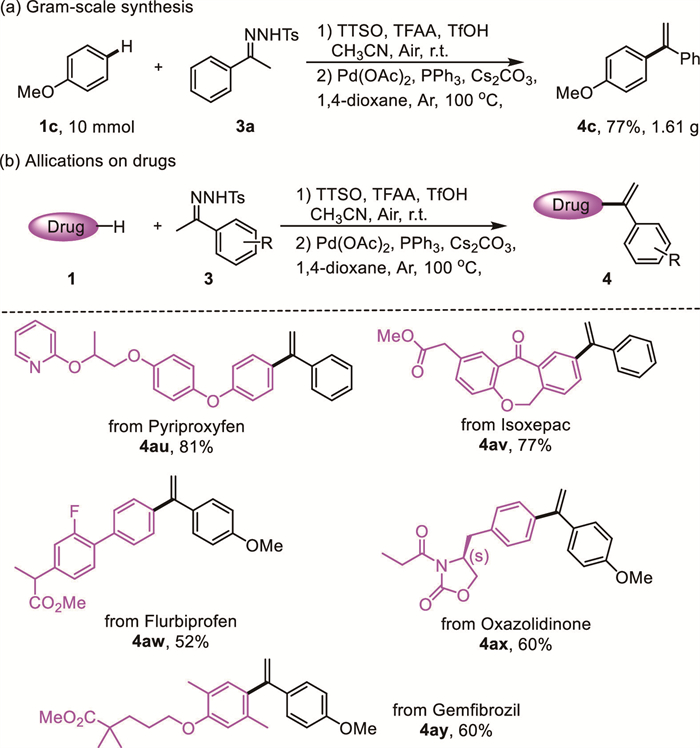
The practicality of this protocol was demonstrated through its successful application in gram-scale synthesis (Scheme 4a). Additionally, in-situ prepared N-tosylhydrazones were used to achieve the one-pot transformation (Section 2.4 in Supporting information). The method was further applied to the late-stage modification of complex bioactive molecule derivatives, including pyriproxyfen [31-33], oxazolidone [34,35], and esters derived from isoxepac [36,37], flurbiprofen [38,39], and gemfibrozil [40,41]. The reactions yielded the desired products (4au–4ay) in good yields, demonstrating its potential for functionalizing pharmaceutically relevant compounds (Scheme 4b). This thianthrenium salt activation strategy for arenes overcomes traditional aryl halide regioselectivity limitations [18,27,28,42-49], enabling direct C—H functionalization with high site-selectivity while preserving halogen substituents. The method eliminates pre-halogenation requirements for bioactive molecules while retaining handles for late-stage diversification, synergistically expanding accessible chemical space for pharmaceutical modification.
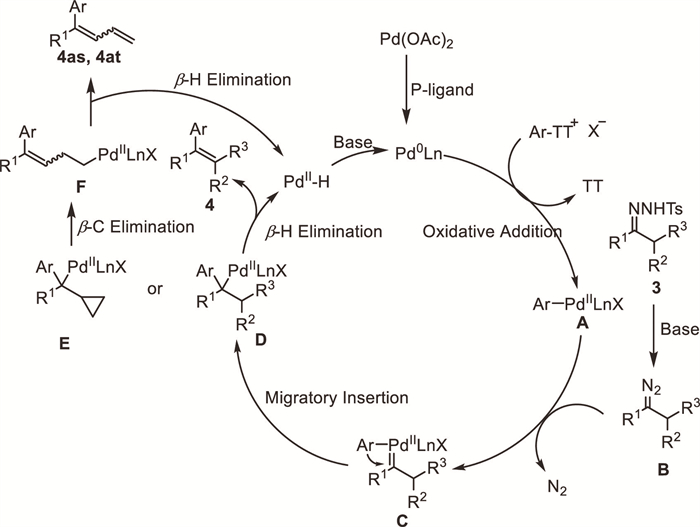
Finally, a plausible mechanism is proposed, as illustrated in Scheme 5 [30,42-51]. The process begins with the generation of palladium(0), which undergoes oxidative addition with the aryl thianthrenium salt. Simultaneously, diazo intermediate B is formed from N-tosylhydrazones in the presence of a base. The aryl palladium intermediate A reacts with the diazo compound B, leading to the formation of the metal carbene intermediate C through the extrusion of N₂. Subsequently, migratory insertion of the carbene, followed by β-H elimination, produces the multi-substituted aryl alkene 4. In the case of cyclopropyl ketones derived N-tosylhydrazones, the intermediate E containing a cyclopropyl group is generated. This intermediate undergoes β-C elimination, followed by β-H elimination, to afford the 1,3-butadiene derivatives 4as and 4at. The radical mechanism was excluded by the inhibition experiments for the ring-opening process (Section 4 in Supporting information).
In conclusion, we have developed a palladium-catalyzed carbene C—H insertion reaction of non-activated arenes using N-tosylhydrazones as carbene and olefin precursors. This protocol features remarkable site selectivity, high step economy, and wide functional group tolerance. Through a thianthrenium salt activation strategy, it not only enables the synthesis of multi-substituted aryl alkenes and 1,3-butadiene derivatives, but also overcomes the regioselectivity limitations of traditional aryl halide-based methods, achieving direct C—H functionalization with precise spatial control while preserving halogen substituents. Importantly, this transformation allows for the modification of the arene moiety in commercially available bioactive molecules, underscoring its significant potential for late-stage functionalization of arene-containing pharmaceuticals.
The authors declare that they have no known competing financial interests or personal relationships that could have appeared to influence the work reported in this paper.
Shihaozhi Wang: Writing – review & editing, Writing – original draft, Project administration, Methodology, Investigation, Formal analysis, Data curation. Jia-Hui Shi: Formal analysis, Data curation. Shan Xu: Formal analysis, Data curation. Xue-Jing Zhang: Writing – review & editing, Writing – original draft, Supervision, Project administration, Funding acquisition. Ming Yan: Writing – review & editing, Supervision, Project administration, Funding acquisition, Conceptualization.
We thank the Natural Science Foundation of Guangdong Province (Nos. 2021A1515010186, 2022A1515010744), and Guangdong Provincial Key Laboratory of Construction Foundation (No. 2023B1212060022) for the financial support.
Supplementary material associated with this article can be found, in the online version, at doi:
M.P. Doyle, R. Duffy, M. Ratnikov, L. Zhou, Chem. Rev. 110 (2010) 704–724. doi: 10.1021/cr900239n
Y. He, Z. Huang, K. Wu, et al., Chem. Soc. Rev. 51 (2022) 2759–2852. doi: 10.1039/d1cs00895a
B. Ma, L. Liu, J. Zhang, Asian J. Org. Chem. 7 (2018) 2015–2025. doi: 10.1002/ajoc.201800472
Y. Xiang, C. Wang, Q. Ding, Y. Peng, Adv. Synth. Catal. 361 (2019) 919–944. doi: 10.1002/adsc.201800960
N. Jha, N.P. Khot, M. Kapur, Chem. Rec. 21 (2021) 4088–4122. doi: 10.1002/tcr.202100193
S. Kumar, S. Nunewar, S. Oluguttula, S. Nanduri, V. Kanchupalli, Org. Biomol. Chem. 19 (2021) 1438–1458. doi: 10.1039/d0ob02309d
S. Bera, A. Biswas, R. Samanta, Chem. Rec. 21 (2021) 1–19.
Y. Xi, Y. Su, Z. Yu, et al., Angew. Chem. Int. Ed. 53 (2014) 9817–9821. doi: 10.1002/anie.201404946
Z. Yu, B. Ma, M. Chen, et al., J. Am. Chem. Soc. 136 (2014) 6904–6907. doi: 10.1021/ja503163k
Z. Yu, Y. Li, P. Zhang, L. Liu, J. Zhang, Chem. Sci. 10 (2019) 6553–6559. doi: 10.1039/c9sc01657k
Z. Yu, G. Li, J. Zhang, L. Liu, Org. Chem. Front. 8 (2021) 3770–3775. doi: 10.1039/d1qo00276g
W.W. Chan, S.F. Lo, Z. Zhou, W.Y. Yu, J. Am. Chem. Soc. 134 (2012) 13565–13568. doi: 10.1021/ja305771y
F. Hu, Y. Xia, F. Ye, et al., Angew. Chem. Int. Ed. 53 (2014) 1364–1367. doi: 10.1002/anie.201309650
B. Ma, Z. Chu, B. Huang, et al., Angew. Chem. Int. Ed. 56 (2017) 2749–2753. doi: 10.1002/anie.201611809
B. Ma, J. Wu, L. Liu, J. Zhang, Chem. Commun. 53 (2017) 10164–10167. doi: 10.1039/C7CC05649D
J.D. Pizarro, I.L. Schmidtke, A. Nova, M.R. Fructos, P.J. Pérez, ACS Catal. 12 (2022) 6851–6856. doi: 10.1021/acscatal.2c01713
X.S. Liu, Z. Tang, Z.Y. Si, et al., Angew. Chem. Int. Ed. 61 (2022) e202208874. doi: 10.1002/anie.202208874
F. Berger, M.B. Plutschack, J. Riegger, et al., Nature 567 (2019) 223–228. doi: 10.1038/s41586-019-0982-0
L. Chen, R.J. Peng, X.J. Zhang, M. Yan, A.S.C. Chan, J. Org. Chem. 86 (2021) 10177–10189. doi: 10.1021/acs.joc.1c00899
R.J. Peng, L. Chen, X.J. Zhang, M. Yan, Adv. Synth. Catal. 364 (2022) 3567–3572. doi: 10.1002/adsc.202200699
P. Zhang, S. Xu, S. Wang, X.J. Zhang, M. Yan, J. Org. Chem. 89 (2024) 17310–17320. doi: 10.1021/acs.joc.4c01896
Y. Zhang, S. Xia, W.X. Shi, et al., Org. Lett. 24 (2022) 7961–7966. doi: 10.1021/acs.orglett.2c03077
W.J. Xiao, C.X. Li, J.Y. Lv, et al., Angew. Chem. Int. Ed. 63 (2024) e202411166.
L. Li, S. Müller, R. Petzold, T. Ritter, Angew. Chem. Int. Ed. 64 (2025) e202419931. doi: 10.1002/anie.202419931
X.Y. Chen, X.X. Nie, Y. Wu, P. Wang, Chem. Commun. 56 (2020) 5058–5061. doi: 10.1039/d0cc00641f
Z.W. Cao, J.X. Zhang, J.T. Wang, et al., Org. Lett. 26 (2024) 6681–6686. doi: 10.1021/acs.orglett.4c02348
Y. Xia, J. Wang, J. Am. Chem. Soc. 142 (2020) 10592–10605. doi: 10.1021/jacs.0c04445
J. Barluenga, P. Moriel, C. Valdés, F. Aznar, Angew. Chem. Int. Ed. 46 (2007) 5587–5590. doi: 10.1002/anie.200701815
D.P. Ojha, K.R. Prabhu, J. Org. Chem. 77 (2012) 11027–11033. doi: 10.1021/jo301987c
L. Zhou, F. Ye, Y. Zhang, J. Wang, Org. Lett. 14 (2012) 922–925. doi: 10.1021/ol2034405
I. Ishaaya, A.R. Horowitz, Pestic. Sci. 43 (1995) 227–232. doi: 10.1002/ps.2780430308
M. Sihuincha, E. Zamora-perea, W. Orellana-rios, et al., J. Med. Entomol. 42 (2005) 620–630. doi: 10.1093/jmedent/42.4.620
E. Seccacini, A. Lucia, L. Harburguer, et al., J. Am. Mosq. Contr. 24 (2008) 398–403. doi: 10.2987/5697.1
D.J. Diekema, R.N. Jones, Drugs 59 (2000) 7–16. doi: 10.2165/00003495-200059010-00002
T.B. Durham, J. Marimuthu, J.L. Toth, et al., J. Med. Chem. 60 (2017) 5933–5939. doi: 10.1021/acs.jmedchem.7b00650
L.S. Gerlis, J.M. Gumpel, Rheumatology 20 (1981) 50–53. doi: 10.1093/rheumatology/20.1.50
W.J. Honig, R. Pelgrom, D.R. Chadha, J. Clin. Pharmacol. 22 (1982) 82–88. doi: 10.1002/j.1552-4604.1982.tb02653.x
R.N. Brogden, R.C. Heel, T.M. Speight, G.S. Avery, Drugs 18 (1979) 417–438. doi: 10.2165/00003495-197918060-00001
F. Richy, V. Rabenda, A. Mawet, J.Y. Reginster, Int. J. Clin. Pract. 61 (2007) 1396–1406. doi: 10.1111/j.1742-1241.2007.01452.x
P.A. Todd, A. Ward, Drugs 36 (1988) 314–339. doi: 10.2165/00003495-198836030-00004
M. Basaranoglu1, O. Acbay, A. Sonsuz, J. Hepatol. 31 (1999) 384. doi: 10.1016/S0168-8278(99)80243-8
F. Berger, T. Ritter, Synlett 33 (2022) 339–345. doi: 10.1055/s-0040-1706034
X.Y. Chen, Y. Wu, P. Wang, Synthesis 54 (2022) 3928–3940. doi: 10.1055/s-0041-1737493
H. Meng, M.S. Liu, W. Shu, Chem. Sci. 13 (2022) 13690–13707. doi: 10.1039/d2sc04507a
J. Zhang, X.F. Wu, Org. Lett. 25 (2023) 2162–2166. doi: 10.1021/acs.orglett.3c00792
B. Peng, L. Dai, R. Liu, Org. Lett. 25 (2023) 2606–2610. doi: 10.1021/acs.orglett.3c00582
Z. Zhang, X. Chen, Z.J. Niu, et al., Org. Lett. 26 (2024) 1813–1818. doi: 10.1021/acs.orglett.3c04351
J. Zhang, L.C. Wang, Y. Wang, B.H. Teng, X.F. Wu, J. Catal. 432 (2024) 115454–115460. doi: 10.1016/j.jcat.2024.115454
Y.H. Zhao, X.W. Gu, X.F. Wu, Org. Lett. 26 (2024) 6507–6511. doi: 10.1021/acs.orglett.4c02440
J. Lin, Z.L. Huang, J. Ma, et al., J. Org. Chem. 87 (2022) 12019–12035. doi: 10.1021/acs.joc.2c01019
G. Zhang, Y.K. Song, F. Zhang, et al., Nat. Commun. 12 (2021) 728. doi: 10.1038/s41467-020-20740-w

Scheme 2 Reaction scope of arenes. Reaction conditions: (1) 1 (0.10 mmol, 1.0 equiv.), TTSO (0.11 mmol, 1.1 equiv.), TFAA (0.30 mmol, 3.0 equiv.), TfOH (0.11 mmol, 1.1 equiv.), and CH3CN (0.40 mL) under air for 12 h at r.t.; (2) 3 (0.18 mmol, 1.8 equiv.), Pd(OAc)2 (0.005 mmol, 5 mol%), PPh3 (0.01 mmol, 10 mol%), Cs2CO3 (0.4 mmol, 4.0 equiv.), and 1,4-dioxane (1.0 mL) under Ar for 24 h at 100 ℃. Isolated yield. TTSO: thianthrene S-oxide.

Scheme 3 Reaction scope of N-tosylhydrazones. Reaction conditions: (1) 1 (0.10 mmol, 1.0 equiv.), TTSO (0.11 mmol, 1.1 equiv.), TFAA (0.30 mmol, 3.0 equiv.), TfOH (0.11 mmol, 1.1 equiv.), and CH3CN (0.40 mL) under air for 12 h at r.t.; (2) 3 (0.18 mmol, 1.8 equiv.), Pd(OAc)2 (0.005 mmol, 5 mol%), PPh3 (0.01 mmol, 10 mol%), Cs2CO3 (0.4 mmol, 4.0 equiv.), and 1,4-dioxane (1.0 mL) under Ar for 24 h at 100 ℃. Isolated yields. a The ratio of E/Z selectivity was determined by the 1H NMR. b PCy3 instead of PPh3. c At 120 ℃. d 3 (0.27 mmol, 2.7 equiv.), Pd(OAc)2 (0.01 mmol, 10 mol%), PPh3 (0.02 mmol, 20 mol%), Cs2CO3 (0.50 mmol, 5.0 equiv.). TTSO: thianthrene S-oxide.

Scheme 4 Gram scale reaction and applications on drugs. Reaction conditions: (1) 1 (0.10 mmol, 1.0 equiv.), TTSO (0.11 mmol, 1.1 equiv.), TFAA (0.30 mmol, 3.0 equiv.), TfOH (0.11 mmol, 1.1 equiv.), and CH3CN (0.40 mL) under air for 12 h at r.t.; (2) 3 (0.18 mmol, 1.8 equiv.), Pd(OAc)2 (0.005 mmol, 5 mol%), PPh3 (0.01 mmol, 10 mol%), Cs2CO3 (0.4 mmol, 4.0 equiv.), and 1,4-dioxane (1.0 mL) under Ar for 24 h at 100 ℃. Isolated yields.
Table 1. Reaction optimization for the second step.a
|
||||
| Entry | Cat. (mol%) | L (mol%) | Base (equiv.) | Yield (%)b |
| 1 | Pd(OAc)2 (10) | PPh3 (20) | Cs2CO3 (2) | 96 |
| 2 | Pd(PPh3)4 (10) | – | Cs2CO3 (2) | 83 |
| 3 | PdCl2 (10) | PPh3 (20) | Cs2CO3 (2) | 88 |
| 4 | CuI (10) | – | Cs2CO3 (2) | 0 |
| 5 | CoBr2 (10) | – | Cs2CO3 (2) | 0 |
| 6c | Pd(OAc)2 (10) | PPh3 (20) | Cs2CO3 (2) | 75 |
| 7d | Pd(OAc)2 (10) | PPh3 (20) | Cs2CO3 (2) | 82 |
| 8 | Pd(OAc)2 (5) | PPh3 (10) | Cs2CO3 (2) | 98 (94) |
| 9 | Pd(OAc)2 (2.5) | PPh3 (5) | Cs2CO3 (2) | 77 |
| 10 | Pd(OAc)2 (5) | PPh3 (10) | Cs2CO3 (1) | 70 |
| 11 | Pd(OAc)2 (5) | PPh3 (10) | Na2CO3 (2) | 69 |
| 12e | Pd(OAc)2 (5) | PPh3 (10) | Cs2CO3 (2) | 86 |
| 13f | Pd(OAc)2 (5) | PPh3 (10) | Cs2CO3 (2) | 83 |
| 14g | Pd(OAc)2 (5) | PPh3 (10) | Cs2CO3 (4) | 92 (88) |
| a Reaction conditions: 2a (0.10 mmol, 1.0 equiv.), 3a (0.18 mmol, 1.8 equiv.), catalyst, ligand, base, and 1,4-dioxane as solvent (1.0 mL) under Ar for 24 h at 100 ℃. b Yield was determined by 1H NMR using 1,3,5-trimethoxybenzene as the internal standard. Isolated yield in parentheses. c Reflux in CH3CN. d Toluene as solvent. e At 80 ℃. f Under aerobic conditions. g One-pot reaction. |
||||
 下载: 导出CSV

 扫一扫看文章


扫一扫关注我们


 下载:
下载: