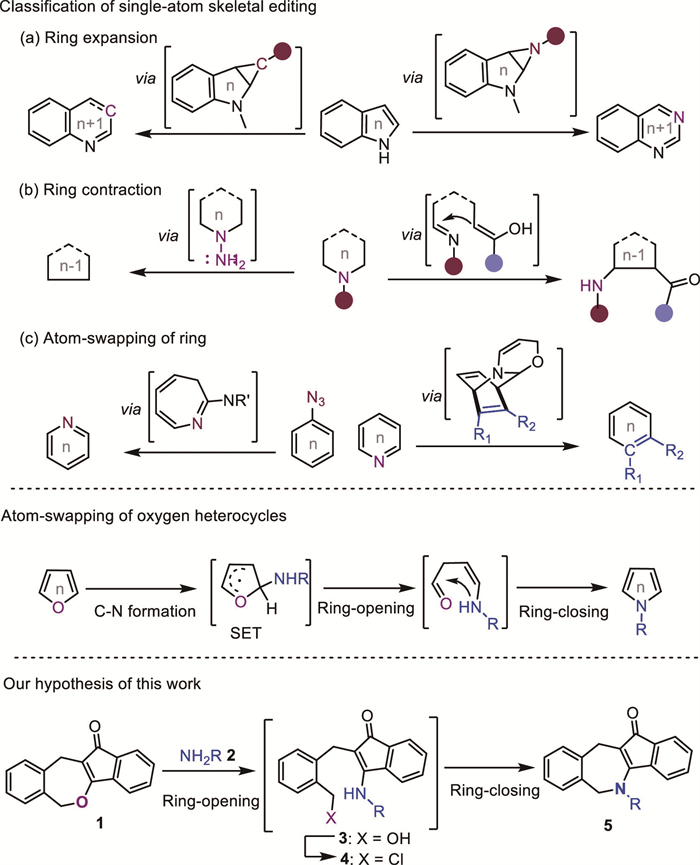
Scheme 1.
Transformations of single-atom skeleton editing.

Atom-swapping skeletal editing of benzo[c]oxepines for the construction of 2-benzodiazepines via a continuous manufacturing one-pot synthesis
Jun-Gang Wang , Bing-Yi Zhou , Yao-Luo Hu , Yong-Dong Du , Rong-He Wu , Chun-Yan Wu , Wen-Chao Yang , An-Xin Wu


Synthetic chemists and pharmaceutical researchers have shown great interest and concern to modify the core of a molecule by interconverting between (hetero)aromatic substructures due to their ubiquity in biologically active compounds [1,2]. The new term of ‘skeletal editing’ [3] was introduced by Levin and co-workers as the subset of ‘molecular editing’ that can be used to construct a new scaffold by precisely replacing or rearranging atoms in the core ring structure of the original molecule [4-6], thus exhibiting great potential in discovering new bioactive molecules [7-10]. In this vein, “single-atom” manipulations of ring systems are of particular interest [11,12]. The strategy of single-atom molecular skeletal editing involves three main transformations (Scheme 1): (a) Ring expansion (n→n + 1) [13,14]: usually achieved by inserting carbine [15-21] or nitrene [22,23]; (b) Ring contraction (n→n−1) [24]: such as through deleting activated N-atom [25,26] or reconstruction of the ring skeleton [27,28]; (c) The atom-swapping of ring [29,30]: such as through rearrangement of azide groups [31,32] or a ring-opening/ring-closing sequence [33-35]. Recently, the deconstruction-reconstruction of heterocycles has provided an effective strategy for the atom-swapping skeletal editing [36]. For example, Park and co-workers reported a photocatalytic strategy that directly converting the furan into a pyrrole analog through swaps an oxygen atom of furan with a nitrogen group [37]. The reaction process underwent a single electron transfer process of ring-opening and subsequent ring-closing of the furan ring with the participation of amines. Inspired by the strategy of deconstruction-reconstruction of oxygen heterocycles in skeletal editing, we want to see whether the benzene[c]oxepines can also undergo the ring-opening and ring-closing reaction sequences to construct 2-benzodiazepine through swaps an oxygen atom of benzene[c]oxepines with a nitrogen group.
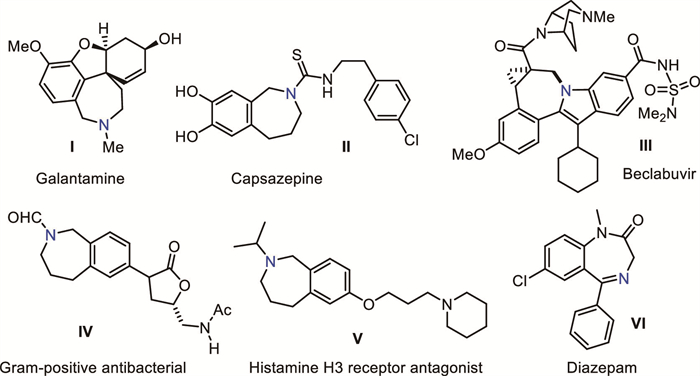
The 2-benzodiazepine skeleton is an unique structural feature in bioactive natural products and drugs (Scheme 2) [38]. For examples, Galantamine (Ⅰ) is an effective acetylcholinesterase inhibitor that can be used to treat Alzheimer's disease [39]. Capsazepine (Ⅱ) is a competitive antagonist of TRPV1 [40]. Beclabuvir (Ⅲ) is an antiviral drug against hepatitis C virus infection [41]. Compound Ⅳ is a Gram-positive antimicrobial drug [42]. Compound Ⅴ is a histamine H3 receptor antagonist [43]. Diazepam (Ⅵ) is one of the psychopharmacological drugs that can treat central nervous system diseases [44].
Therefore, synthetic methodologies for the construction of these privileged structural motifs have attracted much attention of organic chemists [45]. Most recent work for these structures is to construct the seven-membered nitrogen heterocycle through transition metal catalyzed multi-component cyclization from non-cyclic fragment molecule, including rhodium-catalyzed [5 + 1 + 1] one-pot/three component reaction from ortho-vinyl benzaldehyde, aniline and CO [46]; rhodium-catalyzed [5 + 2] cyclization from (E)-3-benzylidene-4-diazopyrrolidine-2,5‑dione and acetonitrile [47]; palladium-catalyzed [5 + 2] cyclization reaction from ortho-methyl benzylamides and allenes as annulation partners [48]; rhodium-catalyzed [4 + 3] cyclization from benzylamines and acrylic acid 2-(acetoxymethyl) ester [49]; palladium-catalyzed intramolecular cyclization from 1-(3-(2-bromophenyl)propyl)-1H-1,2,4-triazole [50]; multi-step synthesis involving palladium, ruthenium and platinum catalysis from ortho-bromobenzaldehyde [51]. However, there were relatively few reports on the construction of 2-benzodiazepine through the ring to ring skeleton editing strategy. Recently, Beeler and co-workers reported the ring-expansion skeletal editing to construct 2-benzodiazepin through the photocatalytic rearrangement of isoquinoline N-ylide [52]. As an interesting class of oxygen heterocycle, the synthesis [53] and synthetic applications of benzo[c]oxepine have attracted attention and have been the focus of our research group for a long time [54-58]. Inspired by our recent skeletal editing work [59] and consideration of strong influence to the biological and physical properties with a nitrogen atom in the compound [60], we attempted to construct 2-benzodiazepine through atom-swapping of O of benzo[c]oxepine atom to N atom.
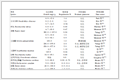
We are fortunate to achieved the ring-opening reaction of benzo[c]oxepines 1a to obtain 3a in the presence of liquid amines under solvent- and additive-free conditions (Supporting information). This solvent- and additive-free conditions and almost quantitative yield can minimize the incompatibility caused by solvent, additive and by-products, which is very beneficial for the subsequent ring-closing conversion in a continuous manufacturing one-pot synthesis [61]. Encouraged, the investigations of the compatible reaction condition were presented in Table 1. Firstly, 1a and 1.0 equiv. of benzylamine were mixed and stirred at 40 ℃ for 2 h under solvent- and additive-free condition (step i). Then, directly added 1.0 equiv. of SOCl2 and MeCN as solvent to the crude product from step i and continued the reaction at room temperature for 2 h (step ii). Sequentially, 3.0 equiv. of KOH were subsequently added to the reaction mixture of step ii at 80 ℃ and reacted for another 4 h (step iii). Finally, compound 5a was fortunately obtained in 62% yield under this continuous manufacturing one-pot synthesis (Table 1, entry 1). When the solvent was added in the step i, a significant excess of amine needed to be added to ensure the step i conversing well. But this is not beneficial to the subsequent conversion, as the yield significantly decreased to 38% (Table 1, entry 2). The addition of HOAc as additive in the step i did not improve the yield significantly (Table 1, entry 3). When we screened the solvents, it was found that MeCN was the most compatible solvent (Table 1, entries 4 and 5). Using 3.0 equiv. of different bases, such as NaH, NaOH, K2CO3, tBuOK did not achieve better results than KOH (Table 1, entries 6–9). When increasing the equivalent of KOH to 10.0, the yields of the target product were significantly increased from 12% to 87% (Table 1, entries 10–12). This may be due to the excess of base that was beneficial for neutralizing the acidic substances produced in the step ii. The temperature was also investigated and showed that 80 ℃ was the most suitable (Table 1, entry 13). Although excessive SOCl2 in the step ii promoted this individual conversion, it is detrimental to the overall process for the continuous manufacturing one-pot synthesis (Table 1, entry 14). Therefore, the optimized reaction conditions and experimental operations are: mixed the compound 1a with 1.0 equiv. of benzylamine 2a in 40 ℃ under solvent- and additive-free conditions and stirred for 2 h; then cooled the crude mixture to 0 ℃ and 1.0 equiv. of SOCl2 with the solvent MeCN (4 mL) were slowly dropped in the reactor and continued the reaction for 2 h at room temperature; then 10.0 equiv. of KOH was added to the reaction mixture and reacted for 4 h at 80 ℃.
 DownLoad:
CSV
DownLoad:
CSV
 |
||||
| Entry | Step ⅰ | Step ⅱ | Step ⅲb | Yield (%)c |
| 1 | 2a (1.0)d | MeCN, r.t. | KOH (3.0) | 62 |
| 2 | 2a (10.0), MeCNe | r.t.b | KOH (3.0) | 38 |
| 3 | 2a (10.0), MeCN, HOAc (2.0) | r.t.b | KOH (3.0) | 36 |
| 4 | 2a (1.0)d | DMF, r.t | KOH (3.0) | 25 |
| 5 | 2a (1.0)d | DMSO, r.t | KOH (3.0) | 28 |
| 6 | 2a (1.0)d | MeCN, r.t. | NaH (3.0) | 35 |
| 7 | 2a (1.0)d | MeCN, r.t. | NaOH (3.0) | 56 |
| 8 | 2a (1.0)d | MeCN, r.t. | K2CO3 (3.0) | 22 |
| 9 | 2a (1.0)d | MeCN, r.t. | tBuOK (3.0) | <5 |
| 10 | 2a (1.0)d | MeCN, r.t. | KOH (1.0) | 12 |
| 11 | 2a (1.0)d | MeCN, r.t. | KOH (4.0) | 65 |
| 12 | 2a (1.0)d | MeCN, r.t. | KOH (10.0) | 87 |
| 13 | 2a (1.0)d | MeCN, r.t. | KOH (10.0)f | 25 |
| 14 | 2a (1.0) | MeCN, r.t.g | KOH (10.0) | 68 |
| a Reaction conditions: 1a (1.0 mmol) was mixed with benzylamine 2a (equiv.) at 40 ℃ for 2 h (step ⅰ); add solvent (4 mL) and slowly dropped SOCl2 (1.0 equiv.) to the crude mixture continue stirring for 2 h (step ⅱ); add base (equiv.) to the reaction mixture to react at 80 ℃ for 4 h (step ⅲ). See Supporting information for details. b Solvent was from the previous step. c Isolated yields based on 1a. d Solvent- and additive-free. e Additive-free. f 40 ℃. g SOCl2 (3.0 mmol). |
||||
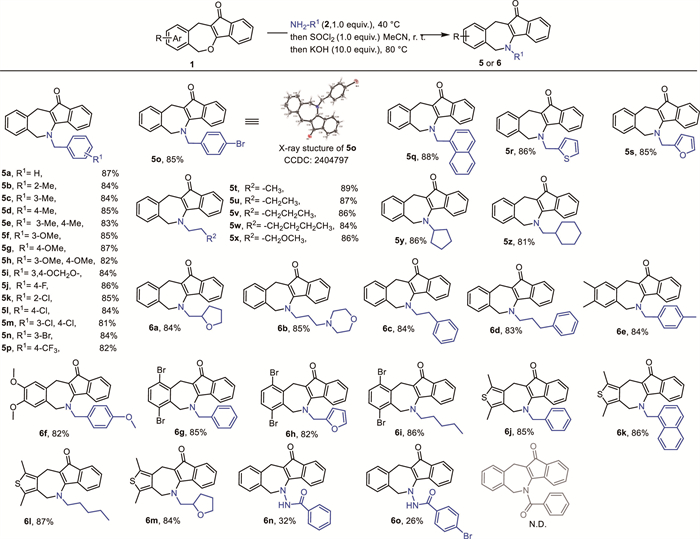
With the optimal reaction condition and experimental operation in hand, the substrate scope for the synthesis of 2-benzodiazepines was explored (Scheme 3). Firstly, various substituted benzylamines bearing electron-neutral (H, 2-Me, 3-Me, 4-Me, 3,4-Me2), electron-rich (3-OMe, 4-OMe, 3,4-(OMe)2, 3,4-OCH2O) groups all participated in this reaction smoothly to afford the expected products in excellent yields (5a-5i, 82%−87%). An array of halogen-substituted benzylamines (4-F, 3-Cl, 4-Cl, 3,4-Cl2, 3-Br, 4-Br) and electron-deficient group (4-CF3) were all found to be compatible with the reaction (5j-5p, 81%−86%). Much to our satisfaction, the reaction can still proceed smoothly when the benzene ring of benzylamine replaced with naphthalene, thiophene and furan (5q-5s; 85%−88%). Besides, other primary amines such as propan-1-amine, butan-1-amine, pentan-1-amine, hexan-1-amine, 3-methoxypropan-1-amine, cyclopentanamine, cyclohexylmethanamine, (tetrahydrofuran-2-yl)methanamine, 3-morpholinopropan-1-amine can smoothly converted into the target product (5t-6b, 84%−89%). Furthermore, the optimized conditions could be applied to 2-phenylethanamine and 3-phenylpropan-1-amine and gave the corresponding products in good yields (6c-6d, 83%−84%). In addition, when benzo[c]oxepines contained the methyl, bromine, methoxy substituents or replacing benzene ring with 2,5-dimethylthiophene, the reaction could also obtain corresponding products in excellent yields (6e-6m; 82%−87%). The structure of product 5o was confirmed by single-crystal X-ray diffraction analysis (Supporting information). Furthermore, when using hydrazides instead of primary amines, the target compounds can also be obtained with lower yields (6n-6o; 26%−32%). Unfortunately, the corresponding benzodiazepines could not be obtained when using benzamides or anilines due to their weak nucleophilicity prevent the conversion of substrate 1 to intermediate 3.
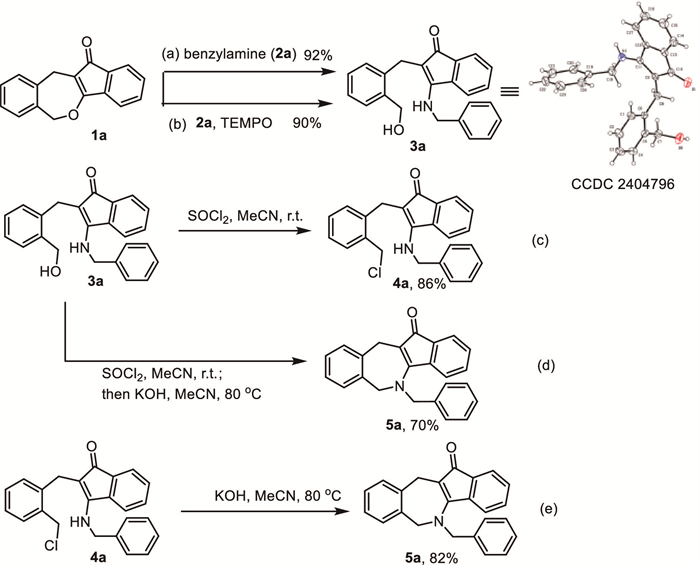
To verify this atom-swapping of oxygen atom to the nitrogen atom skeleton editing strategy through the ring-opening/ring-closing sequential, a series of control experiments were performed (Scheme 4). Compound 1a can efficiently converted to intermediate 3a through ring-opening of oxygen heterocycles in the presence of benzylamine (2a) under solvent-free and additive -free conditions. When TEMPO was added in ring-opening reaction, there was no significant change to the yield of 3a, indicating that the reaction may not be a free-radical process. Intermediate benzyl alcohol 3a can achieve functional group conversion under acidic conditions to obtain intermediate benzyl chloride 4a. Further experiments showed that target product 5a could be obtained from intermediates 3a and 4a under the standard operating conditions.
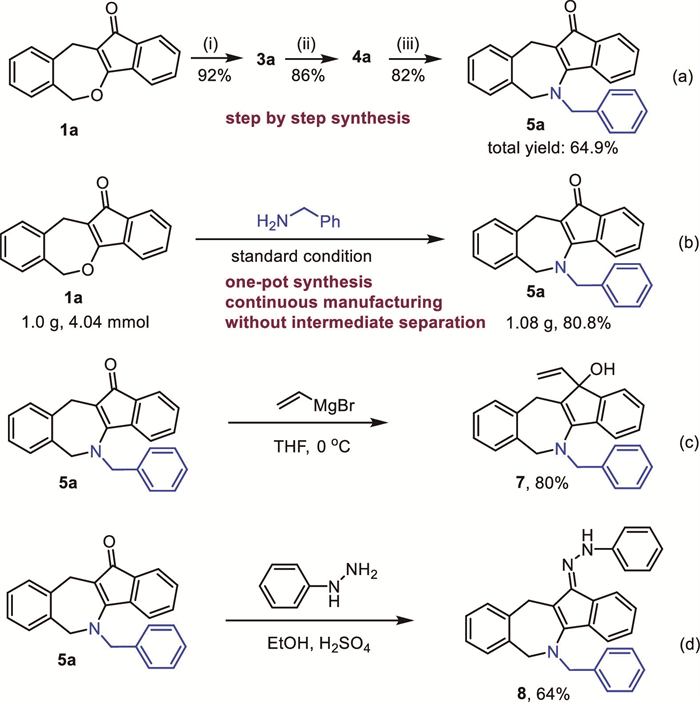
To demonstrate the advantages of this continuous manufacturing one-pot synthesis in constructing of 2-benzodiazepines, we carried out the step-by-step synthesis andobtained the target product 5a in 64.9% yield (Scheme 5a). The reaction was also preceded well on a gram scale and the desired product 5a was isolated in 80.8% yield (Scheme 5b). Furthermore, the nucleophilic attack on the ketone moiety of 5a by Grignard reagent CH2CHMgBr afforded tertiary alcohol 7 in an 80% yield (Scheme 5c). The ketocarbonyl group of 5a was easily reacted with phenylhydrazine under simple conditions to produce imine 8 in a yield of 64% (Scheme 5d).
In order to evaluate the antineoplastic proliferation of these 2-benzodiazepine contained novel structures, the inhibitory activities against common human tumor cells activity of compounds 5a, 5i, 5s, 5t, 5x, 5y, 6b, 6f, 6k, 6l were tested using CCK-8 experimental method (Supporting information). Interestingly, the compound 1,3-dimethyl-5-(naphthalen-1-ylmethyl)-4,5-dihydroindeno[1,2-b]thieno[3,4-e]azepin-10(11H)-one(6k) showed the inhibitory activities against human esophageal cancer cells (TE-1) and human bladder cancer cell (5637), with the IC50 value 9.83 and 15.21 µmol/L, respectively.
In summary, we are fortunate to have developed an efficient method for synthesis of 2-benzodiazepine through atom-swapping skeletal editing via replacing the O atom of benzo[c]oxepine to N atom. This conversion integrated the ring-opening/substitution/ring-closing reactions in one-pot synthesis. This method exhibits good tolerance to various electronic groups, and a series of 2-benzodiazepine derivatives were synthesized with good yield through continuous manufacturing of a three-step reaction sequence. The human tumor cell inhibitory activity of the novel scaffold provides strong inspiration that the atom-swapping skeleton editing through the deconstruction-reconstruction of heterocycles has great potential in the discovery of new drug structures.
The authors declare that they have no known competing financial interests or personal relationships that could have appeared to influence the work reported in this paper.
Jun-Gang Wang: Writing – original draft, Validation, Methodology, Investigation, Funding acquisition, Data curation. Bing-Yi Zhou: Validation, Investigation, Data curation. Yao-Luo Hu: Methodology. Yong-Dong Du: Validation. Rong-He Wu: Validation. Chun-Yan Wu: Validation. Wen-Chao Yang: Writing – review & editing, Project administration, Funding acquisition. An-Xin Wu: Writing – review & editing, Project administration, Funding acquisition, Conceptualization.
This work was supported by the National Key Research and Development Program of China (No. 2024YFE0214300), National Natural Science Foundation of China (Nos. 32372584 and 22171098) and the Program of Major Scientific and Technological, Guizhou Province, China (No. Qiankehechengguo(2024)zhongda007). This work was also supported by the Scientific Research Fund of Guizhou Minzu University (No. GZMUZK[2021]YB25).
Supplementary material associated with this article can be found, in the online version, at doi:
D.A. Horton, G.T. Bourne, M.L. Smythe, Chem. Rev. 103 (2003) 893–930. doi: 10.1021/cr020033s
R.D. Taylor, M. MacCoss, A.D.G. Lawson, J. Med. Chem. 57 (2014) 5845–5859. doi: 10.1021/jm4017625
J. Jurczyk, J. Woo, S.F. Kim, et al., Nat. Synth. 1 (2022) 352–364. doi: 10.1038/s44160-022-00052-1
J.B. Roque, Y. Kuroda, L.T. Göttemann, R. Sarpong, Nature 564 (2018) 244–248. doi: 10.1038/s41586-018-0700-3
J. Woo, A.H. Christian, S.A. Burgess, et al., Science 376 (2022) 527–532. doi: 10.1126/science.abo4282
B. Roure, M. Alonso, G. Lonardi, et al., Nature 637 (2024) 860–867.
Á. Rentería-Gómez, O. Gutierrez, Nature 631 (2024) 30–31. doi: 10.1038/d41586-024-02017-0
F. Ficarra, M. Silvi, Nature 623 (2023) 36–37. doi: 10.1038/d41586-023-03297-8
M. Sicignano, P. Costa, Nat. Catal. 7 (2024) 224–226.
E. Li, C.W. Lindsley, J. Chang, B. Yu, J. Med. Chem. 67 (2024) 13509–13511. doi: 10.1021/acs.jmedchem.4c01841
B.W. Joynson, L.T. Ball, Helv. Chim. Acta 106 (2023) e202200182. doi: 10.1002/hlca.202200182
T. Heilmann, J.M. Lopez-Soria, J. Ulbrich, et al., Angew. Chem. Int. Ed. 63 (2024) e202403826. doi: 10.1002/anie.202403826
J. Wang, H. Lu, Y. He, et al., J. Am. Chem. Soc. 144 (2022) 22433–22439. doi: 10.1021/jacs.2c10570
L. Wu, H. Xia, J. Bai, et al., Nat. Chem. 16 (2024) 1951–1959. doi: 10.1038/s41557-024-01668-w
Z. Liu, X. Zhang, P. Sivaguru, X. Bi, Acc. Chem. Res. 58 (2025) 130–149. doi: 10.1021/acs.accounts.4c00709
Z. Liu, P. Sivaguru, Y. Ning, et al., Chem. Eur. J. 29 (2023) e202301227. doi: 10.1002/chem.202301227
X. Ma, J. Su, Q. Song, Acc. Chem. Res. 56 (2023) 592–607. doi: 10.1021/acs.accounts.2c00830
F. Wu, C.C. Chintawar, R. Lalisse, et al., Nat. Catal. 7 (2024) 242–251. doi: 10.1038/s41929-023-01089-x
S. Liu, Y. Yang, Q. Song, et al., Nat. Chem. 16 (2024) 988–997. doi: 10.1038/s41557-024-01468-2
Y. Yang, Q. Song, P. Sivaguru, et al., Angew. Chem. Int. Ed. 63 (2024) e202401359. doi: 10.1002/anie.202401359
E.E. Hyland, P.Q. Kelly, A.M. Mckillop, et al., J. Am. Chem. Soc. 144 (2022) 19258–19264. doi: 10.1021/jacs.2c09616
Y. Xu, S. Xiang, J. Che, et al., Chin. J. Chem. 42 (2024) 2656–2667. doi: 10.1002/cjoc.202400342
J.C. Reisenbauer, O. Green, A. Franchino, et al., Science 377 (2022) 1104–1109. doi: 10.1126/science.add1383
G.L. Bartholomew, F. Carpaneto, R. Sarpong, J. Am. Chem. Soc. 144 (2022) 22309–22315. doi: 10.1021/jacs.2c10746
S.H. Kennedy, B.D. Dherange, K.J. Berger, M.D. Levin, Nature 593 (2021) 223–227. doi: 10.1038/s41586-021-03448-9
H. Qin, W. Cai, S. Wang, et al., Angew. Chem. Int. Ed. 60 (2021) 20678–20683. doi: 10.1002/anie.202107356
J. Jurczyk, M.C. Lux, D. Adpressa, et al., Science 373 (2021) 1004–1012. doi: 10.1126/science.abi7183
J. Luo, Q. Zhou, Z. Xu, et al., J. Am. Chem. Soc. 146 (2024) 21389–21400. doi: 10.1021/jacs.4c03713
E.Y. Lai, L. Guillemard, Nat. Rev. Chem. 7 (2023) 71. doi: 10.1038/s41570-023-00465-2
Q.H. Luu, J. Li, Chem. Sci. 13 (2022) 1095–1100. doi: 10.1039/d1sc06968c
S.C. Patel, N.Z. Burns, J. Am. Chem. Soc. 144 (2022) 17797–17802. doi: 10.1021/jacs.2c08464
H. Lu, Y. Zhang, X.H. Wang, et al., Nat. Commun. 15 (2024) 3772. doi: 10.1038/s41467-024-48265-6
T. Wang, C. Li, J. Mi, et al., CCS Chem. 7 (2025) 392–402. doi: 10.31635/ccschem.024.202404133
Q. Cheng, D. Bhattacharya, M. Haring, et al., Nat. Chem. 16 (2024) 741–748. doi: 10.1038/s41557-023-01428-2
T. Morofuji, K. Inagawa, N. Kano, Org. Lett. 23 (2021) 6126–6130. doi: 10.1021/acs.orglett.1c02225
B.J.H. Uhlenbruck, C.M. Josephitis, L. Lescure, et al., Nature 631 (2024) 87–93. doi: 10.1038/s41586-024-07474-1
D. Kim, J. You, D.H. Lee, et al., Science 386 (2024) 99–105. doi: 10.1126/science.adq6245
S. Masaki, A. Yoshio, O. Tomohiro, et al., Chem. Pharm. Bull. 52 (2004) 577–590. doi: 10.1248/cpb.52.577
H.E. Pelish, N.J. Westwood, Y. Feng, et al., J. Am. Chem. Soc. 123 (2001) 6740–6741. doi: 10.1021/ja016093h
M. Berglund, M.F. Dalence-Guzmán, S. Skogvall, O. Sterner, Bioorg. Med. Chem. 16 (2008) 2529–2540. doi: 10.1016/j.bmc.2007.11.056
C. Hang, A. Ramirez, C. Chan, et al., ACS Catal. 11 (2021) 2460–2472. doi: 10.1021/acscatal.0c05533
P.D. Johnson, P.A. Aristoff, G.E. Zurenko, et al., Bioorg. Med. Chem. Lett. 13 (2023) 4197–4200.
C.D. Jesudason, L.S. Beavers, J.W. Cramer, et al., Bioorg. Med. Chem. Lett. 16 (2006) 3415–3418. doi: 10.1016/j.bmcl.2006.04.004
N.E. Calcaterra, J.C. Barrow, ACS Chem. Neurosc. 5 (2014) 253–260. doi: 10.1021/cn5000056
Á. Velasco-Rubio, J.A. Varela, C. Saá, Adv. Synth. Cat. 362 (2020) 4861–4875. doi: 10.1002/adsc.202000808
T.O. Vieira, H. Alper, Org. Lett. 10 (2008) 485–487. doi: 10.1021/ol702933g
A. Inyutina, D. Dar’in, G. Kantin, M. Krasavin, Org. Biomol. Chem. 19 (2021) 5068–5071. doi: 10.1039/d1ob00773d
X. Vidal, J.L. Mascareas, M. Gulías, Org. Lett. 23 (2021) 5323–5328. doi: 10.1021/acs.orglett.1c01594
A.K. Pandey, S.H. Han, N.K. Mishra, et al., ACS Catal. 8 (2018) 742–746. doi: 10.1021/acscatal.7b03812
M. Virelli, E. Moroni, G. Colombo, et al., Chem. Eur. J. 2 (2018) 16516–16520. doi: 10.1002/chem.201804244
K. Linkens, H.R. Schmidt, J.J. Sahn, et al., Eur. J. Med. Chem. 151 (2018) 557–567. doi: 10.1016/j.ejmech.2018.02.024
M.J. Mailloux, G.S. Fleming, S.S. Kumta, A.B. Beeler, Org. Lett. 23 (2021) 525–529. doi: 10.1021/acs.orglett.0c04050
N.C. Hsueh, K.T. Chen, M.Y. Chang, Adv. Synth. Catal. 364 (2022) 4110–4121. doi: 10.1002/adsc.202200914
J. Wang, M. Wang, J. Xiang, et al., Org. Lett. 14 (2012) 6060–6063. doi: 10.1021/ol302950w
J. Wang, M. Wang, J. Xiang, et al., Tetrahedron 71 (2015) 7687–7694. doi: 10.1016/j.tet.2015.07.062
M. Wang, J. Wang, J. Xiang, A. Wu, Asian J. Org. Chem. 4 (2015) 741–744. doi: 10.1002/ajoc.201500123
M. Wang, B.C. Tang, J.C. Xiang, et al., J. Org. Chem. 83 (2018) 3409–3416. doi: 10.1021/acs.joc.8b00126
Y. Du, L. Ma, C. Wu, et al., J. Org. Chem. 89 (2024) 15953–15963. doi: 10.1021/acs.joc.4c02206
Y. Zhou, S.G. Lei, B. Abudureheman, et al., Nat. Commun. 15 (2024) 10907. doi: 10.1038/s41467-024-55312-9
R.D. Taylor, M. MacCoss, A.D. Lawson, J. Med. Chem. 60 (2017) 3552–3579. doi: 10.1021/acs.jmedchem.6b01807
Luke. Rogers, K.F. Jensen, Green Chem. 21 (2019) 3481–3498. doi: 10.1039/c9gc00773c

Scheme 3 Substrate scope of 2-benzodiazepine derivatives. Reaction was run on 1.0 mmol scale though a continuous manufacturing one-pot synthesis. (i) amines (2, 1.0 mmol), solvent-free, additive-free, 40 ℃, 2 h; (ii) SOCl2 (1.0 mmol), MeCN, r.t., 2 h; (iii) KOH (10.0 mmol), 80 ℃, 4 h. See Supporting information for details. Isolated yields.

Scheme 5 (a) Step-by-step synthesis: (i) benzylamine (2a, 1.0 mmol), solvent-free, additive-free, 40 ℃, 2 h; (ii) SOCl2 (1.0 mmol), MeCN, r.t., 2 h; (iii) KOH (10.0 mmol), 80 ℃, 4 h. (b) Gram-scale experiment. See Supporting information for details.
Table 1. Investigations of the compatibility reaction condition.a
|
||||
| Entry | Step ⅰ | Step ⅱ | Step ⅲb | Yield (%)c |
| 1 | 2a (1.0)d | MeCN, r.t. | KOH (3.0) | 62 |
| 2 | 2a (10.0), MeCNe | r.t.b | KOH (3.0) | 38 |
| 3 | 2a (10.0), MeCN, HOAc (2.0) | r.t.b | KOH (3.0) | 36 |
| 4 | 2a (1.0)d | DMF, r.t | KOH (3.0) | 25 |
| 5 | 2a (1.0)d | DMSO, r.t | KOH (3.0) | 28 |
| 6 | 2a (1.0)d | MeCN, r.t. | NaH (3.0) | 35 |
| 7 | 2a (1.0)d | MeCN, r.t. | NaOH (3.0) | 56 |
| 8 | 2a (1.0)d | MeCN, r.t. | K2CO3 (3.0) | 22 |
| 9 | 2a (1.0)d | MeCN, r.t. | tBuOK (3.0) | <5 |
| 10 | 2a (1.0)d | MeCN, r.t. | KOH (1.0) | 12 |
| 11 | 2a (1.0)d | MeCN, r.t. | KOH (4.0) | 65 |
| 12 | 2a (1.0)d | MeCN, r.t. | KOH (10.0) | 87 |
| 13 | 2a (1.0)d | MeCN, r.t. | KOH (10.0)f | 25 |
| 14 | 2a (1.0) | MeCN, r.t.g | KOH (10.0) | 68 |
| a Reaction conditions: 1a (1.0 mmol) was mixed with benzylamine 2a (equiv.) at 40 ℃ for 2 h (step ⅰ); add solvent (4 mL) and slowly dropped SOCl2 (1.0 equiv.) to the crude mixture continue stirring for 2 h (step ⅱ); add base (equiv.) to the reaction mixture to react at 80 ℃ for 4 h (step ⅲ). See Supporting information for details. b Solvent was from the previous step. c Isolated yields based on 1a. d Solvent- and additive-free. e Additive-free. f 40 ℃. g SOCl2 (3.0 mmol). |
||||
 下载: 导出CSV

 扫一扫看文章


扫一扫关注我们


 下载:
下载: