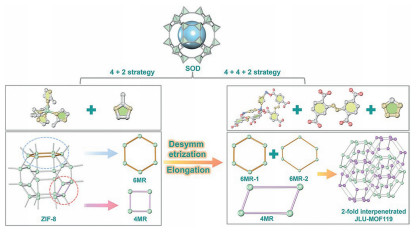
Scheme 1.
Illustration of design strategy of 2-fold interpenetrated SOD topology in JLU-MOF119.

A unique two-fold interpenetrated zeolite-like metal–organic framework with SOD topology for one-step C2H4 purification from ternary mixtures
Jianyun Li , Lifei Zou , Jianwei Cao , Zhaohui Shi , Zhiwei Liu , Lirong Zhang , Jiyang Li , Xin Liu , Yunling Liu


Ethylene (C2H4) is an essential feedstock for the chemical industry, and its downstream chemicals account for the majority of petrochemical products. Presently, three main processes are used to prepare C2H4: Naphtha cracking, oxidation and dehydrogenation (ODH) of ethane, and coal-to-ethylene. Nevertheless, in response to increasingly severe environmental issues and cost-cutting, researchers have developed more production processes with lower energy consumption, fewer pollutant emissions, and higher ethylene recovery rates. The oxidative coupling of methane (OCM) for ethylene, which involves a simple and cost-effective process, is a highly promising technique for ethylene production [1]. In the OCM process, the C–H bond is activated by O2 to generate radicals, which then undergo dehydrogenative coupling to form C2H4, while the extensive thermals released in the process may cause over oxidation of C2H4 to produce C2H2, CO2, and other byproducts. For the sake of downstream products made from C2H4, removing C2H4 from other byproducts is critically important. Considering the cost and environmental impact, porous materials show great potential in separating C2H4 from light hydrocarbon mixtures. Since their slight difference in quadrupole moments (C2H2: 7.2 × 10⁻²⁶ esu cm2, CO2: 4.3 × 10⁻²⁶ esu cm2, C2H4: 1.5 × 10⁻²⁶ esu cm2) and kinetic sizes (C2H2: 3.3 Å, CO2: 3.3 Å, C2H4: 4.2 Å) (Table S1 in Supporting information), one-step purification of C2H4 from C2H2/CO2/C2H4 ternary mixtures is extremely challenging. Therefore, an effective strategy to address this challenge is to design and synthesize a polar structure, wherein a negative electrostatic potential environment within the pores facilitates the enhancement of adsorption differentiation among gas molecules with distinct polarities. Metal–organic frameworks (MOFs) are a class of porous and inorganic-organic hybrid materials. Currently, the pore size designability and modifiability of MOFs have reached the range of sub-angstrom, thus providing great potential in separating molecules with subtle differences, such as C2H2/CO2 [2–4], C2H6/C2H4 [5,6], and xylene isomers separation [7–9]. However, most of the reported MOFs have a poor selectivity for both C2H2/C2H4 and CO2/C2H4 because of their similar physical properties, so it is still difficult to realize one-step purification C2H4 from C2H2/CO2/C2H4 ternary mixtures [10–13]. In the view of pore structure, reducing the pore size of MOFs is one way to improve selectivity, proper apertures allow the framework to selectively capture small gases while excluding larger gases. Therefore, the design and synthesis of new and polar ultra-microporous MOFs is mandatory considering the kinetic sizes and quadrupole moments of C2H2, CO2, and C2H4.
Zeolite-like metal–organic frameworks (ZMOFs) are a unique branch of MOFs, which exceed zeolites and other MOFs in gas storage and separation application [14–19]. Compared to traditional MOFs, the advantages of ZMOFs primarily lie in their cage-like cavities and ultra-microporous window sizes, which are beneficial for enhancing adsorption capacity and selective adsorption performance. Additionally, the anionic or cationic nature of some ZMOFs can be exploited to tailor the frameworks’ affinity for certain gases, improving separation performance. Compared to other ZMOFs topologies, the sodalite (SOD) net is the most common occurrence, owing to its simple tiling of edge-transitive nets (1121). Specifically, the SOD cage is composed of six four-membered rings (4MR) and eight six-membered rings (6MR), while the sodalite network is a 3D structure formed by the interconnected SOD cages through their coplanar assembly. Through the unremitting efforts of researchers, how to construct the SOD topological ZMOFs has made substantial strides. For example, Eddaoudi's group used the Zr6 cluster as a tetrahedral building unit (TBU) and judiciously selected the bent ditopic linker with steric hindrance to construct the Zr-sod-ZMOFs [20]. Subsequently, they utilized the centring structure-directing agents (cSDA) with appropriate geometry to prepare 21 types of ZMOFs with SOD topology, during which Fe-sod-ZMOFs-320 possessed the largest pore volume (3.21 cm3/g) of sodalite compounds and exhibited the outstanding gas storage performance [21]. ZIF-8 with SOD topology can be regarded as a potential ideal material for gas separation due to its ultra-microporous pore size (3.4 Å) and high porosity (0.66 cm3/g). However, ZIF-8 shows poor separation ability in slightly different gases (e.g., C2H2, CO2, and C2H4) owing to its nonpolar skeleton. To solve this problem, a feasible strategy is to construct an interpenetrated SOD structure that can fine-tune the pore size under sub-angstrom and increase the number of active sites per unit volume. However, rare examples of interpenetrated ZMOFs have been witnessed on account of the trait of zeolite type [22,23], and theoretically, the SOD net is not self-dual and forbidden self-interpenetration. Therefore, it remains a great challenge for the synthesis of interpenetrated SOD-based ZMOFs.
In this work, we first proposed a feasible 4 + 4 + 2 strategy to prepare a novel ZMOF (namely JLU-MOF119) with a unique two-fold interpenetrated SOD topology based on the 4 + 2 strategy for ZIF-8 synthesis (Scheme 1). Specifically speaking, based on the 4 + 2 strategy, besides the TBU served by the 4-connected metal node and a 2-connected linker (such as imidazole) to generate the 6MR, a coplanar 4-connected linker is properly chosen to replace some 2-connected linker and serves as the 4MR. In such 4 + 4 + 2 strategy, lengthening of the 4-connected ligand is crucial to construct interpenetrated structures. Given that, following our previous work of JLU-MOF52 (GIS) [24], a 2,5-H4ABTC ligand with low symmetry was utilized as the 4-c ligand. Such ligand may transform its configuration from tetrahedron (in JLU-MOF52) to parallelogram like 3,5-H4ABTC in PCN-250 in appropriate conditions [25]. Meanwhile, to increase the number of polar sites, the imidazole in ZIF-8 is replaced by the TAZ ligand. As a result, the prepared JLU-MOF119 possesses the SOD cage with abundant uncoordinated O and N sites, and the ultra-microporous pore size (4.1 Å and 3.3 Å). JLU-MOF119 exhibits one-step purification C2H4 from ternary mixtures of C2H2/CO2/C2H4, reaching 99.2% purity of C2H4, as proved by the breakthrough and recycling experiments.
According to the reported ZMOFs, constructing the SOD ZMOFs involves several strategies: (1) 4 + 2 strategy, i.e., 4-connected single-metal-ion nodes serve as TBU bridge by ditopic linker [26–30], (2) 4 + 4 strategy, i.e., bridge the TBU with a tetrahedral tetratopic linker [31], (3) 4 + 6 strategy, i.e., bridge the TBU with a hexacarboxylic linker [32], (4) face-directed strategy, i.e., the linker serves as the face of the cage [33–36], (5) polyhedral assembly strategy, i.e., the single-metal building blocks {In(COO)4} as the TBU to construct the SOD-type frameworks and the internal trinuclear clusters {In3O} form the tetrahedral cages (Fig. S1 in Supporting information) [37,38]. Here, based on the 4 + 2 strategy, a novel 4 + 4 + 2 strategy was proposed and successfully applied to prepare JLU-MOF119 with unique 2-fold interpenetrated SOD net. Specifically, a portion of the imidazole ligands is replaced by 4-connected 2,5-H4ABTC ligands, while the remaining imidazole ligands are substituted by TAZ ligands, thereby forming the 4 + 4 + 2 strategy. The employment of elongate 4MR results in two types of 6MR and distorted framework, eventually leading to the interpenetrated SOD structure.
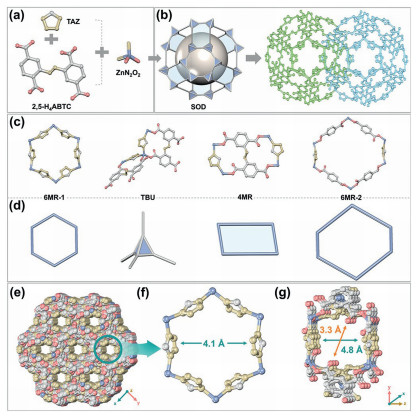
The crystallography data reveals that JLU-MOF119 crystallizes in a trigonal system with R-3 space group (Table S2 in Supporting information). In the skeleton, independent Zn2+ and 2,5-H4ABTC adopt four coordination, and TAZ serves as a ditopic linker. Each Zn2+ is coordinated with two oxygen atoms from two individual 2,5-H4ABTC ligands and two nitrogen atoms from different TAZ, respectively, to form the low-symmetry TBU, ZnN2O2 (Fig. 1a and Fig. S2a in Supporting information). Each independent 2,5-H4ABTC ligand is linked to four Zn2+ and two TAZ, generating the 4MR (Fig. 1c and Fig. S2b in Supporting information). Moreover, each carboxyl group of 2,5-H4ABTC contains an uncoordinated O atom and points into the SOD cage. Each individual TAZ linker is coordinated to two Zn2+ cations and then engenders the 6MR-1 (Fig. S2c in Supporting information), the adjacent TAZ linkers are interlaced, and the uncoordinated N atoms of TAZ point toward the center of the window. There are two kinds of 6MR in the framework, one is the regular 6MR-1, and the other is formed by two TAZ, four half of 2,5-H4ABTC and six Zn2+ (Figs. 1c and d). In the 6MR-2, the TAZ serves as the shorter edge, and the half of 2,5-H4ABTC serves as the longer edge, the length varies between TAZ and 2,5-H4ABTC resulting in the window of 6MR-2 is bigger than that of 6MR-1. From the topological perspective, the 4MR, 6MR-1, and 6MR-2 further extend to a 3D framework, which has the same underlying SOD topology as ZIF-8 (Fig. 1b), yet distinguishes it from the SOD net. In the JLU-MOF119 framework, the 4MR with low symmetry and represents parallelogram, and other 4MR of ZMOFs with SOD net are mostly square. The twisted 4MR gives rise to the formation of 6MR with different sizes, which causes structural interpenetration and distortion of the framework (Fig. 1b). Thus, there are two types of apertures for JLU-MOF119, one is 6MR-1 forming a hexagonal aperture with size of 4.1 Å × 4.1 Å along the [001] direction and the other has a rectangular channel formed by interpenetrated 6MR-2 with size of 4.8 Å × 3.3 Å (Figs. 1e–g). It is noted that the pore structure of JLU-MOF119 is distinct from ZIF-8 due to the interpenetrated framework, in which ZIF-8 only has one kind of hexagonal aperture and a significant smaller cage of SOD (11.6 Å vs. 18.6 Å), yet the cage of JLU-MOF119 is reduced to 5.9 Å after the interpenetration of the framework (Fig. S3 in Supporting information).
Notably, JLU-MOF119 possesses two kinds of ultra-microporous pores as well as better stability in various solvents and thermal stability before 210 ℃ (Figs. S4 and S5 in Supporting information), which endows it with potential adsorption and separation ability in light hydrocarbons mixtures. N2 could not be adsorbed by JLU-MOF119 for its ultra-microporous window size, thereby, CO2 adsorption was used to evaluate the porosity of JLU-MOF119 at 195 K. As shown in Fig. 2a, the uptake of JLU-MOF119 is 125 cm3/g at 195 K and 100 kPa. The Brunauer-Emmett-Teller (BET) and Langmuir surface areas of JLU-MOF119 are 387 and 433 m2/g, respectively. Light hydrocarbons are significant raw materials and industrial gases for the chemical industry, and the ultra-microporous window size of JLU-MOF119 prompts us to hypothesize that it has the potential for the separation of light hydrocarbons. Therefore, JLU-MOF119 was performed for single-component adsorption of N2, CO2, CH4, C2H6, C2H4, C2H2, and C3H8 (Figs. 2b–d and Fig. S6 in Supporting information) at 273 and 298 K. Apparently, the gases of N2, CH4, C2H6, and C3H8 with bigger kinetic diameters are hardly adsorbed by JLU-MOF119 at 273 and 298 K, the slight uptake is primarily attributed to the adsorption on the surface of JLU-MOF119. Simultaneously, the C2H2, CO2, and C2H4 can be adsorbed by JLU-MOF119, these results are consistent with the ultra-microporous pore size, which means that JLU-MOF119 exhibits a respectable size sieving effect. Moreover, the uptake of C2H4 (17.37 cm3/g) is lower than that of C2H2 (45.61 cm3/g) and CO2 (31.54 cm3/g) at 1.0 bar and 298 K, which uncovers the possibility of separating C2H2/C2H4 and CO2/C2H4. Simultaneously, compared to ZIF-8, the advantage of the interpenetrated framework is more obvious in gas separation, which exhibits an increase in the uptake of gases with smaller size (e.g., CO2 and C2H2), while a significant decrease of bigger gas molecules (e.g., C2H6, C3H8, and C3H6) [39–41]. Moreover, the adsorption capacity of JLU-MOF119 for C2H2 remains stable after 12 cyclic tests, indicating that JLU-MOF119 has excellent stability and C2H2 sorption capacity (Fig. S7 in Supporting information).
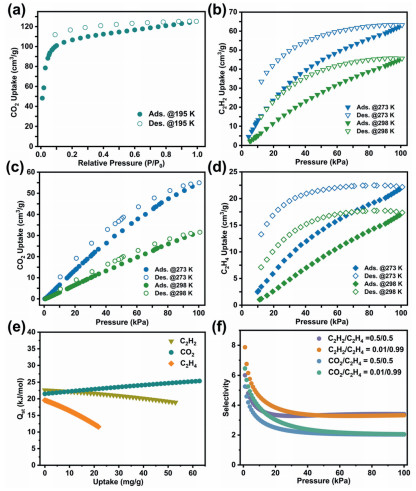
The isosteric heat of adsorption (Qst) for C2H2, CO2, and C2H4 was calculated by the Virial equation to estimate the affinity between gases and the skeleton. As shown in Fig. 2e, the Qst of C2H2, CO2, and C2H4 are 22.6, 21.5, and 19.55 kJ/mol respectively at zero-coverage, indicating a stronger affinity of C2H2 and CO2 than C2H4. Additionally, all the values of Qst are lower than the majority of MOFs, e.g., FJI-H36 (36.1, 29.2, and 29.9 kJ/mol) [42], SNNU-98-Mn (60.2, 29.2, and 30.8 kJ/mol) [43], and ZNU-8 (33.1, 26.6, 25.7 kJ/mol) [4], which implies the low energy consumption for regeneration. The simulation of the adsorption isotherms and Qst plots for the other gases are shown in Figs. S8–S11, Tables S3 and S4 (Supporting information).
To assess the separation capacity, the adsorption selectivity was calculated by the ideal adsorption solution theory (IAST) of dual-site Langmuir-Freundlich model from single component adsorption isotherms. The selectivity for C2H2/C2H4 (50/50, 1/99, v/v) is 3.4 and 3.3 (Fig. 2f), higher than those reported MOFs of Fe-MOF-74 (2.08, 50/50) [44], BSF-1 (2.3, 50/50) [45], TJT-100 (1.8, 50/50) [46], JLU-MOF88 (3, 50/50) (Table S5 in Supporting information) [47]. The selectivity for CO2/C2H4 (50/50, 1/99, v/v) is 2.03 and 2.05, higher than Zn-atz-oba (1.33, 50/50) [13], NKMOF-1-Ni (0.8, 50/50) [48]. Compared to reported MOFs in purification C2H4 from ternary mixtures of C2H2/CO2/C2H4 (Fig. S12 and Table S6 in Supporting information), such as Zn-atz-oba (C2H2/C2H4, 1.33, CO2/C2H4, 1.43) [13], Zn-fa-atz (C2H2/C2H4, 1.5, CO2/C2H4, 1.4) [10], JLU-MOF119 is an effective purification candidate for C2H4 from ternary mixtures of C2H2/CO2/C2H4 by one step.
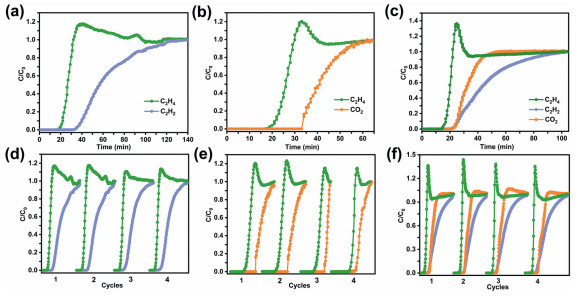
As is well known, compared to C2H4, C2H2, and CO2 possess higher electron cloud densities. Therefore, a polar cage surface demonstrates a stronger affinity for C2H2 and CO2. To thoroughly verify the practical application potential of JLU-MOF119 for C2H2/CO2/C2H4 separation, JLU-MOF119 was executed the breakthrough experimental tests. The binary mixtures breakthrough experiments of C2H2/C2H4 and CO2/C2H4 were performed in equimolar at 2 mL/min and 298 K (Figs. 3a and b). In Fig. 3a, the C2H4 is first flowed out at 17 min, while the C2H2 is eluted at 32 min. The experiment result is consistent with the static adsorption isotherm. Compared to separate C2H2/C2H4, the mixtures of CO2 and C2H4 have closer quadrupole moments, which means it would be more obstacle to separate CO2/C2H4. As indicated in Fig. 3b, the C2H4 is eluted at 17 min, and CO2 is retained until eluted at 33 min, confirming JLU-MOF119’s exceptional CO2/C2H4 separation performance. In the OCM process, C2H2, CO2, and C2H4 are coexistent, thus the breakthrough experiment of C2H2/CO2/C2H4 was executed at 3 mL/min and 298 K (Fig. 3c). As shown in Fig. 3c, the C2H4 is first flowed out at 14 min, while C2H2 and CO2 are flowed out at 21 min and 22 min. And the purity of C2H4 reaches a high value of 99.2% at the outlet before the C2H2 and CO2 flow out further proving JLU-MOF119 achieves one-step purification of C2H4 from C2H2/CO2/C2H4 ternary mixtures. To better meet the practical application, cyclic tests on JLU-MOF119 were performed to evaluate the regenerative capacity. As shown in Figs. 3d–f, the capacity of JLU-MOF119 to separate C2H2/C2H4, CO2/C2H4 and C2H2/CO2/C2H4 remains virtually unchanged after 4 cycles. Moreover, the consistent C2H2 adsorption capacity after 12 cycles indicates that JLU-MOF119 retains its selective C2H4 purification performance even after 12 breakthrough experiments (Fig. S7).
First-principles based calculations with empirical correction for dispersive interactions were performed to investigate the mechanisms that differentiate C2H2, CO2, and C2H4 adsorption in JLU-MOF119 (Figs. 4a–c) [49,50]. In the most plausible adsorption structure (Fig. S13 in Supporting information), C2H2 stays within the channel surrounded by Zn(II), TAZ, and dimethyl ammonia cations (DMA) (Fig. 4a), and the corresponding Eads is 0.75 eV. C2H2 stays around the 6MR-2, it interacts mainly with the uncoordinated O of the 2,5-H4ABTC at H(C2H2)−O(2,5-H4ABTC) distance of 2.31 and 2.61 Å, respectively, and also interacts electrostatically with the TAZ right below it at C(C2H2)−N(DMA) and C(C2H2)−C(DMA) distances of 3.46 and 3.53 Å, respectively. C2H2 is also distorted slightly upon adsorption, the H–C–C and C–C–H angles are distorted from 180° when freestanding to 176.38° and 179.43°, respectively. These, together with the isosurface plot of charge density difference upon C2H2 adsorption suggest that dispersive interactions are formed to stabilize C2H2 (Fig. 4d).
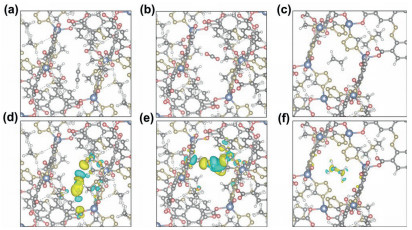
Different from the case of C2H2, CO2 would diffuse into the 6MR-2 opening to interact with the H of adjacent and nearly parallelly arranged TAZ ligands to gain additional stability (Fig. 4b), and the calculated Eads is 0.31 eV. In this configuration, positively charged C(CO2) interacts electrostatically with an H (2,5-H4ABTC) and a carboxylic-O of uncoordination from adjacent 2,5-H4ABTC ligands, and two O(CO2) also interact with the 2 H of different TAZ ligands. The calculated O(2,5-H4ABTC)−C(CO2) and H(2,5-H4ABTC)−C(CO2) distances are 2.75 and 3.20 Å, respectively. The calculated H(TAZ)−O(CO2) distances are 2.89 and 3.29 Å, respectively. The O–C–O angle within CO2 is also distorted from 180° to 177.89°. The isosurface plot of charge density difference upon CO2 adsorption also suggests the dispersive nature of CO2 adsorption with cooperative interactions with both negatively and positively charge centres of adjacent ligands that were previously proposed to account for enhanced CO2 adsorption in microporous amorphous carbon (Fig. 4e).
The case of C2H4 is similar to that of C2H2 (Fig. 4c). Dispersive interactions are formed between C2H4 and TAZ ligands. The calculated H(C2H4)−N(TAZ) distances are 3.00, 3.05, 3.06, and 3.07 Å, respectively. C2H4 is also distorted slightly, the H–C–C angles are distorted from 121.69° when freestanding to 121.87° after adsorption. These together with the charge density difference upon C2H4 adsorption suggests that dispersive interactions account for C2H4 adsorption (Fig. 4f). The charge transfer accompanying C2H4 adsorption is less significant as compared with that of C2H2 and CO2 (Figs. 4d and e), so C2H4 adsorption would be weaker. Accordingly, the calculated Eads of C2H4 is 0.26 eV and C2H4 adsorption is the weakest among the three gases investigated.
In summary, a novel 4 + 4 + 2 strategy is designed to construct the first interpenetrated SOD-based ZMOF, JLU-MOF119. The 4 + 4 + 2 strategy is based on the 4 + 2 strategy of constructing ZIF-8, which is formed by using the 4-c ligand to replace a portion of 2-c ligand. Specifically, the former 4 refers to the TBU of ZnN2O2, which consists of TAZ and 2,5-H4ABTC; the latter 4 refers to the 4-c ligand of 2,5-H4ABTC; and the 2 refers to the 2-c ligand of TAZ. In such framework, the use of elongated and distorted ligand of 2,5-H4ABTC results in the formation of two types of 6MR, and subsequently assemble into a distorted and interpenetrated SOD framework. JLU-MOF119 possesses abundant uncoordinated N and O sites in the SOD cage and the ultra-microporous pore size, which represents a decent separation capacity of C2H2/CO2/C2H4, and the C2H4 purity of 99.2% is obtained by dynamic column breakthrough experiments. The simulations and calculations study gives more insight into the unique structure feature and the distinct affinity between gases of C2H2, CO2, and C2H4 and the framework, accounting for the excellent selectivity of light hydrocarbons. This work pioneers a new and feasible strategy of SOD topology with interpenetrated structure, and explores new MOF materials applied in the field of multi-component light hydrocarbon separation, which also provides an effective pathway for designing structures with specialized functions.
The authors declare that they have no known competing financial interests or personal relationships that could have appeared to influence the work reported in this paper.
Jianyun Li: Writing – original draft, Investigation, Conceptualization. Lifei Zou: Methodology, Investigation, Data curation. Jianwei Cao: Data curation. Zhaohui Shi: Data curation. Zhiwei Liu: Data curation. Lirong Zhang: Writing – review & editing, Supervision. Jiyang Li: Writing – review & editing. Xin Liu: Data curation. Yunling Liu: Writing – review & editing, Funding acquisition, Conceptualization.
This work was supported by the National Natural Science Foundation of China (Nos. 22171100 and U23A20360) and the ‘111 Center’ (No. B17020). X. Liu was supported by National Natural Science Foundation of China (Nos. 21771029, 11811530631, and 21573034). The supercomputer time was provided by High Performance Computing Center at Dalian University of Technology. L. Zou was supported by National Natural Science Foundation of China (No. 22361001).
Supplementary material associated with this article can be found, in the online version, at doi:
J. Liu, J. Yue, M. Lv, et al., Carbon Res. Conv. 5 (2022) 1–14.
J. Wang, Y. Zhang, Y. Su, et al., Nat. Commun. 13 (2022) 200.
L. Zhang, T. Xiao, X. Zeng, et al., J. Am. Chem. Soc. 146 (2024) 7341–7351. doi: 10.1021/jacs.3c12032
Y. Zhang, W. Sun, B. Luan, et al., Angew. Chem. Int. Ed. 62 (2023) e202309925. doi: 10.1002/anie.202309925
G. Wang, R. Krishna, Y. Li, et al., Angew. Chem. Int. Ed. 61 (2022) e202213015. doi: 10.1002/anie.202213015
L. Li, R. Lin, R. Krishna, et al., Science 362 (2018) 443–446. doi: 10.1126/science.aat0586
J. Zhou, T. Ke, Y. Song, et al., J. Am. Chem. Soc. 144 (2022) 21417–21424. doi: 10.1021/jacs.2c10595
X. Cui, Z. Niu, C. Shan, et al., Nat. Commun. 11 (2020) 5456. doi: 10.1038/s41467-020-19209-7
X. Li, J. Wang, N. Bai, et al., Nat. Commun. 11 (2020) 4280. doi: 10.1038/s41467-020-17640-4
R. Yang, Y. Wang, J. Cao, et al., Nat. Commun. 15 (2024) 804. doi: 10.1038/s41467-024-45081-w
Y. Jiang, Y. Hu, B. Luan, et al., Nat. Commun. 14 (2023) 401. doi: 10.1177/02676591211043705
Q. Dong, Y. Huang, K. Hyeon-Deuk, et al., Adv. Fun. Mater. 32 (2022) 2203745. doi: 10.1002/adfm.202203745
J. Cao, S. Mukherjee, T. Pham, et al., Nat. Commun. 12 (2021) 6507. doi: 10.1038/s41467-021-26473-8
M. Eddaoudi, D. Sava, J. Eubank, et al., Chem. Soc. Rev. 44 (2015) 228–249. doi: 10.1039/C4CS00230J
Y. Tan, F. Wang, J. Zhang, Chem. Soc. Rev. 47 (2018) 2130–2144. doi: 10.1039/c7cs00782e
A. Phan, C. Doonan, F. Uribe-Romo, et al., Acc. Chem. Res. 43 (2010), 58–67. doi: 10.1021/ar900116g
F. Yi, H. Yang, X. Zhao, et al., Angew. Chem. Int. Ed. 58 (2019) 2889–2892. doi: 10.1002/anie.201900106
J. Li, D. Sava, V. Guillerm, et al., Chem 10 (2024) 567–577. doi: 10.1016/j.chempr.2023.09.026
K. Park, Z. Ni, A. Cote, et al., Proc. Natl. Acad. Sci. U. S. A. 103 (2006) 10186–10191. doi: 10.1073/pnas.0602439103
N. Alsadun, G. Mouchaham, V. Guillerm, et al., J. Am. Chem. Soc. 142 (2020) 20547–20553. doi: 10.1021/jacs.0c10007
M. Barsukova, A. Sapianik, V. Guillerm, et al., Nat. Synth. 3 (2024) 33–46.
W. Xie, W. He, S. Li, et al., Chem. Eur. J. 22 (2016) 17298–17304. doi: 10.1002/chem.201603487
Y. Liu, M. Grzywa, M. Weil, et al., J. Solid State Chem. 183 (2010) 208–217. doi: 10.1166/sl.2010.1228
L. Zou, X. Sun, J. Yuan, et al., Inorg. Chem. 57 (2018) 10679–10684. doi: 10.1021/acs.inorgchem.8b01330
D. Feng, K. Wang, Z. Wei, et al., Nat. Commun. 5 (2014) 5723. doi: 10.1038/ncomms6723
R. Banerjee, A. Phan, B. Wang, et al., Science 319 (2008) 939–943. doi: 10.1126/science.1152516
X. Huang, Y. Lin, J. Zhang, et al., Angew. Chem. Int. Ed. 45 (2006) 1557–1559. doi: 10.1002/anie.200503778
Y. Liu, V. Kravtsov, R. Larsen, et al., Chem. Commun. 14 (2006) 1488–1490. doi: 10.1039/b600188m
B. Abrahams, M. Haywood, R. Robson, et al., Angew. Chem. Int. Ed. 42 (2003) 1112–1115. doi: 10.1002/anie.200390292
L. Tabares, J. Navarro, J. Salas, J. Am. Chem. Soc. 123 (2001) 383–387. doi: 10.1021/ja002624a
L. Sun, H. Xing, Z. Liang, et al., Chem. Commun. 49 (2013) 11155–11157. doi: 10.1039/c3cc43383h
W. Du, Z. Zhu, Y. Bai, et al., Chem. Commun. 54 (2018) 5972–5975. doi: 10.1039/c8cc02193g
M. Dinca, W. Han, Y. Liu, et al., Angew. Chem. Int. Ed. 46 (2007) 1419–1422. doi: 10.1002/anie.200604362
Y. Tan, Y. He, J. Zhang, Chem. Commun. 47 (2011) 10647–10649. doi: 10.1039/c1cc14118j
T. Mcdonald, D. D'Alessandro, R. Krishna, et al., Chem. Sci. 2 (2011) 2022–2028. doi: 10.1039/c1sc00354b
M. Feng, X. Zhou, X. Wang, et al., ACS Appl. Mater. Interfaces 15 (2023) 11837–11844. doi: 10.1021/acsami.2c22725
S. Zheng, J. Bu, Y. Li, et al., J. Am. Chem. Soc. 132 (2010) 17062–17064. doi: 10.1021/ja106903p
S. Zheng, T. Wu, F. Zuo, et al., J. Am. Chem. Soc. 134 (2012) 1934–1937. doi: 10.1021/ja209800x
S. Xiang, W. Zhou, J. Gallegos, et al., J. Am. Chem. Soc. 131 (2009) 12415–12419. doi: 10.1021/ja904782h
J. McEwen, J. Hayman, A. Yazaydin, Chem. Phys. 412 (2013) 72–76. doi: 10.1016/j.chemphys.2012.12.012
L. Lyu, H. Wu, L. Li, et al., Chem. Ing. Tech. 94 (2022) 119–127. doi: 10.1002/cite.202000259
J. Tian, Q. Chen, F. Jiang, et al., Angew. Chem. Int. Ed. 62 (2023) e202215253. doi: 10.1002/anie.202215253
J. Wang, S. Fan, H. Li, et al., Angew. Chem. Int. Ed. 62 (2023) e202217839. doi: 10.1002/anie.202217839
E. Bloch, W. Queen, R. Krishna, et al., Science 335 (2012) 1606–1610. doi: 10.1126/science.1217544
Y. Zhang, L. Yang, L. Wang, et al., Angew. Chem. Int. Ed. 131 (2019) 8229–8234. doi: 10.1002/ange.201903600
H. Hao, Y. Zhao, D. Chen, et al., Angew. Chem. Int. Ed. 130 (2018) 16299–16303. doi: 10.1002/ange.201809884
T. Xu, P. Zhang, F. Cui, et al., Adv. Mater. 35 (2023) 2204553. doi: 10.1002/adma.202204553
Y. Peng, T. Pham, P. Li, et al., Angew. Chem. Int. Ed. 57 (2018) 10971–10975. doi: 10.1002/anie.201806732
G. Kresse, J. Furthmuller, Phys. Rev. B 54 (1996) 11169–11186. doi: 10.1103/PhysRevB.54.11169
E. Johnson, A. Becke, J. Chem. Phys. 124 (2006) 174104. doi: 10.1063/1.2190220

Scheme 1 Illustration of design strategy of 2-fold interpenetrated SOD topology in JLU-MOF119.

Figure 1 Single crystal structure illustration of JLU-MOF119: (a) The Zn2+ node, TAZ, and 2,5-H4ABTC linker. (b) Polyhedral view of one SOD cage and ball-and-stick view of 2-fold interpenetrated framework. (c) Ball-and-stick representations of the 6MR, TBU, and 4MR SBU. (d) Stick representations of the 6MR, TBU, and 4MR SBU. (e) The CPK view of JLU-MOF119 framework. (f) The window size of 6MR. (g) Another type of window size after interpenetration. Color code: Zn, purple; C, gray; O, pink; N, brown.

Figure 2 JLU-MOF119 adsorption/desorption isotherms: (a) 195 K CO2, (b) C2H2, (c) CO2 and (d) C2H4 at 273 K (blue) and 298 K (green). (e) Qst for C2H2, CO2, C2H4 of JLU-MOF119. (f) Selectivity for C2H2/C2H4 and CO2/C2H4 mixtures predicted by IAST at 298 K and 1.0 bar.

Figure 3 Breakthrough experiments of (a) C2H2/C2H4 in equimolar at 2 mL/min (v/v = 1/1) and 298 K. (b) CO2/C2H4 in equimolar at 2 mL/min (v/v = 1/1) and 298 K. (c) C2H2/CO2/C2H4 in equimolar at 3 mL/min (v/v/v = 1/1/1) and 298 K. Cycles experiments for (d) C2H2/C2H4, (e) CO2/C2H4 and (f) C2H2/CO2/C2H4.

Figure 4 The most plausible adsorption structures (a–c) and corresponding isosurface plots of charge density difference (d–f) of C2H2, CO2 and C2H4 in JLU- MOF119 viewed along z axis. In (a–f), the charge accumulation and charge depletion regions are in yellow and blue, respectively, and the isovalues are ±0.0003 a.u.

 扫一扫看文章


扫一扫关注我们
 DownLoad:
 下载:
下载:
 下载:
下载: