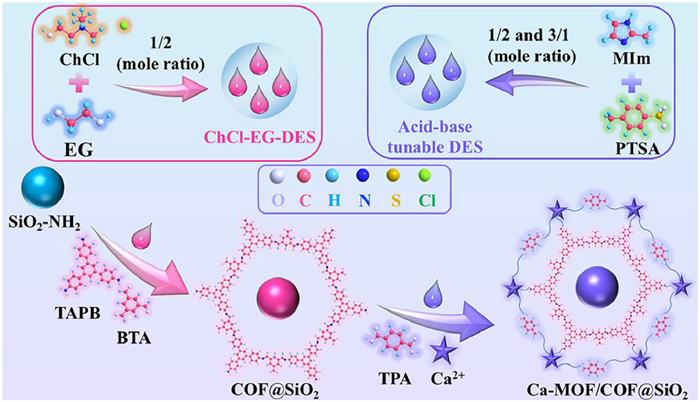
Figure 1.
A synthetic scheme for the preparation of Ca-MOF/COF@SiO2.

Green and mild synthesis of Ca-MOF/COF functionalized silica microspheres in an acid-base tunable deep eutectic solvent for multi-mode chromatography
Yuanfei Liu , Wanjiao Wei , Xu Liu , Rui Hua , Yanjuan Liu , Yuefei Zhang , Wei Chen , Sheng Tang


Metal organic frameworks (MOFs) assembled through coordination bonds between metal cations and ligands are a type of porous materials with excellent porosity and high specific surface area [1–3]. The rich selection of metal cations and ligands endows MOFs with functional designability and diversity. Resulting from their special functionality, MOFs have been applied in extraction, gas storage, catalysis and sensing [4–8]. In recent years, the potential of MOFs in chromatographic stationary phases has also been gradually explored [9–12]. The MOF@SiO2 stationary phase prepared by combining MOF with silica gel can overcome the drawbacks of high column pressure and low column efficiency caused by pure MOF based stationary phase. However, the issue that remains to be addressed is the poor stability of MOF@SiO2 due to the assembly of coordination bonds between metal cations and ligands, which greatly limits its applications in stationary phase. Therefore, it is particularly important to improve the stability of MOFs@SiO2 for chromatographic separation.
Covalent organic frameworks (COFs) are multifunctional porous polymers constructed by covalent bonds, which have the virtues of large specific surface area, structural stability as well as designability [13,14]. COFs have also been widely used in the preparation of stationary phases due to their excellent chromatographic separation ability [15–25]. It has been shown that the stationary phases prepared by combining MOF and COF can make up for the poor stability of MOF@SiO2 [26,27]. Moreover, MOF contains abundant polar groups, and the structure of COF contains rich aromatic rings, thus, the combination of MOF and COF endows the stationary phase material with hydrophilic-hydrophobic balance. However, the traditional methods for preparing COF and MOF stationary phases are generally solvent thermal synthesis, especially the preparation conditions are harsh and the reaction time is long, which have the shortcomings of being harmful to human health and environment, as well as being costly. Thus, finding a green and low-cost synthesis method for the preparation of MOF/COF@SiO2 stationary phase seems necessary.
Deep eutectic solvents (DESs) are complexes formed by hydrogen bond donors/acceptors [28,29]. DESs have the characteristics of biodegradability, low toxicity and low melting point. In the last few years, the use of DES to prepare MOF based stationary phase has been seldom reported. A strategy for green and rapid preparation of MOF in an acid-base tunable DES composed of 2-methylimidazole (MIm) and p-toluenesulfonic acid (PTSA) was reported [30]. Acid-base tunable DES serves as both the green reaction solvent and the reactant. Metal ion will first form the metal/oxygen-containing acid framework with PTSA in acidic DES, which then rapidly assembles with the ligand dissolved in basic DES. Especially, the hydrogen bonding effect of this acid-base tunable DES can facilitate the assembly of MOF. Moreover, the research on metals used for preparing MOFs mainly focuses on transition metals, and there is relatively little research on S-region metal-based MOFs [31]. The S-region metals have the characteristics of being non-toxic and lightweight [32], which are more advantageous in the preparation of stationary phase.
In this work, an acid-base tunable DES was applied for the green synthesis of Ca-MOF/COF@SiO2. Firstly, COF@SiO2 was prepared in a choline chloride (ChCl)/ethylene glycol (EG) based DES. Secondly, acidic and basic DESs were synthesized using PTSA and MIm in mole ratios of 2/1 and 1/3, respectively. Finally, calcium metal was added to acidic DES to form a metal/oxygen-containing organic acid framework, which was rapidly assembled with terephthalic acid (TPA) dissolved in basic DES to form Ca-MOF/COF@SiO2 (Fig. 1). The Ca-MOF/COF@SiO2 combines the excellent chromatographic separation ability of COF and MOF as well as has excellent stability. Meanwhile, the combination of COF and MOF balances the hydrophilicity and hydrophobicity of Ca-MOF/COF@SiO2, which can be used to identify and separate multiple types of analytes. Various retention mechanisms were explored and thermodynamic study was conducted.
The X-ray diffraction (XRD) patterns of Ca-MOF and COF show multiple strong diffraction peaks (Fig. S1 in Supporting information), indicating that the synthesis strategy is feasible. It can be clearly seen that small COF particles grow on the surface of silica microsphere (Figs. S2a and b in Supporting information). Besides, in comparison with COF@SiO2, the scanning electron microscope (SEM) images of Ca-MOF/COF@SiO2 show a denser modification of silica microsphere by more functional materials (Figs. S2c and d in Supporting information), which indicates the successful growth of Ca-MOF. The transmission electron microscope (TEM) characterization reveals that a layer of composite material with a thickness of about 110 nm is covered on the silica surface (Fig. S3 in Supporting information). The infrared spectroscopy analysis of the materials was performed (Fig. S4a in Supporting information). The absorption peaks of the C=N bond formed through the Schiff base reaction [18,19,23,24] as well as the benzene ring skeleton appear around 1510 cm−1, indicating the successful bonding of COF. The absorption peaks of the C=O bond in the TPA and the Ca-O bond appear successively at 1720 cm−1 and 576 cm−1 in the infrared spectrum of Ca-MOF/COF@SiO2, proving the successful immobilization of Ca-MOF. Since SiO2-NH2, COF@SiO2 and Ca-MOF/COF@SiO2 were all prepared by adding corresponding organic ligands on the basis of the former, the results of thermogravimetric analysis (TGA) may be used to further validate the synthesis of materials. The TGA curves reveal that the weight loss of the three materials at 800 ℃ increases sequentially (Fig. S4b in Supporting information), implying that both COF and Ca-MOF have been successfully immobilized on the SiO2-NH2. Meanwhile, a similar trend of weight loss for SiO2-NH2 and Ca-MOF-COF@SiO2 before 300 ℃ suggests that the functional materials covered on silica gel have not yet undergone significant thermal decomposition, while a greater weight loss of COF@SiO2 implies that the combination of Ca-MOF increases the thermal stability of the composite material. The carbon, nitrogen and hydrogen contents of Ca-MOF/COF@SiO2 increase significantly compared with COF@SiO2 and SiO2-NH2 (Table S1 in Supporting information), which further indicates the successful preparation of Ca-MOF/COF@SiO2. The adsorption performance of the three materials was finally studied (Figs. S4c and d in Supporting information). The Ca-MOF and COF materials may be modified in the pore of silica gel, leading to a reduction of specific surface area and pore size (Table S2 in Supporting information).
Ca-MOF/COF@SiO2 was applied to separate positional isomers under normal phase liquid chromatography (NPLC) mode. The result shows that the isomers of chloroanilines and bromoanilines can be favorably separated on the Ca-MOF/COF@SiO2 and the Ca-MOF@SiO2 (Figs. 2a and b), but not on the COF@SiO2, indicating that the introduction of Ca-MOF enhances the shape selectivity of the composite material as well as improves the separation efficiency. The maximum resolution and highest column efficiency for chloroanilines are 6.80 and 64860 plates/m, respectively (Table S3 in Supporting information). Although none of the three stationary phases can completely separate the toluidines (Fig. 2c), the isomers can be well distinguished on the Ca-MOF/COF@SiO2 and the highest column efficiency for m-toluidine is 111653 plates/m (Table S3 in Supporting information). The above results show that combining Ca-MOF with good selectivity for positional isomers and COF with sufficient interaction sites can improve the separation ability and enhance the resolution.

Chloranilines were selected to explore the relationship between the analyte retention and the n-hexane content. It can be observed that the retention is strengthened as the n-hexane content increases (Fig. 2d), showing typical NPLC retention characteristic. The elution order of positional isomers is closely related to their length-width ratio (L/W) [33]. For chloroanilines, bromoanilines and toluidines, the order of L/W is o- < m- < p- (Fig. S5 and Table S4 in Supporting information), which is consistent with the elution order of the three isomers on Ca-MOF/COF@SiO2 column.
Four polycyclic aromatic hydrocarbons (PAHs) and three phthalate esters (PEs) can be separated on the Ca-MOF/COF@SiO2 within 8 min (Figs. 3a and b). The highest column efficiency for both naphthalene and diethyl phthalate is greater than 40, 000 plates/m (Table S5 in Supporting information). The π-π interaction between the Ca-MOF/COF@SiO2 and the PAHs strengthens as the π electron number increases, leading to stronger retention. Although naphthalene and acenaphthene have the same number of π electron, the Log P value of acenaphthene is greater than that of naphthalene (Table S6 in Supporting information), so the retention time of acenaphthene is longer than that of naphthalene. The retention of PEs enhances as their hydrophobicity increases (Table S7 in Supporting information). This indicates that the retention of aromatic compounds such as PAHs and PEs on the Ca-MOF/COF@SiO2 is mainly based on hydrophobic and π-π interactions. The baseline separation of PAHs and PEs cannot be achieved on the COF@SiO2 in a short period of time (Figs. 3a and b), and the Ca-MOF@SiO2 lacks sufficient separation ability for these analytes because of its weak hydrophobicity and strong hydrophilicity. Comparing the hydrophobicity of COF@SiO2 and Ca-MOF/COF@SiO2 through contact angle measurements, it can be seen that the contact angle of COF@SiO2 is obviously greater than that of Ca-MOF/COF@SiO2 (Fig. S6 in Supporting information), showing the hydrophobicity of COF@SiO2 is stronger than that of Ca-MOF/COF@SiO2. Therefore, the introduction of Ca-MOF containing polar ligand balances the hydrophilicity and hydrophobicity of the Ca-MOF/COF@SiO2, thereby improving the hydrophobic separation efficiency. The C18 column fails to achieve a baseline separation of the four PAHs under the optimized conditions, and the separation time is relatively long (Fig. 3a). Although three PEs can be effectively separated on the C18 column under optimal conditions (Fig. 3b), longer separation time and more organic phase are required when compared to Ca-MOF/COF@SiO2 column.

The influence of acetonitrile (ACN) content on the separation was investigated using PAHs as the representatives of hydrophobic analytes. Fig. 3c shows that the retention of four PAHs weakens as the ACN content increases, exhibiting the typical reverse phase liquid chromatography (RPLC) retention pattern. The relationship between ln k and the proportion of ACN in the eluent (CB) is described by Eq. 1 [34,35].
|
|
(1) |
The fitting results for PAHs are exhibited in Fig. 3d and Table S8 (Supporting information).
The baseline separation of four nucleosides/bases (NBs) and three sulfonamides (SAs) can be achieved on the Ca-MOF/COF@SiO2 (Figs. 4a and b). Four NBs were separated for nine times in a row on the Ca-MOF/COF@SiO2 column, and the RSDs for the retention time of four NBs range from 0.5% to 1.0% (Fig. S7 in Supporting information), which displays an awesome separation reproducibility. There has been a significant improvement in separation ability of Ca-MOF/COF@SiO2 compared to COF@SiO2 and Ca-MOF@SiO2, illustrating the advantages of the composite material. The combined action of Ca-MOF and COF facilitates a more efficient hydrophilic separation of polar analytes on the Ca-MOF/COF@SiO2. The highest column efficiency and maximum resolution for NBs are 54307 plates/m and 12.38, respectively (Table S9 in Supporting information). Chromatographic separations of NBs and SAs were also performed using the commercialized XAmide column. The Ca-MOF/COF@SiO2 is observed to be more capable of separating the four NBs than the XAmide column (Figs. 4a and b). In addition, unlike the Ca-MOF/COF@SiO2, the XAmide column needs to use more ACN in the eluent to achieve a comparable separation of the three SAs.
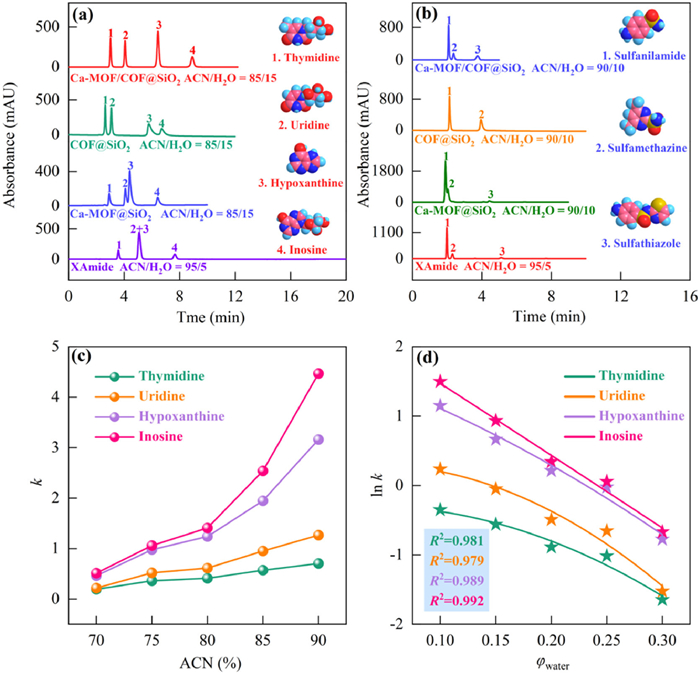
Four NBs were used as probes to study the relationship between the retention of analytes and the ACN content. As the ACN content increases, the retention of four NBs on the Ca-MOF/COF@SiO2 column also enhances (Fig. 4c), exhibiting hydrophilic interaction liquid chromatography (HILIC) retention pattern. Eq. 2 is used to describe the HILIC retention [36,37].
|
|
(2) |
The satisfactory fitting results manifest that the separation of NBs is distribution and adsorption based mechanisms (Fig. 4d and Table S10 in Supporting information).
Moreover, the influence of eluent with different buffer concentration and pH on the retention of analytes was investigated. The retention time of four NBs on the Ca-MOF/COF@SiO2 column decreases with the increase of buffer concentration (Figs. S8a and b in Supporting information). This is because that more and more buffer will gather around the surface of Ca-MOF/COF@SiO2 as the buffer concentration increases, shielding the electrostatic attraction between the Ca-MOF/COF@SiO2 and the positively charged analytes. And the reason why the retention time of analytes increases with increasing pH (Figs. S8c and d in Supporting information) is that the protonation degree of analytes is weakened as the acidity weakens, resulting in a stronger hydrogen bonding with the Ca-MOF/COF@SiO2. Moreover, the carboxyl groups of Ca-MOF carry more negative charges under near neutral condition, which increases the electrostatic repulsion between the analytes and the stationary phase, leading to a decrease in retention at pH 7. As can be seen from Fig. S8, NBs can be well separated over a wide range of salt concentrations and pH.
The thermodynamic properties of Ca-MOF/COF@SiO2 were studied with four NBs and four PAHs. As the temperature increases, the analyte retention shows a decreasing trend (Figs. S9a and b in Supporting information). This may be because the eluent viscosity decreases with increasing temperature, thereby accelerating the elution of analytes. In addition, an elevated column temperature will weaken hydrogen bonding interaction between the Ca-MOF/COF@SiO2 and the analytes. The van't Hoff equation can explain the relationship between temperature and retention (Eq. 3) [38,39].
|
|
(3) |
There has a good linear relationship between ln k and 1/T for NBs and PAHs (Figs. S9c and d in Supporting information). The positive slope and negative ΔH indicate that the separation of NBs and PAHs on the Ca-MOF/COF@SiO2 is an exothermic process (Table S11 in Supporting information), as well as low temperature is beneficial for the retention of analytes.
Finally, the long-term stability and practicability of the Ca-MOF/COF@SiO2 column were investigated. After approximately 600 consecutive injections, chromatographic separation of four PAHs on the Ca-MOF/COF@SiO2 column was again performed. Fig. S10 (Supporting information) shows that there is basically no change in the separation performance of the column, revealing a satisfactory stability. Based on this superiority, the Ca-MOF/COF@SiO2 column was further used to detect PAHs in the actual lake water sample. It can be observed that the Ca-MOF/COF@SiO2 column provides excellent separation and detection of PAHs in lake water without significant interference from the sample matrix (Fig. S11 in Supporting information).
In this work, a novel Ca-MOF/COF@SiO2 stationary phase was prepared by using an acid-base tunable DES as the reaction medium under mild conditions instead of the traditional solvothermal method with high temperature and high pressure. Acid-base tunable DES not only serves as the green reaction solvent, but also participates in the construction of Ca-MOF through the strong hydrogen bonding effect. At the moment of mixing acidic DES and basic DES, the two monomers of acid-base tunable DES will reform hydrogen bonding, thereby accelerating the rapid construction of Ca-MOF/COF@SiO2. The results of this study show that the pure COF has poor separation selectivity for positional isomers, while the Ca-MOF lacks favorable hydrophobic separation ability. The combination of Ca-MOF and COF not only ensures superior stability of the stationary phase, but also endows the Ca-MOF/COF@SiO2 with hydrophobic-hydrophilic balance and abundant interaction sites, making this novel Ca-MOF/COF@SiO2 stationary phase suitable for mixed-mode NPLC/HILIC/RPLC to separate positional isomers and hydrophilic/hydrophobic analytes in a relatively short period of time. This study offers a mild and environmental method for synthesizing MOF/COF@SiO2 stationary phase, and meanwhile, expands the application of Ca-MOF/COF composites in chromatographic separation. In future research, the development of low-cost and multi-purpose liquid chromatographic stationary phases will be continuously explored. There is a need to explore suitable MOF/COF combinations to obtain composites with excellent separation properties. In addition, it is necessary to find a simple and fast strategy to reduce the synthesis time overall.
The authors declare that they have no known competing financial interests or personal relationships that could have appeared to influence the work reported in this paper.
Yuanfei Liu: Writing – original draft, Validation, Methodology, Investigation, Data curation, Conceptualization. Wanjiao Wei: Validation, Methodology, Investigation, Data curation, Conceptualization. Xu Liu: Validation, Investigation. Rui Hua: Data curation. Yanjuan Liu: Writing – review & editing, Resources. Yuefei Zhang: Writing – review & editing. Wei Chen: Supervision. Sheng Tang: Writing – review & editing, Supervision, Resources, Project administration, Methodology, Funding acquisition, Conceptualization.
This work was supported by National Natural Science Foundation of China (Nos. 21906124, 32302202), Natural Science Foundation of Hubei Province (No. 2017CFB220) and Natural Science Foundation of Shandong Province (No. ZR2023MH278).
Supplementary material associated with this article can be found, in the online version, at doi:
W.J. Wang, D. Chen, F.Y. Li, X. Xiao, Q. Xu, Chem 10 (2024) 86–133. doi: 10.1016/j.chempr.2023.09.009
L. Shi, K.O. Kirlikovali, Z.J. Chen, O.K. Farha, Chem 10 (2024) 484–503. doi: 10.1016/j.chempr.2023.09.005
C.Q. Liu, K.J. Quan, J. Chen, X.F. Shi, H.D. Qiu, J. Chromatogr. A 1700 (2023) 464032. doi: 10.1016/j.chroma.2023.464032
M. Bonneau, C. Lavenn, P. Ginet, K.I. Otake, S. Kitagawa, Green Chem. 22 (2020) 718–724. doi: 10.1039/c9gc03561c
Y.H. Xia, K.M. Sun, Y.N. Zuo, S.Y. Zhu, X.E. Zhao, Chin. Chem. Lett. 33 (2022) 2081–2085. doi: 10.1016/j.cclet.2021.08.083
X.W. Zhang, Y.X. Yang, P.G. Pin, et al., Chin. Chem. Lett. 33 (2022) 903–906. doi: 10.1016/j.cclet.2021.07.003
Y. Peng, L.Y. Yu, M.T. Sheng, et al., Anal. Chem. 95 (2023) 18436–18442. doi: 10.1021/acs.analchem.3c03538
Y.X. Sun, K.J. Quan, J. Chen, et al., Chin. Chem. Lett. 34 (2023) 108166. doi: 10.1016/j.cclet.2023.108166
Y. Wu, N. Zhang, K.X. Luo, et al., Trends Anal. Chem. 153 (2022) 116647. doi: 10.1016/j.trac.2022.116647
T.T. Si, X.F. Lu, H.X. Zhang, et al., Chin. Chem. Lett. 33 (2021) 3869–3872.
C.Y. Liu, Y.J. Liu, Y.F. Zhang, W. Chen, S. Tang, Sep. Purif. Technol. 349 (2024) 127827. doi: 10.1016/j.seppur.2024.127827
J.W. Zhou, Y.J. Liu, Y.F. Zhang, W. Chen, S. Tang, Sep. Purif. Technol. 354 (2025) 128718. doi: 10.1016/j.seppur.2024.128718
J. Xiao, J. Chen, J.W. Liu, H. Ihara, H.D. Qiu, Green Energy Environ. 8 (2023) 1596–1618. doi: 10.3390/buildings13071596
J. Xiao, J. Chen, H.D. Qiu, Green Chem. 24 (2022) 2193–2202. doi: 10.1039/d1gc04741h
B. Tang, W. Wang, H.P. Hou, et al., Chin. Chem. Lett. 33 (2022) 898–902. doi: 10.1016/j.cclet.2021.06.089
M.C. Xie, K.J. Quan, H. Li, et al., Chem. Commun. 59 (2023) 314–317. doi: 10.1039/d2cc05650j
Y.F. Liu, S.Q. Shang, W.J. Wei, et al., Anal. Chim. Acta 1283 (2023) 341992. doi: 10.1016/j.aca.2023.341992
H.Y. Long, Y.H. Jiang, Y.J. Liu, et al., Talanta 260 (2023) 124589. doi: 10.1016/j.talanta.2023.124589
W.J. Wei, H.Y. Long, Y.J. Liu, et al., Anal. Chim. Acta 1276 (2023) 341635. doi: 10.1016/j.aca.2023.341635
H.Y. Long, Y.Y. Deng, Y.F. Zhang, S. Tang, W. Chen, Microchem. J. 197 (2024) 109900. doi: 10.1016/j.microc.2024.109900
W.J. Wei, L.L. Zhao, Y.J. Liu, et al., Microchim. Acta 191 (2024) 35. doi: 10.1007/s00604-023-06116-z
Y.F. Liu, L.L. Zhao, Y.J. Liu, et al., Talanta 276 (2024) 126238. doi: 10.1016/j.talanta.2024.126238
Q. Zheng, Y.T. He, W.D. Ma, et al., Chem. Commun. 57 (2021) 7501–7504. doi: 10.1039/d1cc03182a
Q. Zheng, J. Liu, Y.J. Wu, Y. Ji, Z.A. Lin, Anal. Chem. 94 (2022) 18067–18073. doi: 10.1021/acs.analchem.2c04592
Q. Zheng, J.J. Huang, Y.T. He, et al., ACS Appl. Mater. Interfaces 14 (2022) 9754–9762. doi: 10.1021/acsami.1c20989
L.L. Zhao, Y. Wu, Y.J. Liu, et al., Microchem. J. 201 (2024) 110517. doi: 10.1016/j.microc.2024.110517
T. Zhang, Y.M. Sun, X.X. Feng, et al., Anal. Chim. Acta 1288 (2024) 342160. doi: 10.1016/j.aca.2023.342160
Y.X. Hu, T.P. Cai, H.J. Zhang, et al., Talanta 191 (2019) 265–271. doi: 10.1016/j.talanta.2018.08.072
A.K. El-Deen, N. Abdallah, H. Elmansi, F. Belal, G. Magdy, Talanta 265 (2023) 124813. doi: 10.1016/j.talanta.2023.124813
L.F. Chen, X.Z. Ye, T. Zhang, et al., Molecules 27 (2022) 7246. doi: 10.3390/molecules27217246
M. Mazaj, T.B. Celic, G. Mali, et al., Cryst. Growth Des. 13 (2013) 3825–3834. doi: 10.1021/cg400929z
P. Du, Y. Yang, J. Yang, et al., CrystEngComm. 15 (2013) 6986–7002. doi: 10.1039/c3ce40828k
J.H. Zhang, M. Zhang, S.M. Xie, P.G. He, L.M. Yuan, Anal. Methods 7 (2015) 3448–3453. doi: 10.1039/C5AY00551E
Q. Zhao, L.L. Zhao, Y.F. Zhang, W. Chen, S. Tang, J. Chromatogr. A 1722 (2024) 464867. doi: 10.1016/j.chroma.2024.464867
Q.L. Liu, K.M. Zhou, Y.J. Liu, et al., Anal. Chim. Acta 1299 (2024) 342445. doi: 10.1016/j.aca.2024.342445
C.Y. Liu, K.X. Luo, P.P. Cao, et al., Microchem. J. 193 (2023) 109104. doi: 10.1016/j.microc.2023.109104
K.X. Luo, L.L. Zhao, Y.J. Liu, et al., J. Chromatogr. A 1706 (2023) 464279. doi: 10.1016/j.chroma.2023.464279
F.B. Fan, X.F. Lu, L.C. Wang, X.J. Liang, Y. Guo, Anal. Chem. 93 (2021) 16017–16024. doi: 10.1021/acs.analchem.1c03514
Z.F. Hu, J.W. Liao, J.W. Zhou, et al., Chin. Chem. Lett. 36 (2025) 109985. doi: 10.1016/j.cclet.2024.109985

Figure 2 (a-c) Chromatographic separation of positional isomers on different columns. Eluent: n-hexane/isopropanol = 90/10. (d) Chromatographic separation of chloroanilines on the Ca-MOF/COF@SiO2 column at different eluents.

Figure 3 Chromatographic separation of PAHs (a) and PEs (b) on different columns. (c) Plots of k vs. ACN content for PAHs. (d) Plots of ln k vs. the volume fraction of organic phase (CB) for PAHs.

 扫一扫看文章


扫一扫关注我们
 DownLoad:

 下载:
下载:

 下载:
下载: