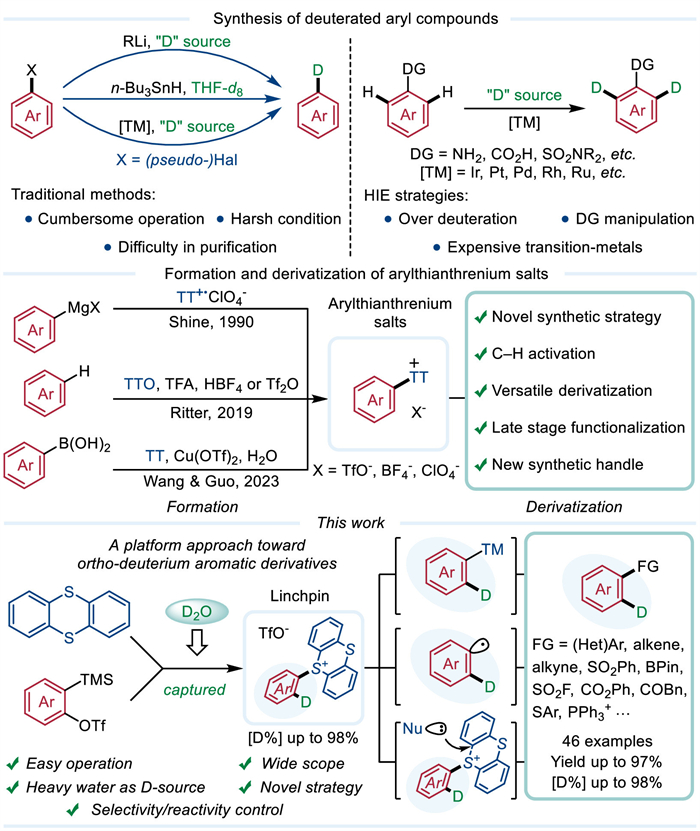
Scheme 1.
Background and working hypothesis.

Precise synthesis of ortho-deuterated aromatic derivatives: An arylthianthrenium salt-based platform approach
Yunhao Guan , Xia Peng , Rong Fan , Xiaoying Feng , Hongguang Du , Jiajing Tan


Deuterated compounds have found wide applications in organic synthesis [1-4], fundamental biology [5-7], drug/agrochemical development process [8,9], and medical imaging [10-12]. In particular, the incorporation of deuterium into bioactive molecules have emerged as a powerful tool for medicinal chemists, as it can often dramatically improve the metabolic and pharmacokinetic properties [13,14]. In 2017, Austedo (deutetrabenazine) was approved by the US Food and Drug Administration as the first deuterated drug [15,16], which has been further stimulating the research on the direction of D-incorporation [2,17-38]. In this vein, a wide array of D-labelling techniques has been developed in recent years with particular success in hydrogen isotope exchange (HIE) reactions of aromatic substrates utilizing catalytic or stoichiometric amount of transition metal such as Ir [39-44], Pt [45-48], Pd [49-53], Rh [54-59], Ru [60-64], etc. [65-70]. Despite these progresses, the over-deuteration and installation and/or removal of DGs are often inevitable. Indeed, the precise control of both the labelled position and the degree of deuteration can greatly affect the physicochemical and biological properties of deuterated compounds [3,5-7]. As such, the selective incorporation of deuterium at aromatic ring remains to be a significant yet challenging task.
Recently, sulfonium chemistry in particular aryl thianthrenium salt, has emerged as a powerful tool in modern organic synthesis [71-81]. In general, aryl thianthrenium salts can participate in both transition metal-catalyzed cross-coupling reactions as the aryl electrophiles [82-89] and photoredox/electrochemical radical reaction as the aryl radical reservoirs [78,90-96]. Moreover, the thianthrenation of aromatics could be achieved via direct C–H activation with corresponding sulfoxides that most of these reported protocols displayed excellent chemoselectivity by combining electronic effect and steric effect together. These progress indeed also empowered site-selective or even late-stage functionalization toward complex real-world targets, which should be beneficial toward medicinal chemistry efforts [71-81]. In addition, C–I bond cleavage (nucleophilic substitution) [97-99] or C–M bond activation (Chan-Lam coupling) [100] was also disclosed to install the thianthrenium group (Scheme 1).
In view of the rapid progress of aryne chemistry [101-131] and our interests in sulfonium zwitterion [77,132-140], we wonder if we could prepare ortho-deuterated aryl thianthrenium salts, and leverage them as a novel class of linchpin to access deuterated aromatic derivatives via versatile downstream derivatization. Indeed, our group and others have demonstrated the employment of aryne species to achieve the vicinal functionalization of arenes with neutral nucleophiles in a variety of transformations. As such, we sought to find the suitable “D+” source to drive the capture of sulfonium zwitterion that were in situ formed. This idea should allow us to control the deuteration selectivity, thereby addressing the aforementioned over-deuteration issues. However, there are two major concerns associated with our working hypothesis. On one hand, the sulfide addition step was kinetically unfavorable, and the solvent molecules or the counterion in D-source may directly couple with the highly reactive aryne species in a competitive pathway. On the other hand, ortho-sulfonium aryl anion intermediates should be thermodynamically unstable, which have been recently discovered as aryne precursors by Stuart and co-workers [141]. Despite these challenges, we herein would like to report the success execution of the abovementioned ideas, and present a linchpin-based platform strategy for facile preparation of ortho-deuterated aromatic derivative from corresponding easily available aryl sulfonium salts. Our user-friendly protocol substitution reactions, over 45 representative ortho-deuterated aryl employed cost effective heavy water as the deuterium source, and empower the precise selectivity control. With the downstream derivatization toolkit including transition metal catalysis, photo/electrochemical methods as well as nucleophilic derivatives could be readily accessed in good structural diversity and deuterium incorporations, part of which could be difficult to be obtained by existing methods. Additionally, an operationally simple phosphine arylation reaction was achieved via electron donor-acceptor complex photoactivation.
We initiated the reaction condition optimization using thianthrene (1a), Kobayashi aryne precursor (2a) and “D+” source (3) as the model substrates (Table 1). At first, a series of fluoride source including potassium fluoride (KF), cesium fluoride (CsF), tetrabutylammonium fluoride (TBAF) and tetrabutylammonium difluorotriphenyl silicate (TBAT) were examined, among which CsF was surprisingly superior to give the desired product in 89% yield and 98% deuterium incorporation (entries 1–4). Reducing the amount of D2O would lead to a decrease of deuterium incorporation whereas a high loading of D2O also failed to increase either the yield or deuterium incorporation (entries 5 and 6). We discovered that further increasing the loading of D2O resulted a heterogeneous reaction, which also failed to increase the yield of 4a as the competitive reaction took place to afford phenol byproduct from D2O and aryne precursor (entry 7). Further screening of other D+ source indicated that chloroform-d (3b) methanol-d4 (3c), and acetone-d6 (3d) gave less satisfying reaction outcome (entries 8–10). Increasing the concentration has a negative effect on this transformation, leading to a slightly lower chemical yield of 78% (entry 11). Different reaction temperature also showed no improvement on the reaction outcome (entries 12 and 13).

 DownLoad:
CSV
DownLoad:
CSV
 |
|||
| Entry | “F-”/Solvent | 3 (equiv.) | Yieldb (%) [D (%)]c |
| 1 | KF/18-C-6/THF | D2O (10) | trace |
| 2 | CsF/MeCN | D2O (10) | 89 [98] |
| 3 | TBAF/THF | D2O (10) | trace |
| 4 | TBAT/THF | D2O (10) | trace |
| 5 | CsF/MeCN | D2O (6) | 75 [82] |
| 6 | CsF/MeCN | D2O (25) | 84 [98] |
| 7 | CsF/MeCN | D2O (160) | trace |
| 8 | CsF/MeCN | CDCl3 (10) | 63 [87] |
| 9 | CsF/MeCN | CD3OD (10) | trace |
| 10 | CsF/MeCN | CD3COCD3 (10) | trace |
| 11d | CsF/MeCN | D2O (10) | 78 [95] |
| 12e | CsF/MeCN | D2O (10) | 55 [98] |
| 13f | CsF/MeCN | D2O (10) | 90 [93] |
| a Reaction conditions: 1a (0.1 mmol), 2a (0.25 mmol), “F-” (0.25 mmol), solvent (0.3 mL), “D+” source, N2, 60 ℃, 36 h. b Isolated yield. c Determined by 1H NMR. d CH3CN (0.15 mL). e 30 ℃. f 80 ℃. |
|||
With optimal conditions described in Table 1, we then explored the substrate scope with various aryne precursors and sulfides (Scheme 2). To our delight, symmetric aryne precursors that incorporate a wide range of functional groups, were well-tolerated, leading to the corresponding deuterated arylthianthrenium salt products (4a-4f) in 55%−89% yields along with high level of deuterium incorporations (92%−98% D). In addition, the transformation with polycyclic arynes also proceeded smoothly, leading to naphthyl and phenanthryl-based products 4e (92% D) and 4f (98% D) in 55% and 78% yield, respectively. In accordance with the distortion/interaction model disclosed by Garg, Houk and colleagues [142], the utilization of 3-substituted benzyne delivered single regioisomer product of 4g-4i. To our surprise, when 4-substituted aryne were investigated for this three-component reaction, a unprecedently high regioselectivity was observed for 4k and 4l, whereas 4l + 4l’ was obtained as a 1:1 mixture. Further studies on extending the scope to 4m and 4n were also performed to afford the desired deuterated sulfonium salts in 96% and 65% yield (both 95% D-incorporation), respectively. Di-p-tolyl sulphide and phenoxathiin was also discovered to be amenable, leading to 4m with 4n with similar level of D-incorporation, both of which have been reported as synthetic handle for downstream transformations [143,144]. For 2,3-pyriydne, the direct two-component, nucleophilic addition of heavy water took place instead, leading to the 4o in 48% yield and 96% deuterium incorporation.

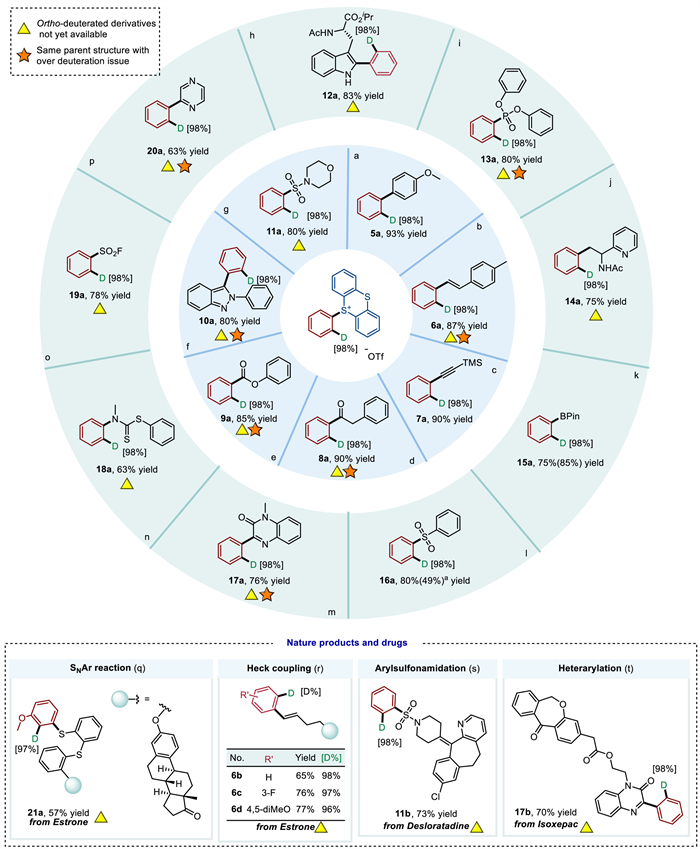
Next, we further demonstrated the application of downstream derivatization toolkit to access versatile ortho-deuterated aromatic derivatives (Scheme 3) [71-96]. At first, the model substrate 4a was evaluated as aryl pseudo-halides for classic transition-metal-catalyzed cross-coupling reactions, including Suzuki-Miyaura (a), Heck (b), Sonogashira (c), α-arylation of carbonyl compounds (d), carbonylation with phenyl formates (e), and arylations of 2H-indazole (f), all of which proceeded smoothly to give the desired products in moderate to good yields without compromising the D-level. Next, both palladium catalyzed arylsulfonamidation (g) and palladium-catalyzed C–H arylation of tryptophan (h) were also explored, leading to the medicinally relevant compound 12a and 13a in 80% and 83% yields, respectively. In addition to transition metal catalysis, the derivatization of ortho-deuterated arylthianthrenium salt could be accomplished via photochemical toolkits (photoredox catalysis or EDA complex). A series of representative transformations were explored including phosphorylation with triphenyl phosphite (i), hydroarylation of azine-substituted enamides (j), borylation with B2Pin2 (k), sulfonylation with sodium sulfinate salt (l), arylation of quinoxalinone (m) and di-aryl dithiocarbomates synthesis (n). These transformations provided straightforward access to versatile D-labelled building blocks with high efficiency, serving as a complementary tool to transition metal catalysis. The mildness and simplicity of photoredox catalysis also enabled a telescoped one-pot cascade reaction combining arylthianthrenium salt formation and photochemical sulfonylation, which successfully delivered 17a in 49% yield. In light of the resurgence of organic electrosynthesis [145-148], we next demonstrated the functionalization of deuterated arylthianthrenium salts using an electrochemically driven method. This exemplified approach provided a viable route to synthesize aryl sulfonyl fluoride (o) with deuterium positioned at the neighboring site, resulting in 20a with a 78% isolated yield. The α-amino alkyl radicals induced Minisci-type reactions of pyrazine using Na2S2O₈ and Bu3N has also been demonstrated (p). Finally, we disclosed that the nucleophilic substitution of 4i selectively took place via thianthrene ring opening, allowing the incorporation of deuterated diphenyl thioether scaffold in a single step (q). More importantly, several active pharmaceutical ingredient or natural product derivatives could be successfully linked to the as-prepared ortho-deuterated aromatic modules (r-t), further showcasing the attractiveness that our protocol might have for deuterated lead discovery. Indeed, this indirect strategy expands far beyond the previously studied vicinal difunctionalization range of aryne chemistry, overcoming the functionality limitation brought by aryne initiation conditions. Note that, in all cases, we observed no erosion of the deuterium content, and strongly believed that our platform protocol offered a synthetic alternative toward ortho-deuterated aryl derivatives, allowing exclusive positional selectivity while avoiding over deuteration. At this stage, the overall results observed with respect to purpose-designed derivatization provided the first glimpse into the blueprint of our strategy, which clearly displayed its great promise and immense potential toward precise synthesis of deuterated aromatics.
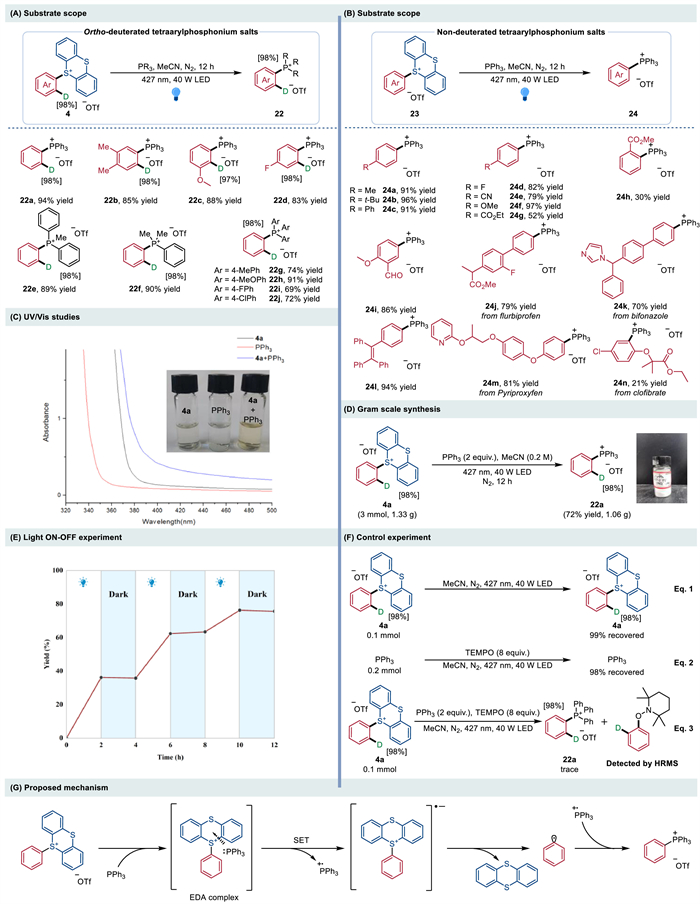
To further expand the elaboration toolkit and the utility of our linchpin-based methods, a photochemical method for phosphine arylation that leveraged the photoexcitation of electron donor–acceptor (EDA) complex was then developed. Upon extensive investigation, we discovered that in the presence of arylthianthrenium salt, triphenylphosphine could be easily arylated with arylthianthrenium salt (4a) under the blue LEDs (40 W, λmax = 427 nm) irradiation to access ortho-deuterated aryl phosphonium salts (Table 2). Thianthrenium salts bearing both electron-rich and electron-poor substituents as well as various aryl phosphines all proved to be amenable, affording the corresponding ortho-deuterated phosphonium salt products (22a-22j) in good to excellent yields (69%−94% yields) along with 97%−98% D-incorporations (Scheme 4A) [149]. Next, non-deuterated sulfonium salts derived from either C–H thianthrenation with sulfoxides or Chan-Lam coupling of arylboronic acids were also investigated to further expand the scope of our protocol. To our delight, various functional groups (alkyl, phenyl, halogen, pseudo-halogen, methoxy and alkoxycarbonyl), and even complex drugs (flurbiprofen, bifonazole, pyriproxyfen and clofibrate), were well tolerated under mild, metal-, and photocatalyst-free conditions (Scheme 4B). The scale-up of 4a was also straightforward (Scheme 4D), leading to comparable reaction outcome. Overall, compared to classic strategy that rely on transition metal catalysis and high-temperature processes, this protocol can offer a sustainable alternative toward aryl phosphonium salts, which shall find potential applications in catalysis, ionic liquids, etc. [150-152]. A series of mechanistic experiments was performed to elucidate the reaction pathway. The redshift of the substrate mixture in the UV–vis spectrum compared to the independent substrates (Scheme 4C) and the 1H NMR titration experiments results (for details, please see Supporting information) [95] indicated the formation of the EDA complex. The light ON—OFF experiments suggested the necessity of light during the reaction and excluded the possible radical chain mechanism (Scheme 4E). No desired product was observed in the presence of TEMPO under otherwise identical conditions, while the radical trapping intermediate was successfully identified by HRMS, suggesting the involvement of a radical process (Scheme 4F). On basis of the above experimental results and previous reports [153-155], a plausible mechanism is proposed (Scheme 4G).
DownLoad:
CSV
 |
||
| Entry | Variations from the standard conditions | Yield (%) [D (%)]b |
| 1 | Nonea | 94 [98] |
| 2 | 456 nm, 40 W | 45 [98] |
| 3 | 440 nm, 40 W | 84 [98] |
| 4 | 427 nm, 20 W | 53 [98] |
| 5 | 427 nm, 30 W | 79 [98] |
| 6 | Dark | N.D. |
| a Reaction conditions: 4a (0.1 mmol), PPh3 (0.2 mmol, 2 equiv.), MeCN (0.5 mL). b Isolated yield [Deuterium incorporation]. |
||
In summary, we have established an ortho-deuterated arylthianthrenium based linchpin platform for the facile preparation of ortho-deuterated aromatic derivatives. Rapid assembly of such linchpin is achieved via a three-component coupling of arynes, thianthrene and heavy water. Both transition metal catalysis and organic photo-/electro-synthesis-based manifolds were explored for elaboration of sulfonium handles, enabling more modular, selective and expedient access to deuterated arene derivatives than previous methodologies. We also demonstrated that these methods can be applied to the modification of complex drug compounds via install D-labelling building blocks, further showcasing its applicability toward medicinal chemistry efforts. From an aryne chemistry perspective, this reported strategy significantly broadens the scope beyond the traditionally explored vicinal difunctionalization, addressing the limitations imposed by the conditions required for aryne generation. Overall, we envision that our platform strategy will allow for the precise synthesis of valuable deuterated aromatic analogues, and highly expedite the exploration of the deuterium isotope effect.
The authors declare that they have no known competing financial interests or personal relationships that could have appeared to influence the work reported in this paper.
Yunhao Guan: Visualization, Validation, Investigation, Formal analysis, Data curation. Xia Peng: Writing – original draft, Visualization, Validation, Investigation, Formal analysis, Data curation. Rong Fan: Validation, Investigation, Data curation. Xiaoying Feng: Investigation, Data curation. Hongguang Du: Writing – review & editing, Validation, Supervision, Resources, Methodology, Funding acquisition, Data curation. Jiajing Tan: Writing – review & editing, Writing – original draft, Visualization, Validation, Supervision, Resources, Project administration, Methodology, Funding acquisition, Formal analysis, Data curation.
This work was supported by the National Natural Science Foundation of China (Nos. 22271010 and 21702013). We appreciate the assistance from Mr. Feiyang Liao during manuscript preparation.
Supplementary material associated with this article can be found, in the online version, at doi:
R. Zhou, L. Ma, X. Yang, J. Cao, Org. Chem. Front. 8 (2021) 426–444. doi: 10.1039/d0qo01299h
Y. Guo, Z. Zhuang, Y. Liu, et al., Coord. Chem. Rev. 463 (2022) 214525. doi: 10.1016/j.ccr.2022.214525
N. Li, Y. Li, X. Wu, C. Zhu, J. Xie, Chem. Soc. Rev. 51 (2022) 6291–6306. doi: 10.1039/d1cs00907a
G. Prakash, N. Paul, G.A. Oliver, D.B. Werz, D. Maiti, Chem. Soc. Rev. 51 (2022) 3123–3163. doi: 10.1039/d0cs01496f
H.M. Chandra Mouli, A. Vinod, S. Kumari, et al., Bioorg. Chem. 135 (2023) 106490. doi: 10.1016/j.bioorg.2023.106490
J. Atzrodt, V. Derdau, W.J. Kerr, M. Reid, Angew. Chem. Int. Ed. 57 (2018) 1758–1784. doi: 10.1002/anie.201704146
M.G. Horning, J.P. Thenot, O. Bouwsma, J. Nowlin, K. Lertratanangkoon, Adv. Pharmacol. Ther, Proc. Int. Congr. Pharmacol. 7 (1978) 245–256.
A.C. Flick, H.X. Ding, C.A. Leverett, et al., J. Med. Chem. 60 (2017) 6480–6515. doi: 10.1021/acs.jmedchem.7b00010
T.G. Gant, J. Med. Chem. 57 (2014) 3595–3611. doi: 10.1021/jm4007998
T. Pirali, M. Serafini, S. Cargnin, A.A. Genazzani, J. Med. Chem. 62 (2019) 5276–5297. doi: 10.1021/acs.jmedchem.8b01808
J.C.M. Low, A.J. Wright, F. Hesse, J. Cao, K.M. Brindle, Prog. Nucl. Magn. Reson. Spectrosc. 134–135 (2023) 39–51. doi: 10.1093/oso/9780197543733.003.0003
S. Kopf, F. Bourriquen, W. Li, et al., Chem. Rev. 122 (2022) 6634–6718. doi: 10.1021/acs.chemrev.1c00795
A. Katsnelson, Nat. Med. 19 (2013) 656. doi: 10.1038/nm0613-656
R.M.C. Di Martino, B.D. Maxwell, T. Pirali, Nat. Rev. Drug. Discov. 22 (2023) 562–584. doi: 10.1038/s41573-023-00703-8
C. Schmidt, Nat. Biotechnol. 35 (2017) 493–494. doi: 10.1038/nbt0617-493
L. Liu, Z. Deng, K. Xu, et al., Org. Lett. 23 (2021) 5299–5304. doi: 10.1021/acs.orglett.1c01448
J. Atzrodt, V. Derdau, T. Fey, J. Zimmermann, Angew. Chem. Int. Ed. 46 (2007) 7744–7765. doi: 10.1002/anie.200700039
J. Atzrodt, V. Derdau, W.J. Kerr, M. Reid, Angew. Chem. Int. Ed. 57 (2018) 3022–3047. doi: 10.1002/anie.201708903
Q. Sun, J.F. Soulé, Chem. Soc. Rev. 50 (2021) 10806–10835. doi: 10.1039/d1cs00544h
P.L. Norcott, Chem. Commun. 58 (2022) 2944–2953. doi: 10.1039/d2cc00344a
M. Gómez-Gallego, M.A. Sierra, Inorg. Chem. Front. 8 (2021) 3934–3950. doi: 10.1039/d1qi00505g
H. Li, M. Peng, L. Wang, et al., Org. Lett. 26 (2024) 719–723. doi: 10.1021/acs.orglett.3c04155
Y. Ding, S. Luo, C. Weng, J. An, J. Org. Chem. 84 (2019) 15098–15105. doi: 10.1021/acs.joc.9b02056
X. Li, J. Zhou, W. Deng, et al., Chem. Sci. 15 (2024) 11418–11427. doi: 10.1039/d4sc03049d
S. Ning, C. Wu, L. Zheng, et al., Green Chem. 25 (2023) 9993–9997. doi: 10.1039/d3gc02345a
W. Li, R. Qu, W. Liu, et al., Chem. Sci. 12 (2021) 14033–14038. doi: 10.1039/d1sc04259a
A. Tortajada, E. Hevia, Catal. Sci. Technol. 13 (2023) 4919–4925. doi: 10.1039/d3cy00825h
W.J. Kerr, G.J. Knox, M. Reid, T. Tuttle, Chem. Sci. 12 (2021) 6747–6755. doi: 10.1039/d1sc01509e
N. Li, Y. Ning, X. Wu, et al., Chem. Sci. 12 (2021) 5505–5510. doi: 10.1039/d1sc00528f
L. Guo, C. Xu, D.C. Wu, et al., Chem. Commun. 55 (2019) 8567–8570. doi: 10.1039/c9cc03988k
H. Xu, M. Liu, L.J. Li, et al., Org. Lett. 21 (2019) 4887–4891. doi: 10.1021/acs.orglett.9b01784
Y. Fan, W. Ou, M. Chen, et al., Org. Lett. 25 (2023) 432–437. doi: 10.1021/acs.orglett.2c04154
B.Q. He, X. Wu, Org. Lett. 25 (2023) 6571–6576. doi: 10.1021/acs.orglett.3c02432
C.H. Hu, Y. Li, J. Org. Chem. 88 (2023) 6401–6406. doi: 10.1021/acs.joc.2c02299
J.L. Lu, J.T. Deng, M. Lang, J.B. Peng, Org. Chem. Front. 11 (2024) 5473–5478. doi: 10.1039/d4qo00956h
S. Liu, H. Liao, B. Chen, et al., Green Chem. 26 (2024) 10456–10462. doi: 10.1039/d4gc01134a
M. Lecomte, M. Lahboubi, P. Thilmany, A.E. Bouzakhi, G. Evano, Chem. Sci. 12 (2021) 11157–11165. doi: 10.1039/d1sc02622d
J. Dong, X. Wang, Z. Wang, et al., Chem. Sci. 11 (2020) 1026–1031. doi: 10.1039/c9sc05132e
E. Martinelli, M. Spiller, R. Weck, et al., Chem. Eur. J. 30 (2024) e202402038. doi: 10.1002/chem.202402038
M. Itoga, M. Yamanishi, T. Udagawa, et al., Chem. Sci. 13 (2022) 8744–8751. doi: 10.1039/d2sc01805e
M. Valero, T. Kruissink, J. Blass, et al., Angew. Chem. Int. Ed. 59 (2020) 5626–5631. doi: 10.1002/anie.201914220
W. Liu, L. Cao, Z. Zhang, et al., Org. Lett. 22 (2020) 2210–2214. doi: 10.1021/acs.orglett.0c00402
W.J. Kerr, M. Reid, T. Tuttle, ACS Catal. 5 (2015) 402–410. doi: 10.1021/cs5015755
C.M. Stork, R. Weck, M. Valero, et al., Angew. Chem. Int. Ed. 135 (2023) e202301512. doi: 10.1002/ange.202301512
M.H. Emmert, J.B. Gary, J.M. Villalobos, M.S. Sanford, Angew. Chem. Int. Ed. 49 (2010) 5884–5886. doi: 10.1002/anie.201002351
M. Yamamoto, Y. Yokota, K. Oshima, S. Matsubara, Chem. Commun. (2004) 1714–1715.
A.J. Hickman, M.A. Cismesia, M.S. Sanford, Organometallics 31 (2012) 1761–1766. doi: 10.1021/om201105b
Y. Sawama, T. Yamada, Y. Yabe, et al., Adv. Synth. Catal. 355 (2013) 1529–1534. doi: 10.1002/adsc.201201102
C. Zheng, J. Xue, Z.J. Jiang, et al., Chem. Commun. 60 (2024) 10338–10341. doi: 10.1039/D4CC03089C
J. Li, Q. Lin, O. Dungan, et al., J. Am. Chem. Soc. 146 (2024) 31497–31506. doi: 10.1021/jacs.4c08176
C. Teja, S. Kolb, P. Colonna, et al., Angew. Chem. Int. Ed. 63 (2024) e202410162. doi: 10.1002/anie.202410162
J. Dey, S. Kaltenberger, M. van Gemmeren, Angew. Chem. Int. Ed. 63 (2024) e202404421. doi: 10.1002/anie.202404421
J. Kong, Z.J. Jiang, J. Xu, et al., J. Org. Chem. 86 (2021) 13350–13359. doi: 10.1021/acs.joc.1c01411
Q.K. Kang, Y. Li, K. Chen, et al., Angew. Chem. Int. Ed. 61 (2022) e202117381. doi: 10.1002/anie.202117381
C.P. Lenges, P.S. White, M. Brookhart, J. Am. Chem. Soc. 121 (1999) 4385–4396. doi: 10.1021/ja984409o
J.L. Rhinehart, K.A. Manbeck, S.K. Buzak, et al., Organometallics 31 (2012) 1943–1952. doi: 10.1021/om2012419
S.C. Schou, J. Labelled Compd. Radiopharm. 52 (2009) 376–381. doi: 10.1002/jlcr.1612
A.L. Garreau, H. Zhou, M.C. Young, Org. Lett. 21 (2019) 7044–7048. doi: 10.1021/acs.orglett.9b02618
W. Peng, Q. Liu, F. Yin, et al., RSC Adv. 11 (2021) 8356–8361. doi: 10.1039/d1ra00236h
M.H.G. Prechtl, M. Hölscher, Y. Ben-David, et al., Angew. Chem. Int. Ed. 46 (2007) 2269–2272. doi: 10.1002/anie.200603677
Q. Chen, Q. Liu, J. Xiao, X. Leng, L. Deng, J. Am. Chem. Soc. 143 (2021) 19956–19965. doi: 10.1021/jacs.1c10071
S. Kopf, F. Ye, H. Neumann, M. Beller, Chem. Eur. J. 27 (2021) 9768–9773. doi: 10.1002/chem.202100468
G. Pieters, C. Taglang, E. Bonnefille, et al., Angew. Chem. Int. Ed. 53 (2014) 230–234. doi: 10.1002/anie.201307930
E. Bresó-Femenia, C. Godard, C. Claver, B. Chaudret, S. Castillón, Chem. Commun. 51 (2015) 16342–16345. doi: 10.1039/C5CC06984J
Z.J. Jiang, S.H. Xu, Y. Su, et al., Chem. Commun. 60 (2024) 384–387. doi: 10.1039/d3cc05257e
C. Zarate, H. Yang, M.J. Bezdek, D. Hesk, P.J. Chirik, J. Am. Chem. Soc. 141 (2019) 5034–5044. doi: 10.1021/jacs.9b00939
S. Garhwal, A. Kaushansky, N. Fridman, L.J.W. Shimon, G. de Ruiter, J. Am. Chem. Soc. 142 (2020) 17131–17139. doi: 10.1021/jacs.0c07689
J. Corpas, P. Viereck, P.J. Chirik, ACS Catal. 10 (2020) 8640–8647. doi: 10.1021/acscatal.0c01714
H. Xu, Z.J. Jiang, Y. Jia, et al., J. Org. Chem. 89 (2024) 8468–8477. doi: 10.1021/acs.joc.4c00352
M. Yang, T. Chen, Z.F. Xu, M. Yu, C.Y. Li, Org. Biomol. Chem. 22 (2024) 7596–7600. doi: 10.1039/d4ob01251h
H. Meng, M.S. Liu, W. Shu, Chem. Sci. 13 (2022) 13690–13707. doi: 10.1039/d2sc04507a
L. Zhang, T. Ritter, J. Am. Chem. Soc. 144 (2022) 2399–2414. doi: 10.1021/jacs.1c10783
S.I. Kozhushkov, M. Alcarazo, Eur. J. Inorg. Chem. 2020 (2020) 2486–2500. doi: 10.1002/ejic.202000249
M.J. Kim, K. Targos, D.E. Holst, D.J. Wang, Z.K. Wickens, Angew. Chem. Int. Ed. 63 (2024) e202314904. doi: 10.1002/anie.202314904
R. Fan, C. Tan, Y. Liu, et al., Chin. Chem. Lett. 32 (2021) 299–312. doi: 10.1016/j.cclet.2020.06.003
Á. Péter, G.J.P. Perry, D.J. Procter, Adv. Synth. Catal. 362 (2020) 2135–2142. doi: 10.1002/adsc.202000220
F. Berger, M.B. Plutschack, J. Riegger, et al., Nature 567 (2019) 223–228. doi: 10.1038/s41586-019-0982-0
J. Li, J. Chen, R. Sang, et al., Nat. Chem. 12 (2020) 56–62. doi: 10.1038/s41557-019-0353-3
M.J. Cabrera-Afonso, A. Granados, G.A. Molander, Angew. Chem. Int. Ed. 134 (2022) e202202706. doi: 10.1002/ange.202202706
D.M. Yan, S.H. Xu, H. Qian, et al., ACS Catal. 12 (2022) 3279–3285. doi: 10.1021/acscatal.2c00638
E.M. Alvarez, T. Karl, F. Berger, L. Torkowski, T. Ritter, Angew. Chem. Int. Ed. 60 (2021) 13609–13613. doi: 10.1002/anie.202103085
P.S. Engl, A.P. Häring, F. Berger, et al., J. Am. Chem. Soc. 141 (2019) 13346–13351. doi: 10.1021/jacs.9b07323
X.Y. Chen, X.X. Nie, Y. Wu, P. Wang, Chem. Commun. 56 (2020) 5058–5061. doi: 10.1039/d0cc00641f
Y. Wu, Y.H. Huang, X.Y. Chen, Org. Lett. 22 (2020) 6657–6661. doi: 10.1021/acs.orglett.0c02458
X.X. Nie, Y.H. Huang, P. Wang, Org. Lett. 22 (2020) 7716–7720. doi: 10.1021/acs.orglett.0c02913
T. Ueda, H. Konishi, K. Manabe, Org. Lett. 14 (2012) 3100–3103. doi: 10.1021/ol301192s
S.A. Ohnmacht, A.J. Culshaw, M.F. Greaney, Org. Lett. 12 (2010) 224–226. doi: 10.1021/ol902537d
E.M. Alvarez, M.B. Plutschack, F. Berger, T. Ritter, Org. Lett. 22 (2020) 4593–4596. doi: 10.1021/acs.orglett.0c00982
N. Kaplaneris, A. Puet, F. Kallert, J. Pöhlmann, L. Ackermann, Angew. Chem. Int. Ed. 62 (2023) e202216661. doi: 10.1002/anie.202216661
K. Sun, C. Ge, X. Chen, et al., Nat. Commun. 15 (2024) 9693. doi: 10.1038/s41467-024-54079-3
K. Cheng, E.W. Webb, G.D. Bowden, et al., Org. Lett. 26 (2024) 3419–3423. doi: 10.1021/acs.orglett.4c00929
X. Kong, Y. Chen, Q. Liu, et al., Org. Lett. 25 (2023) 581–586. doi: 10.1021/acs.orglett.2c03956
Y.L. Zhang, G.H. Wang, Y. Wu, C.Y. Zhu, P. Wang, Org. Lett. 23 (2021) 8522–8526. doi: 10.1021/acs.orglett.1c03229
J. Wu, Z. Wang, X.Y. Chen, et al., Sci. China Chem. 63 (2020) 336–340. doi: 10.1007/s11426-019-9652-x
K. Sun, A. Shi, Y. Liu, et al., Chem. Sci. 13 (2022) 5659–5666. doi: 10.1039/d2sc01241c
Y. Zhang, S. Xia, W. Shi, et al., Org. Lett. 24 (2022) 7961–7966. doi: 10.1021/acs.orglett.2c03077
L. Racicot, T. Kasahara, M.A. Ciufolini, Org. Lett. 16 (2014) 6382–6385. doi: 10.1021/ol503177q
D.Q. Qian, H.J. Shine, J.H. Thurston, K.H. Whitmire, J. Phys. Org. Chem. 16 (2003) 142–147. doi: 10.1002/poc.585
D.Q. Qian, B. Liu, H.J. Shine, I.Y. Guzman-Jimenez, K.H. Whitmire, J. Phys. Org. Chem. 15 (2002) 139–147. doi: 10.1002/poc.462
X.Y. Chen, Y.N. Li, Y. Wu, et al., J. Am. Chem. Soc. 145 (2023) 10431–10440. doi: 10.1021/jacs.3c03413
N. Kim, M. Choi, S.E. Suh, D.M. Chenoweth, Chem. Rev. 124 (2024) 11435–11522. doi: 10.1021/acs.chemrev.4c00296
J. Shi, L. Li, Y. Li, Chem. Rev. 121 (2021) 3892–4044. doi: 10.1021/acs.chemrev.0c01011
H. Takikawa, A. Nishii, T. Sakai, K. Suzuki, Chem. Soc. Rev. 47 (2018) 8030–8056. doi: 10.1039/c8cs00350e
K. Kamikawa, Nat. Rev. Chem. 7 (2023) 496–510. doi: 10.1038/s41570-023-00485-y
J. Shi, Y. Li, Y. Li, Chem. Soc. Rev. 46 (2017) 1707–1719. doi: 10.1039/C6CS00694A
J. Tan, X. Feng, R. Fan, Z. Zhuang, Y. Guo, Synlett 34 (2023) 2379–2387. doi: 10.1055/s-0042-1751476
D.B. Werz, A.T. Biju, Angew. Chem. Int. Ed. 59 (2020) 3385–3398. doi: 10.1002/anie.201909213
S. Yoshida, T. Yano, Y. Misawa, et al., J. Am. Chem. Soc. 137 (2015) 14071–14074. doi: 10.1021/jacs.5b10557
Y. Guo, Z. Zhuang, X. Feng, et al., Org. Lett. 25 (2023) 7192–7197. doi: 10.1021/acs.orglett.3c02785
O. Smith, M.J. Hindson, A. Sreenithya, et al., Nat. Synth. 3 (2024) 58–66.
C. Arakawa, K. Kanemoto, K. Nakai, et al., J. Am. Chem. Soc. 146 (2024) 3910–3919. doi: 10.1021/jacs.3c11524
J. Chen, S. Liu, S. Su, et al., Sci. Adv. 9 (2023) eadi1370. doi: 10.1126/sciadv.adi1370
A. Dasgupta, S. Bhattacharjee, Z. Tong, et al., J. Am. Chem. Soc. 146 (2024) 1196–1203. doi: 10.1021/jacs.3c13080
J. Yao, Z. Zhang, Z. Li, J. Am. Chem. Soc. 146 (2024) 8839–8846. doi: 10.1021/jacs.4c00426
Y. Li, D. Qiu, R. Gu, et al., J. Am. Chem. Soc. 138 (2016) 10814–10817. doi: 10.1021/jacs.6b06981
A. Saputra, R. Fan, T. Yao, J. Chen, J. Tan, Adv. Synth. Catal. 362 (2020) 2683–2688. doi: 10.1002/adsc.202000308
H. Tan, S. Yu, X. Yuan, et al., Nat. Commun. 15 (2024) 3665. doi: 10.1038/s41467-024-47952-8
G. Pan, M. Pu, H. Wang, et al., J. Am. Chem. Soc. 145 (2023) 26318–26327. doi: 10.1021/jacs.3c09594
T. Sephton, A. Charitou, C. Trujillo, et al., Angew. Chem. Int. Ed. 62 (2023) e202310583. doi: 10.1002/anie.202310583
J.K. Xu, S.J. Li, H.Y. Wang, W.C. Xu, S.K. Tian, Chem. Commun. 53 (2017) 1708–1711. doi: 10.1039/C6CC09311F
F. Luo, C.L. Li, P. Ji, et al., Chem 9 (2023) 2620–2636. doi: 10.1016/j.chempr.2023.05.032
T.R. Hoye, B. Baire, D. Niu, P.H. Willoughby, B.P. Woods, Nature 490 (2012) 208–212. doi: 10.1038/nature11518
D. Niu, P.H. Willoughby, B.P. Woods, B. Baire, T.R. Hoye, Nature 501 (2013) 531–534. doi: 10.1038/nature12492
S.K. Thompson, T.R. Hoye, J. Am. Chem. Soc. 141 (2019) 19575–19580. doi: 10.1021/jacs.9b11243
J. Liu, J. Li, B. Ren, et al., Adv. Synth. Catal. 363 (2021) 4734–4739. doi: 10.1002/adsc.202100697
K.A. Spence, J.V. Chari, M.D. Niro, et al., Chem. Sci. 13 (2022) 5884–5892. doi: 10.1039/d2sc01788a
J.V. Chari, K.A. Spence, R.B. Susick, N.K. Garg, Nat. Commun. 12 (2021) 3706. doi: 10.1038/s41467-021-23970-8
Y. Guo, J. Su, J. Xu, Q. Song, Org. Lett. 25 (2023) 6459–6463. doi: 10.1021/acs.orglett.3c01938
J. Shi, L. Li, C. Shan, et al., J. Am. Chem. Soc. 143 (2021) 2178–2184. doi: 10.1021/jacs.0c11119
Z. Liu, R.C. Larock, J. Am. Chem. Soc. 127 (2005) 13112–13113. doi: 10.1021/ja054079p
F.L. Liu, J.R. Chen, Y.Q. Zou, Q. Wei, W.J. Xiao, Org. Lett. 16 (2014) 3768–3771. doi: 10.1021/ol501638x
D. Kaiser, I. Klose, R. Oost, J. Neuhaus, N. Maulide, Chem. Rev. 119 (2019) 8701–8780. doi: 10.1021/acs.chemrev.9b00111
H. Yorimitsu, Chem. Rec. 21 (2021) 3356–3369. doi: 10.1002/tcr.202000172
T. Matsuzawa, T. Hosoya, S. Yoshida, Chem. Sci. 11 (2020) 9691–9696. doi: 10.1039/d0sc04450d
R. Fan, S. Liu, Q. Yan, et al., Chem. Sci. 14 (2023) 4278–4287. doi: 10.1039/d3sc00072a
L. Shang, Y. Chang, F. Luo, et al., J. Am. Chem. Soc. 139 (2017) 4211–4217. doi: 10.1021/jacs.7b00969
Z. Zhang, Z. Sheng, W. Yu, et al., Nature Chem. 9 (2017) 970–976. doi: 10.1038/nchem.2789
M.H. Aukland, M. Šiauciulis, A. West, G.J.P. Perry, D.J. Procter, Nat. Catal. 3 ˇ (2020) 163–169. doi: 10.1038/s41929-019-0415-3
D.E. Holst, D.J. Wang, M.J. Kim, I.A. Guzei, Z.K. Wickens, Nature 596 (2021) 74–79. doi: 10.1038/s41586-021-03717-7
X. Xiao, J. Zeng, J. Fang, et al., J. Am. Chem. Soc. 142 (2020) 5498–5503. doi: 10.1021/jacs.0c00447
R.A. Roberts, B.E. Metze, A. Nilova, D.R. Stuart, J. Am. Chem. Soc. 145 (2023) 3306–3311. doi: 10.1021/jacs.2c13007
J.M. Medina, J.L. Mackey, N.K. Garg, K.N. Houk, J. Am. Chem. Soc. 136 (2014) 15798–15805. doi: 10.1021/ja5099935
Y.F. Yao, J.W. Song, C.P. Zhang, Org. Biomol. Chem. 22 (2024) 7866–7873. doi: 10.1039/d4ob01220h
J.W. Song, F. Xia, X.L. Zhang, C.P. Zhang, Org. Chem. Front. 11 (2024) 4219–4230. doi: 10.1039/d4qo00618f
Z. Tan, H. Zhang, K. Xu, C. Zeng, Sci. China Chem. 67 (2024) 450–470. doi: 10.1007/s11426-023-1735-x
J. Li, S. Zhang, K. Xu, Chin. Chem. Lett. 32 (2021) 2729–2735. doi: 10.1016/j.cclet.2021.03.027
S. Tang, Y. Liu, A. Lei, Chem 4 (2018) 27–45. doi: 10.1016/j.chempr.2017.10.001
M. Yan, Y. Kawamata, P.S. Baran, Chem. Rev. 117 (2017) 13230–13319. doi: 10.1021/acs.chemrev.7b00397
A. Bhunia, T. Kaicharla, D. Porwal, R.G. Gonnade, A.T. Biju, Chem. Commun. 50 (2014) 11389–11392. doi: 10.1039/C4CC05420B
M. Berchel, P.A. Jaffrès, Chapter 2 - recent developments in phosphonium chemistry, in: V. Iaroshenko (Ed.), Organophosphorus Chemistry: From Molecules to Applications, Wiley-VCH, Weinheim, 2019, pp. 59–111.
L.K. Hwang, Y. Na, J. Lee, Y. Do, S. Chang, Angew. Chem. Int. Ed. 44 (2005) 6166–6169. doi: 10.1002/anie.200501582
Y. Toda, S. Gomyou, S. Tanaka, et al., Org. Lett. 19 (2017) 5786–5789. doi: 10.1021/acs.orglett.7b02722
D.I. Bugaenko, A.A. Volkov, M.V. Livantsov, M.A. Yurovskaya, A.V. Karchava, Chem. Eur. J. 25 (2019) 12502–12506. doi: 10.1002/chem.201902955
W. Liu, H. Hou, H. Jing, et al., Org. Lett. 25 (2023) 8350–8355. doi: 10.1021/acs.orglett.3c03473
A.F. Fearnley, J. An, M. Jackson, P. Lindovska, R.M. Denton, Chem. Commun. 52 (2016) 4987–4990. doi: 10.1039/C6CC00556J

Scheme 2 Substrate scope of ortho-deuterated arylthianthrenium. a The crystal data please see Supporting information. b 4k (p): 4k’ (m) = 10.3:1. c 4l (p): 4l’ (m) = 1:1.

Scheme 3 Substrate scope of ortho-deuterated aromatic derivative. Reaction conditions please see Supporting information. a 49% Yield for one-pot, two-steps method.

Scheme 4 Research on the arylation of aryl phosphorus. (A) Substrate scope of ortho-deuterated tetraarylphosphonium salts. (B) Substrate scope of non-deuterated tetraarylphosphonium salts. (C) UV–vis studies, Black line: 4a (0.4 mmol) in 2 mL MeCN; Red line: PPh3 (0.8 mmol) in MeCN (2 mL); Blue line: 4a (0.4 mmol) + PPh3 (0.8 mmol) in MeCN (2 mL). (D) Gram scale synthesis. (E) Light ON—OFF experiment. (F) Control experiments. (G) Plausible mechanism.
Table 1. Reaction condition optimization of synthesis of ortho-deuterated arylthianthrenium salts.a
|
|||
| Entry | “F-”/Solvent | 3 (equiv.) | Yieldb (%) [D (%)]c |
| 1 | KF/18-C-6/THF | D2O (10) | trace |
| 2 | CsF/MeCN | D2O (10) | 89 [98] |
| 3 | TBAF/THF | D2O (10) | trace |
| 4 | TBAT/THF | D2O (10) | trace |
| 5 | CsF/MeCN | D2O (6) | 75 [82] |
| 6 | CsF/MeCN | D2O (25) | 84 [98] |
| 7 | CsF/MeCN | D2O (160) | trace |
| 8 | CsF/MeCN | CDCl3 (10) | 63 [87] |
| 9 | CsF/MeCN | CD3OD (10) | trace |
| 10 | CsF/MeCN | CD3COCD3 (10) | trace |
| 11d | CsF/MeCN | D2O (10) | 78 [95] |
| 12e | CsF/MeCN | D2O (10) | 55 [98] |
| 13f | CsF/MeCN | D2O (10) | 90 [93] |
| a Reaction conditions: 1a (0.1 mmol), 2a (0.25 mmol), “F-” (0.25 mmol), solvent (0.3 mL), “D+” source, N2, 60 ℃, 36 h. b Isolated yield. c Determined by 1H NMR. d CH3CN (0.15 mL). e 30 ℃. f 80 ℃. |
|||
 下载: 导出CSV
Table 2. Reaction condition optimization of synthesis of ortho-deuterated tetraarylphosphonium salts.
|
||
| Entry | Variations from the standard conditions | Yield (%) [D (%)]b |
| 1 | Nonea | 94 [98] |
| 2 | 456 nm, 40 W | 45 [98] |
| 3 | 440 nm, 40 W | 84 [98] |
| 4 | 427 nm, 20 W | 53 [98] |
| 5 | 427 nm, 30 W | 79 [98] |
| 6 | Dark | N.D. |
| a Reaction conditions: 4a (0.1 mmol), PPh3 (0.2 mmol, 2 equiv.), MeCN (0.5 mL). b Isolated yield [Deuterium incorporation]. |
||
下载: 导出CSV

 扫一扫看文章


扫一扫关注我们

 下载:
下载: