Research Center of Resource Chemistry and Energy Materials, State Key Laboratory of Solid Lubrication, Lanzhou Institute of Chemical Physics, Chinese Academy of Sciences, Lanzhou 730000, China
b.
School of Materials Science and Engineering, Sun Yat-sen University, Guangzhou 510275, China
c.
Center of Materials Science and Optoelectronics Engineering, University of Chinese Academy of Sciences, Beijing 100049, China
Received Date:
16 December 2024 Accepted Date:
12 February 2025 Revised Date:
19 January 2025 Available Online:
15 May 2026
Abstract:
Aqueous zinc-ion batteries (AZIBs) are the low-cost and safe secondary battery technology with great application prospects, but remain hindered by the severe Zn-electrolyte interface compatibility, especially in extreme environmental temperature. Innovative electrolyte design is the key to solving the above problems. Here, we introduce an electrolyte additive of Poloxamer 407 (P407) as a solvation restructuring agent and H2O cluster modulator, effectively stabilizing H2O molecules and suppressing parasitic reactions. Meanwhile, P407 facilitates the formation of a stable solid electrolyte interphase (SEI) composed of organic-inorganic composite, thereby improving the interfacial chemistry. More importantly, the thermoreversible gelation property of P407 enhances the system’s high-temperature stability by forming micelle network structures that effectively retains H2O molecules, while at low temperature, it maintains the fluidity of the electrolyte, ensuring efficient ion transport. By using P407-containing electrolyte, the Zn anode achieves long cycling life of 4000, 850, and 1000 h at 30, 60 and −30 ℃, respectively. Moreover, the modified electrolyte enables the Zn-V2O5 full cells to achieve excellent rate performance and cycling stability in a wide temperature range from −30 ℃ to 60 ℃. This study highlights a simple yet effective strategy for electrolyte modification using P407, providing a pathway toward the development of high-performance AZIBs with broad temperature adaptability.
Aqueous zinc-ion batteries (AZIBs) are regarded as promising candidates for large-scale energy storage owing to their affordability, safety, environmental sustainability, as well as a high theoretical specific capacity (820 mAh/g and 5855 mAh/cm3) and a low redox potential (−0.76 V vs. standard hydrogen electrode) of the Zn anodes [1-3]. However, the high reactivity of solvent H2O leads to severe hydrogen evolution reactions (HER) on the Zn anode surface, which further exacerbates interface corrosion, by-product formation, and Zn dendrite growth, collectively degrading battery performance [4-7]. What is more, stable operation of AZIBs under extreme temperatures is a huge challenge [8,9]. Specifically, high temperature can accelerate thermodynamic and kinetic processes, intensifying water evaporation and side reactions; while low temperature can impede ion transport, resulting in compromising the electrochemical performance of AZIBs.
Achieving wide-temperature performance for AZIBs is essential for their practical large-scale applications. This requires suppressing the inherent H2O activity in aqueous electrolytes not at the price of a decrease in ion transport [10]. To this end, several electrolyte engineering strategies have been proposed, including high-concentration electrolytes, solid or quasi-solid electrolytes, organic-inorganic hybrid electrolytes, and additive strategies [11,12]. High-concentration electrolytes with limited free H2O can inhibit HER by high salt/H2O molar ratio, while these electrolytes suffer from high viscosity of limited ion transport especially at low temperature [13-15]. Solid or quasi-solid electrolytes provide physical barriers against leakage and suppress Zn dendrite formation, but their low ionic conductivity and interfacial resistance limit high-rate performance [16-18]. Although organic-aqueous hybrid electrolytes exhibit broadened electrochemical stability window and enhanced wide-temperature performance, hybrid formulations including organic solvents add to costs, increase flammability, and would reduce stability at high temperature [19,20].
In comparison, the electrolyte additive strategy is regarded as a promising approach thanks to its advantages of simplicity, operability, and cost-effectiveness. Electrolyte additives in AZIBs perform multiple functions, including regulating solvation structures, altering hydrogen bond (HB) networks, forming adsorption layers, generating electrostatic shielding effects, and constructing the SEIs [21-24]. Although additive engineering has significantly enhanced the performance of AZIBs, there remains a need to develop additives that can broaden the operational temperature range of the electrolytes [25]. At high temperature, water evaporation and increased side reactions compromise the cycling stability of the Zn anodes; this issue can be addressed by forming gel structures within the electrolyte that restrict water migration [26,27]. Conversely, in environments below 0 ℃, traditional aqueous electrolytes tend to freeze, leading to reduced ion transport and sluggish electrochemical kinetics. Maintaining the electrolyte in a liquid state under low temperature can mitigate these problems [28-30]. Therefore, achieving a wide-temperature operational system requires ensuring stability at high temperature while maintaining efficient ion conduction at low temperature. Introducing an additive that makes electrolyte remain liquid at low temperature and transition to a gel state at high temperature can simultaneously satisfy performance requirements under both conditions. Hence, thermosensitive polymers are undoubtedly excellent candidates for this role.
Herein, a thermosensitive nonionic surfactant, poloxamer 407 (P407), is introduced into a zinc trifluoromethanesulfonate (Zn(OTf)2)-based aqueous electrolyte. At room temperature, P407 acts as a solvation restructuring agent and H2O cluster modulator, facilitating the incorporation of both P407 and OTf− into the Zn2+ solvation shell and reconstructing the HB network via H2O and P407 interactions. This enhances the stability of H2O, reduces parasitic reactions, and promotes the formation of an organic-inorganic composite SEI layer arising from P407 and OTf− decomposition. Benefiting from these improvements, with P407-containing electrolyte, the Zn||Zn symmetric cell cycles stably for 4000 h at 1 mA/cm2, the Zn||Cu cell achieves coulombic efficiency (CE) of 99.2%, and the Zn-V2O5 full cell delivers 114.2 mAh/g at 10 A/g, retaining 94.2% after 6000 cycles at 30 ℃. Notably, electrolyte containing an appropriate concentration P407 remains in a liquid state at room and low temperatures, ensuring efficient ion transport. At high temperature, the micelles intertwine and crosslink to form network structure, effectively trapping H2O molecules to prevent evaporation and maintain normal battery operation [31]. This unique thermosensitive property enables modified electrolyte to exhibit excellent reversibility and stability across a wide temperature range from −30 ℃ to 60 ℃. Moreover, the cycling performance of the full cell is significantly enhanced, highlighting its potential as a promising wide-temperature electrolyte for AZIBs.
A series of electrolytes were prepared by adding P407 of different mass concentrations (10 wt%, 20 wt%, and 30 wt%) into 2 mol/L Zn(OTf)2 aqueous electrolyte. The 2 mol/L Zn(OTf)2 aqueous electrolyte and P407-modified Zn(OTf)2 electrolytes are denoted as Zn(OTf)2/H2O and P407-Zn(OTf)2/H2O, respectively.
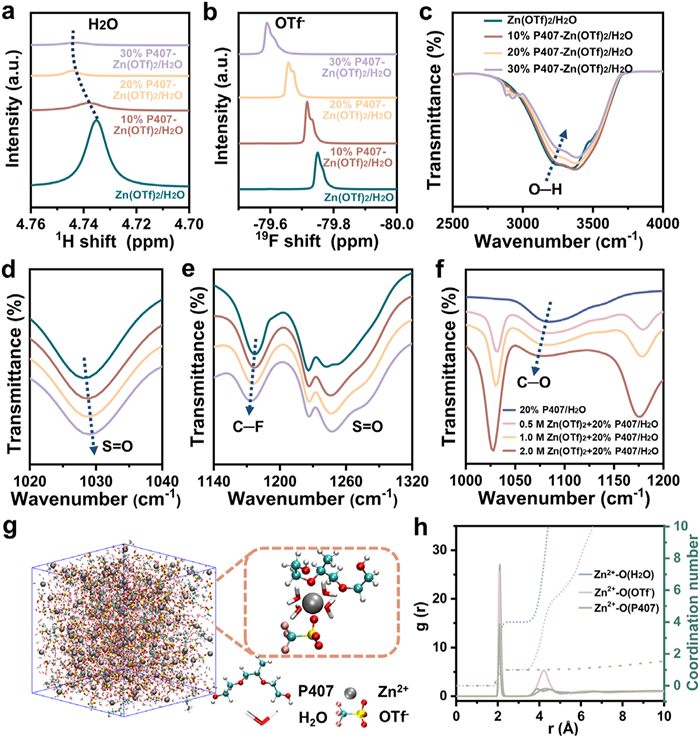
The intermolecular interactions within the electrolytes were systematically investigated using various spectroscopic techniques. Figs. 1a and b revealed nuclear magnetic resonance (NMR) spectra [32,33]. When P407 was added to the Zn(OTf)2/H2O, the 1H NMR peak of H2O molecules gradually shifted downfield from 4.735 ppm to 4.744 ppm, which indicated a decrease in electron cloud density around the hydrogen atoms of H2O arising from their HB interactions with P407. Additionally, the 19F NMR peak of OTf− anions shifted downfield from −79.752 ppm (in Zn(OTf)2/H2O) to −79.593 ppm (in 30% P407-Zn(OTf)2/H2O), which is attributed to an enhanced pairing interaction between OTf− and Zn2+ in the P407-Zn(OTf)2/H2O.
Figure 1
Figure 1.
Analysis of intermolecular interactions in electrolytes. (a) 1H NMR and (b) 19F NMR spectra of different electrolytes. FTIR spectra of different electrolytes (c) between 2500 cm−1 and 4000 cm−1, (d) between 1020 cm−1 and 1040 cm−1, and (e) between 1140 cm−1 and 1320 cm−1. (f) FTIR spectra of electrolytes with different concentrations of Zn(OTf)2 added to 20% P407/H2O. (g) MD simulation snapshot and (h) RDFs and the corresponding coordination numbers in 20% P407-Zn(OTf)2/H2O.
Fourier-transform infrared (FTIR) spectroscopy further elucidated the interactions among electrolyte components and the evolution of Zn2+ solvation environments [34]. As depicted in Fig. 1c and Fig. S1 (Supporting information), the O−H stretching vibration in Zn(OTf)2/H2O appeared as a broad band in the 3000−3800 cm−1 range, corresponding to three distinct states of H2O molecules: Network water (NW) at around 3205 cm−1, intermediate water (IW) at around 3412 cm−1, and multiple water (MW) at around 3564 cm−1 [35]. As P407 concentration increased, the proportion of NW decreased significantly, implying that the introduction of P407 disrupted the strong HB network among H2O molecules while strengthening HB between P407 and H2O. Additionally, a blue shift in the O−H bending vibration in the 1600−1700 cm−1 range suggested the formation of HB between P407 and H2O (Fig. S2a in Supporting information). To exclude the influence of Zn2+, FTIR spectra were also recorded for P407/H2O solutions without zinc salts (Fig. S3 in Supporting information). The results demonstrated that, as the P407 concentration increased, the O−H bending vibration peak shifted to higher wavenumbers, confirming the interaction between P407 and H2O. This reconstructed strong HB network reduced H2O activity, beneficial for suppressing HER and associated side reactions. In addition, as shown in Fig. 1d, the S=O stretching vibration of OTf− around 1028 cm−1 exhibited a blue shift upon P407 addition, indicating that P407 could modulate the coordination environment of OTf−. The changes in the S=O and C−F bond vibrations further indicated that P407 allowed the incorporation of OTf− into the Zn2+ solvation sheath. Additionally, Raman spectra further confirmed these findings, showing similar trends in the vibration changes of the S=O and C−F bonds (Fig. 1e, Figs. S2b and S4 in Supporting information). Moreover, the gradual introduction of P407 to the Zn(OTf)2/H2O system resulted in a red shift of the C−O stretching vibration of P407 (Fig. 1f), suggesting that P407 was incorporated into the Zn2+ solvation sheath. The overall data indicated that P407 led to forming a new HB network with H2O molecules, meanwhile, replacing some coordinated H2O molecules and constructing a stable composite solvation sheath consisting of P407, OTf−, and H2O.
To gain deeper insights of the influence of P407 on the solvation structure of Zn2+, molecular dynamics (MD) simulations were performed for two different electrolyte systems [36]. As depicted in Fig. S5 (Supporting information), the Zn(OTf)2/H2O initially contained six H2O molecules in the primary solvation shell (PSS) of Zn2+. However, in the 20% P407-Zn(OTf)2/H2O, both OTf– and P407 partially replaced H2O molecules in the Zn2+-PSS (Fig. 1g). Radial distribution functions (RDFs) showed that in the 20% P407-Zn(OTf)2/H2O electrolyte, three Zn2+−O peaks corresponding to H2O, OTf− and P407 appeared around 2.08 Å. The average coordination numbers of Zn2+ with H2O, OTf−, and P407 in the Zn2+−PSS were 3.97, 0.96, and 1.02, respectively (Fig. 1h). These findings confirmed that the introduction of P407 significantly altered the Zn2+ solvation structure, resulting in a reduction in solvated H2O content. This restructured solvation configuration decreased H2O activity, which was crucial for suppressing HER and improving electrochemical performance. Furthermore, the incorporation of anion and organic molecule into the Zn2+ solvation shell facilitated the formation of SEI during the Zn plating process, as detailed in the following sections.
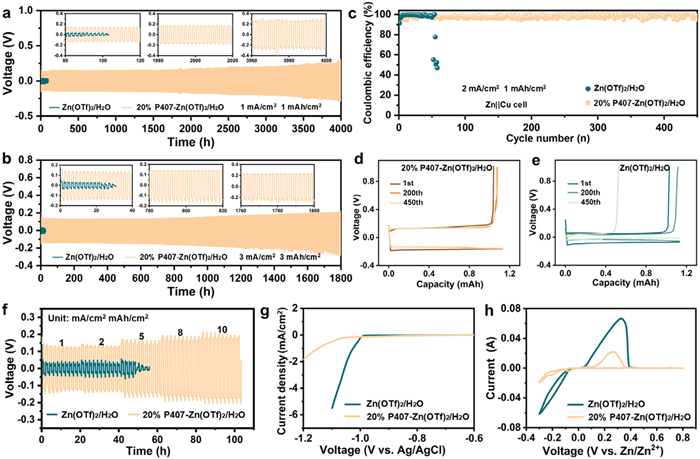
The P407 additive significantly mitigated side reactions on the Zn foil surface prior to cell operation. It was revealed that after 5 days of immersion in Zn(OTf)2/H2O electrolyte, the Zn foil surface was severely corroded and covered with by-products. In contrast, the Zn foil soaked in 20% P407-Zn(OTf)2/H2O electrolyte retained a smooth surface with trace residues, highlighting P407’s role in stabilizing Zn foil and reducing pre-operational degradation (Fig. S6 in Supporting information) [37]. To evaluate the impact of P407 on battery performance, electrochemical measurements were conducted using Zn||Zn symmetric and Zn||Cu asymmetric cells. The optimal P407 concentration in Zn(OTf)2/H2O was 20%, which provided the best electrochemical stability (Fig. S7 in Supporting information). Fig. 2a showed the galvanostatic cycling performance of Zn||Zn symmetric cells in Zn(OTf)2/H2O and 20% P407-Zn(OTf)2/H2O electrolytes. At 1 mA/cm2 and 1 mAh/cm2, the introduction of P407 significantly improved the cycling stability, allowing the cell to operate for over 4000 h without noticeable voltage hysteresis, greatly outperforming the Zn(OTf)2/H2O, which failed after 100 h. The time-voltage profile further verified the stable operation of the cell during long-term plating/stripping processes (insets in Fig. 2a). Additionally, the introduction of P407 increased the Zn2+ plating/stripping potential, primarily due to a reduction in ionic conductivity (Fig. S8 in Supporting information). Even at a higher current density of 3 mA/cm2, the Zn||Zn symmetric cell with 20% P407-Zn(OTf)2/H2O exhibited stable cycling for over 1800 h, while the cell with Zn(OTf)2/H2O failed after approximately 20 h (Fig. 2b). Importantly, at more demanding conditions (5 mA/cm2 and 5 mAh/cm2), the Zn||Zn symmetric cell with 20% P407-Zn(OTf)2/H2O still maintained stable operation for up to 500 h, as shown in Fig. S9 (Supporting information), demonstrating its great potential for practical applications.
Figure 2
Figure 2.
Electrochemical performance of Zn anodes. Long-term constant current cycling performance of Zn||Zn symmetric cells using two electrolytes at (a) 1 mA/cm2 and 1 mAh/cm2, and (b) 3 mA/cm2 and 3 mAh/cm2. Insets show magnified views of the voltage profiles. (c) CE of Zn deposition/stripping in Zn||Cu asymmetric cells using two electrolytes at 2 mA/cm2 and 1 mAh/cm2. The corresponding voltage curves at different cycle numbers in Zn||Cu asymmetric cells using (d) 20% P407-Zn(OTf)2/H2O and (e) Zn(OTf)2/H2O electrolytes. (f) Rate performance of Zn||Zn symmetric cells using two electrolytes at current densities from 1 mA/cm2 to 10 mA/cm2. (g) LSV curves of two electrolytes. (h) CV curves showing Zn nucleation behavior on Cu cathodes in Zn||Cu asymmetric cells in two electrolytes.
Subsequently, Zn||Cu asymmetric cells were tested to evaluate the reversibility of Zn deposition/stripping. At 2 mA/cm2 and 1 mAh/cm2, the Zn||Cu cell with Zn(OTf)2/H2O short-circuited after 50 cycles, whereas the cell with 20% P407-Zn(OTf)2/H2O exhibited significantly improved stability, with a cycling lifespan exceeding 450 cycles (Fig. 2c). The cell with 20% P407-Zn(OTf)2/H2O maintained a high CE of 99.2% after 450 cycles (Fig. 2d), while the cell with Zn(OTf)2/H2O failed prematurely (Fig. 2e). Even under higher current density (4 mA/cm2) and capacity (2 mAh/cm2), the reversibility of Zn deposition/stripping remained excellent, achieving over 300 cycles with an average CE of 99.1% (Fig. S10 in Supporting information). Moreover, the introduction of P407 also significantly enhanced the rate performance of Zn||Zn symmetric cells (Fig. 2f and Fig. S11 in Supporting information). The cell with Zn(OTf)2/H2O short-circuited when the current density increased to 5 mA/cm2, whereas the cell with 20% P407-Zn(OTf)2/H2O consistently exhibited stable voltage polarization and excellent rate performance.
The introduction of P407 reduced H2O activity, and its effect on HER suppression was investigated using linear sweep voltammetry (LSV). As shown in Fig. 2g, the addition of 20% P407 to the Zn(OTf)2/H2O significantly broadened the voltage window, which indicated effective HER inhibition. The superiority of the P407 additive was also manifested by the Tafel plots (Fig. S12 in Supporting information). Adding P407 to Zn(OTf)2/H2O electrolyte reduced the corrosion current of Zn and increased the corrosion potential from −0.897 V to −0.894 V, indicating improved compatibility and less corrosion on the Zn anode. Additionally, the nucleation overpotential in Zn||Cu asymmetric cells using 20% P407-Zn(OTf)2/H2O shifted to a more negative value (Fig. 2h). This shift indicated that P407 facilitated the Zn deposition layer with smaller grain sizes, which enhanced the deposition stability [38]. Such results ultimately contributed to a dendrite-free Zn anode, enhancing both performance and safety.
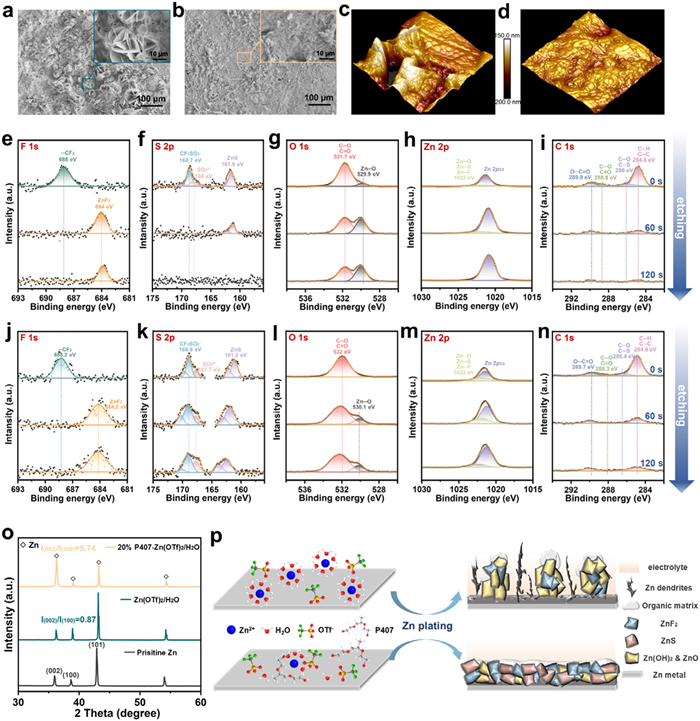
To evaluate the effect of the modified electrolyte on Zn deposition and Zn anode protection, the morphological evolution of Zn anodes was characterized using scanning electron microscopy (SEM), atomic force microscopy (AFM), and 3D digital microscopy. After 50 cycles, Zn deposits in the Zn(OTf)2/H2O exhibited uneven distribution, with sheet-like dendrites and hexagonal by-products (Fig. 3a). In contrast, Zn anode in the 20% P407-Zn(OTf)2/H2O displayed a smooth, dendrite-free surface with minimal signs of corrosion (Fig. 3b). Furthermore, AFM analysis revealed significant surface roughness in Zn(OTf)2/H2O due to severe dendrite growth, whereas 20% P407-Zn(OTf)2/H2O resulted in minor protrusions and reduced roughness (Figs. 3c and d, Fig. S13 in Supporting information) [39]. These findings demonstrated that the introduction of P407 effectively suppressed Zn dendrite growth, promoting a more stable and uniform Zn anode morphology.
Figure 3
Figure 3.
Structural evolution of Zn anodes and interface chemistry. (a, b) SEM and (c, d) AFM images of Zn anodes after cycling for 100 h at 1 mA/cm2 and 1 mAh/cm2 in two electrolytes. XPS spectra of the cycled Zn anodes (e−i) in Zn(OTf)2/H2O and (j−n) in 20% P407-Zn(OTf)2/H2O. (o) XRD pattern of the cycled Zn anodes in two electrolytes. (p) Dendrites and side reactions on the Zn anode in Zn(OTf)2/H2O and SEI of Zn anode in 20% P407-Zn(OTf)2/H2O.
To further investigate interfacial chemical characteristics, Ar+ sputtering X−ray photoelectron spectroscopy (XPS) was used to analyze Zn anodes after 20 cycles in the two electrolytes. Before sputtering, the SEI layers in both electrolytes contained −CF3 and −SO3 components, originating from the partial decomposition of OTf⁻ or trace salt residues. As shown in Figs. 3e and j, as sputtering proceeded, F 1s spectra (~684.2 eV) revealed significantly higher ZnF2 content in the SEI formed in 20% P407-Zn(OTf)2/H2O, indicating a denser and more uniform structure compared to that in Zn(OTf)2/H2O. Meanwhile, the S 2p spectrum revealed the presence of ZnS (~161.5 eV) and ZnSO3 (~168.0 eV) as the main components of the SEI in 20% P407-Zn(OTf)2/H2O, while Zn(OTf)2/H2O showed a substantial decrease in the ZnS signal with sputtering (Figs. 3f and k). This related to the solvation structure of 20% P407-Zn(OTf)2/H2O, where OTf⁻ integrated into the solvation shell and decomposed at the Zn-electrolyte interface, forming these components. The higher ZnF2 and ZnS content contributed to enhanced corrosion resistance [40]. The O 1s spectra highlighted differences in stability between the SEI layers. In Zn(OTf)2/H2O, the high Zn(OH)2/ZnO content indicated that irreversible side reactions hindered SEI stability (Fig. 3g). Conversely, 20% P407-Zn(OTf)2/H2O resulted in significantly lower Zn(OH)2/ZnO content, forming a more robust and stable SEI (Fig. 3l). Moreover, as shown in Figs. 3h and m, Zn 2p spectra also showed higher Zn2+ content in the SEI of the 20% P407-Zn(OTf)2/H2O, suggesting a dense, uniform SEI enriched with a substantial amount of zinc compounds. Additionally, C 1s spectra identified organic components, including C−H/C−C, C−S/C−O, and ZnCO3, derived from the electrochemical decomposition of P407 and OTf− (Figs. 3i and n). These organic materials were concentrated at the SEI surface and diminished rapidly with sputtering, suggesting that these materials were primarily localized at the SEI surface.
Additionally, XRD analysis was employed to investigate the crystallographic difference of the deposited Zn products in the two electrolytes (Fig. 3o). In Zn(OTf)2/H2O, Zn deposition showed no clear preference for orientation, while Zn deposition in 20% P407-Zn(OTf)2/H2O exhibited a significantly enhanced (002) peak. Quantitative analysis showed that the I(002)/I(100) ratio increased from 0.87 to 5.74, indicating a preferential Zn deposition along the (002) crystal plane in the 20% P407-Zn(OTf)2/H2O. This suggested that the organic-inorganic hybrid SEI layer formed a stable interface that promoted Zn deposition and preferential growth of the (002) crystal plane [41]. This preferential orientation along the (002) plane facilitated uniform Zn deposition [42], resulting in a smooth, dendrite-free surface, as observed in the SEM images. In conclusion, Zn(OTf)2/H2O resulted in severe dendrite growth, uneven morphology, and an unstable SEI dominated by Zn(OH)2/ZnO. However, the solvation structure of the 20% P407-Zn(OTf)2/H2O electrolyte led to the decomposition of P407 and the OTf−, resulting in the in situ formation of a hybrid SEI with an organic-rich outer layer and an inorganic-rich inner layer comprising ZnF2 and ZnS. This hybrid structure ensured uniform Zn deposition, enhanced stability, and better cycling performance (Fig. 3p).
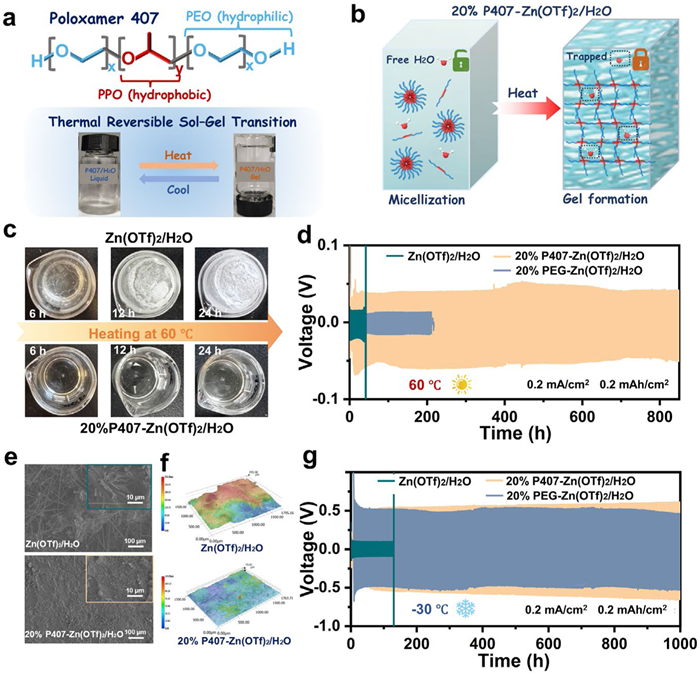
Interestingly, P407 exhibits thermoreversible gelation properties. As shown in Fig. 4a, P407 is a block copolymer containing hydrophilic polyethylene glycol (PEO) segments and hydrophobic polypropylene glycol (PPO) segments. This structure allows P407 to transition between liquid and gel states with temperature changes. At low temperature, P407 aggregates into micelles, with PEO segments forming HB with H2O molecules, thereby maintaining the system in a liquid state. As the temperature increases, these HB break, and PPO segments aggregate into a network structure via hydrophobic interactions, thus transforming into a gel [43]. Experiments were conducted to evaluate the phase states of the 20% P407-Zn(OTf)2/H2O electrolyte at room and high temperatures. As shown in Fig. S14 (Supporting information), the liquid electrolyte transitioned into a gel as the temperature increased from room temperature to 90 ℃. This result confirmed that the 20% P407-Zn(OTf)2/H2O electrolyte retained the thermosensitive properties. At low temperature, as illustrated in Fig. 4b, the electrolyte remained in solution, allowing molecules to migrate freely. At higher temperature, the formed network structures immobilized H2O, enhancing the electrolyte’s thermal adaptability by restricting molecular movement. In the high-temperature water retention experiment, the water in Zn(OTf)2/H2O gradually evaporated over time, leaving only zinc salt solids behind. In contrast, 20% P407-Zn(OTf)2/H2O retained water consistently and stably over an extended period, allowing it to continue operating normally at high temperatures (Fig. 4c). At −30 ℃, Zn(OTf)2/H2O and 20% P407-Zn(OTf)2/H2O electrolytes remained in a liquid state without freezing (Fig. S15 in Supporting information), indicating good ionic conductivities under low temperatures. This allowed 20% P407-Zn(OTf)2/H2O stable operation over a wide temperature range. For comparison, polyethylene glycol (PEG), which only contained ethylene glycol segments with a similar molecular weight as P407 was added to Zn(OTf)2/H2O electrolyte. As shown in Fig. S16 (Supporting information) and Fig. 4g, both P407 and PEG produced similar effects on the electrochemical performance of the electrolytes, resulting in comparable cycling stability at 30 ℃ and −30 ℃. However, at 60 ℃, the 20% P407-Zn(OTf)2/H2O electrolyte demonstrated superior electrochemical stability and much longer cycle life than 20% PEG-Zn(OTf)2/H2O electrolyte (Fig. 4d). This result could be attributed to that PEG lacked thermoreversible gelation properties, resulting in a markedly different H2O behavior in the 20% PEG-Zn(OTf)2/H2O (Fig. S17 in Supporting information). At low temperature, H2O molecules exhibited low kinetic energy, while at higher temperature, the molecules became more active and more prone to evaporation. As a result, the 20% P407-Zn(OTf)2/H2O electrolyte exhibited greater stability and less molecular motion at high temperature compared to the 20% PEG-Zn(OTf)2/H2O electrolyte, confirming the stabilizing effect of P407. To ensure the rigor of our conclusions, we also selected a polymer containing PEO-PPO diblocks for comparison, yielding similar results (Fig. S18 in Supporting information).
Figure 4
Figure 4.
Mechanism of P407-enhanced high-temperature stability. (a) The structure of poloxamer 407 and its thermal reversible property. (b) Diagram of physical states and H2O dynamic behavior of 20% P407-Zn(OTf)2/H2O electrolytes at 30 ℃ and 60 ℃. (c) Digital images of Zn(OTf)2/H2O and 20% P407-Zn(OTf)2/H2O electrolytes after being heated at 60 ℃ for different durations. Long-term constant current cycling performance of Zn||Zn symmetric cells using three electrolytes at (d) 60 ℃ and (g) −30 ℃. (e) SEM and (f) 3D digital microscopy images of Zn anodes after cycling in two electrolytes for 100 h at 1 mA/cm2, 1 mAh/cm2 and 60 ℃.
Specifically regarding 20% P407-Zn(OTf)2/H2O, Zn||Zn symmetric cells and Zn||Cu asymmetric cells were assembled to test the cycling stability and reversibility of the Zn anode in harsh environments. As shown in Fig. 4d, at 60 ℃, the Zn||Zn symmetric cell with 20% P407-Zn(OTf)2/H2O exhibited a lifespan of 850 h at 0.2 mA/cm2 and 0.2 mAh/cm2, while the cell with Zn(OTf)2/H2O short-circuited after just 45 h of plating/stripping. Moreover, even at −30 ℃, the Zn||Zn symmetric cell with 20% P407-Zn(OTf)2/H2O maintained stable performance for 1000 h, while the Zn(OTf)2/H2O cell failed after only 130 h (Fig. 4g). These results indicated that the introduction of P407 significantly enhanced the stability of the Zn anode under both standard and extreme conditions. To further assess the influence of P407 on reversibility, CE of Zn||Cu asymmetric cells was evaluated at both high and low temperatures. At 60 ℃, the CE of the cell with Zn(OTf)2/H2O dropped sharply to 0 after 45 cycles (Fig. S19 in Supporting information), primarily due to severe side reactions such as HER, corrosion, and accelerated electrode-electrolyte interface polarization. Encouragingly, the cell with 20% P407-Zn(OTf)2/H2O exhibited a much higher CE, maintaining an average CE of 92.0% over 80 cycles, with consistent voltage profiles at a current density of 0.4 mA/cm2. Even at −30 ℃, the cell with 20% P407-Zn(OTf)2/H2O achieved CE of 93.8% over more than 500 plating/stripping cycles (Fig. S20 in Supporting information), with stable voltage profiles. These results indicated that the 20% P407-Zn(OTf)2/H2O electrolyte exhibited excellent cycling stability and reversibility across a wide temperature range.
Subsequently, comparisons of the Zn anode surface morphology after 50 cycles at both high and low temperatures confirmed the beneficial effects of P407 (Figs. 4e and f, Figs. S21 and S22 in Supporting information). At 60 ℃, SEM images of the Zn anode in Zn(OTf)2/H2O exhibited significant dendrite growth, whereas the Zn anode in the 20% P407-Zn(OTf)2/H2O electrolyte displayed a much more uniform surface. AFM and 3D microscopy also demonstrated a significant reduction in surface roughness of the Zn anode with the introduction of P407. Similar results were observed at −30 ℃. Additionally, as shown in Fig. S23 (Supporting information), the XRD results further demonstrated that the P407-containing electrolyte facilitated preferential Zn deposition on the (002) crystal plane, which helped improve the performance of the Zn anode. In conclusion, the 20% P407-Zn(OTf)2/H2O electrolyte showed excellent stability and adaptability across a wide temperature range. It improved Zn anode stability, reduced dendrite formation, enhanced reversibility, and ensured electrochemical stability. The introduction of P407 greatly boosted performance under both standard and extreme conditions, making it promising for advanced electrochemical applications.
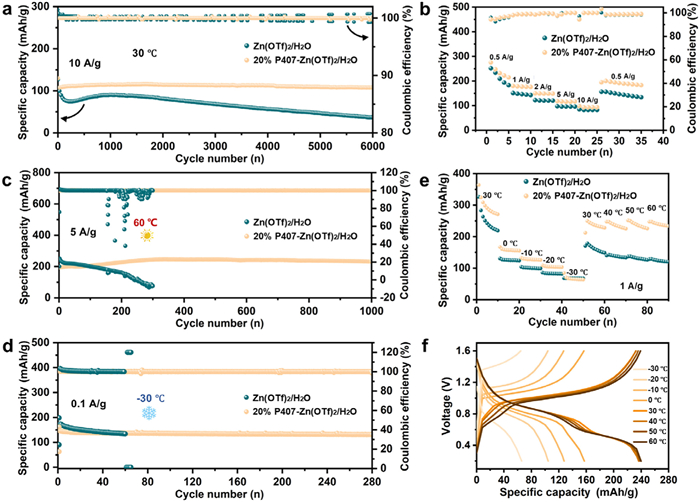
Finally, to evaluate the practicality of the 20% P407-Zn(OTf)2/H2O electrolyte in AZIBs, Zn-V2O5 full cells were assembled. As shown in Fig. S24 (Supporting information), cyclic voltammetry (CV) curves of Zn-V2O5 full cells using Zn(OTf)2/H2O and 20% P407-Zn(OTf)2/H2O electrolytes were measured at a scan rate of 0.1 mV/s. Both CV curves exhibited two pairs of redox peaks with similar shapes [44]. Subsequently, Zn-V2O5 full cells were tested across a wide temperature range. At 30 ℃, the full cell with 20% P407-Zn(OTf)2/H2O achieved a specific capacity of 114.2 mAh/g at 10 A/g, retaining 94.2% of capacity after 6000 cycles (Fig. 5a). In comparison, the cell with Zn(OTf)2/H2O exhibited severe capacity decline after 1000 cycles, retaining only 31.9% after 6000 cycles due to Zn dendrite growth and persistent side reactions. As shown in Fig. 5b and Fig. S25 (Supporting information), the 20% P407-Zn(OTf)2/H2O electrolyte also exhibited excellent rate performance, achieving discharge capacities of 231.9, 177.1, 148.3, 115.3, and 93.1 mAh/g at current densities of 0.5, 1, 2, 5, and 10 A/g, respectively. When the current density returned to 0.5 A/g, the capacity fully recovered, highlighting highly reversible Zn plating/stripping and rapid Zn2+ storage processes. The temperature adaptability of the full cell was further tested. At 60 ℃, the full cell with 20% P407-Zn(OTf)2/H2O maintained stable cycling for 1000 cycles at 5 A/g, with a capacity retention of 94.3% (Fig. 5c). In contrast, the Zn(OTf)2/H2O cell failed after 300 cycles due to accelerated Zn dendrite growth and aggravated side reactions. Even at −30 ℃, the full cell with 20% P407-Zn(OTf)2/H2O retained 90.3% capacity after 280 cycles, demonstrating excellent low-temperature performance (Fig. 5d). Additionally, the 20% P407-Zn(OTf)2/H2O full cell exhibited remarkable capacity stability during temperature fluctuations. As the temperature decreased from 30 ℃ to −30 ℃ and then returned to 30 ℃, the cell maintained stable capacity retention, fully recovering its capacity upon rewarming. Its capacity also increased with temperature, reaching ~240 mAh/g at 60 ℃ (Figs. 5e and f). In contrast, the Zn(OTf)2/H2O full cell failed to recover its capacity after operation at low temperature and showed significant capacity degradation at higher temperature (Fig. S26 in Supporting information). These findings confirmed the superior adaptability of the 20% P407-Zn(OTf)2/H2O electrolyte across extreme conditions. Its excellent thermal and freeze resistance, combined with improved Zn dendrite suppression and enhanced cycling stability, demonstrating its potential for advanced AZIBs applications over a broad temperature range (−30 ℃ to 60 ℃).
Figure 5
Figure 5.
Electrochemical performance of Zn-V2O5 full cells over a wide temperature range. (a) Cycling stability and CE of Zn-V2O5 full cells with two electrolytes at 10 A/g and 30 ℃. (b) Rate performance of the Zn-V2O5 full cells with two electrolytes. Cycling stability and CE of Zn-V2O5 full cells with two electrolytes at (c) 5 A/g and 60 ℃, and (d) 0.1 A/g and −30 ℃. (e) Specific capacity of Zn-V2O5 full cells at 1 A/g under different temperatures. (f) Charge/discharge curves of the Zn||20% P407-Zn(OTf)2/H2O||V2O5 full cell at different temperatures.
In conclusion, P407 is introduced as an effective electrolyte additive to address the critical challenges associated with Zn anodes in AZIBs, offering a promising strategy for achieving wide-temperature performance. P407 facilitates the reconstruction of the solvation structure and regulation of H2O cluster behavior, enabling the in situ formation of a stable and highly conductive organic-inorganic hybrid SEI layer on the Zn anode surface. This approach promotes uniform Zn deposition, suppresses dendrite growth, and effectively mitigates H2O-related side reactions, thereby stabilizing the Zn-electrolyte interface. Additionally, the thermoreversible gelation property of P407 provides dual benefits: at high temperature, its crosslinked network structure retains H2O molecules and minimizes evaporation, while at low temperature, it transitions to a liquid state to ensure efficient ion transport. With the modified electrolyte, Zn||Zn symmetric cell achieves stable cycling for over 4000 h, and Zn||Cu asymmetric cell exhibits a CE of up to 99.2% at 30 ℃. Additionally, Zn-V2O5 full cell demonstrates excellent cycling stability and capacity retention across a wide temperature range from −30 ℃ to 60 ℃. This study presents an innovative additive formulation that not only significantly enhances the interfacial stability and practicality of AZIBs but also provides valuable insights into the development of wide-temperature, high-performance aqueous energy storage systems. Moreover, this strategy shows strong potential for application in other wide-temperature aqueous metal-ion batteries, paving the way for the broader adoption of aqueous rechargeable energy storage technologies.
Declaration of competing interest
The authors declare that they have no known competing financial interests or personal relationships that could have appeared to influence the work reported in this paper.
This work was supported by the Guangdong Basic and Applied Basic Research Foundation (No. 2024A1515010158); the Guangzhou Science and Technology Programme (No. 2024A04J4281); the Young Talent Support Project of Guangzhou Association for Science and Technology; Gansu Provincial Key R & D Program Project-Industrial Projects (No. 24YFGA010) and the Western Young Scholars Foundations of Chinese Academy of Sciences.
Supplementary materials
Supplementary material associated with this article can be found, in the online version, at doi:10.1016/j.cclet.2025.110952.
[1]
M. Chen, Y. Gong, Y. Zhao, et al., Nat. Sci. Rev. 11 (2024) nwae205. doi: 10.1093/nsr/nwae205
Figure 1
Analysis of intermolecular interactions in electrolytes. (a) 1H NMR and (b) 19F NMR spectra of different electrolytes. FTIR spectra of different electrolytes (c) between 2500 cm−1 and 4000 cm−1, (d) between 1020 cm−1 and 1040 cm−1, and (e) between 1140 cm−1 and 1320 cm−1. (f) FTIR spectra of electrolytes with different concentrations of Zn(OTf)2 added to 20% P407/H2O. (g) MD simulation snapshot and (h) RDFs and the corresponding coordination numbers in 20% P407-Zn(OTf)2/H2O.
Figure 2
Electrochemical performance of Zn anodes. Long-term constant current cycling performance of Zn||Zn symmetric cells using two electrolytes at (a) 1 mA/cm2 and 1 mAh/cm2, and (b) 3 mA/cm2 and 3 mAh/cm2. Insets show magnified views of the voltage profiles. (c) CE of Zn deposition/stripping in Zn||Cu asymmetric cells using two electrolytes at 2 mA/cm2 and 1 mAh/cm2. The corresponding voltage curves at different cycle numbers in Zn||Cu asymmetric cells using (d) 20% P407-Zn(OTf)2/H2O and (e) Zn(OTf)2/H2O electrolytes. (f) Rate performance of Zn||Zn symmetric cells using two electrolytes at current densities from 1 mA/cm2 to 10 mA/cm2. (g) LSV curves of two electrolytes. (h) CV curves showing Zn nucleation behavior on Cu cathodes in Zn||Cu asymmetric cells in two electrolytes.
Figure 3
Structural evolution of Zn anodes and interface chemistry. (a, b) SEM and (c, d) AFM images of Zn anodes after cycling for 100 h at 1 mA/cm2 and 1 mAh/cm2 in two electrolytes. XPS spectra of the cycled Zn anodes (e−i) in Zn(OTf)2/H2O and (j−n) in 20% P407-Zn(OTf)2/H2O. (o) XRD pattern of the cycled Zn anodes in two electrolytes. (p) Dendrites and side reactions on the Zn anode in Zn(OTf)2/H2O and SEI of Zn anode in 20% P407-Zn(OTf)2/H2O.
Figure 4
Mechanism of P407-enhanced high-temperature stability. (a) The structure of poloxamer 407 and its thermal reversible property. (b) Diagram of physical states and H2O dynamic behavior of 20% P407-Zn(OTf)2/H2O electrolytes at 30 ℃ and 60 ℃. (c) Digital images of Zn(OTf)2/H2O and 20% P407-Zn(OTf)2/H2O electrolytes after being heated at 60 ℃ for different durations. Long-term constant current cycling performance of Zn||Zn symmetric cells using three electrolytes at (d) 60 ℃ and (g) −30 ℃. (e) SEM and (f) 3D digital microscopy images of Zn anodes after cycling in two electrolytes for 100 h at 1 mA/cm2, 1 mAh/cm2 and 60 ℃.
Figure 5
Electrochemical performance of Zn-V2O5 full cells over a wide temperature range. (a) Cycling stability and CE of Zn-V2O5 full cells with two electrolytes at 10 A/g and 30 ℃. (b) Rate performance of the Zn-V2O5 full cells with two electrolytes. Cycling stability and CE of Zn-V2O5 full cells with two electrolytes at (c) 5 A/g and 60 ℃, and (d) 0.1 A/g and −30 ℃. (e) Specific capacity of Zn-V2O5 full cells at 1 A/g under different temperatures. (f) Charge/discharge curves of the Zn||20% P407-Zn(OTf)2/H2O||V2O5 full cell at different temperatures.


 DownLoad:

 下载:
下载:


 下载:
下载:

