
Scheme 1.
Depiction of the different C2H2 and CO2 separation behavior in pillar–layered MOFs constructed by (a) aromatic and (b) aliphatic linkers.

Delicate pore environment regulation in pillar–layered metal–organic frameworks for enhanced C2H2/CO2 separation
Nan Lu , Lan Lan , Qiang Gao , Ming Liu , Tong-Liang Hu , Na Li , Xian-He Bu


Acetylene (C2H2), as a key raw petrochemical material, is widely applied in manufacturing worthy chemical commodities such as acetaldehyde, acetic acid, and 1,4-butynediol [1–3]. However, carbon dioxide (CO2) is the inevitable by-product of the acetylene industrial production process, and the existence of CO2 will cut down energy conversion efficiency [4,5]. Owing to the identical molecular kinetic diameter and similar physical properties between CO2 and C2H2 (Table S1 in Supporting information) [6–8], obtaining high-purity acetylene (>99%) to manufacture valuable chemicals is relatively energy-intensive in the industry [9,10]. Consequently, developing energy-saving, cost-efficient, and environmentally friendly substitutive approaches is essential for C2H2 purification.
Porous physical adsorbents-based gas adsorptive separation can realize energy-efficient economy and operability, which has attracted the immense attention of researchers [11–13]. Metal–organic frameworks (MOFs) exhibit tunable pore structure, shape, and size [14], which provide numerous opportunities to create unique conditions for gas adsorption and separation. Pillar–layered MOFs (PL-MOFs) constructed from two-dimensional (2D) layers and adjustable pillars have great potential for C2H2 and CO2 separation via delicate pore environment regulation [15–17]. To date, a pillar-layered strategy [18,19] utilizing the selection of different pillars with distinct chemical properties, has been applied in pore environment control of PL-MOFs to obtain the anticipatory pore environment for the optimization of C2H2/CO2 separation [18]. Previous studies have proven that tuning the pillar length and derivatization is capable of manipulating the pore size and pore environment for task-specific gas separation [19,20]. However, most of the pillars are confined to aromatic linkers due to the characteristics of structural stability and easy functionalization [21]. Compared to aromatic linkers, aliphatic linkers possess desirable features such as steric effect, nonaromaticity, and saturated C—H groups [22,23], are expected to expand the kinds of MOF and conducive to create a low-polar pore chemical environment, which generates distinct host-guest interactions for distinguishing specific gas molecules [21,24,25]. So far, the study on the kind of host-guest interactions and the mechanism of adsorption between gas and aliphatic linkers are still scarce.
In light of these considerations, based on the tunability of PL-MOFs, we chose Ni(btc)(pyz) (named Ni-MOF-1; H3btc = 1,3,5-benzene tricarboxylic acid; pyz = pyrazine) as a prototype MOF [26], which has verified the ability to remove trace CO2 from C2H2/CO2 mixture [27]. Inspired by abundant saturated C—H groups of the aliphatic ligand 1,4-diazabicyclo[2.2.2]octane (dabco), we speculate that tuning pillars from pyz to dabco may create an unusual aliphatic chemical environment, pore size, structural rigidity, and enhanced adsorption performance toward C2H2/CO2 separation (Scheme 1) [25,28]. In this regard, Ni(btc)(dabco) (termed Ni-MOF-2) is successfully obtained based on reticular chemistry [29]. As expected, Ni-MOF-2 not only exhibits the relatively high C2H2 capacity over CO2 and 3.5-fold strengthened selectivity but also realizes a complete splitting of equimolar C2H2/CO2 mixture (Scheme 1b). In addition, separation performance and regeneration stability for equimolar C2H2/CO2 mixture of Ni-MOF-2 were testified by the dynamic breakthrough experiments. Theoretical calculations reveal that host-guest interaction is converted from hydrogen bonding interaction to van der Waals (vdW) interaction and the saturated C—H groups of dabco serve as primary adsorption sites to interact with C2H2. The enhanced C2H2/CO2 selectivity, low regeneration energy, and cyclic stability suggest that Ni-MOF-2 is a promising porous adsorbent for C2H2/CO2 separation.
Ni-MOF-1 and Ni-MOF-2 are both obtained by the post-synthetic ligand exchange (PSLE) method [26,30,31]. They are two isostructural PL-MOFs constructed from the same 2D layers and different pillars (Figs. 1a–e). In the 2D layers, each Ni2+ ion coordinates with four O atoms from three btc ligands to form hexagon pores (Figs. S1 and S2 in Supporting information). Then, pyz and dabco as pillars (Figs. 1b and c) connect adjacent 2D layers (Fig. 1a) stacking up and down to generate three-dimensional (3D) frameworks of Ni-MOF with the same hms topology (Figs. 1d and e, Table S2 in Supporting information). Ni-MOF-1 and Ni-MOF-2 show hexagonal-prism cages with pore apertures of 6.9 Å × 7.3 Å [32] and 7.0 Å × 8.0 Å, respectively (Figs. 1f and g), which is consistent with pore size distribution (Fig. S7b in Supporting information). The high phase purity of Ni-MOF-2 was verified by the bulk phase powder X-ray diffraction (PXRD) patterns (Fig S6 in Supporting information). The crystallinity of Ni-MOF-2 can remain after being soaked in common organic solvents for 24 h (Fig. S8 in Supporting information). The whole structure and crystallinity of Ni-MOF-2 survive up to 300 ℃, as verified by thermogravimetric analysis (TGA) (Fig. S9b in Supporting information) and variable temperature PXRD (VT-PXRD) (Fig. S10 in Supporting information). Compared to the thermal stability of Ni-MOF-1, the thermal robustness of Ni-MOF-2 is still preserved, implying the tiny impact of aliphatic pillars on the structural stability. The hexagonal-prism cages, chemical, and thermal stabilities of Ni-MOF-2 pave the way for gas separation.

The activated Ni-MOF-2 was prepared by heating at 150 ℃ for 12 h under a dynamic vacuum. Nitrogen (N2) gas sorption isotherms at 77 K Ni-MOF-2 show a typical type-Ⅰ sorption curve, indicating the microporous structure of Ni-MOF-2. As shown in Fig. S7a (Supporting information), the saturated N2 capacity of Ni-MOF-2 increased from 282.4 cm3/g [32] in Ni-MOF-1 to 351.6 cm3/g, aligning with the pore size derived from the single crystal structure. The calculated Brunauer–Emmett–Teller (BET) surface area of Ni-MOF-2 is 636.0 m2/g, slightly lower than the value of Ni-MOF-1 (686.0 m2/g) (Table S3 in Supporting information) [32]. Additionally, the effective free volume is also narrowed down from 52.8% in Ni-MOF-1 to 44% in Ni-MOF-2. The microporosity, high porosity, appropriate pore size, and additional saturated C—H groups of Ni-MOF-2 exhibit the potential to address the challenge of C2H2/CO2 separation.
To verify the effect of pillar modification on the adsorption of gas molecules, single-component adsorption isotherms of C2H2and CO2 for Ni-MOF were examined. As shown in Figs. 2a and b and Fig. S11 (Supporting information), at both 273 K and 298 K, Ni-MOF-1 prefers adsorbing C2H2 at low pressure but the higher CO2 capacity upon increasing the pressure. However, after pillar variation of Ni-MOF-1, Ni-MOF-2 demonstrates a higher C2H2 adsorption capacity than CO2 within the full pressure region, indicating the potential of Ni-MOF-2 for separating equimolar C2H2/CO2. Moreover, for the diminution of surface area and effective free volume, the saturated capacities of C2H2 and CO2 on Ni-MOF-2 at 298 K are reduced from 106.4 cm3/g and 128.2 cm3/g to 85.4 cm3/g and 75.1 cm3/g, respectively (Fig. 2b and Table S3), demonstrating the greater reduction of CO2 capacity and reversal of the interactions between frameworks and gas molecules after pore environment regulation. And the adsorption trend at 273 K of Ni-MOF is the same (Fig. 2a). Notably, the capacity of C2H2 of Ni-MOF-2 at 298 K and 1 bar is higher than ZJU-74a (76.0 cm3/g) [33], NKMOF-1-Ni (61.0 cm3/g) [34], and Cu(bpy)NP (50.7 cm3/g) [35], comparable to CuSnF6-dpds-cds (80.9 cm3/g) [1], and CAU-10-pydc (88.3 cm3/g) [36], and lower than NCU-100 (102.4 cm3/g) [5], and HIAM-111 (108.9 cm3/g) [37] under the same condition (Fig. 2e and Table S4 in Supporting information).
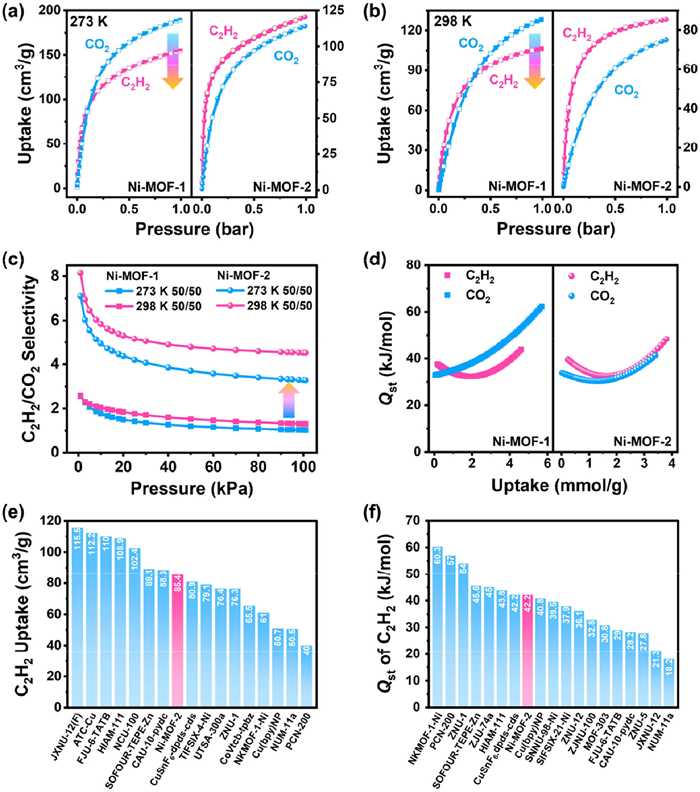
Subsequently, the ideal adsorbed solution theory (IAST) was employed to assess the adsorptive selectivity and evaluate the separation performance for equimolar C2H2/CO2 mixture on Ni-MOF-1 and Ni-MOF-2. As depicted in Fig. 2c, the equimolar C2H2/CO2 selectivity of Ni-MOF-1 is calculated as 1.0 and 1.3 at 273 K and 298 K and 100 kPa, respectively. Nevertheless, by virtue of switching pillars, Ni-MOF-2 exhibits a relatively high selectivity of 3.3 and 4.5 for equimolar C2H2/CO2 mixture, respectively, 3.3- and 3.5-fold higher than that of Ni-MOF-1, respectively, implying the enhanced separation potential of Ni-MOF-2 for equimolar C2H2/CO2. Meanwhile, the equimolar C2H2/CO2 selectivity of Ni-MOF-2 at 298 K outperforms that of some reported MOFs for C2H2/CO2, such as SNNU-98-Ni (3.3) [38], HIAM-111 (2.4) [37], and FJU-90 (4.3) (Table S4) [39].
To compare the binding affinity of Ni-MOF toward C2H2 and CO2, the isosteric heats of adsorption (Qst) were calculated (Fig. S13 in Supporting information). For Ni-MOF-1, Qst of C2H2 and CO2 were calculated to be 38.6 kJ/mol and 32.8 kJ/mol at zero coverage, respectively (Fig. 2d). And the Qst of C2H2 on Ni-MOF-2 is 42.2 kJ/mol, surpassing the Qst of CO2 on Ni-MOF-2 (32.2 kJ/mol) (Fig. 2d), exceeding that of ZNU-12 (36.1 kJ/mol) [2], and MOF-303 (30.8 kJ/mol) [36], inferior to SOFOUR-TEPE-Zn (45.6 kJ/mol) (Fig. 2f and Table S4) [8]. The appropriate Qst of C2H2 facilitates regeneration using a low energy penalty. Increased adsorption disparity of C2H2 and CO2, enhanced equimolar C2H2/CO2 selectivity, and moderate isosteric heat of adsorption make Ni-MOF-2 a prospective candidate for C2H2 purification.
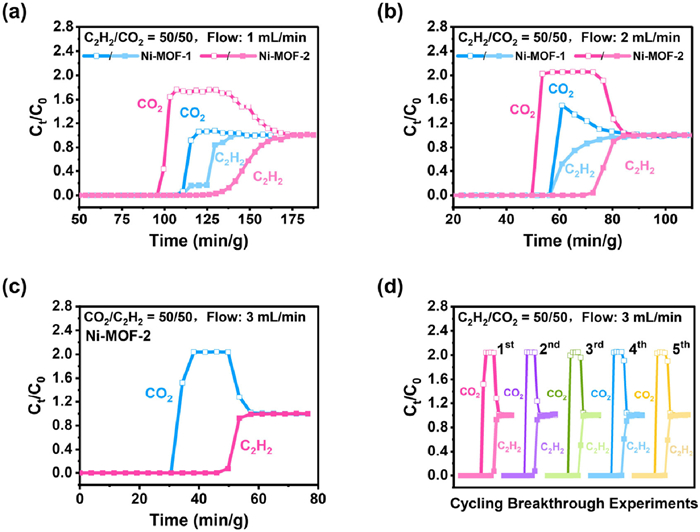
To further validate the effect of pillar modification for equimolar C2H2/CO2 separation, dynamic breakthrough experiments with different flow rates were conducted on Ni-MOF-1 and Ni-MOF-2 at 298 K and 1.0 bar. As shown in Figs. 3a and b, equimolar C2H2/CO2 can be successfully separated on Ni-MOF-2 with a total inlet flow rate of 1 and 2 mL/min, whereas Ni-MOF-1 could not remove C2H2 from equimolar C2H2/CO2 mixture. For Ni-MOF-2 with a flow rate of 1 mL/min, CO2 was first eluted through the column at 99.5 min/g, followed by C2H2 at 118.6 min/g (Fig. 3a). When the flow rates increased to 2 mL/min and 3 mL/min, Ni-MOF-2 still achieved a clean separation of equimolar C2H2/CO2 mixture, and the breakthrough point of CO2 reduced to 53.6 min/g and 34.4 min/g (Figs. 3b and c). And Ni-MOF-2 can be regenerated by purging argon. The separation performance and regeneration of Ni-MOF-2 can be retained with a flow rate of 3 mL/min, proved by cycling breakthrough tests and PXRD (Fig. 3d and Fig. S17 in Supporting information). The practical separation performances and facile reproducibility pave the way for Ni-MOF-2 as the available adsorbent to reduce the energy footprint.
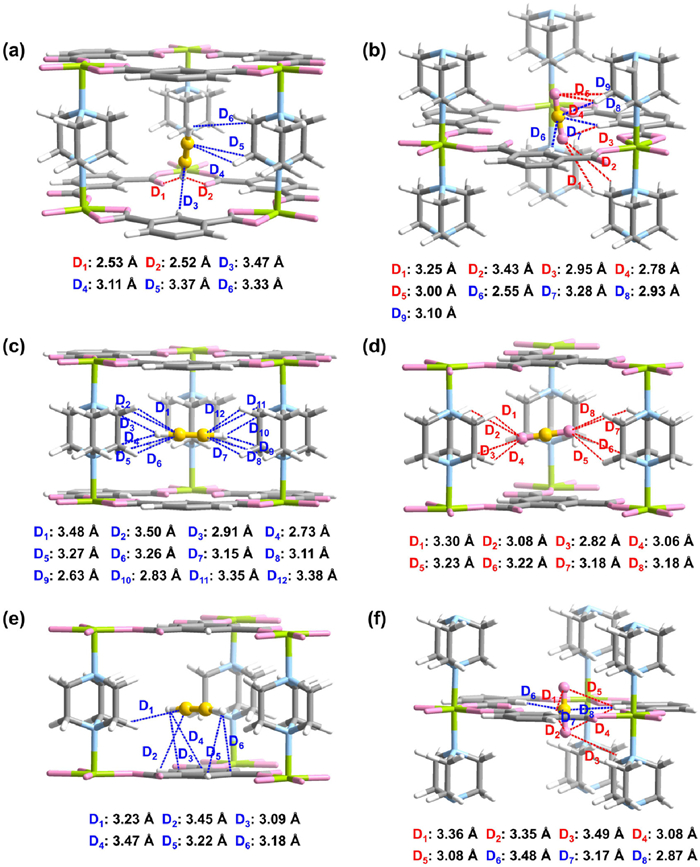
To elucidate the improved separation performance of Ni-MOF-1 and Ni-MOF-2, grand canonical Monte Carlo (GCMC) simulations and density functional theory (DFT) calculations (Fig. 4) were performed on Ni-MOF-2. The aliphatic rings of btc ligands and saturated C—H groups of dabco ligands are the primary adsorption sites of C2H2 and CO2 revealed by GCMC (Fig. S15 in Supporting information). As for DFT calculations, comparing with the C–H···O hydrogen bonding interactions as dominant host-guest interactions between Ni-MOF-1 and C2H2 or CO2 [27], C–H···C vdW interactions and C–H···O hydrogen bonding interactions play the main role between frameworks and C2H2 and CO2, respectively. As shown in Figs. 4a and b, after pillars regulation, in the site Ⅰ of Ni-MOF-2, two C–H···O (H–O, 2.52–2.53 Å) hydrogen bonding interactions and four C–H···C (3.11–3.47 Å) vdW interactions between C2H2 and btc/dabco ligands were observed; as for CO2, five C–H···O (H–O, 2.78–3.43 Å) hydrogen bonding interactions and four C–H···C (2.55–3.28 Å) vdW interactions were formed. In site Ⅱ, C2H2 was firmly captured by twelve C–H···C (H–C, 2.63–3.50 Å) vdW interactions; however, eight C–H···O (H–O, 2.82–3.30 Å) hydrogen bonding interactions were formed between Ni-MOF-2 and CO2 (Figs. 4c and d, Table S5 in Supporting information). The binding pattern of site Ⅲ is similar to site Ⅱ (Figs. 4e and f, Table S5). The type of host-guest interactions of C2H2 underwent the variation from hydrogen bonding interaction to vdW interaction after pillar modification, invariable for CO2; and the number of host-guest interactions plainly clarifies the reason for the improved separation performance of Ni-MOF-2 compared with prototype Ni-MOF-1.
In summary, we reported two isostructural Ni-MOF-1 and Ni-MOF-2, whose molecular recognition abilities for C2H2 and CO2 are diverse. The challenge lies in equimolar C2H2/CO2 mixture separation in Ni-MOF-1 can be addressed via pillar variation from pyz to dabco by virtue of delicate pore environment regulation. Owing to supplemental vdW interactions with C2H2, pillar-modified Ni-MOF-2 achieved efficient separation of equimolar C2H2/CO2 and the 3.5-fold selectivity increased than that of Ni-MOF-1. The practical separation performance, cycle stability, and facile regeneration of Ni-MOF-2 were validated by cyclic experimental breakthrough tests. DFT calculations proved that the extra C—H groups of dabco contribute to more C–H···C vdW interactions between C2H2 and the framework, guaranteeing preferential adsorption of C2H2 over CO2 in Ni-MOF-2. This work sheds new light on delicate pore environment regulation for gas molecular recognition and suggests the potential for other challenging gas separations.
Nan Lu: Writing – original draft, Visualization, Investigation, Formal analysis, Data curation. Lan Lan: Investigation, Formal analysis. Qiang Gao: Resources, Investigation, Formal analysis, Data curation. Ming Liu: Investigation, Funding acquisition, Formal analysis. Tong-Liang Hu: Visualization, Software, Formal analysis, Data curation. Na Li: Writing – review & editing, Supervision, Resources, Project administration, Funding acquisition, Formal analysis, Data curation. Xian-He Bu: Writing – review & editing, Supervision, Resources, Project administration, Funding acquisition.
This work was supported by the National Natural Science Foundation of China (Nos. 22035003, 22371139, 22305130), the Haihe Laboratory of Sustainable Chemical Transformations, and the Programme of Introducing Talents of Discipline to Universities (No. B18030).
Supplementary material associated with this article can be found, in the online version, at doi:
H. Xiong, Y. Peng, X. Liu, et al., Adv. Mater. 36 (2024) 2401693. doi: 10.1002/adma.202401693
Y. Zhang, Y. Han, B. Luan, et al., J. Am. Chem. Soc. 146 (2024) 17220–17229. doi: 10.1021/jacs.4c03442
Z. Zhang, Z. Deng, H.A. Evans, et al., J. Am. Chem. Soc. 145 (2023) 11643–11649. doi: 10.1021/jacs.3c01705
N. Kumar, S. Mukherjee, N.C. Harvey-Reid, et al., Chem 7 (2021) 3085–3098. doi: 10.1016/j.chempr.2021.07.007
J. Wang, Y. Zhang, Y. Su, et al., Nat. Commun. 13 (2022) 200.
S.Q. Yang, T.L. Hu, Coord. Chem. Rev. 468 (2022) 214628. doi: 10.1016/j.ccr.2022.214628
L. Wang, H. Huang, X. Zhang, et al., Coord. Chem. Rev. 484 (2023) 215111. doi: 10.1016/j.ccr.2023.215111
X. Liu, P. Zhang, H. Xiong, et al., Adv. Mater. 35 (2023) 2210415. doi: 10.1002/adma.202210415
S.Q. Yang, R. Krishna, H. Chen, et al., J. Am. Chem. Soc. 145 (2023) 13901–13911. doi: 10.1021/jacs.3c03265
L. Zhang, K. Jiang, L. Yang, et al., Angew. Chem. Int. Ed. 60 (2021) 15995–16002. doi: 10.1002/anie.202102810
L. Li, R.B. Lin, R. Krishna, et al., Science 362 (2018) 443–446. doi: 10.1126/science.aat0586
X. Cui, K. Chen, H. Xing, et al., Science 353 (2016) 141–144. doi: 10.1126/science.aaf2458
J.-B. Lin, T.T.T. Nguyen, R. Vaidhyanathan, et al., Science 374 (2021) 1464–1469. doi: 10.1126/science.abi7281
Y.P. Xia, C.X. Wang, M.H. Yu, et al., Chin. Chem. Lett. 32 (2021) 1153–1156. doi: 10.1016/j.cclet.2020.09.014
F. ZareKarizi, M. Joharian, A. Morsali, J. Mater. Chem. A 6 (2018) 19288–19329. doi: 10.1039/c8ta03306d
X.L. Hu, F.H. Liu, H.N. Wang, et al., J. Mater. Chem. A 2 (2014) 14827–14834. doi: 10.1039/C4TA01749H
X.L. Luo, Z. Yin, M.H. Zeng, et al., Inorg. Chem. Front. 3 (2016) 1208–1226. doi: 10.1039/C6QI00181E
J. Qiao, X. Liu, X. Liu, et al., Inorg. Chem. Front. 7 (2020) 3500–3508. doi: 10.1039/d0qi00641f
L. Liu, Z. Yao, Y. Ye, et al., J. Am. Chem. Soc. 142 (2020) 9258–9266. doi: 10.1021/jacs.0c00612
W. Li, J. Li, B. Zhang, et al., Chem. Eng. J. 483 (2024) 149126.
J. Zhou, T. Ke, Y. Song, et al., J. Am. Chem. Soc. 144 (2022) 21417–21424. doi: 10.1021/jacs.2c10595
J. Zhou, K. Wen, T. Ke, et al., J. Am. Chem. Soc. 146 (2024) 16838–16847. doi: 10.1021/jacs.4c05095
C.S. Smoljan, Z. Li, H. Xie, et al., J. Am. Chem. Soc. 145 (2023) 6434–6441. doi: 10.1021/jacs.2c13715
J. Zhou, T. Ke, F. Steinke, et al., J. Am. Chem. Soc. 144 (2022) 14322–14329. doi: 10.1021/jacs.2c05448
B. Lal, K.B. Idrees, H. Xie, et al., Angew. Chem. Int. Ed. 62 (2023) e202219053. doi: 10.1002/anie.202219053
S. Jeong, D. Kim, S. Shin, et al., Chem. Mater. 26 (2014) 1711–1719. doi: 10.1021/cm404239s
Y.Y. Liu, P. Zhang, W.Y. Yuan, et al., ACS Appl. Mater. Interfaces 16 (2024) 33451–33460. doi: 10.1021/acsami.4c04760
K.B. Idrees, Z. Chen, X. Zhang, et al., Chem. Mater. 32 (2020) 3776–3782. doi: 10.1021/acs.chemmater.9b05048
L. Shi, Z. Yang, F. Sha, et al., Sci. China Chem. 66 (2023) 3383–3397. doi: 10.1007/s11426-023-1809-8
P. Guo, M. Chang, T. Yan, et al., Chin. J. Chem. Eng. 42 (2022) 10–16. doi: 10.1016/j.cjche.2021.08.011
S. Jeong, D. Kim, X. Song, et al., Chem. Mater. 25 (2013) 1047–1054. doi: 10.1021/cm303624p
N. Lu, L. Lan, Q. Gao, et al., Chem. Res. Chin. Univ. 40 (2024) 675–681. doi: 10.1007/s40242-024-4125-2
J. Pei, K. Shao, J.X. Wang, et al., Adv. Mater. 32 (2020) 1908275. doi: 10.1002/adma.201908275
Y.L. Peng, T. Pham, P. Li, et al., Angew. Chem. Int. Ed. 57 (2018) 10971–10975. doi: 10.1002/anie.201806732
Y. Liu, J. Liu, H. Xiong, et al., Nat. Commun. 13 (2022) 5515.
S.M. Jeong, D. Kim, J.Y. Park, et al., ACS Appl. Mater. Interfaces 16 (2023) 1342–1350.
J. Miao, W. Graham, J. Liu, et al., J. Am. Chem. Soc. 146 (2024) 84–88. doi: 10.1021/jacs.3c11260
J.W. Wang, S.C. Fan, H.P. Li, et al., Angew. Chem. Int. Ed. 62 (2023) e202217839.
Y. Ye, Z. Ma, R.B. Lin, et al., J. Am. Chem. Soc. 141 (2019) 4130–4136. doi: 10.1021/jacs.9b00232

Scheme 1 Depiction of the different C2H2 and CO2 separation behavior in pillar–layered MOFs constructed by (a) aromatic and (b) aliphatic linkers.

Figure 1 The structural construction of Ni-MOF-1 and Ni-MOF-2 (Ni, green; C, gray; N, blue; O, pink; H, white; C2H2 and CO2 are represented in space-filling models, C, yellow; O, pink; H, white). (a) 2D Ni-btc layer. (b, c) Pillars of pyz and dabco. (d, e) 3D PL-MOFs of Ni-MOF-1 and Ni-MOF-2. Connolly surfaces of (f) Ni-MOF-1 and (g) Ni-MOF-2 with 1.0 Å of probes.

Figure 2 C2H2 and CO2 adsorption/desorption isotherms at (a) 273 K and (b) 298 K of Ni-MOF-1 and Ni-MOF-2. (c) The equimolar C2H2/CO2 separation selectivities of Ni-MOF-1 and Ni-MOF-2 at 273 K and 298 K. (d) The isosteric heat of adsorption of C2H2 and CO2 for Ni-MOF-1 and Ni-MOF-2. (e) Comparison of saturated C2H2 capacity at 298 K for Ni-MOF-2 with those of other materials for C2H2/CO2 separation. (f) Comparison of the zero-coverage isosteric heat of C2H2 for Ni-MOF-2 with those of other materials for C2H2/CO2 separation.

Figure 3 Equimolar C2H2/CO2 breakthrough curves of Ni-MOF at 298 K and 1.0 bar with a flow rate of (a) 1 mL/min and (b) 2 mL/min. (c, d) Cycling breakthrough tests of equimolar C2H2/CO2 breakthrough curves of Ni-MOF-2 at 298 K and 1.0 bar with a flow rate of 3 mL/min.

Figure 4 DFT-calculated binding sites and interactions of C2H2 and CO2 in Ni-MOF-2 at (a, b) site Ⅰ, (c, d) site Ⅱ, and (e, f) site Ⅲ. (a, c, e) C2H2, (b, d, f) CO2 (Ni, green; C, gray; N, blue; O, pink; H, white; C2H2 and CO2 are represented in ball-and-stick models, C, yellow; O, pink; H, white; The red dashed lines refer to C–H···O hydrogen bonding interactions; The blue dashed lines refer to C–H···C vdW interactions).

 扫一扫看文章


扫一扫关注我们
 DownLoad:
 下载:
下载:
 下载:
下载: