Figure 1.
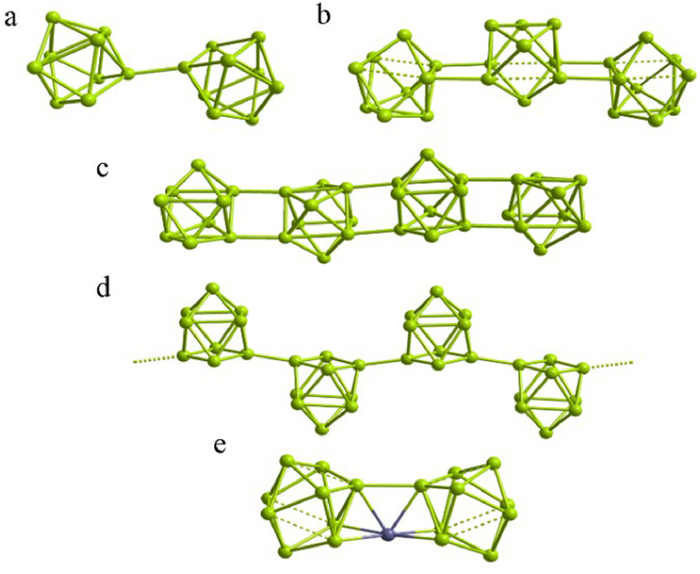
Structures of the oxidative-coupled clusters. (a) [Ge9–Ge9]6–, (b) [Ge9=Ge9=Ge9]6–, (c) [E9=E9=E9=E9]8– (E = Ge, Sn), (d) $ _\infty ^1$

Rational synthesis of highly charged E9 (E = Ge, Sn) dimer and trimer with Nb/Au bridges
Ya-Shan Huang , Wen-Juan Tian , Jing-Xuan Zhang , Zhong-Ming Sun


The variability in size, shape, and composition leads to nonmonotonic and unpredictable changes in cluster properties, creating opportunities for the development of new materials with tailored properties, which are extensively utilized in nanoscience and nanotechnology [1,2]. Although group 14 clusters have been widely studied in recent years, research into anionic clusters has primarily been focused on the reactivity of [E9]4– (E = Si, Ge, Sn, Pb) [3-5]. Experiments have revealed the structural and electronic flexibility of [E9]4–, enabling their reactions with multiple organometallic compounds, while the limited availability of starting materials has hampered the synthesis of novel clusters, particularly large clusters comprising 18 or more atoms [6-19]. Most large clusters are formed by the fusion of several smaller building clusters [20-31], with only a few arising from the oxidative coupling of monomers, including [Ge9–Ge9]6– (Fig. 1a) [32], [Ge9=Ge9=Ge9]6– (Fig. 1b) [33], [E9=E9=E9=E9]8– (E=Ge, Sn, Fig. 1c) [34,35], and infinite chains
The previously reported synthetic methods for [Ge9–Ge9]6– and [Ge9=Ge9=Ge9]6– face constraints related to composition, yield, and solvent, which complicate subsequent reactions. To address this, we sought to find an efficient method for synthesizing large quantities of [Ge9–Ge9]6– and [Ge9=Ge9=Ge9]6– in solution and to explore their reactivity through in-situ reactions in solution. After many attempts, we discovered that the Nb(Ⅳ) complex, NbCp4, functions as a mild oxidizing agent for the formation of [Ge9–Ge9]6– and [Ge9=Ge9=Ge9]6–. Similar oxidation reactions have been noted in previous cluster formations, such as Ge18[Si(SiMe3)3]6 and Ge244–, where Fe(Ⅱ) and Co(Ⅱ) salts act as oxidizing agents, respectively [22,41]. ESI-MS analysis of the reaction solution containing K4Ge9, a small quantity of NbCp4 and 2.2.2-crypt (Fig. S8 in Supporting information) indicated the presence of significant amounts of {[K(2.2.2-crypt)][Ge18]}– (Fig. S9 in Supporting information), {[K(2.2.2-crypt)]3[Ge18]}– (Fig. S10 in Supporting information), and {[K(2.2.2-crypt)]3[Ge27]}– (Fig. S11 in Supporting information), enabling us to explore the reactivity of [Ge9–Ge9]6– and [Ge9=Ge9=Ge9]6–. Reaction of K4Ge9 with excess NbCp4 in the presence of 2.2.2-crypt at room temperature yields the dimeric derivative 1. Elevating the reaction temperature to 70 ℃ and prolonging the reaction time yields the trimeric derivative 2. Furthermore, according to the given reaction energies, it is thermodynamically advantageous to form 1 and 2 ((1), (2)). We also explored the oxidative coupling of [Sn9]4– to form [Sn9–Sn9]6–, however, this attempt was unsuccessful. Given that the only known dimeric Sn9 cluster is the Ag-containing compound, we tried reacting K4Sn9 with the heavier analog, Au(PPh3)Me, and successfully synthesized compound 3. Detailed experimental procedures are provided in Supporting information.
|
|
(1) |
|
|
(2) |
Crystals of 1−3 were characterized by single-crystal X-ray diffraction analysis. Compound 1 crystallizes in the orthorhombic space group Pbcn and the asymmetric unit contains one cluster anion [(Ge9–Ge9)(NbCp2)2]4–, two [K(2.2.2-crypt)]+ cations, and one en molecule (Fig. S2 in Supporting information). The cluster anion exhibits statistical disorder on the atomic level, manifesting a major orientation (67% occupancy) along with a minor contributor, and thus subsequent discussions of the structure will primarily focus on the former. In cluster 1a, the configuration of the two [Ge9] units maintains a monocapped square antiprism, akin to the structure observed in the related [Ge9–Ge9]6–. Conventionally, the two [Ge9] cages within the [Ge9–Ge9]6– dimer exhibit a transoid arrangement. However, upon the incorporation of two [NbCp2]+fragments, the two nine-atom cages in 1a show a sterically less favorable cisoid conformation (Fig. 2a). This phenomenon, characterized by a crowded cisoid conformation, is also evident in [[Ag(Sn9–Sn9)]5– and [(Ge9)2In(C6H5)]4– [40,42]. The bond distance between the two [Ge9] cages in 1a measures 2.443 Å, comparable to the inter-cluster bond distance of 2.488 Å in [Ge9–Ge9]6–, shorter than that observed in [(Ge9)2In(C6H5)]4– (2.583 Å), indicating a two-center, two-electron localized bond. Furthermore, the two [NbCp2] fragments coordinate with the Ge atoms situated on the capped squares within the Ge9 cages (Ge4, Ge5, Ge4′, and Ge5′, respectively), forming four Nb–Ge bonds with an average length of 2.730 Å. These contacts are comparable to those in [(η6-C6H3Me3)-NbHGe6]2− (2.749 Å) [9] and Nb(η5-C5H4SiMe3)2(H)2(GePh3) (2.710 Å) [43], shorter than those in [Nb@Ge13]3– (2.817 Å) [44], [Nb@Ge14]3– (2.869 Å) [44] and [Nb@Ge8As6]3− (2.965 Å) [45], but longer than those in Cp2NbH(GeMe3)2 (2.660 Å) [46] and [(η6-C6H3Me3)NbGe6Nb(η6-C6H3Me3)]2− (2.615 Å) [9]. The Nb–C bond distances (2.379 Å, ave.) are statistically indistinguishable from those observed in the parent compound NbCp4 (2.387 Å) [47]. The average Ge–Ge distances around the capping atom (dcap), at the capped square (dcsq), at the waist (dwst), at the open square (dosq) are similar to those in [Ge9–Ge9]6–: dcap = 2.579 Å (1a), 2.578 Å ([Ge9–Ge9]6–); dcsq = 2.763 Å (1a), 2.810 Å ([Ge9–Ge9]6–); dwst = 2.628 Å (1a), 2.604 Å ([Ge9–Ge9]6–); dosq = 2.573 Å (1a), 2.580 Å ([Ge9–Ge9]6–). Thus, 1a can be formally rationalized as a [Ge9–Ge9]6– dimer coordinating to two [NbCp2]+ with formal Nb3+ cation.
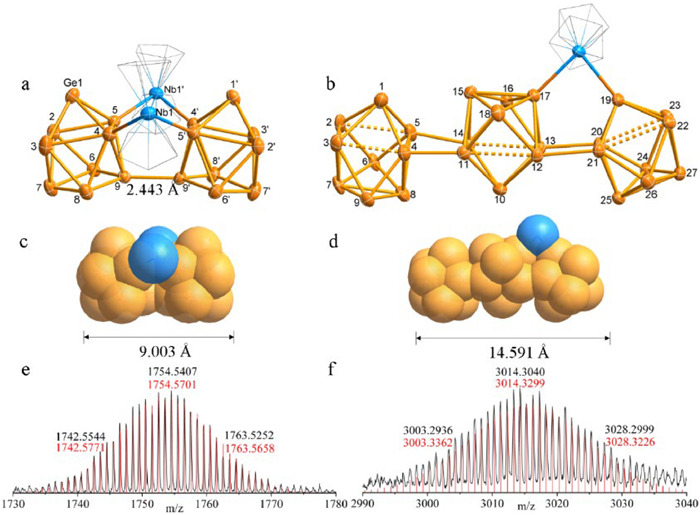
Compound 2 crystallizes in the monoclinic space group P21/c, with the asymmetric unit containing one [(Ge9=Ge9=Ge9)NbCp2]5– anion, five [K(2.2.2-crypt)]+ cations, and one en molecule (Fig. S4 in Supporting information). As observed in [Ge9=Ge9=Ge9]6–, each of the three [Ge9] cages in 2a adopts a tricapped trigonal prisms configuration, elongated along two prismatic edges (Ge2–Ge5, Ge3–Ge4, Ge11–Ge12, Ge13–Ge14, Ge20–Ge23, Ge21–Ge22, Fig. 2b). These cages are interconnected by two exo-bonds along the elongated prismatic edges. Notably, the Ge–Ge bond distances in 2a closely resemble those observed in [Ge9=Ge9=Ge9]6–. However, the incorporation of the [NbCp2]+ fragment induces a deviation from linearity in [Ge9=Ge9=Ge9]6–, causing it to tilt towards the [NbCp2] moiety. This tilt is accompanied by the formation of two Nb–Ge bonds, with lengths of 2.711 Å and 2.653 Å. The angle between the two Nb–Ge bonds (∠Ge17–Nb–Ge19) measures 83.009°, similar to the corresponding angles observed in 1a (∠Ge4–Nb1–Ge5′ = ∠Ge4′–Nb1′–Ge5 = 82.189°). Similarly, 2a can also be rationalized as one [NbCp2]+ fragment with formal Nb3+cation, along with a [Ge9=Ge9=Ge9]6– trimer. The long axes of 1a and 2a measure 9.003 Å (Fig. 2c) and 14.591 Å (Fig. 2d), respectively, which are slightly shorter than those in [Ge9–Ge9]6– (9.266 Å) and [Ge9=Ge9=Ge9]6– (14.241 Å).
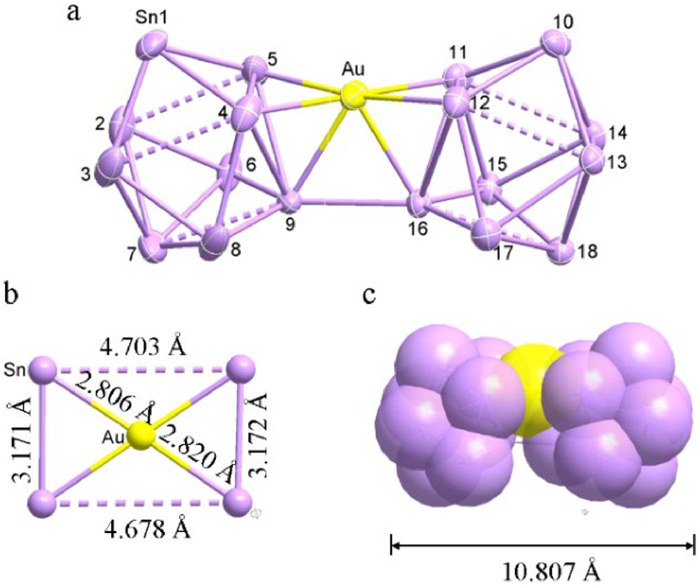
Compound 3 crystallizes in the triclinic space group P-1, with the asymmetric unit containing one cluster anion [Au(Sn9–Sn9)]5–, five [K(2.2.2-crypt)]+ cations, one en molecule, and one toluene molecule (Fig. S6 in Supporting information). The structure of 3a is isostructural with the previously reported cluster [Ag(Sn9–Sn9)]5–. The Au+ ion is positioned between two [Sn9] cages, each adopting a tricapped trigonal prismatic configuration, and is coordinated to the Sn atoms on the triangular faces of both [Sn9] cages, forming six Au-Sn bonds (Fig. 3a). Notably, the Au+ ion and four coordinated Sn atoms (Sn4, Sn5, Sn11, Sn12) are nearly coplanar, forming a rectangular arrangement (Fig. 3b). The four Au-Sn bonds within this rectangle (2.806–2.862 Å) are shorter than the other two (2.921 Å and 2.953 Å, respectively), but slightly longer than the sum of the covalent radii of Ge and Sn (2.75 Å) [48]. The long axis of the cage measures 10.807 Å (Fig. 3c), which is slightly shorter than that in [Ag(Sn9–Sn9)]5– (11.016 Å).
The presence of 1−3 was also confirmed through energy dispersive X-ray spectrometry (EDX, Figs. S35-S37 in Supporting information) and ESI-MS (Figs. S12, S23, and S29 in Supporting information). ESI-MS analysis, conducted by dissolving crystals of compounds 1 and 2 in acetonitrile (ACN) solution, reveals mass envelopes corresponding to the parent clusters, including {[Ge18Nb2Cp4]}– (Fig. 2e), {[K(2.2.2-crypt]2[Ge27NbCp2]}– (Fig. 2f), {[KGe27NbCp2]}2– (Fig. S24 in Supporting information), {[K(2.2.2-crypt][Ge27NbCp2]}2– (Fig. S26 in Supporting information). Furthermore, inevitable decomposition processes in solution lead to the formation of a series of fragments (Figs. S13-S21, S25, and S27 in Supporting information). The ESI-MS of compound 3 shows fragments derived from the parent compound, including {[AuSn9]}– (Fig. S31 in Supporting information), and {[K(2.2.2-crypt)][Sn9]}– (Fig. S33 in Supporting information). This suggests the lower stability of [Sn9–Sn9], which may explain why [Sn9–Sn9]6– has not been successfully synthesized thus far.
Theoretical calculations have been performed to understand the electronic structures of the synthesized species. To deal with the inter-fragment interactions among multiple [E9] units and metal centers, fragment aligned molecular orbital (FAMO) analysis has been performed to give a fragment-based description of the electronic structures of relevant clusters.
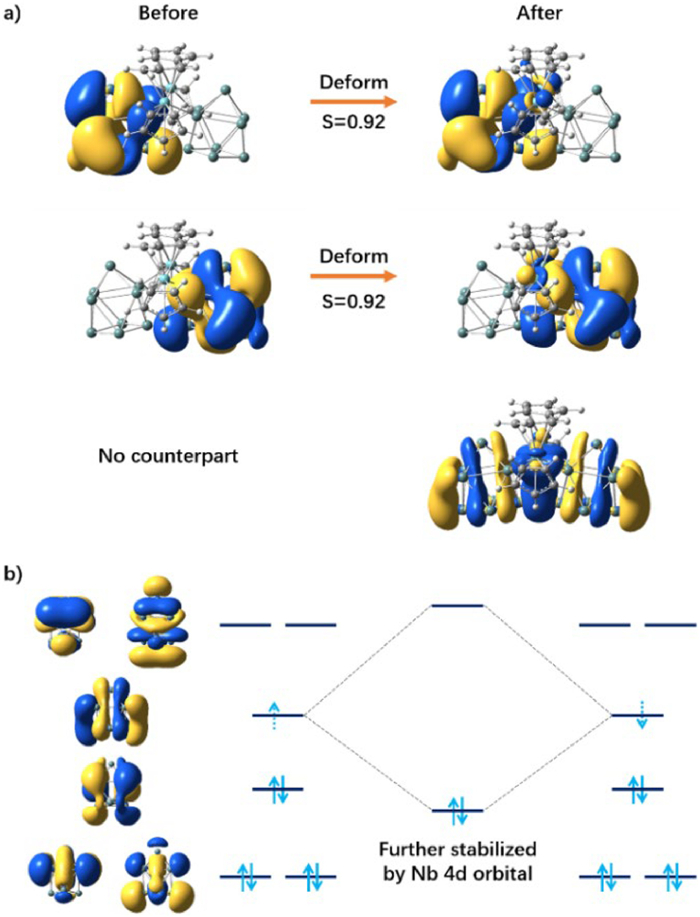
In the case of [Ge18(NbCp2)2]4−, FAMO analysis is performed with two [Ge9]2− moieties and two [NbCp2]+ moieties as the reference fragments. The occupied orbitals of the reference fragments are found to be relatively inactive (FAMO eigenvalues all beyond 0.92), which means these orbitals do not deform much compared to their shapes in isolated fragments (Fig. 4a). In addition, because the total charge is not conserved during fragmentation, there exists one orbital that is occupied in the whole cluster but not in isolated fragments (Fig. 4a). By comparing it against the frontier orbitals of a single [Ge9]2− fragment, one can see that this orbital largely resembles the in-phase combination of the LUMOs of two [Ge9]2− fragments, or equivalently, the SOMOs of [Ge9]3− fragments. This implies that the additional two electrons in [Ge18(NbCp2)2]4− reside in a bonding orbital between two cages forming a single bond. This is consistent with the usual understanding of the inter-cage single bond in [Ge9–Ge9]6– cluster, except that this bond is not completely localized at the two bonded atoms, but in fact delocalized over the whole cage. The [NbCp2]+ fragments do not significantly participate in this inter-cage bonding, but serve as a glue that bridges the two cages by dative interactions as demonstrated. Such interaction can be revealed by the deformation of the matched FAMOs (Fig. 4a), or the principal interacting orbital (PIO) analysis between [Ge9–Ge9]6– and [(NbCp2)2]2+ fragments (Figs. S38-S41 in Supporting information), which shows dative interactions from the cage to the Nb 4d and 5s orbitals [49]. The Nb center of each [NbCp2]+ moiety has 14 valence electrons in total, leaving two orbitals available for bonding with the Ge cages, thus there are four dative bonds from [Ge9–Ge9]6– to [(NbCp2)2]2+ in total, which are exactly the top four PIOs. The overall bonding pattern can be described by an orbital interaction diagram as shown in Fig. 4b.
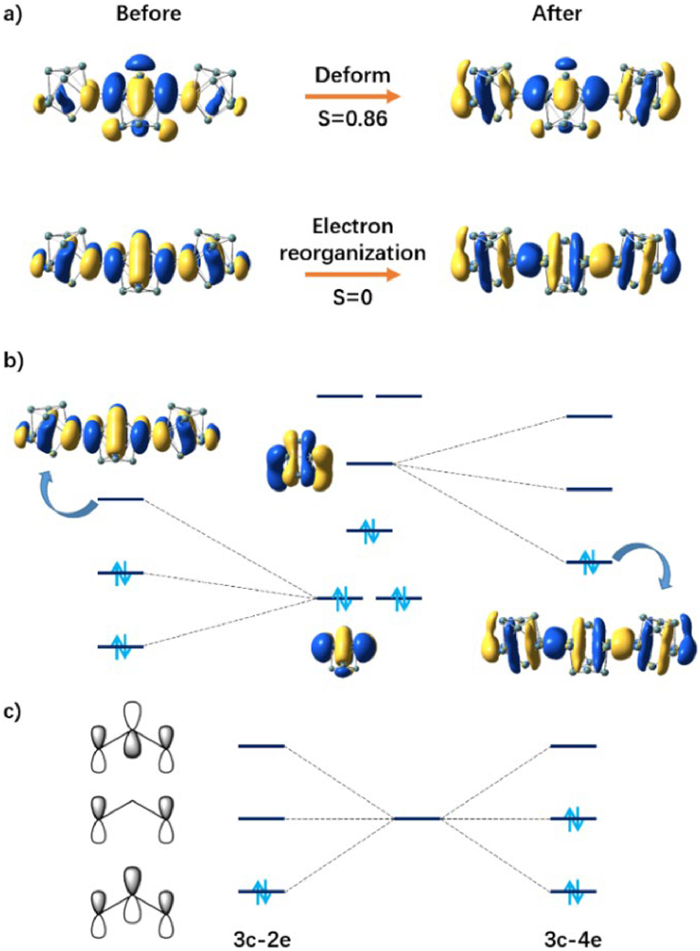
The electronic structure of compound 2 is relatively more complicated. To clearly describe its bonding pattern, two rounds of FAMO analysis have been performed. The first round of FAMO analysis was performed on [Ge27NbCp2]5− with respect to [Ge27]6− and [NbCp2]+ moieties, in which no significant orbital deformation was observed (FAMO eigenvalues all beyond 0.96), showing that the interaction between [Ge9=Ge9=Ge9]6– and [NbCp2]+ moieties is simply donor-accpetor interaction as in [Ge18(NbCp2)2]4− (Fig. S38 in Supporting information). This is also in line with the PIO analysis results with the same fragmentation (Figs. S42-S44 in Supporting information). However, a second round of FAMO analysis on [Ge9=Ge9=Ge9]6– with respect to three [Ge9]2− fragments shows significant electron reorganization. There exists an orbital which is occupied in the cluster but unoccupied in the isolated fragments, and another orbital which is unoccupied in the cluster but occupied in the isolated fragments (Fig. 5a). This means electron reorganization occurs when these three fragments form a [Ge9=Ge9=Ge9]6– cluster. Close examination reveals that the unmatched FAMO pair are nothing but an all-in-phase combination of the LUMO of the [Ge9]2− moieties, and an all-out-of-phase combination of the HOMO-1 of the [Ge9]2− moieties. In other words, the three [Ge9]2− moieties are connected through two delocalized bonds, one 3c-2e bond and one 3c-4e bond. An illustrative orbital interaction diagram is shown in Fig. 5b to describe the electronic structure of [Ge9=Ge9=Ge9]6–. This is in analogy with the delocalized bonding in propene cation and anion (Fig. 5c), except that each center is now a cage not an atom. Besides, the fact that each cage contributes two orbitals involved in the delocalized bonding is also reflected by the PIO analysis on this compound with one [Ge9] cage as a fragment and the rest of atoms as the other in which the top two PIOs exactly bare the shape of the LUMO and HOMO-1 of a [Ge9]2− cluster (Fig. S43). Such bonding scheme explains that why three [Ge9]2− moieties can be linked together without additional electrons when affording the [Ge9=Ge9=Ge9]6– cluster, while two [Ge9]2− fragments need two more electrons to afford the [Ge9–Ge9]6– cluster.
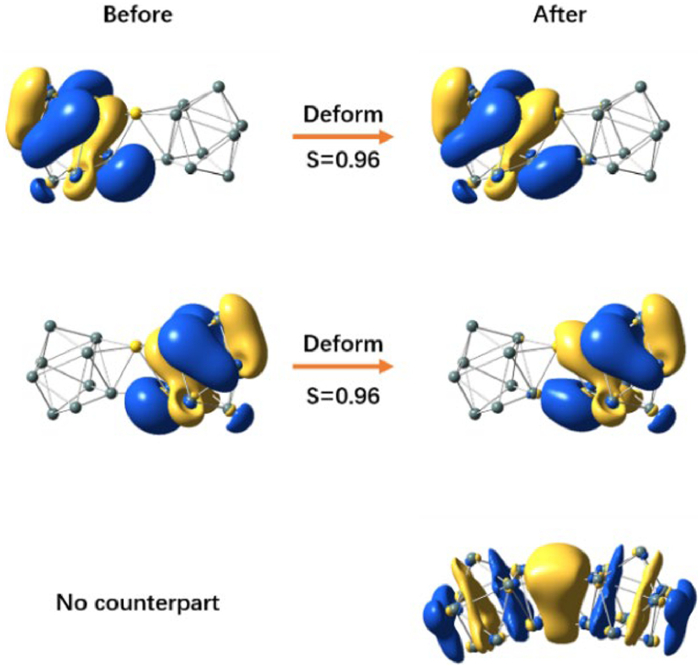
The electronic structure of compound [AuSn18]5− is somehow similar to that of [Ge18(NbCp2)2]4−. Two electrons enter the in-phase combination of the LUMOs of two [Sn9]2− fragments, formally forming a single bond, to afford [Sn9–Sn9]6–. However, FAMO analysis reveals that this bonding orbital between two cages has significant contributions from the [Au]+ 6s orbital (Fig. 6). PIO analysis also suggests a prominent interaction between the Sn cage and the Au center (Fig. S45 in Supporting information). This hints the [Au]+ center might play an important role in stabilizing the [Sn9–Sn9]6– kernel and might explain why bare [Sn9–Sn9]6– cluster has never been isolated.
In summary, we have established that the [Ge9–Ge9]6– and [Ge9=Ge9=Ge9]6– present in the reaction solution can be used as starting materials to react with organometallic compounds to form larger clusters. Their reactions with NbCp4 yield two Nb-containing clusters [(Ge9–Ge9)(NbCp2)2]4– and [(Ge9=Ge9=Ge9)NbCp2]5–. In addition, a Au-containing cluster incorporating a dimeric [Sn9–Sn9]6– unit has also been characterized. FAMO and PIO analysis indicate that the interaction between Ge cage and [NbCp2]+ moieties are predominantly donor-acceptor interaction, while inter-cage bonding is also investigated and discussed. The strategy in our work provides new starting materials for reasonable synthesis of large clusters, opening up new opportunities for applications in nanoscience and nanotechnology.
The authors declare that they have no known competing financial interests or personal relationships that could have appeared to influence the work reported in this paper.
Ya-Shan Huang: Writing – review & editing, Writing – original draft, Methodology, Investigation, Formal analysis, Data curation. Wen-Juan Tian: Writing – review & editing, Writing – original draft, Investigation, Formal analysis, Data curation. Jing-Xuan Zhang: Writing – review & editing, Writing – original draft, Investigation, Formal analysis, Data curation. Zhong-Ming Sun: Writing – review & editing, Writing – original draft, Supervision, Project administration, Funding acquisition, Conceptualization.
This work was supported by the National Natural Science Foundation of China (Nos. 22425107 (Z.-M. Sun), 92461303 (Z.-M. Sun), 22371140 (Z.-M. Sun), 92161102 (Z.-M. Sun), and 22402108 (W.-J. Tian)).
Supplementary material associated with this article can be found, in the online version, at doi:
J. Zhao, Q. Du, S. Zhou, V. Kumar, Chem. Rev. 120 (2020) 9021–9163. doi: 10.1021/acs.chemrev.9b00651
P. Jena, Q. Sun, Chem. Rev. 118 (2018) 5755–5870. doi: 10.1021/acs.chemrev.7b00524
R.J. Wilson, N. Lichtenberger, B. Weinert, S. Dehnen, Chem. Rev. 119 (2019) 8506–8554. doi: 10.1021/acs.chemrev.8b00658
C. Liu, Z.M. Sun, Coordin. Chem. Rev. 382 (2019) 32–56. doi: 10.1016/j.ccr.2018.12.003
T.F. Fässler, Coordin. Chem. Rev. 215 (2001) 347–377. doi: 10.1016/S0010-8545(01)00321-6
J.Q. Wang, S. Stegmaier, T.F. Fässler, Angew. Chem. Int. Ed. 121 (2009) 2032–2036. doi: 10.1002/ange.200805511
B. Zhou, M.S. Denning, D.L. Kays, J.M. Goicoechea, J. Am. Chem. Soc. 131 (2009) 2802–2803. doi: 10.1021/ja900055j
M.W. Hull, S.C. Sevov, Angew. Chem. Int. Ed. 46 (2007) 6695–6698. doi: 10.1002/anie.200701950
A.M. Li, Y. Wang, P.Y. Zavalij, et al., Inorg. Chem. 60 (2021) 14697–14705. doi: 10.1021/acs.inorgchem.1c01799
G. Espinoza-Quintero, J.C.A. Duckworth, W.K. Myers, J.E. McGrady, J.M. Goicoechea, J. Am. Chem. Soc. 136 (2014) 1210–1213. doi: 10.1021/ja411280v
J. Campbell, H.P.A. Mercier, H. Franke, et al., Inorg. Chem. 41 (2002) 86–107. doi: 10.1021/ic010695k
H.L. Xu, L. Q, Z.M. Sun, Chin. J. Chem. 41 (2023) 2432–2438. doi: 10.1002/cjoc.202300150
D.O. Downing, P. Zavalij, B.W. Eichhorn, Eur. J. Inorg. Chem. 2010 (2010) 890–894. doi: 10.1002/ejic.200900983
Y.S. Huang, D. Chen, J. Zhu, Z.M. Sun, Chin. Chem. Lett. 33 (2022) 2139–2142. doi: 10.1016/j.cclet.2021.08.038
B. Kesanli, J. Fettinger, B. Eichhorn, Angew. Chem. Int. Ed. 40 (2001) 2300–2302. doi: 10.1002/1521-3773(20010618)40:12<2300::AID-ANIE2300>3.0.CO;2-0
B.J.L. Witzel, W. Klein, J.V. Dums, M. Boyko, T.F. Fässler, Angew. Chem. Int. Ed. 58 (2019) 12908–12913. doi: 10.1002/anie.201907127
B. Zhou, T. Krämer, A.L. Thompson, J.E. McGrady, J.M. Goicoechea, Inorg. Chem. 50 (2011) 8028–8037. doi: 10.1021/ic200329m
E.N. Esenturk, J. Fettinger, B. Eichhorn, J. Am. Chem. Soc. 128 (2006) 9178–9186. doi: 10.1021/ja061842m
A.M. Li, Y. Wang, P.Y. Zavalij, et al., Chem. Commun. 56 (2020) 10859–10862. doi: 10.1039/d0cc03656k
J.M. Goicoechea, S.C. Sevov, J. Am. Chem. Soc. 127 (2005) 7676–7677. doi: 10.1021/ja051224q
J.M. Goicoechea, S.C. Sevov, Angew. Chem. Int. Ed. 44 (2005) 4026–4028. doi: 10.1002/anie.200500600
H.L. Xu, N.V. Tkachenko, D.W. Szczepanik, et al., Nat. Commun. 13 (2022) 2149. doi: 10.1038/s41467-022-29626-5
A. Spiekermann, S.D. Hoffmann, F. Kraus, T.F. Fässler, Angew. Chem. Int. Ed. 46 (2007) 1638–1640. doi: 10.1002/anie.200602003
A. Spiekermann, S.D. Hoffmann, T.F. Fässler, I. Krossing, U. Preiss, Angew. Chem. Int. Ed. 46 (2007) 5310–5313. doi: 10.1002/anie.200603389
C. Liu, X. Jin, L.J. Li, et al., Chem. Sci. 10 (2019) 4394–4401. doi: 10.1039/c8sc03948h
H.L. Xu, N.V. Tkachenko, Z.C. Wang, et al., Nat. Commun. 11 (2020) 5286. doi: 10.1038/s41467-020-19079-z
L. Qiao, C. Zhang, C.C. Shu, et al., J. Am. Chem. Soc. 142 (2020) 13288–13293. doi: 10.1021/jacs.0c04815
C.C. Shu, H.W.T. Morgan, L. Qiao, J.E. McGrady, Z.M. Sun, Nat. Commun. 11 (2020) 3477. doi: 10.1038/s41467-020-17187-4
H.W.T. Morgan, C.C. Shu, Z.M. Sun, J.E. McGrady, J. Am. Chem. Soc. 144 (2022) 8007–8017. doi: 10.1021/jacs.1c10106
Z.S. Li, W.X. Chen, H.W.T. Morgan, et al., Chem. Sci. 15 (2024) 1018–1026. doi: 10.1039/d3sc04709a
W.X. Chen, Z.S. Li, H.W.T. Morgan, et al., Chem. Sci. 15 (2024) 4981–4988. doi: 10.1039/d4sc00165f
L. Xu, S.C. Sevov, J. Am. Chem. Soc. 121 (1999) 9245–9246. doi: 10.1021/ja992269s
A. Ugrinov, S.C. Sevov, J. Am. Chem. Soc. 124 (2002) 10990–10991. doi: 10.1021/ja026679j
A. Ugrinov, S.C. Sevov, Inorg. Chem. 42 (2003) 5789–5791. doi: 10.1021/ic034677+
N.V. Tkachenko, W.X. Chen, H.W.T. Morgan, et al., Chem. Commun. 58 (2022) 6223–6226. doi: 10.1039/d2cc01745h
C. Downie, J.G. Mao, H. Parmer, A.M. Guloy, Inorg. Chem. 43 (2004) 1992–1997. doi: 10.1021/ic034704w
M.W. Hull, A. Ugrinov, I. Petrov, S.C. Sevov, Inorg. Chem. 46 (2007) 2704–2708. doi: 10.1021/ic0623314
A. Ugrinov, S.C. Sevov, J. Am. Chem. Soc. 125 (2003) 14059–14064. doi: 10.1021/ja037007b
A. Ugrinov, S.C. Sevov, Chem. Eur. J. 10 (2004) 3727–3733. doi: 10.1002/chem.200400130
J.Q. Wang, B. Wahl, T.F. Fässler, Angew. Chem. Int. Ed. 49 (2010) 6592–6595. doi: 10.1002/anie.200907228
O. Kysliak, C. Schrenk, A. Schnepf, Angew. Chem. Int. Ed. 55 (2016) 3216–3219. doi: 10.1002/anie.201510831
D.F. Hansen, B. Zhou, J.M. Goicoechea, J. Organomet. Chem. 721-722 (2012) 53–61. doi: 10.1016/j.jorganchem.2012.05.037
A. Antinolo, F. Carrillo-Hermosilla, A. Castel, et al., Organometallics 17 (1998) 1523–1529. doi: 10.1021/om971001b
Y.S. Huang, Y. Xue, A. Muñoz-Castro, I.A. Popov, Z.M. Sun, Chem. Eur. J. 28 (2022) e202202192. doi: 10.1002/chem.202202192
S. Mitzinger, L. Broeckaert, W. Massa, F. Weigend, S. Dehnen, Chem. Commun. 51 (2015) 3866–3869. doi: 10.1039/C4CC10086G
G.I. Nikonov, A.V. Churakov, M.Y. Antipin, Organometallics 22 (2003) 2178–2180. doi: 10.1021/om0206453
F. Calderazzo, C. Giardi, U. Englert, G. Pampaloni, J. Organomet. Chem. 630 (2001) 275–280. doi: 10.1016/S0022-328X(01)01014-2
L. Pauling, J. Am. Chem. Soc. 69 (1947) 542–553. doi: 10.1021/ja01195a024
J.X. Zhang, F.K. Sheong, Z.Y. Lin, Chem. Eur. J. 24 (2018) 9639–9650. doi: 10.1002/chem.201801220

Figure 1 Structures of the oxidative-coupled clusters. (a) [Ge9–Ge9]6–, (b) [Ge9=Ge9=Ge9]6–, (c) [E9=E9=E9=E9]8– (E = Ge, Sn), (d) $ _\infty ^1$[–(Ge92–)–], (e) [Ag(Sn9−Sn9)]5−.

Figure 2 ORTEP representation of the cluster anion (a) [(Ge9–Ge9)(NbCp2)2]4– and (b) [(Ge9=Ge9=Ge9)NbCp2]5– (thermal ellipsoids are drawn at 50% probability). Space-filling representation of (c) [(Ge9–Ge9)(NbCp2)2]4– and (d) [(Ge9=Ge9=Ge9)NbCp2]5–. Negative ion ESI mass peaks corresponding to (e) {[Ge18Nb2Cp4]}– and (f) {[K(2.2.2-crypt]2[Ge27NbCp2]}–. The experimental mass distributions are shown in black, and the theoretical masses of the isotope distributions are depicted in red.

Figure 3 (a) ORTEP representation of the cluster anion [Au(Sn9–Sn9)]5– (thermal ellipsoids are drawn at 50% probability). (b) The rectangle unit [AuSn4]. (c) Space-filling representation of the crystal structure.

Figure 4 FAMO analysis on the [Ge18(NbCp2)2]4− cluster with respect to two [Ge9]2− fragments and two [NbCp2]+ fragments. (a) Three frontier FAMO pairs are shown here including one unmatched FAMO and two matched FAMOs with least overlaps. (b) Illustrative orbital diagram showing the interaction betwee the two [Ge9] fragments. Note the close resemblance between the unmatched FAMO in (a) and the LUMO of [Ge9]2− in (b).

Figure 5 (a) FAMO analysis on the [Ge9=Ge9=Ge9]6– cluster with respect to three [Ge9]2− fragments. (b) Illustrative orbital diagram showing the interaction among three [Ge9] fragments when affording [Ge9=Ge9=Ge9]6– cluster. (c) Illustrative orbital diagram of propenyl for comparison.

 扫一扫看文章


扫一扫关注我们
 DownLoad:
 下载:
下载:

 下载:
下载: