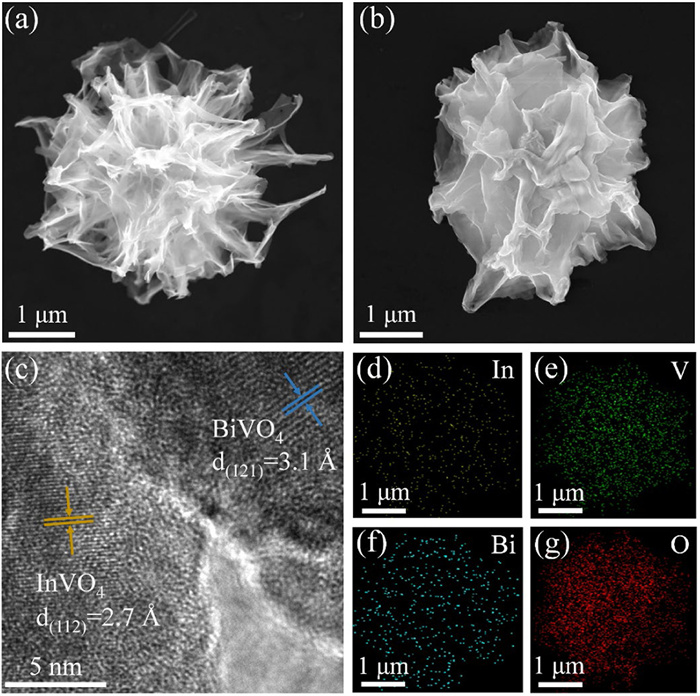
Figure 1.
SEM images of (a) InVO4 and (b) InVO4/BiVO4. (c) HRTEM image of InVO4/BiVO4. (d − g) EDS elemental mapping images (In, V, Bi and O) of InVO4/BiVO4.

The construction of InVO4/BiVO4 heterojunction via cation-exchange for efficient and highly selective CO2 photoreduction to methanol
Cheng-Cheng Jiao , Guang-Xing Dong , Ke Su , You-Xiang Feng , Min Zhang , Tong-Bu Lu


The rapid advancement of global industrial modernization has led to excessive consumption of fossil fuels, causing a sustained and substantial rise in carbon emissions and subsequent detrimental environmental and climatic consequences [1–4]. To effectively mitigate the intensifying greenhouse effect, there is a global consensus on actively pursuing a green and low-carbon transformation of economy and society to achieve “carbon peaking and carbon neutrality” [5,6]. In recent years, photocatalytic CO2 conversion technology has emerged as a promising approach, providing robust support for the realization of “dual carbon” goals [7–12]. Among various photocatalytic CO2 reduction products, liquid-phase products stand out due to their high energy density and convenience in separation, storage, and transportation. Notably, methanol (CH3OH), as a crucial chemical raw material and alternative energy source, holds a pivotal position in industrial production. Thus, leveraging semiconductor catalysts to convert CO2 into CH3OH through photocatalytic method not only addresses environmental challenges but also alleviates the energy crisis, making it a mutually beneficial strategy [13–18]. However, the process of photocatalytic CO2 reduction to CH3OH is complex, involving multiple charge transfers and extended reaction pathways, which leads to a higher rate of photogenerated charge recombination compared to their utilization in the reaction. This limits the catalytic activity and selectivity for CO2 to CH3OH conversion [19–25].
In recent years, metal vanadates, such as BiVO4, InVO4, and FeVO4, have garnered considerable attention in photocatalysis due to their exceptional visible light absorption and robust stability [26–29]. Among them, InVO4, with its suitable energy band structure, stands out as a promising catalyst for photocatalytic CO2 reduction [30,31]. Moreover, it has been proven to achieve high selectivity for CH3OH production [32]; BiVO4 excels in photocatalytic water oxidation, attributed to its relatively high oxidation potential [33–35]. However, both InVO4 and BiVO4 suffer from limited photocatalytic activity due to insufficient carrier separation. Integrating InVO4 and BiVO4 into a Z-scheme heterojunction through methods, such as hydrothermal [36], dipping-calcination [37] and one-pot microwave [38], can enhance the separation efficiency of photogenerated carriers, leveraging their respective strengths in CO2 reduction and water oxidation. Nevertheless, traditional methods often result in loose heterojunctions interfaces, limiting carrier separation efficiency. We herein propose a cation exchange strategy, involving the introduction of Bi3+ ions onto an InVO4 substrate for in-situ conversion to BiVO4, successfully constructing a direct Z-scheme heterojunction of InVO4/BiVO4. Compared to traditional self-assembly method, this approach constructs tighter heterojunction interfaces, thus significantly improving charge transport and separation efficiency, and boosting photocatalytic activity.
The synthesis process for the InVO4/BiVO4 heterojunction is illustrated in Scheme S1 (Supporting information), and specific steps are described in experimental section in Supporting information. Initially, an InVO4 substrate was prepared using a hydrothermal method [27]. Scanning electron microscopy (SEM), transmission electron microscopy (TEM) and atomic force microscopy (AFM) characterizations revealed that the prepared InVO4 exhibits a nanoflower structure with an average size of approximately 3-4 µm (Fig. 1a and Fig. S1 in Supporting information), which is composed of nanosheets with a thickness of 2–2.5 nm (Figs. S2 and S3 in Supporting information). Subsequently, Bi3+ ions were introduced onto the surface of InVO4, and through cation exchange and in-situ conversion, the InVO4/BiVO4 composite material was generated. SEM, TEM and AFM images show that the composite maintains the original nanoflower morphology of the InVO4 substrate (Fig. 1b, Figs. S4 and S5 in Supporting information), indicating that the cation exchange process did not significantly alter its morphology and size. High-resolution TEM (HRTEM) image of InVO4/BiVO4 displays a lattice spacing of 2.7 Å corresponding to the (112) plane of orthorhombic InVO4 and a lattice spacing of 3.1 Å for the (121) plane of monoclinic BiVO4 (Fig. 1c), initially verifying the successful conversion of BiVO4 onto InVO4. Additionally, energy-dispersive X-ray spectroscopy (EDS) analysis indicated a uniform distribution of In, Bi, O, and V elements in the InVO4/BiVO4 composite (Figs. 1d−g), suggesting the uniform growth of BiVO4 on InVO4. It is noteworthy that the morphology of InVO4/BiVO4 heterojunction differs significantly from that of InVO4:BiVO4 composite (prepared via traditional electrostatic attraction method, see details in Supporting information), in which BiVO4 large particles are positioned on the side of the InVO4 nanoflower (Fig. S6 in Supporting information). X-ray diffraction (XRD) and Raman spectroscopy measurements further confirmed the presence of both InVO4 and BiVO4 in the composite. As illustrated in Fig. S7 (Supporting information), the characteristic diffraction peaks of pure InVO4 match well with those of orthorhombic InVO4 (JCPDS No. 48−0898). With the introduction of Bi3+ ions, the characteristic diffraction peaks at 28.9° and 30.5° of BiVO4 (corresponding to JCPDS No. 14−0688) are clearly observed, and as the amount of Bi3+ introduced increased, the diffraction peaks of BiVO4 become more intense. Quantitative analysis of the In and Bi elements within the composite revealed an effective modulation of the conversion ratio of BiVO4, ranging from 2.45 % to 7.99 % (Table S1 in Supporting information). As presented in Fig. S8 (Supporting information), the InVO4/BiVO4 composite exhibits characteristic peaks at 918 and 826 cm−1, attributed to the V−O−In and V−O−Bi stretching vibrations of InVO4 and BiVO4, respectively [39,40].
X-ray photoelectron spectroscopy (XPS) measurements further confirmed the successful conversion of BiVO4 onto the InVO4 substrate, clearly identifying the characteristic signals of In, Bi, O and V elements (Fig. S9 in Supporting information). Additionally, high-resolution XPS measurements unveiled that the characteristic peaks of In 3d5/2 and In 3d3/2 in InVO4 reside at 444.3 and 451.9 eV, respectively, whereas the characteristic peaks of Bi 4f7/2 and Bi 4f5/2 in BiVO4 are positioned at 159.7 and 165.0 eV (Fig. S10 in Supporting information). Notably, the binding energies of In 3d and Bi 4f in the InVO4/BiVO4 composite shifted positively by 0.20 eV and negatively by 0.15 eV, respectively, compared to their individual component values, suggesting strong electronic coupling between InVO4 and BiVO4 (Fig. 2a (left) and Fig. S10). This inference can be further confirmed by theoretical simulations. As presented in Figs. 2b and c, there are significant charge density differences at the InVO4/BiVO4 heterojunction interface, with charge density decreasing on the InVO4 side and increasing on the BiVO4 side. Bader charge analysis indicated a charge transfer of approximately 2.2 electrons from InVO4 to BiVO4 at the interface.
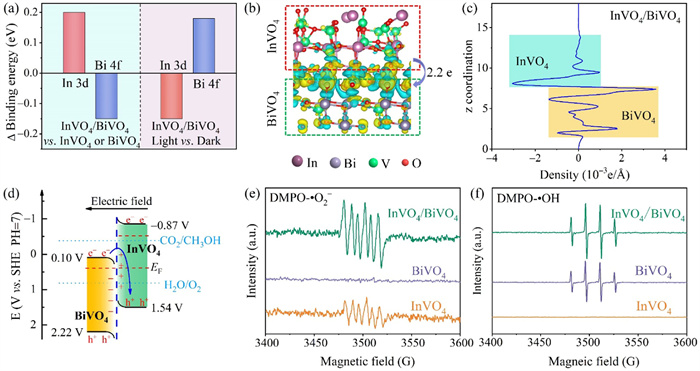
Ultraviolet-visible diffuse reflectance spectra (UV−vis DRS) measurements revealed that both InVO4 and BiVO4 possess good visible light response, with corresponding band gaps (Eg) of 2.41 and 2.12 eV, respectively (Figs. S11 and S12 in Supporting information). The valence band maximum potentials (EVB) of InVO4 and BiVO4 were determined by ultraviolet photoelectron spectroscopy (UPS) measurements to be 1.54 and 2.22 V, respectively, versus the standard hydrogen electrode (vs. SHE) (Fig. S13 in Supporting information). Consequently, the conduction band minimum potentials (ECB) for InVO4 and BiVO4 can be calculated as −0.87 and 0.10 V vs. SHE, respectively, which are close to the flat-band potential values obtained from Mott−Schottky plots (Fig. S14 in Supporting information). In addition, the work functions of InVO4 and BiVO4 were determined by UPS measurements to be 4.25 and 5.27 eV, respectively. The significant difference in work functions between InVO4 and BiVO4 provides a strong driving force for charge transfer at the InVO4/BiVO4 heterostructure interface. Specifically, free electrons in InVO4 tend to transfer to BiVO4, leading to the formation of a unified Fermi level. This transfer behavior is consistent with aforementioned XPS analysis and theoretical calculation results. In this equilibrium state, negative charges accumulate on the BiVO4 side and positive charges accumulate on the InVO4 side, resulting in the formation of a built-in electric field pointing from InVO4 to BiVO4. Upon illumination, the electrons in the valence bands (VB) of BiVO4 and InVO4 transition to their respective conduction bands (CB). Due to the presence of the built-in electric field, the photogenerated electrons in the CB of BiVO4 are driven to recombine with photogenerated holes in the VB of InVO4. This process enables the photogenerated electrons in the CB of InVO4 and photogenerated holes in the VB of BiVO4 to remain separated (Fig. 2d).
The above hypotheses regarding the charge transfer mechanism in the InVO4/BiVO4 heterostructure can be confirmed by in-situ illumination XPS (ISI-XPS) and electron spin resonance (ESR) measurements. As shown in Fig. 2a (right) and Fig. S15 (Supporting information), the characteristic peaks of In 3d shifted towards lower binding energy by 0.15 eV, while the binding energy of Bi 4f shifted towards higher value by 0.18 eV in the InVO4/BiVO4 under illumination. In contrast, the binding energies of pure InVO4 and BiVO4 remained nearly unchanged under the same conditions (Fig. S16 in Supporting information). These photoinduced shifts in binding energies indicate that photogenerated electrons flow from BiVO4 to InVO4 within the InVO4/BiVO4 heterostructure, supporting the hypothesis that photogenerated carriers follow a Z-scheme transfer path in the heterostructure. Moreover, the DMPO-•O2− signal intensity of InVO4/BiVO4 is significantly higher than that of InVO4, while the DMPO-•O2− signal of BiVO4 is nearly undetectable (Fig. 2e). Simultaneously, the DMPO-•OH signal intensity of InVO4/BiVO4 is also significantly higher than that of BiVO4, while the DMPO-•OH signal of InVO4 is barely observable (Fig. 2f). By comparing the redox potentials of O2/•O2− (−0.33 V vs. SHE) and H2O/•OH (1.99 V vs. SHE), if the charge transfer mechanism of the InVO4/BiVO4 heterostructure is the traditional type-Ⅱ double charge transfer, •OH and •O2− radicals should not be produced. However, the experimental results contradicted this assumption, further confirming the formation of a Z-scheme charge transfer pathway, which effectively retained photogenerated electrons in the CB of InVO4 and photogenerated holes in the VB of BiVO4, achieving efficient carrier separation. To further investigate the improved charge separation efficiency in the InVO4/BiVO4 heterostructure, electrochemical impedance spectroscopy (EIS) and transient photocurrent measurements were conducted. Figs. S17 and S18 (Supporting information) demonstrate that, compared to InVO4, BiVO4 and InVO4:BiVO4, InVO4/BiVO4 exhibits the smallest charge transfer resistance (Table S2 in Supporting information) and the largest photocurrent density. These results indicate that the tightly connected heterostructure formed through the ion-exchange and in-situ partial conversion strategy can significantly accelerate charge carrier migration and separation capabilities.
Gas chromatography analysis revealed that the main photocatalytic CO2 reduction products for these InVO4-based materials were CH3OH, accompanied by a small amount of CO, while pure BiVO4 exhibits negligible photocatalytic CO2 reduction activity due to thermodynamic limitation of reduction. As summarized in Fig. 3a, pristine InVO4 displays a moderate activity with a CH3OH yield of 58.1 µmol g−1 h−1. The InVO4:BiVO4 achieves a slight increase in the performance with a CH3OH yield of 65.0 µmol g−1 h−1, indicating that the simple electrostatic self-assembly does not effectively enhance carrier separation. In contrast, InVO4/BiVO4 demonstrates a significant improvement in photocatalytic activity (Fig. S19 in Supporting information), and the optimized yield of CH3OH reaches 130.5 µmol g−1 h−1 with a high selectivity of 92 %, which is 2.2 and 2.0 times higher than that of pure InVO4 and InVO4:BiVO4, respectively, and superior to those of semiconductor photocatalysts reported under similar conditions (Table S3 in Supporting information). Additionally, the O2 yield of InVO4/BiVO4 is 221.2 µmol g−1 h−1, indicating a balanced consumption of photogenerated electrons and holes (Fig. S20 in Supporting information).
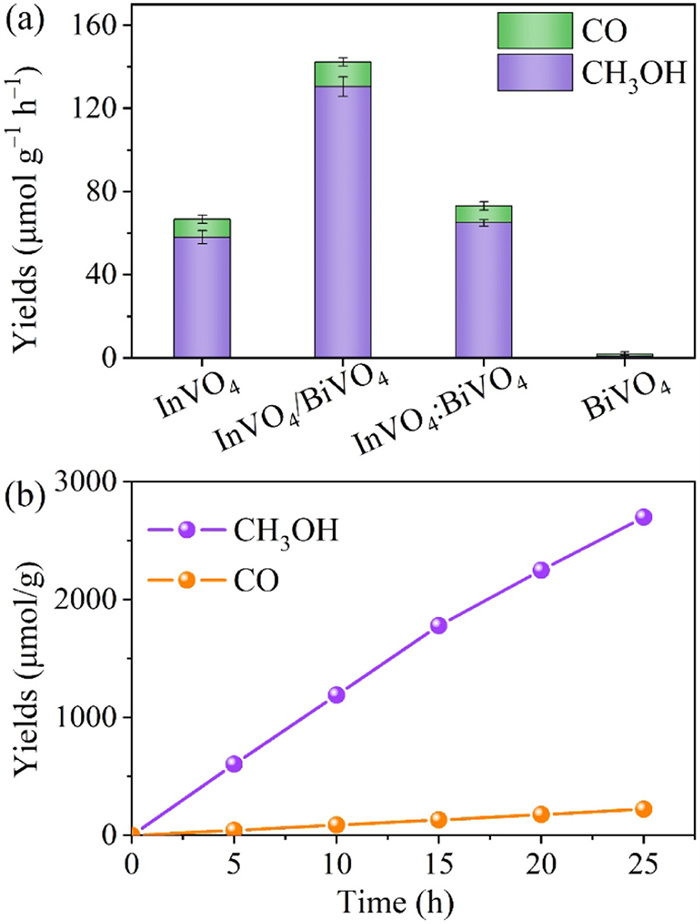
The InVO4/BiVO4 heterostructure also demonstrates excellent photoreaction stability. Fig. 3b and Fig. S21 (Supporting information) illustrate that it maintained high catalytic activity throughout a continuous 25 h illumination reaction and displayed no significant decrease in activity after 4 cycles of reaction tests. The crystal structure and surface state of InVO4/BiVO4 remained stable during the reaction process, as confirmed by XRD patterns and XPS spectra (Figs. S22 and S23 in Supporting information). Moreover, control experiments revealed that light, catalyst, CO2, and H2O are indispensable elements for the generation of CH3OH, indicating that CH3OH originates from light-driven CO2 reduction over photocatalyst with water as electron source (Fig. S24 in Supporting information). Furthermore, when 13CO2 was employed as the reactant, distinctive split peaks attributable to 13CH3OH (δ = 3.04 and 3.40 ppm) were discernible in the 1H nuclear magnetic resonance spectrum (Fig. 4a). Meanwhile, the replacement of H216O with H218O resulted in unequivocal detection of 18O2 (m/z = 36) through mass spectrometry analysis (Fig. 4b). These results further robustly demonstrated that CH3OH and O2 originate from CO2 photoreduction and H2O oxidation, respectively.
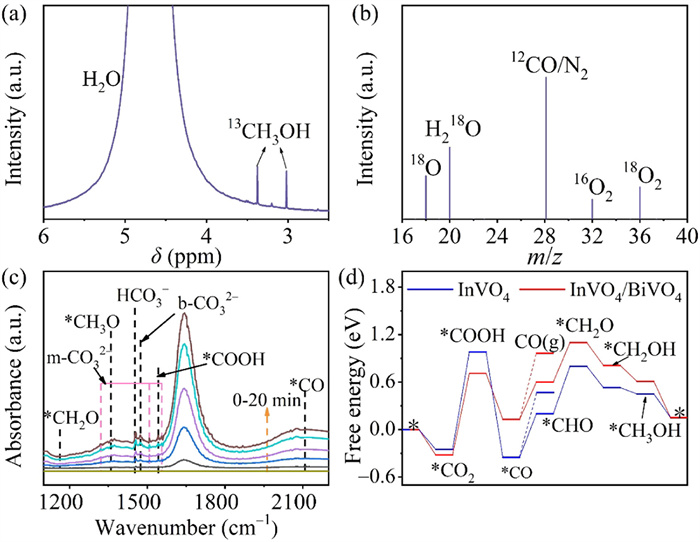
In-situ infrared spectroscopy (IS-IR) measurements were carried out to monitor the evolution of CO2 on the InVO4/BiVO4 surface during photocatalytic reaction. As shown in Fig. 4c, the characteristic absorption peaks emerged for various intermediates like m-CO32− (1321, 1508 and 1556 cm−1), b-CO32− (1476 cm−1), HCO3− (1454 cm−1) and *COOH (1542 cm−1) [41–43], with increasing illumination time. Additionally, the characteristic signal peaks of *CH2O (1163 cm−1) and *CH3O (1362 cm−1) [44,45], which are crucial intermediates in the reduction of CO2 to CH3OH, were also identified. Based on these observations, the reaction pathway for photocatalytic CO2 reduction on the InVO4/BiVO4 heterojunction surface can be speculated as follows. Photoexcited InVO4/BiVO4 generates electron-hole pairs separated via a Z-scheme mechanism, retaining electrons on InVO4 and holes on BiVO4. Electrons on InVO4 drive CO2 reduction through proton-coupled electron transfer, forming *CO via *COOH protonation and dehydration, followed by consecutive reduction and hydrogenation to CH3OH. Furthermore, density functional theory (DFT) calculations determined the Gibbs free energies of the reaction intermediates. As illustrated in Fig. 4d, CO2 adsorbed at the reduction site was first activated to form *CO2, and the adsorption effect of InVO4/BiVO4 on CO2 is more significant than that of InVO4, mainly attributed to the transfer of free electrons in InVO4/BiVO4, rendering InVO4 in an electron-deficient state. The rate-determining step for both InVO4 and InVO4/BiVO4 is the transition from *CO2 to *COOH, but with a significantly lower energy barrier for InVO4/BiVO4 than that of InVO4. Subsequently, *COOH undergoes protonation and dehydration to form a stable *CO intermediate. Notably, hydrogenation of *CO to *CHO has a lower energy barrier than *CO desorption, contributing to high selectivity of InVO4-based materials in reducing CO2 to CH3OH.
In summary, a Z-scheme heterojunction of InVO4/BiVO4 was successfully synthesized through an innovative cation exchange strategy and utilized for photocatalytic CO2 reduction with H2O as the electron source. Microstructural analysis unveiled that the InVO4/BiVO4 features a tightly connected interface, enabling efficient separation of photogenerated carrier through a Z-scheme mechanism, as validated by diverse measurements encompassing ESR, ISI-XPS and photoelectrochemical techniques. Furthermore, DFT calculations revealed that the formation of heterojunction can promote the adsorption and activation of CO2, attributed to the deficient-electron nature of the InVO4 component. Consequently, the InVO4/BiVO4 heterojunction demonstrates remarkable efficiency and selectivity in photocatalytic CO2 reduction to CH3OH, achieving a yield and selectivity of 130.5 µmol g−1 h−1 and 92 % respectively, outperforming other materials reported thus far.
The authors declare that they have no known competing financial interests or personal relationships that could have appeared to influence the work reported in this paper.
Cheng-Cheng Jiao: Writing – original draft, Methodology, Investigation. Guang-Xing Dong: Writing – original draft, Methodology, Investigation. Ke Su: Writing – review & editing, Supervision, Project administration, Methodology. You-Xiang Feng: Investigation. Min Zhang: Writing – review & editing, Supervision, Project administration, Methodology, Funding acquisition, Conceptualization. Tong-Bu Lu: Methodology, Funding acquisition.
This work was financially supported the National Key R&D Program of China (No. 2022YFA1502902), the National Natural Science Foundation of China (NSFC, Nos. 22475152 and U21A20286), and the 111 Project of China (No. D17003).
Supplementary material associated with this article can be found, in the online version, at doi:
S. Fang, M. Rahaman, J. Bharti, et al., Nat. Rev. Methods Prim. 3 (2023) 61.
S. Yang, W.J. Byun, F. Zhao, et al., Adv. Mater. 36 (2024) 2312616.
T. Wang, Y. Wang, Y. Li, C. Li, Nano Res. 17 (2024) 5–17.
Y. Li, Y. Wei, W. He, et al., Chin. Chem. Lett. 34 (2023) 108417.
Q. Tang, T. Li, W. Tu, et al., Adv. Funct. Mater. 34 (2024) 2311609.
C. Liu, F. Chen, B.H. Zhao, Y. Wu, B. Zhang, Nat. Rev. Chem. 8 (2024) 277–293. doi: 10.1038/s41570-024-00589-z
B. Su, Y. Kong, S. Wang, et al., J. Am. Chem. Soc. 145 (2023) 27415–27423. doi: 10.1021/jacs.3c08311
W.J. Wang, K. Chen, Chin. Chem. Lett. 36 (2025) 109998.
S.X. Yuan, K. Su, Y.X. Feng, et al., Chin. Chem. Lett. 34 (2023) 107682.
H.K. Wang, M.R. Zhang, K. Su, et al., Sci. China Mater. 67 (2024) 3176–3184. doi: 10.1007/s40843-024-3035-4
X. Deng, Y. Ke, J. Ding, et al., Chin. Chem. Lett. 35 (2024) 109064.
Z. Xie, H. Luo, S. Xu, L. Li, W. Shi, Adv. Funct. Mater. 34 (2024) 2313886.
Z. Ye, K.R. Yang, B. Zhang, et al., Proc. Natl. Acad. Sci. U. S. A. 121 (2024) e2408183121.
J. Wu, F. Huang, Q. Hu, et al., J. Am. Chem. Soc. 146 (2024) 26478–26484. doi: 10.1021/jacs.4c09841
H. Jian, K. Deng, T. Wang, et al., Chin. Chem. Lett. 35 (2024) 108651.
B. Shang, F. Zhao, S. Suo, et al., J. Am. Chem. Soc. 146 (2024) 2267–2274. doi: 10.1021/jacs.3c13540
H. Lu, N. Uddin, Z. Sun, et al., Nano Energy 115 (2023) 108684.
M. Cheng, N. Cao, Z. Wang, et al., ACS Nano 18 (2024) 10582–10595. doi: 10.1021/acsnano.4c00350
Q. Sun, X. Liu, Q. Gu, et al., J. Am. Chem. Soc. 146 (2024) 28885–28894. doi: 10.1021/jacs.4c09106
C.L. Rooney, M. Lyons, Y. Wu, et al., Angew. Chem. Int. Ed. 63 (2024) e202310623.
Y. Wang, R. Godin, J.R. Durrant, J. Tang, Angew. Chem. Int. Ed. 60 (2021) 20811–20816. doi: 10.1002/anie.202105570
Z. Shang, X. Feng, G. Chen, R. Qin, Y. Han, Small 19 (2023) 2304975.
C. Shen, X.Y. Meng, R. Zou, et al., Angew. Chem. Int. Ed. 63 (2024) e202402369.
J.R. Huang, W.X. Shi, S.Y. Xu, Adv. Mater. 36 (2024) 2306906.
L. Wang, B. Zhu, J. Zhang, et al., Matter 5 (2022) 4187–4211.
H. Chen, X. Yang, M. Lin, et al., ACS Sustain. Chem. Eng. 11 (2023) 18029–18040. doi: 10.1021/acssuschemeng.3c05883
Q. Han, X. Bai, Z. Man, et al., J. Am. Chem. Soc. 141 (2019) 4209–4213. doi: 10.1021/jacs.8b13673
M.Y. Ye, Z.H. Zhao, Z.F. Hu, et al., Angew. Chem. Int. Ed. 56 (2017) 8407–8411. doi: 10.1002/anie.201611127
Y. Liu, H. Shang, B. Zhang, D. Yan, X. Xiang, Nat. Commun. 15 (2024) 8155.
J. Li, F. Wei, Z. Xiu, X. Han, Chem. Eng. J. 446 (2022) 137129.
M. Yu, J. Wang, G. Li, S. Zhang, Q. Zhong, J. Mater. Sci. Technol. 154 (2023) 129–139.
D.S. Lee, Y.W. Chen, J. CO2 Util. 10 (2015) 1–6.
G.X. Dong, M.R. Zhang, K, Su, et al., J. Mater. Chem. A 11 (2023) 9989–9999. doi: 10.1039/d3ta01405c
J. Xu, Z. Bai, X. Xin, A. Chen, H. Wang, Chem. Eng. J. 337 (2018) 684–696.
J.B. Pan, B.H. Wang, S. Shen, L. Chen, S.F. Yin, Angew. Chem. Int. Ed. 62 (2023) e202307246.
F. Guo, W. Shi, X. Lin, et al., Sep. Purif. Technol. 141 (2015) 246–255.
Y. Fan, R. Yang, R. Zhu, Colloid Surf. A 589 (2020) 124448.
L. Yu, H. Wang, Q. Huang, et al., Sep. Purif. Technol. 310 (2023) 123143.
W. Sun, Y. Dong, X. Zhai, et al., Chem. Eng. J. 430 (2022) 132872.
D. Ma, Y. Zhang, M. Gao, et al., Appl. Surf. Sci. 353 (2015) 118–126.
C. Chen, C. Ye, X. Zhao, et al., Nat. Commun. 15 (2024) 7825.
K. Wang, M. Cheng, F. Xia, et al., Small 19 (2023) 2207581.
P. Liu, Y.L. Men, X.Y. Meng, et al., Angew. Chem. Int. Ed. 62 (2023) e202309443.
X. Duan, H. Jia, T. Cao, et al., Appl. Catal. B 352 (2024) 124016.
Z. Wang, J. Zhu, X. Zu, et al., Angew. Chem. Int. Ed. 61 (2022) e202203249.

Figure 1 SEM images of (a) InVO4 and (b) InVO4/BiVO4. (c) HRTEM image of InVO4/BiVO4. (d − g) EDS elemental mapping images (In, V, Bi and O) of InVO4/BiVO4.

Figure 2 (a) Binding energy shifts between InVO4/BiVO4 and InVO4 or BiVO4 in the dark (left), and binding energy shifts of InVO4/BiVO4 upon light irradiation (light). (b) Charge density difference of the InVO4/BiVO4 heterojunction. (c) Planar-averaged charge density difference along the z-axis. (d) Schematic diagram of the energy band structure and direct Z-scheme charge transfer mechanism under illumination for InVO4/BiVO4. The EPR spectra of (e) DMPO-•O2− and (f) DMPO-•OH for InVO4, BiVO4 and InVO4/BiVO4.

Figure 3 (a) Yields of products with different photocatalysts. (b) Time-on-line amounts of products by InVO4/BiVO4.

Figure 4 (a) 1H NMR spectrum of the products produced from 13CO2 reduction. (b) MS analyses for solar-driven reaction of H218O to 18O2 (m/z = 36) using InVO4/BiVO4 as photocatalyst. (c) IS-IR spectra of the CO2 photoreduction reaction with InVO4/BiVO4 as photocatalyst. (d) Calculated free-energy plots for CO2 photoreduction of InVO4, and InVO4/BiVO4.

 扫一扫看文章


扫一扫关注我们
 DownLoad:
 下载:
下载:
 下载:
下载: