
Scheme 1.
Illustration for the fabrication of the MC-LR immunoassay methodology based on PGM.

Point-of-care detection of Microcystin-LR with a personal glucose meter in drinking water source
Lifang Zhao , Long Teng , Juan Zhang , He Li


Microcystins (MC), released by cyanobacteria cells during eutrophication, may lead to liver cancer, intrahepatic bleeding, or other hepatic diseases due to the high toxicity [1]. MC-LR and other microcystins are often playing a negative role as biological contaminants in water pollution [2-4]. As a result, the WHO has proposed a provisional guideline limit of 1 μg/L of MC-LR in drinking water [5].
To date, many methods have been developed for detecting MCLR, which include enzyme-linked immunosorbent assays, liquid chromatography/mass spectrometry, thin-layer chromatography, electrochemical immunoassay [6-13]. But these methods were difficult to apply for field analysis because of the shortcomings of the burdensome of instruments and skillful technicians [14]. Point-of-care testing (POCT) has been considered as one promising method for personal healthcare and on-site environmental monitoring by virtue of the merits of cost-effective, poor equipment burdensome and easy-to-use [15, 16]. Although many research endeavors have been contributed in POCT study, only quite a few quantitative POCT devices have been put into practical use [17]. Particularly, the personal glucose meter (PGM) was the most successful example of quantitative POCT devices, which does great help to improve the living quality of people [18]. PGM has been successfully used for the detection of blood glucose since the first demonstration of glucose monitoring in blood plasma by Clark and Lyons in 1962 [19, 20]. However, PGMs can only detect glucose obtained in the redox reaction which is catalyzed by glucose oxidase or dehydrogenase. Pioneered work was reported to detect other analytes if other enzymes were chosen while the final product was kept as glucose [21]. As expected, the major challenges of detecting other targets beyond glucose using a PGM as a portable device were well addressed.
In this work, we presented a point-of-care immunosensing protocol for the detection of MC-LR employing PGM. The method was relied on the enzyme-based amplification strategy and the use of a universal PGM for recording the transducing signal.
As illustrated in Scheme 1, the PGM readout immunosensor for MC-LR was used ZnFe2O4 magnetic nanoparticles (MNPs) coated with primary antibody (Ab1) to capture the target MC-LR. After capturing the signal labels of the invertase@secondary antibody (Ab2)-conjugated graphene oxide (GO)-Au NPs, the immunosensor was developed with the sandwich type. Invertase is a kind of enzyme which can catalyze the hydrolysis of sucrose to glucose. Then, taking advantage of specific enzymatic conversion of sucrose to glucose, the immunosensor realized rapid and sensitive detection of MC-LR with the PGM.
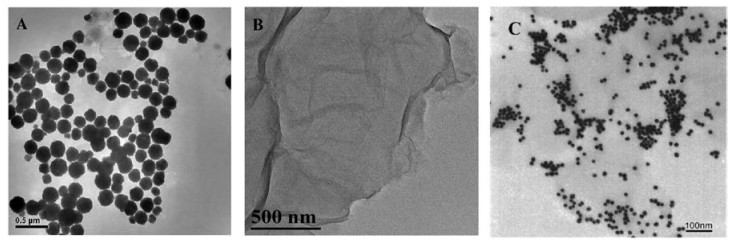
The morphology of ZnFe2O4 MNPs, GO and GO-Au NPs were observed by SEM and TEM (Fig. 1). As revealed in Fig. 1A, ZnFe2O4 MNPs presented spherical structure with an average size of about 200 nm. Also, ZnFe2O4 MNPs exhibited good dispersibility and rapid magnetic separation in aqueous solution (Fig. S1 in Supporting information), which enabled the magnetic enhanced rapid detection of MC-LR. GO exhibited the typical wrinkle morphology (Fig. 1B). Fig. 1C presented that Au NPs were uniformly distributed on the surface of GO nanosheets.
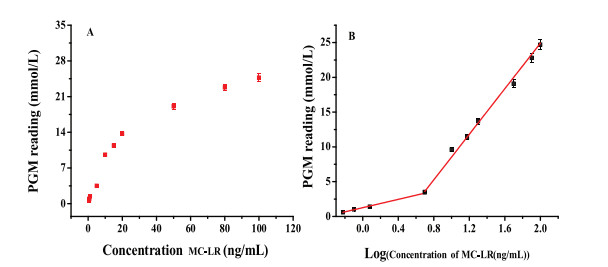
Under the optimal conditions (Fig. S2 in Supporting information), the detection performance of the immunosensor was determined. As shown in Fig. 2, it can be seen that the PGM reading increased along with the increasing MC-LR concentration in the range of 0.60–100.00 ng/mL. The PGM reading dependent on the standard MC-LR concentration was illustrated in Fig. 2B, based on which a quantitative assay for MC-LR can be achieved. The calibration curve was Y = 1.26 + 2.99logC (R2 = 0.996) in rang of 0.60–5.00 ng/mL and Y =-7.81 + 16.38logC (R2 = 0.997) in rang of 5.00–100.00 ng/mL. The limit of detection of the sensor was calculated to be 0.10 ng/mL (S/N = 3), which met the standard of the WHO requirements for MC-LR content in drinking water (1 μg/L) and was superior to the limit of detection for MC-LR of 0.12 μg/L [22] and 0.5 μg/L [23].
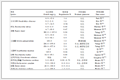
The assay results of polluted water samples were measured to verify the practicality, selectivity and application potential of the PGM readout immunosensor. As shown in Table 1, the recovery were from 99.3% to 100.4% (n = 5) and the RSDs were 6.6%, 1.8%, and 1.6% at the addition level of 1.00, 10.00, and 15.00 ng/mL, respectively. The results indicated that the developed immunosensor has a satisfied performance in the analytical application of the MC-LR level in real water samples. Moreover, the fabricated immunosesnor exhibited the merits of good reproducibility and stability (Fig. S3 in Supporting information), indicating high promising for on-site environmental monitoring.
 DownLoad:
CSV
DownLoad:
CSV

|
In summary, a new PGM readout immunosensor for point-of-care detection of MC-LR hasbeen successfully developed. By using GO-Au NPs loaded with large amount of invertase as signal amplification labels, a relative low level of MC-LR at 0.10 ng/mL could be unambiguously detected. Considering the wide availability of PGMs, the methodology demonstrated here has the great potential for onsite environmental monitoring and medical diagnostics.
The authors would like to thank the Natural Science Foundation of Shandong (No. ZR2017MB017) for the financial support.
Supplementary material related to this article canbefound, in the online version, at doi:https://doi.org/10.1016/j.cclet.2019.01.001.
Y. Xia, J.L. Deng, L. Jiang, Sens. Actuators B:Chem. 145(2010) 713-719. doi: 10.1016/j.snb.2010.01.029
P.F. Xu, X.X. Zhang, C. Miao, et al., Environ. Sci. Technol. 47(2013) 8801-8808.
M.P. Schimer, M. Rossotti, N. Badagion, et al., Anal. Chem. 89(2017) 6800-6860. doi: 10.1021/acs.analchem.7b01221
T.Z. Liu, R. Mazmouz, S.E. Ongley, et al., ACS Chem. Biol. 12(2017) 2021-2029. doi: 10.1021/acschembio.7b00181
Staff W.H.O. Guidelines for drinking-water quality:Surveillance and control of community supplies[J]. World Health Organization, 1997., : .
G.P. Zhang, C. Li, S.Q. Wu, Q.C. Zhang, Sens. Actuator B:Chem. 260(2018) 42-47. doi: 10.1016/j.snb.2017.12.112
K.K. Zhang, H.Y. Ma, P. Yan, et al., Talanta 185(2018) 140-405.
Y.L. Zhang, M. Chen, H.Y. Li, et al., Sens. Actuators B:Chem. 244(2017) 606-615. doi: 10.1016/j.snb.2017.01.030
Z. Li, J. He, Y. Zhang, et al., Chin. Chem. Lett. 27(2016) 1771-1775. doi: 10.1016/j.cclet.2016.06.052
W.Y. Sun, W.Y. Liu, L.B. Qu, Chin. Chem. Lett. 18(2007) 1107-1110. doi: 10.1016/j.cclet.2007.07.008
S.M. Wang, L. Ge, X.R. Song, et al., Biosens. Bioelectron. 31(2012) 212-218. doi: 10.1016/j.bios.2011.10.019
Y.F. Fang, Y.P. Huang, J. Yang, P. Wang, G.W. Cheng, Environ. Sci. Technol. 45(2011) 1593-1600. doi: 10.1021/es103422j
G.C. Zhang, C. Li, S.Q. Wu, Q.C. Zhang, Sens. Actuators B:Chem. 260(2018) 42-47. doi: 10.1016/j.snb.2017.12.112
T.T. Song, W. Wang, L.L. Meng, et al., Chin. Chem. Lett. 28(2017) 226-230.
M. Zarei, Biosens. Bioelectron. 98(2017) 494-506. doi: 10.1016/j.bios.2017.07.024
B.H. Park, S.J. Oh, J.H. Jung, et al., Biosens. Bioelectron. 91(2017) 334-340. doi: 10.1016/j.bios.2016.11.063
N.T. Brannelly, A.J. Killard, Talanta 167(2017) 296-301. doi: 10.1016/j.talanta.2017.02.025
D.T.N. Tram, H. Wang, S. Sugiarto, Biotechnol. Adv. 34(2016) 1275-1288. doi: 10.1016/j.biotechadv.2016.09.003
J. Woo, V. Arboleda, O.B. Garner, J. Clin. Microbiol. 39(2017) 151-157.
L.C. Clark, C. Lyons, Ann. Ny. Acad. Sci. 102(1962) 29-45.
J. Su, J. Xu, Y. Chen, et al., Chem. Commun. 48(2012) 6909-6911. doi: 10.1039/c2cc32729e
S. Morais, J.T. Lopez, R. Puchades, A. Maquieira, Environ. Sci. Technol. 44(2010) 9024-9029. doi: 10.1021/es101653r
M. Lotirrzo, R. Abyknesha, F. Davis, I.E. Tothill, Environ. Sci. Technol. 46(2012) 5504-5510. doi: 10.1021/es2041042

Scheme 1 Illustration for the fabrication of the MC-LR immunoassay methodology based on PGM.

Figure 2 (A) Detection of MC-LR in buffer (pH 7.0) based on the PGM readout immunosensor, the concentration of MC-LR was varied from 0.60 ng/mL to 100.00 ng/mL, (B) the calibration plot of glucometer reading in the range of 0.60–5.00 ng/mL and in the range of 5.00–100.00 ng/mL.
Table 1. Application of the immunoassay methodology based on PGM for detection of MC-LR in polluted water.
|
|
 下载: 导出CSV

 扫一扫看文章


扫一扫关注我们

 下载:
下载: