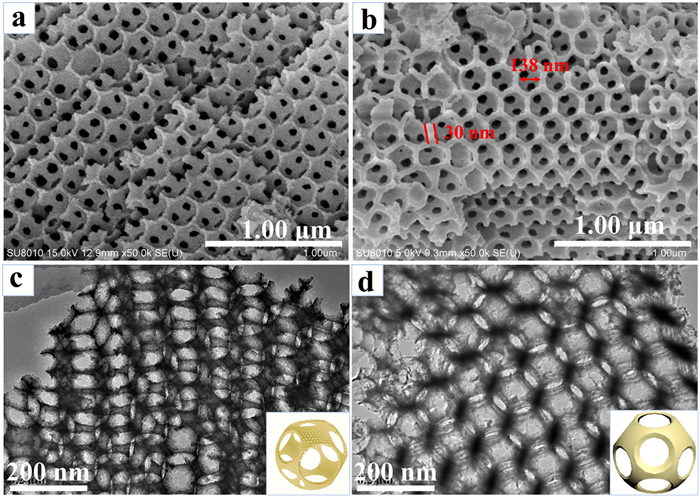
Figure 1.
SEM and TEM of NiCeOx/3DOMM-ZrO2 (a, c) and NiCeOx/3DOM-ZrO2 (b, d) catalysts.

Binary Ni-Ce active sites embedded on 3D ordered macro-mesoporous ZrO2 for boosting coke-resistance dry reforming of methane
Dawei Han , Jing Xiong , Yitao Yang , Zhenpeng Wang , Qifeng Sun , Zhen Zhao , Yuechang Wei


Methane (CH4) valorization is essential for sustainable chemical manufacturing because CH4 is abundant yet chemically inert under mild conditions [1]. Among available routes, dry reforming of methane (DRM; CH4 + CO2 → 2CO + 2H2) is particularly attractive as it simultaneously converts two greenhouse gases into syngas with an H2/CO ratio close to unity, which is well suited for downstream synthesis [2]. Nevertheless, DRM remains industrially challenging due to its strongly endothermic nature (ΔH298K = 247.3 kJ/mol), requiring high operating temperatures (typically >700 ℃). Under such harsh conditions, catalysts often deactivate rapidly through (1) thermal sintering of metal nanoparticles and (2) carbon deposition originating from methane decomposition and the Boudouard reaction, ultimately blocking active sites and mass transport [3–5].
Considerable efforts have therefore been devoted to developing robust DRM catalysts based on both noble and non-noble metals [6–9]. Although noble metals (e.g., Ru, Rh, and Ir) exhibit excellent activity and coke tolerance, their high cost and limited availability hinder large-scale applications [10]. Ni-based catalysts represent a practical alternative, offering high initial activity at a substantially lower cost; however, their stability is often compromised by severe sintering and coking under DRM conditions [11]. Accordingly, rational catalyst design that simultaneously suppresses Ni sintering and mitigates coke accumulation is crucial for advancing Ni-based DRM catalysis [12–15].
Confining Ni nanoparticles in mesoporous hosts can restrain sintering via geometric confinement, yet purely mesoporous channels are prone to blockage by carbon deposits, leading to diffusion limitations and accelerated deactivation [16]. Hierarchical macro-mesoporous architectures provide a promising solution: Interconnected macropores enhance mass transport and offer space to accommodate carbon, while mesopores stabilize and disperse active species [17]. Among the supports widely investigated for DRM, Al2O3, SiO2, MgO, and CeO2 each exhibit distinct advantages but also suffer from certain limitations under harsh high-temperature reaction conditions [18,19]. Al2O3 usually provides good mechanical strength and thermal stability, but its relatively acidic surface may favor carbon deposition and its interaction with Ni is not always sufficient to effectively suppress sintering. SiO2 is chemically inert and often possesses a high surface area; however, its weak metal-support interaction tends to result in Ni aggregation during prolonged high-temperature operation. MgO, due to its basic nature, can promote CO2 adsorption, but its structural stability and ability to maintain highly dispersed active species may remain limited depending on the catalyst architecture. CeO2 is well known for its oxygen storage/release capability and abundant oxygen vacancies, which are beneficial for CO2 activation and carbon removal, yet pure CeO2 may still suffer from limited textural stability and insufficient hierarchical pore transport under severe DRM conditions. In comparison, ZrO2 is considered an attractive support because of its high thermal stability and its relatively strong interaction with Ni species, which helps stabilize dispersed metal particles at elevated temperatures [20]. In addition, defect-rich ZrO2 surfaces can facilitate CO2 adsorption and activation, thereby contributing to improved resistance toward carbon deposition [21]. The design of NiCeOx/3DOMM-ZrO2 was inspired by our previous 3DOMM-ZrO2-based catalyst for soot removal. Considering that soot particles and DRM-derived coke deposits are both carbonaceous species, this hierarchical structure was extended to enhance mass transfer, active-site accessibility, and carbon removal under DRM conditions. More importantly, the present work constructs Ni-Ce interfacial sites, thereby coupling hierarchical confinement with interfacial redox functionality to improve DRM activity and stability. Thus, 3DOMM-ZrO2 was selected based on its thermal robustness, favorable metal-support interaction, defect-assisted CO2 activation, and hierarchical porosity.
Introducing a secondary component is another effective strategy to tune the structural and electronic properties of Ni catalysts and to enhance their resistance to carbon formation [22–24]. In particular, CeO2 is widely recognized for reforming reactions because its high oxygen storage capacity and reversible Ce4+/Ce3+ redox cycle can supply reactive oxygen species. These properties promote CO2 adsorption/activation and facilitate the gasification of deposited carbon, thereby improving catalyst durability [25–28]. Combining a hierarchical 3DOMM framework with Ni-CeOx interfacial synergy is thus expected to deliver advanced DRM catalysts with enhanced activity and stability.
Herein, we fabricate a multifunctional NiCeOx/3DOMM-ZrO2 nanocatalyst via carboxyl-modified colloidal crystal templating (CMCCT) followed by impregnation. The resulting hierarchical architecture provides macropores for efficient transport and carbon accommodation, while mesopores anchor Ni and Ce species to improve thermal stability. Together with the redox-enabled Ni-CeOx synergy, the catalyst exhibits outstanding performance and durability in DRM. Moreover, the DRM reaction pathway and coke-mitigation mechanism over NiCeOx/3DOMM-ZrO2 are systematically investigated and discussed.
The phase composition and crystalline structure of the as-prepared catalysts were investigated by X-ray diffraction (XRD), as shown in Fig. S3 (Supporting information). All three samples exhibit diffraction peaks corresponding to the tetragonal phase of ZrO2 (JCPDS No. 80–0784), the cubic fluorite structure of CeO2 (JCPDS No. 75–0076), and the cubic phase of NiO (JCPDS No. 42–1467). Specifically, the peaks at 2θ = 30.2°, 35.3°, 50.2°, 60.2°, and 62.9° are assigned to the (101), (110), (112), (211), and (202) planes of t-ZrO2, respectively. The diffraction peaks for CeO2 are observed at 28.7°, 33.2°, 47.7°, and 56.4°, corresponding to its (111), (200), (220), and (311) lattice planes. The weaker peaks at 37.2°, 43.3°, and 62.9° can be indexed to the (111), (200), and (220) planes of NiO. Notably, compared to the NiCeOx/3DOM-ZrO2 catalyst, the diffraction peaks for the NiO and CeO2 phases in NiCeOx/Mes-ZrO2 and NiCeOx/3DOMM-ZrO2 are significantly broader and less intense. This suggests a lower crystallinity and smaller crystallite size for the NiO and CeO2 species in these two catalysts, indicating their high dispersion on the mesoporous and hierarchical supports. The pore structures and surface areas of the catalysts were investigated using N2 adsorption-desorption isotherms, with the corresponding Barrett-Joyner-Halenda (BJH) pore size distribution profiles presented in Fig. S4 (Supporting information). As depicted in Fig. S4, the 3DOM-ZrO2 support exhibits a type H3 hysteresis loop, which corresponds to the stacking of its 3D ordered macroporous framework, resulting in a specific surface area of only 2.1 m2/g. In contrast, both the Mes-ZrO2 and 3DOMM-ZrO2 supports display a prominent H4 hysteresis loop in the P/P0 range of 0.4–0.8. This feature, along with the type Ⅱ isotherm observed for 3DOMM-ZrO2, confirms that an ordered mesoporous structure was successfully formed, yielding a significantly higher specific surface area of 51.77 m2/g for 3DOMM-ZrO2. Following the loading of active components, all catalysts exhibit type Ⅳ isotherms with an H3 hysteresis loop (Fig. S5 in Supporting information), confirming the presence of a mesoporous structure in the final materials. The textural properties are summarized in Table S1 (Supporting information). Notably, the specific surface area of the NiCeOx/3DOM-ZrO2 catalyst dramatically increased to 83.4 m2/g. This increase is attributed to the formation of a new mesoporous network created among the NiO particles, CeO2 particles, and the 3DOM-ZrO2 support. The specific surface areas for the NiCeOx/Mes-ZrO2 and NiCeOx/3DOMM-ZrO2 catalysts were 70.9 and 82.9 m2/g, respectively, reflecting the contribution of the NiO and CeO2 species dispersed within the mesopore walls. The hierarchical 3DOMM structure provides a superior architecture for facilitating the mass transfer and diffusion of reactants (CH4 and CO2), thereby increasing the contact efficiency between the reactant molecules and the binary Ni-Ce active sites on the inner walls.
The morphology and structure of NiCeOx/3DOMM-ZrO2 and NiCeOx/3DOM-ZrO2 were examined by scanning electron microscopy (SEM) and transmission electron microscopy (TEM) (Fig. 1). Both catalysts exhibited a well-defined 3DOM framework replicated from the close-packed PMMA template. The macroporous walls were ∼30 nm thick, and abundant interconnected windows with diameters of ∼80 nm formed continuous transport channels. Such an interconnected 3DOM architecture can reduce internal diffusion resistance and improve contact between deposited coke and the catalyst, thereby facilitating carbon removal [29]. TEM images (Figs. 1c and d) further confirmed the ordered macroporous structure with partially overlapped pores; the macropore diameter was ∼140 ± 10 nm, and the window size was 80 ± 5 nm, consistent with SEM observations. For NiCeOx/3DOMM-ZrO2, ordered two-dimensional mesopore arrays were also observed on the macropore walls (Fig. S7 in Supporting information), indicating a hierarchical meso‑macroporous structure. The mesopores were ∼5–6 nm in diameter, which increases accessible surface area and favors a higher surface density of active sites as well as improved adsorption/activation of gaseous reactants. After loading NiO and CeO2 nanoparticles, the hierarchical porous framework remained intact. The nanoparticles were uniformly dispersed on the inner walls (Fig. S7) with a confined size of ∼4.3 nm (1–6 nm), which is beneficial for suppressing carbon deposition.
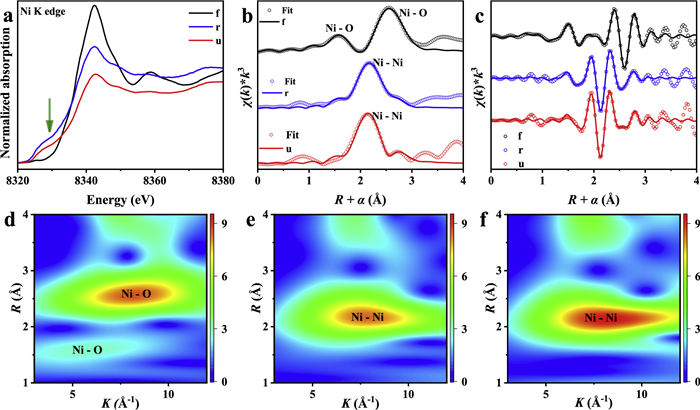
To elucidate the surface chemical states, local atomic arrangement, and electronic structure of the active Ni species, which are crucial determinants of catalytic performance, X-ray photoelectron spectroscopy (XPS) (Fig. S8 in Supporting information) and X-ray absorption spectroscopy (XAS) (Fig. 2) were performed. The analysis was conducted on the NiCeOx/3DOMM-ZrO2 catalyst in its as-prepared (fresh, -f), H2-reduced (-r), and post-reaction (used, -u) states. The Ni K-edge X-ray absorption near-edge structure (XANES) spectra (Fig. 2a) reveal significant changes in the Ni oxidation state. The fresh catalyst exhibits an absorption edge characteristic of cationic Ni2+ in a NiO-like environment. Upon H2 treatment, the edge position shifts to lower energy, confirming a complete reduction to metallic Ni0. After the DRM reaction, the edge position of the used catalyst is intermediate between the reduced and fresh states, indicating that while the majority of Ni remains in its active metallic form, a partial re-oxidation occurs under the catalytic conditions. Further insights were derived from the Fourier-transformed extended X-ray absorption fine structure (EXAFS) data (Figs. 2b and c). Quantitative fitting of the R-space spectra (Table S3 in Supporting information) shows that the fresh catalyst is characterized by a Ni-O coordination shell at 2.07 Å and a long-range Ni-Ni distance of 2.95 Å, consistent with the NiO crystal structure. After reduction, the spectrum is dominated by a metallic Ni-Ni shell at 2.48 Å, characteristic of bulk Ni foil, alongside a Ni-O contribution at 2.03 Å representing the Ni-support interface. For the used catalyst, the Ni-Ni bond distance slightly contracts to 2.47 Å, while the Ni-O bond lengthens to 2.04 Å relative to the reduced state. In addition, the WT-EXAFS contour maps (Figs. 2d-f) are in good agreement with the XANES and EXAFS fitting results, confirming the evolution of the local Ni environment from Ni-O-dominated coordination in the fresh sample to Ni-Ni-dominated coordination after reduction and reaction, with a slightly enhanced Ni-Ni contribution in the used sample. Collectively, these results confirm that metallic Ni0 is the active species and largely persists during catalysis, with the subtle changes in bond distances reflecting the dynamic evolution of the active sites in the reactive atmosphere.
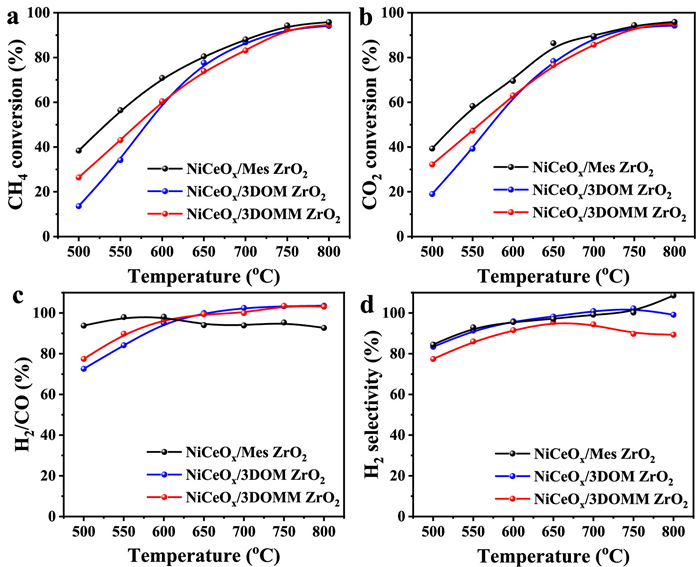
After further probing the redox properties and CO2 adsorption behavior of the catalysts by H2-TPR and CO2-TPD (Fig. S9 in Supporting information), respectively, their catalytic performance in the DRM was evaluated as a function of temperature. The results for NiCeOx/Mes-ZrO2, NiCeOx/3DOM-ZrO2, and NiCeOx/3DOMM-ZrO2 are presented in Fig. 3. A key observation is that while all catalysts exhibited similar high activity above 600 ℃, their performance diverged significantly in the low-temperature region (<600 ℃). As shown in Figs. 3a and b, the NiCeOx/Mes-ZrO2 catalyst demonstrated the highest low-temperature activity, with CH4 and CO2 conversions of 38.4% and 39.3%, respectively, at 500 ℃. In contrast, the NiCeOx/3DOM-ZrO2 and NiCeOx/3DOMM-ZrO2 catalysts showed lower initial conversions under the same conditions. This superior low-temperature performance of NiCeOx/Mes-ZrO2 can be attributed to its significantly larger specific surface area (Table S4 in Supporting information), which provides more accessible active sites. At higher temperatures (e.g., 800 ℃), all catalysts reached near-complete conversions (>94%), suggesting that the reaction becomes limited by thermodynamics rather than catalyst properties. The generally low conversions observed below 650 ℃ are consistent with the high thermodynamic stability of CO2, which acts as the oxidant in the DRM process. The selectivity of H2 and H2/CO molar ratio were also analyzed (Figs. 3c and d). With increasing temperature, all catalysts showed a significant rise in selectivity of H2, approaching near-theoretical values (∼99%) at 800 ℃. The H2/CO ratio, however, was consistently below the stoichiometric value of unity, particularly at lower temperatures. This is a well-known phenomenon in DRM and is attributed to the concurrent reverse water-gas shift (RWGS) reaction (CO2 + H2 ⇌ CO + H2O), which consumes H2 and lowers the H2/CO ratio. To deconstruct the roles of the individual components, control experiments were performed on Ni/3DOMM-ZrO2 and Ce/3DOMM-ZrO2 catalysts (Fig. S10 in Supporting information). The Ce/3DOMM-ZrO2 catalyst exhibited negligible activity, confirming that CeO2 alone is not the primary active species for CH4 activation. Conversely, the Ni/3DOMM-ZrO2 catalyst remained active, indicating that Ni serves as the primary active site. However, a comparison reveals that the bimetallic NiCeOx/3DOMM-ZrO2 catalyst showed markedly superior CH4 and CO2 conversions compared to its Ni-only counterpart. This enhancement in performance is clear evidence of a strong synergistic effect between Ni and Ce, where the presence of ceria significantly promotes the intrinsic activity of the Ni sites. To further probe the reaction mechanism, the apparent activation energies (Ea) for CH4 conversion were calculated for each catalyst (Fig. S11 in Supporting information). The NiCeOx/Mes-ZrO2, NiCeOx/3DOM-ZrO2, and NiCeOx/3DOMM-ZrO2 catalysts displayed similar Ea values of 68.3, 70.2, and 72.4 kJ/mol, respectively. This similarity indicates that the fundamental nature of the active site is the same across these three catalysts, regardless of their different porous architectures. Crucially, the Ea for the Ni/3DOMM-ZrO2 catalyst was significantly higher at 85.1 kJ/mol. The lower activation barrier for the Ni-Ce bimetallic systems provides direct kinetic evidence for the synergistic interaction between Ni and Ce. This synergy facilitates the rate-limiting steps of the reaction, likely the cleavage of C—H and C—O bonds, thereby enhancing the overall catalytic rate.
The long-term stability of the catalysts was evaluated under harsh DRM conditions (750 ℃), and the results are presented in Fig. S12 (Supporting information). The performance was found to be strongly dependent on the catalyst's porous architecture. The NiCeOx/Mes-ZrO2 catalyst exhibited the poorest stability, suffering from rapid and severe deactivation. Over a 480-min period, its CH4 and CO2 conversions plummeted from 96.5% and 93.7% to just 20.0% and 30.9%, respectively. This significant deactivation is likely due to the conventional mesoporous structure being ineffective at inhibiting the growth and accumulation of carbon deposits, which eventually encapsulate the active Ni sites. In comparison, the NiCeOx/3DOM-ZrO2 catalyst demonstrated improved, albeit still moderate, stability. Its CH4 and CO2 conversions decreased from 91.6% and 95.1% to 70.9% and 79.2% over the same duration. The corresponding decline in the H2/CO ratio may be associated with multiple factors under DRM conditions, including the occurrence of the RWGS reaction, variations in the relative CH4 and CO2 conversions, and possible carbon accumulation on active sites, which can collectively contribute to the observed activity loss, consistent with previous reports [30]. Strikingly, the NiCeOx/3DOMM-ZrO2 catalyst showed exceptional stability. After 480 min on stream, the CH4 and CO2 conversions remained remarkably high, decreasing only marginally from 97.9% and 96.7% to 95.2% for both. The H2 selectivity and H2/CO ratio also remained stable. To further evaluate the stability of the NiCeOx/3DOMM-ZrO2 catalyst, a 50-h durability test was conducted (Fig. S13 in Supporting information), during which it maintained high catalytic activity with CH4 and CO2 conversions of 93.6% and 94.7%, respectively, while preserving a stable H2/CO ratio, thereby demonstrating excellent stability. Based on comparisons with related Ni-based and Ni-Ce catalysts reported in the literature [7,31,32], the NiCeOx/3DOMM-ZrO2 catalyst in the present work shows a relatively good level of catalytic performance under DRM conditions. In particular, it demonstrates competitive behavior in balancing catalytic activity and stability, which may be associated with the combined effects of the hierarchical pore structure and Ni-CeOx interfacial synergy. To further elucidate the factors contributing to this excellent stability, a control experiment was conducted on a ceria-free catalyst, Ni/3DOMM-ZrO2, under the same conditions (Fig. S14 in Supporting information). Although it shared the same superior support structure as the best-performing catalyst, its performance degraded more significantly over the 480-min test. The CH4 and CO2 conversions for Ni/3DOMM-ZrO2 dropped from initial values of 95.3% and 91.6% down to 79.4% and 77.6%, respectively. This direct comparison provides compelling evidence for the crucial role of ceria in catalyst stability. The presence of CeO2 alongside Ni in the 3DOMM-ZrO2 support stabilizes the catalytic performance by actively preventing the deactivation caused by carbon deposition. This improved stability is likely associated with the redox functionality of CeO2, and its active oxygen species may facilitate the oxidation and removal of carbon deposits near the active Ni sites.
To investigate the structural evolution and deactivation mechanisms, the used catalysts were characterized by TEM, as shown in Fig. 4. While filamentous carbon was observed on all samples, the extent of structural degradation varied significantly. For the NiCeOx/3DOMM-ZrO2 catalyst (Fig. 4a), the unique 3D ordered macro-mesoporous architecture remained remarkably intact after the reaction. Critically, there was no observable sintering of the Ni nanoparticles, and although carbon deposition occurred, it was primarily located on the surface without blocking the hierarchical pore channels. In contrast, the NiCeOx/3DOM-ZrO2 catalyst (Fig. 4b) exhibited evident metal sintering, contributing to its moderate activity loss. The degradation was most severe for the NiCeOx/Mes-ZrO2 catalyst (Fig. 4c), which was characterized by a high density of filamentous carbon. In this case, Ni particles were frequently observed encapsulated at the tips of the filaments consistent with the mechanism proposed by Baker and Rostrup-Nielsen leading to the physical detachment of active sites from the support [33–35]. In addition, the post-reaction characterization results shown in Fig. S15 (Supporting information) further support these observations, confirming the different degrees of carbon deposition and structural evolution among the spent catalysts. These comparative results succinctly demonstrate that pure mesoporous structures are more susceptible to active-site detachment, whereas macroporous structures tend to undergo metal sintering; in contrast, the hierarchical 3DOMM architecture effectively stabilizes Ni nanoparticles and regulates carbon deposition, thereby preserving catalytic performance.

To elucidate the synergistic mechanism promoting the DRM reaction, in situ diffuse reflectance infrared Fourier transform spectroscopy (DRIFTS) was employed to monitor the evolution of surface reaction intermediates over the Ni/3DOMM-ZrO2 and NiCeOx/3DOMM-ZrO2 catalysts. The experiments were conducted at 650 ℃, a temperature selected to balance the observability of intermediate species with the thermal safety limits of the instrument. Fig. S17 (Supporting information) presents the in situ DRIFT spectra collected after the introduction of the feed gases. Characteristic bands for gaseous CH4 (1270, 1303, 1343, and 3011 cm−1) and CO2 (2357 cm−1) were immediately observed on the surface of the Ni/3DOMM-ZrO2 catalyst [17]. Concurrently, bands appearing in the 3500–3600 cm−1 region were assigned to surface hydroxyl groups (-OH), indicating the occurrence of the Reverse Water-Gas Shift (RWGS) side reaction (CO2 + H2 ⇌ CO + H2O) during the DRM process [36]. A comparison with the NiCeOx/3DOMM-ZrO2 catalyst reveals distinct spectral differences. Notably, the Ce-containing catalyst exhibited additional characteristic peaks assigned to carbonate species at 1512 cm−1 [37,38]. Furthermore, the intensities of bands corresponding to formate and carbonate species at 1573 and 1470 cm−1 were significantly enhanced compared to the Ni-only sample [39]. Even though the overall conversion of CH4 and CO2 appeared low in the short timeframe of the DRIFTS experiment, the clear detection of carbonate and formate species confirms their role as key intermediates in the reaction pathway. The time-resolved evolution of these species is illustrated in Fig. S18 (Supporting information). The peak intensities of the intermediates exhibited a dynamic increase from 0 min to 30 min, confirming their active participation in the reaction. To quantify the influence of Ce species, the normalized accumulation trends of formate and carbonate species are compared in Fig. S17c. It is worth noting that while the surface coverage of these intermediates increased over time for both catalysts, the rate of accumulation was markedly faster on the NiCeOx/3DOMM-ZrO2 catalyst. These results provide direct spectroscopic evidence that the binary Ni-Ce active sites significantly accelerate the activation of CH4 and CO2 into reactive formate and carbonate intermediates, thereby promoting the overall DRM reaction kinetics.
To provide atomistic insights into the surface interactions during the DRM reaction, Density Functional Theory (DFT) calculations were performed. Based on the experimental XRD results, surface models for pure Ni, pure CeO2, and the Ni/CeO2 interface were constructed (Figs. S19 and S20 in Supporting information). The calculated adsorption energies (Eads) indicate that the adsorption behavior of the reactant molecules varies significantly across different surfaces. For CH4, the adsorption energy was calculated to be −0.04 eV on the pure Ni surface and −0.03 eV on the pure CeO2 surface. In contrast, CO2 exhibited a much stronger interaction with the oxide support, with Eads shifting from −0.12 eV on Ni to −0.57 eV on CeO2. This suggests that while Ni provides sites for CH4 interaction, the CeO2 support plays a dominant role in capturing CO2. Most notably, the binary Ni/CeO2 interface exhibited the strongest adsorption capability for both reactants. The adsorption energies for CH4 and CO2 on the Ni/CeO2 model were calculated to be −0.05 eV and −0.61 eV, respectively. These values represent the most stable adsorption configurations among all models tested (i.e., the most negative energies). This enhanced interaction strength indicates that the interface between Ni and CeO2 serves as a dual-active site where both CH4 and CO2 can be activated more effectively than on the isolated components. As shown in Fig. S21 (Supporting information), the activation energy barrier for the initial C—H bond dissociation of CH4 is lower on the NiCeOx surface, suggesting that the Ni-CeOx interfacial structure facilitates C—H bond cleavage and thus promotes CH4 activation during the DRM reaction. These theoretical findings are in excellent agreement with the in situ DRIFTS results, confirming that the synergistic interaction at the Ni-CeO2 boundary is the key driver for the superior catalytic performance.
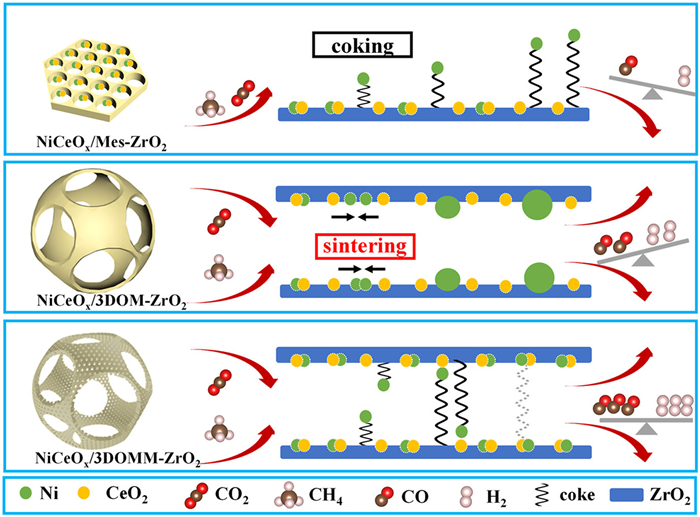
Based on our comprehensive characterization, a schematic illustrating the structure-performance relationships for the catalysts is proposed (Fig. 5). The deactivation mechanisms are highly dependent on the support architecture. For the NiCeOx/Mes-ZrO2, the simple mesoporous structure proved inadequate. Although initially active, the mesopores were rapidly blocked by filamentous carbon, which, as confirmed by TEM, detached and encapsulated the active Ni nanoparticles. This demonstrates a failure of the mesoporous support to physically anchor the active phase against the mechanical stress of carbon growth. In contrast, the NiCeOx/3DOM-ZrO2 exhibited improved coke tolerance due to its open macroporous framework, which enhanced mass transfer and facilitated carbon gasification by CeO2. However, this architecture offered insufficient spatial confinement, leading to significant sintering of Ni nanoparticles and eventual deactivation through active site agglomeration. The superior durability of the NiCeOx/3DOMM-ZrO2 catalyst is attributed to the synergistic effect of its hierarchical macro-mesoporous design. The interconnected macropores ensure efficient mass transport to the active sites, while the mesoporous walls provide a robust confinement effect, physically immobilizing the Ni nanoparticles and preventing thermal sintering. Simultaneously, the intimate Ni-CeO2 interface within this confined space drastically enhances coke resistance by promoting the rapid gasification of surface carbon. This synergy-whereby the macropores facilitate transport and the mesopores prevent sintering-is therefore critical for achieving exceptional long-term stability in DRM catalysts.
In summary, a multifunctional NiCeOx/3DOMM-ZrO2 catalyst with binary Ni-Ce active sites confined in a 3D ordered macro-mesoporous framework was successfully developed via a carboxy-modified colloidal crystal templating strategy combined with wet impregnation. The catalyst exhibited excellent DRM performance, maintaining CH4 and CO2 conversions above 90% with an H2/CO ratio close to unity at 750 ℃. The enhanced performance is mainly attributed to the distinct roles of hierarchical confinement and Ni-Ce interfacial synergy. The hierarchical porous architecture improves reactant diffusion, active-site accessibility, and structural stability, while the Ni-Ce interaction promotes catalytic activity and coke resistance. This work provides an effective strategy for constructing highly active and stable DRM catalysts through the integration of hierarchical porous confinement and interfacial engineering.
Dawei Han: Writing – review & editing, Writing – original draft, Validation, Methodology, Investigation. Jing Xiong: Writing – review & editing, Validation, Methodology, Investigation, Data curation. Yitao Yang: Validation, Methodology, Investigation. Zhenpeng Wang: Methodology. Qifeng Sun: Methodology, Investigation. Zhen Zhao: Supervision, Resources, Project administration. Yuechang Wei: Writing – review & editing, Supervision, Resources, Project administration.
The authors declare that they have no known competing financial interests or personal relationships that could have appeared to influence the work reported in this paper.
This work was financially supported by the National Key Research and Development Program of China (No. 2022YFB3504100), National Natural Science Foundation of China (Nos. 22376217 and 22208373) and Carbon Neutrality Research Institute Fund of Shandong Institute of Petroleum and Chemical Technology (No. CNIF20240106).
Supplementary material associated with this article can be found, in the online version, at doi:
Y. Tang, Y. Wei, Z. Wang, et al., J. Am. Chem. Soc. 141 (2019) 7283–7293. doi: 10.1021/jacs.8b10910
L. Yao, M.E. Galvez, C. Hu, et al., Ind. Eng. Chem. Res. 57 (2018) 16645–16656. doi: 10.1021/acs.iecr.8b04183
C. Palmer, D. Upham, S. Smart, et al., Nat. Catal. 3 (2020) 83–89. doi: 10.1038/s41929-019-0416-2
S. Chen, J. Zaffram, B. Yang, ACS Catal. 10 (2020) 3074–3083. doi: 10.1021/acscatal.9b04429
J. Deng, K. Bu, Y. Shen, et al., Appl. Catal. B 302 (2022) 120859. doi: 10.1016/j.apcatb.2021.120859
Y. Wang, L. Yao, Y. Wang, et al., ACS Catal. 8 (2018) 6495–6506. doi: 10.1021/acscatal.8b00584
I. Yentekakis, P. Panagiotopoulou, G. Artemakis, Appl. Catal. B 296 (2021) 120210. doi: 10.1016/j.apcatb.2021.120210
L. Foppa, M. Silaghi, K. Larmier, et al., J. Catal. 343 (2016) 196–207. doi: 10.1016/j.jcat.2016.02.030
D. Liu, X. Quek, W. Cheo, et al., J. Catal. 266 (2009) 380–390. doi: 10.1016/j.jcat.2009.07.004
P. Wu, Y. Tao, H. Ling, et al., ACS Catal. 9 (2019) 10060–10069. doi: 10.1021/acscatal.9b02286
W. Cai, L. Qian, B. Yue, et al., Chin. Chem. Lett. 25 (2014) 1411–1415. doi: 10.1016/j.cclet.2014.06.016
Q. Zhu, H. Zhou, L. Wang, et al., Nat. Catal. 5 (2022) 1030–1037. doi: 10.1038/s41929-022-00870-8
P. Djinović, A. Pintar, Appl. Catal. B 206 (2017) 675–682. doi: 10.1016/j.apcatb.2017.01.064
Y. Lu, D. Guo, Y. Zhao, et al., J. Catal. 396 (2021) 65–80. doi: 10.3390/foods11010065
L. Buelens, V. Galvita, H. Poelman, et al., Science 354 (2016) 449–452. doi: 10.1126/science.aah7161
W. Cai, L. Qian, B. Yue, et al., Chin. Chem. Lett. 24 (2013) 777–779. doi: 10.1016/j.cclet.2013.05.034
J. Xiong, Z. Li, P. Zhang, et al., Chin. Chem. Lett. 32 (2021) 1447–1450. doi: 10.1016/j.cclet.2020.10.014
S. Lin, J. Wang, Y. Mi, et al., Chin. J. Catal. 42 (2021) 1808–1820. doi: 10.1016/S1872-2067(21)63789-0
J. Zhang, X. Liu, Y. Pan, et al., Energy Fuels 39 (2025) 24320–24332. doi: 10.1021/acs.energyfuels.5c04173
M. Hosseinpour, T. Moser, B. Klötzer, et al., ACS Catal. 15 (2025) 3314–3327. doi: 10.1021/acscatal.4c06230
H. Jiao, G. Wang, ACS Catal. 15 (2025) 3846–3859. doi: 10.1021/acscatal.4c05758
L. Teh, H. Setiabudi, S. Timmiati, et al., Chem. Eng. Sci. 242 (2021) 116606. doi: 10.1016/j.ces.2021.116606
H. Ay, D. Üner, Appl. Catal. B 179 (2015) 128–138. doi: 10.1016/j.apcatb.2015.05.013
X. Zhang, J. Deng, M. Pupucevski, et al., ACS Catal. 11 (2021) 12087–12095. doi: 10.1021/acscatal.1c02124
Z. Ni, X. Djitcheu, X. Gao, et al., Sci. Rep. 12 (2022) 5344. doi: 10.1038/s41598-022-09291-w
D. Kim, K. Stowe, F. Muller, et al. J. Catal. 247 (2007) 101–111. doi: 10.1016/j.jcat.2007.01.011
J. Gao, J. Yang, T. Ma, et al., Chin. Chem. Lett. 34 (2023) 108395. doi: 10.1016/j.cclet.2023.108395
P. Lustemberg, Z. Mao, A. Salcedo, et al., ACS Catal. 11 (2021) 10604–10613. doi: 10.1021/acscatal.1c02154
P. Zhang, X. Mei, X. Zhao, et al., Environ. Sci. Technol. 55 (2021) 11245–11254. doi: 10.1021/acs.est.1c01781
D. Guo, M. Li, Y. Lu, et al., ACS Catal. 12 (2022) 316–330. doi: 10.1021/acscatal.1c04004
M. Li, Z. Sun, Y. Hu, et al., J. Mater. Chem. A 9 (2021) 12495–12520. doi: 10.1039/d1ta00440a
D. Pakhare, J. Spivey, Chem. Soc. Rev. 43 (2014) 7813–7837. doi: 10.1039/C3CS60395D
W. Chen, G. Zhao, Q. Xue, et al., Appl. Catal. B 136-137 (2013) 260–268. doi: 10.1016/j.apcatb.2013.01.044
M. Grabchenko, G. Pantaleo, F. Puleo, et al., Catal. Today 382 (2021) 71–81. doi: 10.1016/j.cattod.2021.07.012
M. Yusuf, M. Beg, M. Ubaidullah, et al., Int. J. Hydrog. Energy 47 (2022) 42150–42159. doi: 10.1016/j.ijhydene.2021.08.021
K. Bu, J. Deng, X. Zhang, et al., Appl. Catal. B 267 (2020) 118692. doi: 10.1016/j.apcatb.2020.118692
S. Zhao, S. Wang, Y. Zhao, et al., Chin. Chem. Lett. 28 (2017) 65–69. doi: 10.1016/j.cclet.2016.06.003
Y. Wang, L. Li, G. Li, et al., ACS Catal. 13 (2023) 6486–6496. doi: 10.1021/acscatal.2c06412
D. He, J. Yan, K. Chen, et al., ACS Catal. 13 (2023) 12114–12124. doi: 10.1021/acscatal.3c00752

Figure 1 SEM and TEM of NiCeOx/3DOMM-ZrO2 (a, c) and NiCeOx/3DOM-ZrO2 (b, d) catalysts.

Figure 2 (a) Normalized XANES spectra of NiCeOx/3DOMM-ZrO2-f, -r, and -u. (b, c) Fourier-transformed EXAFS spectra in R space (circles) and corresponding fits (solid lines). (d-f) WT-EXAFS contour maps of samples -f, -r, and -u, showing Ni-O and Ni-Ni contributions.

Figure 3 Catalytic performance of NiCeOx/Mes-ZrO2, NiCeOx/3DOM-ZrO2 and NiCeOx/3DOMM-ZrO2 catalysts: (a) CH4 conversion, (b) CO2 conversion, (c) H2/CO and (d) H2 selectivity.

Figure 4 TEM images of spent (a) NiCeOx/3DOMM-ZrO2, (b) NiCeOx/3DOMM-ZrO2, (c) NiCeOx/3DOMM-ZrO2 catalysts.

 扫一扫看文章


扫一扫关注我们
 DownLoad:
 下载:

 下载: