
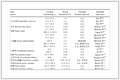
Table 1.
Selected Bond Lengths (Å) for 1


Lanthanide coordination polymers have been receiving wide attention for their fascinating structures and potential applications in gas storage/separation, magnetism, and luminescence[1-5]. To date, a large number of lanthanide coordination polymers have been successfully synthesized with interesting architectures and topologies[6-11]. For example, Long et al reported several unprecedented seven- and eight-connected lanthanide coordination networks by using the 4, 4'-bipyridine-N, N'-dioxide ligand and La3+ ions[12]. These structures suggest that lanthanide ions can adopt high coordination numbers and can be employed for the construction of highly connected frameworks. Yang and coworkers reported a series of porous lanthanide-organic open frameworks with helical tubes constructed from interweaving triple-helical and double-helical chains using 4, 5-imidazoledicarboxylic ligand[13]. However, the design of lanthanide contained architectures with predetermined structures is still a great challenge, perhaps due to the flexible coordination environments, high and variable coordination numbers of the lanthanide ions.
The Zheng group proposed the synthesis of lanthanide clusters via a ligand-controlled hydrolytic approach with the judiciously chosen supporting ligands to limit the degree of lanthanide hydrolysis[14, 15]. At present, the largest reported lanthanide clusters is a wheel shaped Gd140. This nano-sized molecular wheel shows 10-fold symmetry and possesses the largest diameter of 6.0 nm, and displays high stability in solution[16]. Lanthanide clusters can be used to design high-connected coordination polymers for their larger sizes, more coordination sites, and smaller steric hindrance for ligands. For example, Liu and coworkers reported a series of binodal (4, 8)-connected network with cubane-shaped Ln4 clusters and 4, 8-disulfonyl-2, 6-naphthalene dicarboxylic acid ligand[17]. In addition, Ln4 clusters can be linked by organic 3-sulfobenzoate ligand or inorganic SO42- to form the (3, 12)-connected network[18]. The architecture of Ln4(OH)4(SO4)4(H2O)3 contains helical tubes and channels constructed from double left- and right-handed helical chains[18b].
Recently, we have reported a series of lanthanideorganic frameworks constructed by Ln4(OH)4 clusters and mixed ligands of 4, 4'-oxybis(benzoate) (oba) and 2-pyrazinecarboxylic acid[19]. In this work, we use 4, 4'-oxybis(benzoate) and 2, 3-pyridinedicarboxylic acid ligands to continue our search for new lanthanide coordination polymers based on the following considerations: the cooperativity of both ligands can be used to understand the effect of ligands on the lanthanide-organic frameworks and may provide new opportunities for the discovery of interesting structures. Herein, we report the systematic synthesis, structure and topology analysis of a new lanthanide coordination polymer, [Er3(oba)4-(na)]n (1, na = nicotinic acid) under hydrothermal conditions. Compound 1 exhibits a 3D lanthanideorganic framework with an unusual (3, 11)-connected net, which consists of trinuclear lanthanide building units and the mixed ligands of oba2- and na-.
All chemicals were purchased commercially and used without further purification. Powder X-ray diffraction (PXRD) data were obtained by placing the picked crystals onto the flat sample holders using a Philips PW3040/60 diffractometer with CuKα radiation (λ = 1.54056 Å). Elemental analyses were performed on a Vario EL III elemental analyzer. The Fourier transform infrared (FT-IR) spectra (KBr pellets) were recorded on a Nicolet NEXUS670 spectrometer. Thermogravimetric analyses (TGA) was performed on a Netzsch STA 449C analyzer at a heating rate of 10 ℃/min under an air atmosphere.
Synthesis of [Er3(oba)4(na)]n (1). A mixture of Er2O3 (0.5 mmol, 0.191 g), H2oba (0.5 mmol, 0.129 g), 2, 3-pyridinedicarboxylic acid (1 mmol, 0.167 g), HNO3 (0.5 mmol), and H2O (10 mL) was sealed in a 23 mL Teflon-lined bomb at 170 oC for 6 days and then slowly cooled to room temperature. The pink crystals of 1 were obtained (yield: 51% based on H2oba). Anal. Calcd. for C62H36Er3NO22 (1): C, 45.17; H, 2.20; N, 0.85%. Found: C, 44.86; H, 2.43; N, 0.98%. IR bands (cm-1) for 1: 3430 (vs), 2976 (w), 1591 (s), 1518 (s), 1406 (vs), 1240 (s), 1156 (m), 1090 (w), 1044 (w), 877 (m), 774 (m), 700 (w), 635 (w), 570 (w), 505 (w).
The intensity data were collected on a Bruker APEX II with graphite-monochromated Mo-Kα radiation (λ = 0.71073 Å) at room temperature. All absorption corrections were performed using the multi-scan program. The structure was solved by direct methods and refined by full-matrix leastsquares on F2 with the SHELXS-97 and SHELXL-97 programs[20]. The hydrogen atoms of ligands were calculated with the riding model. All atoms except H atoms were refined anisotropically. Selected bond lengths of compounds 1 are listed in Table 1.
 DownLoad:
CSV
DownLoad:
CSV
| Bond | Dist. | Bond | Dist. | |
| Er(1)–O(4A) | 2.229(5) | Er(2)–O(18) | 2.319(5) | |
| Er(1)–O(16B) | 2.231(6) | Er(2)–O(6) | 2.325(5) | |
| Er(1)–O(22C) | 2.239(4) | Er(2)–O(7) | 2.634(4) | |
| Er(1)–O(11D) | 2.245(4) | Er(2)–O(9) | 2.637(5) | |
| Er(1)–O(1) | 2.336(5) | Er(3)–O(21B) | 2.196(4) | |
| Er(1)–O(7) | 2.340(4) | Er(3)–O(17E) | 2.218(5) | |
| Er(1)–O(2) | 2.671(5) | Er(3)–O(12F) | 2.219(5) | |
| Er(2)–O(5A) | 2.213(5) | Er(3)–O(9) | 2.276(5) | |
| Er(2)–O(13) | 2.219(5) | Er(3)–O(14) | 2.318(5) | |
| Er(2)–O(2) | 2.279(5) | Er(3)–O(19) | 2.334(6) | |
| Er(2)–O(8) | 2.303(5) | Er(3)–O(18) | 2.592(6) | |
| Symmetry codes for 1: (A) –x, –y + 1, z – 1/2; (B) x + 1/2, –y + 1/2, z; (C) –x, –y, z – 1/2; (D) –x + 1, –y + 1, z –1/2; (E) –x, –y + 1, z + 1/2; (F) x – 1/2, –y + 3/2, z | ||||
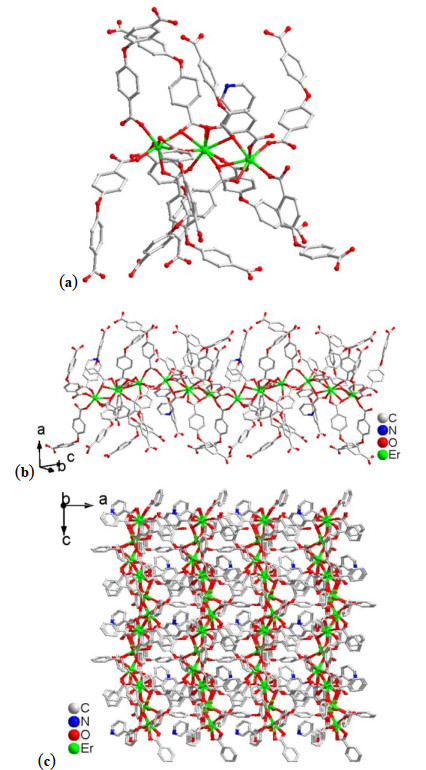
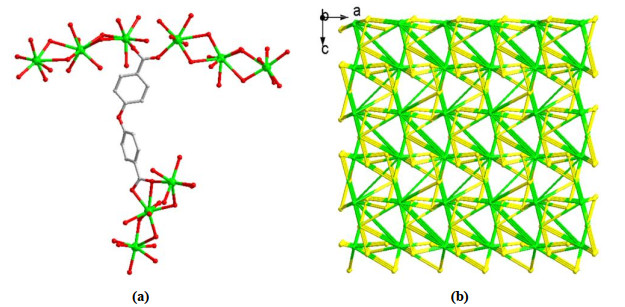
Structure of [Er3(oba)4(na)]n (1). Single-crystal X-ray analysis reveals that compound 1 crystallizes in the noncentrosymmetric orthorhombic space group Pna21[21]. The asymmetric unit of 1 contains three Er3+ ions, four oba2- ligands and one na- ligand. Interestingly, decarboxylation occurred in the ortho position of 2, 3-pdc (2, 3-pdc = 2, 3-pyridinedicarboxylic acid) which was transformed into na- under hydrothermal conditions[22]. The Er(1) and Er(3) ions are seven-coordinated with a capped trigonalantiprism and a capped trigonal-prism coordination environment, respectively (seven carboxylate oxygen atoms (OCOO) from four oba2- ligands and one na ligand for Er(1); seven OCOO from six oba2- ligands for Er(3)). The Er(2) ion is eight-coordinated with a bicapped trigonal-prism coordination environment: eight OCOO from five oba2- ligands and one na- ligand. The oba2- ligands show two types of coordination modes (Fig. S1). The Er−O distances range from 2.196(4) to 2.671(5) Å (Table 1), which are similar to the reported results[19, 22]. Three crystallographically unique Er3+ ions are linked by six OCOO to give a tri-nuclear building block [Er3(COO)6] {Er3} (Fig. 1a). The adjacent {Er3} units are further linked via OCOO groups of oba2- ligands to form 1D chains along the c axis (Fig. 1b). Each chain connects with neighboring others through oba2− ligands to give rise to the final framework (Fig. 1c). In order to better identify the nature of the intricate framework, suitable connectors can be defined by using a topological approach. As shown in Fig. 1a and 2a, each tri-nuclear {Er3} is surrounded by eleven oba2- ligands and one terminal na- ligand, and acts as an 11-connected node (Fig. 1a); while oba2- ligands bridge three neighboring Er3(CO2)6 units and serve as a 3-connected node (Fig. 2a). In this way, the network of 1 can be simplified as a (3, 11)-connected net (Fig. 2b).
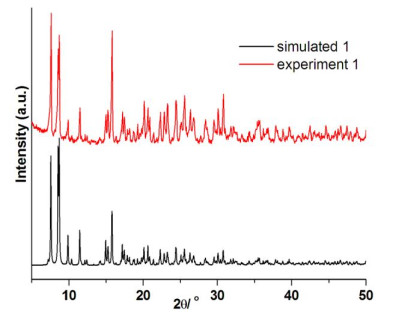
The experimental powder X-ray diffraction (PXRD) patterns of compound 1 match well with the simulated PXRD pattern. The difference in reflection intensities between the simulated and experimental patterns was due to the variation in the preferred orientation of the powder sample during the collection of experimental PXRD data (Fig. 3). The thermal behavior of 1 was examined by Thermogravimetric analyses (TGA) in a dry air atmosphere from 30 to 800 ℃. Compound 1 has a one step of weight loss. Above 500 ℃, the weight loss is due to the decomposition of ligands (calcd./found, 65.2/64.0%) (Fig. S2). The strong and broad absorption bands around 3400 cm−1 in the IR spectra of 1 are assigned as characteristic peak of OH vibration. The strong vibrations appearing around 1592 and 1406 cm−1 are corresponding to the asymmetric and symmetric stretching vibrations of the carboxylate group, respectively (Fig. S3). The second-harmonic-generation (SHG) measurements were tested for compound 1's non-centrosymmetric space group Pna21. Compound 1 shows a very weak SHG response of ∼0.03 KDP (KH2PO4) via nonlinear-optical (NLO) measurement under a 1064 nm laser beam (Fig. S4).
In summary, we have successfully constructed a 3D lanthanide coordination polymer comprising tri-nuclear lanthanide building units and mixed ligands of oba2- and na- under hydrothermal conditions. The framework of 1 exhibits a (3, 11)-connected net, and displays weak second-harmonic generation response for its non-centrosymmetric space group. Our studies indicate that using different mixed-ligands is an effective approach to preparing novel versatile lanthanide-containing coordination frameworks. Further work on this subject is in progress.
Ma, J.; Guo, J.; Wang, H.; Li, B.; Yang, T.; Chen, B. Microporous lanthanide metal-organic framework constructed from lanthanide metalloligand for selective separation of C2H2/CO2 and C2H2/CH4 at room temperature. Inorg. Chem. 2017, 56, 7145-7150. doi: 10.1021/acs.inorgchem.7b00762
(a) Li, Y.; Wang, Y.; Liu, Q. The highly connected MOFs constructed from nonanuclear and trinuclear lanthanide-carboxylate clusters: selective gas adsorption and luminescent pH sensing. Inorg. Chem. 2017, 56, 2159-2164. (b) Wang, Y.; Han, C.; Zhang, Y.; Liu, Q.; Liu, C.; Yin, S. Fine-tuning ligand to modulate the magnetic anisotropy in a carboxylate-bridged Dy2 single-molecule magnet system. Inorg. Chem. 2016, 55, 5578-5584.
(a) Gao, M.; Wang, W.; Liu, L.; Han, Z.; Wei, N.; Cao, X.; Yuan, D. Microporous hexanuclear Ln(III) cluster-based metal-organic frameworks: color tunability for barcode application and selective removal of methylene blue. Inorg. Chem. 2017, 56, 511-517. (b) Zhou, L.; Deng, W.; Wang, Y.; Xu, G.; Yin, S.; Liu, Q. Lanthanide-potassium biphenyl-3, 3'-disulfonyl-4, 4'-dicarboxylate frameworks: gas sorption, proton conductivity, and luminescent sensing of metal ions. Inorg. Chem. 2016, 55, 6271-6277.
Li, B.; Chen, B. Porous lanthanide metal-organic frameworks for gas storage and separation. Struct. Bond. 2015, 163, 75–108.
Chen, L.; Jiang, F.; Zhou, K.; Wu, M.; Hong, M. Metal-organic frameworks based on lanthanide clusters. Struct. Bond. 2015, 163, 145–184.
Cheng, J.; Yang, G. Hydrothermal synthesis of lanthanide and lanthanide-transition-metal cluster organic frameworks via synergistic coordination strategy. Struct. Bond. 2017, 173, 97–120.
Sun, Y.; Zhang, J.; Yang, G. Two novel luminescent lanthanide sulfate-carboxylates with an unusual 2-D bamboo-raft-like structure based on the linkages of left- and right handed helical tubes involving in situ decarboxylation. Chem. Commun. 2006, 1947–1949.
Zhang, Z.; Zhang, Y.; Zheng, Z. Lanthanide hydroxide cluster complexes via ligand-controlled hydrolysis of the lanthanide ions. Struct. Bond. 2017, 173, 1–50.
Xu, H.; Fang, M.; Cao, C.; Qiao, W.; Zhao, B. Unique (3, 4, 10)-connected lanthanide-organic framework as a recyclable chemical sensor for detecting Al3+. Inorg. Chem. 2016, 55, 4790-4794. doi: 10.1021/acs.inorgchem.6b00190
(a) Cheng, J.; Zheng, S.; Yang, G. Diversity of crystal structure with different lanthanide ions involving in situ oxidation-hydrolysis reaction. Dalton Trans. 2007, 4059–4066. (b) Cheng, J.; Zheng, S.; Liu, W.; Yang, G. An unusual eight-connected self-penetrating ilc net constructed by dinuclear lanthanide building units. CrystEngComm. 2008, 10, 765–769.
Fang, W.; Yang, G. Induced aggregation and synergistic coordination strategy in cluster organic architectures. Acc. Chem. Res. 2018, 51, 2888-2896. doi: 10.1021/acs.accounts.8b00346
Long, D.; Blake, A. J.; Champness, N. R.; Wilson, C.; Schröder, M. Unprecedented seven- and eight-connected lanthanide coordination networks. Angew. Chem. Int. Ed. 2001, 40, 2443–2447. doi: 10.1002/1521-3773(20010702)40:13<2443::AID-ANIE2443>3.0.CO;2-C
Sun, Y.; Zhang, J.; Chen, Y.; Yang, G. Porous lanthanide-organic open frameworks with helical tubes constructed from interweaving triple-helical and double-helical chains. Angew. Chem. Int. Ed. 2005, 44, 5814–5817. doi: 10.1002/anie.200500453
(a) Wang, R.; Zheng, Z.; Jin, T.; Staples, R. J. Coordination chemistry of lanthanides at "high" pH: synthesis and structure of the pentadecanuclear complex of europium(III) with tyrosine. Angew. Chem. Int. Ed. 1999, 38, 1813–1815. (b) Zheng, Z. Ligand-controlled self-assembly of polynuclear lanthanide-oxo/hydroxo complexes: from synthetic serendipity to rational supramolecular design. Chem. Commun. 2001, 2521–2529.
(a) Wang, R.; Liu, H.; Carducci, M. D.; Jin, T.; Zheng, C.; Zheng, Z. Lanthanide coordination with α-amino acids under near physiological pH conditions: polymetallic complexes containing the cubane-like [Ln4(μ3-OH)4]8+ cluster core. Inorg. Chem. 2001, 40, 2743-2750. (b) Wang, R.; Selby, H. D.; Liu, H.; Carducci, M. D.; Jin, T.; Zheng, Z.; Anthis, J. W.; Staples. R. J. Halide-templated assembly of polynuclear lanthanide-hydroxo complexes. Inorg. Chem. 2002, 41, 278–286.
Zheng, X.; Jiang, Y.; Zhuang, G.; Liu, D.; Liao, H.; Kong, X.; Long, L.; Zheng, L. A gigantic molecular wheel of {Gd140}: a new member of the molecular wheel family. J. Am. Chem. Soc. 2017, 139, 18178-18181. doi: 10.1021/jacs.7b11112
Liu, Q.; Wang, W.; Wang, Y.; Shan, Z.; Wang, M.; Tang, J. Diversity of lanthanide(III)-organic extended frameworks with a 4, 8-disulfonyl-2, 6-naphthalenedicarboxylic acid ligand: syntheses, structures, and magnetic and luminescent properties. Inorg. Chem. 2012, 51, 2381-2392. doi: 10.1021/ic2023727
(a) Li, X.; Sun, H.; Wu, X.; Qiu, X.; Du, M. Unique (3, 12)-connected porous lanthanide-organic frameworks based on Ln4O4 clusters: synthesis, crystal structures, luminescence, and magnetism. Inorg. Chem. 2010, 49, 1865–1871. (b) Wang, W.; Tian, H.; Zhou, Z.; Feng, Y.; Cheng, J. Two unusual chiral lanthanide-sulfate frameworks with helical tubes and channels constructed from interweaving two double-helical chains. Cryst. Growth Des. 2012, 12, 2567-2571.
Gu, X.; Jin, C.; Cheng, J. A series of lanthanide-organic frameworks constructed by Ln4(OH)4 clusters and mixed ligands. Chin. J. Struct. Chem. 2019, 38, 103-108.
(a) Sheldrick, G. M. SHELXS97, Program for Crystal Structure Solution. University of Göttingen, Göttingen, Germany 1997; (b) Sheldrick, G. M. SHELXL97, Program for Crystal Structure Refinement. University of Göttingen, Göttingen, Germany 1997.
Crystal data for 1: Mr = 1648.70, orthorhombic, Pna2(1), a = 20.6484(5), b = 15.2062(5), c = 18.1476(5) Å, V = 5698.1(3) Å3, Z = 4, Dc = 1.922 cm-3, μ = 4.463 mm-1, S = 0.957, Flack parameter = –0.022(8). The final least-squares refinements converged at R1 (wR2) = 0.0337 (0.0598) and for 10362 reflections with I > 2σ(I).
Cheng, J.; Zheng, S.; Yang, G. Incorporating distinct metal clusters to construct diversity of 3D pillared-layer lanthanide-transition-metal frameworks. Inorg. Chem. 2008, 47, 4930–4935. doi: 10.1021/ic800221j

Figure 1 (a) Tri-nuclear lanthanide building block in 1. (b) 1D chain in 1. (c) 3D framework along the b-axis in 1

Figure 2 (a) View of the 3-connected oba2- ligand. (b) Schematic representation of the (3, 11)-connected net
Table 1. Selected Bond Lengths (Å) for 1
| Bond | Dist. | Bond | Dist. | |
| Er(1)–O(4A) | 2.229(5) | Er(2)–O(18) | 2.319(5) | |
| Er(1)–O(16B) | 2.231(6) | Er(2)–O(6) | 2.325(5) | |
| Er(1)–O(22C) | 2.239(4) | Er(2)–O(7) | 2.634(4) | |
| Er(1)–O(11D) | 2.245(4) | Er(2)–O(9) | 2.637(5) | |
| Er(1)–O(1) | 2.336(5) | Er(3)–O(21B) | 2.196(4) | |
| Er(1)–O(7) | 2.340(4) | Er(3)–O(17E) | 2.218(5) | |
| Er(1)–O(2) | 2.671(5) | Er(3)–O(12F) | 2.219(5) | |
| Er(2)–O(5A) | 2.213(5) | Er(3)–O(9) | 2.276(5) | |
| Er(2)–O(13) | 2.219(5) | Er(3)–O(14) | 2.318(5) | |
| Er(2)–O(2) | 2.279(5) | Er(3)–O(19) | 2.334(6) | |
| Er(2)–O(8) | 2.303(5) | Er(3)–O(18) | 2.592(6) | |
| Symmetry codes for 1: (A) –x, –y + 1, z – 1/2; (B) x + 1/2, –y + 1/2, z; (C) –x, –y, z – 1/2; (D) –x + 1, –y + 1, z –1/2; (E) –x, –y + 1, z + 1/2; (F) x – 1/2, –y + 3/2, z | ||||
 下载: 导出CSV

 扫一扫看文章


扫一扫关注我们

 下载:
下载: