
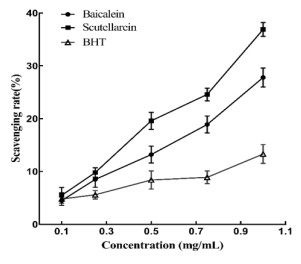
Figure 1.
Comparison of superoxide free radical scavenging capacity of baicalein, scutellarein, and BHT


Baicalein is the main active ingredient extracted from the roots of Scutellaria baicalensis Georgi, which has a wide range of medicinal value such as detoxification, anti-inflammatory and antibacterial[1]. Scutellarein is one of the main components of genus Erigeron karvinskianus, which has anti-inflammatory, blood-activating and antioxidant and other properties[2]. The molecular structures of typical flavonoids are contained in the baicalein and scutellarein. These substances play an important role in the body's antioxidant effects and have high clinical values. Studies have shown that baicalein and scutellarein have anti-inflammatory, immuneenhancing mechanisms and regulation of cardiovascular diseases[3, 4]. The antibacterial and ability to reduce or scavenge free radicals were observed in the baicalein[5, 6]. The two compounds have similar molecular structures, and the phenolic hydroxyl benzene rings in the molecule are connected to each other through a central threecarbon chain (C6–C3–C6). The structure difference between baicalein and scutellarein was that the 4΄-position of the scutellarein molecule is replaced by a hydroxyl group. Currently, density functional theory has been applied to study the relationship between molecular structure and biological activity. The structures and properties of hydrazone compounds[7] and myricetin[8] were theoretically studied using the Dmol3 module in Material Studio, and good results were obtained, respectively. Chen et al[9] reported that the influence of C2=C3 double bond on the antiradical activity of flavonoid based on three prevalently accepted radical scavenging mechanisms employed the density functional theory methods. More studies focused on the extraction, purification, and synthesis[10] of baicalein and scutellarein. There are relatively few studies on the relationship between molecular structure and biological activity of baicalein and the thermodynamic properties of the substance play an important role in studying the antioxidant, transformation and distribution of baicalein and scutellarein in processing. Therefore, the scavenging capacity of superoxide anion radical and 1, 1-diphenyl-2-picrylhydrazyl (DPPH) radical of baicalein and scutellarein was determined in this study. The geometric structures of two compounds were optimized by DMol3 code in Materials Studio 8.0 software based on density functional theory. The effects of atomic charge distribution, bond length, the distribution of molecular frontier orbital, the energy difference and Fukui functions on the free radical scavenging ability were analyzed. The comparison of molecular thermodynamic parameters at different temperature of the compounds was also made. These results offer useful theoretical bases for the research and application of free radicals scavenging capacity of substances containing such molecular structures.
Baicalein (CAS: 491-67-8, purity 98%) and scutellarein (CAS: 112-49-2, purity 99.5%) were obtained from Sinopharm Chemical Reagent Co., Ltd. (Shanghai, China). 1, 1-Diphenyl-2-picrylhydrazyl (DPPH) were the products of Sigma Chemical Co. (St. Louis, MO, USA). All the other reagents used for analysis were of analytical grade.
The superoxide radical-scavenging activity was determined using the method of Pan et al[11] with some modifications. Briefly, baicalein, scutellarein, and butylated hydroxytoluene (BHT) were dissolved in 100 mL methanol before the experiment. Five different concentrations of samples (0.1, 0.25, 0.50, 0.75, 1.0) mg/mL were diluted with methanol solution. Approximately, 4.50 mL of 50 mM tris-HCl buffer (pH 8.2) was mixed with 0.4 mL of samples and then incubated at 25 ℃ for 20 min. After incubation, 0.1 mL of 0.25 mol/L pyrogallic acid was added and then shaken quickly. After incubation at 25 ℃ for 5 min, 10 mM HCl was added to terminate the reaction. The absorbance was measured in triplicate at 325 nm with a 756-PC UV/VIS spectrophotometer (Shanghai Spectrum Instruments Co., Ltd., China). BHT was used as a positive control. Superoxide radical scavenging activity of baicalein and scutellarein was calculated by the following formula:
Superoxide radicals scavenging activity (%) = (Ao ‒ A1) ÷ Ao × 100 where A0 is the abs. of control (methanol instead of the sample), and A1 is the abs. of baicalein, scutellarein or BHT.
The DPPH radical scavenging activity was determined according to Bajpai et al[12] with slight modifications. The reaction mixture contained 2 mL of DPPH dissolved in 100% ethanol and 2 mL of samples (0.1~1.0 mg/L). The mixture was shaken and left for 30 min at room temperature, and the absorbance of the mixture was determined at 517 nm using BHT as a positive control. A lower absorbance represents a higher DPPH scavenging activity. The scavenging effect was expressed as shown in the following equation:
DPPH scavenging activity (%) = (Abscontrol − Abssample)/Abscontrol × 100
Molecular descriptors of baicalein and scutellarein were calculated by DMol3 code based on DFT method using Material Studio 8.0[13] from Accelrys Software Inc (United States). For molecular model calculations, the use of generalized gradient approximation (GGA) was employed which is implemented in the DMol3 code by GGA/RPBE and DNP v.4.0 basis option[14, 15]. A convergence criterion of 10-5 Ha on energy was set as the self-consistent field procedure, and the smearing of electronic occupations was set as 0.005 Ha. The orbital cutoff quality and integration accuracy were set at the fine option. The same setting was used for energy optimization of optimized molecule geometry for both compounds using the DMol3 code. The geometric optimization was performed without any symmetry restriction.
Three replicates of each sample were analyzed (n = 3). All data were expressed as means ± standard errors of three replicates on the figures. The data were analyzed by one-way ANOVA using the statistical software package SPSS v.12.0 for Windows. Duncan's multiple-comparison procedure was applied to detect significant differences among means. The difference at P < 0.05 was considered as significant. Molecular structure optimization data were statistically calculated using the Materials Studio 8.0 software.
Superoxide anion scavenging of baicalein, scutellarein, and BHT at different concentration fractions are presented in Fig. 1. Three compounds in this experiment show considerable scavenging abilities over superoxide anion. The superoxide anion scavenging increased with the increase of sample concentrations and has a dose-effect relationship. The less difference in superoxide anion scavenging ability of baicalein, scutellarein and BHT was observed when the sample concentration was lower than 0.25 mg/mL. When the concentration of baicalein and scutellarein was 1.0 mg/mL, the scavenging rates of baicalein and scutellarein were 36.9% and 27.8%, respectively, which were significantly greater than the scavenging ability of BHT (P < 0.05). Results show that baicalein and scutellarein have stronger antioxidant and free radicals scavenging activities and the two compounds can be potential sources of natural antioxidant.
The stable DPPH radical has been widely used to test the ability of compounds to act as radical scavengers and thus to evaluate the antioxidant activity. Baicalein, scutellarein and BHT had a certain ability to scavenge DPPH radical, and their scavenging rate increased with increasing the concentration of the samples. Results shown in Fig. 2 revealed that the concentration of baicalein and scutellarein at 1.0 mg/mL exhibits an excellent DPPH radical-scavenging activity (51.8% and 60.9%, respectively), which was higher than the scavenging ability of BHT. The baicalein and scutellarein possibly contained some substrates, which were electron donors and could react with free radicals to convert them to be more stable products.
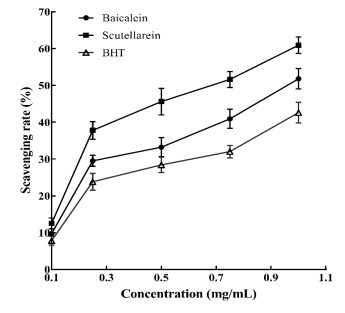
The scavenging rate of DPPH radicals of baicalein and scutellarein was higher than that of O2-· free radicals, both of which showed better antioxidant activity compared with Figs. 1 and 2. The clearance ability in the order of baicalein > scutellarein > BHT was showed. The position and number of hydroxyl groups in the molecular structure of baicalein, scutellarein and BHT were the main sites affecting their antioxidant activity. The hydroxyl group and position in the molecular structure from the baicalein and scutellarein also affected the ability of scavenging free radicals.
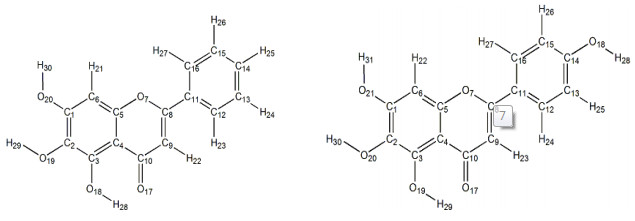
The molecular structures of baicalein and scutellarein were optimized by DMol3 code in Materials Studio 8.0 software based on density functional theory (DFT). The molecular structure and an atomic number of optimized baicalein and scutellarein are shown in Fig. 3.
The main bond lengths and bond angles of the optimized molecular from baicalein and scutellarein are shown in Table 1.
 DownLoad:
CSV
DownLoad:
CSV
| Baicalein | Scutellarein | |||||||
| Bond | (Å) | Angle | (°) | Bond | (Å) | Angle | (°) | |
| C(1)–C(2) | 1.539 | C(1)–C(2)–C(3) | 119.987 | C(1)–C(2) | 1.402 | C(1)–C(2)–C(3) | 118.942 | |
| C(3)–C(4) | 1.542 | C(1)–O(20)-H(30) | 109.609 | C(3)–C(4) | 1.402 | C(1)–O(21)–H(31) | 108.395 | |
| C(4)–C(5) | 1.541 | C(2)–C(3)–C(4) | 120.004 | C(4)–C(5) | 1.402 | C(2)–C(3)–C(4) | 120.362 | |
| C(4)–C(10) | 1.536 | C(6)–C(5)–O(7) | 119.130 | C(4)–C(10) | 1.446 | C(3)–C(2)–O(20) | 119.491 | |
| C(8)–C(9) | 1.540 | C(11)–C(12)–H(23) | 119.995 | C(8)–C(9) | 1.366 | C(1)–C(6)–H(22) | 121.652 | |
| C(8)–C(11) | 1.539 | C(1)–C(2)–O(19) | 119.925 | C(8)–C(11) | 1.462 | C(2)–O(20)–H(30) | 106.400 | |
| C(9)–C(10) | 1.536 | C(2)–O(19)–H(29) | 109.196 | C(9)–C(10) | 1.436 | C(3)–O(19)–H(29) | 103.366 | |
| C(11)–C(16) | 1.539 | C(3)–O(18)–H(28) | 109.213 | C(11)–C(16) | 1.406 | C(11)–C(16)–H(27) | 119.631 | |
| C(1)–O(20) | 1.510 | C(5)–O(7)–C(8) | 119.170 | C(1)–O(21) | 1.381 | C(5)–O(7)–C(8) | 119.946 | |
| C(2)–O(19) | 1.510 | O(7)–C(8)–C(9) | 121.097 | C(2)–O(20) | 1.370 | C(8)–C(9)–O(10) | 122.079 | |
| C(3)–O(18) | 1.510 | C(8)–C(9)–C(10) | 119.775 | C(3)–O(19) | 1.342 | C(9)–C(10)–O(17) | 122.440 | |
| C(5)–O(7) | 1.514 | C(9)–C(10)–O(17) | 120.316 | C(8)–O(7) | 1.370 | C(4)–C(10)–O(17) | 121.847 | |
| C(8)–O(7) | 1.514 | C(4)–C(10)–O(17) | 120.522 | C(10)–O(17) | 1.270 | C(10)–C(9)–H(23) | 117.178 | |
| C(10)–O(17) | 1.510 | C(4)–C(10)–C(9) | 119.162 | C(14)–O(18) | 1.371 | C(14)–O(18)–H(28) | 107.905 | |
| C(15)–O(18) | 1.369 | C(9)–C(8)–C(11) | 119.700 | O(18)–H(28) | 0.982 | C(15)–C(14)–O(18) | 122.823 | |
| O(18)–H(28) | 1.110 | O(7)–C(8)–C(11) | 119.203 | O(19)–H(29) | 1.037 | C(13)–C(14)–O(18) | 117.501 | |
| O(19)–H(29) | 1.110 | C(8)–C(9)–H(22) | 120.074 | O(20)–H(30) | 0.984 | C(9)–C(8)–C(11) | 126.425 | |
| C(6)–H(21) | 1.140 | C(1)–C(6)–H(21) | 119.887 | C(6)–H(22) | 1.091 | O(7)–C(8)–C(11) | 112.387 | |
| C(9)–H(22) | 1.140 | C(16)–C(11)–C(12) | 120.067 | C(9)–H(23) | 1.088 | C(5)–C(4)–C(10) | 119.791 | |
| C(16)–H(27) | 1.140 | C(5)–C(4)–C(10) | 119.678 | C(16)–H(27) | 1.089 | C(6)–C(5)–O(7) | 116.961 | |
As shown in Fig. 3, the bond types of baicalein and scutellarein contained were C=O, C–C, C–H, O–H, C–O, and C=C double bonds. The single bond lengths of C–C in the molecule (1.366 to 1.542 Å) were closer to the standard bond length (C–C single bond in 1.54 Å). The value of C3–C4 in the molecule of baicalein was 1.542 Å, compared to 1.462 Å of C8–C11 in the scutellarein. After optimization, the C–H bond lengths of the molecules were relatively small, and the C–H bond had less influence on the intermolecular activity. The difference of C–C single bonds on the benzene ring of baicalein and scutellarein molecules may be affected by the position and number of -OH, which in turn affected the bond length of the molecule. The single bond length of C8–C11 of scutellarein may be due to the C8=C9 double bond conjugated π bond, and the C8–C11 bond was attached to the ring benzene ring of the compound, forming a p-π conjugation and lowering the electron cloud density of C8–C11, which made the bond longer. Based on the bond lengths of baicalein and scutellarein, the bond lengths of the two molecules were longer, the energy required for the reaction was lower, and the reaction was relatively easier. Both baicalein and scutellarein were typical molecular structures of flavonoids. The bond angles on the benzene ring of each molecule were close to each other, and the conjugation degree in the molecular system was relatively higher. The conjugation and inductive effects could be affected by the bond of the substituent. Substituents had less influence on the bond angles of baicalein and scutellarein. The bond angles of C9–C8–C11 of two molecules reached a maximum of 126.425°. In the reaction, it could be speculated that the hydroxyl groups of two molecules were vulnerable to attack and break. The molecular structures of baicalein and scutellarein contained a certain amount of hydroxyl groups, and there were more H atoms which could react with free radicals. The molecules had more ability to scavenge free radicals and exhibited strong antioxidant activity.
The Mulliken distributions of the optimized atoms of baicalein and scutellarein by DMol3 module are shown in Table 2.
DownLoad:
CSV
| Baicalein | Scutellarein | |||||||||||
| Atom | Charge | Atom | Charge | Atom | Charge | Atom | Charge | Atom | Charge | Atom | Charge | |
| C(1) | 0.325 | C(2) | 0.254 | C(3) | 0.297 | C(1) | 0.324 | C(2) | 0.251 | C(3) | 0.298 | |
| C(4) | –0.053 | C(5) | 0.345 | C(6) | –0.403 | C(4) | –0.054 | C(5) | 0.344 | C(6) | –0.401 | |
| O(7) | –0.447 | C(8) | 0.377 | C(9) | –0.361 | O(7) | –0.452 | C(8) | 0.378 | C(9) | –0.368 | |
| C(10) | 0.371 | C(11) | 0.140 | C(12) | –0.221 | C(10) | 0.372 | C(11) | 0.122 | C(12) | –0.212 | |
| C(13) | –0.148 | C(14) | –0.144 | C(15) | –0.140 | C(13) | –0.234 | C(14) | 0.422 | C(15) | –0.261 | |
| C(16) | –0.209 | O(17) | –0.542 | O(18) | –0.632 | C(16) | –0.205 | O(17) | –0.546 | O(18) | –0.628 | |
| O(19) | –0.641 | O(20) | –0.662 | H(21) | 0.154 | O(19) | –0.633 | O(20) | –0.641 | O(21) | –0.664 | |
| H(22) | 0.181 | H(23) | 0.164 | H(24) | 0.153 | H(22) | 0.152 | H(23) | 0.179 | H(24) | 0.167 | |
| H(25) | 0.152 | H(26) | 0.149 | H(27) | 0.172 | H(25) | 0.167 | H(26) | 0.147 | H(27) | 0.174 | |
| H(28) | 0.467 | H(29) | 0.459 | H(30) | 0.443 | H(28) | 0.436 | H(29) | 0.466 | H(30) | 0.459 | |
| - | - | - | - | - | - | H(31) | 0.442 | - | - | - | - | |
As shown in Table 2, based on the Mulliken charge distribution of optimal baicalein, the non-hydrogen atoms with negative charges were C4, C6, O7, C9, C12, C13, C14, C15, C16, O17, O18, O19, and O20 in baicalein. Other atoms were positively charged. All the O atoms in baicalein were negatively charged. The electronegativity of the O atoms was higher than that of C atoms. When a C atom was connected to an O atom, the O atom could adsorb the electron cloud of the C atom to positively charge the C atom connected to the O atom. The H2, H29, and H30 atoms connected to the O atom had a large positive charge, forming an O–H polar bond, which was prone to breakage. The more negative the atom was, the more likely it was to be attacked by electrophiles. The atoms of O7, O17, O18, O19 and O20 had a large negative charge, which may be the point of the action of electrophile. The more positively charged non-hydrogen atoms were C1, C5, C8 and C10, and this site may be the point of action of the nucleophile attack. As there are a large number of charge sites in the electrophilic action site, baicalein was susceptible to attack by electrophilic agents, so it had better antioxidant capacity. Similar results were reported by Xu[15] and Claudia[16].
The non-hydrogen atoms with negative charge of scutellarein were C4, C6, O7, C9, C12, C13, C15, C16, O17, O18, O19, O20, and O21. Atoms O7, O17, O18, O19, O20, and O21 have a large negative charge, which may be the point of action of the electrophile. The non-hydrogen atoms with positive charge were C1, C5, C8, C10, and C14 and these sites were most likely the points of attack of the nucleophile. As the electrophilic site had more charge, it was susceptible to nucleophilic reactions in the reaction by electrophilic agents, and the scavenging capacity of scutellarein exhibited more ability to radicals.
The values of Fukui functions and frontier orbitals of baicalein and scutellarein are presented in Table 3. The value of molecular orbital energy level with baicalein was 0.07946 Ha, compared with 0.0926 Ha in scutellarein. After calculation, the energy gap of frontier molecular orbitals of scutellarein was 16.5% higher than the values of baicalein. The main compositions of HOMO and LUMO reflected the probability of electrons given by the active centers of baicalein and scutellarein, and the energy gaps between HOMO and LUMO showed that relative molecule possessed certain stability. The free radical scavenging activity depended on the molecular structure and the degree of hydroxylation. The oxygen atoms in the molecular structures of the two substances were the main active sites, as shown in Table 3. The position and relative abundance of the fragments of baicalein and scutellarein depended on the bond energy and any stabilization factors such as p-π conjugating effect and interspace blocking effect. The p-π conjugation effect of O atoms in the hydroxyl group of the molecule could further form hydrogen bonds and exhibited high antioxidant activity. The oxygen atom in the phenolic hydroxyl group of the molecular structure of the samples may be the reaction active sites where the electrophilic reaction occurred. The free radical scavenging activity of the molecule consisted of the Mulliken charge distribution and the Fukui functions.
DownLoad:
CSV
| Name | Fukui functions | Frontier orbitals | ||
| F(-) | F(+) | HOMO | LOMO | |
| Baicalein |  |
 |
 |
 |
| Scutellarein |  |
 |
 |
 |
The thermodynamic parameters of baicalein and scutellarein at different temperature are shown in Fig. 4.
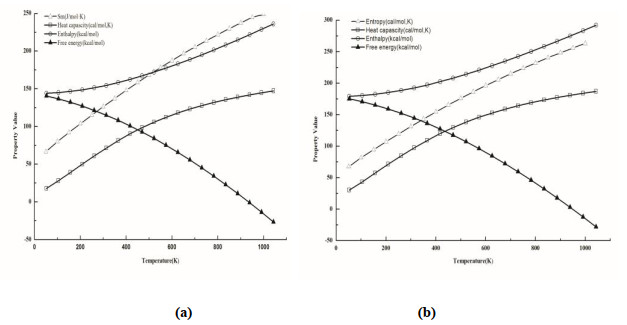
As shown in Fig. 4, the entropy, heat capacity and enthalpy of baicalein and scutellarein increased with the increase of temperature, and the Gibbs free energy decreased with increasing the temperature, indicating that thermal stability of the two molecules decreases with the increase of temperature. The values of entropy, heat capacity, enthalpy, and Gibbs free energy of baicalein were 125.899, 65.96 cal/mol·K and 145.976, 108.439 kcal/mol at 298.15 K, respectively. The values of entropy, heat capacity, enthalpy, and Gibbs free energy of scutellarein were 130.89, 70.685 cal/mol·K and 149.05, 110.06 kcal/mol at 298.15 K, respectively. By fitting the thermodynamic function parameters of the molecule to the temperature, the relationship between the thermodynamic function and the temperature was obtained, as shown in equations (1) to (4).
|
|
(1) |
|
|
(2) |
|
|
(3) |
|
|
(4) |
where Sm is the entropy (cal/mol·K) of the molecule, Hm the enthalpy (kcal/mol) of the molecule, and R2 is larger than 0.96. Molecular thermodynamic data based on density functional theory provide a reference for further exploration of the thermodynamic properties of the relative molecules.
With the increase of the concentration of baicalein and scutellarein, the scavenging ability of superoxide anion radical and DPPH radical of the samples increased with a certain dose-effect relationship. The position and number of hydroxyl groups in the molecular structure of baicalein and scutellarein were the main reaction active sites affecting their antioxidant activity. Due to the hydroxyl groups in the molecular structure, the two substances showed strong ability to scavenge free radicals.
The molecular structures of baicalein and scutellarein were optimized by DMol3 code based on density functional theory. The electronegativity of O atom in the two molecules was large, which was maybe the active site of electrophile and more susceptible to attack by electrophiles. In addition, the p-π conjugation effect of oxygen atoms in the hydroxyl group of the molecular structure had certain electron repellency. Further formation of hydrogen bonds exhibited higher antioxidant activity, and was more susceptible to attack by electrophiles, and baicalein and scutellarein molecules exhibited better antioxidant capacity. The entropy, heat capacity and enthalpy of baicalein and scutellarein increased with the increase of temperature, and the Gibbs free energy decreased with increasing the temperature, indicating that thermal stability of the two molecules decreases with the increase of temperature. Therefore, the molecular design of related compounds could be referenced by theoretical calculation methods in the help of DMol3 module. The results of this study made the foundation for further study of the structure-activity relationship of baicalein and scutellarein and their application in food and pharmaceutical industry.
Li, K.; Fan, H.; Yin, P.; Xue, Q.; Li, X.; Sun, L.; Liu, Y. Structure-activity relationship of eight high content flavonoids analyzed with a preliminary assign-score method and their contribution to antioxidant ability of flavonoids-rich extract from Scutellaria baicalensis shoots. Arab. J. Chem. 2018, 11, 159−170. doi: 10.1016/j.arabjc.2017.08.002
Wang, J.; Zhang, L.; Liu, B.; Wang, Q.; Chen, Y.; Wang, Z.; Zhou, J.; Xiao W.; Zheng, C.; Wang, Y. Systematic investigation of the Erigeron breviscapus mechanism for treating cerebrovascular disease. J. Ethnopharmacol. 2018, 224, 429−440. doi: 10.1016/j.jep.2018.05.022
Sun, W.; Sun, J.; Zhang, B.; Xing, Y.; Yu, X.; Li, X; Xiu, Z.; Dong, Y. Baicalein improves insulin resistance via regulating SOCS3 and enhances the effect of acarbose on diabetes prevention. J. Funct. Foods 2017, 37, 339−353. doi: 10.1016/j.jff.2017.08.005
Ma, J.; Li, S.; Zhu, L.; Guo, S.; Yi, X.; Cui, T.; He, Y.; Chang, Y.; Liu, B.; Li, C.; Jian, Z. Baicalein protects human vitiligo melanocytes from oxidative stress through activation of NF-E2-related factor2 (Nrf2) signaling pathway. Free Radical Bio. Med. 2018, 129, 492−503. doi: 10.1016/j.freeradbiomed.2018.10.421
Zeng, N.; Zhang, G.; Hu, X.; Pan, J.; Zhou, Z.; Gong, D. Inhibition mechanism of baicalein and baicalin on xanthine oxidase and their synergistic effect with allopurinol. J. Funct. Foods 2018, 50, 172−182. doi: 10.1016/j.jff.2018.10.005
Weng, Z. M.; Ge, G. B.; Dou, T. Y.; Wang, P.; Liu, P. K.; Tian, X. H.; Qiao, N.; Yu, Y.; Zou, L. W.; Zhou, Q.; Zhang, W. D.; Hou, J. Characterization and structure-activity relationship studies of flavonoids as inhibitors against human carboxylesterase 2. Bioorg. Chem. 2018, 77, 320−329. doi: 10.1016/j.bioorg.2018.01.011
Kareem, H. S.; Ariffin, A.; Nordin, N.; Heidelberg, T.; Abdul-Aziz, A.; Kong, K. W.; Yehye, W. A. Correlation of antioxidant activities with theoretical studies for new hydrazone compounds bearing a 3, 4, 5-trimethoxy benzyl moiety. Eur. J. Med. Chem. 2015, 103, 497−505. doi: 10.1016/j.ejmech.2015.09.016
Qiu, S.; Jiang, C.; Huang, Y.; Zhou, R. Theoretical investigation on the relationship between the structures and antioxidant activities of myricetin and dihydromyricetin. Chin. J. Struct. Chem. 2017, 6, 1−5.
Zheng, Y. Z.; Deng, G.; Chen, D. F.; Guo, R.; Lai, R. C. The influence of C2C3 double bond on the antiradical activity of flavonoid: different mechanisms analysis. Phytochemistry 2019, 157, 1−7. doi: 10.1016/j.phytochem.2018.10.015
Li, J.; Tian, C.; Xia, Y.; Mutanda I.; Wang, Y. Production of plant-specific flavones baicalein and scutellarein in an engineered E. coli from available phenylalanine and tyrosine. Metab. Eng. 2019, 52, 124−133. doi: 10.1016/j.ymben.2018.11.008
Pan, X.; Wu, S.; Yan, Y.; Chen, X.; Guan, J.; Bao, Y.; Xiong, X.; Liu, L. Rice bran polysaccharide-metal complexes showed safe antioxidant activity in vitro. Int. J. Biol. Macromol. 2019, 126, 934−940. doi: 10.1016/j.ijbiomac.2018.12.265
Bajpai, V. K.; Park, I. W.; Lee, J.; Shukla, S.; Nile, S. H.; Chun, H. S.; Khan, I.; Oh, S. Y.; Lee, H.; Huh, Y. S.; Na, M.; Han, Y. K. Antioxidant and antimicrobial efficacy of a biflavonoid, amentoflavone from Nandina domestica in vitro and in minced chicken meat and apple juice food models. Food Chem. 2019, 271, 329−247.
Delley, B. From molecules to solids with the DMol3 approach. J. Chem. Phys. 2000, 113, 7756−7764. doi: 10.1063/1.1316015
Ghasemi, A.; Asgarpour, Khansary, M.; Marjani, A.; Shirazian, S. Using quantum chemical modeling and calculations for evaluation of cellulose potential for estrogen micropollutants removal from water effluents. Chemosphere 2017, 178, 411−423. doi: 10.1016/j.chemosphere.2017.02.152
Xu, S.; Wang, G.; Liu, H.; Wang, L.; Wang, H. A DMol3 study on the reaction between trans-resveratrol and hydroperoxyl radical: dissimilarity of antioxidant activity among O–H groups of trans-resveratrol. J. Mol. Sruc-Theochem. 2007, 809, 79−85. doi: 10.1016/j.theochem.2007.01.036
Claudia, S. Y.; Carolina, M.; Jorge, I. M. A. A theoretical assessment of antioxidant capacity of flavonoids by means of local hyper-softness. Arab. J. Chem. 2018, 11, 554−563. doi: 10.1016/j.arabjc.2017.10.011

Figure 1 Comparison of superoxide free radical scavenging capacity of baicalein, scutellarein, and BHT

Figure 2 Comparison of DPPH radical scavenging capacity of baicalein, scutellarein, and BHT

Figure 3 Molecular structure and atom number of baicalein (left) and scutellarein (right)

Figure 4 Thermodynamic properties of baicalein (a) and scutellarein (b) at different temperature
Table 1. Bond Lengths and Bond Angles between Atoms in the Optimal Structures of Baicalein and Scutellarein
| Baicalein | Scutellarein | |||||||
| Bond | (Å) | Angle | (°) | Bond | (Å) | Angle | (°) | |
| C(1)–C(2) | 1.539 | C(1)–C(2)–C(3) | 119.987 | C(1)–C(2) | 1.402 | C(1)–C(2)–C(3) | 118.942 | |
| C(3)–C(4) | 1.542 | C(1)–O(20)-H(30) | 109.609 | C(3)–C(4) | 1.402 | C(1)–O(21)–H(31) | 108.395 | |
| C(4)–C(5) | 1.541 | C(2)–C(3)–C(4) | 120.004 | C(4)–C(5) | 1.402 | C(2)–C(3)–C(4) | 120.362 | |
| C(4)–C(10) | 1.536 | C(6)–C(5)–O(7) | 119.130 | C(4)–C(10) | 1.446 | C(3)–C(2)–O(20) | 119.491 | |
| C(8)–C(9) | 1.540 | C(11)–C(12)–H(23) | 119.995 | C(8)–C(9) | 1.366 | C(1)–C(6)–H(22) | 121.652 | |
| C(8)–C(11) | 1.539 | C(1)–C(2)–O(19) | 119.925 | C(8)–C(11) | 1.462 | C(2)–O(20)–H(30) | 106.400 | |
| C(9)–C(10) | 1.536 | C(2)–O(19)–H(29) | 109.196 | C(9)–C(10) | 1.436 | C(3)–O(19)–H(29) | 103.366 | |
| C(11)–C(16) | 1.539 | C(3)–O(18)–H(28) | 109.213 | C(11)–C(16) | 1.406 | C(11)–C(16)–H(27) | 119.631 | |
| C(1)–O(20) | 1.510 | C(5)–O(7)–C(8) | 119.170 | C(1)–O(21) | 1.381 | C(5)–O(7)–C(8) | 119.946 | |
| C(2)–O(19) | 1.510 | O(7)–C(8)–C(9) | 121.097 | C(2)–O(20) | 1.370 | C(8)–C(9)–O(10) | 122.079 | |
| C(3)–O(18) | 1.510 | C(8)–C(9)–C(10) | 119.775 | C(3)–O(19) | 1.342 | C(9)–C(10)–O(17) | 122.440 | |
| C(5)–O(7) | 1.514 | C(9)–C(10)–O(17) | 120.316 | C(8)–O(7) | 1.370 | C(4)–C(10)–O(17) | 121.847 | |
| C(8)–O(7) | 1.514 | C(4)–C(10)–O(17) | 120.522 | C(10)–O(17) | 1.270 | C(10)–C(9)–H(23) | 117.178 | |
| C(10)–O(17) | 1.510 | C(4)–C(10)–C(9) | 119.162 | C(14)–O(18) | 1.371 | C(14)–O(18)–H(28) | 107.905 | |
| C(15)–O(18) | 1.369 | C(9)–C(8)–C(11) | 119.700 | O(18)–H(28) | 0.982 | C(15)–C(14)–O(18) | 122.823 | |
| O(18)–H(28) | 1.110 | O(7)–C(8)–C(11) | 119.203 | O(19)–H(29) | 1.037 | C(13)–C(14)–O(18) | 117.501 | |
| O(19)–H(29) | 1.110 | C(8)–C(9)–H(22) | 120.074 | O(20)–H(30) | 0.984 | C(9)–C(8)–C(11) | 126.425 | |
| C(6)–H(21) | 1.140 | C(1)–C(6)–H(21) | 119.887 | C(6)–H(22) | 1.091 | O(7)–C(8)–C(11) | 112.387 | |
| C(9)–H(22) | 1.140 | C(16)–C(11)–C(12) | 120.067 | C(9)–H(23) | 1.088 | C(5)–C(4)–C(10) | 119.791 | |
| C(16)–H(27) | 1.140 | C(5)–C(4)–C(10) | 119.678 | C(16)–H(27) | 1.089 | C(6)–C(5)–O(7) | 116.961 | |
 下载: 导出CSV
Table 2. Mulliken Charge Distribution of the Optimal Structure Molecules of Baicalein and Scutellarein
| Baicalein | Scutellarein | |||||||||||
| Atom | Charge | Atom | Charge | Atom | Charge | Atom | Charge | Atom | Charge | Atom | Charge | |
| C(1) | 0.325 | C(2) | 0.254 | C(3) | 0.297 | C(1) | 0.324 | C(2) | 0.251 | C(3) | 0.298 | |
| C(4) | –0.053 | C(5) | 0.345 | C(6) | –0.403 | C(4) | –0.054 | C(5) | 0.344 | C(6) | –0.401 | |
| O(7) | –0.447 | C(8) | 0.377 | C(9) | –0.361 | O(7) | –0.452 | C(8) | 0.378 | C(9) | –0.368 | |
| C(10) | 0.371 | C(11) | 0.140 | C(12) | –0.221 | C(10) | 0.372 | C(11) | 0.122 | C(12) | –0.212 | |
| C(13) | –0.148 | C(14) | –0.144 | C(15) | –0.140 | C(13) | –0.234 | C(14) | 0.422 | C(15) | –0.261 | |
| C(16) | –0.209 | O(17) | –0.542 | O(18) | –0.632 | C(16) | –0.205 | O(17) | –0.546 | O(18) | –0.628 | |
| O(19) | –0.641 | O(20) | –0.662 | H(21) | 0.154 | O(19) | –0.633 | O(20) | –0.641 | O(21) | –0.664 | |
| H(22) | 0.181 | H(23) | 0.164 | H(24) | 0.153 | H(22) | 0.152 | H(23) | 0.179 | H(24) | 0.167 | |
| H(25) | 0.152 | H(26) | 0.149 | H(27) | 0.172 | H(25) | 0.167 | H(26) | 0.147 | H(27) | 0.174 | |
| H(28) | 0.467 | H(29) | 0.459 | H(30) | 0.443 | H(28) | 0.436 | H(29) | 0.466 | H(30) | 0.459 | |
| - | - | - | - | - | - | H(31) | 0.442 | - | - | - | - | |
下载: 导出CSV
Table 3. Fukui Functions and Frontier Orbitals of Baicalein and Scutellarein
| Name | Fukui functions | Frontier orbitals | ||
| F(-) | F(+) | HOMO | LOMO | |
| Baicalein | |
|
|
|
| Scutellarein | |
|
|
|
下载: 导出CSV

 扫一扫看文章


扫一扫关注我们
 下载:
下载: