Figure 1.
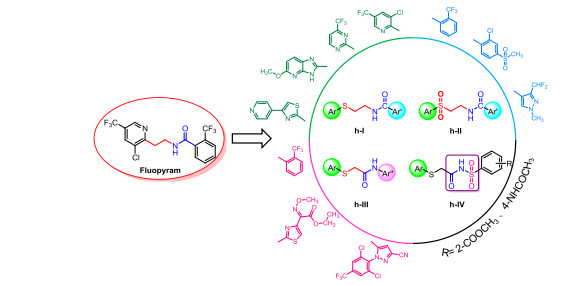
Structural modification of the amide bridge in our previous work

Design, Synthesis and Biological Activity of N-Sulfonyl Aromatic Amide Derivatives
Wen-Rui LIU , Xue-Wen HUA , Sha ZHOU , Feng-Ying YUAN , Gui-Qing WANG , Yi LIU , Xiao-Ran XING


Pesticides play an important role in improving the yield and quality of crops[1-3]. However, with the long-term and large-scale use of pesticides, problems such as drug resistance have become increasingly prominent[4, 5]. The development of new and efficient pesticide active molecules can effectively alleviate the problems caused by drug resistance, and the discovery of lead compounds is the basis of innovative drug research[6, 7].
Fluopyram successfully developed by Bayer company is a new broad-spectrum amide fungicide acting on succinate dehydrogenase (SDH)[8, 9]. At the same time, it has been widely used in the control of soil nematodes in recent years due to its high efficiency and novel mechanism of action[10]. At present, researches on the tri-factor relationship among fluopyram structural modification, fungicidal activity and nematicidal activity are relatively lacking.
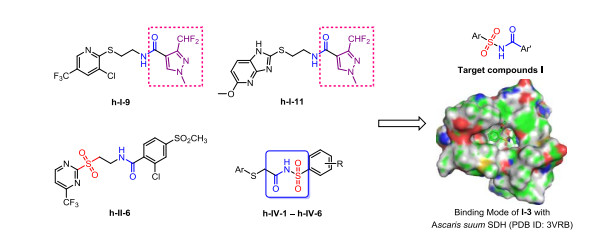
In our previous work, combined with the newly reported structures of new active ingredients in fungicide and nematicide[11-20], four series of amide derivatives with fluopyram as the molecular skeleton were designed and synthesized by introducing sulfide and sulfone substructures into the amide bridge (Fig. 1). Subsequently, the nematicidal and fungicidal activities of the target compounds were measured, and compound h-I-9 displayed excellent fungicidal activity and compounds h-I-11, h-II-6 and h-IV-1~h-IV-6 exhibited good nematicidal activity (Fig. 2)[21-23]. The structure-activity relationships indicated that the N-sulfonyl amide containing aromatic sulfide substructure showed good nematicidal activity[21-23]. On this basis, in order to explore the effect of structural modification of the N-sul-fonyl amide on nematicidal and fungicidal activities, a series of N-sulfonyl amide compounds directly connected to the aromatic rings was designed and synthesized by shortening the amide bridge (Fig. 2). The preliminary molecular docking simulation indicated that the designed molecules could interact with the receptor Ascaris suum SDH (PDB ID: 3VRB) (Fig. 2).
All reaction reagents were of analytical grade. Melting points for target compounds were determined on an X-4 binocular microscope (Gongyi Tech. Instrument Co., Henan, China). Proton (1H)- and carbon-13 (13C)-nuclear magnetic resonance (NMR) were obtained on a Bruker-500 MHz spectrometer, and chemical-shift values (δ) were reported as parts per million (ppm) with tetramethylsilane as the internal standard. Elemental analyses (EA) were determined on an Elementar Vario EL elemental analyzer. High resolution mass spectrometry (HRMS) was recorded using a high resolution mass spectrometer (Varian 7.0T FTMS). The X-ray single-crystal structure was determined on a Bruker D8 Venture diffractometer with Mo-Kα radiation (λ = 0.71073 Å). Column chromatography purification was carried out using silica gel (200~300 mesh).
N-((2-Methoxycarbonylphenyl)sulfonyl)-2-(trifluoromethyl) benzamide (I-1) was synthesized as follows. A mixture of 2-(trifluoromethyl)benzoic acid (0.40 g, 2.1 mmol), 1-ethyl- 3-(3-dimethylaminopropyl)carbodiimide hydrochloride (EDCI, 0.48 g, 2.5 mmol) and 4-dimethylaminopyridine (DMAP, 0.62 g, 5.0 mmol) in N, N-dimethylformamide (DMF, 10 mL) was stirred for 30 min at room temperature, followed by the addition of methyl 2-sulfamoylbenzoate (0.50 g, 2.3 mmol). The reaction was continued to stir for 8 h, and the progress was monitored by TLC. After completion, the mixture was poured into the dilute hydrochloric acid aqueous solution. The resulting precipitate was filtered to provide the product, which was purified by using ethyl acetate to recrystallize. The products could also be purified by dissolving in potassium carbonate aqueous solution, washing with ethyl acetate and using the dilute hydrochloric acid aqueous solution to acidize the water layer to produce the white precipitate, yield 78%.
N-((2-Methoxycarbonylphenyl)sulfonyl)-2-(trifluoromethyl) benzamide (I-1): White granules, yield 78%, m.p. 140~141 ℃. 1H NMR (500 MHz, DMSO-d6) δ 12.99 (s, 1H, CONHSO2), 8.22 (dd, J = 7.7, 1.0 Hz, 1H, Ph-H), 7.89~7.70 (m, 6H, Ph–H), 7.64 (d, J = 7.5 Hz, 1H, Ph–H), 3.89 (s, 3H, COOCH3). 13C NMR (126 MHz, DMSO-d6) δ 167.4, 165.9, 136.3, 134.6, 133.3, 133.0, 132.8, 131.7, 131.2, 129.6, 129.0, 127.1 (q, J = 3.8 Hz), 126.6 (q, J = 32.8 Hz), 123.8 (q, J = 273.4 Hz), 53.6. Anal. Calcd. (%) for C16H12F3NO5S: C, 49.62; H, 3.12; N, 3.62. Found (%): C, 49.53; H, 3.30; N, 3.51.
N-((2-Methoxycarbonylphenyl)sulfonyl)-2-chloro-4-(methylsulfonyl) benzamide (I-2): White granules, yield 79%, m.p. 213~214 ℃. 1H NMR (500 MHz, DMSO-d6) δ 13.10 (s, 1H, CONHSO2), 8.23 (d, J = 7.4 Hz, 1H, Ph–H), 8.09 (d, J = 1.3 Hz, 1H, Ph–H), 7.98 (dd, J = 8.0, 1.4 Hz, 1H, Ph-H), 7.84 (pd, J = 7.5, 1.5 Hz, 2H, Ph-H), 7.79~7.73 (m, 2H, Ph-H), 3.87 (s, 3H, COOCH3), 3.33 (s, 3H, SO2CH3). 13C NMR (126 MHz, DMSO-d6) δ 167.3, 164.4, 144.3, 138.7, 136.5, 134.7, 132.8, 131.5, 131.4, 130.4, 129.7, 128.7, 126.3, 53.7, 43.5. Anal. Calcd. (%) for C16H14ClNO7S2: C, 44.50; H, 3.27; N, 3.24. Found (%): C, 44.39; H, 3.44; N, 3.11.
N-((2-Methoxycarbonylphenyl)sulfonyl)-3-(difluoromethyl)-1-methyl-1H-pyrazole-4-carboxamide (I-3): White granules, yield 82%, m.p. 190~191 ℃. 1H NMR (500 MHz, DMSO-d6) δ 12.40 (s, 1H, CONHSO2), 8.60 (s, 1H, pyrazole-H), 8.18~8.13 (m, 1H, Ph-H), 7.82~7.75 (m, 2H, Ph–H), 7.73~7.68 (m, 1H, Ph–H), 7.09 (t, J = 53.7 Hz, 1H, CHF2), 3.95 (s, 3H, pyrazole-CH3), 3.88 (s, 3H, OCH3). 13C NMR (126 MHz, DMSO-d6) δ 167.3, 159.7, 146.4 (t, J = 23.9 Hz), 137.1, 135.4, 134.3, 132.6, 131.3, 131.3, 129.6, 113.5, 109.8 (t, J = 235.6 Hz), 53.6, 40.1. H RMS (ESI) m/z: calcd. for C14H14F2N3O5S+ 374.0617, found 374.0612 [M + H]+.
N-((2-Methoxycarbonylphenyl)sulfonyl)-2-methyl-4-(trifluoromethyl) thiazole-5-carboxamide (I-4): White needle, yield 77%, m.p. 141~142 ℃. 1H NMR (500 MHz, DMSO-d6) δ 8.14 (d, J = 7.5 Hz, 1H, Ph-H), 7.84~7.75 (m, 2H, Ph-H), 7.70 (dd, J = 7.1, 1.5 Hz, 1H, Ph-H), 3.86 (s, 3H, OCH3), 2.73 (s, 3H, thiazole-CH3). 13C NMR (126 MHz, DMSO-d6) δ 169.2, 167.4, 158.9, 141.2, 140.9, 137.1, 134.1, 132.7, 131.3, 131.1, 129.5, 120.4 (q, J = 272.2 Hz), 53.5, 19.2. Anal. Calcd. (%) for C14H11F3N2O5S2: C, 41.18; H, 2.72; N, 6.86. Found (%): C, 41.03; H, 3.02; N, 6.71.
N-((4-Acetamidophenyl)sulfonyl)-2-(trifluoromethyl)benzamide (I-6): White granules, yield 81%, m.p. 234~236 ℃. 1H NMR (500 MHz, DMSO-d6) δ 12.72 (s, 1H, CONHSO2), 10.42 (s, 1H, CONH), 7.96~7.90 (m, 2H, Ph–H), 7.87~7.82 (m, 2H, Ph–H), 7.81~7.68 (m, 3H, Ph–H), 7.57 (d, J = 7.4 Hz, 1H, Ph–H), 2.12 (s, 3H, COCH3). 13C NMR (126 MHz, DMSO-d6) δ 169.7, 165.9, 144.5, 133.6, 133.1, 132.6, 131.5, 129.6, 128.9, 127.0 (q, J = 5.0 Hz), 126.3 (q, J = 31.5 Hz), 123.7 (q, J = 274.7 Hz), 118.8, 24.7. HRMS (ESI) m/z: calcd. for C16H14F3N2O4S+ 387.0621, found 387.0619 [M + H]+.
N-((4-Acetamidophenyl)sulfonyl)-2-chloro-4-(methylsulfonyl) benzamide (I-7): White granules, yield 75%, m.p. 256~258 ℃. 1H NMR (500 MHz, DMSO-d6) δ 12.89 (s, 1H, CONHSO2), 10.43 (s, 1H, CONH), 8.06 (d, J = 1.5 Hz, 1H, Ph–H), 7.98~7.91 (m, 3H, Ph–H), 7.85 (d, J = 8.9 Hz, 2H, Ph-H), 7.74 (d, J = 8.0 Hz, 1H, Ph–H), 3.32 (s, 3H, SO2CH3), 2.12 (s, 3H, COCH3). 13C NMR (126 MHz, DMSO-d6) δ 169.7, 164.3, 144.7, 144.2, 138.9, 132.5, 131.3, 130.4, 129.6, 128.6, 126.3, 118.9, 43.5, 24.7. Anal. Calcd. (%) for C16H15ClN2O6S2: C, 44.60; H, 3.51; N, 6.51. Found (%): C, 44.52; H, 3.72; N, 6.39.
N-((4-Acetamidophenyl)sulfonyl)-3-(difluoromethyl)-1-me-thyl-1H-pyrazole-4-carboxamide (I-8): White needle, yield 83%, decomposed at 228 ℃. 1H NMR (500 MHz, DMSO-d6) δ 12.26 (s, 1H, CONHSO2), 10.39 (s, 1H, CONH), 8.53 (s, 1H, pyrazole-H), 7.92 (d, J = 8.8 Hz, 2H, Ph–H), 7.81 (d, J = 8.8 Hz, 2H, Ph–H), 7.11 (t, J = 53.8 Hz, 1H, CHF2), 3.93 (s, 3H, pyrazole-CH3), 2.10 (s, 3H, COCH3). 13C NMR (126 MHz, DMSO-d6) δ 169.6, 159.7, 146.3 (t, J = 23.9 Hz), 144.4, 135.4, 133.2, 129.5, 118.9, 113.6, 109.8 (t, J = 235.6 Hz), 24.6. Anal. Calcd. (%) for C14H14F2N4O4S: C, 45.16; H, 3.79; N, 15.05. Found (%): C, 45.03; H, 3.95; N, 14.91.
N-((4-Acetamidophenyl)sulfonyl)-2-methyl-4-(trifluoromethyl) thiazole-5-carboxamide (I-9): White granules, yield 63%, m.p. 215~216 ℃. 1H NMR (500 MHz, DMSO-d6) δ 10.41 (s, 1H, CONH), 7.90 (d, J = 8.9 Hz, 2H, Ph-H), 7.82 (d, J = 8.9 Hz, 2H, Ph–H), 2.73 (s, 3H, thiazole-CH3), 2.11 (s, 3H, COCH3). 13C NMR (126 MHz, DMSO-d6) δ 169.7, 169.5, 158.4, 144.6, 140.9 (q, J = 36.5 Hz), 132.5, 132.3, 129.6, 120.3 (q, J = 272.2 Hz), 118.9, 24.6, 19.2. HRMS (ESI) m/z: calcd. for C14H13F3N3O4S2+ 408.0294, found 408.0291 [M + H]+.
N-((3-(Dimethylcarbamoyl)pyridin-2-yl)sulfonyl)-2-(trifluoromethyl) benzamide (I-11): White needle, yield 71%, m.p. 190~192 ℃. 1H NMR (500 MHz, DMSO-d6) δ 13.15 (s, 1H, CONHSO2), 8.80 (dd, J = 4.6, 1.4 Hz, 1H, pyridine-H), 8.04 (dd, J = 7.8, 1.4 Hz, 1H, pyridine-H), 7.87~7.79 (m, 3H, Ph–H and pyridine-H), 7.75 (dd, J = 12.4, 7.6 Hz, 2H, Ph–H), 3.02 (s, 3H, CH3), 2.87 (s, 3H, CH3). 13C NMR (126 MHz, DMSO-d6) δ 166.9, 166.1, 151.3, 150.0, 137.6, 133.6, 133.1 (q, J = 1.3 Hz), 133.0, 131.8, 129.4, 128.3, 127.1 (q, J = 5.0 Hz), 126.6 (q, J = 32.8 Hz), 123.7 (q, J = 274.7 Hz), 38.7, 34.9. Anal. Calcd. (%) for C16H14F3N3O4S: C, 47.88; H, 3.52; N, 10.47. Found (%): C, 47.75; H, 3.79; N, 10.33.
N-((3-(Dimethylcarbamoyl)pyridin-2-yl)sulfonyl)-2-chlor-4-(methylsulfonyl)benzamide (I-12): White needle, yield 69%, m.p.: 231~232 ℃. 1H NMR (500 MHz, DMSO-d6) δ 13.08 (s, 1H, CONHSO2), 8.81 (dd, J = 4.6, 1.4 Hz, 1H, pyridine-H), 8.11 (s, 1H, Ph-H), 8.06 (dd, J = 7.8, 1.3 Hz, 1H, pyridine-H), 8.00 (dd, J = 8.0, 1.5 Hz, 1H, Ph–H), 7.85~7.80 (m, 2H, pyridine-H and Ph-H), 3.35 (s, 3H, SO2CH3), 3.02 (s, 3H, CH3), 2.87 (s, 3H, CH3). 13C NMR (126 MHz, DMSO-d6) δ 166.1, 165.5, 151.2, 150.1, 144.4, 138.4, 137.7, 133.6, 131.5, 130.7, 128.8, 128.5, 126.3, 43.5, 38.7, 34.9. HRMS (ESI) m/z: calcd. for C16H17ClN3O6S2+ 446.0242, found 446.0240 [M + H]+.
N-((3-(Dimethylcarbamoyl)pyridin-2-yl)sulfonyl)-3-(difluoromethyl)-1-methyl-1H-pyrazole-4-carboxamide (I-13): Transparent needle, yield 72%, m.p. 200~201 ℃. 1H NMR (500 MHz, DMSO-d6) δ 12.63 (s, 1H, CONHSO2), 8.70 (dd, J = 4.6, 1.3 Hz, 1H, pyridine-H), 8.61 (s, 1H, pyrazole-H), 8.01 (dd, J = 7.8, 1.3 Hz, 1H, pyridine-H), 7.76 (dd, J = 7.8, 4.7 Hz, 1H, pyridine-H), 7.03 (t, J = 53.7 Hz, 1H, CHF2), 3.96 (s, 3H, pyrazole-CH3), 3.00 (s, 3H, CH3), 2.87 (s, 3H, CH3). 13C NMR (126 MHz, DMSO-d6) δ 166.2, 160.7, 151.7, 149.9, 146.3 (t, J = 235.6 Hz), 137.6, 135.6, 133.2, 128.2, 113.4, 109.7 (t, J = 235.6 Hz), 40.1, 38.7, 34.8. HRMS (ESI) m/z: calcd. for C14H16F2N5O4S+ 388.0886, found 388.0881 [M + H]+.
N-((3-(Dimethylcarbamoyl)pyridin-2-yl)sulfonyl)-2-methyl-4-(trifluoromethyl)thiazole-5-carboxamide (I-14): White granules, yield 68%, m.p. 193~195 ℃. 1H NMR (500 MHz, DMSO-d6) δ 8.78~8.70 (m, 1H, pyridine-H), 8.07~7.98 (m, 1H, pyridine-H), 7.82~7.74 (m, 1H, pyridine-H), 3.00 (s, 3H, CH3), 2.84 (s, 3H, CH3), 2.75 (s, 3H, thiazole-H). 13C NMR (126 MHz, DMSO-d6) δ 169.6, 166.1, 159.7, 151.6, 149.8, 141.2, 137.6, 133.3, 132.4, 128.3, 120.3 (q, J = 272.2 Hz), 38.7, 34.8, 19.3. HRMS (ESI) m/z: calcd for C14H14F3N4O4S2+ 423.0403, found 423.0401 [M + H]+.
N-((2-Methoxycarbonylphenyl)sulfonyl)-3, 4-dichloroiso-thiazole-5-carboxamide (I-5) was prepared according to the following method. A solution of 3, 4-dichloroisothiazole-5-car- boxylic acid (0.40 g, 2.0 mmol) and 2-(1H-benzotriazole- 1-yl)-1, 1, 3, 3-tetramethyluronium tetrafluoroborate (TBTU, 0.78 g, 2.4 mmol) in N, N-dimethylformamide (10 mL) was stirred for 1 h at 40 ℃, followed by the addition of methyl 2-sulfamoylbenzoate (0.47 g, 2.2 mmol) and N, N-diisopropyl- ethylamine (DIEA, 0.57 g, 4.4 mmol). The mixture was reacted for 8 h at 40 ℃, and the progress was monitored by TLC. After completion, the reaction was poured into the dilute hydrochloric acid aqueous solution. The resulting precipitate was filtered to provide the product, which was purified by dissolving in potassium carbonate aqueous solution, filtration and acidizing with the dilute hydrochloric acid aqueous solution to produce the white pure precipitate, yield 47%.
N-((2-Methoxycarbonylphenyl)sulfonyl)-3, 4-dichloroiso-thiazole-5-carboxamide (I-5): White granules, yield 47%, m.p. 135~136 ℃. 1H NMR (500 MHz, DMSO-d6) δ 8.07 (d, J = 7.7 Hz, 1H, Ph–H), 7.66~7.58 (m, 2H, Ph–H), 7.51~7.45 (m, 1H, Ph–H), 3.77 (s, 3H, COOCH3). 13C NMR (126 MHz, DMSO-d6) δ 168.5, 159.9, 159.5, 148.0, 141.2, 132.6, 131.8, 130.2, 130.1, 128.3, 120.8, 52.9. Anal. Calcd. (%) for C12H8Cl2N2O5S2: C, 36.47; H, 2.04; N, 7.09. Found (%): C, 36.40; H, 2.25; N, 6.93.
N-((4-Acetamidophenyl)sulfonyl)-3, 4-dichloroisothiazole-5-carboxamide (I-10): White needle, yield 42%, decomposed at 209 ℃. 1H NMR (500 MHz, DMSO-d6) δ 10.30 (s, 1H, CONH), 7.90~7.84 (m, 2H, Ph–H), 7.78~7.72 (m, 2H, Ph–H), 2.09 (s, 3H, COCH3). 13C NMR (126 MHz, DMSO-d6) δ 169.4, 158.5, 157.0, 147.9, 143.6, 135.1, 129.3, 121.7, 118.7, 24.6. HRMS (ESI) m/z: calcd. for C12H10Cl2N3O4S2+ 393.9484, found 393.9482 [M + H]+.
N-((3-(Dimethylcarbamoyl)pyridin-2-yl)sulfonyl)-3, 4-dichloroisothiazole-5-carboxamide (I-15): White granular, yield 41%, m.p. 219~220 ℃. 1H NMR (500 MHz, DMSO-d6) δ 8.72~8.68 (m, 1H, pyridine-H), 7.93~7.88 (m, 1H, pyridine-H), 7.71~7.67 (m, 1H, pyridine-H), 3.01 (s, 3H, CH3), 2.89 (s, 3H, CH3). 13C NMR (126 MHz, DMSO-d6) δ 167.0, 160.1, 158.3, 154.6, 149.2, 148.1, 137.3, 132.4, 126.7, 121.3, 38.8, 34.8. HRMS (ESI) m/z: calcd. for C12H11Cl2N4O4S2+ 408.9593, found 408.9589 [M + H]+.
The crystals of the target compounds I-8 and I-9 were cultivated from a mixed solvent of methanol, dichloromethane and n-hexane, respectively. All measurements were made on a Bruker D8 Venture diffractometer with Mo-Kα radiation (λ = 0.71073 Å). The crystal data of compound I-8 were collected at 296.15 K and the colorless crystal is of triclinic system, space group P21/n with a = 7.9151(10), b = 8.5637(11), c = 12.2022(15) Å, α = 87.740(2)º, β = 86.865(2)º, γ = 77.869(2)º, V = 807.09(18) Å3, Z = 2, F(000) = 384, density (calculated) = 1.532 g/cm3, and linear absorption coefficient 0.251 mm-1. All of the non-H atoms were refined anisotropically by full-matrix least-squares to give the final R = 0.0408 and wR = 0.1068 (w = 1/[σ2(Fo2) + (0.0547P)2 + 0.4910P], where P = (Fo2 + 2Fc2)/3) with (Δ/σ)max = 0.000 and S = 1.070 by using the SHELXL program. The crystal data of compound I-9 were collected at 298 K and the colorless crystal is of triclinic system, space group P21/n with a = 8.4911(8), b = 8.6053(9), c = 14.5808(15) Å, α = 80.745(2)º, β = 77.1190(10)º, γ = 74.6030(10)º, V = 995.44(17) Å3, Z = 2, F(000) = 416, density (calculated) = 1.359 g/cm3, and linear absorption coefficient 0.317 mm-1. All of the non-H atoms were refined anisotropically by full-matrix least-squares to give the final R = 0.0567 and wR = 0.1779 (w = 1/[σ2(Fo2) + (0.2000P)2], where P = (Fo2 + 2Fc2)/3) with (Δ/σ)max = 0.001 and S = 0.723 by using the SHELXL program. The crystal structures were solved by direct methods with SHELXS-2014/6 program.
The in vitro fungicidal activities of target compounds were investigated using a mycelia growth inhibition method as previously reported[24]. The target compound (5.0 mg) was dissolved in dimethyl sulfoxide (40 μL), and then diluted with sterilized water containing 0.1% tween-80 to obtain a mother liquor with a concentration of 500 μg⋅mL-1. 1 mL of the stock solution was transferred into a Petri dish with a diameter of 10 cm, and 9 mL of PDA was added to prepare the plate containing 50 μg⋅mL-1 of the test compound. After solidifica- tion, fungi cake with a diameter of 7 mm was inoculated onto the plate and cultured at 25 ℃. After 3 days, the fungal colony diameters were used to calculate the growth inhibition rates. Common agricultural pathogens, including Gibberella zeae, Rhizoctonia solani, Physalospora piricola, Alternaria kikuchiana Tanaka, Colletotrichum capsici, Alternaria sp., were taken as the test objects. Fluopyram and carbendazim were adopted as the positive controls, and each treatment was performed with at least three replicates.
The stock solution with a concentration of 100 μg⋅mL-1 was prepared by dissolving the target compounds (5.0 mg) in dimethyl sulfoxide and diluting with sterilized water, and then 50 μL of the test solution was introduced into the wells of 24-well tissue culture plates. In each well, 50 μL of the third-stage juvenile suspension of Bursaphelenchus xylophilus was added, and the final concentration of nematodes was approximately 50 juveniles per 100 μL of water. The plates were covered and maintained at 25 ± 1 ℃, and each treatment was replicated three times. Nematode mortality was observed under a stereomicroscope after 24 h, and fluopyram and avermectin were used as the positive controls.
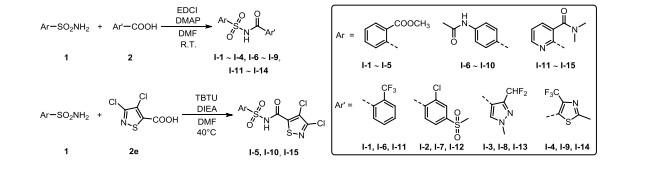
Herein, the target compounds I-1~I-15 were synthesized according to the procedures in Scheme 1. Firstly, EDCI and DMAP were adopted as condensing agents to prepare the target compounds I-1~I-4, I-6~I-9 and I-11~I-14. Subsequently, considering the low reactivity of 3, 4-dichloro- isothiazole-5-carboxylic acid, the target compounds I-5, I-10 and I-15 were synthesized by using the stronger condensing agents TBTU and DIEA. Finally, fifteen novel N-sulfonyl aromatic amide derivatives were identified and characterized by 1H-NMR, 13C-NMR, EA and HRMS. In addition, the polarity of the target compounds was high so that it could only use dichloromethane and methanol as eluent for column chromatography to purify the products. For the purification methods of the target compounds, it would be more convenient to be dissolved in potassium carbonate aqueous solution, filtered and acidified with dilute hydrochloric acid to produce precipitation. On the other hand, column chroma- tography was not recommended due to wasting time and solvents.
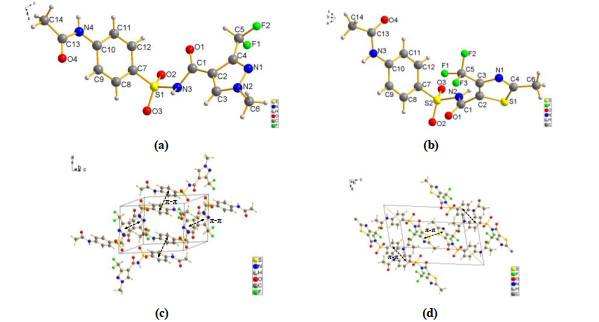
The crystal structures and packing of the target compounds I-8 and I-9 are shown in Fig. 3, respectively. The selected bond lengths and bond angles are listed in Table 1, and the dihedral angles in Table 2. From the data, the sum of bond angles O(4)–C(13)–N(4), O(4)–C(13)–C(14) and N(4)–C(13)–C(14) in compound I-8 is 360º, indicating the sp2 hybridization state of atom C(13). Similarly, the atoms C(1) in I-8 and I-9 and C(13) in I-9 also adopt sp2 hybridization state. In compound I-8, the bond angles of O(2)–S(1)–C(7), O(2)–S(1)–N(3), O(2)–S(1)–O(3), O(3)–S(1)–C(7), O(3)–S(1)–N(3) and C(7)–S(1)–N(3) are 109.56(10)°, 108.49(10)°, 119.29(10)°, 108.26(10)°, 103.54(10)° and 106.93(10)°, respectively, revealing that the atom S(1) is at the center of a tetrahedron. On this basis, the entire molecular configuration forms an "L" shape due to the planar structures of benzene ring, pyrazole ring and amide bond (O=C–N). Likewise, the entire molecular configuration of compound I-9 also forms an "L" shape. However, due to the difference in molecular structure, the configuration of the amide bonds in crystals I-8 and I-9 is completely opposite. The torsion angles of O(1)–C(1)–N(3)–H(3) and O(4)–C(13)–N(4)–H(4) in compound I-8, and O(1)–C(1)–N(2)–H(2) and O(4)–C(13)–N(3)–H(3) in compound I-9 are –130.4(2)°, –174.2(2)°, –169.7(2)° and 176.8(8)°, respectively, implying that the amide bond O(1)–C(1)–N(2)–H(2) is apparently non-planar. In addition, the dihedral angles between the amide plane (O(1)–C(1)–N(3)) and pyrazole ring and between the amide plane (O(1)–C(1)–N(2)) and thiazole ring are 16.95(0.14)° and 65.11(0.19)°, respectively, which indicates that a weak conjugation effect maybe exist between the amide plane (O(1)–C(1)–N(3)) and pyrazole ring. Therefore, under the combined influence of conjugation and induction effects, the bond lengths of O(1)=C(1) (1.210(3) Å) and O(4)=C(13) (1.223(3) Å) in compound I-8 are longer than those correspondingly in compound I-9. At the same time, owing to the direct connection to the sulfonyl group and pyrazole or thiazole ring, the corresponding amide bond length of O(1)=C(1) (1.210(3) Å for I-8 and 1.200(4) Å for I-9) is shorter than that of O(4)=C(13) (1.223(3) Å for I-8 and 1.218(4) Å for I-9). From Table 2, the planes between amide bond (O(4)–C(13)–N(4)) and benzene ring in I-8, between amide bond (O(1)–C(1)–N(3)) and pyrazole ring in I-8, and between amide bond (O(4)–C(13)–N(3)) and benzene ring in I-9, are approximately coplanar. On the other hand, the planes among the amide bonds O(1)–C(1)–N(2) and O(4)–C(13)–N(3) and between amide bond (O(1)–C(1)–N(2)) and benzene ring in I-9 are nearly vertical with the dihedral angles of 86.84(0.11)° and 87.99(0.15)°, respectively. Furthermore, from the crystal configurations of compounds I-8 and I-9, it could be found that there may be an electronic repulsion between the trifluoromethyl group and the carbonyl oxygen atom in compound I-9, while the presence of hydrogen atom in the difluoromethyl group reduced this repulsion effect. Based on the above reasons, the dihedral angle between the amide bond (O(1)–C(1)–N(3)) and the pyrazole ring in compound I-8 is smaller than that between the amide bond (O(1)–C(1)–N(2)) and the thiazole ring in I-9, with the corresponding dihedral angles of 16.95(0.14)° and 65.11(0.19)°, respectively (Fig. 3a and 3b). From the crystal packing, π-π interactions occur between the benzene rings, between the pyrazole rings and between the thiazole rings of the adjacent molecules, thus strengthening the integration of the crystal molecules (Figs. 3c and 3d).

 DownLoad:
CSV
DownLoad:
CSV
| Compound I-8 | Compound I-9 | |||
| Bond | Dist. | Bond | Dist. | |
| C(13)=O(4) | 1.223(3) | C(13)=O(4) | 1.218(4) | |
| C(13)–N(4) | 1.359(3) | C(13)–N(3) | 1.360(4) | |
| C(10)–N(4) | 1.407(3) | C(10)–N(3) | 1.400(4) | |
| C(10)=C(11) | 1.379(3) | C(10)=C(9) | 1.394(4) | |
| C(7)=C(12) | 1.374(3) | C(7)=C(8) | 1.375(4) | |
| C(7)–S(1) | 1.753(2) | C(7)–S(2) | 1.751(3) | |
| S(1)=O(2) | 1.425(3) | S(2)=O(2) | 1.419(2) | |
| S(1)–N(3) | 1.653(3) | S(2)–N(2) | 1.660(3) | |
| N(3)–C(1) | 1.397(3) | N(2)–C(1) | 1.370(4) | |
| C(1)=O(1) | 1.210(3) | C(1)=O(1) | 1.200(4) | |
| C(1)–C(2) | 1.472(3) | C(1)–C(2) | 1.498(5) | |
| N(1)=C(4) | 1.331(3) | N(1)=C(4) | 1.291(5) | |
| N(2)–C(3) | 1.335(3) | S(1)–C(2) | 1.697(4) | |
| C(2)–C(4) | 1.417(3) | C(2)–C(3) | 1.346(5) | |
| Angle | (°) | Angle | (°) | |
| O(1)–C(1)–N(3) | 122.4(2) | O(1)–C(1)–N(2) | 123.9(3) | |
| O(4)–C(13)–N(4) | 122.4(2) | O(4)–C(13)–N(3) | 121.9(3) | |
| O(4)–C(13)–C(14) | 122.5(2) | O(4)–C(13)–C(14) | 122.7(4) | |
| N(4)–C(13)–C(14) | 115.1(2) | N(3)–C(13)–C(14) | 115.4(4) | |
| O(2)–S(1)–O(3) | 119.2(2) | O(2)–S(2)–O(3) | 119.4(2) | |
| C(7)–S(1)–N(3) | 106.9(2) | C(7)–S(2)–N(2) | 104.3(2) | |
| O(2)–S(1)–N(3) | 108.5(2) | O(2)–S(2)–N(2) | 109.5(1) | |
| C(1)–C(2)–C(4) | 124.6(2) | C(1)–C(2)–C(3) | 127.0(3) | |
| C(7)–C(8)–C(9) | 121.2(2) | C(7)–C(12)–C(11) | 120.0(3) | |
| C(3)–N(2)–N(1) | 112.6(2) | C(2)–S(1)–C(4) | 89.9(2) | |
| C(13)–N(4)–C(10) | 128.6(2) | C(13)–N(3)–C(10) | 128.3(3) | |
| N(4)–C(10)–C(9) | 123.1(2) | N(3)–C(10)–C(11) | 123.7(3) | |
DownLoad:
CSV
| Compounds | Groups | Dihedral angles (°) | |
| I-8 | Benzene ring | Pyrazole ring | 65.19(0.10) |
| I-8 | Amide (O(4)–C(13)–N(4)) | Benzene ring | 14.63(0.17) |
| I-8 | Amide (O(4)–C(13)–N(4)) | Pyrazole ring | 59.30(0.21) |
| I-8 | Amide (O(4)–C(13)–N(4)) | Amide (O(1)–C(1)–N(3)) | 69.05(0.24) |
| I-8 | Amide (O(1)–C(1)–N(3)) | Benzene ring | 71.07(0.22) |
| I-8 | Amide (O(1)–C(1)–N(3)) | Pyrazole ring | 16.95(0.14) |
| I-9 | Benzene ring | Thiazole ring | 65.64(0.13) |
| I-9 | Amide (O(4)–C(13)–N(3)) | Benzene ring | 12.28(0.10) |
| I-9 | Amide (O(4)–C(13)–N(3)) | Thiazole ring | 54.33(0.27) |
| I-9 | Amide (O(4)–C(13)–N(3)) | Amide (O(1)–C(1)–N(2)) | 86.84(0.11) |
| I-9 | Amide (O(1)–C(1)–N(2)) | Benzene ring | 87.99(0.15) |
| I-9 | Amide (O(1)–C(1)–N(2)) | Thiazole ring | 65.11(0.19) |
The nematicidal activity of the target compounds against Bursaphelenchus xylophilus, with fluopyram and avermectin as the positive controls, was first screened at the test concentration of 50 μg⋅mL-1. The results showed that the mortality rates of the positive controls were 100%, while the corresponding mortality rates of the target compounds were less than 30%. Combined with the structure-activity relationships obtained in the previous work, the N-sulfonyl amide directly connected to the aromatic rings was unbeneficial to the nematicidal activity, which may be related to the strong polarity of the target compounds. Subsequently, the fungicidal activity of the target compounds was evaluated and the results are displayed in Table 3. From the data, compared with the positive controls, the target compounds exhibited weak fungicidal activity. From the structural characteristics, there was no obvious regularity among the fungicidal activities of the target compounds. Interestingly, compound I-5 showed good fungicidal activity against Colletotrichum capsici with the inhibition rate of 61.7%. In a given category, compounds I-6~I-10 exhibited higher inhibition rates against Gibberella zeae than other target compounds in the preliminary activity screening. In addition, compounds I-11 and I-13~I-15 displayed better fungicidal activity against Alternaria sp. than other target compounds.
DownLoad:
CSV
| Compounds | Mortality of B. xylophilus (%) |
Fungicidal inhibition rate (%) | |||||
| GZ | RS | PP | AK | CC | AS | ||
| I-1 | 21.3 ± 1.37 | 18.4 ± 0.47 | 12.9 ± 0.32 | 13.3± 0.86 | 8.7 ± 0.39 | 15.4 ± 0.62 | 8.9 ± 0.90 |
| I-2 | 12.4 ± 0.88 | 20.1 ± 0.26 | 11.3 ± 0.81 | 12.4 ± 0.29 | 10.0 ± 0.52 | 8.5 ± 0.29 | 17.2 ± 0.43 |
| I-3 | 8.9 ± 0.67 | 21.3 ± 0.37 | 5.8 ± 0.39 | 36.6 ± 0.41 | 7.8 ± 0.63 | 11.1 ± 0.24 | 11.6 ± 0.41 |
| I-4 | 13.3 ± 1.01 | 8.9 ± 0.71 | 12.7 ± 0.93 | 8.5 ± 0.40 | 9.4 ± 0.86 | 19.5 ± 0.62 | 16.7 ± 0.30 |
| I-5 | 17.8 ± 0.76 | 17.9 ± 0.78 | 11.6 ± 0.22 | 19.9 ± 0.59 | 9.3 ± 0.48 | 61.7 ± 0.58 | 8.1 ± 0.43 |
| I-6 | 19.4 ± 1.11 | 30.1 ± 0.42 | 10.9 ± 0.98 | 6.2 ± 0.29 | 6.2 ± 0.24 | 4.1 ± 0.24 | 2.9 ± 0.55 |
| I-7 | 25.8 ±1.34 | 26.7 ± 0.46 | 5.4 ± 0.66 | 3.5 ± 0.63 | 10.8 ± 0.58 | 5.0 ± 0.41 | 3.1 ± 0.70 |
| I-8 | 14.6 ± 0.93 | 22.0 ± 0.21 | 9.2 ± 0.98 | 7.8 ± 0.71 | 9.8 ± 0.53 | 9.7 ± 0.33 | 6.2 ± 0.60 |
| I-9 | 5.6 ± 0.55 | 32.1 ± 0.73 | 6.7 ± 0.53 | 5.4 ± 0.54 | 11.5 ± 0.75 | 9.0 ± 0.29 | 13.0 ± 0.49 |
| I-10 | 23.2 ± 1.42 | 20.1 ± 1.29 | 4.7 ± 0.39 | 10.6 ± 0.71 | 9.7 ± 0.48 | 9.2 ± 0.51 | 2.4 ± 0.49 |
| I-11 | 11.7 ± 0.79 | 16.5 ± 0.70 | 3.0 ± 0.59 | 5.6 ± 0.66 | 13.0 ± 0.29 | 12.6 ± 0.75 | 29.8 ± 0.85 |
| I-12 | 15.4 ± 0.92 | 15.8 ± 0.52 | 11.6 ± 0.78 | 4.3 ± 0.52 | 12.7 ± 0.82 | 15.7 ± 0.62 | 6.7 ± 0.25 |
| I-13 | 10.1 ± 0.37 | 8.6 ± 0.47 | 8.4 ± 0.55 | 22.1 ± 0.90 | 6.3 ± 0.48 | 20.6 ± 0.82 | 20.6 ± 0.65 |
| I-14 | 18.7 ± 0.78 | 13.4 ± 0.95 | 5.6 ± 0.50 | 3.9 ± 0.24 | 10.8 ± 0.41 | 16.7 ± 0.58 | 24.3 ± 1.20 |
| I-15 | 13.4 ± 0.66 | 17.1 ± 0.56 | 11.8 ± 0.27 | 12.2 ± 0.63 | 7.3 ± 0.29 | 3.6 ± 0.29 | 19.6 ± 0.90 |
| Carbendazim | -- | 100 | 100 | 100 | 53.6 ± 0.44 | 100 | 19.7 ± 0.52 |
| Fluopyram | 100 | 92.3 ± 0.23 | 54.2 ± 0.47 | 56.9 ± 0.33 | 97.3 ± 0.53 | 50.5 ± 0.55 | 98.8 ± 0.66 |
| Avermectin | 100 | -- | -- | -- | -- | -- | -- |
| GZ, Gibberella zeae; RS, Rhizoctonia solani; PP, Physalospora piricola; AK, Alternaria kikuchiana Tanaka; CC, Colletotrichum capsici; AS, Alternaria sp |
|||||||
In summary, fifteen novel N-sulfonyl aromatic amide derivatives were designed and synthesized, and their structures were characterized by 1H- and 13C-NMR, EA and HRMS. The crystal structures of compounds I-8 and I-9 were obtained from X-ray diffraction, and the corresponding crystal configurations were discussed. The preliminary bioassay results indicated that the target compounds showed weak namaticidal activity, while compound I-5 displayed good fungicidal activity against Colletotrichum capsici with the inhibition rate of 61.7%.
Liu, M.; Khan, A.; Wang, Z. F.; Liu, Y.; Yang, G. J.; Deng, Y.; He, N. Y. Aptasensors for pesticide detection. Biosens. Bioelectron. 2019, 130, 174−184. doi: 10.1016/j.bios.2019.01.006
Chen, G. B.; Wang, P. E. Electroanalytical methods for detecting pesticides in agricultural products: a review and recent developments. Int. J. Eletrochem. Sci. 2020, 2700−2712.
Liu, X. H.; Yu, W.; Min, L. J.; Wedge, D. E.; Tan, C. X.; Weng, J. Q.; Wu, H. K.; Cantrell, C. L.; Bajsa-Hischel, J.; Hua, X. W.; Duke, S. O. Synthesis and pesticidal activities of new quinoxalines. J. Agric. Food Chem. 2020, 68, 7324−7332. doi: 10.1021/acs.jafc.0c01042
Lucas, J. A.; Hawkins, N. J.; Fraaije, B. A. The evolution of fungicide resistance. Adv. Appl. Microbiol. 2015, 90, 29−92.
Rabelo, M. M.; Paula-Moraes, S. V.; Pereira, E. J. G.; Siegfried, B. D. Contrasting susceptibility of lepidopteran pests to diamide and pyrethroid insecticides in a region of overwintering and migratory intersection. Pest Manag. Sci. 2020, DOI: 10.1002/ps.5984.
Liu, N.; Zhong, H.; Tu, J.; Jiang, Z. G.; Jiang, Y. J.; Jiang, Y.; Jiang, Y. Y.; Li, J.; Zhang, W. N.; Wang, Y.; Sheng, C. Q. Discovery of simplified sampangine derivatives as novel fungal biofilm inhibitors. Eur. J. Med. Chem. 2018, 143, 1510−1523. doi: 10.1016/j.ejmech.2017.10.043
Oyama, T.; Takahashi, S.; Yoshimori, A.; Yamamoto, T.; Sato, A.; Kamiya, T.; Abe, H.; Abe, T.; Tanuma, S. Discovery of a new type of scaffold for the creation of novel tyrosinase inhibitors. Bioorg. Med. Chem. 2016, 24, 4509−4515. doi: 10.1016/j.bmc.2016.07.060
Robertson, G. R.; Rouch, M. G. Use of the succinate dehydrogenase inhibitor fluopyram for controlling blackleg in Brassicaceae species. US patent, 20180228155. 2018-08-16.
Veloukas, T.; Karaoglanidis, G. S. Biological activity of the succinate dehydrogenase inhibitor fluopyram against Botrytis cinerea and fungal baseline sensitivity. Pest Manag. Sci. 2012, 68, 858−864. doi: 10.1002/ps.3241
Hungenberg, H.; Fürsch, H.; Rieck, H.; Hellwege, E. Use of fluopyram for controlling nematodes in crops and for increasing yield. US patent, 20130253018. 2013-09-26.
Kearn, J.; Ludlow, E.; Dillon, J.; O'Connor, V.; Holden-Dye, L. Fluensulfone is a nematicide with a mode of action distinct from anticholinesterases and macrocyclic lactones. Pestic. Biochem. Phys. 2014, 109, 44−57. doi: 10.1016/j.pestbp.2014.01.004
Slomczynska, U.; South, M. S.; Bunkers, G. J.; Edgecomb, D.; Wyse-Pester, D.; Selness, S.; Ding, Y. W.; Christiansen, J.; Ediger, K.; Miller, W.; Charumilind, P.; Hartmann, G.; Williams, J.; Dimmic, M.; Shortt, B.; Haakenson, W.; Wideman, A.; Crawford, M.; Hresko, M.; McCarter, J. Tioxazafen: a new broad-spectrum seed treatment nematicide. ACS Sym. Ser. 2015, 1204, 129−147.
Liu, X. H.; Zhao, W.; Shen, Z. H.; Xing, J. H.; Xu, T. M.; Peng, W. L. Synthesis, nematocidal activity and SAR study of novel difluoromethylpyrazole carboxamide derivatives containing flexible alkyl chain moieties. Eur. J. Med. Chem. 2016, 125, 881−889.
Cheng, L.; Zhao, W.; Shen, Z. H.; Xu, T. M.; Wu, H. K.; Peng, W. L.; Liu, X. H. Synthesis, nematicidal activity and docking study of novel pyrazole-4-carboxamide derivatives against Meloidogyne incognita. Lett. Drug Des. Discov. 2019, 16, 29−35.
Lahm, G. P.; Deangelis, A. J.; Campbell, M. J. Nematocidal heterocyclic amides. WO patent, 2017116646 2017-07-06.
Chen, J. X.; Chen, Y. Z.; Gan, X. H.; Song, B. J.; Hu, D. Y.; Song, B. A. Synthesis, nematicidal evaluation, and 3D-QSAR analysis of novel 1, 3, 4-oxadiazole-cinnamic acid hybrids. J. Agric. Food Chem. 2018, 66, 9616−9623. doi: 10.1021/acs.jafc.8b03020
Chen, J. X.; Gan, X. H.; Yi, C. F.; Wang, S. B.; Yang, Y. Y.; He, F. C.; Hu, D. Y.; Song, B. A. Synthesis, nematicidal activity, and 3D-QSAR of novel 1, 3, 4-oxadiazole/thiadiazole thioether derivatives. Chin. J. Chem. 2018, 36, 939−944. doi: 10.1002/cjoc.201800282
Bellandi, P.; Gusmeroli, M.; Sargiotto, C.; Bianchi, D. Heterocyclic trifluoroalkenyl compounds having a nematocidal activity, their agronomic compositions and use thereof. WO patent, 2017002100 2017-01-05.
Schouteden, N.; Lemmens, E.; Stuer, N.; Curtis, R.; Panis, B.; Waele, D. Direct nematicidal effects of methyl jasmonate and acibenzolar-S-methyl against Meloidogyne incognita. Nat. Prod. Res. 2017, 31, 1219−1222. doi: 10.1080/14786419.2016.1230111
Liu, X. H.; Qiao, L.; Zhai, Z. W.; Cai, P. P.; Cantrell, C. L.; Tan, C. X.; Weng, J. Q.; Han, L.; Wu, H. K. Novel 4-pyrazole carboxamide derivatives containing flexible chain motif: design, synthesis and antifungal activity. Pest Manag. Sci. 2019, 75, 2892−2900. doi: 10.1002/ps.5463
Hua, X. W.; Liu, N. N.; Fan, Z. J.; Zong, G. N.; Ma, Y.; Lei, K.; Yin, H.; Wang, G. Q. Design, synthesis and biological activity screening of novel amide derivatives containing aromatic thioether group. Chin. J. Org. Chem. 2019, 39, 2581−2588.
Hua, X. W.; Liu, W. R.; Su, Y. Y.; Liu, X. H.; Liu, J. B.; Liu, N. N.; Wang, G. Q.; Jiao, X. Q.; Fan, X. Y.; Xue, C. M.; Liu, Y.; Liu, M. Studies on the novel pyridine sulfide containing SDH based heterocyclic amide fungicide. Pest Manag. Sci. 2020, 76, 2368−2378.
Hua, X. W.; Liu, N. N.; Zhou, S.; Zhang, L. L.; Yin, H.; Wang, G. Q.; Fan, Z. J.; Ma, Y. Design, synthesis, and biological activity of novel aromatic amide derivatives containing sulfide and sulfone substructures. Engineering 2020, 6, 553−559. doi: 10.1016/j.eng.2019.09.011
Fan, Z. J.; Yang, Z. K.; Zhang, H. K.; Mi, N.; Wang, H.; Cai, F.; Zuo, X.; Zheng, Q. X.; Song, H. B. Synthesis, crystal structure, and biological activity of 4-methyl-1, 2, 3-thiadiazole-containing 1, 2, 4-triazolo[3, 4-b][1, 3, 4]thiadiazoles. J. Agric. Food Chem. 2010, 58, 2630−2636.

Figure 3 Crystal structures of I-8 (a), I-9 (b), and crystal packing of I-8 (c), I-9 (d)
Table 1. Selected Bond Lengths (Å) and Bond Angles (°) for the Target Compounds I-8 and I-9
| Compound I-8 | Compound I-9 | |||
| Bond | Dist. | Bond | Dist. | |
| C(13)=O(4) | 1.223(3) | C(13)=O(4) | 1.218(4) | |
| C(13)–N(4) | 1.359(3) | C(13)–N(3) | 1.360(4) | |
| C(10)–N(4) | 1.407(3) | C(10)–N(3) | 1.400(4) | |
| C(10)=C(11) | 1.379(3) | C(10)=C(9) | 1.394(4) | |
| C(7)=C(12) | 1.374(3) | C(7)=C(8) | 1.375(4) | |
| C(7)–S(1) | 1.753(2) | C(7)–S(2) | 1.751(3) | |
| S(1)=O(2) | 1.425(3) | S(2)=O(2) | 1.419(2) | |
| S(1)–N(3) | 1.653(3) | S(2)–N(2) | 1.660(3) | |
| N(3)–C(1) | 1.397(3) | N(2)–C(1) | 1.370(4) | |
| C(1)=O(1) | 1.210(3) | C(1)=O(1) | 1.200(4) | |
| C(1)–C(2) | 1.472(3) | C(1)–C(2) | 1.498(5) | |
| N(1)=C(4) | 1.331(3) | N(1)=C(4) | 1.291(5) | |
| N(2)–C(3) | 1.335(3) | S(1)–C(2) | 1.697(4) | |
| C(2)–C(4) | 1.417(3) | C(2)–C(3) | 1.346(5) | |
| Angle | (°) | Angle | (°) | |
| O(1)–C(1)–N(3) | 122.4(2) | O(1)–C(1)–N(2) | 123.9(3) | |
| O(4)–C(13)–N(4) | 122.4(2) | O(4)–C(13)–N(3) | 121.9(3) | |
| O(4)–C(13)–C(14) | 122.5(2) | O(4)–C(13)–C(14) | 122.7(4) | |
| N(4)–C(13)–C(14) | 115.1(2) | N(3)–C(13)–C(14) | 115.4(4) | |
| O(2)–S(1)–O(3) | 119.2(2) | O(2)–S(2)–O(3) | 119.4(2) | |
| C(7)–S(1)–N(3) | 106.9(2) | C(7)–S(2)–N(2) | 104.3(2) | |
| O(2)–S(1)–N(3) | 108.5(2) | O(2)–S(2)–N(2) | 109.5(1) | |
| C(1)–C(2)–C(4) | 124.6(2) | C(1)–C(2)–C(3) | 127.0(3) | |
| C(7)–C(8)–C(9) | 121.2(2) | C(7)–C(12)–C(11) | 120.0(3) | |
| C(3)–N(2)–N(1) | 112.6(2) | C(2)–S(1)–C(4) | 89.9(2) | |
| C(13)–N(4)–C(10) | 128.6(2) | C(13)–N(3)–C(10) | 128.3(3) | |
| N(4)–C(10)–C(9) | 123.1(2) | N(3)–C(10)–C(11) | 123.7(3) | |
 下载: 导出CSV
Table 2. Selected Dihedral Angles (°) for the Target Compounds I-8 and I-9
| Compounds | Groups | Dihedral angles (°) | |
| I-8 | Benzene ring | Pyrazole ring | 65.19(0.10) |
| I-8 | Amide (O(4)–C(13)–N(4)) | Benzene ring | 14.63(0.17) |
| I-8 | Amide (O(4)–C(13)–N(4)) | Pyrazole ring | 59.30(0.21) |
| I-8 | Amide (O(4)–C(13)–N(4)) | Amide (O(1)–C(1)–N(3)) | 69.05(0.24) |
| I-8 | Amide (O(1)–C(1)–N(3)) | Benzene ring | 71.07(0.22) |
| I-8 | Amide (O(1)–C(1)–N(3)) | Pyrazole ring | 16.95(0.14) |
| I-9 | Benzene ring | Thiazole ring | 65.64(0.13) |
| I-9 | Amide (O(4)–C(13)–N(3)) | Benzene ring | 12.28(0.10) |
| I-9 | Amide (O(4)–C(13)–N(3)) | Thiazole ring | 54.33(0.27) |
| I-9 | Amide (O(4)–C(13)–N(3)) | Amide (O(1)–C(1)–N(2)) | 86.84(0.11) |
| I-9 | Amide (O(1)–C(1)–N(2)) | Benzene ring | 87.99(0.15) |
| I-9 | Amide (O(1)–C(1)–N(2)) | Thiazole ring | 65.11(0.19) |
下载: 导出CSV
Table 3. Nematicidal and Fungicidal Activities of the Target Compounds at 50 μg⋅mL-1
| Compounds | Mortality of B. xylophilus (%) |
Fungicidal inhibition rate (%) | |||||
| GZ | RS | PP | AK | CC | AS | ||
| I-1 | 21.3 ± 1.37 | 18.4 ± 0.47 | 12.9 ± 0.32 | 13.3± 0.86 | 8.7 ± 0.39 | 15.4 ± 0.62 | 8.9 ± 0.90 |
| I-2 | 12.4 ± 0.88 | 20.1 ± 0.26 | 11.3 ± 0.81 | 12.4 ± 0.29 | 10.0 ± 0.52 | 8.5 ± 0.29 | 17.2 ± 0.43 |
| I-3 | 8.9 ± 0.67 | 21.3 ± 0.37 | 5.8 ± 0.39 | 36.6 ± 0.41 | 7.8 ± 0.63 | 11.1 ± 0.24 | 11.6 ± 0.41 |
| I-4 | 13.3 ± 1.01 | 8.9 ± 0.71 | 12.7 ± 0.93 | 8.5 ± 0.40 | 9.4 ± 0.86 | 19.5 ± 0.62 | 16.7 ± 0.30 |
| I-5 | 17.8 ± 0.76 | 17.9 ± 0.78 | 11.6 ± 0.22 | 19.9 ± 0.59 | 9.3 ± 0.48 | 61.7 ± 0.58 | 8.1 ± 0.43 |
| I-6 | 19.4 ± 1.11 | 30.1 ± 0.42 | 10.9 ± 0.98 | 6.2 ± 0.29 | 6.2 ± 0.24 | 4.1 ± 0.24 | 2.9 ± 0.55 |
| I-7 | 25.8 ±1.34 | 26.7 ± 0.46 | 5.4 ± 0.66 | 3.5 ± 0.63 | 10.8 ± 0.58 | 5.0 ± 0.41 | 3.1 ± 0.70 |
| I-8 | 14.6 ± 0.93 | 22.0 ± 0.21 | 9.2 ± 0.98 | 7.8 ± 0.71 | 9.8 ± 0.53 | 9.7 ± 0.33 | 6.2 ± 0.60 |
| I-9 | 5.6 ± 0.55 | 32.1 ± 0.73 | 6.7 ± 0.53 | 5.4 ± 0.54 | 11.5 ± 0.75 | 9.0 ± 0.29 | 13.0 ± 0.49 |
| I-10 | 23.2 ± 1.42 | 20.1 ± 1.29 | 4.7 ± 0.39 | 10.6 ± 0.71 | 9.7 ± 0.48 | 9.2 ± 0.51 | 2.4 ± 0.49 |
| I-11 | 11.7 ± 0.79 | 16.5 ± 0.70 | 3.0 ± 0.59 | 5.6 ± 0.66 | 13.0 ± 0.29 | 12.6 ± 0.75 | 29.8 ± 0.85 |
| I-12 | 15.4 ± 0.92 | 15.8 ± 0.52 | 11.6 ± 0.78 | 4.3 ± 0.52 | 12.7 ± 0.82 | 15.7 ± 0.62 | 6.7 ± 0.25 |
| I-13 | 10.1 ± 0.37 | 8.6 ± 0.47 | 8.4 ± 0.55 | 22.1 ± 0.90 | 6.3 ± 0.48 | 20.6 ± 0.82 | 20.6 ± 0.65 |
| I-14 | 18.7 ± 0.78 | 13.4 ± 0.95 | 5.6 ± 0.50 | 3.9 ± 0.24 | 10.8 ± 0.41 | 16.7 ± 0.58 | 24.3 ± 1.20 |
| I-15 | 13.4 ± 0.66 | 17.1 ± 0.56 | 11.8 ± 0.27 | 12.2 ± 0.63 | 7.3 ± 0.29 | 3.6 ± 0.29 | 19.6 ± 0.90 |
| Carbendazim | -- | 100 | 100 | 100 | 53.6 ± 0.44 | 100 | 19.7 ± 0.52 |
| Fluopyram | 100 | 92.3 ± 0.23 | 54.2 ± 0.47 | 56.9 ± 0.33 | 97.3 ± 0.53 | 50.5 ± 0.55 | 98.8 ± 0.66 |
| Avermectin | 100 | -- | -- | -- | -- | -- | -- |
| GZ, Gibberella zeae; RS, Rhizoctonia solani; PP, Physalospora piricola; AK, Alternaria kikuchiana Tanaka; CC, Colletotrichum capsici; AS, Alternaria sp |
|||||||
下载: 导出CSV

 扫一扫看文章


扫一扫关注我们


 下载:
下载: