
Table 1.
PV results of the pristine and modified T-type zeolite membranes for a 90% isopropanol solution at 348 K

Difunctional Effects of Organo-Modified T-Type Zeolite Membranes for Dewatering from Organic Solution
Xue CUI , Yu-Ping ZHANG , Tian GUI , Ming-Liang HE , Fei ZHANG , Na HU , Yu-Qin LI , Xiang-Shu CHEN


In the past decades, membrane separation as an energy conservation technology has been widely investigated as a replacement for traditional high energy consumption methods such as azeotropic rectification and adsorption[1-3]. In addition, membrane separation technology is easily and simply fabricated compared with conventional methods[2, 4-5]. Up to now, many kinds of membranes have been reported for separation, such as polymer membranes[6] and inorganic membranes (zeolite membranes, MOF membranes, etc.) [7-8]. As compared to flexible polymer membranes, inorganic crystalline membranes supported on ceramic supports are more fragile and brittle. Researchers focus on fabricating compact and continuous membranes for achieving excellent separation properties. However, nonzeolitic pores are usually formed during the fabrication process of crystalline membranes[9]. These defects lead to the membrane showing a low separation selectivity due to that the nonzeolitic pores are larger than the zeolite pores[10-11]. In addition, the reproducibility is a pivotal factor to cut down on expenses in the industry. Thus, reducing and/or eliminating the defects of a zeolite membrane is necessary for improving its separation properties[12-15] and reproducibility.
Nomura et al. [16] modified a membrane using a counter-diffusion CVD technique to plug the intercrystalline region, and tetraethyl or thosilicate was adopted as the silica source. The CVD-modified silicalite membranes had a selectivity of 87.8 over n-butane/ isobutane at 288 K. Huang et al. [12] reported that organosilica (APTES) was applied to modify zeolitic imidazolate framework ZIF-90 membranes to achieve both pore mouth narrowing and covering invisible defects of the polycrystalline ZIF-90 layer, and the selectivity of the APTES-modified ZIF-90 membrane was prominently enhanced. Lin et al. [13] eliminated the intercrystalline pores using on-stream counter diffusion CVD modification. At present, for polycrystalline membranes, modifications have always been applied with gas separation. For dehydrations, such as pervaporation (PV) and vapor permeation, the hydrophilicity of the membrane surface is important for preferential adsorption of water, which is beneficial for dewatering from an alcohol solution[17]. To the best of our knowledge, few works have emphasized the hydrophilicity and sealing functions of a zeolite membrane except for a recent work, in which APTES was introduced on the surface to improve the hydrophilicity of a hydrophobic DDR zeolite (all-silica zeolite) membrane[18]. So, we are proposing that if APTES was introduced to modify a hydrophilic zeolite membrane (containing aluminum), the obtained membrane may show a better separation performance, especially for the membranes with defects.
T-type zeolite with a Si/Al ratio (nSi/nAl) of 3-4 was formed by the intergrowth of offertite and erionite with an effective pore size of 0.36 nm×0.51 nm, which is between the size of water and most organic molecules[19-21]. Thus, T-type zeolite membrane is a good candidate for the dehydration of many organic solvents, but, as a type of polycrystalline membrane, formation of pinholes is always unavoidable during the synthesis process. In this work, T- type zeolite membranes were functionalized with APTES in a toluene solution. The obtained materials were used to verify that APTES was modified on the surface. The modified membranes showed a higher separation performance than that of the pristine membrane, and the modified membrane was tested for long-term stability.
T-type zeolite membranes mentioned in this study were fabricated by the same method and conditions. With a secondary growth method, the membranes were supported on tubular mullite supports (Nikkato, 1.3 μm average pore size, 100 mm in length, 8 mm in inner diameter, and 12 mm in outer diameter) using homemade zeolite T crystals as seeds. At first, zeolite T crystals were synthesized with a molar ratio of nSiO2: nAl2O3: nNa2O: nK2O: nH2O being 100:5:28:7:600. The synthesis precursor was prepared by mixing alumina hydroxide (AR, Wako Chemicals), potassium hydroxide (AR, Shanghai Qinxi Chemicals), sodium hydroxide (AR, Sinopharm Chemicals), colloidal silica (Ludox TM -40, Sigma-Aldrich), and deionized water (homemade) in turn and aged for 24 h. Then, the precursor was transferred to a stainless-steel autoclave and moved into a drying oven at 423 K for 24 h. Next, the obtained zeolite T crystals were washed with hot deionized water and dried in an oven at 353 K for 12 h.
The seed-coating method was similar to our previously reported work[22]. The support surface was coated by rubbing with a 2% seed slurry, and then the seeded support was moved into an oven to dry for 1 h at 353 K. The precursor solution for membrane fabrication was prepared with a molar ratio of nSiO2 : nA2Ol3: nNa2O: nK2O: nH2O being 200:3:50:16:5 000. The chemicals were the same as those listed above for preparing the zeolite crystals. The gel was aged for 24 h with stirring at ambient temperature. Then, the precursor solution was poured into an autoclave, with the seeded supports immersed vertically in the autoclaves, and the membranes were synthesized by a two-step varied temperature method, at 428 and 373 K and held for 2 and 10 h, respectively. Then, the obtained membrane was washed thoroughly in a water bath with hot deionized water until the washing solution was neutral. At last, the pristine membranes were dried in an oven at 353 K for 12 h before characterization, separation tests, and/ or modification.
The modification method was similar to previous studies[18, 23]. First, the pristine membranes were immersed in an APTES and toluene solution (5-20 mmol APTES in 60 mL toluene) in a Teflon-lined autoclave. The modification was implemented in an oven at 383 K for 0.5-2.0 h. Then, the modified membranes were washed with toluene three times. Finally, the membranes were thermally processed at 393 K in a tube furnace by inletting argon.
The phases of the powders and membranes were checked by powder X-ray diffraction (PXRD, Rigaku UItima Ⅳ) with a Cu Kα radiation (λ=0.154 06 nm) in a 2θ range of 5°-45° at a scanning speed of 4 (°)·min-1. The tube voltage was 40 kV and the tube current was 40 mA. The sample morphologies were examined by field- emission scanning electron microscopy (FESEM, Hitachi SU8020) with the acceleration voltage of 5 kV. FT-IR analysis was performed using a spectrophotometer (Thermo, Nicolet 6700) in a vibration range of 6004 000 cm-1. X-ray photoelectron spectroscopy (XPS, Thermo Fisher Scientific EscaLab Xi+) was used to investigate the chemical state between APTES and the membrane. The water contact angle (WCA, POWEREACH JC- 2000CD) was calculated to determine the hydrophilicity of the membrane surface.
PV experiments were used to evaluate the membrane separation performance in the water/alcohol mixtures. A flowchart of the PV device was illustrated as previous work, and the entire unit was a large feed circulation system[22]. The membrane was assembled in a module. The feed solution was provided by a metering pump from a 3 L tank, and the permeation side was collected by a liquid nitrogen cold trap and was poured back into the feed tank after analysis to keep all components in the feed tank. A gas chromatograph (Shimadzu GC-14C) equipped with a thermal conductivity detector (TCD) was used for analyzing the composition of the feed and permeation. The permeation flux of the membrane was defined as J (kg·m-2·h-1). The separation factor (α) was determined as α=(Ya/Yb)/(Xa/Xb), where Xa and Xb are the mass fractions of components a and b in the feed, respectively, and Ya and Yb are the corresponding mass fractions of components a and b in the permeation side, respectively.
The integrity of the pristine and modified membranes was checked by single gases with different dynamic diameters (H2, N2 and SF6). The equipment and method were adopted from our previous work[24].
The modified layer on the membrane surface generally leads to increased permeate resistance and the elimination/reduction of defects. Modification usually increases the membrane selectivity but decreases the membrane flux. In addition, for dewatering, the hydrophilicity of the surface is important for the preferential adsorption of water, which is beneficial for the dehydration of an alcohol solution[17]. The effects of APTES content and modification times were investigated to optimize the selectivity of modified membranes with a small decrease in the flux.
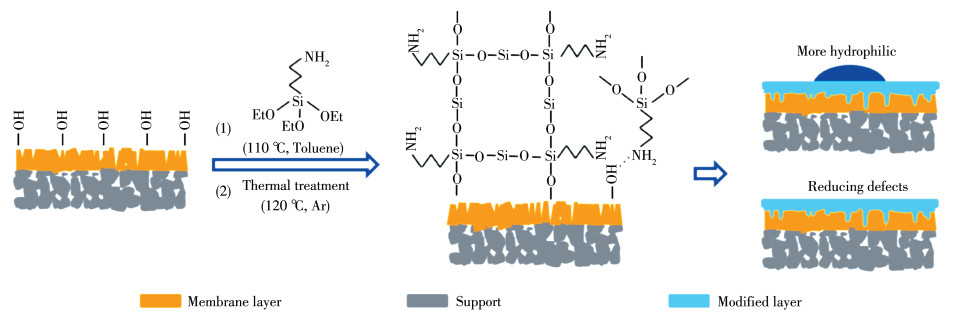
Four different APTES concentrations were used to explore the modification efficiency with a constant modification time. As shown in Table 1, the pristine membrane had a low separation factor. For the membrane modified with a relatively low APTES content, the separation factor of modified M-1 membrane did not show a distinct improvement. As the APTES content increased, the separation factor of M-2 membrane was obviously improved from 420 to 2 910, an increase of about 7 times, while the flux only decreased 13.07%. However, by further increasing the APTES content, the separation factor of M-3 membrane increased slightly less than that of M-2 membrane, while the flux of the modified membrane was obviously reduced. For M-4 membrane, With the increasing of APTES concentration, the self-condensation reaction of APTES was strengthened besides the condensation between APTES and zeolite T membrane. The thick and uneven APTES layer which can provide large mass transfer resistance was modified on the membrane, but the uneven layer was not sufficient to reduce the defects of the membrane, leading M-4 membrane to show the least improvement of the separation factor and the lowest permeation flux. The probable modification mechanism of APTES layer on the membrane is illustrated in Fig. 1.
 下载:
导出CSV
下载:
导出CSV
| Sample | Pristine membrane | Modified membrane* | ||||
| J/(kg·m-2·h-1) | α | nAPTES/mmol | J/(kg·m-2·h-1) | α | ||
| M-1 | 3.33 | 600 | 5 | 3.06 | 630 | |
| M-2 | 3.52 | 420 | 10 | 3.01 | 2 910 | |
| M-3 | 3.58 | 370 | 15 | 1.70 | 2 320 | |
| M-4 | 3.80 | 340 | 20 | 0.80 | 420 | |
| *Reaction conditions: 383 K, 1.5 h and 5-20 mmol APTES in 60 mL toluene solution. | ||||||
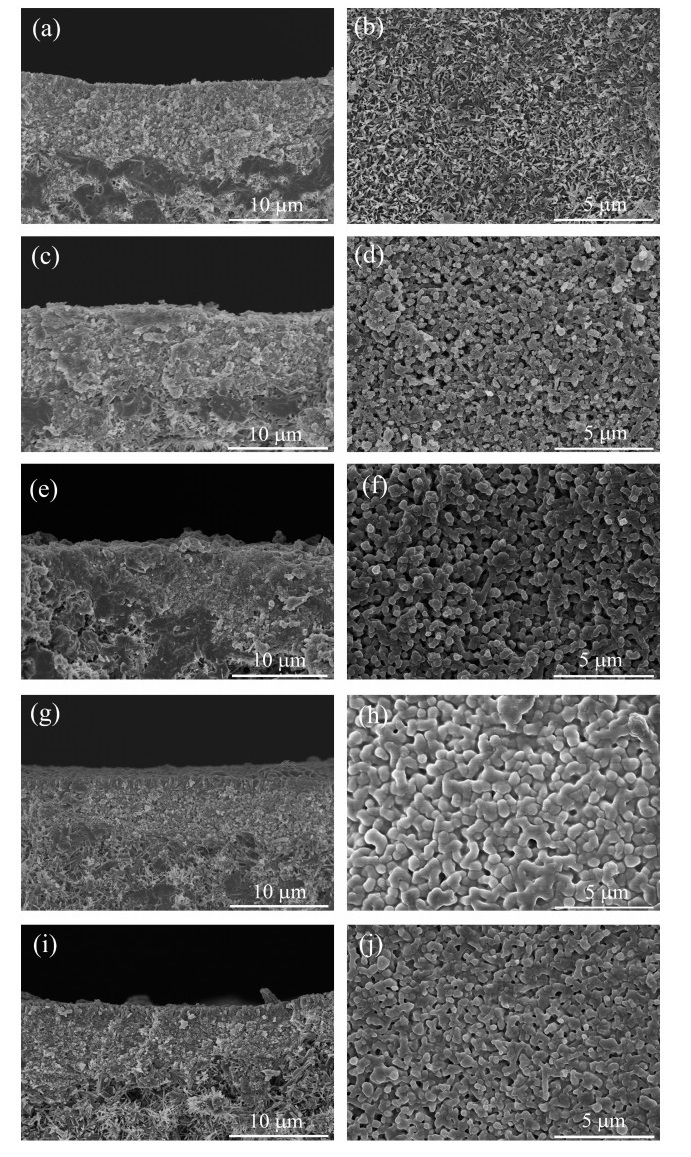
Fig. 2 shows the cross-section and surface morphology of pristine membrane and modified membranes processed with different APTES concentrations. The surface of modified M-1 membrane was covered by a loose APTES layer (Fig. 2c and 2d), which can enhance the hydrophilicity of the membrane[18], but the very loose APTES layer did not significantly decrease the effect of defects, leading to a small increase in the selectivity. M-2 membrane also was modified with a loose APTES layer, but the further increasing of hydrophilicity might result in the desired separation factor (Fig. 2e and 2f). A higher modification concentration (M-3, M-4) also existed many pores in the APTES layer (Fig. 2h and 2j). Fasano et al. investigated the roles of hydrophilicity and surface barriers on the overall water transport through a zeolite membrane, and the surface barriers were proportional to the diffusion resistance[25].
Incorporating the PV performance, the membrane modified in high APTES solution may increase the diffusion resistance, which leads to decreased water transport through the membrane.
Modification time is another factor that influence modification efficiency[17, 26-27]. With the same APTES content (10 mmol APTES in 60 mL toluene) and modification temperature (383 K), the membranes modified with different modification times (0.5-2 h) were investigated. As shown in Table 2, short treatment times (0.5 and 1.0 h) were effective but insufficient for modifying the functionalized coupling agent layer. When the processing time was extended to 1.5 h, the modified membrane showed a high separation factor of 2 910 with a considerable flux of 3.01 kg·m-2·h-1 from a 90% isopropanol solution at 348 K. The longer modified time (2.0 h) did not lead to an obvious increase of the separation factor but resulted in a decrease of the flux as a result of the high treatment content.
下载:
导出CSV
| Sample | Pristine membrane | Modified membrane | ||||
| J/(kg·m-2·h-1) | α | Modification time / h | J/(kg·m-2·h-2) | α | ||
| M-5 | 3.85 | 520 | 0.5 | 3.13 | 1 850 | |
| M-6 | 3.64 | 380 | 1 | 3.05 | 2 300 | |
| M-2 | 3.52 | 420 | 1.5 | 3.01 | 2 910 | |
| M-7 | 3.50 | 390 | 2.0 | 2.65 | 3 030 | |
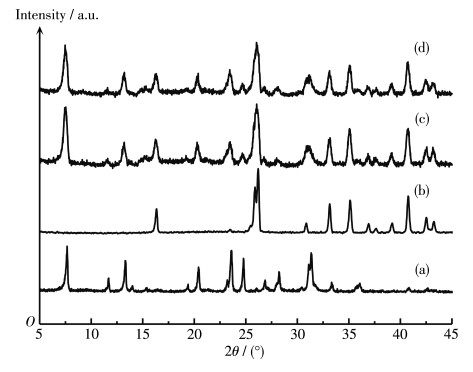
The XRD patterns of pristine and modified T-type zeolite membrane are shown in Fig. 3. The modified membrane (M-2) was obtained under the typical modified conditions. The results show that the pure phase T-type zeolite membranes were synthesized on the supports, and all peaks were in accordance with standard zeolite T crystals together with α-Al2O3 signals. After modification, the location of the characteristic peaks remained well aligned with that of pristine membrane, besides some weakening of the intensity, which is attributed to the overlaid layer of APTES. The XRD pattern results demonstrate that the membranes were stable during the treatment process.
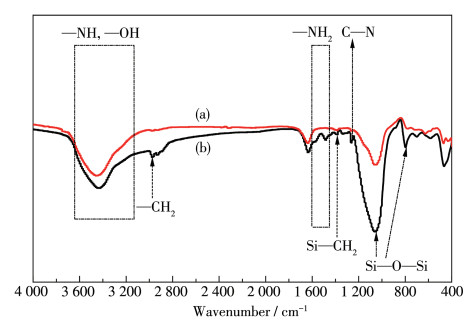
To determine the interactions between APTES and the membrane, the pristine membrane and modified membrane (M-2) were evaluated using FT-IR. As presented in Fig. 4, both before and after modification, the spectral band in the vicinity of 3 450 cm-1 is related to the stretching vibration of —OH from the adsorbed water on the membrane surface. After modification with APTES, the peak width of the band became wider because of overlap with the new —NH[28]. Compared with pristine membrane, the peaks at 1 562 and 1 470 cm-1 of M-2 are assigned to the N—H2 vibration of the amine group (R—NH2)[23, 28]. The peaks around 2 928 cm-1 are assigned to CH2 anti-symmetric vibrations[29], and a new band at 1 384 cm-1 corresponds to the Si—CH2 bending vibration. Additionally, the C—N stretching vibration appeared in the vicinity of 1 250 cm-1 [18]. The bands at 1 085 and 807 cm-1 are assigned to the anti-symmetric and the symmetric vibrations of Si—O—Si[30]. The results indicate that APTES is successfully modified on the membrane surface.
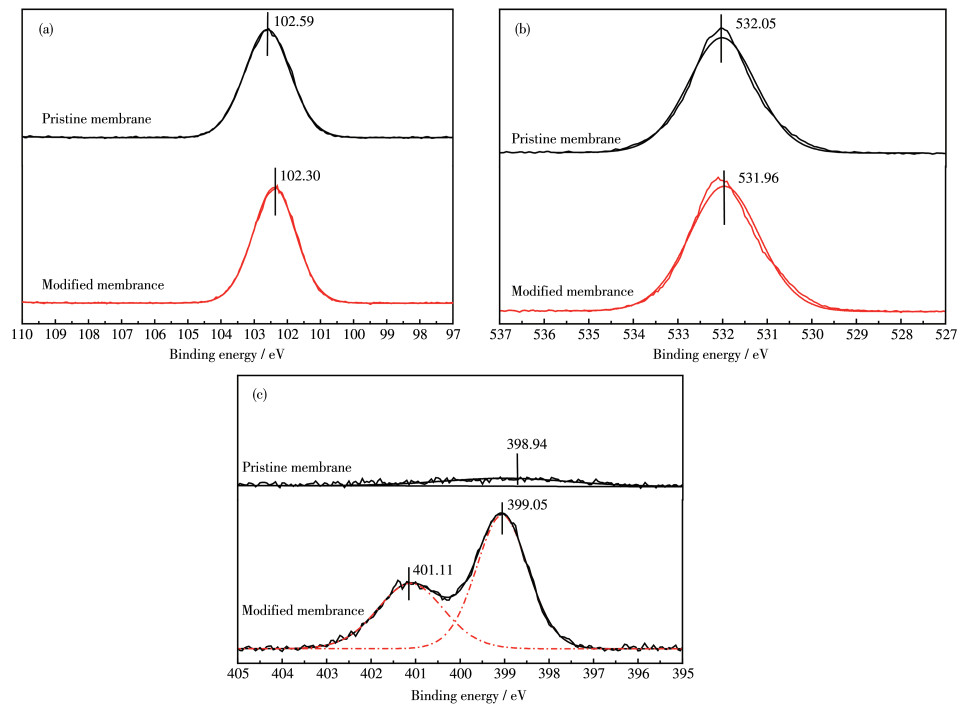
There are several different interactions between the zeolite surface and modified APTES, such as chemical bonds, hydrogen bonding, protonation of the amine and van der Waals forces[31]. XPS was used to analyze the chemical state of the membrane. Comparing the XPS spectra of the membrane before and after modification, Fig. 5a shows that the binding energies of Si2p were 102.59 and 102.30 eV for the pristine and modified membranes (M-2), respectively. Correspondingly, the binding energies of O1s in the pristine and modified membranes were 532.05 and 531.96 eV (Fig. 5b). The decreased binding energy indicates that the chemical state on the surface changes from Si—O—H to Si— O—Si, because the electronegativity of H is 2.2, which is higher than that of Si (1.9). Fig. 5c shows the XPS spectrum of N1s, with a peak at 401.11 eV attributed to hydrogen- bonded and protonated N, and the top peak at 399.05 eV related to the free —NH2 in the terminal molecules of the chemically bonded N that may retain van der Waals forces[26, 31-32]. The results also illustrate that APTES is modified on the membrane surface by chemical bonding[26].
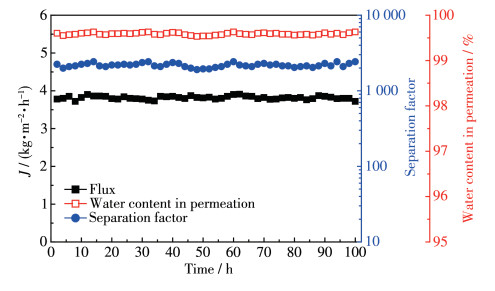
The stability of modified APTES layer is a critical issue during the separation process. Therefore, the modified membrane (M-2) was tested to evaluate the membrane stability at 363 K for 100 h. As illustrated in Fig. 6, during 100 h of continual testing, the modified membranes exhibited a good and stable permeation flux of approximately 3.8 kg·m-2·h-1 together with a high separation factor about 2 000, and the water content of the permeation side reached above 99.50%. Notably, the separation factors of the modified membrane were retained during the entire separation process, indicating that the modified membrane shows a comparable thermal and long-time stability.
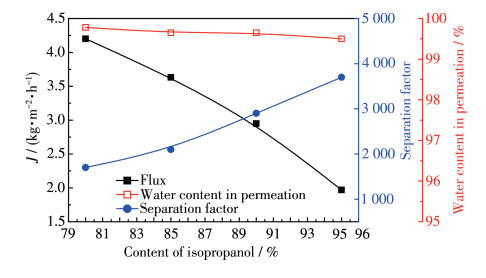
Furthermore, to determine the stability of the modification layer in different water content solutions, the modified membrane (M-2) was used to dewater different isopropanol solutions. Fig. 7 shows the membrane performance's dependence on water content. With a high-water content of 20%, the membrane showed a higher total flux of 4.2 kg·m-2·h-1. With the water content decreasing, the total flux of the membrane decreased. This may be explained by the fact that under high isopropanol content, isopropanol affords a large impact resistance, which decreases the migration velocity of water and hinders the diffusion of water to the membrane surface, leading to a decrease of the total flux. It is worth noting that the water content in the permeation side stayed above 99.50% (isopropanol solution of 95%) for different isopropanol contents, showing that the modification layer has a very high stability in high water and/or isopropanol content solutions. Therefore, we deem this processing method promising for use as a modification membrane in industrial dewatering of isopropanol solutions.
To assess the reproducibility of the modification method, five membranes were modified under the optimal modification conditions. Table 3 shows the PV performance of the modified membranes, and the five membranes had a high separation factor of 2 934±183 and a good total flux of (3.06±0.14) kg·m-2·h-1. The average increase of the separation factor was 717.27%, while the average decrease of the total flux was only 13.07%. The results demonstrate that the simple and reproducible method described in this study is a reliable method to increase the quality of hydrophilic T-type zeolitic membranes.
下载:
导出CSV
| Sample | Pristine membrane | Modified membrane | |||
| J/(kg·m-2·h-1) | α | J/(kg·m-2·h-1) | α | ||
| M-2 | 3.64 | 380 | 3.01 | 2 900 | |
| M-8 | 3.46 | 362 | 2.95 | 3 000 | |
| M-9 | 3.60 | 320 | 3.04 | 2 640 | |
| M-10 | 3.50 | 374 | 3.31 | 3 130 | |
| M-11 | 3.39 | 360 | 2.99 | 3 000 | |
| x±σ | 3.52±0.10 | 359±23 | 3.06±0.14 | 2 934±183 | |
For the dehydration of organic solutions, selectivity is usually dominated by two factors: (1) the hydrophilicity of the membrane surface, which plays a key role during the separation process due to preferential adsorption of water benefiting separation, (2) the number of defects. Hence, eliminating and/or reducing the number of defects that are formed during the polycrystalline membrane synthesis is an effective strategy for improving selectivity.
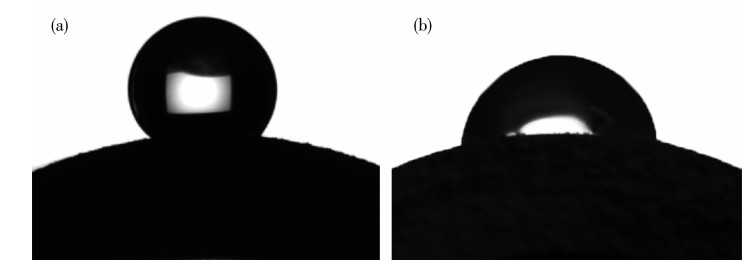
Thus, the membranes before and after modification were analyzed by a contact angle measurement. As shown in Fig. 8, the static water contact angle of the pristine hydrophilic T-type zeolite membrane was 133.40°, and the modified membrane (M-2) had a smaller contact angle (85.11°) related to the enhanced hydrophilic surface compared with that of pristine membrane. Namely, the hydrophilic T-type zeolite membranes after modification showed a more hydrophilic surface, which is better for the preferential adsorption of water, leading to a high separation factor.
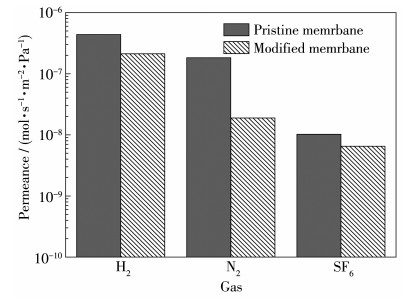
Furthermore, to investigate the decrease of defects, gases with different dynamic diameters (H2, N2 and SF6) were imported as probe molecules to evaluate the contributions of the modification[33]. The permeation results of the three gases are presented in Fig. 9. The ideal selectivities of H2/N2 and H2/SF6 for pristine membrane were 2.4 and 4.3, which were lower than the corresponding Knudsen values of 3.7 and 8.5, respectively. The low ideal selectivities for H2 over N2 and SF6 resulted from many defects in the membrane. After modification, the modified membrane showed a decrease in the permeability of H2 and N2, while there was a sharp reduction of SF6, resulting in a remarkable enhancement of the H2/N2 and H2/SF6 ideal selectivity from 2.39 to 7.33 and from 4.29 to 32.61, respectively. Compared with the pristine membrane, the ideal selectivity of H2/SF6 for the modified membrane was enhanced drastically, which was related to APTES layer coating which reduces the defects in the poly crystalline membranes[34].
In conclusion, as illustrated in Fig. 10, we assume the APTES layer had two functions in attaining the high separation factor in this work, and the contributions of this modification are as follows: (1) increasing the hydrophilicity of the membrane surface for the preferential adsorption of water, and (2) reducing the defects of the polycrystalline membrane layer to achieve a more compact membrane layer.
A simple and feasible modification method was introduced to modify hydrophilic T-type zeolite membranes. The contributions of the processing method play a double function by modifying an APTES layer. On the one hand, the APTES can reduce the defects that are formed during the synthesis process of the zeolite membrane, making the membrane more compact and continuous. On the other hand, APTES can increase the hydrophilicity of the membrane surface, which enhances dewatering by preferential adsorption. This method can effectively improve the reproducibility of T-type zeolite membrane. The modified layer was resistant enough for long-term testing (continuous 100 h) with a stable separation factor, indicating the modification method has enormous potential for industrial applications.
Morigami Y, Kondo M, Abe J, Kita H, Okamoto K. The First Large-Scale Pervaporation Plant Using Tubular-Type Module with Zeolite NaA Membrane[J]. Sep. Purif. Technol., 2001, 25(1/2/3): 251-260.
Van Der Bruggen B, Vandecasteele C, Van Gestel T, Doyen W, Leysen R. A Review of Pressure-Driven Membrane Processes in Wastewater Treatment and Drinking Water Production[J]. Environ. Prog., 2003, 22(1): 46-56. doi: 10.1002/ep.670220116
Koros W J, Fleming G K. Membrane-Based Gas Separation[J]. J. Membr. Sci., 1993, 83(1): 1-80. doi: 10.1016/0376-7388(93)80013-N
Kosinov N, Gascon J, Kapteijn F, Hensen E J M. Recent Developments in Zeolite Membranes for Gas Separation[J]. J. Membr. Sci., 2016, 499: 65-79. doi: 10.1016/j.memsci.2015.10.049
Caro J, Noack M, Kölsch P, Schäfer R. Zeolite Membranes-State of Their Development and Perspective[J]. Microporous Mesoporous Mater., 2000, 38(1): 3-24. doi: 10.1016/S1387-1811(99)00295-4
Wang S W, Li X Q, Wu H, Tian Z Z, Xin Q P, He G W, Peng D D, Chen S L, Yin Y, Jiang Z Y, Guiver M D. Advances in High Permeability Polymer-Based Membrane Materials for CO2 Separations[J]. Energy Environ. Sci., 2016, 9(6): 1863-1890. doi: 10.1039/C6EE00811A
Qiu S L, Xue M, Zhu G S. Metal-Organic Framework Membranes: From Synthesis to Separation Application[J]. Chem. Soc. Rev., 2014, 43(16): 6116-6140. doi: 10.1039/C4CS00159A
Shah M, McCarthy M C, Sachdeva S. Current Status of Metal-Organic Framework Membranes for Gas Separations: Promises and Challenges[J]. Ind. Eng. Chem. Res., 2012, 51(5): 2179-2199. doi: 10.1021/ie202038m
Sheng L Q, Wang C Q, Yang F, Xiang L, Huang X J, Yu J, Zhang L X, Pan Y C, Li Y S. Enhanced C3H6/C3H8 Separation Performance on MOF Membranes Through Blocking Defects and Hindering Framework Flexibility by Silicone Rubber Coating[J]. Chem. Commun., 2017, 53(55): 7760-7763. doi: 10.1039/C7CC03887A
Caro J, Albrecht D, Noack M. Why is it So Extremely Difficult to Prepare Shape-Selective Al-Rich Zeolite Membranes Like LTA and FAU for Gas Separation?[J]. Sep. Purif. Technol., 2009, 66(1): 143-147. doi: 10.1016/j.seppur.2008.11.009
Bonilla G, Tsapatsis M, Vlachos D G, Xomeritakis G. Fluorescence Confocal Optical Microscopy Imaging of the Grain Boundary Structure of Zeolite MFI Membranes Made by Secondary (Seeded) Growth[J]. J. Membr. Sci., 2001, 182(1): 103-109.
Huang A S, Liu Q, Wang N Y, Caro J. Organosilica Functionalized Zeolitic Imidazolate Framework ZIF-90 Membrane for CO2/CH4 Separation[J]. Microporous Mesoporous Mater., 2014, 192: 18-22. doi: 10.1016/j.micromeso.2013.09.025
Kanezashi M, O'Brien-Abraham J, Lin Y S, Suzuki K. Gas Permeation Through DDR-type Zeolite Membranes at High Temperatures[J]. AIChE J., 2008, 54(6): 1478-1486. doi: 10.1002/aic.11457
Yu M, Funke H H, Noble R D, Falconer J L. H2 Separation Using Defect-Free, Inorganic Composite Membranes[J]. J. Am. Chem. Soc., 2011, 133(6): 1748-1750. doi: 10.1021/ja108681n
Zhou R F, Wang H M, Wang B, Chen X S, Li S G, Yu M. Defect-Patching of Zeolite Membranes by Surface Modification Using Siloxane Polymers for CO2 Separation[J]. Ind. Eng. Chem. Res., 2015, 54(30): 7516-7523. doi: 10.1021/acs.iecr.5b01034
Nomura M, Yamaguchi T, Nakao S I. Silicalite Membranes Modified by Counterdiffusion CVD Technique[J]. Ind. Eng. Chem. Res., 1997, 36(10): 4217-4223. doi: 10.1021/ie970338a
Sun C G, Feng X S. Enhancing the Performance of PVDF Membranes by Hydrophilic Surface Modification via Amine Treatment[J]. Sep. Purif. Technol., 2017, 185: 94-102. doi: 10.1016/j.seppur.2017.05.022
Zhang Y T, Qiu X F, Hong Z, Du P, Song Q N, Gu X H. All-Silica DD3R Zeolite Membrane with Hydrophilic-Functionalized Surface for Efficient and Highly-Stable Pervaporation Dehydration of Acetic Acid[J]. J. Membr. Sci., 2019, 581: 236-242. doi: 10.1016/j.memsci.2019.03.061
Tanaka K, Yoshikawa R, Cui Y, Kita H, Okamoto K. Application of Zeolite T Membrane to Vapor-Permeation-Aided Esterification of Lactic Acid with Ethanol[J]. Chem. Eng. Sci., 2002, 57(9): 1577-1584. doi: 10.1016/S0009-2509(02)00033-7
Wang R, Ma N K, Yan Y S, Wang Z B. Ultrasonic-Assisted Fabrication of High Flux T-Type Zeolite Membranes on Alumina Hollow Fibers[J]. J. Membr. Sci., 2018, 548: 676-684. doi: 10.1016/j.memsci.2017.10.047
Chen X X, Wang J Q, Yin D H, Yang J H, Lu J M, Zhang Y, Chen Z. High-Performance Zeolite T Membrane for Dehydration of Organics by a New Varying Temperature Hot-Dip Coating Method[J]. AIChE J., 2013, 59(3): 936-947. doi: 10.1002/aic.13851
Zhang F, Zheng Y H, Hu L L, Hu N, Zhu M H, Zhou R F, Chen X S, Kita H. Preparation of High-Flux Zeolite T Membranes Using Reusable Macroporous Stainless Steel Supports in Fluoride Media[J]. J. Membr. Sci., 2014, 456: 107-116. doi: 10.1016/j.memsci.2014.01.023
Zhou J J, Zhou C, Xu K, Caro J, Huang A S. Seeding-Free Synthesis of Large Tubular Zeolite FAU Membranes for Dewatering of Dimethyl Carbonate by Pervaporation[J]. Microporous Mesoporous Mater., 2020, 292: 109713. doi: 10.1016/j.micromeso.2019.109713
He M L, Zhang Y P, Wang Y Y, Wang X Q, Li Y Q, Hu N, Wu T, Zhang F, Dai Z F, Chen X S, Kita H. High Hydrogen Permeable ZIF-8 Membranes on Double Modified Substrates[J]. Sep. Purif. Technol., 2021, 275(15): 119109.
Fasano M, Humplik T, Bevilacqua A, Tsapatsis M, Chiavazzo E, Wang E N, Asinari P. Interplay Between Hydrophilicity and Surface Barriers on Water Transport in Zeolite Membranes[J]. Nat. Commun., 2016, 7: 12762. doi: 10.1038/ncomms12762
Qiao B, Wang T J, Gao H, Jin Y. High Density Silanization of NanoSilica Particles Using γ-Aminopropyltriethoxysilane (APTES)[J]. Appl. Surf. Sci., 2015, 351: 646-654. doi: 10.1016/j.apsusc.2015.05.174
Zhang F X, Srinivasan M P. Self-Assembled Molecular Films of Aminosilanes and Their Immobilization Capacities[J]. Langmuir, 2004, 20(6): 2309-2314. doi: 10.1021/la0354638
Wang N Y, Mundstock A, Liu Y, Huang A S, Caro J. Amine-Modified Mg-MOF-74/CPO-27-Mg Membrane with Enhanced H2/CO2 Separation[J]. Chem. Eng. Sci., 2015, 124: 27-36. doi: 10.1016/j.ces.2014.10.037
Majoul N, Aouida S, Bessaïs B. Progress of Porous Silicon APTES-Functionalization by FTIR Investigations[J]. Appl. Surf. Sci., 2015, 331: 388-391. doi: 10.1016/j.apsusc.2015.01.107
Hernández-Morales V, Nava R, Acosta-Silva Y J, Macías-Sánchez S A, Pérez-Bueno J J, Pawelec B. Adsorption of Lead (Ⅱ) on SBA -15 Mesoporous Molecular Sieve Functionalized with -NH2 Groups[J]. Microporous Mesoporous Mater., 2012, 160: 133-142. doi: 10.1016/j.micromeso.2012.05.004
Acres R G, Ellis A V, Alvino J, Lenahan C E, Khodakov D A, Metha G F, Andersson G G. Molecular Structure of 3-Aminopropyltriethoxysilane Layers Formed on Silanol-Terminated Silicon Surfaces[J]. J. Phys. Chem. C, 2012, 116(10): 6289-6297. doi: 10.1021/jp212056s
Vandenberg E T, Bertilsson L, Liedberg B, Uvdal K, Erlandsson R, Elwing H, Lundström I. Structure of 3-Aminopropyl Triethoxy Silane on Silicon Oxide[J]. J. Colloid Interface Sci., 1991, 147(1): 103-118. doi: 10.1016/0021-9797(91)90139-Y
Zhang H F, James J, Zhao M, Yao Y, Zhang Y S, Zhang B Q, Lin Y S. Improving Hydrostability of ZIF-8 Membranes via Surface Ligand Exchange[J]. J. Membr. Sci., 2017, 532: 1-8. doi: 10.1016/j.memsci.2017.01.065
Chang H, Wang Y, Xiang L, Liu D H, Wang C Q, Pan Y C. Improved H2/CO2 Separation Performance on Mixed-Linker ZIF-7 Polycrystalline Membranes[J]. Chem. Eng. Sci., 2018, 192: 85-93. doi: 10.1016/j.ces.2018.07.027

Figure 2 SEM images of (a, b) the pristine membrane and modified (c, d) M-1, (e, f) M-2, (g, h) M-3, (i, j) M-4 membranes

Figure 3 XRD patterns of (a) zeolite T, (b) mullite support, (c) the pristine membrane and (d) the modified membrane (M-2)

Figure 5 High-resolution XPS spectra of the pristine and modified membranes: (a) Si2p, (b) O1s and (c) N1s

Figure 6 PV performance of the modified membrane (M-2) in a 90% isopropanol solution at 363 K for 100 h

Figure 7 PV performance of the modified membrane (M-2) in different isopropanol aqueous solutions at 348 K

Figure 8 Water contact angle of (a) the pristine and (b) modified T-type zeolite membranes

Figure 9 Single gas permeability of the pristine and modified T⁃type zeolite membranes
Table 1. PV results of the pristine and modified T-type zeolite membranes for a 90% isopropanol solution at 348 K
| Sample | Pristine membrane | Modified membrane* | ||||
| J/(kg·m-2·h-1) | α | nAPTES/mmol | J/(kg·m-2·h-1) | α | ||
| M-1 | 3.33 | 600 | 5 | 3.06 | 630 | |
| M-2 | 3.52 | 420 | 10 | 3.01 | 2 910 | |
| M-3 | 3.58 | 370 | 15 | 1.70 | 2 320 | |
| M-4 | 3.80 | 340 | 20 | 0.80 | 420 | |
| *Reaction conditions: 383 K, 1.5 h and 5-20 mmol APTES in 60 mL toluene solution. | ||||||
 下载: 导出CSV
Table 2. PV results of the pristine and modified T-type zeolite membranes for a 90% isopropanol solution at 348 K
| Sample | Pristine membrane | Modified membrane | ||||
| J/(kg·m-2·h-1) | α | Modification time / h | J/(kg·m-2·h-2) | α | ||
| M-5 | 3.85 | 520 | 0.5 | 3.13 | 1 850 | |
| M-6 | 3.64 | 380 | 1 | 3.05 | 2 300 | |
| M-2 | 3.52 | 420 | 1.5 | 3.01 | 2 910 | |
| M-7 | 3.50 | 390 | 2.0 | 2.65 | 3 030 | |
下载: 导出CSV
Table 3. PV results of the pristine and modified T-type zeolitic membranes for a 90% isopropanol solution at 348 K
| Sample | Pristine membrane | Modified membrane | |||
| J/(kg·m-2·h-1) | α | J/(kg·m-2·h-1) | α | ||
| M-2 | 3.64 | 380 | 3.01 | 2 900 | |
| M-8 | 3.46 | 362 | 2.95 | 3 000 | |
| M-9 | 3.60 | 320 | 3.04 | 2 640 | |
| M-10 | 3.50 | 374 | 3.31 | 3 130 | |
| M-11 | 3.39 | 360 | 2.99 | 3 000 | |
| x±σ | 3.52±0.10 | 359±23 | 3.06±0.14 | 2 934±183 | |
下载: 导出CSV

 扫一扫看文章


扫一扫关注我们



 下载:
下载: