Citation:
Yue Xu, Qian Zhang, Qizhao Li, Yongshu Xie. Structures and aromaticity of hexaphyrins(2.1.2.1.2.1) and their metal complexes[J]. Chinese Chemical Letters,
2026, 37(8): 112642.
doi:
10.1016/j.cclet.2026.112642
Structures and aromaticity of hexaphyrins(2.1.2.1.2.1) and their metal complexes
English
Structures and aromaticity of hexaphyrins(2.1.2.1.2.1) and their metal complexes
College of Chemical Engineering and Technology, Shandong Provincial Engineering Research Center for Novel Functional Polymer Materials, Yantai Nanshan University, Yantai 265700, China
b.
Shanghai Key Laboratory of Functional Materials Chemistry, Key Laboratory for Advanced Materials and Institute of Fine Chemicals, School of Chemistry & Molecular Engineering, East China University of Science & Technology, Shanghai 200237, China
As a class of 18π aromatic tetrapyrrolic macrocycles, porphyrins have been extensively studied because of their distinctive structural characteristics and remarkable photophysical properties. Beyond their applications in traditional fields, porphyrin-based materials have recently demonstrated significant potential for applications in emerging fields like photocatalysis for micropollutant abatement [1] and photodynamic antibacterial therapy [2]. In recent years, porphyrin analogues have been developed by modifying the skeleton of the porphyrin macrocycle to achieve novel structures, properties, and applications. In this respect, hexaphyrins have been developed as macrocycles incorporating six pyrrolic units to achieve flexible structures, strong coordination ability, near-infrared (NIR) absorption, and multi-electron redox activity [3].
Since the first synthesis of meso–phenyl hexaphyrin(1.1.1.1.1.1) in 1997 by Dolphin's group [4], a wide variety of hexaphyrins have been reported to achieve diverse conformations like rectangular, figure-of-eight, and spindle shapes. Additionally, their conformations and aromaticity can be effectively modulated through structural modification, endowing them with distinctive aromatic, optical and electronic properties. One of the useful structural modification strategies involves incorporating extended carbon bridges between the pyrrolic units, which enables the design of novel architectures, coordination environments, and electronic properties [3].
In 2019, Yamada, Xue and coworkers reported a series of hexaphyrins(2.1.2.1.2.1) by linking dipyrrin units with diphenylvinylene, dimethylvinylene, and vinylene bridges [5]. These hexaphyrins(2.1.2.1.2.1) exhibit versatile coordination ability with various metal ions, including copper(Ⅱ), zinc(Ⅱ), and rhodium(Ⅰ). Their molecular conformations, optical behavior, and electronic structures are strongly influenced by both the substituents on the vinylene bridges and the coordinated metal ions. For instance, vinylene-bridged hexaphyrin(2.1.2.1.2.1) adopts a planar geometry, whereas dimethyl- and diphenyl-substituted analogues form distorted structures. Notably, copper coordination can transform the distorted non-aromatic diphenyl-substituted hexaphyrin(2.1.2.1.2.1) into an aromatic figure-of-eight conformation [5].
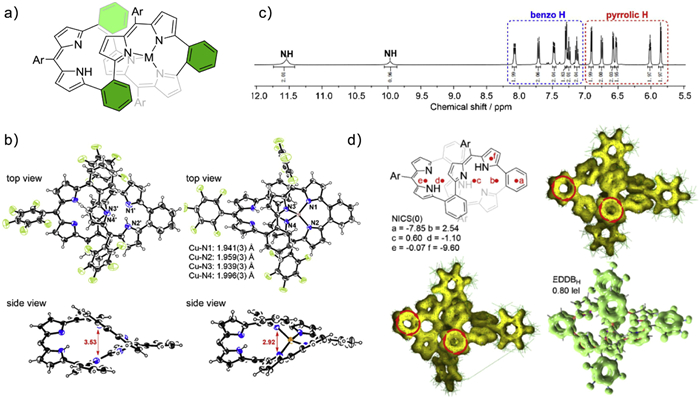
In a recent study, Xue and coworkers reported benzo-bridged figure-of-eight hexaphyrin(2.1.2.1.2.1) (Hex) and its copper complex (HexCu), which contain three benzo bridges between the dipyrrin units (Fig. 1a) [6]. Interestingly, despite the typical figure-of-eight conformation, neither Hex nor HexCu exhibits global aromatic character. Thus, HexCu was synthesized in 15% yield by reacting equimolar 1,2-di(1H-pyrrol-2-yl)benzene (DPB), 1,2,4,5-tetra(pyrrol-2-ly)benzene (TPB), and C6F5CHO in the presence of 3 mol% BF3⋅OEt2 in CH2Cl2, followed by oxidation with DDQ and subsequent metalation with Cu(OAc)2⋅H2O, and the demetalization of HexCu afforded Hex in 92% yield. Single crystal X-ray diffraction analysis clearly reveals that both Hex and HexCu adopt figure-of-eight conformations, with the copper ion in HexCu coordinated in a distorted square-planar geometry provided by four nitrogen atoms (Fig. 1b). In both of the compounds, the bond lengths between the benzo bridges and adjacent pyrrole α-carbons lie within the range of 1.446–1.483 Å, typical for C–C single bonds, indicative of non-aromatic character of the macrocycles. Consistently, the UV–vis absorption spectra of Hex and HexCu exhibit nonaromatic features, and thus the 1H NMR spectrum of Hex in CDCl3 shows pyrrolic protons and benzo signals with δ values lying within the ranges of 6.90–5.85 ppm and 8.09–7.11 ppm, respectively (Fig. 1c). The open-shell character of HexCu was confirmed by EPR spectroscopy, indicating an axially symmetric Cu(Ⅱ) species. In addition, cyclic voltammetry experiments in CH2Cl2 revealed multiple oxidation and reduction waves for both of the compounds, indicating multi-electron transfer capabilities consistent with their degenerate frontier molecular orbitals.
Figure 1
Figure 1.
(a) Chemical structures of Hex (M = 2H) and HexCu (M = Cu), Ar = C6F5. (b) Molecular structures of Hex (left) and HexCu (right) revealed by single crystal X-ray diffraction. (c) 1H NMR spectrum (CDCl3, 298 K) of Hex. (d) Calculated NICS(0) values at key positions of the Hex core (top left), Ar = C6F5; ACID plots (isovalue = 0.03) for Hex (top right) and HexCu (bottom left); and EDDBp(r) isosurface for Hex along the Vogel's pathway (red). Electron populations correspond to EDDBH atomic contributions (bottom right).
To further evaluate the aromaticity, HOMA, ACID, NICS, and EDDB calculations were performed (Fig. 1d). These methods consistently revealed that both Hex and HexCu lack global aromaticity but exhibit local diatropic ring currents within the benzo bridges, suggesting that the strongly aromatic benzo fragments disrupt the global conjugation and aromaticity. This electronic behavior contrasts sharply with their previously reported aromatic diphenyl vinylene-bridged copper complex [5]. On the basis of this interesting research, Xue and coworkers continued to explore the coordination of Hex with group 10 metals, and thus successfully synthesized a mono-Ni(Ⅱ) complex (HexNi) and a bis-Pd(Ⅱ) complex (HexPd) [7]. As a result, both of them retain figure-of-eight conformations. In the case of HexPd, the structure shows two Pd(Ⅱ) ions bridged by a chloride atom. Notably, HexPd demonstrates enhanced ability to generate ¹O2 upon irradiation with yellow light (570–590 nm), suggesting its promising applications in photodynamic therapy.
In conclusion, Xue and coworkers reported the synthesis and structures of benzo-bridged hexaphyrin(2.1.2.1.2.1) and its metal complexes. These results demonstrate that incorporating benzo units into the hexaphyrin macrocycle not only alters the molecular geometry but also disrupts global aromaticity, offering new insights into modulating aromaticity of hexaphyrins. Furthermore, the benzo-bridged hexaphyrin(2.1.2.1.2.1) provides a promising platform for synthesizing complexes of a variety of metal ions with potential applications in photodynamic therapy and other related areas.
Declaration of competing interest
The authors declare that they have no known competing financial interests or personal relationships that could have appeared to influence the work reported in this paper.
J. Wu, X. Lv, Z. Xue, et al., Dalton Trans. 54 (2025) 5255–5258. doi: 10.1039/D5DT00036J
Figure 1
(a) Chemical structures of Hex (M = 2H) and HexCu (M = Cu), Ar = C6F5. (b) Molecular structures of Hex (left) and HexCu (right) revealed by single crystal X-ray diffraction. (c) 1H NMR spectrum (CDCl3, 298 K) of Hex. (d) Calculated NICS(0) values at key positions of the Hex core (top left), Ar = C6F5; ACID plots (isovalue = 0.03) for Hex (top right) and HexCu (bottom left); and EDDBp(r) isosurface for Hex along the Vogel's pathway (red). Electron populations correspond to EDDBH atomic contributions (bottom right).


 DownLoad:

 下载:
下载:


 下载:
下载:

