

Scheme 1.
H3dpna ligand formed via in situ reaction
]


In recent years, the design and hydro(solvo)ther-mal in situ syntheses of metal-organic coordination plymers have attracted great interest in the field of coordination chemistry and organic chemistry not only because of their intriguing architectures and topologies, but also for that they have shown a variety of potential applications in catalysis, magnetism, luminescence and gas absorption[1-8].Commpared with the traditional synthesis method, hydrothermal and solvothermal method could create more chances for in situ synthese of ligands due to the reaction conditions of high temperature and high pressure[9-12].At the same time, the hydro(solvo)thermal method has demonstrated increasing success in providing alternative pathways to crystalline complexes with in situ synthesized ligands which are difficult to obtain by routine synthetic methods.
Following our interest in the exploration of novel and poorly investigated multicarboxylic acids for the design of coordination polymers[13-17], recently, we began to construct coordination polymers by use of the advantage of in situ ligand reaction.On the basis of current research on in situ ligand reaction, the carboxylate-based ligands can be in situ generated from the CN-containing ligands precursor[7, 18-19].Thus, the precursor we selected is 5-(2, 3-dicyanobenzoxy)nicotic acid (Hdbna) due to its following characteristics: (1) it contains one carboxylate and two CN groups, which can form a tricarboxylate ligand through in situ ligand reaction (Scheme 1); (2) its corresponding acid, 5-(2, 3-dicarboxylphenoxy)nicotic acid (H3dpna), still remain largely unexplored in the construction of coordination polymers[20].
Herein, we report the synthesis, crystal structure, and catalytic properties of Mn(Ⅱ) coordination polymer with H3dpna ligands.
All chemicals and solvents were of AR grade and used without further purification.Carbon, hydrogen and nitrogen were determined using an Elementar Vario EL elemental analyzer.IR spectrum was recorded using KBr pellets and a Bruker EQUINOX 55 spectrometer.Thermogravimetric analysis (TGA) data were collected on a LINSEIS STA PT1600 thermal analyzer with a heating rate of 10 ℃·min-1.Powder X-ray diffraction (PXRD) patterns were measured on a Rigaku-Dmax 2400 diffractometer using Cu Kα radiation (λ=0.154 06 nm); the X-ray tube was operated at 40 kV and 40 mA.The data collection range was between 5° and 45°.Solution 1H NMR spectra were recorded on a JNM ECS 400M spectrometer.
A mixture of Mn Cl2·4H2O (0.040 g, 0.2 mmol), Hdbna (0.053 g, 0.2 mmol), 2, 2′-bipy (0.031 g, 0.2mmol), Na OH (0.016 g, 0.4 mmol), and H2O (10 mL)was stirred at room temperature for 15 min, and then sealed in a 25 mL Teflon-lined stainless steel vessel, and heated at 160 ℃ for 3 d, followed by cooling to room temperature at a rate of 10 ℃·h-1.Yellow blockshaped crystals were isolated manually, and washed with distilled water.Yield: 55% (based on Hdbna).Anal.Calcd.for C24H15Mn N3O7(%): C 56.26, H 2.95, N8.20;Found(%): C 56.48, H 2.93, N 8.16.IR (KBr, cm-1): 1 688w, 1 598m, 1 553s, 1 470s, 1 437s, 1 412m, 1 371m, 1 301w, 1 256m, 1 210w, 1 148w, 1 062w, 1 017w, 976w, 905w, 844w, 819w, 794w, 761m, 736w, 716w, 695w, 629w.
The compound is insoluble in water and common organic solvents, such as methanol, ethanol, acetone and DMF.
The single crystal with dimensions of 0.24 mm×0.21 mm×0.20 mm was collected at 293(2) K on a Bruker SMART APEX Ⅱ CCD diffractometer with Cu Kα radiation (λ=0.154 178 nm).The structure was solved by direct methods and refined by full matrix least-square on F2using the SHELXTL-2014 program[21].All non-hydrogen atoms were refined anisotropically.All the hydrogen atoms were positioned geometrically and refined using a riding model.A summary of the crystallography data and structure refinement for 1 is given in Table 1.The selected bond lengths and angles for compound 1 are listed in Table 2.Hydrogen bond parameters of compound 1 are given in Table 3.

 下载:
导出CSV
下载:
导出CSV
| Formula | C24H15MnN3O7 | F(000) | 522 | |
| Formula weight | 512.33 | θ range for data collection / (°) | 3.606~65.998 | |
| Crystal system | Triclinic | Limiting indices | -9 < h < 7, -12 < k < 13, -15 < l < 15 | |
| Space group | P1 | Reflection collected, unique (Rint) | 6 931, 3 547 (0.076 5) | |
| a / nm | 0.784 98(8) | Dc / (g·cm-3) | 1.617 | |
| b / nm | 1.130 30(13) | μ / mm-1 | 5.592 | |
| c / nm | 1.290 01(11) | Data, restraint, parameter | 3 547, 0, 317 | |
| α/ (°) | 73.119(9) | Goodness-of-fit on F2 | 1.015 | |
| β / (°) | 79.443(8) | Final R indices [I≥2σ(I)] R1, wR2 | 0.067 5, 0.149 9 | |
| γ /(°) | 75.309(10) | R indices (all data) R1, wR2 | 0.119 4, 0.199 3 | |
| V /nm3 | 1.052 0(2) | Largest diff. peak and hole / (e·nm-3) | 512 and -888 | |
| Z | 2 |
下载:
导出CSV
| Mn1—O1 | 0.219 4(4) | Mn1—O2 | 0.230 7(4) | Mn1—O6A | 0.208 5(4) |
| Mn1—N1B | 0.222 7(5) | Mn1—N2 | 0.225 9(5) | Mn1—N3 | 0.228 5(5) |
| O6A—Mn1—O1 | 106.66(18) | O6A—Mn1—N1B | 100.3(2) | O1—Mn1—N1B | 90.28(18) |
| O6A—Mn1—N2 | 90.0(2) | N2—Mn1—O1 | 158.02(19) | N1B—Mn1—N2 | 101.0(2) |
| N3—Mn1—O6A | 161.3(2) | O1—Mn1—N3 | 91.28(18) | N1B—Mn1—N3 | 84.60(19) |
| N2—Mn1—N3 | 71.3(2) | O6A—Mn1—O2 | 93.6(2) | O1—Mn1—O2 | 58.29(16) |
| O2—Mn1—N1B | 148.27(18) | O2—Mn1—N2 | 107.48(18) | O2—Mn1—N3 | 91.34(19) |
| Symmetry codes: A: x, y+1, z; B: x+1, y, z. | |||||
下载:
导出CSV
| D—H…A | d(D—H) / nm | d(H…A) / nm | d(D…A) / nm | ∠DHA / (°) |
| O4—H4…O7 | 0.082 0 | 0.159 6 | 0.240 9 | 170.89 |
CCDC: 2025016.
In a typical test, a suspension of an aromatic aldehyde (0.50 mmol, 4-nitrobenzaldehyde as a model substrate), trimethylsilyl cyanide (1.0 mmol) and catalyst(molar fraction: 3%) in dichloromethane (2.5 mL) was stirred at room temperature.After a desired reaction time, the catalyst was removed by centrifugation, followed by an evaporation of the solvent from the filtrate under reduced pressure to give a crude solid.This solid was dissolved in CDCl3 and analyzed by 1H NMR spectroscopy for quantification of products (Fig.S1, Supporting information).To perform the recycling experiment, the catalyst was isolated by centrifugation, washed with dichloromethane, dried at room temperature, and reused.The subsequent steps were performed as described above.
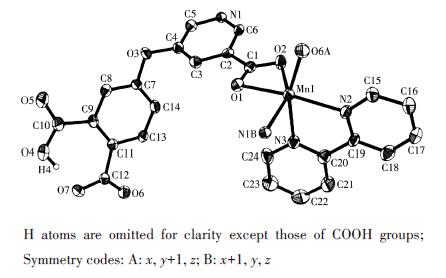
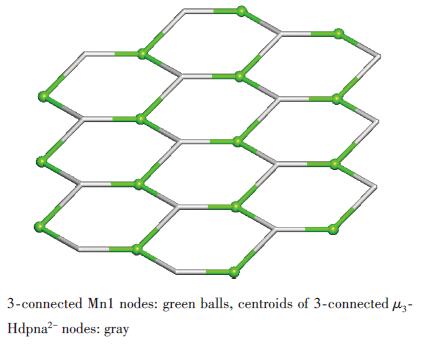
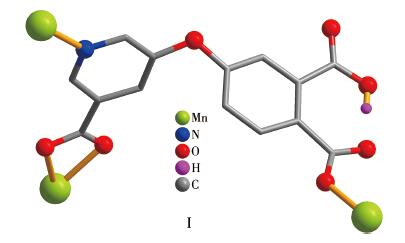
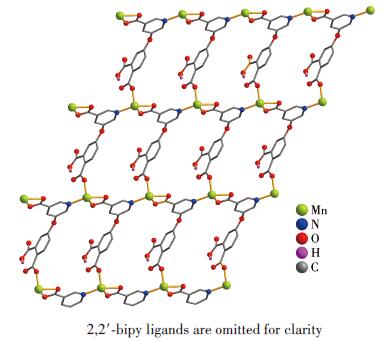
X-ray crystallography analysis reveals that compound 1 crystallizes in the triclinic system space group P1.As shown in Fig. 1, the asymmetric unit of 1 bears one crystallographically unique Mn(Ⅱ) atom, one μ3-Hdpna2- block, and one 2, 2′-bipy.The Mn1 center is six-coordinated and forms a distorted octahedral{Mn N3O3}geometry.It is completed by three carboxylate O and one N atoms from three μ3-Hdpna2- blocks and two N atoms from the 2, 2′-bipy moiety.The Mn—O and Mn—N bond distances are 0.208 5(4)~0.230 7(4)nm and 0.222 7(5)~0.228 5(5) nm, respectively; these are within the normal ranges observed in related Mn(Ⅱ) compounds[15-17].In 1, the Hdpna2- ligand adopts the coordination mode Ⅰ (Scheme 2) with two deprontonated carboxylate groups being monodentate or bidentate.In the Hdpna2- ligand, a dihedral angle (between two aromatic rings) and a C—Oether—C angle are 69.75° and 116.43°, respectively.The μ3-Hdpna2- ligands connect Mn1 atoms to give a 2D sheet (Fig. 2).This sheet is composed of the 3-connected, topologically equivalent Mn1 and μ3-Hdpna2- nodes (Fig. 3).The resulting net can be described as a uninodal 3-connected layer with an hcb (Shubnikov hexagonal plane net/(6, 3)) topology and point symbol of (63).
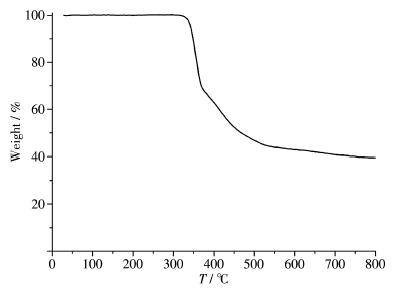
To determine the thermal stability of compound 1, its thermal behavior was investigated under nitrogen atmosphere by TGA.As shown in Fig. 4, compound 1 did not contain solvent of crystallization or H2O ligands and remained stable up to 312 ℃, followed by a decomposition on further heating.
Given the potential of manganes(Ⅱ) coordination compounds to catalyze the organic reactions[22-23], we explored the application of 1 as a heterogeneous catalyst in the cyanosilylation of 4-nitrobenzaldehyde as a model substrate to give 2-(4-nitrophenyl)-2-((trimethyl-silyl)oxy)acetonitrile.Typical tests were carried out by reacting a mixture of 4-nitrobenzaldehyde, trimethylsilyl cyanide (TMSCN) and a Mn catalyst in dichloromethane at room temperature (Scheme 3, Table 4).Such effects as reaction time, catalyst loading, solvent composition, catalyst recycling and finally substrate scope were investigated.
下载:
导出CSV
| Entry | Catalyst | Time / h | Catalyst loading / % (n/n) | Solvent | Yield* / % |
| 1 | 1 | 1 | 3.0 | CH2Cl2 | 29 |
| 2 | 1 | 2 | 3.0 | CH2Cl2 | 53 |
| 3 | 1 | 4 | 3.0 | CH2Cl2 | 62 |
| 4 | 1 | 6 | 3.0 | CH2Cl2 | 69 |
| 5 | 1 | 8 | 3.0 | CH2Cl2 | 75 |
| 6 | 1 | 10 | 3.0 | CH2Cl2 | 78 |
| 7 | 1 | 12 | 3.0 | CH2Cl2 | 82 |
| 8 | 1 | 12 | 2.0 | CH2Cl2 | 63 |
| 9 | 1 | 12 | 4.0 | CH2Cl2 | 84 |
| 10 | 1 | 12 | 3.0 | CH3CN | 71 |
| 11 | 1 | 12 | 3.0 | THF | 63 |
| 12 | 1 | 12 | 3.0 | CH3OH | 75 |
| 13 | 1 | 12 | 3.0 | CH3Cl | 77 |
| 14 | blank | 12 | — | CH2Cl2 | 3 |
| 15 | MnCl2 | 12 | 3.0 | CH2Cl2 | 7 |
| 16 | H3dpna | 12 | 3.0 | CH2Cl2 | 6 |
| * Calculated by 1H NMR spectroscopy: nproduct/naldehyde×100%. | |||||
Upon using compound 1 as the catalyst (molar fraction: 3%), a high conversion of 82% of 4-nitrobenz-aldehyde into 2-(4-nitrophenyl)-2-((trimethylsilyl)oxy) acetonitrile was reached after 12 h in dichloromethane at room temperature (Table 4, Entry 7).Upon extending the reaction time further to 18 h, only a slight increase in the product yield to 83% occurred.Moreover, no other products were detected, and the yield of this product was considered the conversion of 4-nitrobenzaldehyde (Fig.S1).
We also compared the activities of catalyst 1 in the reactions of other substituted aromatic and aliphatic aldehydes with trimethylsilyl cyanide, and the corresponding cyanohydrin derivatives were produced in yields ranging from 43% to 82% (Table 5).Aryl aldehydes bearing strong electron-withdrawing substituents (e.g., nitro and chloro) exhibited the higher reactivities(Table 5, Entry 2~5), which may be related to an increase in the electrophilicity of the substrate.Aldehydes containing electron-donating proups (e.g., methyl) showed lower reaction yields (Table 5, Entry 7), as expected.An ortho-substituted aldehyde showed lower reactivity, possibly as a result of steric hindrance.
下载:
导出CSV
| Entry | Substituted benzaldehyde substrate (R—C6H4CHO) | Product yieldb / % |
| 1 | R=H | 52 |
| 2 | R=2-NO2 | 72 |
| 3 | R=3-NO2 | 78 |
| 4 | R=4-NO2 | 82 |
| 5 | R=4-Cl | 54 |
| 6 | R=4-OH | 48 |
| 7 | R=4-CH3 | 43 |
| a Reaction condition: aldehyde (0.5 mmol), TMSCN (1.0 mmol), catalyst 1(molar fraction: 3.0%) and CH2Cl2(2.5 mL) at room temperature; b Calculated by 1H NMR spectroscopy. | ||
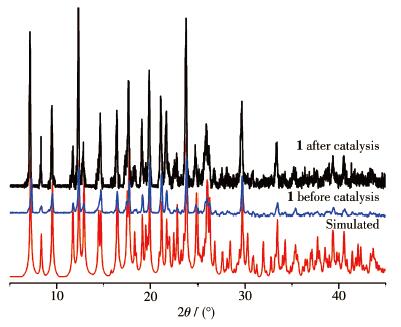
To examine the stability of 1 in the cyanosilylation reaction, we tested the recyclability of this heterogeneous catalyst.For this purpose, upon completion of a reaction cycle, we separated the catalyst by centrifugation, washed it with CH2Cl2, and dried it at room temperature before its further use.The catalytic system mained the high activity in at least five consecutive cycles (the yields were 80%, 80%, 79% and 78% for second to fifth run, respectively).According to the PXRD data (Fig. 5).the structure of 1 was essentially preserved after five catalytic cycles.
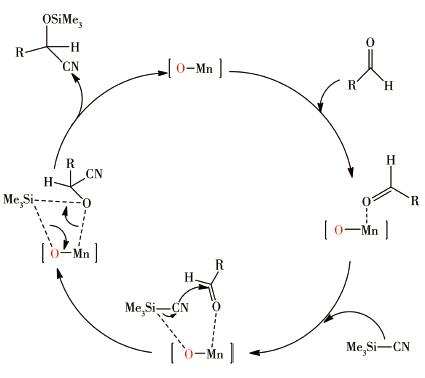
A possible catalytic cycle for the cyanosilylationreaction catalyzed by a Mn coordination polymer is proposed in Scheme 4.It can involve dual activation of thecarbonyl and TMSCN by the Mn(Ⅱ) centre and a ligatedcarboxylate group, respectively, followed by the formation of the C—C bond leading to cyanohydrin[24-25].
In summary, we have synthesized one Mn(Ⅱ) coordination polymer 1 based on a tricarboxylate ligandgenerated by in situ reaction.Compound 1 shows a 2D sheet structure, and it exhibits a higher catalytic activityin the cyanosilylation at room temperature.
Wang Q, Fan Y, Song, T Y, Xu J N, Wang J, Chai J, Liu Y L, Wang L, Zhang L R. Inorg. Chim. Acta, 2015, 438: 128-134 doi: 10.1016/j.ica.2015.08.033
Ding L, Zhong J C, Qiu X T, Sun Y Q, Chen Y P. J. Solid State Chem. , 2017, 246: 138-144 doi: 10.1016/j.jssc.2016.11.002
Chen X M, Tong M L. Acc. Chem. Res. , 2007, 40(2): 162-170 doi: 10.1021/ar068084p
Wang C, Piel I, Glorius F. J. Am. Chem. Soc. , 2009, 131(12): 4194-4195 doi: 10.1021/ja8100598
Wu D, Bai X J, Tian H R, Yang W T, Li Z W, Huang Q, Du S Y, Sun Z M. Inorg. Chem. , 2015, 54(17): 8617-8624 doi: 10.1021/acs.inorgchem.5b01266
Rongere T, Langry A, Bennis K, Taviot-Gueho C, Ducki S, Leroux F. J. Solid State Chem. , 2018, 268: 159-167 doi: 10.1016/j.jssc.2018.08.043
Li Y Y, Lu Y Q, Qiao X Y, Huang W M, Niu Y Y. Inorg. Chem. Commun. , 2020, 118: 108002 doi: 10.1016/j.inoche.2020.108002
Zhuang G M, Li X B, Gao E Q. Inorg. Chem. Commun. , 2014, 47: 134-137 doi: 10.1016/j.inoche.2014.07.018
Wang X P, Zhao Y Q, Jagličić Z, Wang S N, Lin S J, Li X Y, Sun D. Dalton Trans. , 2015, 44(24): 11013-11020
Chen Q H, Jiang F L, Chen L, Yang M, Hong M C. Chem. Eur. J. , 2012, 18(29): 9117-9124 doi: 10.1002/chem.201104001
Dai F N, Cui P P, Ye F, Sun D F. Cryst. Growth Des. , 2010, 10(4): 1474-1477 doi: 10.1021/cg1000914
Sun D, Liu F J, Huang R B, Zheng L S. Inorg. Chem. , 2011, 50(24): 12393-12395 doi: 10.1021/ic201746q
Gu J Z, Wen M, Cai Y, Shi Z F, Nesterov D S, Kirillova M V, Kirillov A M. Inorg. Chem. , 2019, 58(9): 5875-5885 doi: 10.1021/acs.inorgchem.9b00242
邹训重, 吴疆, 顾金忠, 赵娜, 冯安生, 黎彧. 无机化学学报, 2019, 35(9): 1705-1711ZOU X Z, WU J, GU J Z, ZHAO N, FENG A S, LI Y. Chinese J. Inorg. Chem. , 2019, 35(9): 1705-1711
Li Y, Wu J, Gu J Z, Qiu W D, Feng A S. Chin. J. Struct. Chem. , 2020, 39(4): 727-736
Gu J Z, Cui Y H, Liang X X, Wu J, Lv D Y, Kirillov A M. Cryst. Growth Des. , 2016, 16(8): 4658-4670 doi: 10.1021/acs.cgd.6b00735
Gu J Z, Gao Z Q, Tang Y. Cryst. Gorwth Des. , 2012, 12(6): 3312-3323 doi: 10.1021/cg300442b
Hu T P, Bi W H, Hu X Q, Zhao X L, Sun D F. Cryst. Growth Des. , 2010, 10(8): 3324-3326 doi: 10.1021/cg100725j
Evans O R, Xiong R G, Wang Z Y, Wong G K, Lin W B. Angew. Chem. Int. Ed. , 1999, 38(4): 536-538 doi: 10.1002/(SICI)1521-3773(19990215)38:4<536::AID-ANIE536>3.0.CO;2-3
Zhao Q, Luo B M, Fan H T, Feng Y Q, Liu X D, Deng Y L, Ma X. Mater. Lett. , 2017, 197: 201-204 doi: 10.1016/j.matlet.2017.02.134
Spek A L. Acta Crystallogr. Sect. C, 2015, 71(1): 9-18 doi: 10.1107/S2053229614024929
Pal S, Maiti S, Nayek H P. Appl. Organometal Chem. , 2018, 32: e4447
Loukopoulos E, Kostakis G E. J. Coord. Chem. , 2018, 71(3): 371-410 doi: 10.1080/00958972.2018.1439163
Karmakar A, Hazra S, da Silva M F C G, Pombeiro A J L. Dalton Trans. , 2015, 44(1): 268-280
Aguirre-Díaz L M, Iglesias M, Snejko N, Gutiérrez-Puebla E, Monge M Á. CrystEngComm, 2013, 15(45): 9562-9571

Figure 1 Drawing of asymmetric unit of compound 1 with 30% probability thermal ellipsoids

Figure 3 Topological representation of uninodal 3-connected metal-organic layer with hcb (Shubnikov hexagonal plane net/(6, 3)) topology viewed along c axis
Table 1. Crystal data for compound 1
| Formula | C24H15MnN3O7 | F(000) | 522 | |
| Formula weight | 512.33 | θ range for data collection / (°) | 3.606~65.998 | |
| Crystal system | Triclinic | Limiting indices | -9 < h < 7, -12 < k < 13, -15 < l < 15 | |
| Space group | P1 | Reflection collected, unique (Rint) | 6 931, 3 547 (0.076 5) | |
| a / nm | 0.784 98(8) | Dc / (g·cm-3) | 1.617 | |
| b / nm | 1.130 30(13) | μ / mm-1 | 5.592 | |
| c / nm | 1.290 01(11) | Data, restraint, parameter | 3 547, 0, 317 | |
| α/ (°) | 73.119(9) | Goodness-of-fit on F2 | 1.015 | |
| β / (°) | 79.443(8) | Final R indices [I≥2σ(I)] R1, wR2 | 0.067 5, 0.149 9 | |
| γ /(°) | 75.309(10) | R indices (all data) R1, wR2 | 0.119 4, 0.199 3 | |
| V /nm3 | 1.052 0(2) | Largest diff. peak and hole / (e·nm-3) | 512 and -888 | |
| Z | 2 |
 下载: 导出CSV
Table 2. Selected bond distances (nm) and bond angles (°) for compound 1
| Mn1—O1 | 0.219 4(4) | Mn1—O2 | 0.230 7(4) | Mn1—O6A | 0.208 5(4) |
| Mn1—N1B | 0.222 7(5) | Mn1—N2 | 0.225 9(5) | Mn1—N3 | 0.228 5(5) |
| O6A—Mn1—O1 | 106.66(18) | O6A—Mn1—N1B | 100.3(2) | O1—Mn1—N1B | 90.28(18) |
| O6A—Mn1—N2 | 90.0(2) | N2—Mn1—O1 | 158.02(19) | N1B—Mn1—N2 | 101.0(2) |
| N3—Mn1—O6A | 161.3(2) | O1—Mn1—N3 | 91.28(18) | N1B—Mn1—N3 | 84.60(19) |
| N2—Mn1—N3 | 71.3(2) | O6A—Mn1—O2 | 93.6(2) | O1—Mn1—O2 | 58.29(16) |
| O2—Mn1—N1B | 148.27(18) | O2—Mn1—N2 | 107.48(18) | O2—Mn1—N3 | 91.34(19) |
| Symmetry codes: A: x, y+1, z; B: x+1, y, z. | |||||
下载: 导出CSV
Table 3. Hydrogen bond parameters of compound 1
| D—H…A | d(D—H) / nm | d(H…A) / nm | d(D…A) / nm | ∠DHA / (°) |
| O4—H4…O7 | 0.082 0 | 0.159 6 | 0.240 9 | 170.89 |
下载: 导出CSV
Table 4. Mn⁃catalyzed cyanosilylation of 4⁃nitrobenzaldehyde with TMSCN
| Entry | Catalyst | Time / h | Catalyst loading / % (n/n) | Solvent | Yield* / % |
| 1 | 1 | 1 | 3.0 | CH2Cl2 | 29 |
| 2 | 1 | 2 | 3.0 | CH2Cl2 | 53 |
| 3 | 1 | 4 | 3.0 | CH2Cl2 | 62 |
| 4 | 1 | 6 | 3.0 | CH2Cl2 | 69 |
| 5 | 1 | 8 | 3.0 | CH2Cl2 | 75 |
| 6 | 1 | 10 | 3.0 | CH2Cl2 | 78 |
| 7 | 1 | 12 | 3.0 | CH2Cl2 | 82 |
| 8 | 1 | 12 | 2.0 | CH2Cl2 | 63 |
| 9 | 1 | 12 | 4.0 | CH2Cl2 | 84 |
| 10 | 1 | 12 | 3.0 | CH3CN | 71 |
| 11 | 1 | 12 | 3.0 | THF | 63 |
| 12 | 1 | 12 | 3.0 | CH3OH | 75 |
| 13 | 1 | 12 | 3.0 | CH3Cl | 77 |
| 14 | blank | 12 | — | CH2Cl2 | 3 |
| 15 | MnCl2 | 12 | 3.0 | CH2Cl2 | 7 |
| 16 | H3dpna | 12 | 3.0 | CH2Cl2 | 6 |
| * Calculated by 1H NMR spectroscopy: nproduct/naldehyde×100%. | |||||
下载: 导出CSV
Table 5. Cyanosilylation of various aldehydes with TMSCN catalyzed by compound 1a
| Entry | Substituted benzaldehyde substrate (R—C6H4CHO) | Product yieldb / % |
| 1 | R=H | 52 |
| 2 | R=2-NO2 | 72 |
| 3 | R=3-NO2 | 78 |
| 4 | R=4-NO2 | 82 |
| 5 | R=4-Cl | 54 |
| 6 | R=4-OH | 48 |
| 7 | R=4-CH3 | 43 |
| a Reaction condition: aldehyde (0.5 mmol), TMSCN (1.0 mmol), catalyst 1(molar fraction: 3.0%) and CH2Cl2(2.5 mL) at room temperature; b Calculated by 1H NMR spectroscopy. | ||
下载: 导出CSV

 扫一扫看文章


扫一扫关注我们



 下载:
下载: