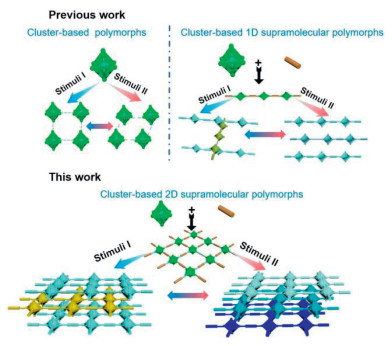
Scheme 1.
Illustration of reversible interconversion of cluster-based individual/supramolecular polymorphs with different assembly modes.

Solvent-triggered reversible transformation of 2D supramolecular polymorphic silver cluster assembled materials for tailoring photoluminescence and photothermal conversion effect
Wen-Yan Huang , Li-Hong Cai , Di-Feng Yang , Jun-Jiang Pu , Shengchang Xiang , Jia-Qi Wang , Zhangjing Zhang


Chemical compounds that exist in multiple crystalline forms are called polymorphism, which have attracted significant attentions for decades due to paramount importance in fields such as pharmacology, solid-state chemistry, and material science [1,2]. The atomic-level understanding of the structure-property relation in polymorphic materials play a crucial role in modulation of solubility, melting point, density, color, and other basic properties. One of these materials is atomically precise metal clusters, which have become an important research direction of advanced materials science in virtue of the potential applications in many fields, such as sensor, biochemistry, catalysis, and optics [3-12]. The noncovalent interactions among the inter-clusters can guide the self-organization towards superlattice, which facilitates diverse packing arrangements in the solid state, leading to generation of cluster-based polymorphs (Scheme 1) [13-18]. Furthermore, the interconversion of these polymorphic structures is attributed to the similarity in their chemical bonds, which can occur via reconstructive or order–disorder mechanisms. Intriguingly, the reversible crystalline forms are responsible for some tunable physical properties in cluster-based polymorphs [13,17].
In the context, incorporation of atomically defined metal clusters as building blocks into extensive structures through strong coordination bonding with linkers can give rise to one-, two-, or three-dimensional cluster-based supramolecular assemblies displaying improved or coupled functions [19-25]. Layer-stacking structures are very common in two-dimensional framework materials manifesting unique electronic structures and potential applications in solid-state nanochemistry [26-29]. The directional coordination-assisted cluster arraying arrangement can generate extensive sheet structures within each layer, and the cohesion between adjacent layers relies on noncovalent forces, such as hydrogen bonds, van der Waals forces, π···π stacking, and C−H···π interactions. Notably, the stacking configurations of 2D framework is greatly influenced by these noncovalent forces, which can be modulated by external stimuli to bestow upon them structural flexibility. Nevertheless, the precise investigation concerning reversible 2D cluster-based supramolecular polymorphism, has not been disclosed hitherto.
In this work, we obtain two polymorphic 2D silver cluster assembled materials (designated as Ag16-TPPE-a and Ag16-TPPE-b) built from Cl-templated silver-thiolate cluster Cl@Ag16(tBuS)8(CF3COO)7 and 1,1,2,2-tetrakis(4-(pyridin-4-yl)phenyl)-ethene (TPPE) in two appropriate solvent systems. Ag16-TPPE were analyzed by single-crystal X-ray diffraction, which reveals both the compounds are identical in the formula but differ in their crystal lattice. Ag16-TPPE-a and Ag16-TPPE-b crystallized in orthorhombic lattice with P212121 space group (a = 16.183 Å; b = 24.098 Å; c = 19.860 Å; α = β = γ = 90°) and monoclinic system with C2 space group (a = 18.919 Å; b = 23.918 Å; c = 19.823 Å; α = 90°; β = 117.09°; γ = 90°), respectively. More typically, differences in photothermal conversion properties arises from varying crystal packing arrangements which may be accompanied by distinct inter-layer interactions. Furthermore, the two crystalline forms can also be reversibly transformed to each other in response to solvent stimuli. It is the first time to observe reversible polymorphism in 2D cluster-based layered structures.
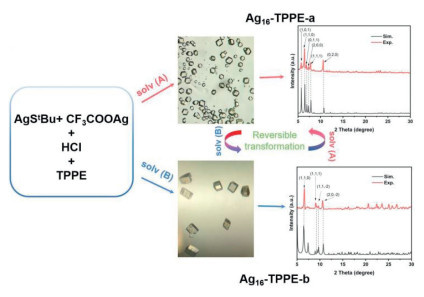
As illustrated in Fig. 1, Ag16-TPPE-a and Ag16-TPPE-b were prepared through one-pot synthesis by mixture of AgStBu, CF3COOAg, hydrochloric acid and TPPE in CH3CN/MeOH/CHCl3 solvent mixture and DMAc, respectively. FT-IR spectroscopy confirmed the chemical composition of both materials (Fig. S1 in Supporting information). Characteristic bands at 1650 cm-1 (C=O), and 1130 and 1190 cm-1 (CF3) verify the presence of CF3COO- ligands. The distinctive pyridine ring vibration observed at 1630 cm-1, indicates pyridine group incorporation. As shown in Fig. S2 (Supporting information), Ag16-TPPE-a and Ag16-TPPE-b exhibit similar morphological features in their SEM images. Elemental mapping further confirms the homogeneous distribution of key components (e.g., Ag, Cl, S) throughout the crystals. Inductively coupled plasma atomic emission spectroscopy (ICP-AES) was employed to determine the silver content. The measured Ag content was 44.05% for Ag16-TPPE-a and 44.13% for Ag16-TPPE-b, both of which are in good agreement with the calculated value of 44.23%. Additionally, elemental analysis was carried out to quantify the C, N, S, and H contents, and the results also correspond closely with the theoretical values. Although both of them have similar shapes and colors in the solid state under an optical microscope, distinct crystal packing arrangements of the two polymorphs cause difference in powder X-ray diffraction patterns in Fig. 1. PXRD analysis reveals Ag16-TPPE-a exhibits intense diffraction peaks at 2θ = 5.74°, 6.52°, and 7.84° corresponding to the (101), (110), and (111) planes, respectively. In contrast, Ag16-TPPE-b displays distinct peaks at 2θ = 6.51°, 9.33° and 10.71° that are attributed to the (110), 112, and 202 diffractions, respectively. Additionally, the simulated PXRD patterns of Ag16-TPPE-a and Ag16-TPPE-b were in good agreement with the experimental data, indicative of the phase purity of the two prepared samples. Furthermore, we observed that the two polymorphs can undergo reversible interconversion. Dispersion of Ag16-TPPE-a crystals in solvent system (B) and subsequent overnight soaking yielded Ag16-TPPE-b crystals, and vice versa, as evidenced by powder X-ray diffraction (PXRD) analysis and screening the unit cell parameters on an X-ray diffractometer (Fig. S3 in Supporting information).
Single-crystal X-ray diffraction analyses revealed two polymorphs feature identical molecular formula [Cl@Ag16(StBu)8(CF3COO)7(TPPE)]n. The Cl@Ag16 skeleton features a Ag4S4−Ag8Cl−Ag4S4 three-layer fashion. The templating chloride ion is encapsulated within a D4d-symmetric square gyrobicupola silver cage composed of eight triangular and ten square faces (Fig. S4 in Supporting information). In Ag16-TPPE-a and Ag16-TPPE-b, Ag–Ag distances are in the range of 3.002(3) –3.380(3) Å and 2.994(17)–3.321(2) Å, respectively, which are shorter than the van der Waals distance (3.44 Å), indicative of significant argentophilic interactions. The building unit Cl@Ag16 is protected peripherally by eight μ4-StBu- and seven CF3CO2- ligands (Fig. 2a). The CF3CO2- ligates with Ag atoms in three different modes. Five CF3CO2- bind to the equatorial octagonal plane through Ag-O bonds with three in μ1-η1 and two in chelation mode μ2-η2. In Ag16-TPPE-a, the other two CF3CO2- ligands cover the upper and lower Ag4 squares in a bidentate bridging μ2-η1:η1 mode. Whereas the upper and lower Ag4 squares in Ag16-TPPE-b are face-capped by the two additional CF3CO2- ligands in a μ3-η1:η2 mode (Fig. S5 in Supporting information). As depicted in Fig. 2a, each Cl@Ag16 core are connected to four TPPE and weaved into an extensive sheet with rhomboidal grids of sides 1.5 × 1.5 nm through Ag-N bonds. The analysis of the connectivity of the sheet determines Cl@Ag16 acts as 4-connected node in assembly with μ4-TPPE linker, which can generate sql topology with the point symbol {44}.
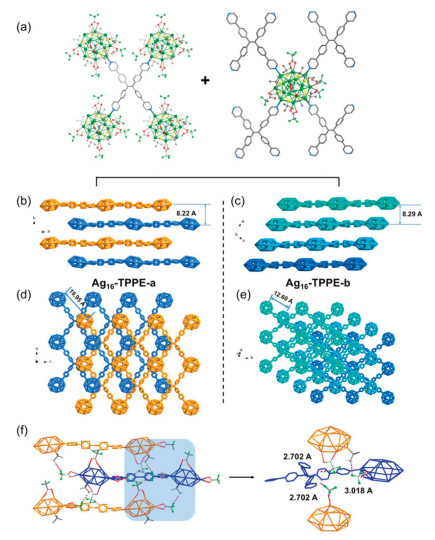
From the perspective of a single-layer structure, Ag16-TPPE-a and Ag16-TPPE-b possess identical extensive sheet structures. To further understand the structural difference, we compared the interlayer stacking configurations of the two polymorphs. The structural analysis demonstrates that the adjacent layers of Ag16-TPPE-b shift along the b direction at 12.60 Å with unidirectional slippage arrangement. Ag16-TPPE-b exhibits an interlayer spacing 8.29 Å with the porosity of 36.5% calculated by PLATON (Fig. 2). In contrast, structural analysis reveals Ag16-TPPE-a exhibit an AB-stacked mode along the b axis. As illustrated from top view and side view in Figs. 2b and d, the 19.95 Å interlayer shifting instance along the a and c directions between the adjacent layers can be observed, resulting in the slip of Ag16 cores in B-layer to the location of ethene segments in A-layer of Ag16-TPPE-a. Together with the reduced porosity of 29.2% calculated by PLATON, The distance between adjacent TPPE linker layers along the b axis was shortened to 8.22 Å. The different interlayer shifting behaviors and structure shrinkage should originate from noncovalent interlayer C−H···F interactions in Ag16-TPPE-a, whereas such an inter-layer interaction is absent in Ag16-TPPE-b. As schematically shown in the Fig. 2f, C−H···F interactions exist between phenyl groups of TPPE and CF3CO2- of Ag16 nodes in the adjacent layers at an average distance of 2.85 Å. We systematically introduced individual solvents from System A into Solvent System B (Table S1 in Supporting information). PXRD analysis revealed that the addition of acetonitrile or chloroform to Solvent B had little effect on the formation of Ag16-TPPE-b phase, whereas the addition of methanol led to the crystallization of the Ag16-TPPE-a (Fig. S6 in Supporting information). This discrepancy in interlayer noncovalent cohesion arises because solv(A) contains methanol, a potent hydrogen-bond donor. The solvation effect exerted by methanol facilitates the outward orientation of the trifluoromethyl groups towards the solvent network [22]. This preferential orientation promotes the formation of interlayer C−H···F interactions by inducing an extended conformation away from the Ag16 cluster surface during stacking process (Fig. S7 in Supporting information). In contrast, solv(B) lacks this specific solvation capability. Although weak, such hydrogen bonding can effectively trigger different interlayer shifting behaviors, thus enabling the packing arrangement of 2D supramolecular sheets varying from unidirectional slippage (Ag16-TPPE-b) to AB-stacked (Ag16-TPPE-a) pattern in the crystal growth. The inter-layer C−H···F interactions drive adjacent layers closer, thus leading to more dense stacking arrangement in Ag16-TPPE-a, consistent with the unit cell parameters listed in Table S2 (Supporting information).
These subtle changes in density and porosity can arouse a substantial variance in photophysical properties. To probe optical properties of the polymorphs, we carried out UV–vis spectrometry and luminescence. The two polymorphs exhibit similar absorption profiles with a prominent band at 415 nm, one shoulder around 483 nm, and one broad peak at 518 nm tailing to 700 nm. The optical energy gap was determined to be 2.12 eV (Fig. S8 in Supporting information). Upon excitation at 400 nm, the crystalline state of Ag16-TPPE-a displays intense photoluminescence in the visible region with an emission maximum of 460 nm at 25 ℃, while Ag16-TPPE-b exhibits weaker photoluminescence, although the emission wavelength does not change (Fig. 3a and Fig. S9 in Supporting information). The normalized and emission spectra of Ag16-TPPE-a, Ag16-TPPE-b, and TPPE were measured. Compared to TPPE, both Ag16-TPPE-a and Ag16-TPPE-b exhibit a slight red-shift in emission wavelength (Fig. S10a in Supporting information), which can be attributed to intramolecular Ag···Ag interactions commonly present in silver-chalcogenide clusters [30]. Meanwhile, the fluorescence intensity increases in an order of TPPE < Ag16-TPPE-b < Ag16-TPPE-a (Fig. S10b in Supporting information). The weak luminescence of TPPE in its molecular state is significantly enhanced upon incorporation into framework. This enhancement is due to the restricted intramolecular vibrations and rotations of TPPE within the framework, which suppresses non-radiative transitions and reduces energy loss. The very similar emission peaks and almost identical UV−visible absorption between the two assemblies indicate electronic structures of the ground and excited states are not significantly affected by the stacking patterns. We investigated the temperature-dependent optical properties of Ag16-TPPE-a and Ag16-TPPE-b (Fig. S11 in Supporting information). The spectra reveal a gradual decrease in photoluminescence intensity with increasing temperature in both compounds. Ag16-TPPE-a exhibited stronger overall emission intensity compared to Ag16-TPPE-b. This temperature-dependent fluorescence behavior can be attributed to enhanced molecular vibrations and rotations of the TPPE ligand at higher temperatures, which can promote non-radiative transitions. Moreover, the decay measurements of Ag16-TPPE-a and Ag16-TPPE-b at 298 K are fitted to double-exponential functions, respectively, giving average lifetime value of τ = 2.25 ns and τ = 1.30 ns (Table S3 in Supporting information and Fig. 3b). In addition, the solid-state quantum yield was determined to be 32.29% for Ag16-TPPE-a, which is higher than that of Ag16-TPPE-b was 16.72% (Table S4 in Supporting information). The different luminous behaviors greatly aroused our interest in further investigating the crystal-packing -dependent photoluminescence in Ag16-TPPE-a and Ag16-TPPE-b. The collected average lifetimes and PLQYs were presented in Table S3 and used to calculate the corresponding radiative decay rate (kr) and nonradiative decay rate (knr). The transformation of Ag16-TPPE-a into Ag16-TPPE-b results in a slight decrease of kr (from 1.48 × 10⁸ s-1 to 1.29 × 10⁸ s-1), and the increase is observed in knr (from 3.10 × 10⁸ s-1 to 6.43 × 10⁸ s−1). Consequently, the suppression of the nonradiative decay channel in Ag16-TPPE-a results in enhanced PLQY, longer lifetime and greater emission intensity compared to Ag16-TPPE-b.
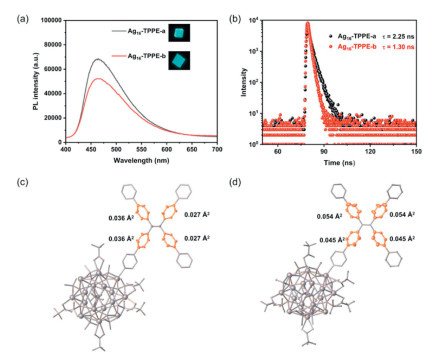
The absence of the inter-layer C−H···F interactions endowed TPPE with more flexible twisting angles and thus greater conformational variation, resulting in a broader emission spectrum. As shown in Fig. S12 (Supporting information), the emission spectrum of Ag16-TPPE-b displays a full width at half maximum (FWHM) of 89 nm, significantly broader than the 81 nm FWHM observed for Ag16-TPPE-a. Furthermore, the less dense stacking pattern in Ag16-TPPE-b released space around the TPPE ligands and thus significantly enhanced the rotations/vibrations of TPPE, giving a higher rate of nonradiative transitions and lower PLQY in the crystalline state [31]. Isotropic temperature (Ueq) is a physical factor that reflects the thermal vibration level of an atom in the crystal [32,33]. The mean temperature factors of C atoms of both the phenyl rings in Ag16-TPPE-b are much larger than those in Ag16-TPPE-a (Figs. 3c and d, Table S5 in Supporting information), indicating that thermal vibrations in Ag16-TPPE-b are much stronger than those in Ag16-TPPE-a.
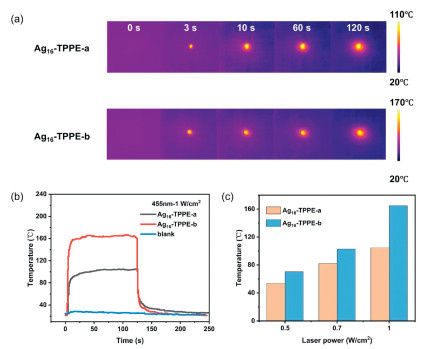
Motivated by the crystal-packing effect on thermal vibrations and nonradiative decay rate constants between these polymorphs, we subsequently investigated their photothermal conversion performance [34,35]. The photothermal behavior of both polymorphs was evaluated and compared by subjecting crystalline samples to continuous 455 nm laser irradiation. As depicted in Fig. 4a, the temperature of Ag16-TPPE-a and Ag16-TPPE-b crystals increased to approximately 110 ℃ and 170 ℃, respectively, within 120 s. Subsequently, the temperature rapidly decreased to room temperature within 60 s after laser removal (Fig. 4b). Furthermore, across different power densities ranging from 0.5 W/cm2 to 1.0 W/cm2, both Ag16-TPPE-a and Ag16-TPPE-b exhibited a positive correlation between incident power and temperature elevation, whereby the maximum temperature increased with higher irradiation power (Fig. 4c). As we have already mentioned above, the light absorbance of Ag16-TPPE-a and Ag16-TPPE-b are almost identical in absorption intensities. Thereby the photothermal conversion should be associated with nonradiative transition (heat) and radiative emission [36], and the inhibition of radiative transitions can facilitate the light-to-heat energy conversion efficacy of Ag16-TPPE-b.
In summary, we successfully fabricated two silver-cluster-based 2D supramolecular polymorphs in appropriate solvents. The packing patterns of two different polymorphic forms, orthorhombic (Ag16-TPPE-a) and monoclinic (Ag16-TPPE-b), can be reversibly transformed into each other through C−H···F-interaction-driven layer sliding. Ag16-TPPE-a, possessing the interlayer C−H⋯F interactions and more dense stacking arrangement, displayed higher PLQY and longer lifetime that might be attributed to the restriction of the rotations\vibrations of phenyl groups in TPPE. Additionally, Ag16-TPPE-b showed the enhanced nonradiative decay rate and better photothermal performance. The current study provides a valuable approach for precisely control layer-sliding-triggered reversible interconversion of two 2D supramolecular polymorphs through solvent control of intermolecular interactions to tune their luminous and photothermal behaviors.
Wen-Yan Huang: Investigation, Data curation. Li-Hong Cai: Formal analysis. Di-Feng Yang: Formal analysis. Jun-Jiang Pu: Formal analysis. Shengchang Xiang: Methodology. Jia-Qi Wang: Writing – original draft, Supervision, Methodology, Funding acquisition. Zhangjing Zhang: Writing – review & editing, Funding acquisition.
The authors declare that they have no known competing financial interests or personal relationships that could have appeared to influence the work reported in this paper.
This work was support by the National Science Fund for Distinguished Young Scholars of China (No. 22425102), the National Natural Science Foundation of China (Nos. 22201038, 2271046 and 22373015), the Fujian Provincial Department of Science and Technology (No. 2022J05040), Education and Research Project of Young and Middle-aged Teachers in Fujian Province (No. JAT210048). This project was also funded by the State Key Laboratory of Structural Chemistry.
Supplementary material associated with this article can be found, in the online version, at doi:
I. Weissbuch, V.Y. Torbeev, L. Leiserowitz, et al., Angew. Chem. Int. Ed. 44 (2005) 3226–3229. doi: 10.1002/anie.200500164
A. Lévesque, T. Maris, J.D. Wuest, J. Am. Chem. Soc. 142 (2020) 11873–11883. doi: 10.1021/jacs.0c04434
J.Q. Wang, R.L. He, W.D. Liu, et al., J. Am. Chem. Soc. 145 (2023) 12255–12263. doi: 10.1021/jacs.3c02567
M. Chi, J. Wei, Z. Zhao, et al., Angew. Chem. Int. Ed. 64 (2025) e202424499. doi: 10.1002/anie.202424499
J.Q. Wang, S.Shi, R.L.He, et al., J. Am. Chem. Soc. 142 (2020) 18086–18092. doi: 10.1021/jacs.0c07397
F. Hu, Z.C. Long, F. Zhao, et al., J. Am. Chem. Soc. 147 (2025) 19886–19892. doi: 10.1021/jacs.5c04083
S. Wang, L. Tang, B. Cai, et al., J. Am. Chem. Soc. 9 (2022) 3787–3792. doi: 10.1021/jacs.2c01570
W.Q. Shi, L. Zeng, R.L. He, et al., Science 383 (2024) 326–330. doi: 10.1126/science.adk6628
Y. Zhao, S. Zhuang, L. Liao, et al., J. Am. Chem. Soc. 142 (2020) 973–977. doi: 10.1021/jacs.9b11017
H. Qian, M. Zhu, Z. Wu, et al., Acc. Chem. Res. 45 (2012) 1470–1479. doi: 10.1021/ar200331z
Z. Wang, L. Li, L. Feng, et al., Angew. Chem. Int. Ed. 61 (2022) e202200823. doi: 10.1002/anie.202200823
Y. Feng, M. Zhao, J. Yang, et al., Angew. Chem. Int. Ed. 64 (2025) e202505511. doi: 10.1002/anie.202505511
Q. Benito, X.F. Le Goff, S. Maron, et al., J. Am. Chem. Soc. 136 (2014) 11311–11320. doi: 10.1021/ja500247b
A. Nag, P. Chakraborty, M. Bodiuzzaman, et al., Nanoscale 10 (2018) 9851–9855. doi: 10.1039/c8nr02629g
M.P. Maman, A. Nath, S. Anjusree, et al., Chem. Commun. 57 (2021) 2935–2938. doi: 10.1039/d1cc00402f
X. Fu, X. Lin, X. Ren, et al., Chin. Chem. Lett. 32 (2021) 565–568. doi: 10.1016/j.cclet.2020.02.041
Z. Han, Y. Si, X.Y. Dong, et al., J. Am. Chem. Soc. 145 (2023) 6166–6176. doi: 10.1021/jacs.2c12055
P. Chakraborty, A. Nag, A. Chakraborty, et al., Acc. Chem. Res. 52 (2018) 2–11.
J.Q. Wang, M.Q. Zhou, D.F. Yang, et al., Small 20 (2024) 2404290. doi: 10.1002/smll.202404290
M. Cao, R. Pang, Q.Y. Wang, et al., J. Am. Chem. Soc. 141 (2019) 14505–14509. doi: 10.1021/jacs.9b05952
J.Y. Wang, Y. Si, X.M. Luo, et al., Adv. Sci. 10 (2023) 2207660. doi: 10.1002/advs.202207660
K. Sheng, Z. Wang, L. Li, et al., J. Am. Chem. Soc. 145 (2023) 10595–10603. doi: 10.1021/jacs.3c00321
R.W. Huang, X.Y. Dong, B.J. Yan, et al., Angew. Chem. Int. Ed. 57 (2018) 8560–8566. doi: 10.1002/anie.201804059
S. Li, X.S. Du, B. Li, et al., J. Am. Chem. Soc. 140 (2018) 594–597. doi: 10.1021/jacs.7b12136
Y. Feng, X. Jing, F. Fu, et al., Sci. China Mater. 68 (2024) 580–589.
Y. Sun, S. Gao, F. Lei, et al., Acc. Chem. Res. 48 (2014) 3–12. doi: 10.1504/IJITM.2014.059146
H. Yang, H. Zhang, C. Kang, et al., Sci. Adv. 10 (2024) eads0260. doi: 10.1126/sciadv.ads0260
X.S. Du, B.J. Yan, J.Y. Wang, et al., Chem. Commun. 54 (2018) 5361–5364. doi: 10.1039/c8cc01559g
Y. Sun, Z. Sun, S. Gao, et al., Nat. Commun. 3 (2012) 1057. doi: 10.1038/ncomms2066
V.W.W. Yam, K.K.W. Lo, Chem. Soc. Rev. 28 (1999) 323–334. doi: 10.1039/a804249g
J. Mei, N.L.C. Leung, R.T.K. Kwok, et al., Chem. Rev. 115 (2015) 11718–11940. doi: 10.1021/acs.chemrev.5b00263
X. Fan, F. Yuan, J. Wang, et al., CCS Chem. 5 (2022) 350–360. doi: 10.1049/cvi2.12092
L. Samperisi, A. Jaworski, G. Kaur, et al., J. Am. Chem. Soc. 143 (2021) 17947–17952. doi: 10.1021/jacs.1c08354
S. Gao, G. Wei, S. Zhang, et al., Nat. Commun. 10 (2019) 2206. doi: 10.1038/s41467-019-10056-9
Z. Zhao, J. Wei, Z.L. Lang, et al., J. Am. Chem. Soc. 147 (2025) 25107–25114. doi: 10.1021/jacs.5c09440
W. Du, Y. Chong, X. Hu, et al., Adv. Funct. Mater. 30 (2019) 201908073.

Scheme 1 Illustration of reversible interconversion of cluster-based individual/supramolecular polymorphs with different assembly modes.

Figure 1 Schematic representation of the one-pot synthesis and reversible interconversion of Ag16-TPPE-a and Ag16-TPPE-b.

Figure 2 (a) Molecular structures of the 4-c building units (Ag16S8 node and TPPE linker). (b) Side view and (d) top view for Ag16-TPPE-a; (c) Side view and (e) top view for Ag16-TPPE-b. (f) Interlayer C–H···F hydrogen bonding in Ag16-TPPE-a.

Figure 3 (a) The emission spectra of Ag16-TPPE-a and Ag16-TPPE-b in the solid state. Inset: Photoluminescence photographs of the two crystalline samples. (b) PL decay traces of Ag16-TPPE-a and Ag16-TPPE-b. Thermal ellipsoid model (50% probability) of benzene rings in (c) Ag16-TPPE-a and (d) Ag16-TPPE-b obtained from SCXRD (solid) data, highlighting the mean temperature factors of C of the benzene rings.

Figure 4 (a) Infrared thermal images of Ag16-TPPE-a and Ag16-TPPE-b under 455 nm laser irradiation (1.0 W/cm2). (b) Photothermal heating curves of Ag16-TPPE-a and Ag16-TPPE-b under continuous 455 nm laser irradiation (1.0 W/cm2). (c) Comparison of the maximum temperatures reached by Ag16-TPPE-a and Ag16-TPPE-b under 455 nm laser irradiation at various power densities (0.5, 0.7, and 1.0 W/cm2).

 扫一扫看文章


扫一扫关注我们
 DownLoad:
 下载:
 下载: