

Table 1.
Selected Bond Lengths (Å) and Bond Angles (°) for 1


Luminescence mechanochromic materials that exhibit reversible color and luminescence changes triggered by external mechanical grinding have received considerable interest due to their potential applications in the fields such as structural flaw detection materials, optical recording/storage equipment, erasable writing devices, and pressure-sensitive sensors[1-3]. In the past two decades, great progress has been made in the design and application of such materials and many kinds of compounds including inorganic salts, organic compounds, transition-metal complexes, macro-molecules, polymers, and nanoparticles have been developed[4-11]. It is well known that the electronic structure of Pt(II) complexes can be perturbed by changing the intermolecular interactions such as Pt-Pt contact, hydrogen bonding or aromatic π-π stacking, resulting in dramatic changes in spectroscopic properties[12-20]. Meanwhile, the unique square-planar structure makes the molecular arrangement of Pt(II) complex very sensitive to external forces, so platinum(II) complexes are good candidate for studying luminescent mechanochromic materials. However, previous studies were mostly focused on the vapoluminescence of Pt(II) complexes, and studies on the luminescent mechanochromic property are still very limited.
Our research interest focuses on the stimulus-responsive phosphorescence switches of squareplanar diimine platinum(II) complexes. In our previous work, we have reported a series of platinum(II) luminescence switches based on bipyridine derivatives that exhibited remarkable luminescent vapochromic, thermochromic, and mechanochromic properties[17-20]. As the continuation of our researching work, we report herein a new platinum(II) complex with 3-trimethylsilylethynyl-1, 10-phenanthroline (Me3SiC≡Cphen) ligand, [Pt(Me3SiC≡Cphen)(C≡CC6H4Cl-3)2] (1). This complex stacks in the columnar structure and exhibits interesting reversible luminescent mechanochromic property. On this basis, a simple device was developed and used for rewritable data storage.
All operations were carried out under a dry argon atmosphere using Schlenk techniques and vacuumline systems unless otherwise specified. Ligand 3-trimethylsilylethynyl-1, 10-phenanthroline and intermediate Pt(Me3SiC≡Cphen)Cl2 were synthesized according to a similar method in literature[19]. All the other chemicals were purchased commercially and used without further purification. 1H NMR spectra were measured using a Bruker Avance II (400 MHz) spectrometer with SiMe4 as the internal reference. Infrared spectra (IR) were recorded on a Nicolet-20DXB spectrometer as KBr pellets in the range of 4000~400 cm-1. Elemental analyses of C, H, and N were determined on a Vario EL III Elemental Analyzer. A Finnigan LCQ mass spectrometer was used to acquire electrospray ionization mass spectra (ESI-MS) and dichloromethane was used as the mobile phases. Powder X-ray diffraction patterns (XRD) data were collected on a Rigaku SmartLab XRD instrument with a sealed Cu tube (λ = 1.54178 Å). Emission spectra were acquired at ambient temperature by using a Perkin-Elmer LS55 luminescence spectrometer. The solid UV-visible absorption spectra were obtained by a V-550 ultraviolet spectrophotometer, while the liquid absorption data were recorded using Cary-300 UV/Vis spectrometer. Emission decay lifetimes and emission quantum yield at room temperature were measured on an Edinburgh FLS 920 fluorescence spectrometer with an integrating sphere accessory. Luminescence photographs were taken by a Canon camera under ambient light and UV lamp irradiation.
A mixture containing Pt(Me3SiC≡Cphen)Cl2 (271.2 mg, 0.5 mmol), 3-chlorophenylacetylene (170.7 mg, 1.25 mmol), CuI (1 mg) and diisopropylamine (2 mL) in 50 mL of CH2Cl2 was stirred overnight at room temperature. The mixture was dried under vacuum and then subjected to column chromatography over silica gel (300~400 mesh) and eluted with dichloromethane to afford the pure product. Yield: 83% (308.2 mg). IR (KBr, cm−1): 2954 (w, C–H), 2164 (w, C≡CTMS), 2121 (s, C≡CPt), 1628(w, C=N), 1587 (s, C=C), 1548 (m, benzene ring), 1470 (s, benzene ring), 1434 (m, benzene ring), 1244 (m, C–Si), 1073 (m, C–Cl), 794 (s, Si-CH3). Anal. Calcd. (%) for C33H24Cl2N2PtSi: C, 53.37; H, 3.26; N, 3.77. Found (%): C, 53.35; H, 3.28; N, 3.75. ESI-MS(m/z): calcd. for C33H24Cl2N2PtSi, 742.6; found 742.6 [M]+. 1H NMR (d6-DMSO, 400MHz) δ: 0.315 (s, 9H), 7.274 (m, 8H), 8.238 (t, J = 6.0 Hz, 2H), 8.331 (d, J = 7.2 Hz, 1H), 9.036 (d, J = 7.2 Hz, 1H), 9.223 (s, 1H), 9.736 (s, 2H).
A yellow single crystal of 1 with dimensions of 0.10mm × 0.10mm × 0.08mm was mounted on the top of a glass fiber for single-crystal X-ray diffraction analysis. All measurements were performed on a Bruker SMART APEX II CCD area detector system equipped with graphite-monochromated Mo-Kα radiation (λ = 0.71073 Å) at 210(2) K. A total of 7953 reflections were collected, of which 5150 were independent (Rint = 0.0328) and 4377 were observed with I > 2σ(I). The intensity data set was collected with an ω scan mode in the range of 2.36 < θ < 25.05° at 210(2) K. The structure was solved by direct methods using SHELXS-97[21] and refined by full-matrix least-squares procedure on F2 with SHELXL-97[22]. All non-hydrogen atoms were refined anisotropically, and hydrogen atoms were positioned geometrically. The final refinement gave R = 0.0369, wR = 0.0786 (w = 1/[σ2(Fo2) + (0.0333P)2], where P = (Fo2 + 2Fc2)/3), S = 1.023, (Δρ)max = 1.854 and (Δρ)min = −0.976 e/Å3.
Complex 1 crystallizes in a triclinic space group P
 DownLoad:
CSV
DownLoad:
CSV
| Bond | Dist. | Bond | Dist. | Bond | Dist. | ||
| Pt(1)–C(18) | 1.949(5) | Pt(1)–C(26) | 1.947(5) | Pt(1)–N(1) | 2.059(3) | ||
| Pt(1)–N(2) | 2.079(4) | ||||||
| Angle | (°) | Angle | (°) | Angle | (°) | ||
| N(1)–Pt(1)–N(2) | 80.0(2) | N(1)–Pt(1)–C(18) | 93.1(2) | N(2)–Pt(1)–C(26) | 95.5(2) | ||
| C(18)–Pt(1)–C(26) | 91.4(2) | N(1)–Pt(1)–C(26) | 175.5(2) | N(2)–Pt(1)–C(18) | 173.0(2) |
The UV-vis absorption spectra of 1 in dichloromethane exhibit high-energy bands at 230~335 nm and low-energy bands at about 414 and 440 nm (Fig. 3a). The high-energy bands can be mainly ascribed to intraligand charge transfer (1ILCT) state and low-energy broad bands, resulting mostly likely from a mixture of metal-to-ligand charge transfer (1MLCT) and ligand-to-ligand charge transfer (1LLCT) transitions[23-25]. In degassed dichloromethane solution at room temperature, 1 displays a bright orange-yellow luminescence peak at 570 nm with the lifetime of 0.27 μs and the quantum yield of 12.71% (Fig. 3b). This emission is mostly likely attributed to a mixture of 3MLCT and 3LLCT states[23-25].
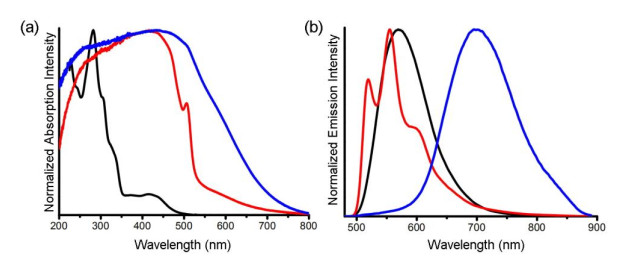
In the solid state, the yellow-green crystalline species of 1 exhibits the lowest energy absorption band at 412~506 nm (Fig. 3a), arising from both 1LLCT and 1MLCT transitions. Under irradiation at 350 < λex < 500 nm, crystalline state 1 exhibits a bright green luminescence at ca. 518 and 554 nm (598 nm, sh) with lifetime of 0.65 μs and quantum yield of 10.36% (Fig. 3b). This emission may also result from a mixture of 3MLCT and 3LLCT states according to the complexes with similar structures[23-25].
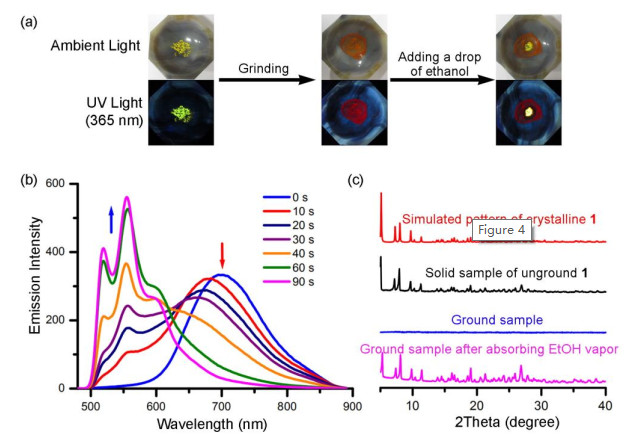
Complex 1 displays interesting reversible luminescent mechanochromic property. Once mechanical grinding the solid species 1 in an agate mortar, the emission of 1 exhibits a drastic red shift from 518 and 554 nm to a broad unstructured emission centered at 700 nm with lifetime of 0.13 μs and quantum yield of 0.49%, affording a drastic mechanoluminescence red shift at about 146-182 nm (Fig. 3b). Meanwhile, the color of the sample also changed from yellow-green to red with the red-shift of solid absorption spectrum (Fig. 3 and Fig. 4a). The PXRD measurement reveals that the crystalline species of 1 changed to the amorphous phase after grounding (Fig. 4c). The significant red shifts of UV-vis and emission spectra demonstrate that luminescence mechanochromic property of complex 1 is most probably due to the conversion of emissive state from 3MLCT/3LLCT to 3MMLCT/3LLCT character[15-20]. Furthermore, luminescent mechanochromic property of complex 1 displays excellent reversibility. As shown in Fig. 4, once exposed to C2H5OH vapor, the color and luminescence of the ground sample could be restored thoroughly to the original crystalline state of 1.
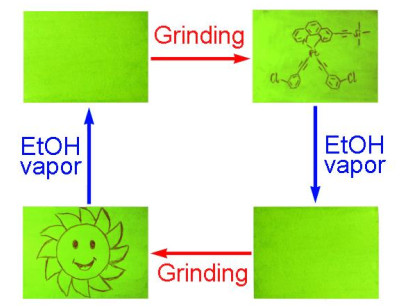
Based on this property, complex 1 was successfully used to develop a simple rewritable data recording device. As shown in Fig. 5, on a piece of 1-coated filter paper, a metal cone was used as the "pen" to write the message (the chemical structure of 1). The message will be recorded on the paper because color and luminescence of message changes from yellow to red and the background is unchanged. The recorded message can be easily erased upon exposure to C2H5OH vapor and the paper can be used to record other message (a cartoon image of sun).
In summary, a new planar-square diimine platinum(II) complex was synthesized and characterized. It exhibits interesting reversible luminescent mechanochromic property with emission response shift of 146~182 nm. On this basis, a simple rewritable data recording device was developed and successfully used to record the messages.
Chi, Z. G.; Zhang, X. Q.; Xu, B. J.; Zhou, X.; Ma, C. P.; Zhang, Y.; Liu, S. W.; Xu, J. R. Recent advances in organic mechanofluorochromic materials. Chem. Soc. Rev. 2012, 41, 3878–3896. doi: 10.1039/c2cs35016e
Zhang, X. Q.; Chi, Z. G.; Zhang, Y.; Zhang, Y.; Liu, S. W.; Xu, J. R. Recent advances in mechanochromic luminescent metal complexes. J. Mater. Chem. C 2013, 1, 3376–3390. doi: 10.1039/c3tc30316k
Sagara, Y.; Yamane, S.; Mitani, M.; Weder, C.; Kato, T. Mechanoresponsive luminescent molecular assemblies: an emerging class of materials. Adv. Mater. 2016, 28, 1073–1095. doi: 10.1002/adma.201502589
Yamane, S.; Sagara, Y.; Mutai, T.; Araki, K.; Kato, T. Mechanochromic luminescent liquid crystals based on a bianthryl moiety. J. Mater. Chem. C 2013, 1, 2648–2656. doi: 10.1039/c3tc00861d
Cuerva, C.; Campo, D. J.; Cano, M.; Lodeiro, C. Platinum(II) metallornesogens: new external-stimuli-responsive photoluminescence materials. Chem. Eur. J. 2016, 22, 10168–10178. doi: 10.1002/chem.201601115
Xue, P. C.; Yao, B. Q.; Liu, X. H.; Sun, J. B.; Gong, P.; Zhang, Z. Q.; Qian, C.; Zhang, Y.; Lu, R. Reversible mechanochromic luminescence of phenothiazine-based 10, 10΄-bianthracene derivatives with different lengths of alkyl chains. J. Mater. Chem. C 2015, 3, 1018–1025. doi: 10.1039/C4TC02126F
Zhang, G.; Lu, J.; Sabat, M.; Fraser, C. L. Polymorphism and reversible mechanochromic luminescence for solid-state difluoroboron avobenzone. J. Am. Chem. Soc. 2010, 132, 2160–2162. doi: 10.1021/ja9097719
Sagara, Y.; Komatsu, T.; Ueno, T.; Hanaoka, K.; Kato, T.; Nagano, T. Covalent attachment of mechanoresponsive luminescent micelles to glasses and polymers in aqueous conditions. J. Am. Chem. Soc. 2014, 136, 4273–4280. doi: 10.1021/ja412670g
Bazhin, D. N.; Kudyakova, Y. S.; Bogomyakov, A. S.; Slepukhin, P. A.; Kim, G. A.; Burgart, Y. V.; Saloutin, V. I. Dinuclear lanthanide-lithium complexes based on fluorinated beta-diketonate with acetal group: magnetism and effect of crystal packing on mechanoluminescence. Inorg. Chem. Front. 2019, 6, 40–49. doi: 10.1039/C8QI00772A
Tukhbatullin, A. A.; Sharipov, G. L.; Galina, A. A. Mechanoluminescence of Ce/Tb inorganic salts in methane-acetylene mixtures with inert gases. Luminescence 2018, 33, 1180–1184. doi: 10.1002/bio.3533
Yang, J.; Qin, J. W.; Geng, P. Y.; Wang, J. Q.; Fang, M. M.; Li, Z. Molecular conformation-dependent mechanoluminescence: same mechanical stimulus but different emissive color over time. Angew. Chem. Int. Ed. 2018, 57, 14174–14178. doi: 10.1002/anie.201809463
Yeung, M. C. L.; Yam, V. W. W. Phosphate derivative-induced supramolecular assembly and NIR-emissive behaviour of alkynylplatinum(II) terpyridine complexes for real-time monitoring of enzymatic activities. Chem. Sci. 2013, 4, 2928–2935. doi: 10.1039/c3sc50383f
Ohno, K.; Kusano, Y.; Kaizaki, S.; Nagasawa, A.; Fujihara, T. Chromism of tartrate-bridged clamshell-like platinum(II) complex: intramolecular Pt–Pt interaction-induced luminescence vapochromism and intermolecular interactions-triggered thermochromism. Inorg. Chem. 2018, 57, 14159–14169. doi: 10.1021/acs.inorgchem.8b02074
Wong, Y. S.; Yeung, F. C. M.; Ng, M.; Cheng, H. K.; Yam, V. W. W. Platinum(II)-based supramolecular scaffold-templated side-by-side assembly of gold nanorods through Pt···Pt and π-π interactions. Angew. Chem. Int. Ed. 2018, 57, 15797–15801. doi: 10.1002/anie.201810302
Zhang, X.; Wang, Y. G.; Ni, J.; Zhang, L. Y.; Chen, Z. N. Vapochromic and mechanochromic phosphorescence materials based on a platinum(II) complex with 4-trifluoromethylphenylacetylide. Inorg. Chem. 2012, 51, 5569–5579. doi: 10.1021/ic202421d
Kitani, N.; Kuwamura, N.; Tsuji, T.; Tsuge, K.; Konno, T. Water-molecule-driven vapochromic behavior of a mononuclear platinum(II) system with mixed bipyridine and thioglucose. Inorg. Chem. 2014, 53, 1949–1951. doi: 10.1021/ic402887f
Kang, J. J.; Zhang, X. X.; Zhou, H. H; Gai, X. Q; Jia, T.; Xu, L.; Zhang, J. J.; Li, Y. Q.; Ni, J. 1‑D "platinum wire" stacking structure built of platinum(II) diimine bis(σ-acetylide) units with luminescence in the NIR region. Inorg. Chem. 2016, 55, 10208–10217. doi: 10.1021/acs.inorgchem.6b01426
Ni, J.; Wang, Y. G.; Wang, H. H.; Xu, L.; Zhao, Y. Q.; Pan, Y. Z.; Zhang, J. J. Thermo- and mechanical-grinding-triggered color and luminescence switches of the diimine-platinum(II) complex with 4-bromo-2, 2΄-bipyridine. Dalton Trans. 2014, 43, 352–360. doi: 10.1039/C3DT51936H
Ni, J.; Zhang, X.; Wu, Y. H.; Zhang, L. Y.; Chen, Z. N. Vapor- and mechanical-grinding-triggered color and luminescence switches for bis(σ-fluorophenylacetylide) platinum(II) complexes. Chem. Eur. J. 2011, 17, 1171–1183. doi: 10.1002/chem.201002752
Ni, J.; Zhang, X.; Qiu, N.; Wu, Y. H.; Zhang, L. Y.; Zhang, J.; Chen, Z. N. Mechanochromic luminescence switch of platinum(II) complexes with 5-trimethylsilylethynyl-2, 2΄-bipyridine. Inorg. Chem. 2011, 50, 9090–9096. doi: 10.1021/ic2012777
Sheldrick, G. M. SHELXS-97, Program for X-ray Crystal Structure Determination. University of Gottingen, Germany 1997.
Sheldrick, G. M. SHELXL-97, Program for X-ray Crystal Structure Refinement. University of Gottingen, Germany 1997.
Ni, J.; Kang, J. J.; Wang, H. H.; Gai, X. Q.; Zhang, X. X.; Jia, T.; Xu, L.; Pan, Y. Z.; Zhang, J. J. A colorimetric/luminescent benzene compound sensor based on a bis(σ-acetylide) platinum(II) complex: enhancing selectivity and reversibility through dual-recognition sites strategy. RSC Adv. 2015, 5, 65613–65617. doi: 10.1039/C5RA13987B
Shiotsuka, M.; Asano, T.; Kurono, Y.; Kawabe, R. Synthesis and photophysical characterization of phosphorescent platinum(II) bis-(trimethylsilyl)ethynyl-phenanthroline organometallic complexes with bis-aryethynyl derivatives. J. Organomet. Chem. 2017, 851, 1–8. doi: 10.1016/j.jorganchem.2017.09.009
Hissler, M.; Connick, W. B.; Geiger, D. K.; McGarrah, J. E.; Lipa, D.; Lachicotte, R. J.; Eisenberg, R. Platinum diimine bis(acetylide) complexes: synthesis, characterization, and luminescence properties. Inorg. Chem. 2000, 39, 447–457. doi: 10.1021/ic991250n

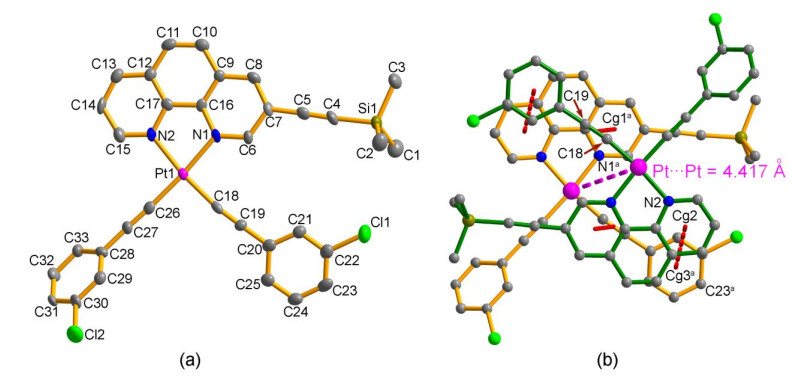
Figure 1 Structure of 1. (a) An ORTEP drawing of 1 with 30% thermal ellipsoids. (b) A dimer formed by adjacent molecules with antiparallel packing pattern. π-π stacking interactions are represented as red dotted line. Symmetry code: a: –x+2, –y+2, –z+1 (The hydrogen atoms are omitted for clarity)

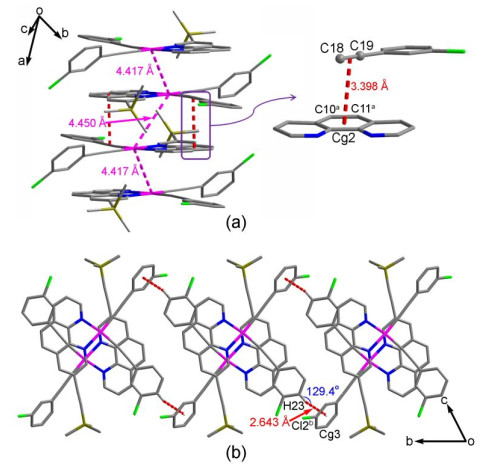
Figure 2 Stacking structure of 1. (a) Columnar structure along the a axis. (b) Packing of columnar structures. The π-π stacking interactions and C–H···π hydrogen bonds are represented as red dotted line. Symmetry codes: a: –x+1, –y+2, –z+1; b: –x+2, –y+1, –z+1 (All hydrogen atoms not participated in hydrogen bonds are omitted for clarity)

Figure 3 (a) UV-vis absorption and (b) emission spectra of 1 in CH2Cl2 solution (black line), unground solid state (red line) and ground solid state (blue line)

Figure 4 Reversible luminescent mechanochromic property of 1. (a) Photographic images of color and luminescence changes of 1 during reversible process. (b) Solid-state emission spectral changes of ground species 1 in response to ethanol vapor. (c) PXRD diagrams of 1 in different states. All above confirm the reversibility of luminescent mechanochromic property of 1

Figure 5 Practical application of 1 for rewritable data recording device. All photographs were taken in the UV light (365 nm) with the digital camera
Table 1. Selected Bond Lengths (Å) and Bond Angles (°) for 1
| Bond | Dist. | Bond | Dist. | Bond | Dist. | ||
| Pt(1)–C(18) | 1.949(5) | Pt(1)–C(26) | 1.947(5) | Pt(1)–N(1) | 2.059(3) | ||
| Pt(1)–N(2) | 2.079(4) | ||||||
| Angle | (°) | Angle | (°) | Angle | (°) | ||
| N(1)–Pt(1)–N(2) | 80.0(2) | N(1)–Pt(1)–C(18) | 93.1(2) | N(2)–Pt(1)–C(26) | 95.5(2) | ||
| C(18)–Pt(1)–C(26) | 91.4(2) | N(1)–Pt(1)–C(26) | 175.5(2) | N(2)–Pt(1)–C(18) | 173.0(2) |
 下载: 导出CSV

 扫一扫看文章


扫一扫关注我们
 下载:
下载: