
Table 1.
Selected Bond Lengths (Å) and Bond Angles (°) for 1

A Zinc Based Coordination Polymer: Multi-functional Material for Humidity Sensor and Fluorescence Applications
Cheng-Peng WANG , Chiranjeevulu KASHI , Xiao-Liang YE , Wen-Hua LI , Guan-E WANG , Gang XU


Multifunctional materials with two or more functions in one material[1] exhibit great potential for applications in biology, physical, chemistry, etc.[2-4]. The reported multifunctional materials are usually obtained through the combination of multiple materials. It is still a great challenge to achieve multiple functions in a single component[1]. Recently, coordination polymers combining the advantages of inorganic metals and organic ligands[5] have been widely applicant in catalysis[6-9], adsorption[10, 11], energy[12-14], electrical[15-17] and fluorescence[18-24]. This type of material is easier to the design of single-component multifunctional materials.
Zinc based coordination polymers have been extensively studied for their excellent optical properties. Cui et al. reported two compounds[25]. They exhibited highly efficient purple-light emission and excellent selectivity in the detection of Fe3+. Zn2Cl4(u-bipy)2, reported by Tan et al., showed white-light-emitting phosphor upon exposure to 378 nm UV light[26]. Zinc based coordination polymers have such good fluorescence properties, and if combined with electrical properties, they maybe have potential applications in the field of energy materials. However, the reports on semiconductor properties of zinc based fluorescent coordination polymers are still rare.
Herein, we demonstrated one-step hydrothermal syntheses of a new semiconductive coordination polymer material, Zn(OAc)SPhNH (HSPhNH2 = 4-aminophenol) (1), using 4-aminothiophenol as a template, which contained a novel 2D layer structure with Zn–S chains cross-linked by 4-aminothiophenol ligands. Compound 1 showed blue light emitting and semiconductor properties.
Zn(OAc)2, 4-aminothiophenol and ethanol received from Sinopharm Chemical Reagent Co. Ltd were directly used without further purification. A mixture of Zn(OAc)2 (0.0183 g, 0.1 mmol), 4-aminothiophenol (0.0375 g, 0.3 mmol), ethanol (5 mL) and deionized water (3 mL) was heated at 85 ℃ for two days. After cooling at a rate of 5 ℃ per minute to 30 ℃, white transparent block crystals were obtained (yield about 74%). The purity of the mechanically separated sample was proved by powder X-ray diffraction (Fig. S1) and elemental analysis. Elem. Anal. Calcd. for compound 1 (%): C, 38.47; H, 3.26; N, 5.56; S, 13.15. Found: C, 38.41; H, 3.40; N, 5.58; S, 13.06.
The single-crystal X-ray diffraction measurement was performed on a Rigaku SATURN70 CCD diffractometer using graphite-monochromated Mo-Kα radiation (λ = 0.71073 Å). Intensity data were collected using an ω scan mode and corrected for Lp effects. The primitive structure was solved by direct methods using the Olexsys Olex2™ Version 1.2.10 package of crystallographic software. The difference Fourier maps based on these atomic positions yield the other nonhydrogen atoms. The final structure was refined using a full-matrix least-squares refinement on F2. All non-hydrogen atoms were refined anisotropically. Hydrogen atoms on carbon, nitrogen and oxygen atoms were generated geometrically. Additional crystallographic details are given in Table S1, and the bond distances and bond angles in Table 1.
 DownLoad:
CSV
DownLoad:
CSV
| Bond | Dist. | Bond | Dist. | Bond | Dist. | ||
| Zn(1)–S(1)a | 2.339(6) | Zn(1)–O(1) | 1.958(7) | Zn(1)–S(1)b | 2.346(6) | ||
| Zn(1)–N(1) | 2.059(8) | ||||||
| Angle | (°) | Angle | (°) | Angle | (°) | ||
| S(1)a–Zn(1)–S(1)b | 107.00(2) | N(1)–Zn(1)–S(1)a | 103.52(6) | S(1)a–Zn(1)–O(1) | 125.12(6) | ||
| N(1)–Zn(1)–S(1)b | 115.15(6) | S(1)b–Zn(1)–O(1) | 101.82(5) | N(1)–Zn(1)–O(1) | 104.88(8) | ||
| Symmetry codes: (a) 0.5+x, 0.5–y, 1–z; (b) = 1–x, 1–y, 1–z | |||||||
Powder X-ray diffraction (PXRD) pattern was collected on a MiniFlex 600 diffractometer using Cu-Kα radiation (λ = 1.540598 Å) at 30 kV and 15 mA. The simulated PXRD pattern of compound 1 was exported from the Mercury Version 3.9 software.
PerkinElmer Lambda-950 UV/Vis/NIR spectrophotometer was used to perform the UV-vis spectrum. Spectrally pure barium sulfate was used as a background to load compound 1. The band gap spectrum was calculated from the reflection spectrum via the Kubelka-Munk function: α/S = (1 − R)2/2R, where α is the absorption coefficient, S the scattering coefficient and R the reflectance.
An electrode was prepared on both ends of a single crystal and extracted by silver paste and two 50 um gold wires. I-V curves were recorded by KEITH-LEY4200-SCS at different temperature.
Interdigital electrodes were used to prepare devices for humidity sensing performance test of compound 1. The powder of compound 1 was dispersed in ethanol to form a dispersion liquid which was then dropped on an Al2O3-based silver platinum electrode. The electrodes were led out with silver paste through two gold wires with a diameter of 50 um. The humidity response measurement was performed by the reported instrument at room temperature[27, 28]. Moisture was produced by bubbling in a closed quartz chamber. The chamber was fulfilled with gas at a flow rate of 600 mL⋅min-1 for 2 minutes. A bias voltage of 1 V was applied to both ends of the electrode and Keithley 2602B Source meter was applied to record the current.
Edinburgh FLS980 fluorescence spectrometer was used to characterize the solid-state photoluminescent property of compound 1 at room temperature, and CIE chromaticity coordinates were calculated by using the CIE calculator version 1.6 software.
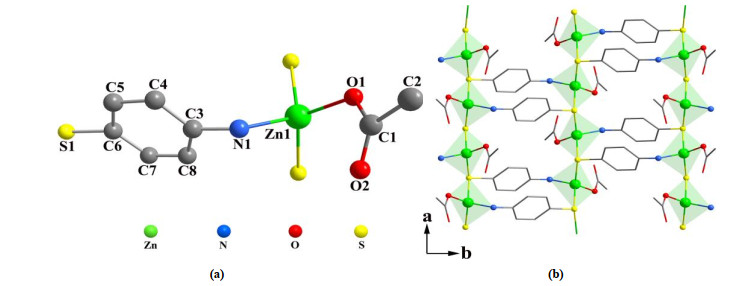
Single-crystal X-ray diffraction showed that compound 1 belongs to the Pbcn space group. As shown in Fig. 1a, the Zn atom was coordinated by two S and one N atoms from three ligands, and one O atom from acetate to form a twisted tetrahedron. These tetrahedra connect with each other through corner-sharing to form a chain. And such Zn–S chains were further connected by 4-aminothiophenol ligand to form two-dimensional layers which were further stacked orderly along the c axis to form a three-dimensional structure through van der Waals force (Fig. S2). The bond lengths of Zn–S fall in the range of 2.339(6)~2.346(6) Å, similar to those reported in literatures[29, 30].
FT-IR analysis was carried out to verify the coordination of ligand in compound 1. As shown in Fig. 2a, the strong absorption at about 2550 cm-1 (S–H ligand) disappeared, indicating that the S atom from SPhNH2 ligand was coordinated with Zn2+ ions. The -NH2 peak at 3300 cm-1 was vanished, and the stretching vibration of the amino group indicated its participation in coordination.
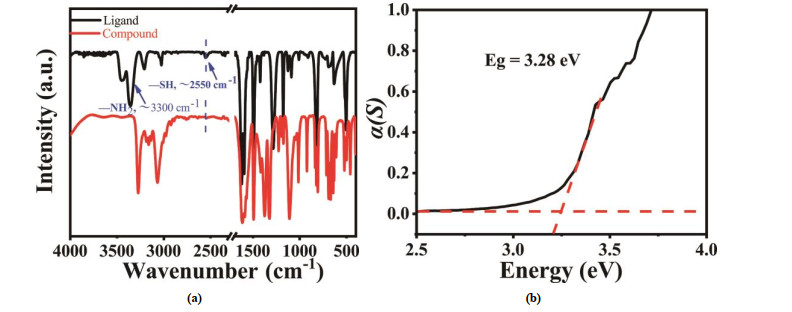
Solid-state UV-Vis diffuse spectrum of 1 (Fig. S3) calculated from the diffuse reflectance data by using the Kubelka-Munk function showed its absorption edge of 3.28 eV (Fig. 2b). This absorption edge was consistent with the white color of the crystal and also suggests that 1 has potential semiconductive properties.
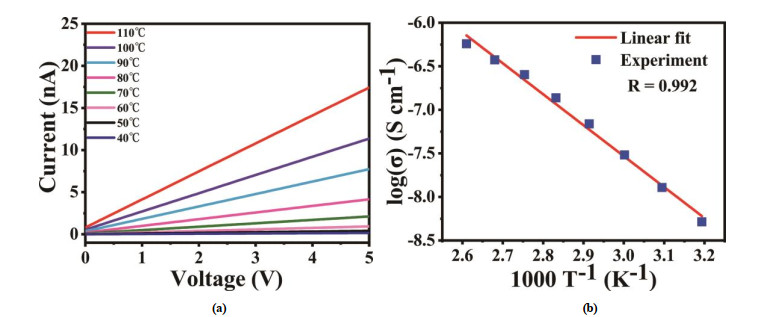
Thermogravimetric (TG) analysis (Fig. S4) showed that compound 1 has a good thermal stability before 240 ℃. XRD (Fig. S5) patterns at different temperature also confirmed the above result. The semiconductive property was tested by two-terminal electron probe technology, and temperature-dependent I-V curve was used to investigate the semiconductive properties of compound 1. As shown in Fig. 3a, the conductivity at 40 ℃ was 2.97 × 10⁻¹¹ S⋅cm−1, which increased to 2.14 × 10⁻¹⁰ S⋅cm−1 at 110 ℃. The conductivity of 1 linearly increased by reducing the value of 1/T, demonstrating its semiconductive feature (Fig. 3b). The activation energy (Ea) of 1, calculated by fitting the electrical conductivity data to the Arrhenius equation, was 0.7 eV from the least-squares fits of the slope.
The semiconductor properties of the material prompt us to further explore the application of compound 1 in electrical aspects. As compound 1 is sensitive to humidity, a sensing device was produced by interdigital electrodes. The real-time response-recovery current curve of compound 1 as a humidity sensor in the broad RH range from 10% to 100% is shown in Fig. 4a. The baseline current was ~10−12 A under dry air flow. And the electrical current rapidly increased under the humidity atmosphere, and then gradually reached a relatively stable value, which quickly returned to the baseline current when the gas returned to dry air. Response was calculated and the sensing properties of compound 1 under different water conditions were revealed. The sensor's response in detecting humidity is defined as the resistance ratio between the dry and humidity gases:
|
|
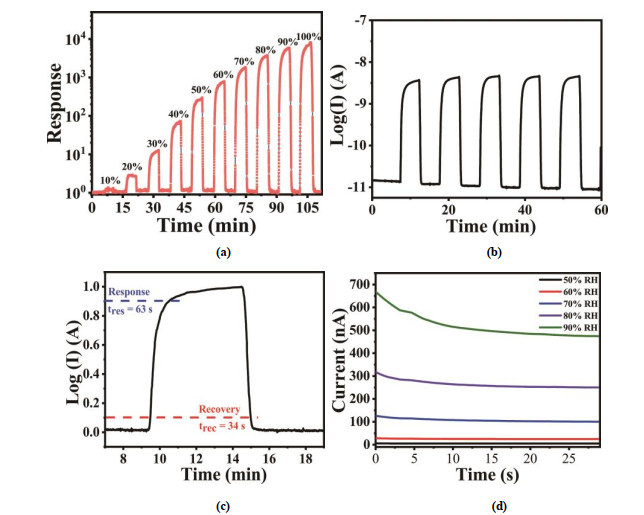
The response of compound 1 can reach up to three orders of magnitude high under the 100% RH, which is comparable to other metal oxides and metal-organic frameworks (MOFs) based humidity sensors[15, 31, 32]. Fig. 4b demonstrated the repeating cycles of compound 1 at 60% RH. The current variation of the sample in each cycle was restored to the original value, indicating that the sensor has good repeatability. Response time is defined as the time required for the sensor to reach 90% of the final saturation current change in the humid air, and recovery time as the time for the humidity sensor to recover to 10% of the current change in the air above the original current value. We calculated the response and recovery time at 60% RH. As shown in Fig. 4c, the response time of 60% RH was about 63 s, and the corresponding recovery time was 34 s.
We used in-situ IR spectrum to prove the adsorption and desorption behaviors of water molecules (Fig. S6). As shown in Fig S6, when the gas with 100% RH was introduced, the peaks for -OH vibration (3300 to 3600 cm-1) gradually enhanced, while if introducing dry air, these peaks disappeared, thus proving the adsorption and desorption of water molecules on the compound. Moreover, this compound has no pores, so water molecules can only adsorb on the surface of the materials, and this behavior makes H2O molecules move through the materials easier, resulting in a rapid recovery speed[33]. These properties indicated the potential of compound 1 in water sensing surface mechanism is the main mechanism of humidity sensing in materials[34, 35]. Water molecules on the surface jointly determine the change of resistance through chemical and physical action. Hydroxyl groups ionized and water work together between the electrode and the material, as well as on the grain boundary to reduce the resistance and potential barrier. In order to investigate the contribution of electrons and ions to increase the humidity-sensitive conductivity, we applied instantaneous polarity reversal on a DC circuit. The operating voltage was 5 V. Fig. 4d shows the current vs. time at different RH conditions. When the DC voltage was applied to the sensing material, the current decayed exponentially, eventually stabilized at a current greater than the baseline value of 2~3 orders (depend on RH). These results indicated that electronic conduction plays a leading role[28].
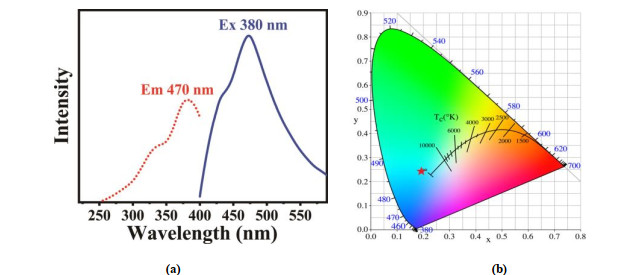
Materials with both semiconductor and fluorescent properties are considered to be the next generation of promising light source materials. Compound 1 shows a bule light centered at 470 nm when excited by a 380 nm light source, with the life time of 1.4 ns. CIE calculation shows that the chromaticity coordinates of fluorescence are located at (0.1807, 0.2408) (Fig. 5b). The ligand showed no emission when excited by 380 nm (Fig. S7), indicating that the fluorescence may not come from the ligand. Moreover, it is reported in the literature that ZnS has similar luminescence in the blue region[36], so this emission may come from the ZnS chain.
In summary, a novel coordination polymer material with 2D structure has been successfully synthesized and structurally characterized. The optical band gap was 3.28 eV, displaying a typical semiconductive performance. Compound 1 is a multifunctional coordination polymer with excellent humidity sensing behavior and blue light emission property, and thereby has potential applications in new energy materials.
Molina-Jorda, J. M. Highly adsorptive and magneto-inductive guefoams (multifunctional guest-containing foams) for enhanced energy-efficient preconcentration and management of VOCs. ACS Appl. Mater. Interfaces 2020, 12, 11702−11712. doi: 10.1021/acsami.9b22858
Guo, Z. G.; Cao, R.; Wang, X.; Li, H. F.; Yuan, W. B.; Wang, G. J.; Wu, H. H.; Li, J. A multifunctional 3D ferroelectric and NLO-active porous metal-organic framework. J. Am. Chem. Soc. 2009, 131, 6894−6895. doi: 10.1021/ja9000129
Lee, E. Y.; Jang, S. Y.; Suh, M. P. Multifunctionality and crystal dynamics of a highly stable, porous metal-organic framework [Zn4O(NTB)2]. J. Am. Chem. Soc. 2005, 127, 6374−6381. doi: 10.1021/ja043756x
Salonitis, K.; Pandremenos, J.; Paralikas, J.; Chryssolouris, G. Multifunctional materials: engineering applications and processing challenges. Int. J. Adv. Manuf. Tech. 2009, 49, 803−826.
Xi, X.; Fang, Y.; Dong, T.; Cui, Y. Bottom-up assembly from a helicate to homochiral micro- and mesoporous metal-organic frameworks. Angew. Chem. Int. Ed. 2011, 50, 1154−1158. doi: 10.1002/anie.201004885
Jiao, L.; Wang, Y.; Jiang, H. L.; Xu, Q. Metal-organic frameworks as platforms for catalytic applications. Adv. Mater. 2018, 30, 1703663−23. doi: 10.1002/adma.201703663
Kongpatpanich, K.; Horike, S.; Sugimoto, M.; Kitao, S.; Seto, M.; Kitagawa, S. A porous coordination polymer with a reactive diiron paddlewheel unit. Chem. Commun. 2014, 50, 2292−2294. doi: 10.1039/c3cc47954d
Lin, W.; Rieter, W. J.; Taylor, K. M. Modular synthesis of functional nanoscale coordination polymers. Angew. Chem. Int. Ed. 2009, 48, 650−658. doi: 10.1002/anie.200803387
Mo, K.; Yang, Y.; Cui, Y. A homochiral metal-organic framework as an effective asymmetric catalyst for cyanohydrin synthesis. J. Am. Chem. Soc. 2014, 136, 1746−1749. doi: 10.1021/ja411887c
Liang, L. F.; Jiang, F. L.; Chen, Q. H.; Yuan, D. Q.; Hong, M. C. Ultra-microporous metal-organic framework with high concentration of free carboxyl groups and Lewis basic sites for CO2 capture at ambient conditions. Chin. J. Struct. Chem. 2019, 38, 559−565.
Li, J. R.; Sculley, J.; Zhou, H. C. Metal-organic frameworks for separations. Chem. Rev. 2012, 112, 869−932. doi: 10.1021/cr200190s
Dinca, M.; Long, J. R. Hydrogen storage in microporous metal-organic frameworks with exposed metal sites. Angew. Chem. Int. Ed. 2008, 47, 6766−6779. doi: 10.1002/anie.200801163
Tang, J.; Salunkhe, R. R.; Liu, J.; Torad, N. L.; Imura, M.; Furukawa, S.; Yamauchi, Y. Thermal conversion of core-shell metal-organic frameworks: a new method for selectively functionalized nanoporous hybrid carbon. J. Am. Chem. Soc. 2015, 137, 1572−1580. doi: 10.1021/ja511539a
Xia, W.; Mahmood, A.; Zou, R.; Xu, Q. Metal-organic frameworks and their derived nanostructures for electrochemical energy storage and conversion. Energy Environ. Sci. 2015, 8, 1837−1866. doi: 10.1039/C5EE00762C
Huang, J.; He, Y.; Yao, M. S.; He, J.; Xu, G.; Zeller, M.; Xu, Z. A semiconducting gyroidal metal-sulfur framework for chemiresistive sensing. J. Mater. Chem. A 2017, 5, 16139−16143. doi: 10.1039/C7TA02069D
Sun, L.; Campbell, M. G.; Dinca, M. Electrically conductive porous metal-organic frameworks. Angew. Chem. Int. Ed. 2016, 55, 3566−3579. doi: 10.1002/anie.201506219
Yao, M. S.; Tang, W. X.; Wang, G. E.; Nath, B.; Xu, G. MOF thin film-coated metal oxide nanowire array: significantly improved chemiresistor sensor performance. Adv. Mater. 2016, 28, 522−5234.
Wang, W.; Wen, W. F.; Liu, C. S.; He, L. F.; Zhang, Y.; Yang, S. L.; Chen, W. T. Syntheses, structures, solid-state photoluminescence and optical band gaps of two novel heterometallic lanthanide/mercury compounds. J. Solid State Chem. 2020, 291, 121623−7. doi: 10.1016/j.jssc.2020.121623
Chen, L. Z.; Ji, Q.; Dan, Y. Y. Synthesis, structure, and luminescent and dielectric properties of two novel 1D chains based on a t-shaped tripodal ligand 4-(4, 5-dicarboxy-1H-imidazol-2-yl)pyridineloxide. Chin. J. Struct. Chem. 2016, 35, 1728−1735.
Chen, W. T. Synthesis, structure and photophysical properties of a new zinc compound. Inorg. Nano. Met. Chem. 2020, 50, 1295−1301. doi: 10.1080/24701556.2020.1745840
Gu, X. Y.; Jin, C. C.; Cheng, J. W. A series of lanthanide-organic frameworks constructed by Ln4(OH)4 clusters and mixed ligands. Chin. J. Struct. Chem. 2019, 38, 103−108.
Liu, G. N.; Zhu, W. J.; Zhang, M. J.; Xu, B.; Liu, Q. S.; Zhang, Z. W.; Li, C. C. Syntheses, crystal and band structures, and optical properties of a selenidoantimonate and an iron polyselenide. J. Solid State. Chem. 2014, 218, 109−115. doi: 10.1016/j.jssc.2014.06.012
Lustig, W. P.; Li, J. Luminescent metal-organic frameworks and coordination polymers as alternative phosphors for energy efficient lighting devices. Coor. Chem. Rev. 2018, 373, 116−147. doi: 10.1016/j.ccr.2017.09.017
Wu, Q. Q.; Wen, Y. H. Hydrothermal syntheses, crystal structures and luminescence properties of Zn(II) and Cu(II) complexes based on 2, 2΄-((sulfonylbis(4, 1-phenylene))bis(oxy))diacetic acid. Chin. J. Struct. Chem. 2019, 39, 294−300.
Wei, X. J.; Li, Y. H.; Qin, Z. B.; Cui, G. H. Two zinc(II) coordination polymers for selective luminescence sensing of iron(III) ions and photocatalytic degradation of methylene blue. J. Mol. Struct. 2019, 1175, 253−260. doi: 10.1016/j.molstruc.2018.08.001
Liu, R. S.; Drozd, V.; Bagkar, N.; Shen, C. C.; Baginskiy, I.; Chen, C. H.; Tan, C. H. Direct white light phosphor based on metallorganic coordination extended networks for UV-light-emitting diodes. J. Electrochem. Soc. 2008, 155, 71−73.
Cai, M. L.; Wang, G. E.; Yao, M. S.; Wu, G. D.; Li, Y. Z.; Xu, G. Semiconductive 1D nanobelt iodoplumbate hybrid with high humidity response. Inorg. Chem. Commun. 2018, 93, 42−46. doi: 10.1016/j.inoche.2018.05.002
Lv, X. J.; Yao, M. S.; Wang, G. E.; Li, Y. Z.; Xu, G. A new 3D cupric coordination polymer as chemiresistor humidity sensor: narrow hysteresis, high sensitivity, fast response and recovery. Sci. China Chem. 2017, 60, 1197−1204.
Chen, Z.; Luo, D.; Kang, M.; Lin, Z. New semiconducting coordination polymers from zinc sulfide clusters and chains. Inorg. Chem. 2011, 50, 4674−4676. doi: 10.1021/ic2004003
Sampanthar, J. T.; Vittal, J. J. Syntheses and crystal structures of the dimer [{Zn(SPh)2(bpy)}2(mu-bpy)] and two forms of the zigzag coordination polymer [{Zn(SPh)2 (mu-bpy)}n], (bpy = 4, 4΄-bipyridyl). J. Chem. Soc. Dalton. 1999, 1993−1997.
Tian, M.; Fu, Z. H.; Nath, B.; Yao, M. S. Synthesis of large and uniform Cu3TCPP truncated quadrilateral nano-flake and its humidity sensing properties. RSC. Adv. 2016, 6, 88991−88995. doi: 10.1039/C6RA19403F
Xie, W.; Liu, B.; Xiao, S.; Li, H.; Wang, Y.; Cai, D.; Wang, D.; Wang, L.; Liu, Y.; Li, Q.; Wang, T. High performance humidity sensors based on CeO2 nanoparticles. Sens. Actuat. B. Chem. 2015, 215, 125−132. doi: 10.1016/j.snb.2015.03.051
Wang, L.; He, Y.; Hu, J.; Qi, Q.; Zhang, T. DC humidity sensing properties of BaTiO3 nanofiber sensors with different electrode materials. Sens. Actuat. B Chem. 2011, 153, 460−464. doi: 10.1016/j.snb.2010.11.016
Ahmadipour, M.; Ain, M. F.; Ahmad, Z. A. Fabrication of resistance type humidity sensor based on CaCu3Ti4O12 thick film. Measurement 2016, 94, 902−908. doi: 10.1016/j.measurement.2016.09.030
Bi, H. C.; Yin, K. B.; Xie, X.; Ji, J.; Wan, S.; Sun, L. T.; Terrones, M.; Dresselhaus, M. S. Ultrahigh humidity sensitivity of graphene oxide. Sci. Rep. 2013, 3, 2714−7.
Zhu, Y. C.; Bando, Y.; Xue, D. F.; Golberg, D. Oriented assemblies of ZnS one-dimensional nanostructures. Adv. Mater. 2004, 16, 831−834.

Figure 1 (a) Coordination environment of zinc ion. (b) 2D layer of compound 1 along the ab plane with hydrogen atoms omitted for clarity

Figure 2 (a) FT-IR spectrum of 4-aminothiophenol and compound 1. (b) Optical absorption spectrum for compound 1 converted from the plot of Kubelka-Munk function

Figure 3 (a) Temperature-dependent I–V curves for single crystal 1. (b) Arrhenius plot of single crystal 1 at different temperature

Figure 4 (a) Current response of 1 to dry air and different RH (10%~100%) at room temperature; (b) Response and recovery under 60% RH for 5 cycles. (c) Response and recovery time of compound 1 at 60% RH. (d) Curves of current vs. time of the compound 1 based sensor at various RH obtained by the DC reverse polarity method

Figure 5 (a) Solid-state excitation and emission spectrum of 1. (b) CIE-1931 chromaticity diagram of the emissions excited at 380 nm
Table 1. Selected Bond Lengths (Å) and Bond Angles (°) for 1
| Bond | Dist. | Bond | Dist. | Bond | Dist. | ||
| Zn(1)–S(1)a | 2.339(6) | Zn(1)–O(1) | 1.958(7) | Zn(1)–S(1)b | 2.346(6) | ||
| Zn(1)–N(1) | 2.059(8) | ||||||
| Angle | (°) | Angle | (°) | Angle | (°) | ||
| S(1)a–Zn(1)–S(1)b | 107.00(2) | N(1)–Zn(1)–S(1)a | 103.52(6) | S(1)a–Zn(1)–O(1) | 125.12(6) | ||
| N(1)–Zn(1)–S(1)b | 115.15(6) | S(1)b–Zn(1)–O(1) | 101.82(5) | N(1)–Zn(1)–O(1) | 104.88(8) | ||
| Symmetry codes: (a) 0.5+x, 0.5–y, 1–z; (b) = 1–x, 1–y, 1–z | |||||||
 下载: 导出CSV

 扫一扫看文章


扫一扫关注我们
 下载:
下载: