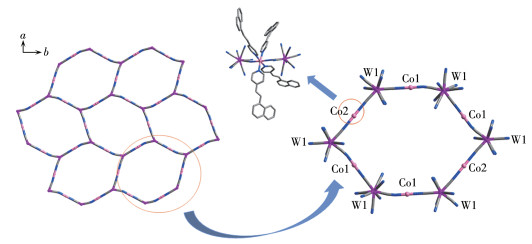
Figure 1.
Arrangement of 1 in the ab plane (left) and detailed structural linkage (right)
W: purple, Co: pink, C: gray, N: blue, O: red; The H atom and methanol molecules are omitted for clarity

A 2D cyano-bridged WⅤ-CoⅡ coordination network exhibiting reversible thermal-induced charge transfer
Dan LIU , Liang ZHAO , Zhen SHAO , Yin-Shan MENG , Tao LIU


Magnetic molecular switchable materials exhibiting bistable chemical and physical properties associated with the electron movement and charge redistribution under external stimuli such as temperature[1-2], light[3-4], electric field[5], pressure[6], or guest mole-cules[7], are attracting considerable interest for both fun-damental interests and potential applications such as switching, display, sensors, information storage devices[8-14]. Typical magnetic molecular switchable materials have been demonstrated concerning variations in electron configuration, such as spin crossover (SCO) of 3d4-3d7 ions, valence tautomerism in a pair of metalions, and ring-opening/closing and cis-trans isomerization[15-20]. Among them, ETCST (electron-transfer-coupled spin transition) compounds have emerged as the topic issue in this field because of their excellent adjustable bistable characters deriving from the inter-converted metal-to-metal charge transfer (MMCT) between two energetically adjacent metal sites[21-23]. In the recent decade, the MMCT process has been utilized as the switchable unit to manipulate magnetic, electric, thermal expansion, and photochromic properties[24-25]. The most famous MMCT system is the cyano-bridged bimetallic Fe-Co Prussian blue analogues (PBAs) that were first observed by Hashimoto et al. and widely used to construct molecular-based materials with a syn-ergistic response to multiple functions[26-31]. Octacyano-metalate-based compounds have also been certified to be suitable systems to expand the family of ETCST materials, such as in CuⅡ-MoⅣ, WⅤ-CoⅡ, and WⅤ-FeⅡ compounds involving the valence-state conversion WⅣ/Ⅴ and MoⅣ/Ⅴ[5, 32-37].
Moreover, octacyanometallate ions possessing more diffuse 4d/5d orbitals and large spin-orbit coupling constants can produce stronger magnetic interaction with another adjacent metal ion, which will give benefit in constructing multi-responsive molecular magnets with higher Curie temperature[3, 38]. In particular, the W-Co charge-transfer compounds display appealing features in their photo-induced magnetic states, such as huge magnetic hysteresis and site-selective switching[39-42]. However, it is still a big challenge to construct W-Co charge-transfer compounds. Until now, only a few samples have been reported, and most of them fail to obtain well-defined structures at different temperatures to confirm the occurrence of the charge-transfer process. First, it is because [W(CN)8]3-unit has a more flexible way to connect with CoⅡ with its eight cyano groups. As a result, it is not easy to control the coordination sphere of CoⅡ centers and the dimensions of the overall structure. Second, the occurrence of charge transfer requires the constituent CoⅡ center located at a suitable coordination environment to provide equivalent redox potential with adjacent WⅤ ions. Therefore, rational selection of the auxiliary ligands is important. Third, the thermal hysteresis of the charge-transfer materials, which is crucial for practical application, needs suitable intermolecular interactions. With these concerns, we aim to assemble [W(CN)8]3- with CoⅡ to obtain a novel WⅤ-CoⅡ charge-transfer compound, in which the auxiliary ligands 4-(2-naphthalene-1-yl)vinyl pyridine (4-nvp) is selected to adjust the coordination sphere of the CoⅡ center and provide intermolecular π-π interaction. Herein, a 2D reticular cyano-bridge compound {[WⅤ (CN)8]2[CoⅡ (4-nvp)4]3}·4CH3OH (1) is reported, which underwent incomplete MMCT in a temperature range of 90-180 K with a 27 K-width thermal hysteresis.
All chemicals were purchased from commercial suppliers and used without further purification. The building blocks (Bu4N)3[W(CN)8]·2H2O (Bu4N=tetrabu-tylammonium) were synthesized according to the litera-ture.
In a 250 mL three-necked flask, reaction mixtures of 1-bromonaphthalene (2.25 g, 10.937 mmol), 4-vinyl pyridine (1.2 mL, 11.288 mmol), tri(o-tolyl)phosphine (0.6 g, 1.970 mmol), Pd(OAc)2 (21 mg, 0.093 5 mmol), and triethylamine (60 mL) in dry DMF (30 mL) were thoroughly mixed under argon. The reaction mixture was then degassed by free-pump-thaw five times before heating at 85 ℃ for 12 h. After this time, the reaction mixture cooled to room temperature, and the triethyl-amine was removed by rotary evaporation, water (50 mL) was added. The mixture was extracted with CH2Cl2 (3×50 mL). Then the organic phase was extracted with H2O (3×50 mL) and saturated NaHCO3 (3×50 mL). The solution was dried over anhydrous MgSO4 and concen-trated under a vacuum. The crude product was purified by column chromatography (silica gel, ethyl acetate/petroleum ether, 2∶1, V/V) and a yellow product (2.115 g, 69%) was got.
Compound 1 was synthesized by diffusion method in a test tube. The aqueous solution (1.0 mL) of Co(ClO4)2·6H2O (1.83 mg, 0.005 0 mmol) was slowly added dropwise to the bottom of the test tube. Then a mix-ture of methanol/water (1∶1, V/V, 3 mL) was layered as the middle buffer. Finally, 1.0 mL methanol solution of (Bu4N)3[W(CN)8] (0.010 mmol) and 4-nvp (0.010 mmol) was carefully added as the third layer. After a few weeks, black red crystals were collected (Yield: 1.23 mg, 19% based on Co(ClO4)2·6H2O). Anal. Calcd. for C224H172Co3W2N28O4(%): C 69.73, H 4.46, N 10.17; Found(%): C 69.81, H 4.45, N 10.20.
The single-crystal X-ray diffraction data for 1 were collected on a Bruker D8 Venture CMOS-based diffractometer (Mo Kα radiation, λ =0.071 073 nm) using the SMART and SAINT programs. Final unit cell parameters were based on all observed reflections from the integration of all frame data. The structures were solved with the ShelXT structure solution program using Intrinsic Phasing and refined with the ShelXL refinement package using Least Squares minimization that was implanted in Olex2. The powder X-ray diffrac-tion (PXRD) patterns were collected on a Rigaku Smartlab 9 kW X-ray diffractometer (Cu Kα radiation, λ =0.154 178 nm, U=45 kV, I=200 mA) in a range of 5°-50° at a rate of 5 (°)·min-1. Variable-temperature infrared spectra were measured on KBr pellet samples using a Nicolet iS10 FT-IR spectrometer equipped with a Bruker cryostat (Optistat CF2). UV-Vis absorption spectra were recorded on a HITACHI UH-4150 UV-Vis spectrophotometer. Magnetic measurement of the sample was performed on a PPMS magnetometer. Data were corrected for the diamagnetic contribution calcu-lated from Pascal constants. The sample (12.85 mg) was measured under a DC field of 1 000 Oe. The variable-temperature magnetization data were collected within a temperature range of 2-300 K at a rate of 2 K· min-1. The elemental analysis was performed by Elementar Vario EL Ⅲ (Germany). Thermogravimetric analysis was performed under an N2 atmosphere at 10 K·min-1 using a TG/DTA STD-Q600 system (TA Instruments, the United States).
Compound 1 was synthesized by the diffusion method through the reaction of Co(ClO4)2·6H2O, 4-nvp, and (Bu4N)3[W(CN)8] ·2H2O in a methanol/water mix-ture, and the crystals were obtained after a few weeks. Single-crystal X-ray diffraction analysis at 120 K revealed that 1 crystallizes in a monoclinic space group P21/n (Table S1, Supporting information). The unit cell consists of two [W(CN)8]3- units and three [Co(4-nvp)4]2+ units, forming a wavy-like layer connected by CN-bond along the a-axis and c-axis (Fig.S1-S3). The layer is constituted with alternately WⅤ and CoⅡ ions through cyano groups, presenting a hexagonal grid structure arranged in order (Fig. 1). In the layers, each [W(CN)8]3- unit bridges three CoⅡ ions through three of its eight CN- groups, and each CoⅡ ion is coordinated to two nitrogen atoms from the cyanide ligand in the apical positions and four nitrogen atoms from the 4-nvp ligand in the equatorial positions. The coordination geometry of the W and CoⅡ site were square antiprism (D4d) and octahedron (Oh), respectively. Two free water molecules were located around [W(CN)8]3-, forming hydrogen bonds with the uncoordinated CN-ligands as hydrogen bond lengths of 0.192 1 and 0.201 6 nm (H… O), respectively (Fig.S4). The nearest metal-metal distance between the two layers is 1.763 9 nm.
W: purple, Co: pink, C: gray, N: blue, O: red; The H atom and methanol molecules are omitted for clarity

 下载:
导出CSV
下载:
导出CSV
| Bond length/angle | 120 K | 295 K |
| Co1—N1 | 0.190 6(6) | 0.213 8(4) |
| Co1—N2 | 0.189 1(6) | 0.215 1(4) |
| Co1—N3 | 0.196 7(6) | 0.215 8(4) |
| Co1—N4 | 0.195 9(6) | 0.214 8(5) |
| Co1—N5 | 0.198 0(6) | 0.217 4(5) |
| Co1—N6 | 0.198 0(6) | 0.217 3(5) |
| Co1—Navg | 0.194 7(1) | 0.215 7(0) |
| Co2—N12 | 0.214 7(6) | 0.214 5(5) |
| Co2—N13 | 0.218 0(8) | 0.215 9(8) |
| Co2—N14 | 0.218 6(10) | 0.220 8(10) |
| Co2—Navg | 0.217 1(0) | 0.217 0(6) |
| W1—Cavg | 0.216 7(7) | 0.216 3(3) |
| ∠Co1—N≡C | 170.4(6) | 166.1(4) |
| ∠Co2—N≡C | 179.1(7) | 176.9(6) |
At 295 K, the Co—Ncyanide and Co—N4-nvp bond distances are 0.213 8(4)-0.215 1(4) and 0.214 8(5)-0.217 4(5) nm, respectively, which are characteristic of the high spin (HS) CoⅡ ions. The angles of Co—N≡C are 166.1(4)°-176.9(6)°, departing from linearity slightly. The average distances of the W—C bond are 0.216 3(3) nm, and the angles of W—N≡C are close to 180°. Three independent Co—W—Co angles are 137.0(2)°, 136.7(3)°, and 81.5(3)°, respectively. When the temperature declined to 120 K, Co1—Ncyanide and Co1—N4-nvp bond distances are shortened to 0.189 1(6)-0.190 6(6) and 0.195 9(6)-0.198 0(6) nm, respectively, whereas Co2—Ncyanide and Co2— N4-nvp bond lengths remain unchanged, which indicate Co1HSⅡ ions change into Co1LSⅢ (LS=low spin). Moreover, Co1—N≡C and Co2—N≡C angles decrease by 4.3(2)° and 2.2(1)° to 170.4(6)° and 179.1(7)°, respectively (Table S1-S4). These structural characteristics variations and charge compensation indicate the occurrence of the charge transfer between Co1Ⅱ and WⅤ ions, and 1 underwent a metal-to-metal charge-transfer from the paramagnetic WⅤ —CN—Co1HSⅡ linkage to the diamagnetic WⅣ — CN—Co1LSⅢ linkage.
The π-π interaction is crucial not only in controlling the assembly or packing of the structure but also in manipulating the properties of the compound. The usual π-π interaction is an offset or slipped stacking of the benzene rings or aromatic nitrogen heterocycles, and the effective distance is 0.330 0-0.380 0 nm. In the layer of compound 1, two kinds of the π-π interac-tion are observed between the naphthalene ring of 4-nvp molecules belonging to the Co1 and Co1 site, and Co1 and Co2 site, with the distance of 0.344 8 and 0.329 9 nm, respectively (Fig. S5). The distances between the ligands among adjacent layers are in a range of 0.363 8 to 0.371 8 nm (Fig.S6), which is in the normal range of the π-π interaction. Those observed π-π interactions directly affect the coordination mode of W—C≡N—Co. The sum of the angles of the three independent Co—W—Co angles is 355.2°, close to 360°. As a result, the plane only fluctuates slightly. For the PXRD analysis, the comparison of the powdered sample of 1 with the simulated pattern calculated by the single crystal structure proves that the single crys-tal and powder samples had the same crystallographic structure, so we used the polycrystalline sample for the next test (Fig.S6).
The solid-state FT-IR spectroscopy provides fur-ther evidence for thermo-induced charge transfer. The spectrum of 1 was recorded in a range of 80-300 K, showing an explicit temperature dependence (Fig. 2a). IR peaks caused by CN- stretching patterns were observed at 2 000-2 300 cm-1. At low temperatures, four peaks due to the cyanide stretching vibrations were observed: 2 166, 2 160, 2 140, and 2 120 cm-1, where the peaks centered at 2 120 and 2 140 cm-1 can be attributed to [WⅣ (CN)8]4- unit. As the temperature gradually rose, these peaks gradually diminished and finally disappeared, thus confirming the thermally-induced conversion of WⅣ to WⅤ. Variable-tempera-ture solid-state UV-Vis-NIR absorption spectra of 1 were also performed in the temperature interval of 80-300 K to further investigated the charge-transfer pro-cess. As the temperature decreased, the broad absorp-tion bands in the region of 800-1 000 nm for the char-acteristic band of the WⅣ →CoⅢ MMCT gradually increased, which demonstrates the occurrence of the charge transfer from WⅤ ions to CoⅡ ions (Fig. 2b and S7).

The temperature-dependent magnetic susceptibility measurement of 1 was measured from 2 to 300 K under the direct current (DC) field of 1 000 Oe (Fig. 3). At 300 K, the χMT per [Co3W2] unit was 10.03 cm3· mol-1·K (χM is the molar magnetic susceptibility), which was higher than the expected spin-only value for two isolated WⅤ (S=1/2, g=2.04) and three CoⅡ (S=3/2, g=2.04) due to the orbital contributions of CoⅡ ions. Upon cooling, the χMT remained nearly constant until 180 K and then gradually decreased to 8.16 cm3·mol-1·K at 90 K with T1/2 ↓=127 K. When heating the sample, the χMT could return to the initial value with T1/2↑ =154 K, which represents a reversible, thermally induced charge-transfer process with a 27 K-wide ther-mal hysteresis. The transfer ratio was about 26.4%, which is probably attributed to the limited deformation of the coordination configuration of Co ions caused by the weak intra-and intermolecular π-π interactions of 1. Further cooling, the χMT gradually increased and got a sharp maximum of 161.35 cm3·mol-1·K at 9 K, which confirms the strong ferromagnetic interaction between WⅤ and CoⅡ center. Subsequently, the χMT dropped sharply to 58.25 cm3·mol-1·K at 3.7 K due to zero-field splitting and/or antiferromagnetic interactions. This magnetic behavior determines a reversible charge-transfer process that involves conversion between the high-temperature (HT) phase with WⅤ (S=1/2)-CoHSⅡ (S=3/2) linkage and the low-temperature (LT) phase with diamagnetic WⅣ (S=0)-CoLSⅢ (S=0) linkage. Taking into account the change in the χMT values, only one pair of WⅤ-CoⅡHS linkage converted to WⅣ-CoLSⅢ, in accordance with the result of the crystallographic analysis. Therefore, the transformation could be expressed as {[WⅤ (CN)8]2[CoHSⅡ(4-nvp)4]3}·4CH3OH→{[WⅤ (CN)8][WIⅤ(CN)8][CoHSⅡ(4-nvp)4]2[CoLSⅢ(4-nvp)4]}·4CH3OH.
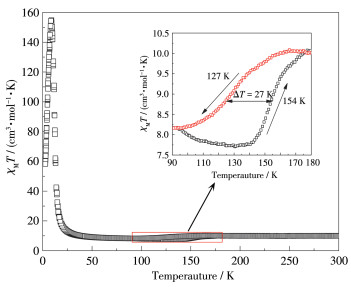
Inset: temperature-dependent magnetic susceptibilities of 1 in a temperature range of 90-180 K
The field-dependent magnetization of 1 was mea-sured up to 50 kOe at 2 K (Fig.S8). The magnetization in the low field region increased rapidly to 4Nβ at 150 Oe, then gradually increased to 6.6Nβ at 50 kOe with-out saturation. To further investigate the change of sus-ceptibility with the applied magnetic field, a complete hysteresis loop was recorded at 2 K, in which a subtle hysteresis was observed with a remnant magnetization (Mr) of 4.15Nβ and a coercive field (Hc) of 250 Oe. Zero-field-cooled (ZFC) and field-cooled (FC) magnetization of 1 were measured at 10 Oe in a temperature range of 2-20 K to investigate the phase transformation at low temperatures (Fig. S9). The ZFC and FC curves were irreversible at 9 K, which indicates the presence of spontaneous magnetization of 1 below 9 K. According to all the magnetic analysis mentioned above, we can conclude that only one WⅤ-CoHSⅡ linkage in the [Co3W2] unit undergo charge-transfer to convert to WⅣ-CoLSⅢ and the remanent WⅤ-CoHSⅡ linkage exhibit strong ferromagnetic coupling. However, no obvious photo-respond magnetic behavior of 1 has been observed at low temperatures because less distortion of the inner coordination sphere of the CoLSⅢ center results in the fast relaxation speed from the photo-induced excited state to the ground state.
To date, the report of WⅤ-CoⅡ charge-transfer compounds is very limited. Here, we summarize four cases of related WⅤ-CoⅡ charge-transfer compounds in the literature to discover some instructive laws for further investigation. As shown in Table 2, firstly, both 2D and 3D compounds exhibited obvious thermal hystere-sis, whereas zero-dimensional (0D) clusters did not. Moreover, the width of hysteresis in 3D compounds was far broad than that of 2D ones. First, in general, thermal hysteresis is attributed to intermolecular interactions (interactions at transition sites) such as hydrogen bonding interaction and π-π interaction. Therefore, to construct bistable molecules with hysteresis, the inter-molecular interaction sites must be appropriately increased. Second, the cyanide-bridged WⅤ-CoⅡ com-pounds with 2D and 3D configurations show large mag-netic hysteresis than 0D ones, attributed to strong ferro-magnetic interaction and axis anisotropy of the com-pound. In a multidimensional structure, numerous metal sites could support stronger interactions and systematic axial anisotropy, resulting in magnetic hysteresis. Third, according to the ∑Co and CShMCo before and after spin transition in the well-defined structure, we inferred that the ideal octahedral coordination sphere of the CoⅡ can stabilize the CoLSⅢ state in the WⅤ-CoⅡ charge-transfer system. In summary, to constitute a WⅤ-CoⅡ charge-transfer material with large thermal and magnetic hysteresis, the auxiliary ligands are important. According to the literature, the smallest pyr-idine-based auxiliary ligands with π-π interaction site are preferred not only for their ability to release the spatial resistance of the CoⅡ center to achieve the ideal octahedral coordination sphere of the CoⅡ but also to increase the magnetic dimension and intermolecular interaction of the compound.
下载:
导出CSV
| Compound | State | Configuration | T1/2 and ΔT | At low temperatures | At high temperatures | |||||
| Co—Navg | ∑Coa | CShMCob | Co—Navg | ∑Co | CShMCo | |||||
| 1 | Crystal | 2D | T1/2↓=127 K T1/2↑=154 K |
0.194 7 | 15.5 | 0.092 | 0.215 7 | 20.44 | 0.122 | |
| ΔT=27 K | 0.217 1 | 20.33 | 0.154 | 0.217 0 | 23.2 | 0.154 | ||||
| [Co(bik)3][{W(CN)8}3 {Co-(bik)2}3]·2H2O· 13CH3CN[44] |
Crystal | 0D | T1/2=215 K | 0.193 1 | 25.8 | 0.175 0 | 0.213 0 | 33.4 | 0.215 | |
| 0.192 4 | 19.1 | 0.107 1 | 0.211 1 | 34.8 | 0.229 | |||||
| 0.191 2 | 14.8 | 0.057 2 | 0.191 2 | 15.0 | 0.054 | |||||
| 0.212 1 | 38.5 | 2.226 3 | 0.213 1 | 38.0 | 0.267 | |||||
| CsⅠ[{CoⅡ(3-cyanopyri- dine)2}{WⅤ(CN)8}]· H2O[32] |
Powder | 2D | T1/2↓=167 K T1/2↑=216 K ΔT=49 K |
— | — | — | 0.210 1 | 11.308 | 0.031 | |
| ([{CoⅡ(pyrimidine)2}2 {CoⅡ(H2O)2}{WⅤ(CN)8}2]· 4H2O[39] |
Powder | 3D | T1/2↓=208 K T1/2↑=298 K |
— | — | — | 0.210 8 | 11.9 | 0.043 | |
| ΔT=90 K | 0.216 5 | 18.8 | 0.139 | |||||||
| [{CoⅡ(4-methylpyridine) (pyrimidine)}2{CoⅡ(H2O)2} |
Powder | 3D | T1/2↓=172 K T1/2↑=241 K |
— | — | — | 0.213 1 | 44.455 | 0.033 | |
| {WⅤ(CN)8}2]·4H2O[34] | ΔT=69 K | — | — | — | 0.211 1 | 50.4 | 0.449 | |||
| a The anomalous octahedral distortion parameter ∑ around the CoⅡ ion; b continuous shape measure relative to the ideal octahedron of the CoⅡ center. | ||||||||||
We synthesized a cyano-bridged 2D layer WⅤ-CoⅡ compound{[WⅤ (CN)8]2[CoⅡ (4-nvp)4]3} ·4CH3OH (1) by using 4-(2-(naphthalene-1-yl)vinyl)pyridine (4-nvp) as the auxiliary ligands. Due to the intra-and intermolecular interaction, compound 1 shows a wave-like configuration. Magnetic and spectroscopic studies manifest that the 2D network displays incomplete reversible charge-transfer behaviors with a 27 K width of thermal hysteresis associated with the intermolecu-lar π-π interaction. In addition, we summarize and an-alyze the published WⅤ-CoⅡ charge-transfer com-pounds and gave rough guidance to construct the new charge-transfer materials, which will help expand the number of magnetic molecular switchable materials.
Supporting information is available at http://www.wjhxxb.cn
Guo F S, He M, Huang G Z, Giblin S R, Billington D, Heinemann F W, Tong M L, Mansikkamäki A, Layfield R A. Discovery of a dyspro-sium metallocene single-molecule magnet with two high-temperature Orbach processes[J]. Inorg. Chem., 2022, 61(16): 6017-6025. doi: 10.1021/acs.inorgchem.1c03980
Kawamura A, Xie J, Boyn J N, Jesse K A, Mcneece A J, Hill E A, Collins K A, Valdez-Moreira J A, Filatov A S, Kurutz J W, Mazziotti D A, Anderson J S. Reversible switching of organic diradical charac-ter via iron-based spin-crossover[J]. J. Am. Chem. Soc., 2020, 142(41): 17670-17680. doi: 10.1021/jacs.0c08307
Zhao L, Meng Y S, Liu Q, Sato O, Shi Q, Oshio H, Liu T. Switching the magnetic hysteresis of an[FeⅡ-NC-WⅤ]-based coordination polymer by photoinduced reversible spin crossover[J]. Nat. Chem., 2021, 13(7): 698-704. doi: 10.1038/s41557-021-00695-1
Zhu H L, Meng Y S, Hu J X, Oshio H, Liu T. Photoinduced magnetic hysteresis in a cyanide-bridged two-dimensional[Mn2W] coordination polymer[J]. Inorg. Chem. Front., 2022, 9(19): 4974-4981. doi: 10.1039/D2QI01101H
Ohkoshi S, Tokoro H, Hozumi T, Zhang Y, Hashimoto K, Mathonière C, Bord I, Rombaut G, Verelst M, Cartier dit Moulin C, Villain F. Photoinduced magnetization in copper octacyanomolybdate[J]. J. Am. Chem. Soc., 2006, 128(1): 270-277. doi: 10.1021/ja0559092
Pinkowicz D, Rams M, Mišek M, Kamenev K V, Tomkowiak H, Katrusiak A, Sieklucka B. Enforcing multifunctionality: A pressure-induced spin-crossover photomagnet[J]. J. Am. Chem. Soc., 2015, 137(27): 8795-8802. doi: 10.1021/jacs.5b04303
Xie K P, Ruan Z Y, Lyu B H, Chen X X, Zhang X W, Huang G Z, Chen Y C, Ni Z P, Tong M L. Guest-driven light-induced spin change in an azobenzene loaded metal-organic framework[J]. Angew. Chem. Int. Ed., 2021, 60(52): 27144-27150. doi: 10.1002/anie.202113294
Hicks R G. A new spin on bistability[J]. Nat. Chem., 2011, 3(3): 189-191. doi: 10.1038/nchem.997
Dogariu A, Michael J B, Scully M O, Miles R B. High-gain backward lasing in air[J]. Science, 2011, 331(6016): 442-445. doi: 10.1126/science.1199492
Itkis M E, Chi X, Cordes A W, Haddon R C. Magneto-opto-electronic bistability in a phenalenyl-based neutral radical[J]. Science, 2002, 296(5572): 1443-1445. doi: 10.1126/science.1071372
Fujita W, Awaga K. Room-temperature magnetic bistability in organic radical crystals[J]. Science, 1999, 286(5438): 261-263. doi: 10.1126/science.286.5438.261
Vincent R, Klyatskaya S, Ruben M, Wernsdorfer W, Balestro F. Electronic read-out of a single nuclear spin using a molecular spin transistor[J]. Nature, 2012, 488(7411): 357-360. doi: 10.1038/nature11341
Ohkoshi S, Imoto K, Tsunobuchi Y, Takano S, Tokoro H. Light-in-duced spin-crossover magnet[J]. Nat. Chem., 2011, 3(7): 564-569. doi: 10.1038/nchem.1067
Mannini M, Pineider F, Sainctavit P, Danieli C, Otero E, Sciancalepore C, Talarico A M, Arrio M, Cornia A, Gatteschi D, Sessoli R. Magnetic memory of a single-molecule quantum magnet wired to a gold surface[J]. Nat. Mater., 2009, 8(3): 194-197. doi: 10.1038/nmat2374
Pierpont C G. Studies on charge distribution and valence tautomerism in transition metal complexes of catecholate and semiquinonate ligands[J]. Coord. Chem. Rev., 2001, 216-217: 99-125. doi: 10.1016/S0010-8545(01)00309-5
Aguilà D, Prado Y, Koumousi E S, Mathonière C, Clérac R. Switch-able Fe/Co Prussian blue networks and molecular analogues[J]. Chem. Soc. Rev., 2015, 45(1): 203-224.
Ohkoshi S, Tokoro H, Hashimoto K. Temperature-and photo-induced phase transition in rubidium manganese hexacyanoferrate[J]. Coord. Chem. Rev., 2005, 249(17): 1830-1840.
王康杰, 李鸿庆, 孙宇辰, 王新益. 氢键桥连一维铁自旋交叉化合物的合成和性质[J]. 无机化学学报, 2020,36,(6): 1143-1148. WANG X Y, WANG K J, LI H Q, SUN Y C. Synthesis and properties of an iron spin crossover compound with 1D chains bridged by hydrogen bonds[J]. Chinese J. Inorg. Chem., 2020, 36(6): 1143-1148.
杨蕊, 张舒雅, 王润国, 孟银杉, 刘涛, 朱元元. 三联吡啶异配体对构筑单核钴自旋交叉配合物的合成和磁性. 无机化学学报, 2022, 38(8): 1477-1486YANG R, ZHANG S Y, WANG R G, MENG Y S, LIU T. Synthesis and magnetic properties of mononuclear cobalt(Ⅱ) spin crossover complexes from complementary terpyridine ligand pairing. Chinese J. Inorg. Chem., 2022, 38(8): 1477-1486
Jiang W J, Jiao C Q, Meng Y S, Zhao L, Liu Q, Liu T. Switching single chain magnet behavior via photoinduced bidirectional metal-to-metal charge transfer[J]. Chem. Sci., 2018, 9(3): 617-622. doi: 10.1039/C7SC03401F
Weinberg D R, Gagliardi C J, Hull J F, Murphy C F, Kent C A, Westlake B C, Paul A, Ess D H, Mccafferty D G, Meyer T J. Proton-coupled electron transfer[J]. Chem. Rev., 2012, 112(7): 4016-4093. doi: 10.1021/cr200177j
Bernardo B, Cheyns D, Verreet B, Schaller R D, Rand B P, Giebink N C. Delocalization and dielectric screening of charge transfer states in organic photovoltaic cells[J]. Nat. Commun., 2014, 5(1): 1-7.
Akimov A V, Neukirch A J, Prezhdo O V. Theoretical insights into photoinduced charge transfer and catalysis at oxide interfaces[J]. Chem. Rev., 2013, 113(6): 4496-4565. doi: 10.1021/cr3004899
Meng Y S, Sato O, Liu T. Manipulating metal-to-metal charge trans-fer for materials with switchable functionality[J]. Angew. Chem. Int. Ed., 2018, 57(38): 12216-12226. doi: 10.1002/anie.201804557
Mathonière C. Metal-to-Metal Electron Transfer: A powerful tool for the design of switchable coordination compounds[J]. Eur. J. Inorg. Chem., 2018, (3/4): 248-258.
Li D F, Clérac R, Roubeau O, Harté E, Mathonière C, Le Bris R, Holmes S M. Magnetic and optical bistability driven by thermally and photoinduced intramolecular electron transfer in a molecular cobaltiron Prussian blue analogue[J]. J. Am. Chem. Soc., 2008, 130(1): 252-258. doi: 10.1021/ja0757632
Zhang Y Z, Li D F, Clérac R, Kalisz M, Mathonière C, Holmes S M. Reversible thermally and photoinduced electron transfer in a cyano-bridged {Fe2Co2} square complex[J]. Angew. Chem. Int. Ed., 2010, 49(22): 3752-3756. doi: 10.1002/anie.201000765
Koumousi E S, Jeon I, Gao Q, Dechambenoit P, Woodruff D N, Merzeau P, Buisson L, Jia X, Li D F, Volatron F, Mathonière C, Clérac R. Metal-to-metal electron transfer in Co/Fe Prussian blue molecular analogues: The ultimate miniaturization[J]. J. Am. Chem. Soc., 2014, 136(44): 15461-15464. doi: 10.1021/ja508094h
Liu T, Dong P D, Kanegawa S, Kang S, Sato O, Shiota Y, Yoshizawa K, Hayami S, Wu S, He C, Duan C Y. Reversible electron transfer in a linear {Fe2Co} trinuclear complex induced by thermal treatment and photoirraditaion[J]. Angew. Chem. Int. Ed., 2012, 51(18): 4367-4370. doi: 10.1002/anie.201201305
Huang W, Ma X, Sato O, Wu D Y. Controlling dynamic magnetic properties of coordination clusters via switchable electronic configuration[J]. Chem. Soc. Rev., 2021, 50(12): 6832-6870. doi: 10.1039/D1CS00101A
Liu Q, Yao N T, Sun H Y, Hu J X, Meng Y S, Liu T. Light actuated single-chain magnet with magnetic coercivity[J]. Inorg. Chem. Front., 2022, 9(19): 5093-5104. doi: 10.1039/D2QI01371A
Arimoto Y, Ohkoshi S, Zhong Z J, Seino H, Mizobe Y, Hashimoto K. Photoinduced magnetization in a two-dimensional cobalt octacyano-tungstate[J]. J. Am. Chem. Soc., 2003, 125(31): 9240-9241. doi: 10.1021/ja030130i
Chorazy S, Podgajny R, Nogas W, Nitek W, Koziel M, Rams M, Juszynska-Galazka E, Zukrowski J, Kapusta C, Nakabayashi K, Fujimoto T, Ohkoshi S, Sieklucka B. Charge transfer phase transi-tion with reversed thermal hysteresis loop in the mixed-valence Fe9[W(CN)8]6·xMeOH cluster[J]. Chem. Commun., 2014, 50(26): 3484-3487. doi: 10.1039/c3cc48029a
Ozaki N, Tokoro H, Hamada Y, Namai A, Matsuda T, Kaneko S, Ohkoshi S. Photoinduced magnetization with a high Curie temperature and a large coercive field in a Co-W bimetallic assembly[J]. Adv. Funct. Mater., 2012, 22(10): 2089-2093. doi: 10.1002/adfm.201102727
Herrera J M, Marvaud V, Verdaguer M, Marrot J, Kalisz M, Mathonière C. Reversible photoinduced magnetic properties in the heptanuclear complex[MoⅣ (CN)2(CNCuL)6]8+ : A photomagnetic high-spin mole-cule[J]. Angew. Chem. Int. Ed., 2004, 43(41): 5468-5471. doi: 10.1002/anie.200460387
Zhao L, Duan R, Zhuang P F, Zheng H, Jiao C Q, Wang J L, He C, Liu T. 12-Metal 36-membered ring based WⅤ-CoⅡ layers showing spin-glass behavior[J]. Dalton Trans., 2015, 44(28): 12613-12617. doi: 10.1039/C5DT01318F
Podgajny R, Chorazy S, Nitek W, Rams M, Majcher A M, Marszałek B, Zukrowski J, Kapusta C, Sieklucka B. Co—NC—W and Fe— NC—W electron-transfer channels for thermal bistability in trimetal-lic {Fe6Co3[W(CN)8]6} cyanido-bridged cluster[J]. Angew. Chem. Int. Ed., 2013, 52(3): 896-900. doi: 10.1002/anie.201208023
Ohkoshi S, Tokoro H. Photomagnetism in cyano-bridged bimetal assemblies[J]. Acc. Chem. Res., 2012, 45(10): 1749-1758. doi: 10.1021/ar300068k
Ohkoshi S, Hamada Y, Matsuda T, Tsunobuchi Y, Tokoro H. Crystal structure, charge-transfer-induced spin transition, and photoreversible magnetism in a cyano-bridged cobalt-tungstate bimetallic assembly[J]. Chem. Mater., 2008, 20(9): 3048-3054. doi: 10.1021/cm703258n
Mahfoud T, Molnár G, Bonhommeau S, Cobo S, Salmon L, Demont P, Tokoro H, Ohkoshi S, Boukheddaden K, Bousseksou A. Electric-field-induced charge-transfer phase transition: A promising approach toward electrically switchable devices[J]. J. Am. Chem. Soc., 2009, 131(41): 15049-15054. doi: 10.1021/ja9055855
Ohkoshi S, Ikeda S, Hozumi T, Kashiwagi T, Hashimoto K. Photoin-duced magnetization with a high Curie temperature and a large coer-cive field in a cyano-bridged cobalt-tungstate bimetallic assembly[J]. J. Am. Chem. Soc., 2006, 128(16): 5320-5321. doi: 10.1021/ja060510e
Mondal A, Chamoreau L, Li Y, Journaux Y, Seuleiman M, Lescouëzec R. W-Co discrete complex exhibiting photo-and thermo-induced magnetisation[J]. Chem.-Eur. J., 2013, 19(24): 7682-7685. doi: 10.1002/chem.201300661

Figure 1 Arrangement of 1 in the ab plane (left) and detailed structural linkage (right)
W: purple, Co: pink, C: gray, N: blue, O: red; The H atom and methanol molecules are omitted for clarity

Figure 2 (a) Variable-temperature solid-state FT-IR spectra for 1; (b) Variable-temperature solid-state UV-Vis-NIR absorption spectra for 1

Figure 3 Temperature-dependent magnetic susceptibilities of 1 in a temperature range of 2-300 K under an applied field of 1 000 Oe
Inset: temperature-dependent magnetic susceptibilities of 1 in a temperature range of 90-180 K
Table 1. Selected bond lengths (nm) and bond angles (°) of 1 at 120 and 295 K, respectively
| Bond length/angle | 120 K | 295 K |
| Co1—N1 | 0.190 6(6) | 0.213 8(4) |
| Co1—N2 | 0.189 1(6) | 0.215 1(4) |
| Co1—N3 | 0.196 7(6) | 0.215 8(4) |
| Co1—N4 | 0.195 9(6) | 0.214 8(5) |
| Co1—N5 | 0.198 0(6) | 0.217 4(5) |
| Co1—N6 | 0.198 0(6) | 0.217 3(5) |
| Co1—Navg | 0.194 7(1) | 0.215 7(0) |
| Co2—N12 | 0.214 7(6) | 0.214 5(5) |
| Co2—N13 | 0.218 0(8) | 0.215 9(8) |
| Co2—N14 | 0.218 6(10) | 0.220 8(10) |
| Co2—Navg | 0.217 1(0) | 0.217 0(6) |
| W1—Cavg | 0.216 7(7) | 0.216 3(3) |
| ∠Co1—N≡C | 170.4(6) | 166.1(4) |
| ∠Co2—N≡C | 179.1(7) | 176.9(6) |
 下载: 导出CSV
Table 2. W-Co metal-metal charge transfer compounds and related structure parameters
| Compound | State | Configuration | T1/2 and ΔT | At low temperatures | At high temperatures | |||||
| Co—Navg | ∑Coa | CShMCob | Co—Navg | ∑Co | CShMCo | |||||
| 1 | Crystal | 2D | T1/2↓=127 K T1/2↑=154 K |
0.194 7 | 15.5 | 0.092 | 0.215 7 | 20.44 | 0.122 | |
| ΔT=27 K | 0.217 1 | 20.33 | 0.154 | 0.217 0 | 23.2 | 0.154 | ||||
| [Co(bik)3][{W(CN)8}3 {Co-(bik)2}3]·2H2O· 13CH3CN[44] |
Crystal | 0D | T1/2=215 K | 0.193 1 | 25.8 | 0.175 0 | 0.213 0 | 33.4 | 0.215 | |
| 0.192 4 | 19.1 | 0.107 1 | 0.211 1 | 34.8 | 0.229 | |||||
| 0.191 2 | 14.8 | 0.057 2 | 0.191 2 | 15.0 | 0.054 | |||||
| 0.212 1 | 38.5 | 2.226 3 | 0.213 1 | 38.0 | 0.267 | |||||
| CsⅠ[{CoⅡ(3-cyanopyri- dine)2}{WⅤ(CN)8}]· H2O[32] |
Powder | 2D | T1/2↓=167 K T1/2↑=216 K ΔT=49 K |
— | — | — | 0.210 1 | 11.308 | 0.031 | |
| ([{CoⅡ(pyrimidine)2}2 {CoⅡ(H2O)2}{WⅤ(CN)8}2]· 4H2O[39] |
Powder | 3D | T1/2↓=208 K T1/2↑=298 K |
— | — | — | 0.210 8 | 11.9 | 0.043 | |
| ΔT=90 K | 0.216 5 | 18.8 | 0.139 | |||||||
| [{CoⅡ(4-methylpyridine) (pyrimidine)}2{CoⅡ(H2O)2} |
Powder | 3D | T1/2↓=172 K T1/2↑=241 K |
— | — | — | 0.213 1 | 44.455 | 0.033 | |
| {WⅤ(CN)8}2]·4H2O[34] | ΔT=69 K | — | — | — | 0.211 1 | 50.4 | 0.449 | |||
| a The anomalous octahedral distortion parameter ∑ around the CoⅡ ion; b continuous shape measure relative to the ideal octahedron of the CoⅡ center. | ||||||||||
下载: 导出CSV

 扫一扫看文章


扫一扫关注我们
 下载:
下载: