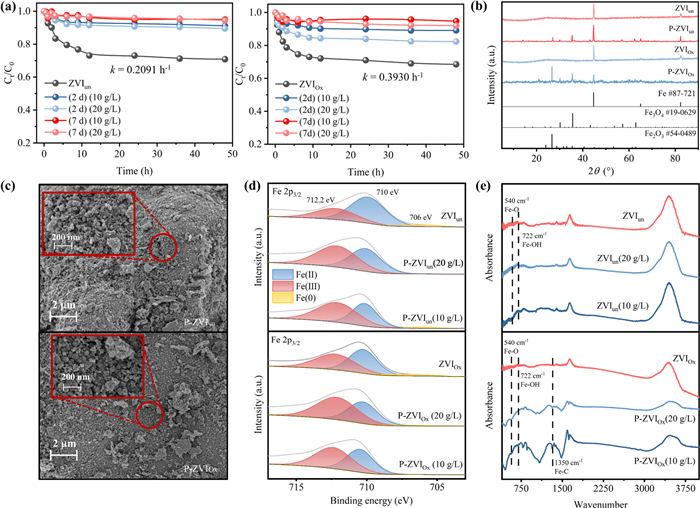
Figure 1.
(a) Degradation activity of two types of nZVI with different concentrations after passivation over varying time periods. XRD (b), SEM (c), XPS (d), FTIR (e) characterization analysis diagrams.

The key to unlocking passivated nZVI: Molecular structure-driven activation effect of low-molecular-weight organic acids
Xiao Tang , Yi Chen , Jing Wang , Xiaoqin Su , Yuting Xu , Rui Peng , Chenglong Yu , Yu Hou , Zhou Cao , Yue Gao , Yong Zhai , Shengyan Pu


Groundwater, as the ultimate “reservoir” in the “atmosphere-surface water-soil” chain, often exhibits a mismatch between the time and resources invested in remediation and the anticipated outcomes, due to its concealed nature and complex hydrogeological characteristics [1]. Nanoscale zero-valent iron (nZVI), as an efficient reductant, is widely used for in situ groundwater remediation owing to its strong reducing capacity, environmental compatibility, operational flexibility, high efficiency, and low cost [2]. However, nZVI is prone to the formation of an oxide film or passivation layer during remediation due to surface precipitation. This layer impedes direct contact between nZVI and contaminants, as well as electron transfer (ET) within the film, significantly diminishing its reductive efficiency and service life, thereby severely compromising the practical remediation effectiveness [3,4]. To overcome this limitation, various depassivation strategies have been proposed, including external field stimulation (e.g., ultrasound and weak magnetic fields) and material modification (e.g., bimetallic alloys and core–shell structures) [5,6]. While these methods have demonstrated some success under laboratory conditions, they face practical challenges in situ applications: External field stimulation often involves high energy consumption and equipment dependency, complicating field operations; material modification not only increases costs but also carries the risk of secondary pollution from the release of modifiers [7]. Furthermore, it remains uncertain whether more complex oxide layers may form in groundwater environments, potentially exacerbating passivation. In other words, traditional de-passivation strategies generally lack feasibility and sustainability in long-term, dynamic groundwater remediation scenarios [8]. Consequently, developing a green, low-carbon, sustainable, and environmentally adaptive control strategy is crucial for mitigating nZVI passivation and enhancing the long-term effectiveness of in situ remediation.
Against this backdrop, naturally prevalent low-molecular-weight organic acids (LMWOAs) offer a promising alternative. LMWOAs possess multiple chemical functions: They can act as proton donors and electron acceptors, facilitating interfacial charge transfer; they can also stabilize dissolved iron species through multidentate complexation, preventing their rapid precipitation into inert phases, thereby delaying passivation film formation and maintaining iron cycling activity [9,10]. Previous studies have shown that pre-modification of nZVI with citric acid (CA) enhances iron dissolution and hydrogen release through the synergistic effect of multiple carboxyl and hydroxyl groups [11,12], while modification with oxalic acid (OA) promotes electron flow by forming stable complexes with iron [13,14]. However, these studies predominantly focus on static “pre-treatment modification” strategies. Groundwater remediation is a long-term process where nZVI passivation is inevitable [7], thus understanding how to achieve effective de-passivation through dynamic regulation remains limited.
More critically, the wide variety of LMWOAs means that differences in molecular structure (e.g., number of functional groups, steric hindrance, acid dissociation capacity, and electron affinity) lead to significant variations in proton donation capacity, complexation ability, and charge transfer characteristics [15,16]. For instance, studies have found that CA and OA can form chromate esters with dissolved Cr(Ⅵ) and reduce it via intramolecular electron transfer, demonstrating distinct ligand-to-metal charge transfer (LMCT) characteristics; under similar conditions, formic acid and acetic acid exhibit negligible reduction capability toward Cr(Ⅵ) [17–19]. We speculate that the effectiveness of different LMWOAs in activating passivated nZVI (P-ZVI) may not be universally applicable but rather highly selective [20]. Therefore, it is essential to deeply analyze the key role of LMWOAs' molecular structural features in inducing passivation layer dissociation and regulating nZVI reactivity, providing a theoretical basis for the targeted regulation of nZVI.
Accordingly, this study focuses on the passivation-activation evolution of different nZVI and the key mechanisms governing LMWOA-induced activation. Through systematic characterization, density functional theory (DFT) calculations, and solution chemistry modeling, we systematically deciphered the reconstruction behavior of the surface passivation layer and the proton-ligand coupled regulation pathways of LMWOAs. Furthermore, a multilevel structure-activity relationship linking “molecular structure–fundamental property–macroscopic performance” was established to quantitatively elucidate the fundamental mechanism of how LMWOA structure governs nZVI activation. This work provides a new perspective for understanding the environmental fate of nZVI and its intrinsic driving mechanisms, while also offering a theoretical foundation for the precise application of nZVI in groundwater remediation.
Chemical reagents and experimental methods are shown in Texts S1-S8 (Supporting information).
By using actual contaminated groundwater (Table S1 in Supporting information), we systematically investigated the differences in reactivity between two types of nZVI: Conventional unmodified nZVI (ZVIun) and pre-modified nZVI (ZVIOx), in order to avoid the problem of insufficient understanding of the passivation characteristics caused by the differences between laboratory simulations and the real environment. It can be observed that the pre-modified ZVIOx exhibits the faster reaction kinetic (Fig. 1a), which is consistent with the cognition in other studies that the core-shell structure of the surface derived from the OA-modification accelerates electron transfer [9,14]. Furthermore, from the perspective of the passivation regularity, ZVIOx shows a significant passivation alleviation effect within a 2-day time scale compared to the ZVIun. Moreover, by increasing the concentration of passivating ZVIOx, the enhancement of its reactivity is much more superior to that of ZVIun. Until the passivation time reached 7 days under conditions of complex contaminated groundwater, the reaction performance decay of both is similar even considering the concentration effect. This phenomenon indicates that surface pre-modification can only alleviate passivation on a “day” time scale, and this alleviation effect disappears on a “week” time scale [21]. In addition, considering the diversity of environmental conditions, we also examine the passivation characteristics under common water chemical conditions for 7 days (Fig. S1 in Supporting information). The results show that the reaction rate (k) of ZVIOx material (0.0873 h−1) is slightly higher than that of ZVIun (0.0658 h−1). This is related to the rapid reaction rate caused by the core-shell structure mentioned earlier. However, in terms of the passivation degree, both materials exhibit similar degradation performance attenuation. The actual passivation on the site was statistically analyzed for the passivation levels of two materials, and ZVIOx also almost dropped to its lowest performance within 7 days (Fig. S2 in Supporting information). It can be seen that the pre-modification did not effectively alleviate the passivation behavior during the application in the real environment like contaminated groundwater in our study to achieve long-term stable remediation as expected in the current studies [22].
We further analyze the material properties to understand the surface reconstruction behavior during passivation. The XRD findings demonstrate that both materials display identical characteristic diffraction peaks of α-Fe0 at 44.7° and 65° (JCPDS No. 87–721) without any iron oxide peaks (Fig. 1b), in accordance with previous research reports [14,23]. This outcome also suggests that the ball milling method employed for preparing ZVIOx does not exert an impact on the main structure centered around α-Fe0. Subsequent to passivation, the surfaces of both materials also exhibit comparable patterns of crystal structure alteration. Specifically, α-Fe0 undergoes transformation into iron oxides, predominantly in the hematite structure of Fe2O3 (JCPDS No. 54–0489) [24], and is intermixed with the magnetic cubic structure of Fe3O4 (JCPDS No. 19–0629) [25,26]. These results suggest that, under complex groundwater conditions, the pre-modified core–shell structure of ZVIOx is rapidly corroded, exposing the internal α-Fe0 and thereby undergoing a passivation process essentially identical to that of unmodified nZVI. This interpretation is further supported by SEM images (Fig. 1c), which reveal that the passivated surfaces of both materials are covered with uniformly sized and morphologically similar aggregates. Moreover, XPS analysis shows a pronounced increase in the Fe(Ⅲ)/Fe(Ⅱ) ratio after seven days of passivation, a trend particularly evident for P-ZVIOx (passivated ZVIOx) at low concentrations (Fig. 1d and Fig. S3 in Supporting information), this also indicates that the effect of pre-modification in preventing passivation is not significant. This shift is in agreement with FTIR results (Fig. 1e), where the emergence of stronger Fe-C and Fe-O absorption bands indicates that the passivation products (primarily Fe2O3) are tightly integrated with surface -C2O4 groups, thereby reinforcing the stabilization and retention of Fe(Ⅲ).
Subsequently, the performance of different LMWOAs in activating P-ZVI is discussed and explained based on the following three aspects:
The activation kinetics: First, the impact of the molecular structure of LMWOAs on the activation kinetics of passivated ZVIun and ZVIOx (P-ZVIun and P-ZVIOx) was explored. As depicted in Fig. 2a, when overlooking the disparities stemming from nZVI type, these LMWOAs demonstrate a consistent activation pattern in both systems. Specifically, the order is citric acid (CA) > oxalic acid (OA) > malic acid (MA) > tartaric acid (TA) > acetic acid (AcA) > glutamic acid (GA) > ascorbic acid (AsA) > lactic acid (LA). Evidently, the type of small molecule acid significantly impacts the activation effect. Upon comparing the two systems (Fig. 2b), the activation effect of the ZVIOx system is comparable to that of ZVIun. Moreover, the degradation rate of the activated groups in the ZVIOx system is similar to that in the ZVIun system. Given that ZVIOx, due to surface regulation, possesses a higher specific surface area both prior to and after passivation (Table S2 in Supporting information), However, the activation effects of the two nZVI types are similar. Although the FeC2O4·2H2O shell formed on their surfaces acts as a mass transfer channel, there may be some mechanism that limits the activation of P-ZVIOx [12,14,27]. Combining the results from the first part of the study, it can be concluded that whether pre-modification occurs or not affects the passivation and activation efficiency of P-ZVI, but does not influence its final passivation characteristics or its response to the activation of small molecule acids.
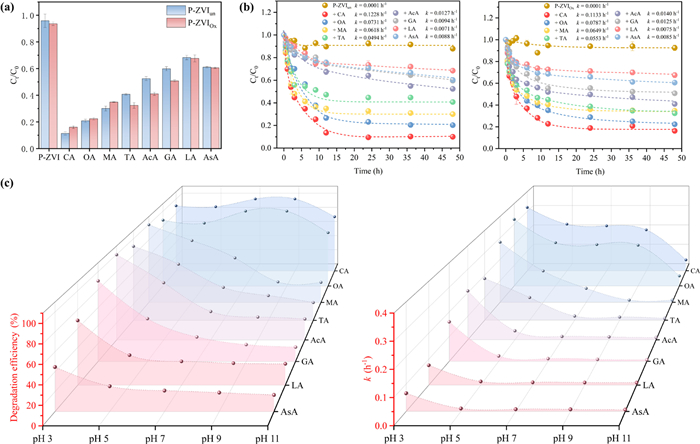
Concentration effect of LMWOAs: From a thermodynamic standpoint, the concentration of LMWOAs is a crucial factor affecting the activation behavior of P-ZVI [28]. In this research, through the regulation of LMWOAs concentration, it was discovered that their activation effects can be classified into three typical patterns (Fig. S4 in Supporting information): The low-concentration sensitive type, the gradient-dependent type and the weakly dependent type (Text S9 in Supporting information).
Dissociation effect of LMWOAs: The dissociation behavior of molecules is regarded as a crucial factor affecting environmental behavior. Consequently, this study delved deeper into the impact of the dissociation of LMWOAs on the activation of P-ZVI by adjusting pH values [29]. The results of Fig. 2c indicate that LMWOAs display two distinct activation behaviors under different pH conditions. Specifically, the activation effects of CA and OA follow a multi-stage high-response pattern of decrease-increase-decrease. In contrast, the other six types of LMWOAs exhibit a consistent pH-dependent characteristic, namely, their activation ability gradually diminishes as pH increases. Upon further examination of these six types of small organic acids (Fig. 2c and Fig. S5 in Supporting information), it was found that TA and MA gradually decline within the experimental pH range. Meanwhile, the other four types maintain an almost identical low activation effect when pH ≥ 7. As typical monoprotic acids, AcA (pKa = 4.76) and LA (pKa = 3.86) either form monodentate ligands or possess low complexation constants [30,31], resulting in their generally weak complexation ability [32]. Hence, it can be inferred that their overall activation ability stems from protonolysis. Based on this, it is hypothesized that for systems with similar patterns, that is, LMWOAs with consistent pH-dependent characteristics, the protons they release may be the key mechanism for activating P-ZVI. For systems with opposing patterns (such as CA and OA), both ligand stabilization and protonolysis may drive the activation process [33]. Moreover, ligand stabilization may play a dominant role across a wide pH range, as evidenced by the significant increase in activation ability in the pH range of 7–9. This speculation also applies to the TA and MA systems. That is, due to the certain degree of complexation between the passivation layer and these two LMWOAs, but this complexation is significantly weaker than that of CA and OA. As a result, a clear pattern emerges: The activation effect decreases proportionally with the increase in pH.
From the perspective of activation, the activation of P-ZVI can be divided into two stages: the process of breaking through the constraints of the passivation layer (first step) and the synergistic enhancement effect of LMWOAs (second step). For the first de-passivation process, results above showed that proton dissolution plays varying roles in different small-molecule acid systems. Therefore, from this perspective, we carried out further investigations. First, in theory, under acidic conditions, protons (H+) usually react with oxides or hydroxides in the passivation layer on the surface of nZVI, promoting the dissolution of the passivation layer (Eqs. 1 and 2) [34]. Accordingly, we evaluated the changes in the mass or concentration of iron in different states to macroscopically assess the extent of the proton dissolution effect. The results are shown in Fig. 3.
|
|
(1) |
|
|
(2) |
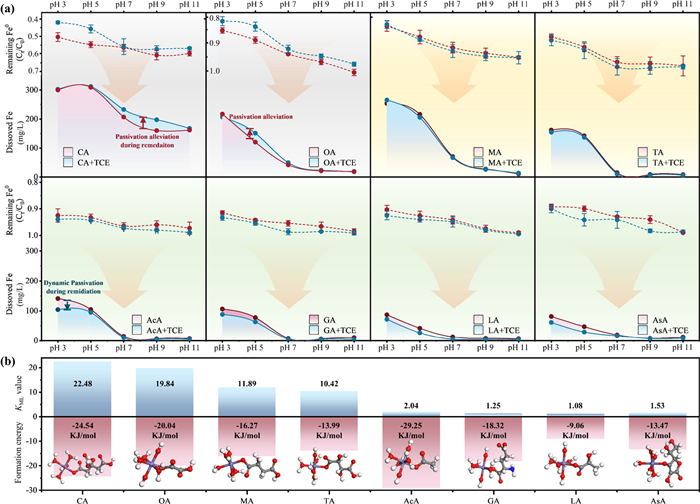
From the changes in residual P-ZVI mass and total dissolved Fe ions content (Fig. 3a), the OA and CA systems effectively promote a dynamic response of “dissolution activation → passivation degradation → re-dissolution activation,” displaying a more efficient and sustainable behavior compared with other activation treatments. First, the role of proton-induced initiation is unequivocal. This is confirmed by the lower residual P-ZVI mass, higher total dissolved Fe ions content, and improved degradation performance observed for all LMWOAs under low-pH conditions. Second, the influence of stable complexation was further assessed using the Stern-Volmer equation (Text S6 in Supporting information) and MINTEQ simulations [35,36]. Comparison of metal-organic complexation constants (KML) and coordination modes across systems revealed that OA and CA form stronger complexes with Fe ions, with higher KML values (22.48 and 19.84, respectively) (Fig. S6 and Table S3 in Supporting information). This aligns with their ability to coordinate with dissolved Fe to yield more soluble complexes. Such complex formation reduces the activity of free Fe ions in solution, thereby shifting the dissolution equilibrium toward further dissolution (Fig. 3a). Considering molecular structures, CA, as a tetradentate ligand (3 × -COO−, 1 × -OH), can form highly stable mixed chelate rings [37]. Its three pKa values ensure coexistence of proton-donating species and strong complexing forms across a wide pH range (Fig. S7 in Supporting information), which is key to achieving the synergistic effect. Similarly, OA, as a bidentate ligand, forms exceptionally stable five-membered chelate rings [38], while its two pKa values provide an effective buffering range. Therefore, under the Proton–Ligand Synergistic Dissolution effect, OA and CA systems drive continuous dissolution of the passivation layer more effectively than monodentate ligands, achieving sustained de-passivation.
For the AcA, LA, GA, and AsA activation systems, the residual P-ZVI mass and total dissolved Fe ions content exhibit patterns opposite to those of the OA and CA systems. This indicates a pronounced imbalance between LMWOA-induced de-passivation and passivation caused by contaminant degradation. As a result, the released Fe ions readily re-precipitates as iron oxides or hydroxides that redeposit onto the nZVI surface, leading to markedly lower activation and degradation performance compared with OA and CA (Fig. 2c). This is corroborated by the much lower KML values and speciation simulation results (Fig. 3b and Fig. S8 in Supporting information). Due to the lack of strong complexing anions, only trace amounts, or virtually no stable complexes, are formed. Consequently, dissolved Fe ions undergo rapid hydrolysis or redox-driven precipitation, in order to prevent the formation of these precipitates, the activation system will consume a large amount of H+ to maintain activity, causing a sharp rise in pH (Fig. S9 in Supporting information). Thermodynamically, this reduces the reductive capacity of nZVI and weakens the driving force for electron transfer [39]. Structural analysis further explains these limitations. AcA is a monodentate ligand, resulting in weak overall complexation capacity [40]. Although LA also has a single carboxyl group, its α-OH substituent provides some chelation ability, but the resulting chelate rings are considerably less stable than those formed by multidentate ligands. Similarly, GA’s zwitterionic nature restricts its proton contribution and yields weak complexation [41]. As for AsA, while the enediol hydroxyls can coordinate Fe, the molecule itself is readily oxidized, failing to maintain a stable coordination environment [42]. In summary, due to the limited stabilizing effects of these ligands, Sole Proton Etching emerges as the dominant mechanism for de-passivation in these LMWOA systems.
Evidently, MA and TA exhibit characteristics of a transitional de-passivation behavior. Structurally, both molecules share similar spatial configurations (Table S4 in Supporting information), each containing two carboxyl and hydroxyl groups, which endow them with moderate proton-donating capacity and complexation potential. Notably, the MA system demonstrates Fe dissolution comparable to that of OA and CA (Fig. 3). However, comparison of their KML values and proton-release windows reveals that in the critical near-neutral pH range, MA and TA are almost fully dissociated. Under these conditions, they retain only complexation ability while losing their proton-donating capacity, preventing the maintenance of synergistic effects across a broader pH spectrum. Consequently, they exhibit an unstable mode of proton-induced but weak ligand-assisted dissolution.
We further employed DFT calculations to evaluate the formation energies of dissolved Fe ions stabilized by different LMWOAs through monodentate coordination, thereby assessing their thermodynamic stability. The results are shown in Table S5 (Supporting information) and Fig. 3b. Except for AcA, the variations in the formation energies of LMWOA-Fe complexes are consistent with the complexing ability of LMWOAs. For multi-coordination-point molecules such as CA and OA, the formation energies are highly negative (>20 kJ/mol), indicating that complex formation is more favorable, the resulting complexes are more stable, and consequently, the coordination and dissolution capacities are stronger. In contrast, although AcA has a significantly negative formation energy (−29.25 kJ/mol), owing to its low molecular weight and simple monocarboxyl coordination geometry, presents smaller steric hindrance and shorter Fe-COOH distances [43]. This enhances electrostatic attraction and yields tighter binding. However, although AcA tends to form complexes with Fe, the formation and dissociation rates of monodentate coordination bonds are both very fast, and the limited number of coordination sites restricts the dissolution and depassivation kinetics [44,45]. Combined with its low KML and low binding energy (Table S6 in Supporting information), this indicates behavior that is thermodynamically favorable but kinetically constrained, consistent with the experimental observations. In the case of GA, the low binding energy indicates unstable complex formation. This instability arises because the α-carbon simultaneously binds -COOH and -NH2 groups, enabling strong intermolecular hydrogen bonding that hinders Fe(Ⅲ) coordination [46]. Overall, while monodentate coordination can be thermodynamically favorable, its overall efficiency is constrained by both the coordination mode and the number of available binding sites.
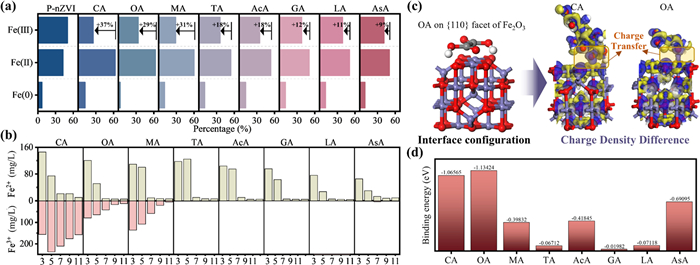
Considering the pivotal role of iron speciation in environmental remediation, we further evaluated the forms and distributions of both solid-phase and dissolved iron (Fig. 4). XPS analysis revealed that the addition of LMWOAs accelerated the transformation of surface Fe(Ⅲ) to Fe(Ⅱ) (Fig. 4a), clearly demonstrating their potential to promote the reductive dissolution of passivation layers such as Fe2O3 (Eq. 3). Consequently, the exposed Fe° core could be oxidized to Fe(Ⅱ) through direct electron transfer (Eq. 4), a phenomenon particularly evident in the CA, OA, and MA treatments. In addition, different pH levels have a significant impact on the release of Fe ions, with low pH conditions promoting the release of both Fe2+ and Fe3+. Simultaneously, the dynamic variations of Fe2+ and Fe3+ concentrations in solution further confirmed the high activity of this cycling behavior (Eq. 5 and Fig. 4b). Compared with the pure activation group, systems containing TCE exhibited distinct shifts in iron speciation (Fig. S10 in Supporting information): Due to Fenton-driven reduction and degradation, dissolved Fe2+ was continuously consumed and oxidized to Fe3+, and this phenomenon becomes more pronounced at higher pH values [47]. As a result, Fe3+ concentrations were elevated while Fe2+ concentrations decreased in the TCE groups, a trend especially pronounced in strong complexing acid systems such as CA and OA. Their efficient Fe(Ⅲ) complexation-reduction capacity synergized with the rapid electron demand from TCE degradation, forming a positive feedback loop. Notably, this transformation further substantiates the central role of iron cycling in the activation process. Linear regression analysis (Fig. S11 in Supporting information) reinforced this conclusion, showing a strong correlation between iron speciation dynamics and reactivity. Collectively, these results highlight that LMWOAs enhance the reactivity of P-ZVI systems by regulating iron cycling and fully mobilizing their redox capacity.
|
|
(3) |
|
|
(4) |
|
|
(5) |
However, the efficiency of Fe cycling did not exhibit the anticipated enhancement in the P-ZVIOx system (Fig. S12 in Supporting information). Under prolonged passivation, ZVIOx underwent continuous Fe0 transformation into the more stable Fe2O3 phase, while the pre-existing FeC2O4·2H2O shell layer provided additional stabilization through oxalate coordination [9,14]. This protective effect rendered the electronic structure of the passivation layer less susceptible to further attack or reduction by small organic acids, leading to the persistent presence of Fe2O3 even after activation, as confirmed by XRD analysis (Fig. S13 in Supporting information). In parallel, the stable core-shell configuration restricted interfacial dissolution, resulting in a localized, slow, and discontinuous release of iron ions that favored the accumulation of Fe(Ⅲ) in the form of metastable FeOOH [48]. From this perspective, P-ZVIOx may have a weaker positive effect during the activation stage compared to P-ZVIun, possibly due to incomplete activation or slow surface reaction kinetics. Nevertheless, facilitated by the FeC2O4·2H2O shell, the surface oxide layer retained a certain degree of controllable reactivity and electron transfer pathways. Consequently, due to the balance between these two processes, the overall activation performance of P-ZVIOx is comparable to that of P-ZVIun.
In order to more clearly identify the Fe(Ⅲ)-LMWOA complexes formed during the activation process, as well as the interaction mechanisms between LMWOAs and the passivation layer at the atomic scale, we employed density functional theory (DFT) calculations to investigate the interfacial behavior of Fe2O3 surfaces with different acids. The results showed that multi-functional acids such as CA and OA exhibited more negative adsorption energies (∼−1 eV) (Fig. 4d), indicating more stable binding to iron oxide surfaces. Differential charge density maps (Fig. 4c and Fig. S14 in Supporting information) further revealed pronounced electron redistribution upon CA and OA adsorption, with electrons transferring from the LMWOA molecules to the Fe2O3 surface. These findings suggest that the structural features of multi-dentate ligands with multiple electron-donating groups (e.g., carboxyl and hydroxyl) provide both strong coordination and stable conformations, underpinning their strong interfacial interactions, higher adsorption energies, and enhanced electron transfer. FTIR characterization (Fig. S15 in Supporting information) corroborated these computational results, showing the emergence of Fe-organic complex characteristic peaks on P-ZVI surfaces after OA and CA treatment, thus confirming interfacial interactions [14]. Interestingly, AsA also exhibited highly negative adsorption energies and evident charge transfer to solid Fe. This can be attributed to the enediol structure of AsA, which imparts strong reducing capability while simultaneously engaging in coordination [42,49]. During adsorption, AsA donates a large number of electrons to the Fe2O3 surface, reducing Fe(Ⅲ) to Fe(Ⅱ). However, owing to its limited coordination sites, the Fe(Ⅲ)/Fe(Ⅱ) cycling efficiency in the AsA system was weaker than that of OA and CA.
Once Fe is dissolved into the solution and Fe3+ is generated, LMWOAs further modulate its electronic state through coordination. Mulliken charge population analysis revealed (Fig. S16 in Supporting information) that CA and OA significantly promoted Fe3+ electron delocalization, resulting in a higher positive charge density on Fe atoms (∼+1.55 e). A similar trend was observed in the AsA system, consistent with its strong reducing capability. This charge redistribution enhances the polarity of Fe-organic complexes, facilitating their stability in aqueous solution and enabling them to act as electron mediators in subsequent Fenton-like reactions [50]. Taken together, these results demonstrate that the solution-phase coordination process is not an isolated event but is intrinsically coupled with interfacial adsorption-induced electron transfer, establishing a continuous “solid-phase adsorption-interfacial migration-solution stabilization” electron pathway.
It is generally accepted that the degradation of organic pollutants by nZVI proceeds primarily through the two-electron reduction of oxygen on the nZVI surface, producing hydrogen peroxide (H2O2) (Eq. 6) [51]. Meanwhile, aqueous corrosion of nZVI rapidly generates Fe(Ⅱ) (Eqs. 7 and 8), which subsequently initiates the conventional Fenton reaction (Eq. 9) [52].
|
|
(6) |
|
|
(7) |
|
|
(8) |
|
|
(9) |
The H2O2 yield from the LMWOAs activation system shows consistency with the results of activation degradation (Fig. S17a in Supporting information), and when there is no O2 in the system, almost no H2O2 is produced (Fig. S17b in Supporting information), indicating that Eq. 6 is the main pathway for H2O2 generation [53]. Furthermore, the H2O2 yield is highly correlated with •OH production (Fig. S17c in Supporting information), confirming that •OH mainly originates from this H2O2.
Interestingly, a direct comparison between radical yields and the extent of degradation inhibition revealed mechanistic diversity among activation systems (Fig. 5a), with radicals generated by the activation systems being primarily •OH (Fig. 5b and Fig. S18 in Supporting information). For instance, in the CA treatment, which exhibited the highest •OH yield (107 μmol/L), the inhibition ratio after quencher addition (71%) was lower than that observed for TA and AcA systems (76%), despite their lower •OH yields. This indicates the coexistence of multiple pathways in different LMWOA activation systems.
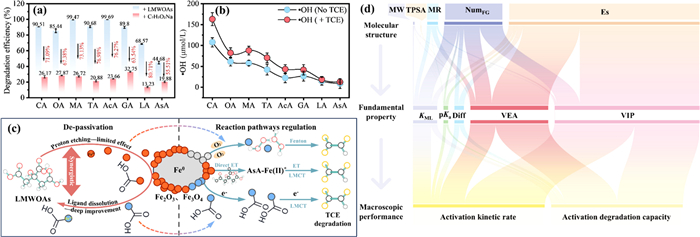
For multi-carboxyl ligands such as CA and OA, although •OH radicals remained the dominant species, their strong coordination capacity likely facilitated additional non-radical pathways. The CV curves of P-ZVI activated in LMWOAs (Fig. S19a in Supporting information) show that, particularly for CA and OA, more pronounced redox peaks appear at −0.4, 0.1, and 0.8 V, demonstrating excellent Interfacial electron transfer. The Nyquist plots of each activation system all exhibit a semicircular shape (Fig. S19b in Supporting information). The Rct (charge transfer resistance) values indicate, for example, that the CA (1.93) and OA (2.1) systems are significantly reduced (Fig. S19c in Supporting information), smaller transfer resistance makes it easier for them to undergo the ligand-to-metal charge transfer (LMCT) process [54,55]. Specifically, the favorable proton-ligand synergistic de-passivation effect enhanced direct electron transfer from Fe0 (Eq. 10), while LMCT pathways enabled direct electron donation to pollutants or intermediates, leading to non-radical oxidation [56,57]. This interpretation is consistent with our earlier finding that CA and OA induced pronounced electron transfer between solid Fe and dissolved Fe species. In contrast, in TA and AcA systems, limited proton-etching de-passivation and weak ligand effects resulted in restricted •OH production and hindered non-radical pathways, rendering these systems more reliant on radical oxidation. A distinctive case was observed for the AsA treatment, which exhibited the lowest inhibition ratio. In the system where only LMWOAs interact with TCE (Fig. S20 in Supporting information), AsA exhibits a higher degree of degradation capability than other LMWOAs, which is attributed to its reducing power through direct electron transfer [49,58]. This strongly corroborates that AsA, due to its strong reductive nature, can actively participate in non-radical reactions, and that this pathway contributes comparably to pollutant removal alongside the radical-dominated mechanism.
|
|
(10) |
In addition, the presence of TCE markedly increased •OH radical production compared with systems without TCE (Fig. 5b). This observation indicates that TCE not only served as the target contaminant undergoing degradation but also significantly promoted •OH generation within the system. Mechanistically (Fig. 5c), this enhancement arises from altered reaction kinetics and a strengthened driving force for iron cycling. When TCE is present, Fe0 or Fe(Ⅱ) species are oxidized to higher-valent iron during the reduction of TCE. These high-valent iron species can then be rapidly reduced back to Fe(Ⅱ) with the assistance of low-molecular-weight organic acids, thereby accelerating the Fe(Ⅱ)/Fe(Ⅲ) cycling rate and sustaining •OH production. Moreover, TCE itself acts as a reductive sink, effectively pulling the iron redox cycle forward [59–61]. This facilitates more efficient reactions between H2O2 and Fe(Ⅱ), leading to enhanced and continuous •OH generation.
In conventional studies, molecular structure parameters are often directly correlated with overall degradation efficiencies [62,63]. Although such “black-box” correlations may reveal statistical trends, they provide little insight into the underlying mechanistic pathways and controlling factors. This limitation becomes especially pronounced in multi-factor coupled heterogeneous catalytic systems, where neither a single structural descriptor nor a terminal performance metric can adequately explain the fundamental question of why a particular structure exhibits specific activity. To address this gap, we established a three-tiered structure–property–performance framework that deconstructs the activation process into three causally linked levels. Relevant descriptors and results are provided in Fig. 5, Fig. S21, Text S10 and Tables S7-S11 (Supporting information).
By integrating multivariate linear regression with principal component analysis (PCA), we quantified the contributions of hierarchical factors to their downstream targets (Fig. 5d). The multi-level structure-property-performance analysis revealed that not all molecular descriptors exerted significant influence. At the microscopic level, intrinsic molecular features such as Es, MR, and NumFG made the greatest contributions to fundamental molecular properties. In particular, Es and NumFG accounted for >50% of the variance in the KML, VEA, and first pKa. This finding underscores that NumFG, and especially Es, which reflects their function groups type and spatial distribution, are the primary determinants of electronic behavior and coordination capacity. For example, although CA and TA share the same number of functional groups (NumFG = 4), CA exhibits a more expanded spatial configuration (Es = −2.1). This “distributed steric hindrance” allows multiple carboxyl groups to simultaneously interact with different Fe active sites, facilitating multi-dentate coordination (KML = 22.48) and promoting the formation of electron transfer channels (VIP = 9.334 eV). Thus, steric effects should not be regarded merely as spatial barriers; rather, by dictating the orientation of functional groups, they can indirectly enhance proton dissociation capacity and complexation stability [64–66]. In contrast, AcA, possessing only a single functional group (GM = 1) and an overly simple spatial configuration, displayed the weakest performance, with the lowest KML (2.04) and the highest VIP (10.516 eV), which limits its activation kinetics and leads to the least passivation elimination and reactivation capability.
At the macroscopic level, the contributions of KML and pKa are primarily reflected in the stability and recycling capacity of Fe3+ in solution, which determine whether the iron cycle remains open and sustainable. In contrast, VEA and VIP directly govern interfacial charge transfer, thereby dictating the efficiency and kinetics of pollutant degradation. These findings are consistent with our previous analyses: the multiple carboxyl groups of CA and OA facilitate proton–ligand coupling, which in turn drives both Fenton-like processes and direct electron transfer (ET). Moreover, the low KML and the lowest VIP observed for AsA further indicate that its activation effect is more strongly associated with the promotion of interfacial electron transfer, rather than the ligand-stabilized, proton-assisted iron cycling that couples with radical pathways. Therefore, AsA tends to use LMCT as the main pathway during the activation process.
In addition, to explore the environmental applications and impacts of the activation system, validation experiments were conducted (Text S11 in Supporting information), in which CA can effectively activate the passivated in situ reaction zones under neutral conditions.
This study systematically elucidated the passivation characteristics of different nZVI materials (ZVIun and ZVIOx) and their differential responses to LMWOAs with distinct molecular structures. Results showed that although ZVIOx exhibited superior electron transfer capacity at the initial stage, the formation of a stable iron oxalate layer during long-term passivation suppressed the conversion of Fe(Ⅲ) to Fe(Ⅱ), leading to Fe2O3 and FeOOH remaining as the dominant phases after activation. In contrast, conventional nZVI (ZVIun) activated by multi-carboxylic acids such as CA and OA underwent a complete reconstruction of the passivation layer, where strong ligand complexation (KML = 22.48 and 19.84) effectively inhibited Fe3+ precipitation, maintained iron cycling, and enabled more efficient TCE degradation (up to 83.17% of CA system on site application). Theoretical calculations further revealed that CA and OA, through multidentate coordination and stronger interfacial charge transfer, significantly reduced adsorption energies (≈ −1 eV) and exhibited a synergistic “proton dissolution–ligand complexation–electron transfer” mechanism, thereby enhancing iron cycling coupled with •OH radical pathways and LMCT non-radical pathways. In contrast, monocarboxylic acids such as acetic acid and lactic acid provided only limited proton etching, with dissolved Fe concentrations remaining below 2 mg/L, high residual Fe(Ⅲ) on the surface, weak interfacial interactions (Eab −0.01–0.4 eV), and degradation efficiencies below 50%. Notably, ascorbic acid (AsA), due to its lowest VIP (8.351 eV), favored LMCT as the dominant pathway during activation. Furthermore, this study, for the first time, quantitatively established a three-level structure–property–performance relationship (“molecular structure–fundamental property–macroscopic performance”), demonstrating that electronic descriptors (Es) and the number of functional groups (NumFG) are the core parameters controlling the passivation process (contribution > 50%). Overall, this work not only advances the mechanistic understanding of nZVI passivation–activation dynamics but also provides theoretical guidance for improving the long-term efficiency, environmental sustainability, and precision regulation of nZVI in the in-situ remediation of groundwater contaminated with complex pollutants.
Xiao Tang: Writing – review & editing, Writing – original draft, Visualization, Investigation, Data curation, Conceptualization. Yi Chen: Writing – review & editing, Writing – original draft, Supervision, Funding acquisition, Conceptualization. Jing Wang: Visualization, Validation, Data curation, Conceptualization. Xiaoqin Su: Writing – original draft, Visualization, Validation, Data curation, Conceptualization. Yuting Xu: Writing – original draft, Visualization, Data curation, Conceptualization. Rui Peng: Visualization, Investigation, Data curation. Chenglong Yu: Visualization, Supervision, Methodology, Conceptualization. Yu Hou: Visualization, Validation, Supervision, Conceptualization. Zhou Cao: Validation, Supervision, Formal analysis, Conceptualization. Yue Gao: Visualization, Investigation, Conceptualization. Yong Zhai: Visualization, Conceptualization. Shengyan Pu: Supervision, Methodology, Funding acquisition.
We declare that we do not have any commercial or associative interest that represents a conflict of interest in connection with the work submitted.
This research was supported by the National Key Research and Development Program of China (No. 2023YFC3708003), the National Natural Science Foundation of China (No. 42307119), the National Key Research and Development Program of China (No. 2024YFC3712700), and the Research Fund of State Key Laboratory of Geohazard Prevention and Geoenvironment Protection (No. SKLGP2020Z002).
Supplementary material associated with this article can be found, in the online version, at doi:
Y. Zhao, J. Song, K. Cheng, et al., Land. Degrad Dev. 35 (2024) 2700–2715. doi: 10.1002/ldr.5103
A. Galdames, L. Ruiz-rubio, M. Orueta, et al., Int. J. Environ. Res. Public Health. 17 (2020) 5817. doi: 10.3390/ijerph17165817
Q. Zhou, Y. Li, H. Yang, et al., J. Environ. Sci. 90 (2020) 385–394. doi: 10.1016/j.jes.2019.12.003
Y. Sun, M. Gu, S. Lyu, et al., J. Hazard. Mater. 392 (2020) 122328. doi: 10.1016/j.jhazmat.2020.122328
Y. Dai, L. Duan, W. Du, et al., Chemosphere 290 (2022) 133372. doi: 10.1016/j.chemosphere.2021.133372
W. Wang, P. Zhao, Y. Hu, et al., J. Clean. Prod. 262 (2020) 121341. doi: 10.1016/j.jclepro.2020.121341
Q. Chen, M. Zhou, Y. Pan, et al., Processes 11 (2023) 620. doi: 10.3390/pr11020620
A.A.H. Falsal, A.H. Sulaymon, Q.M. Khaliefa, Int. J. Environ. Sci. Tech. 15 (2018) 1123–1138. doi: 10.1007/s13762-017-1466-0
B. Zhang, L. Zhou, C. Xue, et al., J. Hazard. Mater. 480 (2024) 135851. doi: 10.1016/j.jhazmat.2024.135851
C.P. Tso, Y.H. Shih, J. Environ. Manage. 206 (2018) 817–825. doi: 10.1016/j.jenvman.2017.11.070
X. Hou, H. Ma, M. Zhao, et al., Chin. Chem. Lett. 36 (2025) 110332. doi: 10.1016/j.cclet.2024.110332
Z. Lou, L. Song, X. Zhang, et al., Chem. Eng. J. 507 (2025) 160770. doi: 10.1016/j.cej.2025.160770
S. Wu, S. Deng, Z. Ma, et al., Chemosphere 287 (2022) 132421. doi: 10.1016/j.chemosphere.2021.132421
J. Lan, L. Qiu, X. Cai, et al., Sep. Purif. Tech. 331 (2024) 125966. doi: 10.1016/j.seppur.2023.125966
L. Yang, Y. Deng, D. Gong, et al., Environ. Sci. Pollut. Res. 28 (2021) 9582–9597. doi: 10.1007/s11356-020-11405-8
K. Zhu, S. Ma, N. Chen, et al., J. Hazard. Mater. 464 (2024) 132960. doi: 10.1016/j.jhazmat.2023.132960
J. Liang, P. Zhen, L. Liu, et al., Water Res. 265 (2024) 122221. doi: 10.1016/j.watres.2024.122221
K. Kim, W. Choi, Environ. Sci. Tech. 45 (2011) 2202–2208. doi: 10.1021/es103513u
M.N. Le, M.S. Lee, J. Min. Metall. Sect. B-Met. 56 (2020) 127–133. doi: 10.2298/jmmb190613055l
E.T. Kefalas, M. Dakanali, P. Panagiotidis, et al., Inorg. Chem. 44 (2005) 4818–4828. doi: 10.1021/ic050286e
K. Plessl, A. Russ, D. Vollprecht, Int. J. Environ. Sci. Tech. 20 (2023) 6913–6928. doi: 10.1007/s13762-022-04536-7
S. Yang, A. Liu, J. Liu, et al., Acta Chim. Sin. 80 (2022) 1536–1554. doi: 10.6023/a22080345
M. Liao, S. Zhao, K. Wei, et al., Appl. Catal. B: Environ. 330 (2023) 122619. doi: 10.1016/j.apcatb.2023.122619
L. Jiang, J. Chen, L.X. You, et al., Front. Environ. Sci. 12 (2024) 1429684. doi: 10.3389/fenvs.2024.1429684
E. Amiruddin, A. Awaluddin, M. Rianna, et al., J. Phys. Conf. Ser. 2733 (2024) 012026. doi: 10.1088/1742-6596/2733/1/012026
C. Hu, C. Gu, M. Guo, et al., Int. J. Energy Res. 46 (2022) 12378–12390. doi: 10.1002/er.8004
Z. Yang, X. Ma, C. Shan, et al., J. Hazard. Mater. 368 (2019) 698–704. doi: 10.1016/j.jhazmat.2019.01.105
Y. Li, H. Liu, X. Li, et al., Water Air Soil Pollut 235 (2024) 181. doi: 10.1007/s11270-024-06987-9
Z. Wang, P.A. Peng, W. Huang, J. Hazard. Mater. 166 (2009) 992–997. doi: 10.1016/j.jhazmat.2008.11.106
A. Mikaia, J. Phys. Chem. Ref. Data 51 (2022) 031501. doi: 10.1063/5.0091956
K. Huang, Y. Xu, W. Lu, et al., Appl. Biochem. Biotechnol. 183 (2017) 1426–1438. doi: 10.1007/s12010-017-2509-1
M. Vitkova, M. Komarek, V. Tejnecky, et al., J. Hazard. Mater. 293 (2015) 7–14. doi: 10.1016/j.jhazmat.2015.03.033
X. Chai, X. Qin, X. Gu, et al., Water Air Soil Pollut. 234 (2023) 617. doi: 10.1007/s11270-023-06606-z
O. Eljamal, R. Mokete, N. Matsunaga, et al., J. Environ. Chem. Eng. 6 (2018) 6207–6220. doi: 10.1016/j.jece.2018.09.012
H. Wu, Z. Chen, F. Sheng, et al., Sci. Total Environ. 796 (2021) 148923. doi: 10.1016/j.scitotenv.2021.148923
Z. Zhou, D. Wu, H. Wu, et al., Chemosphere 341 (2023) 139926. doi: 10.1016/j.chemosphere.2023.139926
S. Yang, W. Yu, B. Du, et al., Chem. Eng. J. 421 (2021) 129967. doi: 10.1016/j.cej.2021.129967
H. Chen, V.H. Grassian, Environ. Sci. Tech. 47 (2013) 10312–10321. doi: 10.1021/es401285s
J. Cao, Z. Xiong, B. Lai, Chem. Eng. J. 343 (2018) 492–499. doi: 10.1016/j.cej.2018.03.036
V. Sladkov, J. Roques, J. Photochem. Photobiol. A: Chem. 322 (2016) 10–15.
F. Fournier, C. Afonso, A.E. Fagin, et al., J. Am. Soc. Mass Spectrom. 19 (2008) 1887–1896. doi: 10.1016/j.jasms.2008.07.022
J. Wu, J. Zou, S. Li, et al., Sep. Purif. Technol. 330 (2024) 125382. doi: 10.1016/j.seppur.2023.125382
X. Min, X. Fan, J. Liu, R. Soc. Open Sci. 5 (2018) 180156. doi: 10.1098/rsos.180156
Z. Wang, C.C. Ainsworth, D.M. Friedrich, et al., Geochim. Cosmochim. Acta 64 (2000) 1159–1172. doi: 10.1016/S0016-7037(99)00360-9
D. Jacewicz, A. Chylewska, A. Dabrowska, et al., Z. Anorg. Allg. Chem. 634 (2008) 137–141. doi: 10.1002/zaac.200700344
Z. Li, M.H. Matus, H.A. Velazquez, et al., Int. J. Mass Spectrom. 265 (2007) 213–223. doi: 10.1016/j.ijms.2007.02.009
Y. Han, W. Yan, Environ. Sci. Tech. 50 (2016) 12992–13001. doi: 10.1021/acs.est.6b03997
J. Majzlan, K.D. Grevel, A. Navrotsky, Am. Mineral. 88 (2003) 855–859. doi: 10.2138/am-2003-5-614
W. Kang, S. Li, C. Wang, et al., Mater. Res. Express. 8 (2021) 045007. doi: 10.1088/2053-1591/abf1a6
X. Wang, S. Sahoo, J. Gascon, et al., Energy Environ. Sci. 16 (2023) 4388–4403. doi: 10.1039/d3ee01647a
A. Liu, J. Liu, J. Han, et al., J. Hazard. Mater. 322 (2017) 129–135. doi: 10.1016/j.jhazmat.2015.12.070
W. Yu, S. Yang, B. Du, et al., J. Hazard. Mater. 396 (2020) 122657. doi: 10.1016/j.jhazmat.2020.122657
X. Li, W. Fu, R. Guan, et al., Chin. Chem. Lett. 35 (2024) 109625. doi: 10.1016/j.cclet.2024.109625
H. Zhu, H. Ma, Z. Zhao, et al., J. Hazard. Mater. 486 (2025) 136825. doi: 10.1016/j.jhazmat.2024.136825
C. Li, K. Zhou, H. He, et al., Int. J. Environ. Res. Public Health 17 (2020) 806. doi: 10.3390/ijerph17030806
R. Yin, Y. Chen, J. Hu, et al., Appl. Catal. B: Environ. 283 (2021) 119663. doi: 10.1016/j.apcatb.2020.119663
H. Dai, X. Miao, J. Zhu, et al., Chemosphere 298 (2022) 134240. doi: 10.1016/j.chemosphere.2022.134240
C. Chang, Q. Wang, Q. Xue, et al., Microchem. J. 173 (2022) 107037. doi: 10.1016/j.microc.2021.107037
P. Pant, S. Pant, J. Environ. Sci. 22 (2010) 116–126. doi: 10.1016/S1001-0742(09)60082-6
S. Pu, S. Xue, Z. Yang, et al., Environ. Sci. Pollut. Res. 25 (2018) 17310–17320. doi: 10.1007/s11356-018-1872-y
Z. Wang, L. Qiu, Y. Huang, et al., Chin. Chem. Lett. 35 (2024) 109195. doi: 10.1016/j.cclet.2023.109195
K. Efil, I.B. Obot, Prot. Met. Phys. Chem. Surf. 53 (2017) 1139–1149. doi: 10.1134/s2070205118010215
P. Asselin, A. Schlachter, D. Fortin, et al., Chem. Mater. 34 (2022) 7242–7255. doi: 10.1021/acs.chemmater.2c01105
K.D. Mcnamara, R.W. Zoellner, Comput. Theor. Chem. 1170 (2019) 112622. doi: 10.1016/j.comptc.2019.112622
H. Wang, Z. He, Q. Yang, et al., J. Environ. Chem. Eng. 10 (2022) 108365. doi: 10.1016/j.jece.2022.108365
P. Wang, J. Li, P. An, et al., J. Hydrol. 618 (2023) 129260. doi: 10.1016/j.jhydrol.2023.129260

Figure 1 (a) Degradation activity of two types of nZVI with different concentrations after passivation over varying time periods. XRD (b), SEM (c), XPS (d), FTIR (e) characterization analysis diagrams.

Figure 2 Degradation efficiency of various LMWOAs in activating two types of P-ZVI (a), and degradation kinetics (b). Distribution of degradation efficiency and degradation rate (k) for P-ZVI activated by LMWOAs under different initial pH conditions (c).

Figure 3 (a) Comparison of residual mass and total dissolved iron concentration after activation of P-ZVI by LMWOAs. (b) Distribution of metal-organic complexation constant (KML) and formation energy of LMWOA-Fe coordination.

Figure 4 Changes in the proportion of solid-phase Fe after activation of P-ZVIun by LMWOAs (a), composition of dissolved Fe (b). Differential charge diagram of the interfacial interaction between CA, OA, and Fe2O3 (c), distribution of binding energy between LMWOAs and P-ZVI (d).

 扫一扫看文章


扫一扫关注我们
 DownLoad:
 下载:

 下载: