Citation:
ZHANG Yang, WANG Jian. Construction of Two Coordination Polymers Based on 5-Methoxyisophthalic Acid Ligand: Structures, Luminescence and Catalytic Properties[J]. Chinese Journal of Inorganic Chemistry,
2018, 34(3): 589-596.
doi:
10.11862/CJIC.2018.073
Received Date:
11 October 2017 Revised Date:
20 November 2017 Available Online:
10 March 2018
Abstract:
Two new 1D cadmium/cobalt-based coordination polymers, {[Cd2(CH3O-ip)2(ethanol)2(H2O)4]·3H2O}n (1) and {[Co2(CH3O-ip)2(dmbpy)(H2O)4]·H2O·C2H3N}n (2) (CH3O-H2ip=5-methoxyisophthalic acid, dmbpy=2, 2'-dimethyl -4, 4'-bipyridine, C2H3N=acetonitrile), were synthesized in mixed solvent and characterized by IR spectroscopy, elemental analysis, thermogravimetric analysis (TGA), powder X-ray diffraction and single-crystal X-ray diffraction. Both complexes are synthesized using dual linkers (CH3O-H2ip and dmbpy). Complex 1 is a wave-like chain and further connected into 2D network through O-H…O hydrogen bonds, whereas 2 shows a ladder chain and further linked into 3D supramolecular framework by O-H…O, O-H…N and C-H…O hydrogen bonds. Furthermore, the luminescence property of 1 and the catalytic degradation of methyl orange in a Fenton-like process of 1~2 are also investigated.
In recent years, metal-organic coordination polymers (CPs) have received widespread attention due to their modular assembly, structural diversity and fascinating topologies, chemical versatility, as well as their applications in gas storage and separa-tion[1-2], nonlinear optics[3], catalysis[4], magnetism[5], luminescence[6-7], drug delivery[8], sensing[9] and detec-tion[10]. During the attainment of CPs, many factors can influence the construction progress, e.g., metal ions, organic ligands, solvents, pH values, reaction temper-atures[11-13]. Among many on-going efforts to develop CPs materials, solvent effect is one of the most significant factors that affect the structures and properties of final products[14]. Moreover, most of the studies about the effects of solvents on the resultant structures are obtained by changing the types of the solvents[14-16]. As part of an on-going study related to functional CPs, 5-methoxyisophthalic acid (CH3O-H2ip) and 2, 2′-dime-thyl-4, 4′-bipyridine (dmbpy) were chosen to afford two new CPs in the mixed solvent. Their structural diver-sities reveal that the solvent media play important role in the self-assembly processes. These two CPs are characterized by elemental analyses, IR spectra, thermogravimetric analyses, powder X-ray diffraction and single-crystal X-ray crystallography. Furthermore, the luminescent property of 1 and catalytic properties of 1~2 were also investigated.
1.
Experimental
1.1
Materials and measurements
All chemicals were commercially available and used as received without further purification. Elemental analyses for C, H, and N were carried out using a Vario EL Ⅲ Elemental Analyzer. Infrared spectra were recorded (4 000~400 cm-1) as KBr disks on a Bruker 1600 FTIR spectrometer. Thermogravimetric analyses (TGA) were performed on a simultaneous SDT thermal analyzer (STA449C, Netzsch) under a flow of N2 at a heating rate of 10 ℃·min-1 between ambient tempera-ture and 800 ℃. Powder XRD investigations were carried out on a Bruker AXS D8-Advanced diffracto-meter at 40 kV and 40 mA with Cu Kα (λ=0.154 06 nm) radiation. The 2θ scan range was from 5° to 40°. Luminescence spectra for crystalline samples were recorded at room temperature on an Edinburgh FLS920 phosphorimeter.
1.2
Synthesis of 1
A mixture of Cd(NO3)2·4H2O (0.092 5 g, 0.3 mmol), 5-methoxyisophthalic acid (0.058 8 g, 0.3 mmol), 2, 2′-dimethyl-4, 4′-bipyridine (0.052 2 g, 0.3 mmol), H2O (5 mL) and ethanol (5 mL) were sealed in a 23 mL Teflon reactor and kept under autogenous pressure at 150 C for 3 days. Colorless single crystals were obtained (Yield: 53%, based on CH3O-ip) upon cooling the solution to room temperature at 5 ℃·h-1. Anal. Calcd. for C22H38 O19Cd2(%): C, 31.76; H, 4.57. Found: C, 30.95; H, 4.59. IR (KBr, cm-1): 3 402(vs), 2 972(w), 1 614(m), 1 555(vs), 1 458(m), 1 371(vs), 1 346(w), 1 309(m), 1 139(w), 1 060(s), 935(s), 901(w), 786(m), 740(w), 705(w), 652(w), 599(w), 426(w) (Supporting information).
1.3
Synthesis of 2
A mixture of Co(NO3)2·6H2O (0.087 3 g, 0.3 mmol), 5-methoxyisophthalic acid (0.058 8 g, 0.3 mmol), 2, 2′-dimethyl-4, 4′-bipyridine (0.052 2 g, 0.3 mmol), H2O (5 mL) and acetonitrile (5 mL) were sealed in a 23 mL Teflon reactor and kept under autogenous pressure at 150 ℃ for 3 days. Purple single crystals were obtained (Yield: 43%, based on CH3O-ip) upon cooling the solution to room temperature at 5 ℃·h-1. Anal. Calcd. for C32H37O15N3Co2(%): C, 46.74; H, 4.50; N, 5.11. Found(%): C, 46.85; H, 4.59; N, 5.02. IR (KBr, cm-1): 3 447(vs), 3 126(w), 2 998(w), 1 699(vs), 1 602(s), 1 463(s), 1 412(s), 1 279(vs), 1 181(w), 1 130(s), 1 057(s), 1 017(w), 908(s), 883(m), 832(m), 759(s), 699(s), 662(m), 616(w), 559(m), 513(w), 441(w) (Supporting information).
1.4
Crystal structure analysis
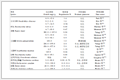
X-ray diffraction for complexes 1~2 was perfo-rmed on a Bruker SMART Apex Ⅱ CCD diffracto-meter operating at 50 kV and 30 mA using Mo Kα radiation (λ=0.071 073 nm) at room temperature. Data collection and reduction were performed using the APEX Ⅱ software[17]. Multi-scan absorption corrections were applied to all the data sets using SADABS[17]. The structures were solved by direct methods and refined by least squares on F2 using the SHELXTL program package[18]. All non-hydrogen atoms were located from Fourier map directly and refined anisotropically. Hydrogen atoms attached to carbon and oxygen were placed in geometrically idealized positions and refined using a riding model. For 1, the ethanol group (C10 and C11) and the free water molecule (O9) disordered, being split into two sets of positions with occupancy ratio of 0.50. Crystal data, as well as details of data collection and refinement for 1~2 are summarized in Table 1. Selected bond lengths and angles for the complexes are given in Table 2. H-bonding parameters for 1~2 are given in Table 3.
表 1
表 1
Crystal data and structure refinement information for complexes 1~2
Table 1.
Crystal data and structure refinement information for complexes 1~2
Symmetry codes:ⅱ -x, 1-y, 2-z;ⅲx, y, 1+z;ⅳx, 0.5-y, 0.5+z;ⅴ -1+x, 0.5-y, 0.5+z;ⅵ 1-x, -O.5+y, 1.5-z;ⅶ 1+x, 0.5-y, 0.5+z;ⅷ -x, 1-y, 1-z;ⅸ 1-x, 0.5+y, 0.5-z for 1;ⅱ 2-x, 1-y, z;ⅲ 1-x, 1-y, -z;ⅳ 1-x, 2-y, -z; vx, y, 1+z;ⅵ -1+x, y, 1+z for 2.
1.5
Catalysis experiments
The photocatalytic activity of 1~2 were tested using methyl orange solutions. The degradation reaction was carried out with 150 mL aqueous methyl orange solution (10 mg·L-1) containing 5 mg of sodium persulfate and 50 mg of 1 or 2 as catalyst[19]. The mixture was placed and stirred in a 250 mL beaker, which was 15 cm vertically below the visible-light source. The container and the light source were placed inside a black box to prevent visible-light leakage. The experiments were performed at 298 K and the pH value was adjusted to 3 with sulfuric acid (1 mol·L-1). The progress of the reaction was estimated by monitoring the absorbance characteristic of methyl orange at 506 nm. Aliquots of the reaction mixture were taken periodically during irradiation, and after filtration, they were analyzed by UV-Vis spectrophoto-metry. This procedure was repeated in the absence of coordination polymers as a blank experiment, and by using equivalent amounts of cobalt salt (cobalt(Ⅱ) nitrate hexahydrate) and cadmium salt (cadmium(Ⅱ) nitrate tetrahydrate) as catalysts instead of the coor-dination polymers as control experiment, respectively.
2.
Results and discussion
2.1
Structure description
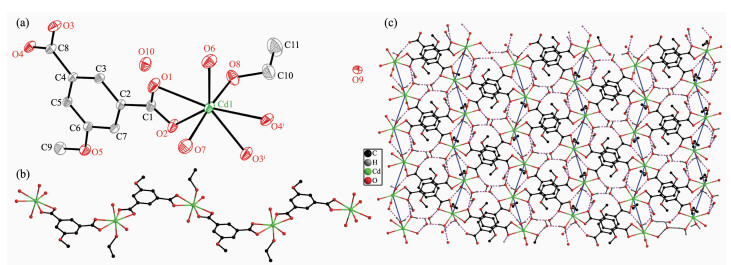
Single-crystal X-ray structure analysis reveals that 1 crystallizes in the P21/c space group and has a 1D wave-like chain structure. As shown in Fig. 1a, the asymmetric unit of 1 contains one Cd(Ⅱ) cation, one CH3O-ip anion, two aqua ligands, one ethanol ligand and two lattice water molecules. The seven-coordinated Cd(Ⅱ) center is surrounded by four carboxylate oxygen atoms from two different CH3O-ip anions, two aqua ligands and one ethanol ligand, to give a distorted pentagonal bipyramid geometry with Cd-O distances, and O-Cd-O bond angles ranging from 0.228 8(2) to 0.242 7(2) nm and from 53.96(7)° to 173.32(9)°, respectively, all of which are within the range of those found in other seven-coordinated Cd(Ⅱ) complexes with oxygen donating ligands[20-21].
图 1
图 1
(a) View of the asymmetric unit of 1 with atom labeling and 30% thermal ellipsoids; (b) View of the 1D wave-like chain of 1; (c) View of the 2D network of 1 formed by O-H…O hydrogen bonds
Figure 1.
(a) View of the asymmetric unit of 1 with atom labeling and 30% thermal ellipsoids; (b) View of the 1D wave-like chain of 1; (c) View of the 2D network of 1 formed by O-H…O hydrogen bonds
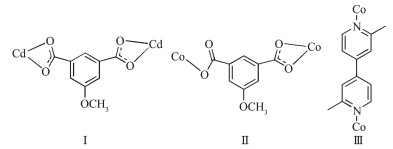
The coordination mode of CH3O-ip ligand in 1 is depicted in Scheme 1, the carboxylate groups adopt the μ2 bridging-chelating mode to connect two Cd centers. In this manner, the μ2-CH3O-ip ligands link Cd(Ⅱ) ions to give a wave-like chain with the ethanol molecules pointing alternately up and down (Fig. 1b). The adjacent Cd…Cd separation within the chain is 0.967 4 nm, and the angle of successive three cadmium ions is 141.40°. The chains are further extended into a layered structure through O-H…O hydrogen bonds involving the aqua ligand, the free water molecules and carboxylate oxygen atoms of CH3O-ip ligands (Fig. 1c, Table 3).
图 Scheme 1
图 Scheme 1
Coordination modes of CH3O-ip and dmbpy ligands in the structures of 1~2
Figure Scheme 1.
Coordination modes of CH3O-ip and dmbpy ligands in the structures of 1~2
Complex 2 crystallizes in the triclinic space group P1 and exhibits a 1D ladder-like infinite chain. The asymmetric unit of 2 includes a Co(Ⅱ) ion, half a dmbpy ligand, one CH3O-ip anion, two aqua ligands, one free water molecule and one acetonitrile molecule (Fig. 2a). Each Co(Ⅱ) center is six-coordinated by three carboxylate oxygen atoms from two different CH3O-ip ligands, one nitrogen atom from dmbpy ligand and two aqua ligands, adopting a distorted octahedral geometry with Co-O, Co-N distances and O-Co-O, O-Co-N bond angles ranging from 0.230 0(6) nm to 0.240 5(6) nm and from 53.81(18)° to 144.2(2)°, respectively, all of which are within the reasonable range of those reported for other six-coordinated Co(Ⅱ) complexes with oxygen and nitrogen donating ligands[22-23]. In the polymeric structure of 2, the CH3O-ip ligand adopt the μ2 bridging mode to connect two Co(Ⅱ) ions, whereas the dmbpy ligand acts as a trans-bidentate bridging mode to link pairs of Co(Ⅱ) ions (Scheme 1: modes Ⅱ and Ⅲ). The CH3O-ip ligands link the Co(Ⅱ) ions to construct an infinite chain with the separation of 1.010 2 nm between two Co(Ⅱ) ions, in which these chains are further connected into a ladder-like chain though dmbpy ligands (Fig. 2b). Finally, the chains are further extended into a 3D supramolecular structure through O-H…O, O-H…N and C-H…O weak hydrogen bonds involving the aqua ligands, acetonitrile mole-cules, carboxylate oxygen atoms of CH3O-ip ligands and the free water molecules (Fig. 2c, Table 3).
图 2
图 2
(a) View of the asymmetric unit of 2 with atom labeling and 30% thermal ellipsoids; (b) View of the 1D ladder chain of 2;
(c) View of the 3D supramolecular structure of 2 formed by O-H…O, O-H…N and C-H…O hydrogen bonds
Figure 2.
(a) View of the asymmetric unit of 2 with atom labeling and 30% thermal ellipsoids; (b) View of the 1D ladder chain of 2;
(c) View of the 3D supramolecular structure of 2 formed by O-H…O, O-H…N and C-H…O hydrogen bonds
The IR spectra of 1~2 were recorded as KBr pellets (Fig.S1). In the IR spectra, strong, broad bands at 3 402 cm-1 for 1 and 3 447 cm-1 for 2 can be assigned to the ν(O-H) stretching vibrations of the water mole-cules. The features at 1 555 and 1 371 cm-1 for 1, 1 699 and 1 279 cm-1 for 2, are associated with the asymmetric (C-O-C) and symmetric (C-O-C) stretching vibrations.
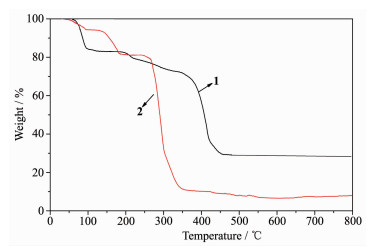
The TG curves of 1~2 are shown in Fig. 3. Complex 1 shows three weight loss steps. The first correspon-ding to the removal of three free water molecules and four aqua ligands is observed from 50 to 120 ℃ (Calcd. 15.16%, Obsd. 16.03%). The second corres-ponding to the removal of two ethanol ligands is observed from 170 to 300 ℃ (Calcd. 10.87%, Obsd. 11.02%). The third weight-loss step occurred above 350 ℃, which corresponds to the decomposition of the framework structure. Finally, complex 1 was completely degraded into CdO with total loss of 69.31% (Calcd. 69.09%). For complex 2, the weight loss in the temperature range of 50~100 ℃ corresponds to the removal of one lattice water molecule and one acetonitrile molecule (Calcd. 7.18%, Obsd. 7.30%). Then it follows a continuous weight loss from 130~180 ℃ attributed to the release of four aqua ligands (Calcd. 8.76%, Obsd. 8.90%). The complex begins to decompose when the temperature is raised to 250 ℃.
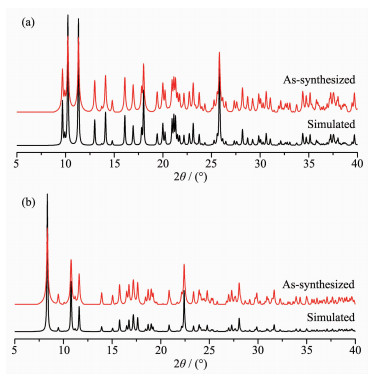
In order to check the purity of complexes 1~2, bulk samples were measured by powder X-ray diffraction at room temperature. As shown in Fig. 4, the peak positions of the experimental patterns are in good agreement with the simulated patterns based on the single-crystal structure, which clearly indicates the good purity of the complex.
图 4
图 4
PXRD patterns of complexes 1 (a) and 2 (b)
Figure 4.
PXRD patterns of complexes 1 (a) and 2 (b)
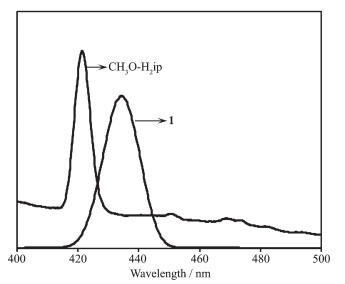
Luminescent properties of coordination polymers with d10 metal centers have attracted intense interest because of their potential applications[24-26]. Herein, we examined the luminescent property of 1 in the solid state at room temperature. As shown in Fig. 5, complex 1 display the maxima emission peaks at 433 nm under the excitation wavelengths of 275 nm. The short wavelength band at 433 nm of 1 are almost same as that of the free CH3O-H2ip ligand (λem=421 nm, λex=220 nm, Fig.S2), which suggests that the emissions of 1 probably originate from ligand centered π-π* transitions[27].
图 5
图 5
Emission spectra for complex 1 and CH3O-H2ip ligand in solid state at room temperature
Figure 5.
Emission spectra for complex 1 and CH3O-H2ip ligand in solid state at room temperature
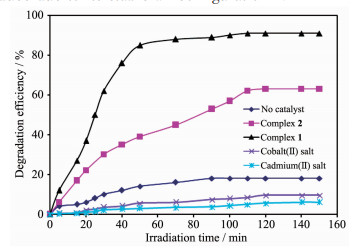
Herein, we tested complexes 1~2 as heterogen-eous catalysts to activate persulfate anions and to degrade methyl orange. The possible catalytic mecha-nism[28] was shown in Scheme 2. The photodegradation activity results of 1~2 are compared with the activity of control blank (i.e. non-catalytic). The progress of the catalysis degradation of methyl orange reaction was estimated by monitoring the absorbance chara-cteristic of methyl orange at 506 nm. As shown in Fig. 6, the degradation efficiency was 91.0% for 2 after 150 min, whereas that of 1 was 63.2% after 150 min, in contrast to the control experiments (without coor-dination polymers and with cobalt(Ⅱ), cadmium(Ⅱ) salts), which are 18.2%, 10.4% and 7.3%, respec-tively. The degradation efficiency of 1 is lower than 2, which may be due to their different metal centers and supramolecular network[29]. Compared to 1, 2 performs better at the beginning, the residual rate of methyl orange was decreased to 10% in the first 50 min. Subsequently, the reaction continued slowly and nearly ceased at the end. The activity of 1~2 in the degradation of methyl orange may be due to S2O82-, which can be transformed into sulfate radicals (SO4·-) by catalysis of 1~2, whilst M2+ was oxidized into M3+[30] (Scheme 2). The Cd(Ⅱ) ion is difficult to oxidize or reduce due to its stable d10 configuration[31].
In conclusion, two transition metals-based coor-dination polymers has been constructed based on 5-methoxyisophthalic acid, 2, 2′-dimethyl-4, 4′-bipyridine and metal salts under mixed solvents conditions and structurally characterized. Both of 1 and 2 show 1D infinite chain structures and further connected into 2D and 3D structures through weak hydrogen bonding interactions, respectively. Furthermore, 2 shows higher catalytic activities than 1 for the degradation of methyl orange dye in a Fenton-like process.
ChangHN, Hou S X, Cui G H, et al. J. Inorg. Organomet. Polym. Mater., 2017, 27:518-527 doi: 10.1007/s10904-016-0494-4
[30]
Qin L, Zheng X H, Xiao S L, et al. Trans. Met. Chem., 2013, 38:891-897 doi: 10.1007/s11243-013-9764-y
[31]
Zhao X X, Hao Z C, Hou S X, et al. J. Inorg. Organomet. Polym. Mater., 2017, 27:934-940 doi: 10.1007/s10904-017-0538-4
Figure 1
(a) View of the asymmetric unit of 1 with atom labeling and 30% thermal ellipsoids; (b) View of the 1D wave-like chain of 1; (c) View of the 2D network of 1 formed by O-H…O hydrogen bonds
Symmetry codes:ⅰ-x, -O.5+y, 1.5-z; Dashed line: O-H…O hydrogen bond
Figure 2
(a) View of the asymmetric unit of 2 with atom labeling and 30% thermal ellipsoids; (b) View of the 1D ladder chain of 2;
(c) View of the 3D supramolecular structure of 2 formed by O-H…O, O-H…N and C-H…O hydrogen bonds
Symmetry codes:ⅰ-1+x, y, z; Dashed line: O-H…O hydrogen bond


 下载:
下载:


 下载:
下载:


 下载:
下载:

