表 1
Selected crystallographic data for 1, 2 and (HL)ClO4·H2O
Table 1.
Selected crystallographic data for 1, 2 and (HL)ClO4·H2O

Li(Ⅰ)/Na(Ⅰ) Complexes and Perchlorate Salt of 2-(5-Chloroquinolin-8-yloxy)-1-(pyrrolidin-1-yl)ethanone: Syntheses, Crystal Structures and Fluorescence Properties
Pan-Dong MAO , Wei-Na WU , Miao YANG , Qing-Wen YANG , Yuan WANG


The complexes with the amide group have gained much attention due to their structural diversities, intriguing properties and applications in various fields[1-2]. Such ligands with flexible structure, could form stable complexes with varies of transition metal or rare earth metal ions[3-6]. To the best of our knowledge, however, the investigations on the complexes with main-group metal ions are relatively scarce. Thus, in this work, Li(Ⅰ)/Na(Ⅰ) complexes were obtained via the reaction of 2-(5-chloroquinolin-8-yloxy)-1-(pyrrolidin-1-yl)ethanone (L) with Li(Ⅰ)/Na(Ⅰ) perchlorate, which have been characterized by X-ray diffraction. In CH3CN solution, both complexes show similar fluorescence emission as L. However, under the same synthetic conditions, (HL) ClO4·H2O was accidentally produced in the case of Al(Ⅲ) perchlorate, which exhibits quite different fluorescence spectra from that of L.
Solvents and starting materials for synthesis were purchased commercially and used as received. Elemental analysis was carried out on an Elemental Vario EL analyzer. The IR spectra (ν=4000~400 cm-1) were determined by the KBr pressed disc method on a Bruker V70 FTIR spectrophotometer. The UV spectra were recorded on a Purkinje General TU-1800 spectrophotometer. Fluorescence spectra were determined on a Varian CARY Eclipse spectrophotometer, in the measurements of emission and excitation spectra the pass width is 5 nm.
The ligand L[7-8] (0.1 mmol) and LiClO4, NaClO4 or Al(ClO4)3 (0.1 mmol) were dissolved in the ethyl acetate/acetone (10 mL, 1:2, V/V) solution, respectively. The mixture was filtered and spontaneously volatilized at room temperature to obtain crystals of 1, 2 and (HL)ClO4·H2O, respectively.
1: Colorless needles. Anal. Calcd. for C30H30Cl3LiN4O8(%): C, 52.38; H, 4.40; N, 8.14. Found(%): C, 52.27; H, 4.52; N, 7.9. FT-IR (cm-1): ν(C=O) 1 650, ν(C=N) 1 588, ν(Ar-O-C) 1 236.
2: Colorless plates. Anal. Calcd. for C30H30Cl3NaN4O8(%): C, 51.19; H, 4.30; N, 7.96. Found(%): C, 51.07; H, 4.45; N, 7.78. FT-IR (cm-1): ν(C=O) 1 656, ν(C=N) 1 593, ν(Ar-O-C) 1 238.
(HL)ClO4·H2O: Yellow rods. Anal. Calcd. for C15H15Cl2N2O7(%): C, 44.35; H, 3.72; N, 6.90. Found(%): C, 44.13; H, 3.96; N, 6.67. FT-IR (cm-1): ν(C=O) 1 641, ν(C=N) 1 594, ν(Ar-O-C) 1 231.
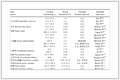
The X-ray diffraction measurements for 1, 2 and (HL)ClO4·H2O were performed on a Bruker SMART APEX Ⅱ CCD diffractometer equipped with a graphite monochromatized Mo Kα radiation (λ=0.071 073 nm) by using φ-ω scan mode. Semi-empirical absorption correction was applied to the intensity data using the SADABS program[9]. The structures were solved by direct methods and refined by full matrix least-square on F2 using the SHELXTL-97 program[10]. All non-hydrogen atoms were refined anisotropically. The C13 and C14 atoms of 1 occupied two positions, with the occupancy value of C13(C14)/C13B(C14B) being 0.692/0.308. The similar feature of C14 atom in 2 is observed, with the occupancy value of C14/C14B being 0.717/0.283. The H atoms for water molecule in (HL)ClO4·H2O are located from difference Fourier map and refined with restraints in bond length and thermal parameters. All the other H atoms were positioned geometrically and refined using a riding model. Details of the crystal parameters, data collection and refinements for 1, 2 and (HL)ClO4·H2O are summarized in Table 1.
 下载:
导出CSV
下载:
导出CSV
| 1 | 2 | (HL)C1O4-H2O | |
| Empirica1 formu1a | C30H30Cl3LiN4O8 | C30H30Cl3NaN4O8 | C15H15C12N2O7 |
| Formu1a weight | 687.87 | 703.92 | 409.21 |
| T/K | 296(2) | 296(2) | 296(2) |
| Crysta1 system | Monoc1inic | Monoc1inic | Tric1inic |
| Space group | P2/n | P2/n | P1 |
| a/nm | 1.315 4(2) | 1.393 5(3) | 0.704 0(2) |
| b/nm | 0.923 66(13) | 0.866 26(16) | 0.902 8(3) |
| c/nm | 1.428 0(2) | 1.299(3) | 1.457 8(5) |
| α/(°) | 114.440(2) | 112.796(3) | 99.866(6) |
| β/(°) | 102.255(7) | ||
| γ/(°) | 96.336(6) | ||
| V/nm3 | 1.579 5(4) | 1.591 3(5) | 0.881 6(5) |
| Z | 2 | 2 | 2 |
| Dc/(g·cm-3) | 1.446 | 1.469 | 1.542 |
| F(000) | 712 | 728 | 424 |
| Unique reflections (Rint) | 2 673 (0.026 8) | 2 805 (0.021 3) | 3 084 (0.023 0) |
| Goodness-of-fit (GOF) on F2 | 1.068 | 1.093 | 1.050 |
| Final R indices [I > 2σ(I)] | R1=0.049 7, wR2=0.129 1 | R1=0.038 8, wR2=0.100 0 | R1=0.067 4, wR2=0.187 5 |
| R indices (all data) | R1=0.062 5, wR2=0.140 2 | R1=0.055 3, wR2=0.110 6 | R1=0.100 5, wR2=0.214 2 |
CCDC: 1573564, 1; 1573565, 2; 1573566, (HL)ClO4·H2O.
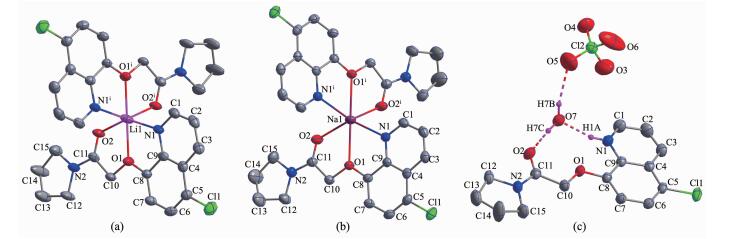
A diamond drawing of 1, 2 and (HL)ClO4·H2O is shown in Fig. 1. Selected bond distances are summarized in Table 2. Complexes 1 and 2 are isostructural and crystallize in the monoclinic, space group P2/n. Thus the structure of 1 is discussed in detail for an example. As shown in Fig. 1a, the asymmetric unit of 1 contains a half of coordination cation with the Li(Ⅰ) ion lying on the two-fold rotate axis, and a half of free perchlorate anion for charge balance. The Li(Ⅰ) ion in 1 is surrounded by two acetamide ligands with N2O4 donor set, thus giving a distorted octahedron geometry[11-12]. As expected, there exist no classic hydrogen bonds in both complexes.
 下载:
导出CSV
下载:
导出CSV
| 1 | ||||||
| Li1-O1 | 0.212 84(16) | Li1-O2 | 0.207 9(4) | Li1-N1 | 0.226 4(5) | |
| O2i-Li1-O2 | 103.0(3) | O1i-Li1-O1 | 173.4(4) | O2-L11-O1i | 109.95(16) | |
| O2-Li1-O1 | 74.35(10) | O1-Li1-N1 | 72.11(11) | O2-L11-N1i | 87.76(7) | |
| N1-Li1-N1i | 100.8(3) | O1-L11-N1i | 103.53(17) | O2-Li1-N1 | 146.45(7) | |
| 2 | ||||||
| Na1-O1 | 0.245 27(14) | Na1-O2 | 0.229 85(19) | Na1-N1 | 0.247 1(2) | |
| O2i-Na1-O2 | 112.97(12) | O1i-Na1-O1 | 178.09(10) | O2-Na1-N1 | 130.95(6) | |
| O2-Na1-O1i | 114.89(6) | O2-Na1-N1i | 86.57(6) | O1-Na1-N1 | 64.71(5) | |
| O2-Na1-O1 | 66.27(5) | O1-Na1-N1i | 114.16(6) | N1i-Na1-N1 | 114.73(10) | |
| (HL)ClO4·H2O | ||||||
| N1-C1 | 0.129 6(6) | N1-C9 | 0.135 8(5) | O1-C8 | 0.135 0(5) | |
| O1-C10 | 0.142 1(5) | O2-C11 | 0.122 2(5) | N2-C11 | 0.131 7(6) | |
| Symmetry codes: i -x+1/2, y, -z+3/2 for 1 and 2. | ||||||
In (HL)ClO4·H2O, the distances of C=N and C=O are slightly shorter than those in 1 and 2, probably due to the protonation of quinoline N atom and the formation of hydrogen bonds, respectively. In the crystal, the cation (HL)+ and free perchlorate anion are linked by crystal water molecule via intermolecular N-H…O (N1-H1A…O7, with D…A distance being 0.261 1(5) nm, D-H… A angle being 163.0°) and O-H…O hydrogen bonds (O7-H7C…O2, with D…A distance being 0.267 3(5) nm, D-H…A angle being 173.0°; O7-H7B…O5, with D…A distance being 0.295 3(4) nm, D-H…A angle being 160.0°).
The spectral regions for both complexes are more or less similar due to the similarity in coordination modes of the ligand with the metal centre. The free ligand L exhibit three absorption bands at 1 682, 1 598 and 1 241 cm-1, assigned to ν(C=O), ν(C=N) and ν(C-O-C), respectively[13-16]. However, in complexes 1 and 2, such three absorption bands shift evidently to lower frequency, indicating that the oxygen atoms of the carbonyl group, quinoline nitrogen atoms and ethereal oxygen atoms take part in coordination to the central metal ion. In addition, compared with that of the ligand, the stretching vibration frequency of the C=O (at 1 641 cm-1) and C=N (at 1 594 cm-1) of (HL)ClO4·H2O shifted by 41 cm-1 and 4 cm-1, indicating the existence of hydrogen bonds involving carbonyl group and the protonation of the quinoline nitrogen atom[17].
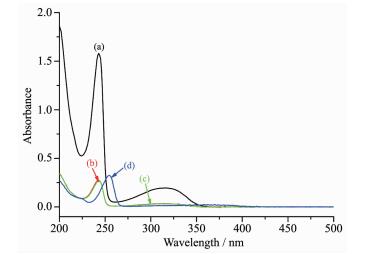
The UV spectra of 1, 2 and (HL)ClO4·H2O in CH3CN solution (concentration: 10 μmol·L-1) were measured at room temperature (Fig. 2). The spectra of L features two main band located around 244 nm(ε=156 000 L·mol-1·cm-1) and 316 nm (ε=19 500 L·mol-1 ·cm-1), which could be assigned to characteristic π-π* transition centered on quinoline ring and the acetamide unit, respectively[18]. Similar bands are observed in 1 (242 nm, ε=26 948 L·mol-1·cm-1; 314 nm, ε=3 389 L·mol-1·cm-1) and 2 (243 nm, ε=26 072 L·mol-1·cm-1; 314 nm, ε=3 198 L·mol-1·cm-1). The hyperchromicities indicate that the ligand L take part in the coordination in 1 and 2. However, a significant red-shift (254 nm, ε=32 400 L·mol-1·cm-1; 371 nm, ε=1 850 L·mol-1·cm-1) can be observed in the case of (HL)ClO4·H2O, probably due to the protonation of quinoline N atom[19].
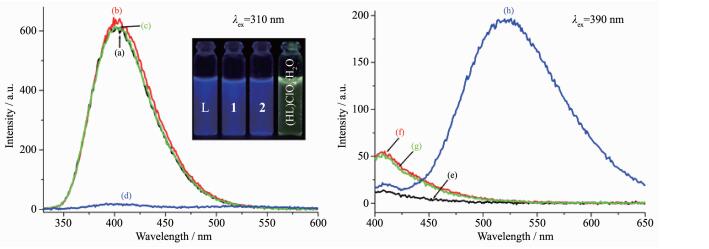
The fluorescence spectra of 1, 2 and (HL)ClO4·H2O in CH3CN solution (concentration: 10 μmol·L-1) were measured at room temperature (Fig. 3). When excited at 310 nm, complexes 1 and 2 show a broad emission at 403 nm as the free ligand L[18], while (HL)ClO4·H2O exhibits almost no emission under the same tested conditions (Fig. 3A). On the contrary, (HL)ClO4·H2O could display intense green emission (at 525 nm) observed by naked eyes at excitation of 390 nm (Fig. 3B). The protonation of nitrogen atoms can greatly enhance the electron-withdrawing ability of quinoline, which may lead to a little bit delocalize. Meanwhile, the delocalization of the electron cloud density can help to stabilize the molecules in the excited states, which is contributed to the shifts of the fluorescence spectra to longer wavelength[20].
Song X Q, Wen X G, Liu W S, et al. J. Solid State Chem., 2010, 183:1-9 doi: 10.1016/j.jssc.2009.07.062
Binnemans K. Coord. Chem. Rev., 2015, 295:1-45 doi: 10.1016/j.ccr.2015.02.015
Yan Z Z, Hou N, Wang C M. Spectrochim. Acta A, 2015, 137:1265-1269 doi: 10.1016/j.saa.2014.09.035
Song X Q, Xing D Y, Lei Y K, et al. Inorg. Chim. Acta, 2013, 404:113-122 doi: 10.1016/j.ica.2013.04.004
Song X Q, Wang Y W, Zheng J R, et al. Spectrochim. Acta A, 2007, 68:701-704 doi: 10.1016/j.saa.2006.12.048
Wu W N, Tang N, Yan L. J. Fluoresc., 2008, 18:101-107 doi: 10.1007/s10895-007-0244-7
Wu W N, Yuan W B, Tang N, et al. Spectrochim. Acta A, 2006, 65:912-918 doi: 10.1016/j.saa.2006.01.031
毛盼东, 陈亮, 吴伟娜, 等.无机化学学报, 2016, 32(2):336-342 http://www.wjhxxb.cn/wjhxxbcn/ch/reader/view_abstract.aspx?flag=1&file_no=20160219&journal_id=wjhxxbcnMAO Pan-Dong, CHEN Liang, WU Wei-Na, et al. Chinese J. Inorg. Chem., 2016, 32(2):336-342 http://www.wjhxxb.cn/wjhxxbcn/ch/reader/view_abstract.aspx?flag=1&file_no=20160219&journal_id=wjhxxbcn
Sheldrick G M. SADABS, University of Göttingen, Germany, 1996.
Sheldrick G M. SHELX-97, Program for the Solution and the Refinement of Crystal Structures, University of Göttingen, Germany, 1997.
Huang Y Q, Zhao W, Chen J G, et al. Z. Anorg. Allg. Chem., 2012, 638:679-682 doi: 10.1002/zaac.v638.3/4
Huang Y Q, Wan Y, Chen H Y, et al. New J. Chem., 2016, 40:7587-7595 doi: 10.1039/C6NJ01231K
Wu W N, Tang N, Yan L. Spectrochim. Acta A, 2008, 71: 1461-1465 doi: 10.1016/j.saa.2008.05.001
Wu W N, Cheng F X, Yan L, et al. J. Coord. Chem., 2008, 61:2207-2215 doi: 10.1080/00958970801901329
毛盼东, 徐君, 吴伟娜, 等.无机化学学报, 2016, 32(4):677-682 doi: 10.11862/CJIC.2016.079MAO Pan-Dong, XU Jun, WU Wei-Na, et al. Chinese J. Inorg. Chem., 2016, 32(4):677-682 doi: 10.11862/CJIC.2016.079
叶行培, 吴伟娜, 李飞飞, 等.无机化学学报, 2013, 29(13):2678-2682 http://www.wjhxxb.cn/wjhxxbcn/ch/reader/view_abstract.aspx?flag=1&file_no=20131228&journal_id=wjhxxbcnYE Xing-Pei, WU Wei-Na, LI Fei-Fei, et al. Chinese J. Inorg. Chem., 2013, 29(13):2678-2682 http://www.wjhxxb.cn/wjhxxbcn/ch/reader/view_abstract.aspx?flag=1&file_no=20131228&journal_id=wjhxxbcn
徐木生, 庄峙厦, 孙大海, 等.光谱学与光谱分析, 1999, 19(4):556-558 http://kns.cnki.net/KCMS/detail/detail.aspx?filename=guan904.013&dbname=CJFD&dbcode=CJFQXU Mu-Sheng, ZHUANG Zhi-Xia, SUN Da-Hai, et al. Spectroscopy and Spectral Analysis, 1999, 19(4):556-558 http://kns.cnki.net/KCMS/detail/detail.aspx?filename=guan904.013&dbname=CJFD&dbcode=CJFQ
Song X Q, Zang Z P, Liu W S, et al. J. Solid State Chem., 2009, 182:841-848 doi: 10.1016/j.jssc.2008.12.025
郝勇静, 谢娟, 殷晓茹.西北大学学报:自然科学版, 2016, 52(5):64-67 http://kns.cnki.net/KCMS/detail/detail.aspx?filename=xbsf201605015&dbname=CJFD&dbcode=CJFQHAO Yong-Jing, XIE Juan, YIN Xiao-Ru. Journal of Northwest University: Nature Science, 2016, 52(5):64-67 http://kns.cnki.net/KCMS/detail/detail.aspx?filename=xbsf201605015&dbname=CJFD&dbcode=CJFQ
Ma S Q, Zhang J B, Liu Y J, et al. J. Phys. Chem. Lett., 2017, 8:3068-3072 doi: 10.1021/acs.jpclett.7b01454

Figure 1 Diamond drawing of 1 (a), 2 (b) and (HL)ClO4·H2O (c) with 30% thermal ellipsoids
Disordered perchlorate anion and carbon atoms are not shown for clarity in (a) and (b); Symmetry codes: i -x+1/2, y, -z+3/2 for 1 and 2

Figure 2 UV spectra of L (a), 1 (b), 2 (c) and (HL)ClO4·H2O (d) in CH3CN solution at room temperature
c=10 μmol·L-1

Figure 3 Fluorescence emission spectra of L (a, e), 1 (b, f), 2 (c, g), and (HL)ClO4·H2O (d, h) in CH3CN solution at room temperature excited at different wavelengths
c=10 μmol·L-1; Inset: solution colour of L, 1, 2, and (HL)ClO4·H2O under 365 nm UV lamp
Table 1. Selected crystallographic data for 1, 2 and (HL)ClO4·H2O
| 1 | 2 | (HL)C1O4-H2O | |
| Empirica1 formu1a | C30H30Cl3LiN4O8 | C30H30Cl3NaN4O8 | C15H15C12N2O7 |
| Formu1a weight | 687.87 | 703.92 | 409.21 |
| T/K | 296(2) | 296(2) | 296(2) |
| Crysta1 system | Monoc1inic | Monoc1inic | Tric1inic |
| Space group | P2/n | P2/n | P1 |
| a/nm | 1.315 4(2) | 1.393 5(3) | 0.704 0(2) |
| b/nm | 0.923 66(13) | 0.866 26(16) | 0.902 8(3) |
| c/nm | 1.428 0(2) | 1.299(3) | 1.457 8(5) |
| α/(°) | 114.440(2) | 112.796(3) | 99.866(6) |
| β/(°) | 102.255(7) | ||
| γ/(°) | 96.336(6) | ||
| V/nm3 | 1.579 5(4) | 1.591 3(5) | 0.881 6(5) |
| Z | 2 | 2 | 2 |
| Dc/(g·cm-3) | 1.446 | 1.469 | 1.542 |
| F(000) | 712 | 728 | 424 |
| Unique reflections (Rint) | 2 673 (0.026 8) | 2 805 (0.021 3) | 3 084 (0.023 0) |
| Goodness-of-fit (GOF) on F2 | 1.068 | 1.093 | 1.050 |
| Final R indices [I > 2σ(I)] | R1=0.049 7, wR2=0.129 1 | R1=0.038 8, wR2=0.100 0 | R1=0.067 4, wR2=0.187 5 |
| R indices (all data) | R1=0.062 5, wR2=0.140 2 | R1=0.055 3, wR2=0.110 6 | R1=0.100 5, wR2=0.214 2 |
 下载: 导出CSV
Table 2. Selected bond lengths (nm) and angles (°) in 1, 2 and (HL)ClO4·H2O
| 1 | ||||||
| Li1-O1 | 0.212 84(16) | Li1-O2 | 0.207 9(4) | Li1-N1 | 0.226 4(5) | |
| O2i-Li1-O2 | 103.0(3) | O1i-Li1-O1 | 173.4(4) | O2-L11-O1i | 109.95(16) | |
| O2-Li1-O1 | 74.35(10) | O1-Li1-N1 | 72.11(11) | O2-L11-N1i | 87.76(7) | |
| N1-Li1-N1i | 100.8(3) | O1-L11-N1i | 103.53(17) | O2-Li1-N1 | 146.45(7) | |
| 2 | ||||||
| Na1-O1 | 0.245 27(14) | Na1-O2 | 0.229 85(19) | Na1-N1 | 0.247 1(2) | |
| O2i-Na1-O2 | 112.97(12) | O1i-Na1-O1 | 178.09(10) | O2-Na1-N1 | 130.95(6) | |
| O2-Na1-O1i | 114.89(6) | O2-Na1-N1i | 86.57(6) | O1-Na1-N1 | 64.71(5) | |
| O2-Na1-O1 | 66.27(5) | O1-Na1-N1i | 114.16(6) | N1i-Na1-N1 | 114.73(10) | |
| (HL)ClO4·H2O | ||||||
| N1-C1 | 0.129 6(6) | N1-C9 | 0.135 8(5) | O1-C8 | 0.135 0(5) | |
| O1-C10 | 0.142 1(5) | O2-C11 | 0.122 2(5) | N2-C11 | 0.131 7(6) | |
| Symmetry codes: i -x+1/2, y, -z+3/2 for 1 and 2. | ||||||
下载: 导出CSV

 扫一扫看文章


扫一扫关注我们
 下载:
下载: