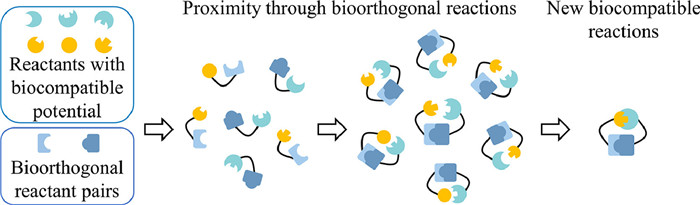
Scheme 1.
A schematic illustration of a bioorthogonal platform for discovering proximity-induced biocompatible reactions.

A biocompatible Horner-Wadsworth-Emmons (HWE) reaction triggered by a bioorthogonal proximity-induced platform
Yayue Wang , Haojie Yang , Jie Li , Qiao Kong , Siming Zhou , Hongbao Sun , Lili Pan , Qiyong Gong , Ping Feng , Haoxing Wu


Biocompatible reactions, such as those used for labeling molecules or influencing chemical reactions in situ, are extremely useful for understanding and modulating cellular and molecular processes [1-3]. However, designing such reactions is a challenge. They must occur chemo-selectively in a physiological milieu, even when the reactants are present at low concentrations, and the resulting products must be non-toxic. Additionally, the reaction must not interfere with native processes. Therefore, the reactants should ideally be inert towards all components in the physiological milieu except the intended bioorthogonal partner [2,4]. Fulfilling these requirements is quite challenging, which explains why relatively few bioorthogonal reactions have been discovered so far, despite the growing demand for them in biomedicine [5-9].
One way to achieve such reactions is to rely on reactants that do not normally occur in vivo. This is the strategy behind Staudinger ligation [10], strain-promoted [3 + 2] reactions [11], inverse electron-demand Diels-Alder (IEDDA) reactions [12,13], and photoinducible bioorthogonal chemistry [14-16]. Another way to achieve biocompatible reactions is to bring the reactants close enough together and keep them in proximity so that the desired reaction occurs before any side reactions. This is the strategy behind nucleic acid-templated reactions [17-22], ligand-biomolecule interactions [23-26], and non-covalent click chemistry [27]. While promising, this strategy of “proximity-induced” reactions usually requires the use of specific ligands or toxic transfection reagents. Therefore, a more flexible and non-toxic platform is needed for designing and optimizing proximity-induced biocompatible reactions.
We hypothesized that a small molecular bioorthogonal reactant pair, modified with suitable functional groups, could serve as an effective platform (Scheme 1). In particular, we focused on loading desired reactants onto tetrazine and dienophile, positioning them close to each other following tetrazine bioorthogonal cycloaddition. This strategy allowed us to utilize recent synthetic advances in unsymmetric tetrazines to generate desired reaction precursors with tunable physicochemical properties [28-30]. We reacted these precursors with various dienophiles, resulting in cycloadducts with varying bulk and microenvironment properties.
To demonstrate the feasibility of our platform, we focused on the Horner-Wadsworth-Emmons (HWE) reaction as a potential biocompatible reaction for three reasons. Firstly, the rate-limiting step is typically the nucleophilic attack of the carbanion on the aldehyde, which could be accelerated by increasing the chances of collisions [31,32]. Secondly, both reactant aldehydes and phosphonates are reasonably stable in physiological environments. Lastly, this carbon-carbon double bond-forming reaction could be used to generate a fluorophore in situ.
Tetrazine bioorthogonal ligation is a well-established, highly biocompatible reaction for tagging molecules in living cells and organisms [12,13]. Tetrazines can undergo IEDDA reactions with various dienophiles, producing cycloadducts with tunable kinetics [4-9,12,13]. Therefore, we explored tetrazine ligation involving stable, water-soluble tetrazine and dienophiles as the basis for developing biocompatible HWE reactions. Our plan was to attach the phosphonate to the tetrazine and the aldehyde to the dienophile, so that the resulting cycloadduct would bring the two reactants close enough together to react rapidly under mild aqueous conditions.
We initiated our research by designing and synthesizing a series of phosphonates and aldehydes (Fig. 1A). Initially, we synthesized four tetrazine methylphosphonates 1A–1D, with varying electronic properties, employing the synthetic approach reported earlier [28]. We expected that the strongly electron-withdrawing tetrazine group would stabilize the carbanion intermediate and facilitate elimination. Subsequently, we synthesized a range of water-soluble aldehydes (2a–2l), that comprised three dienophiles and differed in size, reactivity [33] and lengths of flexible polyethylene glycol (PEG) linker.
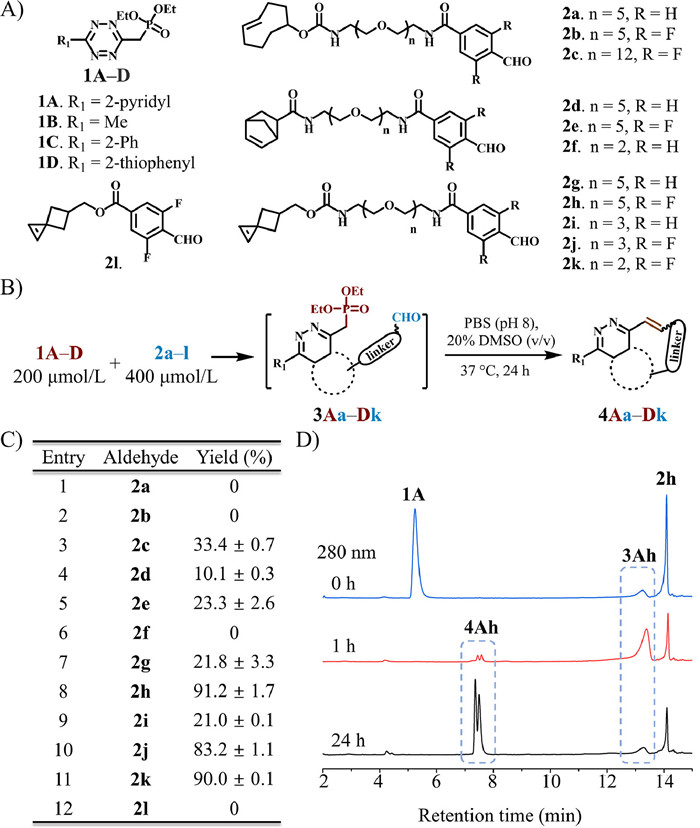
First, we attempted to react various aldehydes 2a–2l with pyridyl-tetrazine phosphonate 1A in phosphate-buffered saline (PBS) at a pH of 8.0 (Fig. 1B). Aldehydes 2a and 2b, which had a bulky dienophile trans-cyclooctene (TCO), reacted rapidly with 1A to produce cycloadduct 3Aa–3Ab. However, we did not observe subsequent HWE reactions for 3Aa and 3Ab (Fig. 1C, lines 1 and 2). By replacing TCO with the smaller norbornene 2d, we obtained HWE product 4Ad in 10.1% yield after 24 h. The use of more reactive 2,6-difluoro-benzaldehyde 2e improved the HWE yield to 23.3%. Additionally, employing spirohexene as a “handle” of minimal bulk [34] led to a similar HWE yield when benzaldehyde 2g was used (21.8%). Furthermore, a nearly complete transformation was achieved with 2h, which contained a more reactive aldehyde (91.2%, Fig. 1D). The confirmation of reaction products and yields was conducted through high performance liquid chromatography (HPLC) and high-resolution mass spectrometry (Figs. S1–S24 in Supporting information).
We have also discovered that an appropriate linker length, allowing for molecular collision flexibility, is crucial for the HWE reaction. Moreover, bulkier cycloadducts often require longer linkers to facilitate the occurrence of the HWE reaction. For example, when aldehyde 2c, which contains a twelve-unit PEG linker, was used, the HWE product 4Ac was obtained with a yield of 33.4% after 24 h (Fig. 1C, line 3). On the other hand, aldehydes 2j and 2k, featuring short PEG linkers and a compact spirohexene handle, underwent successful reactions when treated with 1A, resulting in the formation of the desired HWE products with excellent yields (Fig. 1C, lines 10 and 11). In contrast, no HWE product was observed for aldehydes 2f and 2l, which have shorter linker lengths and limited flexibility.
To explain these reactivity patterns, we modelled the energetics of the HWE reaction of 3Aa, 3Ag, and 3Ah. The reaction involving 3Aa required a higher activation free energy than the reaction involving the spirohexene-substituted benzaldehyde, 3Ag (Fig. 2A). This observation aligns with our experimental results. The optimized transition state structures indicated that the presence of spiro rings in 3Ag and 3Ah distorted the molecule, allowing the neighboring amino group to interact with the oxygen anion in transition state Ⅱ. This interaction serves to stabilize the transition state, thereby lowering the activation barrier (Fig. S59 in Supporting information). Furthermore, the activation barrier appears to be even smaller for the reaction involving 3Ah than for the reaction involving 3Ag. This may be due to the electron-withdrawing difluoro-substitution, which enhances the positivity charge on the carbonyl carbon, thereby increasing the reactivity.
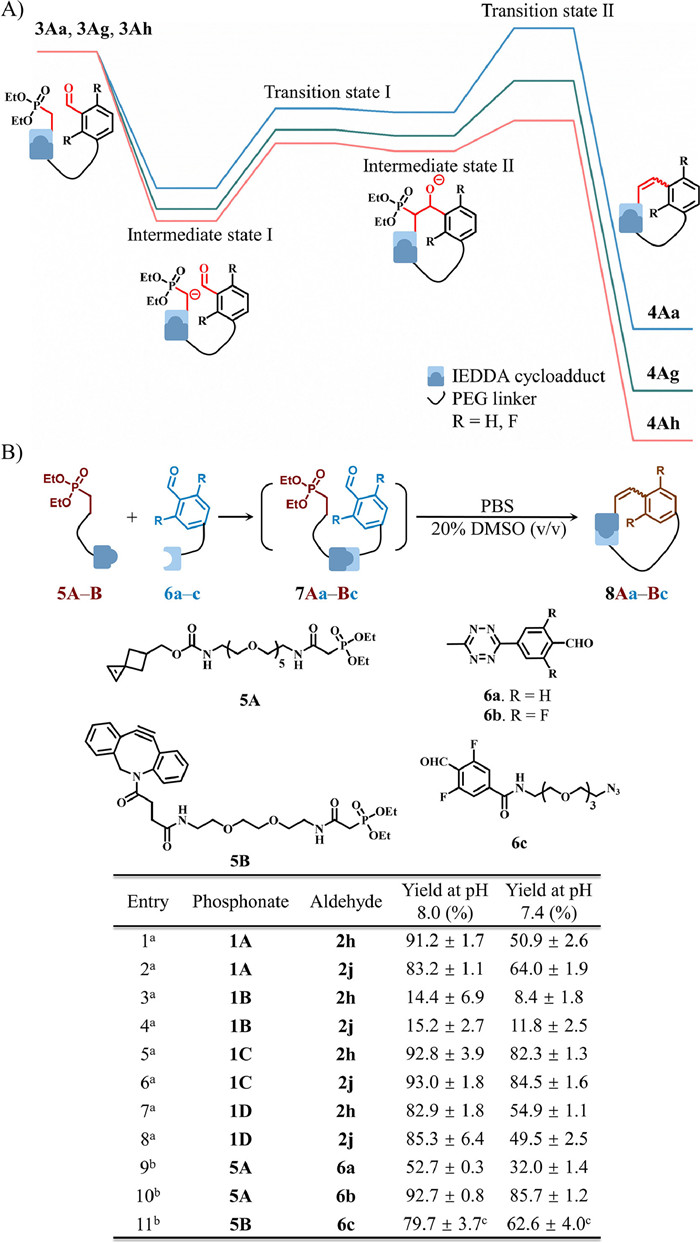
These results demonstrated the feasibility of our proximity-induced reaction design. We then focused on evaluating the generality of the HWE reaction using various phosphonates and aldehydes. Phosphonates 1B–1D bearing different groups on the tetrazine, were incubated under the same conditions with aldehydes 2h or 2j and monitored by liquid chromatography-mass spectroscopy (LC-MS) (Figs. S25–S43 in Supporting information). Generally, tetrazines with aromatic substituents (1A, 1C, and 1D) performed well, yielding over 80% (Fig. 2B). Phenyl-tetrazine 1C provided the highest yield of 93.0%. However, replacing the aromatic group with a methyl group resulted in an HWE yield of less than 15%. Most of the reactants underwent a slow side reaction of hydrazone ligation [35] between the aldehyde and a dihydro-pyridazine intermediate, as indicated by HPLC and high-resolution mass spectrometry (Figs. S25–S31 in Supporting information). This suggests that the intramolecular interaction, such as π-π stacking between benzaldehyde and aromatic substituents can promote the HWE reaction.
We have confirmed that our reaction can proceed at physiological pH by treating 2h and 2j with phosphonates in PBS at pH 7.4. All phosphonates with aryl substitutions on tetrazine produced HWE products in good yields, albeit slightly lower than the yields at alkaline pH, with phenyl-tetrazine 1C again giving the highest yield (Fig. 2B).
To further investigate the general applicability of the HWE reaction in diverse microenvironments, we synthesized two phosphates: containing spirohexene (5A) and dibenzocyclooctyne (5B) respectively. We also prepared the corresponding partners, tetrazine-aldehydes (6a and 6b) and azide-aldehyde (6c, Fig. 2B), and monitored the reactions by HPLC. 5A exhibited excellent HWE yield when reacted with 6b (92.7%, Fig. 2B). Furthermore, we observed a respectable yield of 79.7% for the HWE reaction facilitated by azide-alkyne click cycloaddition (Fig. 2B). These results imply that the HWE reaction holds potential for occurrence in various biomolecular circumstances.
To investigate whether this HWE reaction involving a π conjugate system could generate a fluorophore in situ [36,37], we conducted further examination. The HWE products displayed significantly fluorescence turn-on than the reactants (Figs. S50–S55 in Supporting information) [38,39]. For instance, illuminating the precursor 1C with a ultraviolet-visible spectroscopy (UV) lamp resulted in negligible fluorescence, whereas illuminating the HWE product 4Cj induced bright blue fluorescence with a turn-on ratio of 83 (Fig. 3A).
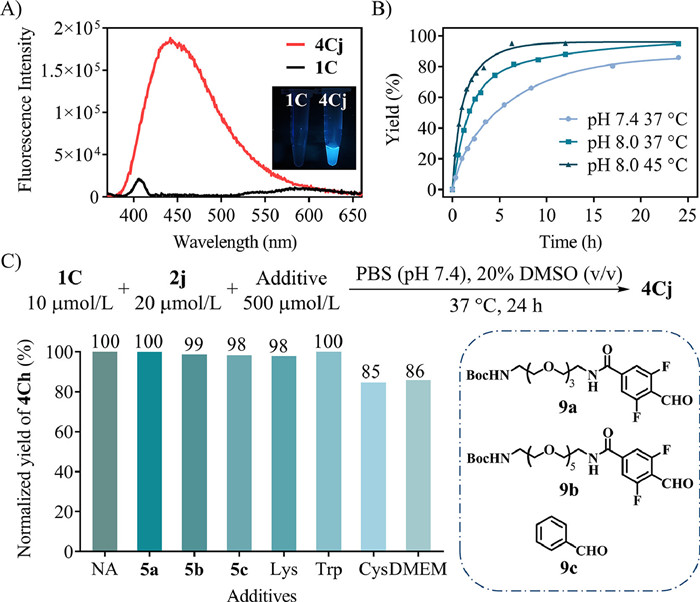
We explored whether the HWE reaction could occur rapidly enough for biomedical applications. Our results demonstrate that the HWE reaction of 1C with 2j has a half-life of 3.6 h at pH 7.4 and 1.6 h at pH 8.0 (Fig. 3B). We assume that the rapid second-order rate constant of the first tetrazine ligation step ensures efficient reaction even at sub-micromolar concentrations [34]. Interestingly, slightly raising the reaction temperature to 45 ℃ shortened the HWE half-life at pH 8.0 to 54 min (Table S1 in Supporting information).
To confirm the selectivity of our strategy, we incubated compound 1C in the presence of a large excess of dissociative aldehydes 9a–9c, but we did not observe any intermolecular HWE product (Fig. S57 in Supporting information). Next, we incubated 1C with 2j and an excess of dissociative aldehydes. We obtained only proximity-induced HWE product in similar yield as in the absence of the dissociative aldehydes (Fig. 3C). We obtained similar results when we performed the reaction in culture medium or in buffer containing biologically relevant nucleophiles such as amines or thiols (Fig. 3C). These findings indicate that the HWE reaction is biocompatible and depends only on the reactant proximity created in the previous tetrazine bioorthogonal reaction.
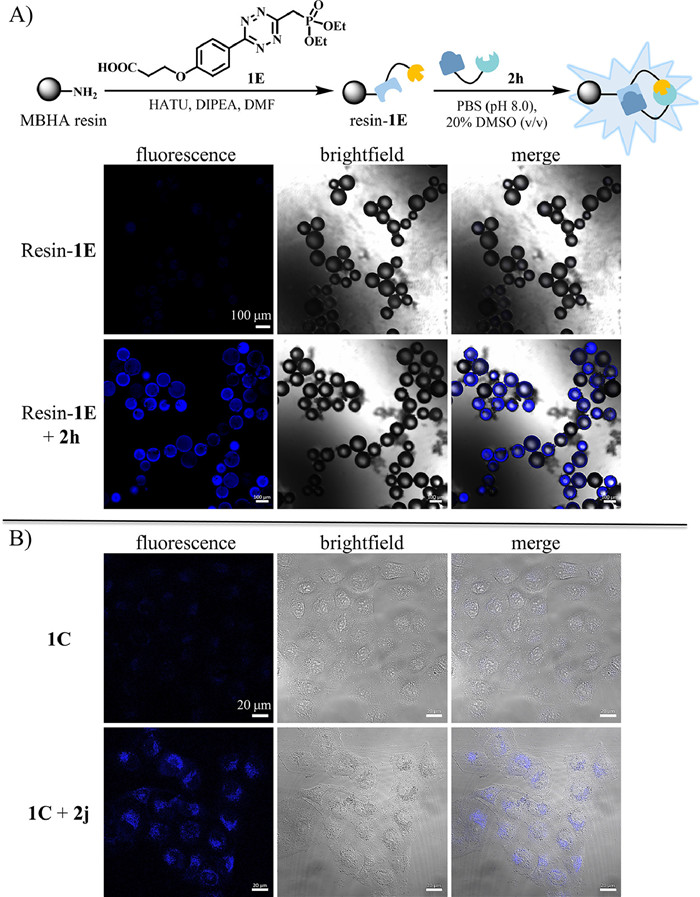
Finally, we applied our strategy to generate molecular fluorophores in the presence of live cells. To test this in vitro, we decorated 4-methylbenzhydrylamine (MBHA) resin beads with tetrazine-phosphonate 1E and incubated them with 2h or buffer as a negative control. After 3 h of incubation, the decorated beads showed strong fluorescence, while control beads showed minimal background signal (Fig. 4A). Encouraged by this success, we incubated HeLa cells with 1C and 2j for 6 h, or with only 1C as a negative control. We then imaged the cells using confocal laser scanning microscopy. The control cells displayed only background fluorescence, whereas the cells incubated with 1C and 2j showed robust fluorescence, indicating the successful performance of the HWE reaction in the presence of live cells (Fig. 4B). In addition, neither the reactants nor the product affected cell viability after 24 h of incubation at the concentrations used in imaging (Fig. S58 in Supporting information).
In conclusion, our study presents a novel approach to developing biocompatible reactions based on bioorthogonal chemistry, utilizing an intramolecular cascade reaction. Our method employs tetrazine bioorthogonal chemistry to bring the desired reactants into proximity, facilitating the HWE reaction, which typically occurs under anhydrous conditions, proceeds rapidly and efficiently under physiological conditions and within diverse molecular contexts. The reaction yield is influenced by various factors, including the steric effects surrounding the HWE reactants, the length of the flexible linker, the reactivity of the aldehyde, and the structure of the phosphonate. By rational designing the reactants, we achieved a yield of 93.0% yield for a fluorophore in situ, enabling fluorescence imaging of living cells [40-43]. The development of fluorogenic proximity-induced HWE reactions has potential applications in template chemistry and protein-ligand studies. Furthermore, our bioorthogonal platform offers a promising avenue for discovering additional biocompatible reactions for biomedical applications.
The authors declare that they have no known competing financial interests or personal relationships that could have appeared to influence the work reported in this paper.
This work was supported by the National Natural Science Foundation of China (Nos. 21977075, 22271200), the National Key R&D Program of China (Nos. 2022YFC2009902, 2022YFC2009900), the Science and Technology Plan Project of Sichuan Province (No. 2023YFS0121) and the 1•3•5 Project for Disciplines of Excellence at West China Hospital (No. ZYYC23003), Sichuan University. We thank Feijing Su and Qifeng Liu at the Core Facilities of West China Hospital and the Analytical & Testing Center of Sichuan University for their help with NMR measurements.
Supplementary material associated with this article can be found, in the online version, at doi:
V. Rigolot, C. Biot, C. Lion, Angew. Chem. Int. Ed. 60 (2021) 23084-23105. doi: 10.1002/anie.202101502
J.A. Prescher, C.R. Bertozzi, Nat. Chem. Biol. 1 (2005) 13-21. doi: 10.1038/nchembio0605-13
D. Wu, K. Yang, Z. Zhang, et al., Chem. Soc. Rev. 51 (2022) 1336-1376. doi: 10.1039/d1cs00451d
N.K. Devaraj, ACS Cent. Sci. 4 (2018) 952-959. doi: 10.1021/acscentsci.8b00251
S.L. Scinto, D.A. Bilodeau, R. Hincapie, et al., Nat. Rev. Methods Primers 1 (2021) 30. doi: 10.1038/s43586-021-00028-z
D.M. Patterson, L.A. Nazarova, J.A. Prescher, ACS Chem. Biol. 9 (2014) 592-605. doi: 10.1021/cb400828a
J. Wang, X. Wang, X. Fan, P.R. Chen, ACS Cent. Sci. 7 (2021) 929-943. doi: 10.1021/acscentsci.1c00124
E. Kim, H. Koo, Chem. Sci. 10 (2019) 7835-7851. doi: 10.1039/c9sc03368h
I. Novianti, T. Kowada, S. Mizukami, Org. Lett. 24 (2022) 3223-3226. doi: 10.1021/acs.orglett.2c01010
T.K. Heiss, R.S. Dorn, J.A. Prescher, Chem. Rev. 121 (2021) 6802-6849. doi: 10.1021/acs.chemrev.1c00014
E.M. Sletten, C.R. Bertozzi, Acc. Chem. Res. 44 (2011) 666-676. doi: 10.1021/ar200148z
B.L. Oliveira, Z. Guo, G.J.L. Bernardes, Chem. Soc. Rev. 46 (2017) 4895-4950. doi: 10.1039/C7CS00184C
H. Wu, N.K. Devaraj, Top. Curr. Chem. 374 (2015) 3. doi: 10.1201/b18327-3
G.S. Kumar, Q. Lin, Chem. Rev. 121 (2021) 6991-7031. doi: 10.1021/acs.chemrev.0c00799
R.K.V. Lim, Q. Lin, Acc. Chem. Res. 44 (2011) 828-839. doi: 10.1021/ar200021p
J. Li, H. Kong, C. Zhu, Y. Zhang, Chem. Sci. 11 (2020) 3390-3396. doi: 10.1039/c9sc06540g
O. Seitz, J. Pept. Sci. 25 (2019) e3198. doi: 10.1002/psc.3198
A.Osuna Gálvez, J.W. Bode, J. Am. Chem. Soc. 141 (2019) 8721-8726. doi: 10.1021/jacs.9b03597
X. Li, D.R. Liu, Angew. Chem. Int. Ed. 43 (2004) 4848-4870. doi: 10.1002/anie.200400656
Y. Huang, Y. Li, X. Li, Nat. Chem. 14 (2022) 129-140. doi: 10.1038/s41557-021-00877-x
G. Li, Y. Liu, Y. Liu, et al., Angew. Chem. Int. Ed. 52 (2013) 9544-9549. doi: 10.1002/anie.201302161
P. Zhao, Z. Chen, Y. Li, et al., Angew. Chem. Int. Ed. 53 (2014) 10056-10059. doi: 10.1002/anie.201404830
B.Z. Stanton, E.J. Chory, G.R. Crabtree, Science 359 (2018) eaao5902. doi: 10.1126/science.aao5902
T.W. Corson, N. Aberle, C.M. Crews, ACS Chem. Biol. 3 (2008) 677-692. doi: 10.1021/cb8001792
M.J.C. Long, J.R. Poganik, Y. Aye, J. Am. Chem. Soc. 138 (2016) 3610-3622. doi: 10.1021/jacs.5b12608
S. Kolodych, E. Rasolofonjatovo, M. Chaumontet, et al., Angew. Chem. Int. Ed. 52 (2013) 12056-12060. doi: 10.1002/anie.201305645
C.L. Schreiber, B.D. Smith, Nat. Rev. Chem. 3 (2019) 393-400. doi: 10.1038/s41570-019-0095-1
W. Mao, W. Shi, J. Li, et al., Angew. Chem. Int. Ed. 58 (2019) 1106-1109. doi: 10.1002/anie.201812550
Y. Xie, Y. Fang, Z. Huang, et al., Angew. Chem. Int. Ed. 59 (2020) 16967-16973. doi: 10.1002/anie.202005569
Z.S. Alghamdi, M. Klausen, A. Gambardella, A. Lilienkampf, M. Bradley, Org. Lett. 25 (2023) 3104-3108. doi: 10.1021/acs.orglett.3c00955
P. Brandt, P.O. Norrby, I. Martin, T. Rein, J. Org. Chem. 63 (1998) 1280-1289. doi: 10.1021/jo971973t
R.O. Larsen, G. Aksnes, Phosphorus Sulf. Relat. Elem. 15 (1983) 219-228. doi: 10.1080/03086648308073297
S.S. Nguyen, J.A. Prescher, Nat. Rev. Chem. 4 (2020) 476-489. doi: 10.1038/s41570-020-0205-0
C.P. Ramil, M. Dong, P. An, et al., J. Am. Chem. Soc. 139 (2017) 13376-13386. doi: 10.1021/jacs.7b05674
D.K. Kölmel, E.T. Kool, Chem. Rev. 117 (2017) 10358-10376. doi: 10.1021/acs.chemrev.7b00090
W. Mao, J. Tang, L. Dai, et al., Angew. Chem. Int. Ed. 60 (2021) 2393-2397. doi: 10.1002/anie.202011544
T.K. Heiss, R.S. Dorn, A.J. Ferreira, A.C. Love, J.A. Prescher, J. Am. Chem. Soc. 144 (2022) 7871-7880. doi: 10.1021/jacs.2c02058
Z. Shao, C. Zhang, X. Zhu, et al., Chin. Chem. Lett. 30 (2019) 2169-2172. doi: 10.1016/j.cclet.2019.06.023
X. Li, H. Yang, Y. Teng, et al., Chin. Chem. Lett. 33 (2022) 4223-4228. doi: 10.1016/j.cclet.2022.03.008
N. Ahmed, W. Zareen, Y. Ye, Chin. Chem. Lett. 33 (2022) 2765-2772. doi: 10.1016/j.cclet.2021.12.092
W. Liu, J. Chen, Q. Qiao, X. Liu, Z. Xu, Chin. Chem. Lett. 33 (2022) 4943-4947. doi: 10.1016/j.cclet.2022.03.121
S. He, S. Zhang, X. Zhao, et al., Chin. Chem. Lett. 33 (2022) 4233-4237. doi: 10.1016/j.cclet.2022.02.020
Z. Cao, D. Wu, M. Li, et al., Chin. Chem. Lett. 33 (2022) 1533-1536. doi: 10.1016/j.cclet.2021.09.001

Scheme 1 A schematic illustration of a bioorthogonal platform for discovering proximity-induced biocompatible reactions.

Figure 1 (A) Molecular structures of the phosphates and aldehydes. (B) A biocompatible HWE reaction induced by tetrazine bioorthogonal chemistry. (C) Development and evaluation of proximity-induced HWE reaction of phosphonate 1A with various aldehydes (yields determined by HPLC based on absorbance at 350 nm). (D) HPLC traces showing the reaction between 1A (0.2 mmol/L) and 2h (0.4 mmol/L) in PBS.

Figure 2 (A) Modelled profiles of activation Gibbs free energy for proximity-induced HWE reactions involving the cycloadducts 3Aa, 3Ag or 3Ah. (B) Evaluation the general applicability of the HWE reaction using various phosphonates and aldehydes under physiological pH. Reaction yields were determined by HPLC based on absorbance at 350 nm after 24 h. a Phosphonate (0.2 mmol/L) and aldehyde (0.4 mmol/L) were used. b Phosphonate (0.4 mmol/L) and aldehyde (0.2 mmol/L) were used. c Reaction yields were determined by HPLC based on absorbance at 254 nm after 48 h.

Figure 3 (A) Emission spectra of phosphate 1C (black) and the corresponding HWE reaction product 4Cj (red). The inset displays equimolar solutions of 1C and 4Cj excited by a UV lamp. (B) Reaction kinetics of the HWE reaction of 3Cj. (C) The compatibility of the HWE reaction with biological challenging conditions were tested. Reactants 1C and 2j were incubated with reactive additives for 24 h at 37 ℃ (NA, no additive).

Figure 4 The fluorogenic HWE reaction was performed in vitro and in the presence of live cells. (A) Fluorogenic HWE reaction on MBHA resin beads. Scale bar, 100 µm. (B) No-wash fluorescence imaging of live HeLa cells treated with 1C (10 µmol/L) alone or together with 2j (100 µmol/L). Scale bar, 20 µm.

 扫一扫看文章


扫一扫关注我们
 DownLoad:
 下载:
下载:
 下载:
下载: