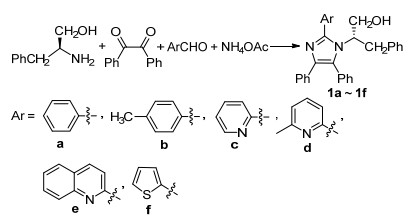
Scheme 1.
Synthesis of multi-aryl substituted imidazole amino alcohol derivatives 1a~1f

Synthesis of Chiral Imidazole Amino Alcohols and Their Application in the Asymmetric Copper-Catalyzed Henry Reaction
Pu Mao , Liangru Yang , Yongmei Xiao , Jinwei Yuan , Wenpeng Mai , Jie Gao , Xinchi Zhang


The Henry reaction (nitroaldol reaction) is a very attractive atom economic method for the construction of carbon- carbon bond.[1~3] The resulting β-nitro alcohols can be easily transformed to β-amino alcohols, α-hydroxy acids, α- hydroxy ketones, and many other building blocks.[4~6] In fact, the enantioenriched nitroaldol adducts have been re- cognized as an almost unlimited source of valuable synthetic intermediates readily convertible to many biological active compounds.[7~11] Asymmetric Henry reactions catalyzed by various metal complexes[12~21] with chiral ligands have been explored quite extensively since the pioneering work of Shibasaki in 1992.[22] While copper continues to be the preferred metal due to its inexpensive and less toxic nature together with prominent result in most cases.[23~29] Concerning the chiral ligands, since the pioneering work of J rgensen[23, 30] and Evans, [31] bisoxazolines, [32~37] bisoxazolidines, [38, 39] boron-bridged bisoxazolines, [40] chiral diamines, [41~45] sulfonyldiamine, [26, 46] thioure[47, 48] and pyridine derivatives, [49~51] etc. have been tested in the asymmetric Henry reaction.
The development of the chiral ligands plays pivotal role in the development of efficient metal-catalyzed asymmetric reactions, and the discovery of novel chiral ligands can open a new era of asymmetric catalysis. Amino alcohols represent one of the most studied classes of chiral ligands/ auxiliaries.[52~54] They have been used in different forms since the beginning of asymmetric synthesis, including asymmetric Henry reaction.[55~58] Imidazole derived chiral ionic liquids have been applied successfully as chiral medium or additives to achieve high levels of efficiency in asymmetric reaction. While studies on the application of imidazole derivatives as chiral ligands for the highly enantioselective reactions are still quite rare. Here we report the convenient synthesis of a series of multi-aryl substituted imidazole amino alcohol derivatives and their performance in the asymmetric Henry reaction.
It has been reported that N-substituted imidazole derivatives containing chiral groups could be synthesized efficiently through a “four component-one pot procedure” from the condensation reaction of amino acids, formaldehyde, glyoxal, and ammonia.[59, 60] By carefully choosing the condensation components, we observed that multi-aryl substituted imidazole amino alcohol derivatives 1a~1f carrying appended chiral functionalities could be obtained from the reaction of L-phenylalaninol, dibenzoyl, ammonium acetate and different aromatic aldehydes (Scheme 1).
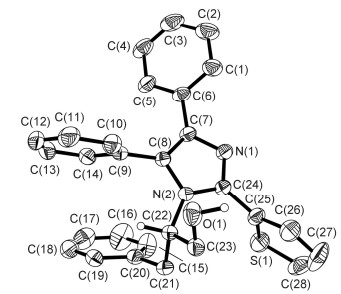
Because the chiral center did not participate in the condensation directly, there was little risk for the racemization/epimerization of the chiral center.[61] Figure 1 showed the molecular structure of 1f, demonstrating clearly S configuration of the chiral carbon. The molecular structures of 1b~1c have already been reported to possess S configuration at the chiral carbon.[62, 63] These results confirmed that the chiral carbon in L-phenylalaninol retained the S configuration during the reaction.
Using the addition of nitromethane to benzaldehyde in i-PrOH at room temperature as a model, Cu(OAc)2•H2O as copper source, the potential of the chiral imidazole amino alcohol derivatives 1a~1f in asymmetric Henry reaction was tested (Table 1). The results demonstrated that addition of ligands 1a~1f to Cu(OAc)2 catalyzed Henry reaction improved the yield obviously (Table 1, Entries 1~7). The results obtained with ligand 1c were superior to others in terms of yield and enationselectivity (97% yield, 17% ee), indicating that the coordination ability of the C2-bound substituent on the imidazole affects the yield and enantioselectivity significantly. Other copper sources including CuBr2, CuBr, CuCl2, and CuI2 were tested, and Cu(OAc)2•H2O turned out to be the best copper catalyst for the reaction (Table 1, Entries 4, 8~11).

 下载:
导出CSV
下载:
导出CSV
 |
||||
| Entrya | Ligand | Copper salts | Yield/% | ee/% |
| 1 | — | Cu(OAc)2•H2O | 15 | 3 |
| 2 | 1a | Cu(OAc)2•H2O | 48 | 3 |
| 3 | 1b | Cu(OAc)2•H2O | 62 | 2 |
| 4 | 1c | Cu(OAc)2•H2O | 97 | 17 |
| 5 | 1d | Cu(OAc)2•H2O | 77 | 13 |
| 6 | 1e | Cu(OAc)2•H2O | 68 | 10 |
| 7 | 1f | Cu(OAc)2•H2O | 73 | 10 |
| 8 | 1c | CuBr2 | 56 | 5 |
| 9 | 1c | CuBr | 10 | 8 |
| 10 | 1c | CuCl2 | 12 | 11 |
| 11 | 1c | CuI2 | 38 | 6 |
| a Reagents and conditions: benzaldehyde (1.0 mmol), nitromethane (10.0 mmol), i-PrOH (2 mL), a week. b Enantiomeric excesses were determined by HPLC using Chiralcel OD-H. | ||||
The effects of catalyst loading, temperature, and solvent were then investigated by running the addition of nitromethane to benzaldehyde in the presence of Cu(OAc)2•H2O and ligand 1c as a model. Compared to the blank reaction, addition of 10 mol% of ligand 1c and Cu(OAc)2•H2O accelerated the reaction efficiently, improving the yield from 13% to 97% (Table 2, Entries 1~2). Increasing catalyst loading to 20 mol% improved neither yield nor ee value significantly (Table 2, Entries 2~3). Addition of either ligand 1c or Cu(OAc)2•H2O alone resulted in very low yields of 22% and 15%, respectively (Table 2, Entries 4~5). These results indicated that the proper catalyst loading is 10 mol% to benzaldehyde. The results from different temperature and solvent showed that lower temperature decelerated the reaction rate with little change on the ee value, while higher temperature resulted in lower ee value (Table 2, Entries 2, 6~7). Among the solvents screened, i-PrOH was superior to EtOH and MeOH (Table 2, Entries 2, 8~9). Other solvents, such as H2O, DMF, pyridine, toluene, Et2O, or 1, 4-dioxane lead to decrease in ee value, or both the yield and ee value (Table 2, Entries 10~15).
下载:
导出CSV
 |
||||||
| Entry | 1c/ mol% |
Cu(OAc)2•H2O/ mol% |
Solvent | Temp. | Yield/% | eeb/% |
| 1 | — | — | i-PrOH | r.t. | 13 | — |
| 2 | 10.0 | 10.0 | i-PrOH | r.t. | 97 | 17 |
| 3 | 20.0 | 20.0 | i-PrOH | r.t. | 98 | 17 |
| 4 | 10.0 | — | i-PrOH | r.t. | 22 | 5 |
| 5 | — | 10.0 | i-PrOH | r.t. | 15 | 3 |
| 6 | 10.0 | 10.0 | i-PrOH | 0 | 71 | 18 |
| 7 | 10.0 | 10.0 | i-PrOH | 50 | 98 | 8 |
| 8 | 10.0 | 10.0 | EtOH | r.t. | 98 | 3 |
| 9 | 10.0 | 10.0 | MeOH | r.t. | 91 | 5 |
| 10 | 10.0 | 10.0 | H2O | r.t. | 90 | — |
| 11 | 10.0 | 10.0 | DMF | r.t. | 87 | — |
| 12 | 10.0 | 10.0 | Pyridine | r.t. | 76 | — |
| 13 | 10.0 | 10.0 | Toluene | r.t. | 2 | — |
| 14 | 10.0 | 10.0 | Et2O | r.t. | 38 | — |
| 15 | 10.0 | 10.0 | 1, 4-Dioxane | r.t. | 41 | — |
| a Reagents and conditions: benzaldehyde (1.0 mmol), nitromethane (10.0 mmol), solvent (2 mL), a week. b Enantiomeric excesses were determined by HPLC using Chiralcel OD-H. | ||||||
Under the standard conditions, using Cu(OAc)2•H2O as catalyst, i-PrOH as solvent, ligands 1c~1f were further investigated as auxiliary catalysts for the Henry reaction of different aryl-aldehydes with nitromethane. The results were listed in Table 3. The reactions worked well and ge- nerated the Henry products in moderate to excellent results in terms of yield and enationselectivity. For aromatic aldehydes tested, the present system tolerated both electron-withdrawing and electron-donating substituents, and the substituent on the phenyl ring showed limited effect on the enantioselectivity (Table 3, Entries 2~14). Reaction of 2-naphthaldehyde produced the corresponding adducts with low yield and high enantioselectivity, which can be tentatively attributed to the large sterical hindrance of the aldehyde (Table 3, Entries 15~16).
下载:
导出CSV
 |
|||||
| Entry | Ligand | Ar' | Product | Yield/% | ee/% |
| 1 | 1c | C6H5 | 3a | 97 | 17 |
| 2 | 1c | 4-ClC6H4 | 3b | 77 | 79 |
| 3 | 1d | 4-ClC6H4 | 3b | 58 | 89 |
| 4 | 1e | 4-ClC6H4 | 3b | 63 | 92 |
| 5 | 1f | 4-ClC6H4 | 3b | 57 | 95 |
| 6 | 1c | 4-BrC6H4 | 3c | 66 | 88 |
| 7 | 1d | 4-BrC6H4 | 3c | 60 | 98 |
| 8 | 1e | 4-BrC6H4 | 3c | 81 | 93 |
| 9 | 1f | 4-BrC6H4 | 3c | 67 | >99 |
| 10 | 1d | 2-BrC6H4 | 3d | 61 | 92 |
| 11 | 1e | 2-BrC6H4 | 3d | 89 | >99 |
| 12 | 1f | 2-BrC6H4 | 3d | 64 | 97 |
| 13 | 1e | 2-CH3OC6H4 | 3e | 76 | >99 |
| 14 | 1f | 2-CH3OC6H4 | 3e | 51 | 54 |
| 15 | 1d | 2-Naphthyl | 3f | 36 | >99 |
| 16 | 1e | 2-Naphthyl | 3f | 38 | >99 |
| a Reagents and conditions: aromatic aldehyde (1.0 mmol), nitromethane (10.0 mmol), i-PrOH (2 mL), a week. b Enantiomeric excesses were determined by HPLC using Chiralcel OD-H. | |||||
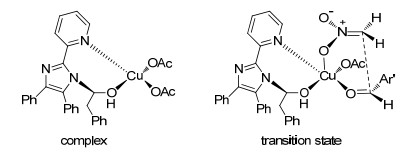
Considering the coordination ability and steric effect of the substituent on imidazole C2, pyridinyl was the most favorable one for the formation of hydroxyl-pyridinyl- chelated copper complex, which might be catalytic active species for the reaction. We proposed a possible catalytic transition state for our system based on the generally accepted model proposed by Jrgensen[23] and Kodama et al.[64] (Figure 2). Due to Jahn-Teller distortion, the Cu(II) complex with an octahedral geometry has four strong coordination sites at the equatorial positions and two weak coordination sites at the apical positions. Addition of bidentate ligand 1c afforded the complex, in which the two neighboring strong coordination sites were occupied by OH and C2-pyridinyl group. Under the coordination influence of the complex, the multi-aryl substituted imidazole alcohol causes an obvious steric hindrance to leave space and provides two weak coordination sites at the apical positions of the metal complex. Both the aryl-aldehyde and nitromethane are efficiently activated by coordination to the equatorial and apical positions of the copper complex, respectively. The nitromethane approaches from the unoccupied upper side of the copper ion, forming a transition state. The rigid multi-aryl substituted imidazole and phen- ylpropyl of 1c occupy the major space around the transition state to leave only the above space, whereas the benzaldehyde molecule with less steric hindrance is coordinated to the metal atom via the less-crowded space to give (S)-enantiomer. The donor ability of C2-substitutent is essential for the asymmetric induction.
A series of multi-aryl substituted imidazole amino alcohol derivatives 1a~1f containing appended chiral functionalities were synthesized by using L-phenylalaninol as chiral source. Application of ligands 1a~1f in asymmetric copper-catalyzed Henry reactions showed that C2- heteroaryl substituted ligands 1c~1f, in combination with Cu(OAc)2•H2O, were able to promote a highly enantioselective Henry reaction between nitromethane and aromatic aldehydes, providing β-hydroxynitro compounds in high yields and excellent enantioselectivities with S configuration. A possible catalytic transition state for the system was proposed and application of these convenient available chiral ligands to other enantioselective catalytic processes is in progress in our laboratory.
All experiments were performed in air. All reagents and solvents were analytical grade materials purchased from commercial sources and used as received unless otherwise stated. Reactions were monitored by TLC (Qingdao Haiyang Chemical Co. Ltd. Silica gel 60 F254) and detected using an UV/Vis lamp (254 nm). Column chromatography was performed on Qingdao Haiyang Chemical Co. Ltd. Gel 60 (200~300 mesh).
NMR spectra were recorded at 25 ℃ on a 400 MHz Bruker spectrometer. Chemical shifts were referenced to the internal solvent (DMSO-d6, δH 2.50, δC 40.0). ESI-MS spectra were recorded on a Bruker Esquire 3000. Elemental analysis were obtained from a Thermo Flash 2000.
To a solution of L-phenylalaninol (15.1 g, 0.1 mol) in MeOH (50 mL) in an ice-bath, molar equivalent of dibenzoyl, aryl-aldehyde and ammonium acetate were added. The mixture was kept stirring in the ice-bath until all the solids were dissolved before being heated to 60 ℃ for 5 h. The mixture was then cooled to room temperature and the solvent was removed by evaporation. The residue was washed with H2O to obtain the crude product. Crystallization of the crude product in EtOH afforded colorless crystals of 1a~1f.
(S)-3-Phenyl-2-(2, 4, 5-triphenyl-1H-imidazol-1-yl)pro- pan-1-ol (1a): Yield 87%. m.p. 230~231 ℃; -73.51 (c 0.0430, CH2Cl2); 1H NMR (400 MHz, DMSO-d6) δ: 7.56~6.77 (m, 20H, ArH), 5.25 (t, J=8.0 Hz, 1H, NCH), 3.70~3.64 (m, 1H, CH2OH), 3.48~3.39 (m, 1H, CH2OH), 2.79~2.73 (m, 1H, CH2Ph), 2.65~2.61 (m, 1H, CH2Ph); 13C NMR (100 MHz, DMSO-d6) δ: 138.2, 135.3, 132.6, 130.5, 129.7, 129.3, 129.1, 129.0, 128.8, 128.7, 128.4, 126.9, 126.3, 62.8, 61.4, 37.4; IR (KBr) v: 3153, 3057, 3026, 2841, 1954, 1882, 1819, 1601, 1498, 1442, 1358, 1122, 1074, 1033, 962, 773, 698, 557 cm-1; ESI-MS m/z: 431.1 [M+H]+. Anal. calcd for C30H26N2O: C 83.69, H 6.09, N 6.51; found C 83.48, H 5.88, N 6.59.
(S)-2-(4, 5-Diphenyl-2-(p-tolyl)-1H-imidazol-1-yl)-3- phenylpropan-1-ol (1b): Yield 89%. m.p. 199~200 ℃; -23.38 (c 0.0005, CH2Cl2); 1H NMR (400 MHz, DMSO-d6) δ: 7.54~6.78 (m, 19H, ArH), 5.23 (t, J=4.0 Hz, 1H, NCH), 3.69~3.41 (m, 2H, CH2OH), 2.78~2.72 (m, 1H, CH2Ph), 2.65~2.60 (m, 1H, CH2Ph), 2.38 (s, 3H, PhCH3); 13C NMR (100 MHz, DMSO-d6) δ: 138.6, 138.2, 135.3, 132.6, 130.4, 129.6, 129.2, 129.0, 128.8. 128.4, 126.9, 126.3, 62.9, 61.6, 37.3, 21.4; IR (KBr) v: 3153, 3060, 3030, 2968, 2914, 2854, 1965, 1896, 1809, 1603, 1500, 1441, 1386, 1074, 1053, 964, 827, 781, 696, 523 cm-1; ESI-MS m/z: 445.1 [M+H]+. Anal. calcd for C31H28N2O: C 83.75, H 6.35, N; 6.30; found C 83.55, H 6.16, N; 6.43.
(S)-2-(4, 5-Diphenyl-2-(pyridin-2-yl)-1H-imidazol-1-yl)-3-phenylpropan-1-ol (1c): Yield 90%. m.p. 144~145 ℃; -88.68 (c 0.0149, CH2Cl2); 1H NMR (400 MHz, DMSO-d6) δ: 8.73~6.80 (m, 19H, ArH), 4.98 (t, J=4.0 Hz, 1H, NCH), 4.41~3.70 (m, 2H, CH2OH), 3.15~2.69 (m, 2H, CH2Ph); 13C NMR (100 MHz, DMSO-d6) δ: 151.6, 148.5, 145.6, 138.9, 137.5, 135.1, 132.3, 129.4, 129.2, 128.7, 128.5, 126.8, 126.6, 126.5, 125.2, 123.6, 63.0, 62.3, 37.3; IR (KBr) v: 3147, 3055, 2918, 2843, 1954, 1892, 1601, 1589, 1498, 1433, 1363, 1282, 1128, 1055, 995, 968, 912, 758, 696, 621, 559 cm-1; ESI-MS m/z: 432.3 [M+H]+. Anal. calcd for C29H25N3O: C 80.72, H 5.84, N 3.71; found C 80.58, H 5.66, N; 3.83.
(S)-2-(2-(6-Methylpyridin-2-yl)-4, 5-diphenyl-1H-imidazol-1-yl)-3-phenylpropan-1-ol (1d): Yield 90%. m.p. 60~61 ℃; -52.36 (c 0.0023, CH2Cl2); 1H NMR (400 MHz, DMSO-d6) δ: 7.86 (t, J=6.8 Hz, 2H, ArH), 7.49~7.47 (m, 3H, ArH), 7.34~7.29 (m, 4H, ArH), 7.18~7.07 (m, 7H, ArH), 6.85~6.81 (m, 2H, ArH), 4.96 (t, J=4.0 Hz, 1H, NCH), 4.06~4.00 (m, 2H, CH2OH), 3.18 (d, J=4.0 Hz, 2H, CH2Ph), 2.61 (s, 3H, PhCH3); 13C NMR (100 MHz, DMSO-d6) δ: 170.8, 156.8, 150.9, 139.0, 137.7, 135.0, 132.2, 129.3, 129.1, 128.7, 128.4, 126.7, 126.5, 126.4, 122.8, 122.1, 62.9, 60.2, 24.2, 21.2; IR (KBr) v: 3059, 3026, 2952, 2922, 2852, 1950, 1890, 1807, 1736, 1574, 1454, 1350, 1028, 775, 696 cm-1; ESI-MS m/z: 446.4 [M+H]+. Anal. calcd for C30H27N3O: C 80.87, H 6.11, N 9.43; found C 80.59, H 6.01, N; 9.64.
(S)-2-(4, 5-Diphenyl-2-(quinolin-2-yl)-1H-imidazol-1-yl)- 3-phenylpropan-1-ol (1e): Yield 70%. m.p. 128~129 ℃; -86.25 (c 0.0072, CH2Cl2); 1H NMR (400 MHz, DMSO-d6) δ: 8.51 (s, 2H, ArH), 8.14~8.06 (m, 2H, ArH), 7.88~7.84 (m, 1H, ArH), 7.68 (t, J=7.5 Hz, 1H, ArH), 7.50~7.49 (m, 3H, ArH), 7.34 (d, J=7.2 Hz, 3H, ArH), 7.19~7.10 (m, 7H, ArH), 6.78 (bs, 2H, ArH), 4.99 (bs, 1H, NCH), 4.12~3.97 (m, 2H, CH2OH), 3.17 (d, J=4.0 Hz, 2H, CH2Ph); 13C NMR (100 MHz, DMSO-d6) δ: 151.1, 146.7, 139.0, 137.0, 134.9, 132.1, 130.6, 129.8, 129.4, 129.2, 129.0, 128.9, 128.7, 128.5, 128.4, 127.4, 127.3, 126.7, 126.5, 122.7, 63.0, 61.8, 37.1; IR (KBr) v: 3267, 3053, 3026, 2931, 2887, 2389, 2332, 1589, 1560, 1504, 1473, 1363, 1045, 964, 835, 775, 758, 698, 561 cm-1; ESI-MS m/z: 482.4 [M+H]+. Anal. calcd for C33H27N3O: C 82.30, H 5.65, N 8.73; found C 82.09, H 5.45, N; 8.70.
(S)-2-(4, 5-Diphenyl-2-(thiophen-2-yl)-1H-imidazol-1-yl)-3-phenylpropan-1-ol (1f): Yield 90%. m.p. 189~190 ℃; -134.27 (c 0.0218, CH2Cl2); 1H NMR (400 MHz, DMSO-d6) δ: 7.69~7.55 (m, 5H, ArH), 7.26 (d, J=7.5 Hz, 2H, ArH), 7.17~7.07 (m, 9H, ArH), 6.83 (bs, 2H, ArH), 5.25 (bs, 1H, NCH), 3.70~3.52 (m, 2H, CH2OH), 2.82~2.72 (m, 2H, CH2Ph); 13C NMR (100 MHz, DMSO-d6) δ: 143.3, 138.2, 134.9, 132.5, 129.8, 129.3, 129.0, 128.9, 128.5, 127.6, 127.0, 126.6, 126.5, 63.0, 60.3, 37.1; IR (KBr) v: 3183, 3057, 2922, 2852, 2362, 2341, 2025, 1961, 1815, 1784, 1601, 1498, 1441, 1414, 1360, 1244, 1057, 1049, 949, 849, 788, 702, 594, 555, 532, 499 cm-1; ESI-MS m/z: 437.3 [M+H]+. Anal. calcd for C28H24N2OS: C 77.03, H 5.54, N; 6.42; found C 76.80, H 5.25, N 6.70.
One of the ligands 1a~1f (0.2 mmol) and Cu(OAc)2• H2O (40.0 mg, 0.2 mmol) were added to i-PrOH (2.0 mL) and the mixture was stirred for 30 min at room temperature. Then aryl-aldehyde (1.0 mmol) and CH3NO2 (0.54 mL, 10.0 mmol) were added and the mixture was stirred for the time indicated in the Tables. The solvents were removed under reduced pressure, and the crude product was purified by column chromatography [silica, V(AcOEt)/ V(hexane)=1/4].
Stereochemical assignments. The absolute configurations of compound 3e were assigned as S by comparison of its optical rotations with literature values.[30] The absolute configurations of the remaining examples were assigned by analogy.
2-Nitro-1-phenylethan-1-ol (3a): 1H NMR (400 MHz, DMSO-d6) δ: 7.46~7.30 (m, 5H, ArH), 6.15 (s, 1H, CHOH), 5.29 (dd, J=3.3, 10.0 Hz, 1H, CHOH), 4.85 (dd, J=3.4, 12.5 Hz, 1H, CH2NO2), 4.60~4.55 (m, 1H, CH2NO2). Enantiomeric excess was determined by HPLC with a Chiralcel OD-H column [V(hexane):V(isopro-panol)=85:15, 0.8 mL/min, 215 nm], major enantiomer tr=13.96 min, minor enantiomer tr=17.13 min.
1-(4-Chlorophenyl)-2-nitroethan-1-ol (3b): 1H NMR (400 MHz, DMSO-d6) δ: 7.49~7.41 (m, 4H, ArH), 6.23 (d, J=4.8 Hz, 1H, CHOH), 5.33~5.29 (m, 1H, CHOH), 4.84 (dd, J=3.1, 12.5 Hz, 1H, CH2NO2), 4.61~4.56 (m, 1H, CH2NO2). Enantiomeric excess was determined by HPLC with a Chiralcel OD-H column [V(hexane):V(isopropanol)=85:15, 0.8 mL/min, 254 nm], major enantiomer tr=11.60 min, minor enantiomer tr=13.07 min.
1-(4-Bromophenyl)-2-nitroethan-1-ol (3c): 1H NMR (400 MHz, DMSO-d6) δ: 7.57 (d, J=8.4 Hz, 2H, ArH), 7.40 (d, J=8.4 Hz, 2H, ArH), 6.20 (dd, J=0.6, 5.0 Hz, 1H, CHOH), 5.29~5.24 (m, 1H, CHOH), 4.88~4.83 (m, 1H, CH2NO2), 4.59~4.54 (m, 1H, CH2NO2). Enantiomeric excess was determined by HPLC with a Chiralcel OD-H column [V(hexane):V(isopropanol)=85:15, 0.8 mL/min, 254 nm], major enantiomer tr=11.87 min, minor enantiomer tr=13.60 min. +12.17 (c 0.09, CH2Cl2), (99% ee, (S)-isomer).
1-(2-Bromophenyl)-2-nitroethan-1-ol (3d): 1H NMR (400 MHz, DMSO-d6) δ: 7.68~7.62 (m, 2H, ArH), 7.48~7.44 (m, 1H, ArH), 7.31~7.27 (m, 1H, ArH), 6.39 (d, J=4.4 Hz, 1H, CHOH), 5.60~5.55 (m, 1H, CHOH), 4.79 (dd, J=2.2, 12.64 Hz, 1H, CH2NO2), 4.50~4.45 (m, 1H, CH2NO2). Enantiomeric excess was determined by HPLC with a Chiralcel OD-H column [V(hexane):V(isopro-panol)=85:15, 0.8 mL/min, 254 nm], major enantiomer tr=10.78 min, minor enantiomer tr=11.77 min. +6.82 (c 0.02, CH2Cl2), (99% ee, (S)-isomer).
1-(2-Methoxyphenyl)-2-nitroethan-1-ol (3e): 1H NMR (400 MHz, DMSO-d6) δ: 7.49~7.47 (m, 1H, ArH), 7.33~7.29 (m, 1H, ArH), 7.03~6.98 (m, 2H, ArH), 5.99 (d, J=4.6 Hz, 1H, CHOH), 5.56~5.52 (m, 1H, CHOH), 4.73 (dd, J=2.1, 12.2 Hz, 1H, CH2NO2), 4.40~4.34 (m, 1H, CH2NO2), 3.83 (s, 3H, CH3). Enantiomeric excess was determined by HPLC with a Chiralcel OD-H column [V(hexane):V(isopropanol)=85:15, 0.8 mL/min, 254 nm], major enantiomer tr=13.04 min, minor enantiomer tr=15.00 min.
1-(Naphthalen-2-yl)-2-nitroethan-1-ol (3f): 1H NMR (400 MHz, DMSO-d6) δ: 8.04~7.91 (m, 4H, ArH), 7.67~7.50 (m, 3H, ArH), 6.27 (d, J=4.8 Hz, 1H, CHOH), 5.47~5.42 (m, 1H, CHOH), 4.97 (dd, J=3.3, 12.5 Hz, 1H, CH2NO2), 4.69~4.64 (m, 1H, CH2NO2). Enantiomeric excess was determined by HPLC with a Chiralcel OD-H column [V(hexane):V(isopropanol)=85:15, 0.8 mL/min, 215 nm], major enantiomer tr=20.97 min, minor enantiomer tr=28.37 min.
Supporting Information ESI-MS, 1H NMR and 13C NMR spectra of ligands 1a~1f. The Supporting Information is available free of charge via the Internet at http://sioc-journal.cn/.
Rosini, G. In Comprehensive Organic Synthesis, Vol. 2, Eds.: Trost, B. M., Fleming, I., Pergamon, Oxford, UK, 1999, p. 321.
Pinnick, H. W. In Organic Reactions, Vol. 38, Ed.: Paquette, L. A., Wiley, New York, 1990, Chapter 3.
Palomo, C.; Oiarbide, M.; Laso, A. Eur. J. Org. Chem. 2007, 2561.
Ono, N. The Nitro Group in Organic Synthesis, Wiley-VCH, New York, 2001.
Shibasaki, M.; Gröger, H. In Comprehensive Asymmetric Catalysis, Vol. Ⅲ, Eds.:Jacobsen, E. N.; Pfaltz, A.; Yamamoto, H.; Springer, Berlin, Germany, 1999, p. 1075.
Shibasaki, M.; Gröger, H.; Kanai, M. In Comprehensive Asymmetric Catalysis, Eds.: Supplement, I.; Jacobsen, E. N.; Pfaltz, A.; Yamamoto, H., Springer, Heidelberg, Germany, 2004, p. 131.
Luzzio, F. A. Tetrahedron 2001, 57, 915. doi: 10.1016/S0040-4020(00)00965-0
Bandini, M.; Piccinelli, F.; Tommasi, S.; Ronchi, A. U.; Ventrici, C. Chem. Commun. 2007, 616.
Blay, G.; Hernández-Olmos, V.; Pedro, J. R. Synlett 2011, 1195.
Palomo, C.; Oiarbide, M.; Mielgo, A. Angew. Chem., Int. Ed. 2004, 43, 5442. doi: 10.1002/(ISSN)1521-3773
Zhang, S.; Li, Y.; Xu, Y.; Wang, Z. Chin. Chem. Lett. 2018, 29, 873. doi: 10.1016/j.cclet.2017.10.001
Bhatt, A. P.; Pathak, K.; Jasra, R. V.; Kureshy, R. I.; Khan, N. H.; Abdi, S. H. R. J. Mol. Catal. A:Chem. 2006, 244, 110. doi: 10.1016/j.molcata.2005.08.045
Trost, B. M.; Yeh, V. S. C. Angew. Chem., Int. Ed. 2002, 41, 861. doi: 10.1002/1521-3773(20020301)41:5<861::AID-ANIE861>3.0.CO;2-V
Palomo, C.; Oiarbide, M.; Laso, A. Angew. Chem., Int. Ed. 2005, 44, 3881. doi: 10.1002/(ISSN)1521-3773
Liu, S. L.; Wolf, C. Org. Lett. 2008, 10, 1831. doi: 10.1021/ol800442s
Bulut, A.; Aslan, A.; Dogan, Ö. J. Org. Chem. 2008, 73, 7373.
Park, J.; Lang, K.; Abboud, K. A.; Hong, S. J. Am. Chem. Soc. 2008, 130, 16484. doi: 10.1021/ja807221s
Kogami, Y.; Nakajima, T.; Ikeno, T.; Yamada, T. Synthesis 2004, 1947.
Kowalczyk, R.; Kwiatkowski, P.; Skarzewski, J.; Jurczak, J. J. Org. Chem. 2009, 74, 753. doi: 10.1021/jo802107b
Zulauf, A.; Mellah, M.; Schulz, E. J. Org. Chem. 2009, 74, 2242. doi: 10.1021/jo802769y
Choudary, B. M.; Ranganath, K. V. S.; Pal, U.; Kantam, M. L.; Sreedhar, B. J. Am. Chem. Soc. 2005, 127, 13167. doi: 10.1021/ja0440248
Sasai, H.; Suzuki, T.; Arai, S.; Arai, T.; Shibasaki, M. J. Am. Chem. Soc. 1992, 114, 4418. doi: 10.1021/ja00037a068
Christensen, C.; Juhl, K.; Hazell, R. G.; Jørgensen, K. A. J. Org. Chem. 2002, 67, 4875. doi: 10.1021/jo025690z
Xiong, Y.; Wang, F.; Huang, X.; Wen, Y.; Feng, X. Chem.-Eur. J. 2007, 13, 829. doi: 10.1002/(ISSN)1521-3765
Bandini, M.; Piccinelli, F.; Tommasi, S.; Umani-Ronchi, A.; Ventrici, C. Chem. Commun. 2007, 616.
Arai, T.; Takashita, R.; Endo, Y.; Watanabe, M.; Yanagisawa, A. J. Org. Chem. 2008, 73, 4903. doi: 10.1021/jo800412x
Ma, K.; You, J. Chem.-Eur. J. 2007, 13, 1863. doi: 10.1002/(ISSN)1521-3765
Dixit, A.; Kumar, P.; Yadav, G. D.; Singh, S. Inorg. Chim. Acta 2018, 479, 240. doi: 10.1016/j.ica.2018.04.048
Khlebnikova, T. B.; Konev, V. N.; Pai, Z. P. Tetrahedron 2018, 74, 260. doi: 10.1016/j.tet.2017.11.059
Christensen, C.; Juhl, K.; Jørgensen, K. A. Chem. Commun. 2001, 2222.
Evans, D. A.; Seidel, D.; Rueping, M.; Lam, H. W.; Shaw, J. T.; Downey, C. W. J. Am. Chem. Soc. 2003, 125, 12692. doi: 10.1021/ja0373871
McManus, H. A.; Guiry, P. J. Chem. Rev. 2004, 104, 4151. doi: 10.1021/cr040642v
Desimoni, G.; Faita, G.; Jørgensen, K. A. Chem. Rev. 2006, 106, 3561. doi: 10.1021/cr0505324
Hargaden, G. C.; Guiry, P. J. Chem. Rev. 2009, 109, 2505. doi: 10.1021/cr800400z
Aydin, A. E.; Yuksekdanaci, S. Tetrahedron:Asymmetry 2013, 24, 14. doi: 10.1016/j.tetasy.2012.11.022
Wolinska, E. Tetrahedron:Asymmetry 2014, 25, 1122. doi: 10.1016/j.tetasy.2014.06.019
Cruz, H.; Aguirre, G.; Madrigal, D. Chavez, D.; Somanathan, R. Tetrahedron:Asymmetry 2016, 27, 1217. doi: 10.1016/j.tetasy.2016.10.007
Liu, S.; Wolf, C. Org. Lett. 2008, 10, 1831. doi: 10.1021/ol800442s
Spangler, K. Y.; Wolf, C. Org. Lett. 2009, 11, 4724. doi: 10.1021/ol9018612
Toussaint, A.; Pfaltz, A. Eur. J. Org. Chem. 2008, 14, 459. doi: 10.1002/(ISSN)1521-3765
Kowalczyk, R.; Sidorowicz, L.; Skarzewski, J. Tetrahedron:Asymmetry 2008, 19, 2310. doi: 10.1016/j.tetasy.2008.09.032
Selvakumar, S.; Sivasankaran, D.; Singh, V. K. Org. Biomol. Chem. 2009, 7, 3156. doi: 10.1039/b904254g
Chunhong, Z.; Liu, F.; Gou, S. Tetrahedron:Asymmetry 2014, 25, 278. doi: 10.1016/j.tetasy.2013.12.017
Cwiek, R.; Nideziejko, P.; Kaluza, Z. J. Org. Chem. 2014, 79, 1222. doi: 10.1021/jo402631u
El-Asaad, B.; Metay, E.; Karame, I.; Lemaire, M. Mol. Catal. 2017, 435, 76. doi: 10.1016/j.mcat.2017.03.017
Jin, W.; Li, X.; Huang, Y.; Wu, F.; Wan, B. Chem.-Eur. J. 2010, 16, 8259. doi: 10.1002/chem.v16:28
Otevrel, J.; Bobal, P. J. Org. Chem. 2017, 82, 8342. doi: 10.1021/acs.joc.7b00079
吴丽丽, 苏瀛鹏, 种思颖, 张为钢, 黄丹风, 王克虎, 胡雨来, 有机化学, 2017, 37, 936. http://sioc-journal.cn/Jwk_yjhx/CN/abstract/abstract345873.shtmlWu, L.; Su, Y.; Chong, S.; Zhang, W.; Huang, D.; Wang, K.; Hu, Y. Chin. J. Org. Chem. 2017, 37, 936(in Chinese). http://sioc-journal.cn/Jwk_yjhx/CN/abstract/abstract345873.shtml
Blay, G.; Climent, E.; Fernández, I.; Hernández-Olmos, V.; Pedro, J. R. Tetrahedron:Asymmetry 2007, 18, 1603. doi: 10.1016/j.tetasy.2007.06.023
Blay, G.; Hernández-Olmos, V.; Pedro, J. R. Chem. Commun. 2008, 4840.
Arai, T.; Suzuki, K. Synlett 2009, 3167.
Sappino, C.; Mari, A.; Mantineo, A.; Moliterno, M.; Palagri, M.; Tatangelo, C.; Suber, L.; Bovicelli, P.; Ricelli, A.; Righi, G. Org. Biomol. Chem. 2018, 16, 1860. doi: 10.1039/C8OB00165K
Vicario, J.; Badia, D.; Carrillo, L.; Reyes E.; Etxebarria, J. Curr. Org. Chem. 2005, 9, 219. doi: 10.2174/1385272053369105
Ager, D. J.; Prakash, I.; Schaad, D. R. Chem. Rev. 1996, 96, 835. doi: 10.1021/cr9500038
Guo, J.; Mao, J. Chirality 2009, 21, 619. doi: 10.1002/chir.v21:6
Xu, F.; Lei, C.; Yan, L.; Tu, J.; Li, G. Chirality 2015, 27, 761. doi: 10.1002/chir.22498
Lu, G.; Zheng, F.; Wang, L.; Guo, Y.; Li, X.; Cao, X.; Wang, C.; Chi, H.; Dong, Y.; Zhang, Z. Tetrahedron:Asymmetry 2016, 27, 732. doi: 10.1016/j.tetasy.2016.06.018
Chen, W.; Zhou, Z., Chen, H. Org. Biomol. Chem. 2017, 15, 1530. doi: 10.1039/C6OB02569B
Bao, W.; Wang, Z.; Li, Y. J. Org. Chem. 2003, 68, 591. doi: 10.1021/jo020503i
Mao, P.; Cai, Y.; Xiao, Y.; Yang, L.; Xue, Y.; Song, M. Phosphorus, Sulfur Silicon Relat. Elem. 2010, 185, 2418. doi: 10.1080/10426501003671460
Matsuoka, Y.; Ishida, Y.; Sasaki, D.; Saigo, K. Tetrahedron 2006, 62, 8199. doi: 10.1016/j.tet.2006.05.079
Xiao, Y.; Yang, L.; He, K.; Yuan, J.; Mao, P. Acta Crystallogr. 2012, E68, o264.
Yang, L.; Xiao, Y.; He, K.; Yuan, J.; Mao, P. Acta Crystallogr. 2012, E68, o1670.
Kodama, K.; Sugawara, K.; Hirose, T. Chem.-Eur. J. 2011, 17, 13584. doi: 10.1002/chem.v17.48

Scheme 1 Synthesis of multi-aryl substituted imidazole amino alcohol derivatives 1a~1f

Figure 1 ORTEP drawing of the molecular structures of ligands 1f at 30% probability displacement ellipsoids. Aromatic, methylene and methyne hydrogen atoms are omitted for clarity
Table 1. Screening of ligands (1a~1f) and copper source
|
|
||||
| Entrya | Ligand | Copper salts | Yield/% | ee/% |
| 1 | — | Cu(OAc)2•H2O | 15 | 3 |
| 2 | 1a | Cu(OAc)2•H2O | 48 | 3 |
| 3 | 1b | Cu(OAc)2•H2O | 62 | 2 |
| 4 | 1c | Cu(OAc)2•H2O | 97 | 17 |
| 5 | 1d | Cu(OAc)2•H2O | 77 | 13 |
| 6 | 1e | Cu(OAc)2•H2O | 68 | 10 |
| 7 | 1f | Cu(OAc)2•H2O | 73 | 10 |
| 8 | 1c | CuBr2 | 56 | 5 |
| 9 | 1c | CuBr | 10 | 8 |
| 10 | 1c | CuCl2 | 12 | 11 |
| 11 | 1c | CuI2 | 38 | 6 |
| a Reagents and conditions: benzaldehyde (1.0 mmol), nitromethane (10.0 mmol), i-PrOH (2 mL), a week. b Enantiomeric excesses were determined by HPLC using Chiralcel OD-H. | ||||
 下载: 导出CSV
Table 2. Effects of catalyst loading, temperature and solvent on the reactiona
|
|
||||||
| Entry | 1c/ mol% |
Cu(OAc)2•H2O/ mol% |
Solvent | Temp. | Yield/% | eeb/% |
| 1 | — | — | i-PrOH | r.t. | 13 | — |
| 2 | 10.0 | 10.0 | i-PrOH | r.t. | 97 | 17 |
| 3 | 20.0 | 20.0 | i-PrOH | r.t. | 98 | 17 |
| 4 | 10.0 | — | i-PrOH | r.t. | 22 | 5 |
| 5 | — | 10.0 | i-PrOH | r.t. | 15 | 3 |
| 6 | 10.0 | 10.0 | i-PrOH | 0 | 71 | 18 |
| 7 | 10.0 | 10.0 | i-PrOH | 50 | 98 | 8 |
| 8 | 10.0 | 10.0 | EtOH | r.t. | 98 | 3 |
| 9 | 10.0 | 10.0 | MeOH | r.t. | 91 | 5 |
| 10 | 10.0 | 10.0 | H2O | r.t. | 90 | — |
| 11 | 10.0 | 10.0 | DMF | r.t. | 87 | — |
| 12 | 10.0 | 10.0 | Pyridine | r.t. | 76 | — |
| 13 | 10.0 | 10.0 | Toluene | r.t. | 2 | — |
| 14 | 10.0 | 10.0 | Et2O | r.t. | 38 | — |
| 15 | 10.0 | 10.0 | 1, 4-Dioxane | r.t. | 41 | — |
| a Reagents and conditions: benzaldehyde (1.0 mmol), nitromethane (10.0 mmol), solvent (2 mL), a week. b Enantiomeric excesses were determined by HPLC using Chiralcel OD-H. | ||||||
下载: 导出CSV
Table 3. Henry reactions of aryl-aldehydes with nitromethane catalyzed by Cu(OAc)2 with 1c~1f a
|
|
|||||
| Entry | Ligand | Ar' | Product | Yield/% | ee/% |
| 1 | 1c | C6H5 | 3a | 97 | 17 |
| 2 | 1c | 4-ClC6H4 | 3b | 77 | 79 |
| 3 | 1d | 4-ClC6H4 | 3b | 58 | 89 |
| 4 | 1e | 4-ClC6H4 | 3b | 63 | 92 |
| 5 | 1f | 4-ClC6H4 | 3b | 57 | 95 |
| 6 | 1c | 4-BrC6H4 | 3c | 66 | 88 |
| 7 | 1d | 4-BrC6H4 | 3c | 60 | 98 |
| 8 | 1e | 4-BrC6H4 | 3c | 81 | 93 |
| 9 | 1f | 4-BrC6H4 | 3c | 67 | >99 |
| 10 | 1d | 2-BrC6H4 | 3d | 61 | 92 |
| 11 | 1e | 2-BrC6H4 | 3d | 89 | >99 |
| 12 | 1f | 2-BrC6H4 | 3d | 64 | 97 |
| 13 | 1e | 2-CH3OC6H4 | 3e | 76 | >99 |
| 14 | 1f | 2-CH3OC6H4 | 3e | 51 | 54 |
| 15 | 1d | 2-Naphthyl | 3f | 36 | >99 |
| 16 | 1e | 2-Naphthyl | 3f | 38 | >99 |
| a Reagents and conditions: aromatic aldehyde (1.0 mmol), nitromethane (10.0 mmol), i-PrOH (2 mL), a week. b Enantiomeric excesses were determined by HPLC using Chiralcel OD-H. | |||||
下载: 导出CSV

 扫一扫看文章


扫一扫关注我们

 下载:
下载: