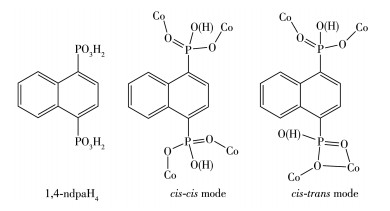
Scheme 1.
Molecular structure and coordination modes of 1, 4-ndpaH4 ligand

Pyridinium/imidazolium-triggered modulation of structure and properties of cobalt naphthalene-diphosphates
Yan XU , Xuan WANG , Zhao-Wen LIU , Xiao-Yang WANG , Wen-Kang GAO , Lei CUI


Coordination polymers (CPs) have received tremendous attention recently due to their versatile structures and multiple functions that can be designed and tailored. As an important class of inorganic - organic hybrid materials or CPs, metal phosphonates can show versatile architectures with interesting physical and chemical properties[1-8]. Many metal phosphonates have been constructed by decorating the phosphonate ligand with other coordinating functional groups[9-13] or introducing a second auxiliary ligand[14-17]. In principle, a near - limitless number of metal phosphonates can be obtained through different combinations of metal ions and organic ligands. Therefore, it is crucial to understand the mechanism of structure assembly and the structure-property relationships of this class of material for the final purpose of designing and synthesizing materials according to on-demand. Many factors, such as the coordination geometry of the central metal ions, connective modes of the organic ligands, deprotonation of the phosphonic acid group, and synthesis conditions, can affect the final structures. Compared with the carboxylate group, the phosphonate group has an additional oxygen atom, featuring one more coordinating site and consequently more coordination modes, which makes it a great challenge to design and synthesize materials with specific structures and functions. Many efforts have been made to understand these by investigating different metal centers, functionalized phosphonate ligands, and synthesis conditions. An effective strategy to fabricate metal phosphonates with fascinating structures is using different templates or mineralizers in the reaction mixture. A few metal phosphonates are reported based on amine - templated. Wang Guo Ming and co-workers have taken 1-hydroxyethane-1, 1diphosphonic acid (hedpH4) as the diphosphonate ligand to build a family of open- framework structures with templated aliphatic amines[16, 18-21]. To the best of our knowledge, the syntheses of metal phosphonates using different di-pyridinium templates in the reaction mixture have not been adopted so far. Here, the naphthalene - diphosphonate ligand (Scheme 1) has been utilized for the generation of more coordination sites, along with di-pyridinium/imidazolium as template ions for the first time.
In this work, three cobalt naphthalene-diphosphonates with entirely different structures are obtained under hydrothermal conditions simply by changing the auxiliary ligands and the pH of the reaction mixture. Complexes (1, 3-dppH2)2[Co4(1, 4-ndpa)(1, 4-ndpaH)2(1, 4ndpaH2)]·6H2O (1) and (1, 4 -bixH2)0.5[Co(1, 4-ndpaH)] (2) (1, 3-dppH22+=protonated 1, 3-di(4-pyridyl)propane, 1, 4 - bixH22+=protonated bis(imidazol - 1 - ylmethyl)benzene, 1, 4-ndpaH4=1, 4-naphthalenediphosphonic acid) show 3D open - framework structures, respectively. While complex (1, 4 - bixH2)0.5[Co2(1, 4-ndpaH) (1, 4 ndpaH2)(H2O)2] (3) displays 2D layer structure. Magnetic studies reveal that complexes 1 and 2 show dominant antiferromagnetic interactions.
1, 4-ndpaH4 was synthesized according to the literature[22]. All starting materials were of analytical reagent grade and used as received without further purification. Elemental analysis for C, H, and N was performed on a Perkin - Elmer 240C elemental analyzer. Infrared spectra were measured as KBr pellets on a Bruker Tensor 27 spectrometer in 400 - 4 000 cm-1. Thermogravimetric analysis (TGA) was performed on a METTLER TOLEDO TGA/DSC - 1 over 25 - 800 ℃ under a nitrogen flow at a heating rate of 10 ℃·min-1. Powder X - ray diffraction (PXRD) data were collected on a Bruker D8 ADVANCE X-ray powder diffractometer (Cu Kα, λ=0.154 06 nm) operating at 45 kV and 40 mA over a 2θ range of 5° to 50° at room temperature. The magnetization data were recorded on a vibrating sample magnetometer (VSM) of Quantum Design. The diamagnetic contribution of the sample itself was estimated from Pascal′s constants[23].
A mixture of CoCl2·6H2O (0.476 g, 0.1 mmol), 1, 4ndpaH4 (0.028 6 g, 0.1 mmol), and 1, 3-dpp (0.019 6 g, 0.1 mmol) in 10 mL of water, which pH value was adjusted to 4.15 with 0.5 mol·L-1 NaOH solution, was sealed in a Teflon-lined autoclave and heated at 140 ℃ for 3 d. After cooling to room temperature, blue rod like crystals were collected and washed with water by suction filtration. Yield: 55.3 mg. Elemental analysis Calcd. for C66H72Co4N4O30P8(%): C, 42.06; H, 3.85; N, 2.97. Found(%): C, 42.11; H, 3.81; N, 2.83. FT - IR (KBr, cm-1): 3 397(w), 3 237(w), 1 635(m), 1 507(m), 1 215(m), 1 187(w), 1 154(vs), 1 123(vs), 1 090(vs), 1 040(m), 1 017(s), 963(s), 941(s), 856(m), 812(m), 757 (m), 624(s), 570(m), 519(s), 478(s), 439(w), 407(w), 403(w).
A mixture of CoCl2·6H2O (0.047 4 g, 0.2 mmol), 1, 4-ndpaH4 (0.031 2 g, 0.1 mmol), and 1, 4-bix (0.025 6 g, 0.1 mmol) in 10 mL of water, which pH value was adjusted to 5.6 with 0.5 mol·L-1 NaOH solution, was sealed in a Teflon-lined autoclave and heated at 140 ℃ for 2 d. After cooling to room temperature, blue rod like crystals were collected and washed with water by suction filtration. Yield: 23.8 mg. Elemental analysis Calcd. for C17H15CoN2O6P2(%): C, 43.99; H, 3.26; N, 6.03. Found(%): C, 43.83; H, 3.29; N, 6.12. FT - IR (KBr, cm-1): 3 140(m), 3 090(w), 1 570(m), 1 550(m), 1 516(m), 1 445(m), 1 273(m), 1 208(m), 1 158(w), 1 092(vs), 1 016(s), 944(vs), 863(m), 770(s), 709(m), 619(s), 522(s), 413(m).
Complex 3 was obtained as purple rod-like crystals by following a similar procedure to that of 2, except that the pH value of the reaction mixture was adjusted to 4.3. Yield: 15.9 mg. Elemental analysis Calcd. for C27H27Co2N2O14P4(%): C, 38.37; H, 3.22; N, 3.31. Found (%): C, 38.56; H, 3.18; N, 3.29. FT - IR (KBr, cm-1): 3 356(s), 1 578(m), 1 511(m), 1 213(s), 1 186(vs), 1 157 (vs), 1 086(vs), 1 072(vs), 1 034(w), 1 010(w), 970(m), 940(vs), 756(m), 631(s), 571(m), 524(m), 509(m), 493 (w), 436(w).
Single crystals with sizes of 0.15 mm×0.13 mm× 0.12 mm for 1, 0.12 mm×0.11 mm×0.10 mm for 2, and 0.16 mm×0.15 mm×0.13 mm for 3 were used for structural determination on a Bruker D8 Venture diffractometer using graphite - monochromated (Mo Kα, λ = 0.071 073 nm) at 100 K. A hemisphere of data was collected in a 2θ range of 3.03° - 58.818° for 1, 4.124° 58.884° for 2, and 2.996°-58.666° for 3. The numbers of observed and unique reflections are 56 305 and 16 056 (Rint=0.031 8) for 2, 16 837 and 4 117 (Rint=0.029 3) for 2, 33 130 and 6 926 (Rint=0.036 4) for 3. Using Olex2, the structure was solved with the SHELXT structure solution program using Intrinsic Phasing and refined with the SHELXL refinement package using Least Squares minimization All H atoms were refined isotropically, with the isotropic vibration parameters related to the non-H atom to which they are bonded. Details of the crystal data and refinements of 1-3 are summarized in Table 1, and selected bond lengths and angles of 1-3 are listed in Table S1-S3 (Supporting information).

 下载:
导出CSV
下载:
导出CSV
| Parameter | 1 | 2 | 3 |
| Formula | C66H72Co4N4O30P8 | C17H15CoN2O6P2 | C27H27Co2N2O14P4 |
| Formula weight | 1 884.75 | 464.18 | 845.24 |
| Crystal system | Monoclinic | Monoclinic | Monoclinic |
| Space group | P21/c | P21/n | P21/n |
| a/nm | 1.629 35(3) | 0.892 37(2) | 0.795 02(2) |
| b/nm | 1.643 11(3) | 1.619 29(4) | 1.738 02(3) |
| c/nm | 2.744 57(5) | 1.278 26(4) | 2.212 33(5) |
| β/(°) | 101.661(2) | 102.860(3) | 99.848(2) |
| V/nm3 | 7.196 1(2) | 1.800 76(8) | 3.011 87(12) |
| Z | 4 | 4 | 4 |
| Dc/(g·cm-3) | 1.740 | 1.172 | 1.864 |
| μ/mm-1 | 1.177 | 1.170 | 1.392 |
| F(000) | 3 856 | 944.0 | 1 716.0 |
| Rint | 0.031 8 | 0.029 3 | 0.036 4 |
| GOF on F2 | 1.036 | 1.078 | 1.062 |
| R1, wR2* [I > 2σ(I)] | 0.037 7, 0.091 6 | 0.033 2, 0.081 2 | 0.032 0, 0.083 0 |
| R1, wR2 (all data) | 0.050 6, 0.097 4 | 0.038 8, 0.084 1 | 0.040 6, 0.088 0 |
| (Δρ)max, (Δρ)min/(e·nm-3) | 978, -643 | 980, -330 | 520, -780 |
| *R=∑||Fo|-|Fc||/∑|Fo|, wR=[∑w(Fo2-Fc2)2/∑w(Fo2)2]1/2. | |||
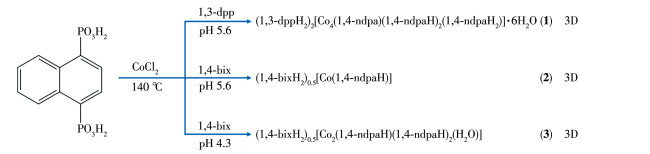
Complexes 1 - 3 were synthesized under similar experimental conditions except for the auxiliary ligands and the pH value of the reaction mixture (Scheme 2). Pure phases of blue rod crystals of 1 and blue shuttle crystals of 2 were obtained at pH=5.6. When the pH was descended to 4.3, purple rob crystals of 3 were obtained, contaminated with a small amount of 2. We tried to isolate a pure phase of 3 by changing the reaction temperature and solvents but failed. Purple rob crystals of 3 were manually selected under the microscope for subsequent characterization. Its purity was confirmed by the PXRD pattern in comparison with that simulated from the single crystal data (Fig.S1-S3).
Complex 1 crystallizes in the monoclinic system space group P21/c. The asymmetric unit contains four Co(Ⅱ) ions, one 1, 4-ndpa4- ion, two 1, 4-ndpaH3- ions, one 1, 4 - ndpaH22- ion, two 1, 3 - dppH22+ ions, and six lattice water molecules (Fig. 1a). All Co (Ⅱ) ions have distorted tetrahedral geometry, surrounded by four phosphonate oxygen atoms (O1, O6A, O10B, O21C for Co1, O4, O7, O12D, O13 for Co2; O2E, O16, O18F, O19 for Co3; O8B, O14B, O22, O23G for Co4) (Symmetry codes: A: -x+1, y-1/2, -z+3/2; B: x-1, y, z; C: x, y1, z; D: -x+2, y+1/2, -z+3/2; E: x, y+1, z, F: -x+1, -y+ 2, -z+1; G: -x, -y+1, -z+1). The Co—O bond lengths and O—Co—O angles fall in a range of 0.193 37(15)0.198 50(15) nm and 95.74(7)°-117.86(6)°, respectively, in agreement with those for the other cobalt phosphonates with tetrahedral geometry[24-25].
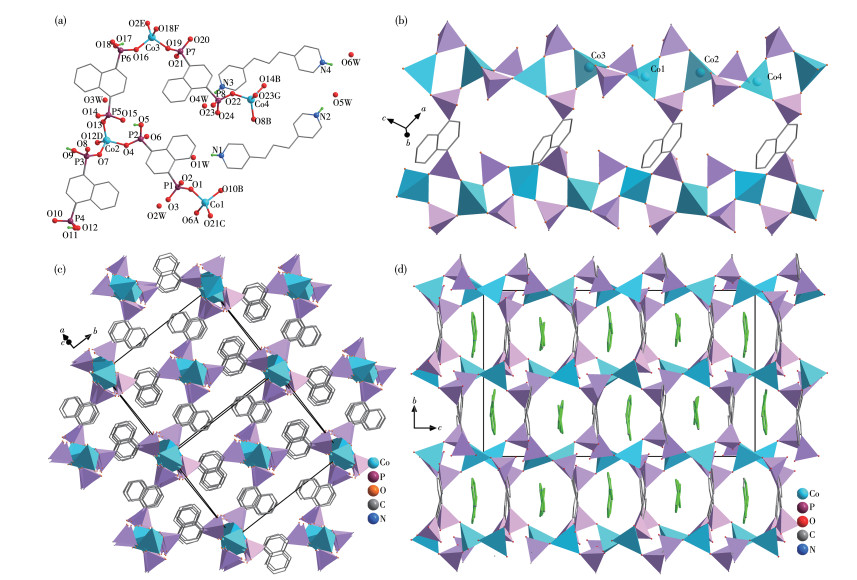
All H atoms and water molecules are omitted for clarity
The eight phosphonate groups (P1 - P8) connect four Co(Ⅱ) ions using two of its three phosphonate oxygen atoms in a cis - cis coordination mode (Scheme 1), forming an infinite chain. Notably, P2, P3, P4, and P6 are singly protonated, while the remaining phosphonate groups are all fully deprotonated. The {CoO4} polyhedra are each involved in the corner sharing with four {PO3C} tetrahedrons, forming a 1D inorganic chain in the ac plane (Fig. 1b). The Co…Co distances over the double O—P—O bridges are in a range of 0.417 71(7)0.454 40(8) nm. The inorganic chains are further crosslinked by naphthalene groups, leading to a 3D open framework structure (Fig. 1c). Notably, in the 3D structure, channels extend indefinitely along the a-axis. The protonated 1, 3-dppH22+ occupies these channels along with free water molecules (Fig. 1d), interacting with each other and the framework through hydrogen bonds (N1…O1W: 0.270 3(2) nm; N2…O5W: 0.270 4(3) nm, N3…O4W: 0.272 9(3) nm; N4…O6W: 0.278 64(3) nm) (Table S2).
Complex 2 crystallizes in the monoclinic system space group P21/n. The asymmetric unit contains one Co(Ⅱ) ion, one 1, 4-ndpaH3- ion, and half a 1, 4-bixH22+ ion (Fig. 2a). Like 1, Co (Ⅱ) ion in complex 2 also displays a distorted tetrahedral geometry, in which all of the four coordination sites are occupied by phosphonate oxygens (O1, O2A, O4, and O6B) (Symmetry codes: A: 1-x, -y, 1-z; B: 0.5+x, 0.5-y, 0.5+z) from four equivalent 1, 4 - ndpaH3- ions. The Co—O bond lengths are 0.193 06(16) - 0.195 63(15) nm, and O— Co—O angles are 105.52(7)°-116.99(6)°. Like those in complex 1, the phosphonate ligands in 2 adopt a cis-cis coordination mode (Scheme 1), behaving as a quadrdentate ligand, and coordinating with four Co (Ⅱ) ions. Thus each {CoO4} tetrahedron is corner - shared with four {PO3C}, forming an infinite chain along the a-axis (Fig. 2b). The Co…Co distances over the double O—P—O bridges are 0.460 97(4) and 0.456 61(4) nm. Like those found in complex 1, the chains are also linked by naphthalene groups, forming a 3D supramolecular structure. Furthermore, the protonated template of 1, 4-bixH22+ is suspended in the skeletal voids of the crystal structure. Hydrogen bonds exist between the phosphonate oxygen atoms and 1, 4-bixH22+ counterions (N1…O5: 0.273 4(3) nm) along the b-axis (Fig. 2c).
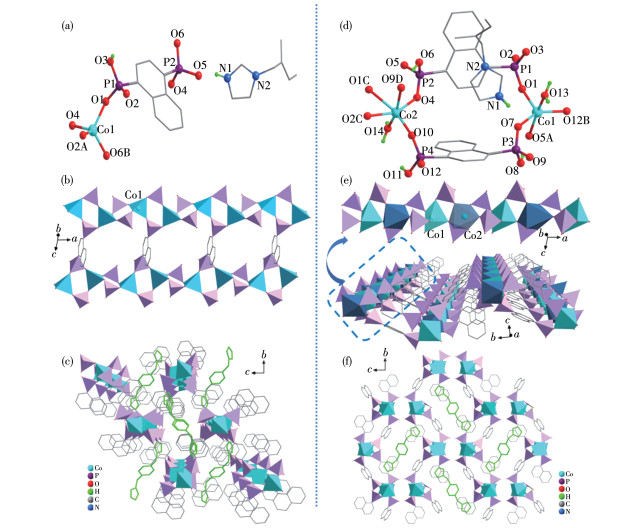
Symmetry codes: A: 1-x, -y, 1-z; B: 1/2+x, 1/2-y, 1/2+z for 2; A: 3/2-x, -1/2+y, 1/2-z; B: 1/2-x, -1/2+y, 1/2-z; C: 3/2-x, 1/2+y, 1/2-z; D: 1/2-x, 1/2+y, 1/2-z for 3
Complex 3 crystallizes in the monoclinic system space group P21/n and shows a 2D layer structure. The asymmetric unit contains two Co (Ⅱ) ions, one 1, 4 ndpaH3- ion, one 1, 4 - ndpaH22- ion, two coordination water molecules, and half a 1, 4-bixH22+ ion. Compared with complex 2, Co1 is five-coordinate with a distorted trigonal- bipyramidal geometry in complex 3, in which four of the five coordination sites are occupied by phosphonate oxygens (O1, O7, O5A, O12B, Symmetry codes: A: 3/2-x, -1/2+y, 1/2-z; B: 1/2-x, -1/2+y, 1/2-z) from four equivalent 1, 4-ndpaH3- ions and the remaining one is filled with the oxygen atom (O13) of the coordination water molecule (Fig. 2d). Co2 has a distorted octahedral environment with the five sites occupied by five phosphonate oxygen (O1C, O2C, O4, O9D, O10, Symmetry codes: C: 3/2-x, 1/2+y, 1/2-z; D: 1/2-x, 1/2+ y, 1/2-z), and one coordination water atom (O14). The Co—O bond lengths are between 0.199 02(13) and 0.226 70(14) nm and the O—Co—O bond angles lie in a range of 84.68(5)°-164.51(5)° (Table S4). Two tetradentate naphthalene phosphonate ligands differ slightly in their protonation, monoprotonated (1, 4-ndpaH3-) and bi-protonated (1, 4-ndpaH22-). Unlike those in complexes 1 and 2, the phosphonate ligands in 3 adopt a cis-trans coordination mode (Scheme 1). They chelate and bridge four cobalt ions. Each {Co1O5} polyhedron is corner-shared with four {PO3C} tetrahedrons, while the {Co2O6} polyhedron is involved in corner-sharing with three {PO3C} tetrahedrons and edge - sharing with one {PO3C} tetrahedron. Therefore, the Co1 and Co2 are bridged by one μ2-O(P) and one O—P—O linker, forming a dimeric unit of Co2. The Co1…Co2 distance within the dimer is 0.388 94(4) nm. The equivalent dimers are connected by two {PO3C} tetrahedrons to form an infinite chain running along the a - axis (Fig. 2e). The distance between the dimers is 0.415 04(4) nm. The chains are cross-linked by naphthalene groups, forming a 2D wave layer in the ab plane (Fig. 2e). The protonated 1, 4-bixH22+ are filled between layers (Fig. 2f).
All the complexes exhibit di-pyridinium/imidazolium templated 3D or 2D extended structures on the connectivity between the Co2+ ions and naphthalene diphosphonate units. The reaction conditions in all the cases are similar, but the observed structural differences are mainly due to the presence of variable dipyridine molecules and pH. Both complexes 1 and 2 have analogous 3D open - framework structures connecting through metal and diphosphonates (naphthalene diphosphonic acid), while the di-pyridinium/imidazolium template is different in the framework. In the structure of 1, the template 1, 3 - dppH22+ is placed in the channel formed from {CoO4} tetrahedron and {CPO3} tetrahedron connected by naphthalene groups (Fig. 1d) with a channel size of 0.64 nm×0.64 nm (shortest atomatom contact distances, not including the van der Waals radii). The protonated 1, 3 - dppH22+ molecules occupy these channels along with free water molecules and interact with each other and with the framework through hydrogen bonds. The above channel is growing along the a - axis, which is different from the direction of the inorganic chain. In the structure of 2, templated 1, 4-bixH22+ cations are situated inside the bigger channel of size (1.34 nm×0.66 nm), constructed from four inorganic chains made up of {CoO4} tetrahedron and {PO3C} tetrahedron along the a-axis (Fig. 2c). The protonated 1, 4 - bixH22+ are stabilized through extensive N—H…O hydrogen bonding interactions with the framework. Complexes 2 and 3, despite slight distinction of pH in the reactions, the same template effect leads to different topological structures. Comparing with complex 2, complex 3 exhibits an anionic layer with protonated di - pyridinium/imidazolium template located in interlayer space. Since at a lower pH value (4.3), there are diprotonated diphosphonates (1, 4 ndpaH22-), which are absent in 1 and 2. It is worth mentioning that although cobalt phosphonates with open framework structures composed of inorganic chains and organoamine - directed were previously reported[21, 26-27], none of them contain a di - pyridinium/imidazolium template.
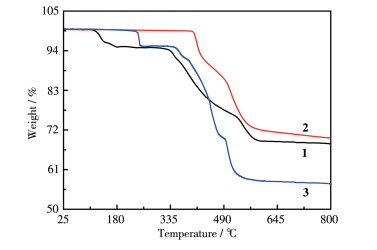
The TGA curves for complexes 1-3 are shown in Fig. 3. The TGA curve of complex 1 revealed a multistep weight loss process. The first step below 175 ℃ corresponds to a weight loss of 5.47%, attributed to the release of six lattice water molecules (Calcd. 5.73%). The dehydrated samples were stable up to 330 ℃, above which a second weight - loss step was observed with the removal of two 1, 3 - dppH22+ ions (19.18%) (Calcd. 19.76%). The third step was observed above 525 ℃, corresponding to the decomposition of the organic ligands and the collapse of the structure. Thermal analysis revealed that complex 2 was stable up to 400 ℃, above which the curve drops rapidly, due to the burn of the organic components and the collapse of the 3D structure. For complex 3, the first step occurred at about 240 ℃ with a weight loss of 4.46%, in agreement with the removal of two lattice water molecules (Calcd. 4.26%). This was followed by a short plateau until 355 ℃, above which a quick weight loss was observed corresponding to the release of the uncoordinated 1, 4-bixH22+ ions and the decomposition of the organic components.
We attempted to synthesize sufficient amounts of complex 3 to characterize its magnetic properties but unfortunately failed. The temperature - dependent magnetic susceptibilities of 1 and 2 were measured in a temperature range of 2-300 K under an applied field of 1 kOe (Fig. 4). The χMT values for each Co(Ⅱ) at 300 K were 2.36 cm3·mol-1·K for 2 and 2.41 cm3·mol-1·K for 2, and both are larger than the spin-only value of 1.875 cm3·mol-1·K for one spin - only Co (Ⅱ) (S=3/2, g=2). Since the ground state of a tetrahedral Co(Ⅱ) is 4A2, the higher value of χMT could be attributed to the orbital contribution from the lowing excited states[25]. Upon cooling, the χMT products of 1 and 2 gradually decreased to 0.35 and 0.29 cm3·K·mol-1 at 2 K, respectively. Above 100 K, the susceptibility data follow the Curie-Weiss law with the Curie constants (C) and Weiss constants (θ) of 2.77 cm3·K·mol-1 and -20.98 K for 1 and 2.45 cm3·K·mol-1 and -4.59 K for 2, respectively. The negative Weiss constant is attributed to the antiferromagnetic exchange couplings between the Co(Ⅱ) centers and/or the spin-orbital coupling of the single Co(Ⅱ) ion. For 2, the χM vs T plot shows a peak at 6 K confirming the presence of antiferromagnetic interactions between the Co(Ⅱ) centers.
In summary, we report for the first time that di-pyridinium/imidazolium templated modulated structure in metal phosphonates. Three new cobalt naphthalene - diphosphonates, namely (1, 3 - dppH2)2[Co4(1, 4 ndpa)(1, 4-ndpaH)2(1, 4-ndpaH2)]·6H2O (1), (1, 4-bixH2)0.5[Co(1, 4-ndpaH)] (2), and (1, 4-bixH2)0.5[Co2(1, 4-ndpaH)(1, 4-ndpaH2)(H2O)2] (3), were successfully prepared by the hydrothermal method in the reaction of CoCl2· 6H2O with 1, 4-ndpaH4 and 1, 3-dpp for 2 and 1, 4-bix for 2, 3 at different pH values. Complexes 1 and 2 have 3D open-framework structures, constructed by inorganic chains cross - linked by naphthalene groups, while complex 3 exhibits a 2D layer structure, constructed by inorganic chains connected by naphthalene groups. The protonated di - pyridinium/imidazolium templates, 1, 3-dppH22+ for 1, 1, 4-bixH22+ for 2 and 3, fill and compensate the negative charge. Magnetic studies reveal that dominant antiferromagnetic interactions between the magnetic centers are propagated in complexes 1 and 2. The present examples are not only enriching the field of di - pyridinium/imidazolium - templated open framework materials but also open possibilities for investigations of new phosphonates using different templates and metal combinations.
Supporting information is available at http://www.wjhxxb.cn
Clearfield A, Demadis K. Metal phosphonate chemistry: From synthesis to applications. Cambridge: Royal Society of Chemistry, 2012.
Bao S S, Zheng L M. Magnetic materials based on 3d metal phosphonates[J]. Coord. Chem. Rev., 2016, 319: 63-85. doi: 10.1016/j.ccr.2016.05.002
Yücesan G, Zorlu Y, Stricker M, Beckmann J. Metal - organic solids derived from arylphosphonic acids[J]. Coord. Chem. Rev., 2018, 369: 105122.
Goura J, Chandrasekhar V. Molecular metal phosphonates[J]. Chem. Rev., 2015, 115: 6854-6965. doi: 10.1021/acs.chemrev.5b00107
Mao J G. Structures and luminescent properties of lanthanide phosphonates[J]. Coord. Chem. Rev., 2007, 251: 1493-1520. doi: 10.1016/j.ccr.2007.02.008
Firmino A D G, Figueira F, Tome J P C, Paz F A A, Rocha J. Metalorganic frameworks assembled from tetraphosphonic ligands and lanthanides[J]. Coord. Chem. Rev., 2018, 355: 133-149. doi: 10.1016/j.ccr.2017.08.001
Jia J G, Zheng L M. Metal-organic nanotubes: Designs, structures and functions[J]. Coord. Chem. Rev., 2020, 403: 213083. doi: 10.1016/j.ccr.2019.213083
Weng G G, Zheng L M. Chiral metal phosphonates: Assembly, structures and functions[J]. Sci. China Chem., 2020, 63(5): 619-636. doi: 10.1007/s11426-020-9707-4
Liu B, Liu J C, Shen Y, Feng J S, Bao S S, Zheng L M. Polymorphic layered copper phosphonates: Exfoliation and proton conductivity studies[J]. Dalton Trans., 2019, 48: 6539-6545. doi: 10.1039/C9DT00970A
Huang J, Ding H M, Xu Y, Zeng D, Zhu H, Zang D M, Bao S S, Ma Y Q, Zheng L M. Chiral expression from molecular to macroscopic level via pH modulation in terbium coordination polymers[J]. Nat. Commun., 2017, 8: 2131. doi: 10.1038/s41467-017-02260-2
Huang X D, Wen G H, Bao S S, Jia J G, Zheng L M. Thermo- and light-triggered reversible interconversion of dysprosium- anthracene complexes and their responsive optical, magnetic and dielectric properties[J]. Chem. Sci., 2021, 12: 929-937. doi: 10.1039/D0SC04851H
Liu S B, Bao S S, Zheng L M. Polar layered coordination polymers incorporating triazacyclononane - triphosphonate metalloligands[J]. Dalton Trans., 2020, 49: 3758-3765. doi: 10.1039/C9DT03858B
Wen G H, Chen X M, Xu K, Xu X J, Bao S S, Zheng L M. Uranyl phosphonates: Crystalline materials and nanosheets for temperature sensing[J]. Dalton Trans., 2021, 50: 17129-17139. doi: 10.1039/D1DT02977K
Feng J S, Bao S S, Ren M, Cai Z S, Zheng L M. Chirality- and pHcontrolled supramolecular isomerism in cobalt phosphonates and its impact on the magnetic behavior[J]. Chem. - Eur. J., 2015, 21: 17336. doi: 10.1002/chem.201502335
Tang S F, Li L J, Wang C, Zhao X B. Investigation of the structure variation of metal diphosphonates with the changing of N-donor auxiliary ligands and their properties[J]. CrystEngComm, 2014, 16: 9104. doi: 10.1039/C4CE01266F
Rom T, Kumar N, Sharma M, Gaur A, Paul A K. Colossal dielectric responses from the wide band gap 2D - semiconducting amine templated hybrid framework materials[J]. Inorg. Chem., 2020, 59(14): 94659470.
Fu R B, Hu S M, Wu X T. New layered metal phosphonates based on functionalized phosphonic acids[J]. Cryst. Growth Des., 2015, 15(6): 3004-3014. doi: 10.1021/acs.cgd.5b00423
Rom T, Biswas R, Haldar K K, Sarkar S, Saha U, Paul A K. Charge separated one-dimensional hybrid cobalt/nickel phosphonate frameworks: A facile approach to design bifunctional electrocatalyst for oxygen evolution and hydrogen evolution reactions[J]. Inorg. Chem., 2021, 60: 15106-15111. doi: 10.1021/acs.inorgchem.1c02320
Paul A K, Kanagaraj R, Jana A K, Maji P K. Novel amine templated three-dimensional zinc-organophosphonates with variable poreopenings[J]. CrystEngComm, 2017, 19: 6425-6435. doi: 10.1039/C7CE00994A
Ma Y J, Hu J X, Han S D, Pan J, Li J H, Wang G M. Manipulating on/off single-molecule magnet behavior in a Dy(Ⅲ)-based photochromic complex[J]. J. Am. Chem. Soc., 2020, 142: 2682-2689. doi: 10.1021/jacs.9b13461
Liu H H, Ma Y J, Han S D, Li J H, Wang G M. Zinc diphosphonates with extended dipyridine units: Synthesis, structures, in situ reactions, and photochromism[J]. Dalton Trans., 2019, 48: 3955-3961. doi: 10.1039/C9DT00081J
Bulut A, Zorlu Y, Wörle M, Çetinkaya A C, Kurt H, Tam B, Yazaydın A, Beckmann J, Yücesan G. Short naphthalene organophosphonate linkers to microporous frameworks[J]. ChemistrySelect, 2017, 2: 7050. doi: 10.1002/slct.201701411
Kahn O. Molecular magnetism. New York: Wiley-VCH, 1993.
Zou Q, Bao S S, Huang X D, Wen G H, Jia J G, Wu L Q, Zheng L M. Cobalt(Ⅱ)-dianthracene frameworks: Assembly, exfoliation and properties[J]. Chem.-Asian J., 2021, 16: 1-11. doi: 10.1002/asia.202001239
Zheng T, Bao S S, Ren M, Zheng L M. Cobalt phosphonates based on 4-(ethoxycarbonyl)-naphthalen-1-yl)phosphonic acid[J]. Dalton Trans., 2013, 42: 16396-16402. doi: 10.1039/c3dt52125g
Pan J, Ma Y J, Han S D, Xue Z Z, Wang G M. Switching the zincdiphosphonates from 1D chain to 2D layer and 3D framework by the modulation of a flexible organic amine[J]. Cryst. Growth Des., 2019, 19: 2919-2926. doi: 10.1021/acs.cgd.9b00139
Paul A K, Kanagaraj R, Pant N, Naveen K. Rare examples of aminetemplated organophosphonate open - framework compounds: Combined role of metal and amine for structure building[J]. Cryst. Growth Des., 2017, 17: 5620-5624. doi: 10.1021/acs.cgd.7b01110

Figure 1 (a) Building unit of 1 with atomic labeling scheme; (b) 1D inorganic chain; (c) Inorganic chains cross-linked by naphthalene groups, where 1, 3-dppH22+ ions are omitted for clarity; (d) View of the supramolecular structure of 1 along the [011] direction showing the template, 1, 3-dppH22+, placed in the channel
All H atoms and water molecules are omitted for clarity

Figure 2 (a) Building unit of 2 with the atomic labeling scheme; (b) Inorganic chains cross-linked by naphthalene groups; (c) 3D polyhedral view of complex 2; (d) Building unit of 3 with the atomic labeling scheme; (e) Wave single layer structure of 3 where the inorganic chains are cross-linked by naphthalene; (f) Packing diagram of 2 in ABAB mode viewed along the a-axis
Symmetry codes: A: 1-x, -y, 1-z; B: 1/2+x, 1/2-y, 1/2+z for 2; A: 3/2-x, -1/2+y, 1/2-z; B: 1/2-x, -1/2+y, 1/2-z; C: 3/2-x, 1/2+y, 1/2-z; D: 1/2-x, 1/2+y, 1/2-z for 3
Table 1. Crystallographic data and structure refinement details for complexes 1-3
| Parameter | 1 | 2 | 3 |
| Formula | C66H72Co4N4O30P8 | C17H15CoN2O6P2 | C27H27Co2N2O14P4 |
| Formula weight | 1 884.75 | 464.18 | 845.24 |
| Crystal system | Monoclinic | Monoclinic | Monoclinic |
| Space group | P21/c | P21/n | P21/n |
| a/nm | 1.629 35(3) | 0.892 37(2) | 0.795 02(2) |
| b/nm | 1.643 11(3) | 1.619 29(4) | 1.738 02(3) |
| c/nm | 2.744 57(5) | 1.278 26(4) | 2.212 33(5) |
| β/(°) | 101.661(2) | 102.860(3) | 99.848(2) |
| V/nm3 | 7.196 1(2) | 1.800 76(8) | 3.011 87(12) |
| Z | 4 | 4 | 4 |
| Dc/(g·cm-3) | 1.740 | 1.172 | 1.864 |
| μ/mm-1 | 1.177 | 1.170 | 1.392 |
| F(000) | 3 856 | 944.0 | 1 716.0 |
| Rint | 0.031 8 | 0.029 3 | 0.036 4 |
| GOF on F2 | 1.036 | 1.078 | 1.062 |
| R1, wR2* [I > 2σ(I)] | 0.037 7, 0.091 6 | 0.033 2, 0.081 2 | 0.032 0, 0.083 0 |
| R1, wR2 (all data) | 0.050 6, 0.097 4 | 0.038 8, 0.084 1 | 0.040 6, 0.088 0 |
| (Δρ)max, (Δρ)min/(e·nm-3) | 978, -643 | 980, -330 | 520, -780 |
| *R=∑||Fo|-|Fc||/∑|Fo|, wR=[∑w(Fo2-Fc2)2/∑w(Fo2)2]1/2. | |||
 下载: 导出CSV

 扫一扫看文章


扫一扫关注我们


 下载:
下载: