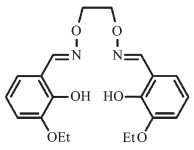
图 Scheme 1
Structure of the ligand H2L
Figure Scheme 1.
Structure of the ligand H2L

Heterobimetallic Cu(Ⅱ)-Nd(Ⅲ) and Zn(Ⅱ)-Ce(Ⅲ) Salamo-Type Complexes: Syntheses, Crystal Structures and Fluorescence Properties
Yu-Hua YANG , Yu ZHANG , Meng YU , Shan-Shan ZHENG , Wen-Kui DONG


Much recent interests have been focused on 3d transition metal complexes with Salen-[1-7] or Salamo-type[8-12] ligands, which have potential applications, such as luminescent[13-19] and magnetic[20-25] materials, supramolecular architectures[26-31], biological fields[32-39], molecular recognitions[40-43] and electrochemistries[44-45]. Because of the high coordination ability of phenoxy groups, many central metals can be coordinated to form heteronuclear metal complexes[46-50].
Because the f-f transitions of lanthanide ions are parity forbidden, the absorption coefficients are very low and the emissive rates are slow[51], suitable organic ligands must be well-designed to strengthen lumine-scent intensity, which act as sensitizers to excite lanthanide ions (antenna effect)[52].
Herein, two kinds of hetero-bimetallic 3d-4f com-plexes containing a Salamo-type ligand O, O′-(ethane-1, 2-diyl)bis(1-(3-ethoxy-2-hydroxyphenyl)-3-ethoxy-2-hydroxybenzaldehyde oxime) (H2L) were synthesized and structurally characterized. Furthermore, their fluorescence properties were investigated.
3-Ethoxybenzaldehyde (99%) was purchased from Alfa Aesar and used without further purification. Ethanol and methanol and other reagents and solvents were analytical grade reagents from Tianjin Chemical Reagent Factory. C, H and N analyses were obtained using a GmbH VarioEL V3.00 automatic elemental analysis instrument. Elemental analyses for metals were monitored with an IRIS ER/S-WP-1 ICP atomic emission spectrometer. Melting points were acquired by the use of a microscopic melting point apparatus made in Beijing Taike Instrument Limited Company and were uncorrected. IR spectra were recorded on a Vertex70 FT-IR spectrophotometer, with samples prepared as KBr (500~4 000 cm-1). UV-Vis absorption spectra were recorded on a Shimadzu UV-3900 spectrometer. Fluorescence spectra in solution were recorded on a Hitachi F-7000 spectrometer. 1H NMR spectra were determined by a German Bruker AVANCE DRX-400 spectrometer.
The Salamo-type ligand H2L was synthesized according to an analogous method reported earlier[53]. A solution of 1, 2-bis(aminooxy)ethane (276.0 mg, 3.0 mmol) in ethanol (10 mL) was added to a solution of 3-ethoxybenzaldehyde (996.0 mg, 6.0 mmol) in ethanol (20 mL), and the mixture was heated at 55~60 ℃ for 5h. After cooling to room temperature, the precipitate was filtered off, and white crystalline H2L was obtained. Yield: 784.0 mg, 67.3%. m.p. 462~463 K. Anal. Calcd. for C20H24N2O6(%): C, 61.84; H, 6.23; N, 7.21. Found(%): C, 61.80; H, 6.30; N, 7.19. 1H NMR (400 MHz, CDCl3): δ 1.47 (t, J=4 Hz, 6H, CH3), 4.11 (dd, J=4, 8 Hz, 4H, CH2), 4.46 (s, 4H, CH2), 6.82 (m, 3H, ArH), 6.88 (m, 3H, ArH), 8.26 (s, 2H, CH=N), 9.68 (s, 2H, OH). IR (KBr, cm-1): 1 611 (νC=N), 1 248 (νAr-O). UV-Vis (MeCN, 10 μmol·L-1), λmax/nm: 270, 319.
The ligand H2L (19.4 mg, 0.05 mmol) was disso-lved in 5 mL of ethanol and stirred with ethanol solution (5 mL) of Cu(OAc)2·2H2O (10.3 mg, 0.05 mmol) and Nd(NO3)3·6H2O (22.6 mg, 0.05 mmol), filtered to get a dark green solution. Through partial solvent evaporation, single crystals suitable for X-ray diffraction anal-ysis were obtained after several days. Yield: 60.3%. Anal. Calcd. for C22H28NdCuN5O16(%): C, 31.98; H, 3.42; N, 8.48. Found(%): C, 32.24; H, 3.29; N, 8.43.
The synthesis of complex 2 is similar to that of complex 1, except that the solvent is replaced. The ligand was dissolved in acetone, while the metal salts Zn(OAc)2 and Ce(NO3)3 were dissolved in methanol. White crystals of complex 2 were collected. Yield: 58.6%. Anal. Calcd. for C23H29CeZnN4O15(%): C, 34.23; H, 3.62; N, 6, 94. Found(%): C, 34.39; H, 3.47; N, 6.82.
The single crystals of complexes 1 and 2 were placed on a Super Nova Dual Eos four-circle diffracto-meter. The diffraction data were collected using a graphite monochromated Mo Kα radiation (λ=0.710 73 nm). Data collection and reduction were performed using CrysAlisPro and then processed with Olex2. The structures were solved with SHELXS-2008 and refined with SHELXL-2014[54]. All non-hydrogen atoms were refined anistropically and hydrogen atoms were added in calculated positions and refined using a riding model. The crystallographic data and structural refine-ments for complexes 1 and 2 are listed in Table 1.
 下载:
导出CSV
下载:
导出CSV
| Complex | 1 | 2 |
| Empirical formula | C22H28NdCuN5O16 | C23H29CeZnN4O15 |
| Formula weight | 826.27 | 806.99 |
| Crystal system | Monoclinic | Triclinic |
| Space group | P21/n | P1 |
| a/nm | 0.942 91(3) | 0.905 77(8) |
| b/nm | 1.528 96(4) | 1.203 32(13) |
| c/nm | 2.135 12(4) | 1.547 57(13) |
| α/(°) | 99.496(8) | |
| β/(°) | 92.353(2) | 102.562(7) |
| γ/(°) | 111.854(9) | |
| V/nm3 | 3.075 55(14) | 1.470 7(3) |
| Z | 4 | 2 |
| Dc/(g·cm-3) | 1.784 | 1.822 |
| μ/mm-1 | 2.441 | 2.422 |
| F(000) | 1 648 | 806 |
| Crystal size/mm | 0.24×0.22×0.15 | 0.21×0.14×0.12 |
| θ range/(°) | 3.43~26.02 | 3.52~26.02 |
| Limiting indices | -11 ≤ h ≤ 9, -13 ≤ k ≤ 18, -16 ≤ l ≤ 26 | -11 ≤ h ≤ 11, -14 ≤ k ≤ 11, -19 ≤ l ≤ 18 |
| Independent reflection | 6 053 | 5 765 |
| Completeness to θ/% | 99.68 | 99.75 |
| Data, restraint, parameter | 6 053, 30, 434 | 5 765, 3, 404 |
| GOF on F2 | 1.035 | 1.026 |
| Final R indices [I>2σ(I)] | R=0.035 2, wR=0.058 7 | R=0.034 5, wR=0.064 9 |
| Largest diff. peak and hole/(e · nm-3) | 650 and -510 | 470 and -840 |
CCDC: 1815944, 1; 1815943, 2.
IR spectra of H2L and its corresponding complexes 1 and 2 exhibited various bands in the region of 4 000~400 cm-1 (Fig. 1). The O-H stretching band of the free ligand H2L was observed at 2 981 cm-1 that belongs to the phenolic hydroxyl group, whereas complexes 1 and 2 showed a vibration band at 3 413 and 3 402 cm-1 that belong to coordinated ethanol or methanol molecules.
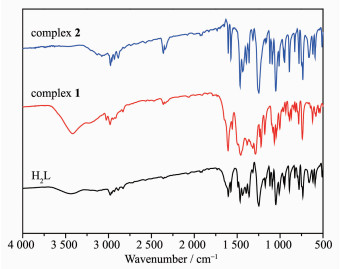
The free ligand H2L exhibited characteristic C=N stretching band at 1 611 cm-1, which is shied by 5~7 cm-1 in complexes 1 and 2, respectively, indicating that the nitrogen atoms of C=N group are coordinated to the Cu(Ⅱ) or Zn(Ⅱ) ions, which is similar to previously reported metal(Ⅱ) complexes[55].
The Ar-O stretching frequency appeared at 1 248 cm-1 for the ligand H2L, while the Ar-O stretching frequencies in complexes 1, and 2 are observed at 1 233 and 1 242 cm-1, respectively. The Ar-O stretching frequencies are shifted to lower frequencies, indicat-ing that the Cu-O or Zn-O bonds are formed between the metal(Ⅱ) ions and oxygen atoms of phenolic groups.
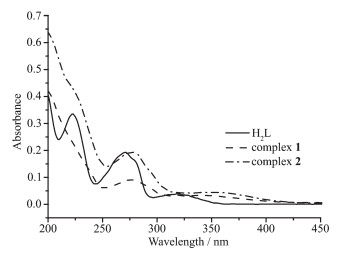
The absorption spectra of H2L and its complexes 1 and 2 in diluted acetonitrile solution are shown in Fig. 2. The free ligand H2L showed three absorption bands at 222, 270 and 319 nm. The peaks at 222 and 270 nm can be assigned to the π-π* transitions of the benzene rings and the latter peak at 319 nm can be assigned to intra-ligand π-π* transition of the oxime groups[56]. Compared with the absorption peaks of H2L, with the emergence of the first absorption peaks at ca. 276 and 277 nm were observed in complexes 1 and 2, respectively. These peaks are bathochromically shifted, indicating coordination of the ligand moieties with metal(Ⅱ) ions. The absorption peaks at ca. 270 and 319 nm were absent in complexes 1 and 2. Meanwhile, new absorption peaks were observed at ca. 344 and 350 nm in complexes 1 and 2, may be due to L→M charge-transfer transitions, which are characteristic of the transition metal complexes with Salen-type N2O2 coordination spheres.
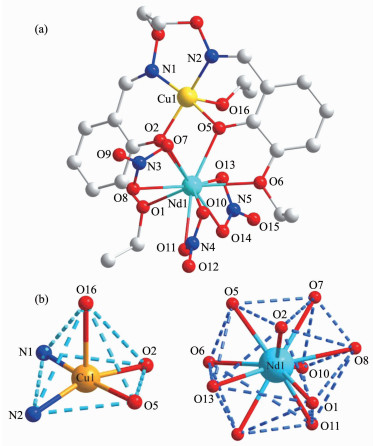
Selected bond lengths and angles for complex 1 are presented in Table 2. Complex 1 crystallizes in the monoclinic system, space group P21/n, An asymmetric unit of complex 1 includes one completely deprotonated L2- unit, one Cu(Ⅲ) atom (Cu1), one Nd(Ⅲ) ion (Nd1), three NO3- ions and one coordinated ethanol molecule. The crystal structure of complex 1 and geometries of metal atoms are shown in Fig. 3.
 下载:
导出CSV
下载:
导出CSV
| 1 | ||||||
| Nd1-O1 | 0.255 2(3) | Nd1-O8 | 0.256 8(3) | Cu1-O2 | 0.194 7(2) | |
| Nd1-O2 | 0.240 1(2) | Nd1-O10 | 0.254 0(3) | Cu1-O5 | 0.194 1(2) | |
| Nd1-O5 | 0.241 0(2) | Nd1-O11 | 0.255 0(3) | Cu1-O16 | 0.227 8(3) | |
| Nd1-O6 | 0.259 7(3) | Nd1-O13 | 0.256 6(3) | Cu1-N1 | 0.194 3(3) | |
| Nd1-O7 | 0.256 5(3) | Nd1-O14 | 0.253 8(3) | Cu1-N2 | 0.199 2(3) | |
| O1-Nd1-O6 | 144.77(8) | O5-Nd1-O13 | 73.89(9) | O13-Nd1-O8 | 146.81(9) | |
| O1-Nd1-O7 | 111.40(9) | O5-Nd1-O14 | 115.12(9) | O14-Nd1-O1 | 76.O8(9) | |
| O1-Nd1-O8 | 71.29(9) | O7-Nd1-O6 | 103.25(9) | O14-Nd1-O6 | 70.49(8) | |
| O1-Nd1-O13 | 78.68(9) | O7-Nd1-O8 | 49.26(9) | O14-Nd1-O7 | 169.61(9) | |
| O2-Nd1-O1 | 63.53(8) | O7-Nd1-O13 | 137.16(9) | O14-Nd1-O8 | 131.22(9) | |
| O2-Nd1-O5 | 64.74(8) | O8-Nd1-O6 | 141.38(8) | O14-Nd1-O10 | 100.70(9) | |
| O2-Nd1-O6 | 121.84(8) | O10-Nd1-O1 | 123.68(9) | O14-Nd1-O11 | 66.50(10) | |
| O2-Nd1-O7 | 75.64(9) | O10-Nd1-O6 | 74.32(9) | O14-Nd1-O13 | 49.88(8) | |
| O2-Nd1-O8 | 81.52(9) | O10-Nd1-O7 | 69.26(9) | O2-Cu1-O16 | 95.55(12) | |
| O2-Nd1-O10 | 144.19(9) | O10-Nd1-O8 | 70.48(9) | O2-Cu1-N2 | 161.42(12) | |
| O2-Nd1-O11 | 141.02(11) | O10-Nd1-O11 | 49.73(10) | O5-Cu1-O2 | 83.01(10) | |
| O2-Nd1-O13 | 72.52(9) | O10-Nd1-O13 | 140.90(9) | O5-Cu1-O16 | 88.39(11) | |
| O2-Nd1-O14 | 114.64(9) | O11-Nd1-O1 | 80.36(10) | O5-Cu1-N1 | 173.19(12) | |
| O5-Nd1-O1 | 126.50(8) | O11-Nd1-O6 | 95.95(10) | O5-Cu1-N2 | 87.78(11) | |
| O5-Nd1-O6 | 62.24(7) | O11-Nd1-O7 | 106.83(10) | N1-Cu1-O2 | 90.18(12) | |
| O5-Nd1-O7 | 66.90(9) | O11-Nd1-O8 | 73.00(10) | N1-Cu1-O16 | 92.04(13) | |
| O5-Nd1-O8 | 113.36(8) | O11-Nd1-O13 | 115.97(9) | N1-Cu1-N2 | 98.83(13) | |
| O5-Nd1-O10 | 106.10(9) | O13-Nd1-O6 | 71.53(9) | N2-Cu1-O16 | 100.29(14) | |
| O5-Nd1-O11 | 153.13(10) | |||||
| 2 | ||||||
| Ce1-O1 | 0.266 4(2) | Ce1-O9 | 0.262 0(3) | Zn1-O2 | 0.199 7(3) | |
| Ce1-O2 | 0.244 1(2) | Ce1-O10 | 0.262 4(3) | Zn1-O5 | 0.205 0(2) | |
| Ce1-O5 | 0.243 0(3) | Ce1-O12 | 0.272 7(3) | Zn1-O8 | 0.197 4(3) | |
| Ce1-O6 | 0.274 4(3) | Ce1-O13 | 0.256 4(3) | Zn1-N1 | 0.210 5(3) | |
| Ce1-O7 | 0.244 4(2) | Ce1-O32 | 0.260 6(3) | Zn1-N2 | 0.206 1(3) | |
| O1-Ce1-O6 | 146.10(8) | O7-Ce1-O1 | 127.32(8) | O13-Ce1-O10 | 74.20(10) | |
| O1-Ce1-O12 | 69.61(9) | O7-Ce1-O6 | 85.03(8) | O13-Ce1-O12 | 48.02(10) | |
| O2-Ce1-O1 | 60.92(8) | O7-Ce1-O9 | 141.59(10) | O13-Ce1-O32 | 80.10(10) | |
| O2-Ce1-O6 | 124.37(8) | O7-Ce1-O10 | 149.63(9) | O32-Ce1-O1 | 71.47(8) | |
| O2-Ce1-O7 | 81.56(8) | O7-Ce1-O12 | 112.84(9) | O32-Ce1-O6 | 141.20(8) | |
| O2-Ce1-O9 | 84.83(9) | O7-Ce1-O13 | 81.42(9) | O32-Ce1-O9 | 145.19(9) | |
| O2-Ce1-O10 | 127.05(9) | O7-Ce1-O32 | 63.90(9) | O32-Ce1-O10 | 127.23(10) | |
| O2-Ce1-O12 | 124.67(9) | O9-Ce1-O1 | 73.88(9) | O32-Ce1-O12 | 66.18(9) | |
| O2-Ce1-O13 | 154.73(10) | O9-Ce1-O6 | 73.50(9) | O2-Zn1-O5 | 79.75(10) | |
| O2-Ce1-O32 | 75.68(9) | O9-Ce1-O10 | 48.14(10) | O2-Zn1-N1 | 87.49(12) | |
| O5-Ce1-O1 | 115.68(8) | O9-Ce1-O12 | 104.46(10) | O2-Zn1-N2 | 136.25(12) | |
| O5-Ce1-O2 | 64.38(8) | O10-Ce1-O1 | 80.85(9) | O5-Zn1-N1 | 160.94(12) | |
| O5-Ce1-O6 | 60.13(8) | O10-Ce1-O6 | 70.63(9) | O5-Zn1-N2 | 85.54(12) | |
| O5-Ce1-O7 | 71.67(9) | O10-Ce1-O12 | 62.27(9) | O8-Zn1-O2 | 110.44(11) | |
| O5-Ce1-O9 | 70.04(10) | 012-Ce1-O6 | 110.32(8) | O8-Zn1-O5 | 95.00(11) | |
| O5-Ce1-O10 | 1O8.94(9) | O13-Ce1-O1 | 117.54(9) | O8-Zn1-N1 | 102.75(12) | |
| O5-Ce1-O12 | 169.71(8) | O13-Ce1-O6 | 72.37(9) | O8-Zn1-N2 | 111.73(13) | |
| O5-Ce1-O13 | 126.41(10) | O13-Ce1-O9 | 119.81(10) | N2-Zn1-N1 | 94.17(13) | |
| O5-Ce1-O32 | 123.37(9) | |||||
Cu1 atom was penta-coordinated by inner N2O2 (N1, N2, O1 and O5) cavity from the deprotonated L2- unit and one oxygen atom (O16) of the coordinated ethanol molecule. According to the calculation of structural index parameter τ1=0.196, Cu1 atom adopts a slightly distorted square pyramidal configuration, which N2O2 site occupies the basal plane and O16 is in the axial position. The bond lengths of Cu-N bonds are in the range of 0.194 3(3)~0.199 2(3) nm, and those of Cu-O bonds are in 0.194 1(2)~0.227 8(3) nm with longer bond exists in the axial position. In addition, the angles of N1-Cu1-O16 and O5-Cu1-O16 are 92.04(13)° and 88.39(11)°, respectively, nearly equal to the upright angle. Compared with crystal structures of other analogous, acetate ions no longer bridge two metal ions in a common μ2-fashion[57] or as a terminal monodentate ligand, which does not participate in the coordination of complex 1. Nd1 atom is deca-coordinated with outer O4 site (O1, O2, O5 and O6) and six oxygen atoms provided by three bidentate NO3- ions (O7, O8, O10, O11, O13 and O14), showing a distorted bicapped twelve surface geometry. The Nd-O bond lengths are in the range of 0.240 1(2)~0.259 7(3) nm, as can be seen from Fig. 3b the distances are close to each other.
Selected bond lengths and angles for complex 2 are presented in Table 2. Complex 2 crystallizes in the triclinic system, space group P1. The crystal structure of complex 2 and geometries of metal atoms are shown in Fig. 4.
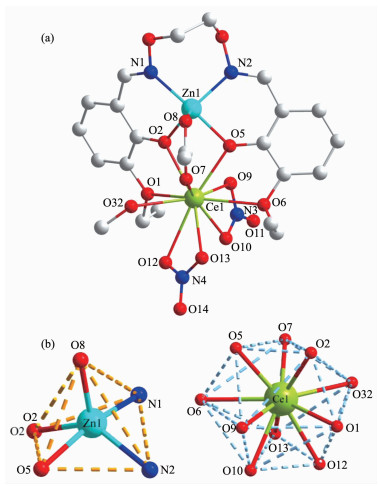
For complex 2, an asymmetric unit includes a fully deprotonated L2- unit, one Zn(Ⅱ) ion (Zn1), Ce(Ⅲ) ion (Ce1), one μ2-acetate ion, two NO3- ions and one coordinated methanol molecule. Five donor atoms (N1, N2, O2, O5 and O8) of Zn1 atom come from N2O2 cavity and the μ2-acetate ion, respectively. The structural index parameter τ1 is equal to 0.412 by calculated. It is well known that the geometry of pentacoor-dinated complex is decided by geometric parameter τ, when τ=0, metal ions adopt square pyramidal configuration, when τ=1, will adopt the trigonal bipyramidal geometry. Herein, the τ value is closed to 0.5, indicating that the geometry of Zn1 atom is distorted square pyramidal configuration, where N2O2 are basal plane and O8 occupies the axial position. The bond lengths of Zn-N bonds are 0.206 1(3) and 0.210 5(3) nm, and those of Zn-O bonds is in the range of 0.197 4(3)~0.205 0(2) nm, which are obvious shorter than Zn-N. It is worth noting that the angle of O5-Zn1-N1 is 160.94(12)°, which is relatively close to 180o, also implying that the geometry of Zn1 atom possesses square pyramidal.
The coordination number and geometry of Ce1 atom are same with Nd1 of complex 1, and both of them adopt a deca-coordinated bicapped twelve surface geometry. The differences are one methanol molecule and one μ2-acetate ion coordinated with Ce1. The bond lengths of Ce-O bonds are in the range of 0.243 0(3)~0.274 4(3) nm, while Ce1-O2 and Ce1-O5 have a shortest bond lengths and Ce1-O6 are the longest.
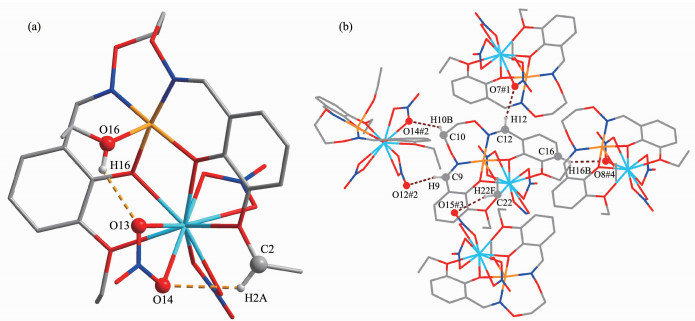
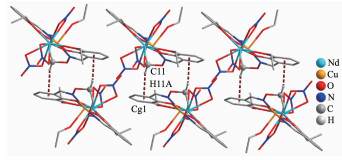
As shown in Fig. 5 and 6, the self-assembling array of complex 1 is linked by intramolecular hydrogen bonds and intermolecular interactions. The hydrogen bond data and intermolecular interaction data are given in Table 3. In the crystal structure, there are eight intramolecular hydrogen bond interactions: O16-H16…O13, O16-H16A…O13, C2-H2A…O14, C9-H9…O12#2, C10-H10B…O14#2, C12-H12…O7#1, C16-H16B…O8#3 and C22-H22F…O15#4[58-61] (Table 3), which is shown in Fig. 5 involving the coordinated ethanol molecule and NO3- ions in each molecule. There is also one intermolecular C-H…π (C11-H11A…Cg6) interaction. The molecule is interlinked through intermolecular C-H…π interac-tions into an infinite 1D chain (Fig. 6).
 下载:
导出CSV
下载:
导出CSV
| Complex | D-H…A | d(D-H)/nm | d(H…A)/nm | s(D…A)/nm | ∠DHA/(°) |
| 1 | O16-H16…O13 | 0.085(5) | 0.217(3) | 0.282 9(4) | 135(5) |
| O16-H16A…O13 | 0.084(4) | 0.223(4) | 0.282 9(4) | 129(4) | |
| C2-H2A…O14 | 0.097 00 | 0.260 | 0.327 7(5) | 127 | |
| C9-H9…O12#2 | 0.093 00 | 0.234 | 0.324 7(5) | 166 | |
| C10-H10B…O14#2 | 0.097 00 | 0.256 | 0.334 2(5) | 137 | |
| C12-H12…O7#1 | 0.093 00 | 0.237 | 0.324 1(4) | 157 | |
| C16-H16B…O8#3 | 0.093 00 | 0.254 | 0.339 9(5) | 153 | |
| C22-H22F…O15#4 | 0.096 00 | 0.252 | 0.344 8(11) | 163 | |
| C11-H11A…Cg6 | 0.096 00 | 0.282 | 0.338 9(5) | 119 | |
| 2 | O32-H32…O7 | 0.085(3) | 0.236(4) | 0.267 5(4) | 102(3) |
| O32#5-H32…O11#5 | 0.085(3) | 0.207(3) | 0.28 55(5) | 153(4) | |
| C2-H2B…O12 | 0.097 00 | 0.236 | 0.307 5(5) | 130 | |
| C10-H10A…08 | 0.097 00 | 0.241 | 0.334 0(5) | 159 | |
| C12-H12…O14#6 | 0.093 00 | 0.253 | 0.332 5(7) | 144 | |
| C10-H10B…O12#7 | 0.097 00 | 0.258 | 0.353 9(6) | 169 | |
| C19-H19B…O13 | 0.097 00 | 0.239 | 0.302 6(6) | 122 | |
| Symmetry codes: #1: 2-x, 2-y, -z; #2: -1/2+x, 3/2-y, -1/2+z; #3: 2-x, 1-y, -z; #4: 1+x, y, z for 1; #5: 1+x, y, z; #6: x, 1+y, z; #7: 1+x, 1+y, z for 2. | |||||
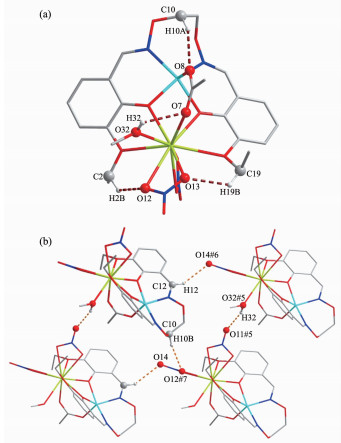
In the crystal structure of complex 2, there are seven intra-and inter-molecular hydrogen bond interactions: O32-H32…O7, O32#5-H32…O11#5, C2-H2B…O12, C10-H10A…O8, C10-H10B…O12#7, C12-H12…O14#6 and C19-H19B…O13#6, which are show in Table 3[62-66]. Due to the presence of the methanol molecule, hydrogen bonds constructed via the hydroxyl (Fig. 7). The hydrogen bonds make the crystal structure of complex 2 more stable.
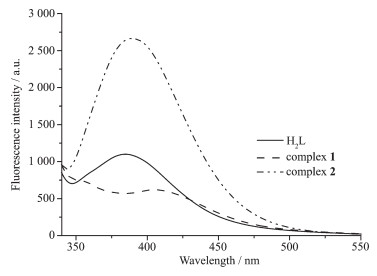
The fluorescence properties of H2L and its comp-lexes 1 and 2 were investigated in acetonitrile (10 μmol·L-1) with excitation at 318 nm at room tempera-ture (Fig. 8). The ligand exhibited an intense emission peak at 384 nm, which should be assigned to the intraligand π-π* transition. The emission spectra of complex 2 showed one main peak at 389 nm (λex=318 nm). Meanwhile, it can be seen that complexes 1 and 2 exhibit a red-shift with respect to the ligand H2L, which is tentatively assigned to a ligand-to-metal charge transfer (LMCT). In addition, compared with the emission spectrum of H2L, the enhanced fluore-scence intensity of complex 2 was observed, which is attributed to the following reasons: (1) the more rigidity of the ligand coordination to Zn(Ⅱ) ion that effectively reduces the loss of energy and increase the emission efficiency; (2) the full d10 electronic config-uration of Zn(Ⅱ) ion; (3) an increased rigidity in structure of complex 2 and a restriction in the photo-induced electron transfer (PET)[67]. In addition, the differences of the peak positions may be considered to be a result of the dissimilar coordination of the metal centers because the emission behavior is closely associated to the metal ions and ligand L2- units around them. Compared with the free ligand H2L, an extremely weak fluorescence intensity of complex 1 was observed, indicating that fluorescent characteristic has been influenced by the introduction of the Cu(Ⅱ) ion.
Two new heterobinuclear 3d-4f complexes were prepared by the one-pot reaction of a Salamo-type ligand H2L with lanthanide(Ⅲ) nitrate and zinc(Ⅱ)acetate or copper(Ⅱ) acetate, respectively. The crystal structures of complexes 1 and 2 were confirmed by X-ray single crystal diffraction, and in complexes 1 and 2, Cu(Ⅱ) and Zn(Ⅱ) ions are both penta-coordinated with a distorted square pyramidal geometry and the Nd(Ⅲ) and Ce(Ⅲ) ions are both deca-coordinated adopting a distorted bicapped twelve surface geometry.
Liu P P, Sheng L, Song X Q, et al. Inorg. Chim. Acta, 2015, 434:252-257 doi: 10.1016/j.ica.2015.05.026
Song X Q, Peng Y J, Chen G Q, et al. Inorg. Chim. Acta, 2015, 427:13-21 doi: 10.1016/j.ica.2014.12.008
Chen C Y, Zhang J W, Zhang Y H, et al. J. Coord. Chem., 2015, 68:1054-1071 doi: 10.1080/00958972.2015.1007965
Bunzli J C G, Piguet C. Chem. Soc. Rev., 2005, 34:1048-1077 doi: 10.1039/b406082m
Song X Q, Liu P P, Xiao Z R, et al. Inorg. Chim. Acta, 2015, 438:232-244 doi: 10.1016/j.ica.2015.09.022
Song X Q, Liu P P, Liu Y A, et al. Dalton Trans., 2016, 45:8154-8163 doi: 10.1039/C6DT00212A
Dong W K, Sun Y X, Xing S J, et al. Z. Naturforsch., 2012, 67b:197-203
Dong X Y, Gao L, Wang F, et al. Crystals, 2017, 7:267 doi: 10.3390/cryst7090267
杨玉华, 郝静, 董银娟, 等.无机化学学报, 2017, 33:1280-1292 doi: 10.11862/CJIC.2017.150YANG Yu-Hua, HAO Jing, DONG Yin-Juan, et al. Chinese J. Inorg. Chem., 2017, 33:1280-1292 doi: 10.11862/CJIC.2017.150
Dong Y J, Dong X Y, Dong W K, et al. Polyhedron, 2017, 123:305-315 doi: 10.1016/j.poly.2016.12.010
Dong X Y, Sun Y X, Wang L, et al. J. Chem. Res., 2012, 36:387-390 doi: 10.3184/174751912X13366711594575
Xu L, Zhu L C, Ma J C, et al. Z. Anorg. Allg. Chem., 2015, 641:2520-2524 doi: 10.1002/zaac.201500619
Song X Q, Cheng G Q, Wang X R, et al. Inorg. Chim. Acta, 2015, 425:145-153 doi: 10.1016/j.ica.2014.09.028
Dong X Y, Akogun S F, Zhou W M, et al. J. Chin. Chem. Soc., 2017, 64:412-419 doi: 10.1002/jccs.2017.64.issue-4
Ma J C, Dong X Y, Dong W K, et al. J. Coord. Chem., 2016, 69:149-159 doi: 10.1080/00958972.2015.1108410
Chen L, Dong W K, Zhang H, et al. Cryst. Growth Des., 2017, 17:3636-3648 doi: 10.1021/acs.cgd.6b01860
Zheng S S, Dong W K, Zhang Y, et al. New J. Chem., 2017, 41:4966-4973 doi: 10.1039/C6NJ04090J
Dong W K, Zhu L C, Dong Y J, et al. Polyhedron, 2016, 117:148-154 doi: 10.1016/j.poly.2016.05.055
Dong Y J, Li X L, Zhang Y, et al. Supramol. Chem., 2017, 29:518-527 doi: 10.1080/10610278.2017.1285031
Zhang H, Dong W K, Zhang Y, et al. Polyhedron, 2017, 133:279-293 doi: 10.1016/j.poly.2017.05.051
Dong W K, Ma J C, Zhu L C, et al. New J. Chem., 2016, 40:6998-7010 doi: 10.1039/C6NJ00855K
Li G, Hao J, Liu L Z, et al. Crystals, 2017, 7:217 doi: 10.3390/cryst7070217
Liu P P, Wang C Y, Zhang M, et al. Polyhedron, 2017, 129:133-140 doi: 10.1016/j.poly.2017.03.019
Liu Y A, Wang C Y, Zhang M, et al. Polyhedron, 2017, 127:278-286 doi: 10.1016/j.poly.2017.02.007
Song X Q, Zheng Q F, Wang L, et al. Luminescence, 2012, 25:328-335
Dong W K, Sun Y X, Zhao C Y, et al. Polyhedron, 2010, 29:2087-2097 doi: 10.1016/j.poly.2010.04.006
Wang P, Zhao L. Synth. React. Inorg. Met.-Org. Nano-Met. Chem., 2016, 46:1095-1101 doi: 10.1080/15533174.2015.1004416
Hao J, Li L L, Zhang J T, et al. Polyhedron, 2017, 134:1-10 doi: 10.1016/j.poly.2017.05.060
Zhao L, Dang X T, Chen Q, et al. Synth. React. Inorg. Met.-Org. Nano-Met. Chem., 2013, 43:1241-1246 doi: 10.1080/15533174.2012.757236
Sun Y X, Xu L, Zhao T H, et al. Synth. React. Inorg. Met.-Org. Nano-Met. Chem., 2013, 43:509-513 doi: 10.1080/15533174.2012.740756
Sun Y X, Zhang S T, Ren Z L, et al. Synth. React. Inorg. Met.-Org. Nano-Met. Chem., 2013, 43:995-1000 doi: 10.1080/15533174.2012.753614
Wu H L, Wang C P, Wang F, et al. J. Chin. Chem. Soc., 2015, 62:1028-1034 doi: 10.1002/jccs.v62.11
Wu H L, Bai Y C, Zhang Y H, et al. J. Coord. Chem., 2014, 67:3054-3066 doi: 10.1080/00958972.2014.959507
Wu H L, Pan G L, Bai Y C, et al. J. Photochem. Photobiol. B, 2014, 135:33-43 doi: 10.1016/j.jphotobiol.2014.04.005
Wu H L, Pan G. L, Bai Y C, et al. Res. Chem. Intermed., 2015, 41:3375-3388 doi: 10.1007/s11164-013-1440-5
Chai L Q, Zhang K Y, Tang L J, et al. Polyhedron, 2017, 130:100-107 doi: 10.1016/j.poly.2017.04.010
Wu H L, Pan G L, Bai Y C, et al. J. Chem. Res., 2014, 38:211-217 doi: 10.3184/174751914X13933417974082
Dong W K, Ma J C, Dong Y J, et al. Polyhedron, 2016, 115:228-235 doi: 10.1016/j.poly.2016.05.017
Wang L, Hao J, Zhai L X, et al. Crystals, 2017, 7:277 doi: 10.3390/cryst7090277
Wang B J, Dong W K, Zhang Y, et al. Sens. Actuators B, 2017, 247:254-264 doi: 10.1016/j.snb.2017.02.154
Wang F, Gao L, Zhao Q, et al. Spectrochim. Acta Part A, 2018, 190:111-115 doi: 10.1016/j.saa.2017.09.027
Dong W K, Akogun S F, Zhang Y, et al. Sens. Actuators B, 2017, 238:723-734 doi: 10.1016/j.snb.2016.07.047
Dong W K, Li X L, Wang L, et al. Sens. Actuators B, 2016, 229:370-378 doi: 10.1016/j.snb.2016.01.139
Dong W K, Ma J C, Zhu L C, et al. Inorg. Chim. Acta, 2016, 445:140-148 doi: 10.1016/j.ica.2016.02.043
Dong X Y, Lan P F, Zhou W M, et al. J. Coord. Chem., 2016, 69:1272-1283 doi: 10.1080/00958972.2016.1168520
Wang L, Li X Y, Zhao Q, et al. RSC Adv., 2017, 7:48730-48737 doi: 10.1039/C7RA08789F
Dong X Y, Li X Y, Liu L Z, et al. RSC Adv., 2017, 7:48394-48403 doi: 10.1039/C7RA07826A
Dong W K, Ma J C, Zhu L C, et al. Cryst. Growth Des., 2016, 16:6903-6914 doi: 10.1021/acs.cgd.6b01067
Wang L, Ma J C, Dong W K, et al. Z. Anorg. Allg. Chem., 2016, 642:834-839 doi: 10.1002/zaac.v642.15
Dong Y J, Ma J C, Zhu L C, et al. J. Coord. Chem., 2017, 70:103-115 doi: 10.1080/00958972.2016.1262537
Sabbatini N, Guardigli M, Lehn J M, et al. Coord. Chem. Rev., 1993, 123:201 doi: 10.1016/0010-8545(93)85056-A
Bazzicalupi C, Bencini A, Giorgi C, et al. Chem. Commun., 2000, 7:561
Akine S, Taniguchi T, Dong W K, et al. J. Org. Chem., 2005, 70:1704-1711 doi: 10.1021/jo048030y
(a) Sheldrick G M. Acta Crystallogr. Sect. A: Found. Crystall-ogr., 2008, A64: 112-122
(b)Sheldrick G M. Acta Crystallogr. Sect. C: Cryst. Struct. Commun., 2015, C71: 3-8
Panja A, Shaikh N, Vojtisek P, et al. New J. Chem., 2002, 26:1025-1028 doi: 10.1039/B200384H
Wang P, Zhao L. Spectrochim. Acta Part A, 2015, 135:342-350 doi: 10.1016/j.saa.2014.06.129
Addison A W, Rao T N, Reedijk J, et al. Dalton Trans., 1984, 7:1349-1356
Gao L, Wang F, Zhao Q, et al. Polyhedron, 2018, 139:7-16 doi: 10.1016/j.poly.2017.10.004
董文魁, 王莉, 孙银霞, 等.无机化学学报, 2011, 27(2):372-376 http://www.wjhxxb.cn/wjhxxbcn/ch/reader/view_abstract.aspx?flag=1&file_no=20110228&journal_id=wjhxxbcnDONG Wen-Kui, WANG Li, SUN Yin-Xia, et al. Chinese J. Inorg. Chem., 2011, 27(2):372-376 http://www.wjhxxb.cn/wjhxxbcn/ch/reader/view_abstract.aspx?flag=1&file_no=20110228&journal_id=wjhxxbcn
Sun Y X, Gao X H. Synth. React. Inorg. Met.-Org. Nano-Met. Chem., 2011, 41:973-978 doi: 10.1080/15533174.2011.591329
Li L H, Dong W K, Zhang Y, et al. Appl. Org. Chem., 2017, 31:e3818 doi: 10.1002/aoc.v31.12
董文魁, 冯建华, 张玉洁, 等.无机化学学报, 2011, 27:1865-1870 http://www.wjhxxb.cn/wjhxxbcn/ch/reader/view_abstract.aspx?flag=1&file_no=20110932&journal_id=wjhxxbcnDONG Wen-Kui, FENG Jian-Hua, ZHANG Yü-Jie, et al. Chinese J. Inorg. Chem., 2011, 27:1865-1870 http://www.wjhxxb.cn/wjhxxbcn/ch/reader/view_abstract.aspx?flag=1&file_no=20110932&journal_id=wjhxxbcn
Tao C H, Ma J C, Zhu L C, et al. Polyhedron, 2017, 128:38-45 doi: 10.1016/j.poly.2017.02.040
董文魁, 吕忠武, 孙银霞, 等.无机化学学报, 2009, 25:1627-1634 doi: 10.3321/j.issn:1001-4861.2009.09.020DONG Wen-Kui, LÜZhong-Wu, SUN Yin-Xia, et al. Chinese J. Inorg. Chem., 2009, 25:1627-1634 doi: 10.3321/j.issn:1001-4861.2009.09.020
Li X Y, Chen L, Gao L, et al. RSC Adv., 2017, 7:35905-35916 doi: 10.1039/C7RA06796H
Sun Y X, Wang L, Dong X Y, et al. Synth. React. Inorg. Met.-Org. Nano-Met. Chem., 2013, 43:599-603 doi: 10.1080/15533174.2012.751424
Chai L Q, Wang G, Sun Y X, et al. J. Coord. Chem., 2012, 65:1621-1631 doi: 10.1080/00958972.2012.677836

Figure 2 UV-Vis absorption spectra of H2L and its complexes 1 and 2 in acetonitrile (10 mol·L-1)

Figure 3 (a) Molecule structure and atom numberings of complex 1 with 30% probability displacement ellipsoids; (b) Coordination polyhedron for Cu(Ⅱ) and Nd(Ⅲ) ions of complex 1
Hydrogen atoms and solvent molecules are omitted for clarity

Figure 4 (a) Molecule structure and atom numberings of complex 2 with 30% probability displacement ellipsoids; (b) Coordination polyhedron for Zn(Ⅱ) and Ce(Ⅲ) ions of complex 2
Hydrogen atoms and solvent molecules are omitted for clarity

Figure 5 (a) View of the intramolecular hydrogen-bonding interactions of complex 1; (b) View of intermolecular interactions of complex 1
Symmetry codes: #1: 2-x, 2-y, -z; #2: -1/2+x, 3/2-y, -1/2+z; #3: 2-x, 1-y, -z; #4: 1+x, y, z

Figure 6 View of intermolecular C-H…π interactions of complex 1
Symmetry codes: 2-x, 2-y, -z

Figure 7 (a) View of the intramolecular hydrogen-bonding interactions of complex 2; (b) View of intermolecular interactions of complex 2
Symmetry codes: #5: 1+x, y, z; #6: x, 1+y, z; #7: 1+x, 1+y, z

Figure 8 Emission spectra of H2L and its complexes 1 and 2 in acetonitrile solutions (10 μmol·L-1) at room temperature
Table 1. Crystallographic data and refinement parameters for complexes 1 and 2
| Complex | 1 | 2 |
| Empirical formula | C22H28NdCuN5O16 | C23H29CeZnN4O15 |
| Formula weight | 826.27 | 806.99 |
| Crystal system | Monoclinic | Triclinic |
| Space group | P21/n | P1 |
| a/nm | 0.942 91(3) | 0.905 77(8) |
| b/nm | 1.528 96(4) | 1.203 32(13) |
| c/nm | 2.135 12(4) | 1.547 57(13) |
| α/(°) | 99.496(8) | |
| β/(°) | 92.353(2) | 102.562(7) |
| γ/(°) | 111.854(9) | |
| V/nm3 | 3.075 55(14) | 1.470 7(3) |
| Z | 4 | 2 |
| Dc/(g·cm-3) | 1.784 | 1.822 |
| μ/mm-1 | 2.441 | 2.422 |
| F(000) | 1 648 | 806 |
| Crystal size/mm | 0.24×0.22×0.15 | 0.21×0.14×0.12 |
| θ range/(°) | 3.43~26.02 | 3.52~26.02 |
| Limiting indices | -11 ≤ h ≤ 9, -13 ≤ k ≤ 18, -16 ≤ l ≤ 26 | -11 ≤ h ≤ 11, -14 ≤ k ≤ 11, -19 ≤ l ≤ 18 |
| Independent reflection | 6 053 | 5 765 |
| Completeness to θ/% | 99.68 | 99.75 |
| Data, restraint, parameter | 6 053, 30, 434 | 5 765, 3, 404 |
| GOF on F2 | 1.035 | 1.026 |
| Final R indices [I>2σ(I)] | R=0.035 2, wR=0.058 7 | R=0.034 5, wR=0.064 9 |
| Largest diff. peak and hole/(e · nm-3) | 650 and -510 | 470 and -840 |
 下载: 导出CSV
Table 2. Selected bond lengths (nm) and angles (°) for complexes 1 and 2
| 1 | ||||||
| Nd1-O1 | 0.255 2(3) | Nd1-O8 | 0.256 8(3) | Cu1-O2 | 0.194 7(2) | |
| Nd1-O2 | 0.240 1(2) | Nd1-O10 | 0.254 0(3) | Cu1-O5 | 0.194 1(2) | |
| Nd1-O5 | 0.241 0(2) | Nd1-O11 | 0.255 0(3) | Cu1-O16 | 0.227 8(3) | |
| Nd1-O6 | 0.259 7(3) | Nd1-O13 | 0.256 6(3) | Cu1-N1 | 0.194 3(3) | |
| Nd1-O7 | 0.256 5(3) | Nd1-O14 | 0.253 8(3) | Cu1-N2 | 0.199 2(3) | |
| O1-Nd1-O6 | 144.77(8) | O5-Nd1-O13 | 73.89(9) | O13-Nd1-O8 | 146.81(9) | |
| O1-Nd1-O7 | 111.40(9) | O5-Nd1-O14 | 115.12(9) | O14-Nd1-O1 | 76.O8(9) | |
| O1-Nd1-O8 | 71.29(9) | O7-Nd1-O6 | 103.25(9) | O14-Nd1-O6 | 70.49(8) | |
| O1-Nd1-O13 | 78.68(9) | O7-Nd1-O8 | 49.26(9) | O14-Nd1-O7 | 169.61(9) | |
| O2-Nd1-O1 | 63.53(8) | O7-Nd1-O13 | 137.16(9) | O14-Nd1-O8 | 131.22(9) | |
| O2-Nd1-O5 | 64.74(8) | O8-Nd1-O6 | 141.38(8) | O14-Nd1-O10 | 100.70(9) | |
| O2-Nd1-O6 | 121.84(8) | O10-Nd1-O1 | 123.68(9) | O14-Nd1-O11 | 66.50(10) | |
| O2-Nd1-O7 | 75.64(9) | O10-Nd1-O6 | 74.32(9) | O14-Nd1-O13 | 49.88(8) | |
| O2-Nd1-O8 | 81.52(9) | O10-Nd1-O7 | 69.26(9) | O2-Cu1-O16 | 95.55(12) | |
| O2-Nd1-O10 | 144.19(9) | O10-Nd1-O8 | 70.48(9) | O2-Cu1-N2 | 161.42(12) | |
| O2-Nd1-O11 | 141.02(11) | O10-Nd1-O11 | 49.73(10) | O5-Cu1-O2 | 83.01(10) | |
| O2-Nd1-O13 | 72.52(9) | O10-Nd1-O13 | 140.90(9) | O5-Cu1-O16 | 88.39(11) | |
| O2-Nd1-O14 | 114.64(9) | O11-Nd1-O1 | 80.36(10) | O5-Cu1-N1 | 173.19(12) | |
| O5-Nd1-O1 | 126.50(8) | O11-Nd1-O6 | 95.95(10) | O5-Cu1-N2 | 87.78(11) | |
| O5-Nd1-O6 | 62.24(7) | O11-Nd1-O7 | 106.83(10) | N1-Cu1-O2 | 90.18(12) | |
| O5-Nd1-O7 | 66.90(9) | O11-Nd1-O8 | 73.00(10) | N1-Cu1-O16 | 92.04(13) | |
| O5-Nd1-O8 | 113.36(8) | O11-Nd1-O13 | 115.97(9) | N1-Cu1-N2 | 98.83(13) | |
| O5-Nd1-O10 | 106.10(9) | O13-Nd1-O6 | 71.53(9) | N2-Cu1-O16 | 100.29(14) | |
| O5-Nd1-O11 | 153.13(10) | |||||
| 2 | ||||||
| Ce1-O1 | 0.266 4(2) | Ce1-O9 | 0.262 0(3) | Zn1-O2 | 0.199 7(3) | |
| Ce1-O2 | 0.244 1(2) | Ce1-O10 | 0.262 4(3) | Zn1-O5 | 0.205 0(2) | |
| Ce1-O5 | 0.243 0(3) | Ce1-O12 | 0.272 7(3) | Zn1-O8 | 0.197 4(3) | |
| Ce1-O6 | 0.274 4(3) | Ce1-O13 | 0.256 4(3) | Zn1-N1 | 0.210 5(3) | |
| Ce1-O7 | 0.244 4(2) | Ce1-O32 | 0.260 6(3) | Zn1-N2 | 0.206 1(3) | |
| O1-Ce1-O6 | 146.10(8) | O7-Ce1-O1 | 127.32(8) | O13-Ce1-O10 | 74.20(10) | |
| O1-Ce1-O12 | 69.61(9) | O7-Ce1-O6 | 85.03(8) | O13-Ce1-O12 | 48.02(10) | |
| O2-Ce1-O1 | 60.92(8) | O7-Ce1-O9 | 141.59(10) | O13-Ce1-O32 | 80.10(10) | |
| O2-Ce1-O6 | 124.37(8) | O7-Ce1-O10 | 149.63(9) | O32-Ce1-O1 | 71.47(8) | |
| O2-Ce1-O7 | 81.56(8) | O7-Ce1-O12 | 112.84(9) | O32-Ce1-O6 | 141.20(8) | |
| O2-Ce1-O9 | 84.83(9) | O7-Ce1-O13 | 81.42(9) | O32-Ce1-O9 | 145.19(9) | |
| O2-Ce1-O10 | 127.05(9) | O7-Ce1-O32 | 63.90(9) | O32-Ce1-O10 | 127.23(10) | |
| O2-Ce1-O12 | 124.67(9) | O9-Ce1-O1 | 73.88(9) | O32-Ce1-O12 | 66.18(9) | |
| O2-Ce1-O13 | 154.73(10) | O9-Ce1-O6 | 73.50(9) | O2-Zn1-O5 | 79.75(10) | |
| O2-Ce1-O32 | 75.68(9) | O9-Ce1-O10 | 48.14(10) | O2-Zn1-N1 | 87.49(12) | |
| O5-Ce1-O1 | 115.68(8) | O9-Ce1-O12 | 104.46(10) | O2-Zn1-N2 | 136.25(12) | |
| O5-Ce1-O2 | 64.38(8) | O10-Ce1-O1 | 80.85(9) | O5-Zn1-N1 | 160.94(12) | |
| O5-Ce1-O6 | 60.13(8) | O10-Ce1-O6 | 70.63(9) | O5-Zn1-N2 | 85.54(12) | |
| O5-Ce1-O7 | 71.67(9) | O10-Ce1-O12 | 62.27(9) | O8-Zn1-O2 | 110.44(11) | |
| O5-Ce1-O9 | 70.04(10) | 012-Ce1-O6 | 110.32(8) | O8-Zn1-O5 | 95.00(11) | |
| O5-Ce1-O10 | 1O8.94(9) | O13-Ce1-O1 | 117.54(9) | O8-Zn1-N1 | 102.75(12) | |
| O5-Ce1-O12 | 169.71(8) | O13-Ce1-O6 | 72.37(9) | O8-Zn1-N2 | 111.73(13) | |
| O5-Ce1-O13 | 126.41(10) | O13-Ce1-O9 | 119.81(10) | N2-Zn1-N1 | 94.17(13) | |
| O5-Ce1-O32 | 123.37(9) | |||||
下载: 导出CSV
Table 3. Intra-and inter-molecular hydrogen geometries for complexes 1 and 2
| Complex | D-H…A | d(D-H)/nm | d(H…A)/nm | s(D…A)/nm | ∠DHA/(°) |
| 1 | O16-H16…O13 | 0.085(5) | 0.217(3) | 0.282 9(4) | 135(5) |
| O16-H16A…O13 | 0.084(4) | 0.223(4) | 0.282 9(4) | 129(4) | |
| C2-H2A…O14 | 0.097 00 | 0.260 | 0.327 7(5) | 127 | |
| C9-H9…O12#2 | 0.093 00 | 0.234 | 0.324 7(5) | 166 | |
| C10-H10B…O14#2 | 0.097 00 | 0.256 | 0.334 2(5) | 137 | |
| C12-H12…O7#1 | 0.093 00 | 0.237 | 0.324 1(4) | 157 | |
| C16-H16B…O8#3 | 0.093 00 | 0.254 | 0.339 9(5) | 153 | |
| C22-H22F…O15#4 | 0.096 00 | 0.252 | 0.344 8(11) | 163 | |
| C11-H11A…Cg6 | 0.096 00 | 0.282 | 0.338 9(5) | 119 | |
| 2 | O32-H32…O7 | 0.085(3) | 0.236(4) | 0.267 5(4) | 102(3) |
| O32#5-H32…O11#5 | 0.085(3) | 0.207(3) | 0.28 55(5) | 153(4) | |
| C2-H2B…O12 | 0.097 00 | 0.236 | 0.307 5(5) | 130 | |
| C10-H10A…08 | 0.097 00 | 0.241 | 0.334 0(5) | 159 | |
| C12-H12…O14#6 | 0.093 00 | 0.253 | 0.332 5(7) | 144 | |
| C10-H10B…O12#7 | 0.097 00 | 0.258 | 0.353 9(6) | 169 | |
| C19-H19B…O13 | 0.097 00 | 0.239 | 0.302 6(6) | 122 | |
| Symmetry codes: #1: 2-x, 2-y, -z; #2: -1/2+x, 3/2-y, -1/2+z; #3: 2-x, 1-y, -z; #4: 1+x, y, z for 1; #5: 1+x, y, z; #6: x, 1+y, z; #7: 1+x, 1+y, z for 2. | |||||
下载: 导出CSV

 扫一扫看文章


扫一扫关注我们


 下载:
下载: