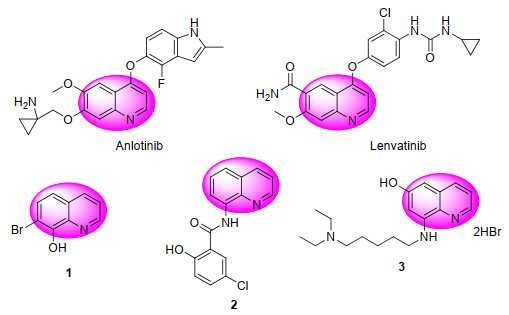
Figure 1.
Structures of quinoline derivatives previously reported

Design, Synthesis and Anticancer Activity Studies of Novel Trimethoxyphenyl-quinoline Derivatives
Bowen Wu , Xinxin Cui , Ting Zhu , Shenghui Wang , Chaofan Lu , Jinjie Wang , Hexiang Dang , Saiyang Zhang , Li'na Ding , Chengyun Jin


According to statistics from the International Agency for Research on Cancer in 2018, cancer is expected to rank as one of the leading cause of death and the single most important barrier to increase life expectancy in the 21st century[1]. Although there have some progresses in the treatment and prevention of cancers, successful treatments of cancer remain a challenge.[1~3] Therefore, there is still an urgent need to develop more efficient and safer antitumor agents.
N-Containing heterocycles play a vital role in the design of medicinal chemical structures.[4~9] Among them, quinoline and its derivatives have been reported to display broad biological activities such as anticancer, [4~7] antibac- terial, [8, 9] anti-HIV, [10, 11] anti-inflammation[12] and so on. In recent years, many quinoline-based protein kinase inhibitors have been approved for clinical application by food and drug administration (FDA), such as anlotinib[13], and lenvatinib[14] (Figure 1). Quinoline scaffold plays an important role in anticancer drug development as their derivatives have shown excellent results.[15~19] What is more, 8-substituted quinolines and their derivatives represent excellent scaffolds in antitumor agents. 8-Hydroxyquino- line (1) has inhibitory effects on relaxation of supercoiled plasmid DNA by suppressing the topoisomerase I enzyme and exhibits moderate antitumor activity against HeLa cell lines with IC50 value of 7.5 μmol/L.[20] Compound 2 showed potent inhibitory activity against VEGFR-2 kinase and HUVEC with IC50 values of 3.8 and 5.5 nmol/L, respectively.[21] Compound 3 is a novel HSP90 inhibitor and demonstrates consistent activities in both FP and WB assays with low micromolar activities (1 μmol/L).[22] Based on the above findings mentioned, the 8-aminoquinoline scaffold is chosen as a core for designing novel derivatives in this work (Figure 1).
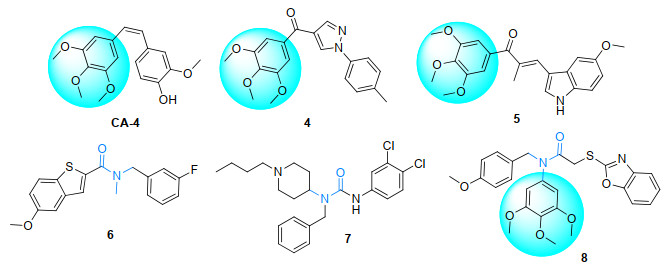
Meanwhile, many trimethoxyphenyl (TMP)-based derivatives have been discovered as potential anticancer agents[23~25] such as CA-4, [26] compounds 4[27] and 5[28] (Figure 2). Summaries of SAR of compounds 4 and 5 indicate that trimethoxyphenyl (TMP) moiety is essential for the anticancer activity. Recently, the tertiary amide fragments are frequently utilized to design novel anticancer agents to enhance the biological efficacy.[29~33] Compound 6 as a potent inhibitor of Clk1 and Clk4 could trigger the depletion of EGFR and p70S6 kinases.[29] Compound 7 regulated DCN1-mediated cullin neddylation and DCN1- UBE2M protein-protein interaction on squamous cell carcinoma cell lines.[30] Tertiary amide 8 containing 3, 4, 5- trimethoxyphenyl fragment exhibited the potent antiproliferative activity against MGC-803 cell lines with IC50 value of 0.45 μmol/L.[33]
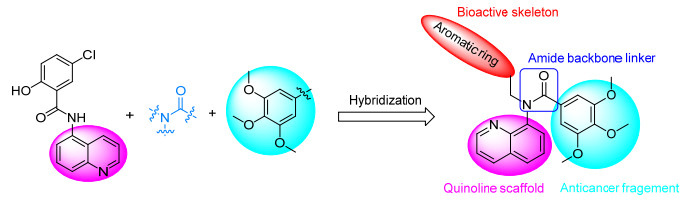
As the continuation of our studies on the development of antitumor agents and inspired by the results of the above studies, the amide backbone was linked to trimethoxyphenyl group and quinoline scaffold by the principle of molecular hybridization strategy. Accordingly, a series of trimethoxyphenyl-quinoline hybrids and their activity against three selected cancer cell lines were reported in this work (Figure 3).
All the target compounds 12a~12o were synthesized according to Scheme 1. Firstly, compounds 10a~10o were prepared by the reaction of 8-aminoquinoline (9) with substituted chloromethyl aromatic ring compounds in the presence of K2CO3 in N, N-dimethylformamide (DMF) at room temperature. Then, compounds 10a~10o reacted with 3, 4, 5-trimethoxybenzoyl chloride (11) to obtain compounds 12a~12o in the presence of triethylamine (TEA) in dichloromethane (DCM) at 25 ℃ for 2 h. Finally, the structures of compounds 12a~12o were fully characterized by 1H NMR, 13C NMR and ESI-MS.
Reagents and conditions: (a) substituted chloromethyl aromatic ring compounds, K2CO3, DMF, r.t.; (b) 3, 4, 5-trimethoxybenzoyl chloride, TEA, DCM, r.t.
All compounds 12a~12o were evaluated for their antitumor activity against three human cancer cell lines (EC-109, PC-3, and MGC-803) using 3-(4, 5-dimethyl- thiazol-2-yl)-2, 5-diphenyltetrazolium bromide (MTT) assay method and the anti-tumor drug 5-fluorouracil as a positive control drug. The results are summarized in Tables 1 and 2. Among them, compound 12j showed potential antitumor activity against PC-3 cells and MGC-803 cells with IC50 values of 9.23 and 12.42 μmol/L, respectively.
 下载:
导出CSV
下载:
导出CSV
| Compd. | R | IC50a/(μmol•L-1) | ||
| EC-109 | PC-3 | MGC-803 | ||
| 12a | 4-F | 59.53±3.22 | 32.37±1.54 | 52.97±2.96 |
| 12b | 4-Cl | 23.76±0.01 | 21.72±1.45 | 35.54±1.56 |
| 12c | 4-Br | 29.81±1.93 | 19.64±0.18 | 64.01±13.84 |
| 12d | 4-CH3 | 33.77±2.24 | 28.37±1.34 | 67.73±0.96 |
| 12e | 4-OCH3 | 41.77±12.24 | 16.62±1.82 | 25.57±1.40 |
| 12f | 4-C(CH3)3 | 24.16±2.21 | 11.13±2.39 | 18.12±1.84 |
| 12g | 3-F | 56.82±1.02 | 48.36±0.91 | > 80 |
| 12h | 3-Cl | 48.90±1.81 | 38.79±2.49 | > 80 |
| 12i | 3-CH3 | > 80 | 32. 52±0.78 | > 80 |
| 12j | 3-CH2Cl | 18.09±1.09 | 9.23±0.81 | 12.41±0.32 |
| 12k | 2, 4-Cl2 | 54.99±4.29 | 68.22±7.02 | 68.75±1.86 |
| 5-Fu | — | 9.79±0.17 | 20.42±1.83 | 21.21±3.61 |
| a Antitumor activity was assayed by exposure for 48 h. | ||||
下载:
导出CSV
| Compd. | IC50a/(μmol•L-1) | |||||
| EC-109 | PC-3 | MGC-803 | ||||
| 12j | 18.09±1.09 | 9.23±0.81 | 12.41±0.32 | |||
| 12l | 38.19±1.89 | 12.35±0.66 | 20.18±1.62 | |||
| 12m | 42.45±2.34 | 24.16±1.37 | 24.46±2.02 | |||
| 12n | 12.09±1.35 | 19.26±1.82 | 18.57±1.57 | |||
| 12o | 47.38±2.45 | 32.12±1.27 | 46.17±2.82 | |||
| 5-Fu | 9.79±0.17 | 20.42±1.83 | 21.21±3.61 | |||
| a Antiproliferative activity was assayed by exposure for 48 h. | ||||||
From the antitumor activity results of compounds 12a~12k in Table 1, some of compounds exhibited moderate activity against three human cancer cell lines. The potency of the compounds varies with respect to substitutions on the simple phenyl ring. Among them, 12j showed potential antitumor activity against three cell lines (EC-109, PC-3 and MGC-803) with IC50 values of 18.09±1.09, 9.23±0.81 and 12.46±0.32 μmol/L, respectively. What's more, most of compounds against EC-109 cell lines and MGC- 803 cell lines displayed weaker activity then PC-3 cell lines. Compound 12j with 3-chloromethyl group showed the most potent activity against PC-3 cell lines with IC50 value of 9.23 μmol/L, which exhibited better activity than compounds 12g~12i with electron-donating groups and electron-withdrawing groups at the 3-position of phenyl ring. The relationships between the halogen substituents and the antiproliferative activities against PC-3 cell lines were 4-Br > 4-Cl > 4-F > 3-Cl > 3-F > 2, 4-Cl2. It could also be found that the relationships between the electron-dona- ting groups and the antiproliferative activities against PC-3 cell lines were 4-C(CH3)3 > 4-OCH3 > 4-CH3 > 3-CH3. In addition, comparing 12a~12c with 12d~12f, compounds with electron-donating groups of phenyl showed better activity than compounds with electron-withdrawing groups at the 4-position for the inhibitory activity against PC-3 cells.
In order to complete the structure activity relationships, compounds 12l~12o were synthesized and evaluated for their antiproliferative activity as shown in Table 2. Some of compounds 12l~12o retained the cytotoxic activity but displayed weaker activity against three selected cancer cell lines compared to compound 12j. Furthermore, PC-3 cells were more sensitive to the compounds than EC-109 cells, and MGC-803 cells. Compared compound 12j with compounds 12l~12o, the relationships between phenyl ring and heterocyclic rings, and the antiproliferative activities against PC-3 cells were 12j > 12i > 12m > 12n > 12o.
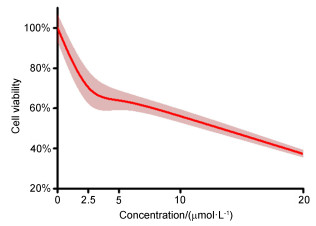
Compound 12j was chosen to further evaluate its possible anticancer mechanism of action against PC-3 cell based on the above results. We firstly investigated the impacts of compound 12j on cells viability in PC-3 cells by MTT assay. As shown in Figure 4, after treatment with compound 12j for 48 h, the cell viability was inhibited in a dose-dependent manner with an IC50 value of 9.23 μmol/L. Then, the effect of compound 12j on the cell proliferation was evaluated by colony formation assay. As shown in Figure 5, compound 12j inhibited the proliferation of PC-3 cells in a dose-dependent manner after a 7 d treatment with different concentrations of compound 12j. These results suggested that compound 12j inhibited cell viability and proliferation in a dose-dependent manner.
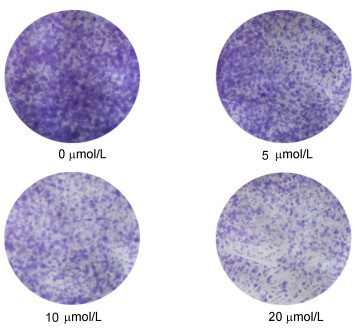
PC-3 cells were treated with different concentrations of compound 12j for 7 d
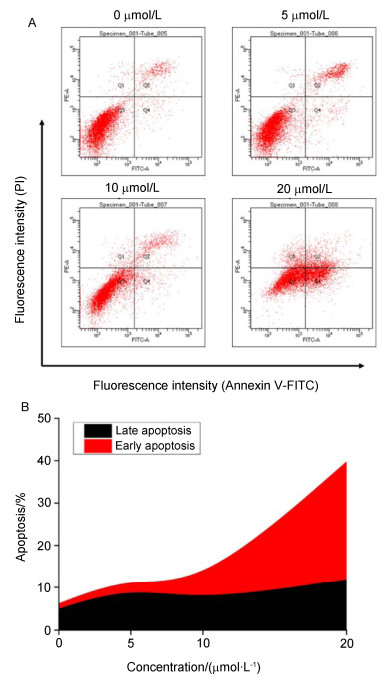
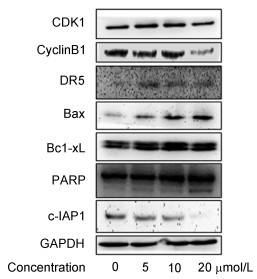
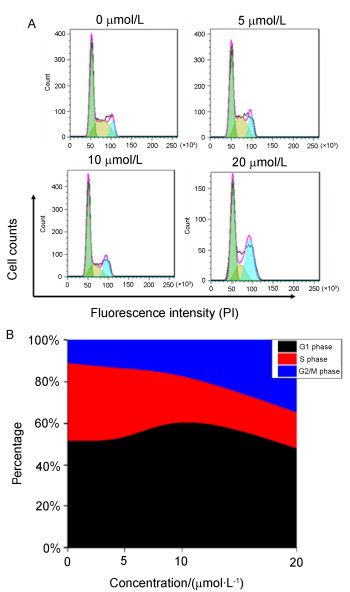
To explore the detail cytotoxic effects of 12j on PC-3 cells, the activity inducing cell cycle arrestment was then to detect. After 48 h treatment with compound 12j, PC-3 cells were arrested in G2/M phase (Figure 6), and the G2 phase related protein CyclinB1 was down regulated (Figure 7). Then, the apoptosis induction of compound 12j against PC-3 cells was next investigated. After 48 h treatment with different concentrations of compound 12j, the apoptosis rate was elevated to about 40% with high dose treatment group of compounds 12j (Figure 8). The apoptosis related proteins were detected next. The results in Figure 7 showed that the apoptosis related proteins DR5 and Bax were up-regulated. The anti-apoptosis protein c-IAP1 was down-regulated while Bcl-xL showed no significant change. What's more, apoptosis biomarker PARP was also cleaved (Figure 7). These proteins were involved in both intrinsic and extrinsic apoptosis pathway. Therefore, these results suggested compound 12j arrested PC-3 in G2/M phase and induced apoptosis via extrinsic and intrinsic apoptosis pathways.
In conclusion, a series of novel trimethoxyphenyl-quino- line derivatives were synthesized and evaluated for their antitumor activity against EC-109 cell lines, PC-3 cell lines and MGC-803 cell lines using MTT assay. These chemical structures were characterized by NMR and ESI-MS spectroscopic methods. Among all the tested compounds, compound 12j possessed the best antitumor ability with IC50 value of 9.23 μmol/L against PC-3 cells. Further mechanism studies suggested that compound 12j inhibited the cell viability and cell proliferation of PC-3 cells in a dose-dependent manner. Compound 12j arrested PC-3 cells in G2/M phase and induced cell apoptosis via activating intrinsic and extrinsic apoptosis pathway. Therefore, these results suggested that trimethoxyphenylquinoline hybrids might be considered as potential anticancer agents for further structural modifications and worth a further research.
All commercial materials were used without further purification. TLC analysis was carried out on silica gel plates GF254 (Qingdao Haiyang Chemical, China). Silica gel chromatography was carried out on 200~300 mesh gel. Anhydrous solvents and reagents were dried by routine protocols. Melting points were determined on an X-5 micromelting apparatus and are uncorrected. 1H NMR and 13C NMR spectra were recorded on a Bruker 400 MHz and 100 MHz spectrometer, respectively. Electrospray ionization mass spectrometries of all derivatives were recorded on a Waters Micromass Q-T of Micromass spectrometer by electrospray ionization (ESI).
A solution of compound 9, substituted benzyl halides (1.2 equiv.) and anhydrous potassium carbonate (3.0 equiv.) were added into DMF (5 mL), and then the mixture was stirred at room temperature for 6 h. After completion of the reaction (monitored by thin-layer chromatography (TLC)), water was added and the product was extracted by using ethyl acetate three times. The combined organic phases were washed with saturated NaCl solution, dried over anhydrous MgSO4 and evaporated to give the products. The crude residue was purified with column chromatography to obtain compounds 10a~10o.
N-(4-Fluorobenzyl)quinolin-8-amine (10a): Yellow liquid, yield 58%. 1H NMR (400 MHz, DMSO-d6) δ: 8.76 (dd, J=4.1, 1.6 Hz, 1H), 8.20 (dd, J=8.3, 1.6 Hz, 1H), 7.50 (dd, J=8.3, 4.2 Hz, 1H), 7.44 (dd, J=8.4, 5.7 Hz, 2H), 7.29 (t, J=7.9 Hz, 1H), 7.21~7.09 (m, 3H), 7.06 (d, J=8.0 Hz, 1H), 6.57 (d, J=7.5 Hz, 1H), 4.53 (d, J=6.3 Hz, 2H); 13C NMR (100 MHz, DMSO-d6) δ: 161.1 (d, J=240.0 Hz), 146.9, 144.1, 137.5, 136.0 (d, J=3.0 Hz), 135.9, 128.9 (d, J=8.0 Hz), 128.3, 127.6, 121.7, 115.0 (d, J=210.0 Hz), 113.41, 104.82, 45.36; HRMS (ESI) calcd for C16H14FN2 [M+H]+ 253.1136, found 253.1131.
N-(4-Chlorobenzyl)quinolin-8-amine (10b): Yellow solid, yield 64%. m.p. 76~78 ℃; 1H NMR (400 MHz, DMSO-d6) δ: 8.77 (dd, J=4.2, 1.7 Hz, 1H), 8.21 (dd, J=8.3, 1.6 Hz, 1H), 7.51 (dd, J=8.3, 4.2 Hz, 1H), 7.43 (d, J=8.6 Hz, 2H), 7.36 (d, J=8.6 Hz, 2H), 7.27 (dd, J=16.4, 8.5 Hz, 2H), 7.06 (dd, J=8.2, 0.9 Hz, 1H), 6.53 (dd, J=7.7, 0.9 Hz, 1H), 4.54 (d, J=6.1 Hz, 2H); 13C NMR (100 MHz, DMSO-d6) δ: 146.9, 144.0, 139.0, 137.6, 135.9, 131.1, 128.9, 128.3, 128.3, 127.6, 121.7, 113.5, 104.8, 45.4; HRMS (ESI) calcd for C16H14ClN2 [M+H]+ 269.0840, found 269.0836.
N-(4-Bromobenzyl)quinolin-8-amine (10c): Yellow solid, Yield 66%. m.p. 92~93 ℃; 1H NMR (400 MHz, DMSO-d6) δ: 8.83~8.71 (m, 1H), 8.21 (d, J=8.3 Hz, 1H), 7.55~7.45 (m, 3H), 7.36 (d, J=7.9 Hz, 2H), 7.31~7.18 (m, 2H), 7.06 (d, J=8.1 Hz, 1H), 6.52 (d, J=7.6 Hz, 1H), 4.52 (d, J=6.3 Hz, 2H); 13C NMR (100 MHz, DMSO-d6) δ: 147.0, 144.0, 139.5, 137.5, 135.9, 131.2, 129.2, 128.3, 127.6, 121.7, 119.6, 113.5, 104.8, 45.4; HRMS (ESI) calcd for C16H14BrN2 [M+H]+ 313.0335, found 313.0328.
N-(4-Methylbenzyl)quinolin-8-amine (10d): Yellow solid, yield 47%. m.p. 53~55 ℃; 1H NMR (400 MHz, DMSO-d6) δ: 8.75 (dd, J=4.1, 1.6 Hz, 1H), 8.20 (dd, J=8.3, 1.6 Hz, 1H), 7.50 (dd, J=8.3, 4.2 Hz, 1H), 7.28 (t, J=7.9 Hz, 3H), 7.12 (d, J=7.8 Hz, 2H), 7.05 (d, J=8.1 Hz, 2H), 6.57 (d, J=7.6 Hz, 1H), 4.49 (s, 2H), 2.26 (s, 3H); 13C NMR (100 MHz, DMSO) δ: 146.9, 144.2, 137.5, 136.7, 136.0, 135.7, 128.9, 128.3, 127.6, 127.1, 121.7, 113.3, 104.9, 46.0, 20.6; HRMS (ESI) calcd for C17H17N2 [M+H]+ 249.1386, found 249.1382.
N-(4-Methoxybenzyl)quinolin-8-amine (10e): Yellow solid, Yield 52%. m.p. 67~69 ℃; 1H NMR (400 MHz, DMSO-d6) δ: 8.75 (dd, J=4.1, 1.6 Hz, 1H), 8.20 (dd, J=8.3, 1.5 Hz, 1H), 7.50 (dd, J=8.3, 4.2 Hz, 1H), 7.33 (t, J=7.1 Hz, 2H), 7.30~7.24 (m, 1H), 7.09~6.98 (m, 2H), 6.89 (d, J=8.6 Hz, 2H), 6.61 (d, J=7.6 Hz, 1H), 4.46 (d, J=5.3 Hz, 2H), 3.72 (s, 3H); 13C NMR (100 MHz, DMSO-d6) δ: 158.2, 146.9, 144.2, 137.5, 135.9, 131.5, 129.1, 128.4, 128.2, 127.6, 121.7, 113.8, 113.6, 113.3, 104.8, 56.0, 45.7; HRMS (ESI) calcd for C17H17N2O [M+H]+ 265.1335, found 265.1333.
N-(3-Fluorobenzyl)quinolin-8-amine (10g): Yellow liquid, yield 67%. 1H NMR (400 MHz, DMSO-d6) δ: 8.80 (dd, J=4.2, 1.7 Hz, 1H), 8.23 (dd, J=8.3, 1.6 Hz, 1H), 7.54 (dd, J=8.3, 4.2 Hz, 1H), 7.38 (td, J=7.9, 6.1 Hz, 1H), 7.30 (dd, J=15.5, 7.7 Hz, 3H), 7.23 (d, J=10.2 Hz, 1H), 7.12~7.02 (m, 2H), 6.63~6.52 (m, 1H), 4.60 (d, J=6.4 Hz, 2H); 13C NMR (100 MHz, DMSO-d6) δ: 162.2 (d, J=242.0 Hz), 146.8, 143.9, 143.1 (d, J=7.0 Hz), 137.4, 135. 8, 130.1 (d, J=8.0 Hz), 128.1, 127.4, 122.81 (d, J=3.0 Hz), 121.55, 113.3 (d, J=40.0 Hz), 113.37, 113.3 (d, J=2.0 Hz), 104.7, 45.5; HRMS (ESI) calcd for C16H14FN2 [M+H]+ 253. 1136, found 253. 1135.
N-(3-Chlorobenzyl)quinolin-8-amine (10h): Yellow liquid, yield 54%. 1H NMR (400 MHz, DMSO-d6) δ: 8.78 (dd, J=4.1, 1.3 Hz, 1H), 8.21 (dd, J=8.3, 1.3 Hz, 1H), 7.51 (dd, J=8.2, 4.2 Hz, 1H), 7.46 (s, 1H), 7.36 (dd, J=13.0, 7.6 Hz, 2H), 7.29 (dd, J=14.2, 6.4 Hz, 3H), 7.06 (d, J=8.1 Hz, 1H), 6.55 (d, J=7.6 Hz, 1H), 4.56 (d, J=5.8 Hz, 2H); 13C NMR (100 MHz, DMSO-d6) δ: 147.0, 144.0, 142.8, 137.5, 136.0, 133.1, 130.2, 128.3, 127.6, 126.7, 126.6, 125.7, 121.7, 113.6, 104.8, 45.5; HRMS (ESI) calcd for C16H14ClN2 [M+H]+ 269.0840, found 269.0838.
N-(3-Methylbenzyl)quinolin-8-amine (10i): Yellow liquid, yield 51%. 1H NMR (400 MHz, DMSO-d6) δ: 8.76 (dd, J=4.2, 1.7 Hz, 1H), 8.20 (dd, J=8.3, 1.6 Hz, 1H), 7.50 (dd, J=8.3, 4.2 Hz, 1H), 7.29 (t, J=7.9 Hz, 1H), 7.23 (s, 1H), 7.21~7.18 (m, 2H), 7.10~7.01 (m, 3H), 6.62~6.54 (m, 1H), 4.49 (d, J=6.1 Hz, 2H), 2.26 (s, 3H); 13C NMR (100 MHz, DMSO-d6) δ: 146.9, 144.3, 139.8, 137.5, 137.4, 135.9, 128.3, 127.7, 127.6, 127.4, 124.2, 121.7, 113.3, 104.8, 46.2, 21.0; HRMS (ESI) calcd for C17H17N2 [M+H]+ 249.1386, found 249.1383.
N-(3-(Chloromethyl)benzyl)quinolin-8-amine (10j): Yellow liquid, yield 65%. 1H NMR (400 MHz, DMSO-d6) δ: 8.77 (dd, J=4.1, 1.6 Hz, 1H), 8.22 (dd, J=8.3, 1.5 Hz, 1H), 7.52 (dd, J=8.3, 4.2 Hz, 1H), 7.49 (s, 1H), 7.41~ 7.26 (m, 4H), 7.06 (d, J=8.1 Hz, 1H), 6.57 (d, J=7.6 Hz, 1H), 4.74 (s, 2H), 4.55 (s, 2H); 13C NMR (100 MHz, DMSO-d6) δ: 146.7, 143.8, 140.3, 137.7, 136.6, 128.7, 128.4, 127.8, 127.4, 127.3, 127.1, 121.7, 113.6, 105.3, 46.2, 46.1; HRMS (ESI) calcd for C17H16ClN2 [M+H]+ 283.0997, found 283.0992.
N-(2, 4-Dichlorobenzyl)quinolin-8-amine (10k): White solid, yield 59%. m.p. 162~163 ℃; 1H NMR (400 MHz, DMSO-d6) δ: 8.79 (d, J=2.5 Hz, 1H), 8.23 (d, J=8.2 Hz, 1H), 7.63 (s, 1H), 7.53 (dd, J=8.2, 4.1 Hz, 1H), 7.35 (s, 2H), 7.28 (t, J=7.7 Hz, 2H), 7.09 (d, J=8.1 Hz, 1H), 6.44 (d, J=7.5 Hz, 1H), 4.59 (d, J=5.0 Hz, 2H); 13C NMR (100 MHz, DMSO-d6) δ: 147.1, 143.7, 137.5, 136.0, 135.8, 133.1, 132.0, 129.8, 128.7, 128.3, 127.6, 127.3, 121.8, 113.9, 104.7, 43.6; HRMS (ESI) calcd for C16H13Cl2N2 [M+H]+ 303.0450, found 303.0444.
N-((4-Methylquinazolin-2-yl)methyl)quinolin-8-amine
(10l): Yellow solid, yield 57%. m.p. 175~176 ℃; 1H NMR (400 MHz, DMSO-d6) δ: 8.85 (dd, J=4.2, 1.7 Hz, 1H), 8.35~8.16 (m, 2H), 8.01 (d, J=1.7 Hz, 2H), 7.73 (ddd, J=8.2, 5.7, 2.4 Hz, 1H), 7.54 (dd, J=7.1, 2.9 Hz, 2H), 7.39 (t, J=7.9 Hz, 1H), 7.20~7.06 (m, 1H), 6.79 (d, J=7.0 Hz, 1H), 4.79 (d, J=5.1 Hz, 2H), 2.96 (s, 3H); 13C NMR (100 MHz, DMSO-d6) δ: 169.0, 162.1, 148.9, 147.2, 144.0, 137.6, 135.9, 134.3, 128.2, 127.9, 127.8, 127.4, 125.9, 122.6, 121.8, 113.7, 104.9, 48.9, 21.6; HRMS (ESI) calcd for C19H17N4 [M+H]+ 301.1448, found 301.1441.
N-((1H-Benzo[d]imidazol-2-yl)methyl)quinolin-8-amine (10m): White solid, yield 68%. m.p. 180~181 ℃; 1H NMR (400 MHz, DMSO-d6) δ: 12.37 (s, 1H), 8.82 (dd, J=4.1, 1.6 Hz, 1H), 8.23 (dd, J=8.3, 1.5 Hz, 1H), 7.52 (dt, J=21.4, 10.7 Hz, 3H), 7.31 (dt, J=13.4, 6.8 Hz, 2H), 7.14 (ddd, J=14.9, 9.4, 5.8 Hz, 3H), 6.70 (d, J=7.4 Hz, 1H), 4.77 (d, J=5.8 Hz, 2H); 13C NMR (100 MHz, DMSO-d6) δ: 153.1, 147.1, 144.1, 137.6, 135.9, 128.2, 127.6, 121.8, 121.4, 114.1, 104.9, 41.5; HRMS (ESI) calcd for C17H15N4 [M+H]+ 275.1291, found 275.1282.
N-((5-Chlorobenzo[b]thiophen-3-yl)methyl)quinolin-8-amine (10n): White solid, yield 71%. m.p. 178~179 ℃; 1H NMR (400 MHz, DMSO-d6) δ: 8.76 (d, J=2.2 Hz, 1H), 8.25 (s, 1H), 8.20 (d, J=8.1 Hz, 1H), 8.01 (d, J=8.6 Hz, 1H), 7.77 (s, 1H), 7.50 (dd, J=8.1, 4.1 Hz, 1H), 7.39 (d, J=8.5 Hz, 1H), 7.32 (t, J=7.9 Hz, 1H), 7.26 (s, 1H), 7.06 (d, J=8.1 Hz, 1H), 6.78 (d, J=7.6 Hz, 1H), 4.77 (d, J=5.2 Hz, 2H); 13C NMR (100 MHz, DMSO-d6) δ: 146.9, 144.2, 139.4, 138.6, 137.5, 136.0, 133.7, 129.4, 128.3, 127.6, 126.4, 124.5, 124.4, 121.8, 121.7, 113.5, 104.9, 40.8; HRMS (ESI) calcd for C18H14ClN2S [M+H]+ 325.0561, found 325.0552.
N-((5-Chlorothiophen-2-yl)methyl)quinolin-8-amine(10o): Yellow liquid, yield 35%. 1H NMR (400 MHz, DMSO-d6) δ: 8.75 (dd, J=4.2, 1.6 Hz, 1H), 8.21 (dd, J=8.3, 1.6 Hz, 1H), 7.50 (dd, J=8.3, 4.2 Hz, 1H), 7.33 (t, J=7.9 Hz, 1H), 7.20 (s, 1H), 7.12~7.08 (m, 1H), 6.98 (d, J=3.7 Hz, 1H), 6.94 (d, J=3.7 Hz, 1H), 6.75~6.69 (m, 1H), 4.66 (s, 2H); 13C NMR (100 MHz, DMSO-d6) δ: 147.1, 143.8, 143.7, 137.6, 136.0, 128.3, 127.5, 126.4, 126.1, 124.7, 121.7, 114.1, 105.2, 41.8; HRMS (ESI) calcd for C14H12ClN2S [M+H]+ 275.0404, found 275.0402.
A solution of compounds 10a~10o (1.0 equiv.), 3, 4, 5-trimethoxybenzoyl chloride (11, 1.2 equiv.) and TEA (3.0 equiv.) were added into DCM (10 mL). And then the mixture was stirred at room temperature for 2 h. After completion of the reaction (monitored by TLC), the mixture was further purified using column chromatography to afford the pure compounds 12a~12o in moderate yield.
N-(4-Fluorobenzyl)-3, 4, 5-trimethoxy-N-(quinolin-8-yl)benzamide (12a): White solid, yield 71%. m.p. 160~161 ℃; 1H NMR (400 MHz, CDCl3) δ: 8.98 (d, J=2.8 Hz, 1H), 8.11 (d, J=8.1 Hz, 1H), 7.59 (d, J=8.1 Hz, 1H), 7.41 (dd, J=8.2, 4.1 Hz, 1H), 7.14 (dd, J=8.3, 5.8 Hz, 3H), 6.92~6.75 (m, 3H), 6.49 (s, 2H), 5.81 (d, J=12.6 Hz, 1H), 4.57 (dd, J=49.7, 12.5 Hz, 1H), 3.60 (s, 3H), 3.30 (s, 6H); 13C NMR (100 MHz, CDCl3) δ: 170.12, 162.1 (d, J=440.0 Hz), 151.2, 149.5, 139.0, 138.0, 135.6, 132.5 (d, J=3.0 Hz), 130.5, 130.0 (d, J=8.0 Hz), 128.3, 126.8, 125.3, 120.7, 114.0 (d, J=210.0 Hz), 104.6, 59.7, 54.6, 51.5; HRMS (ESI) calcd for C26H24FN2O4 [M+H]+ 447.1715, found 447.1733.
N-(4-Chlorobenzyl)-3, 4, 5-trimethoxy-N-(quinolin-8-yl)benzamide (12b): White solid, yield 67%. m.p. 166~168 ℃; 1H NMR (400 MHz, CDCl3) δ: 8.98 (d, J=2.8 Hz, 1H), 8.10 (d, J=8.1 Hz, 1H), 7.59 (d, J=8.1 Hz, 1H), 7.41 (dd, J=8.2, 4.1 Hz, 1H), 7.18~7.08 (m, 5H), 6.87 (t, J=14.7 Hz, 1H), 6.49 (s, 2H), 5.80 (d, J=12.3 Hz, 1H), 4.63 (d, J=12.9 Hz, 1H), 3.60 (s, 3H), 3.30 (s, 6H); 13C NMR (100 MHz, CDCl3) δ: 170.1, 151.2, 149.6, 142.8, 139.0, 137.9, 135.6, 135.2, 132.1, 130.4, 129.9, 129.7, 128.2, 127.3, 126.9, 125.3, 120.7, 104.5, 59.6, 54.6, 51.5; HRMS (ESI) calcd for C26H24ClN2O4 [M+H]+ 463.1419, found 463.1425.
N-(4-Bromobenzyl)-3, 4, 5-trimethoxy-N-(quinolin-8-yl)benzamide (12c): White solid, yield 69%. m.p. 161~162 ℃; 1H NMR (400 MHz, CDCl3) δ: 8.98 (dd, J=4.1, 1.4 Hz, 1H), 8.11 (d, J=8.0 Hz, 1H), 7.60 (d, J=7.9 Hz, 1H), 7.41 (dd, J=8.3, 4.2 Hz, 1H), 7.31~7.24 (m, 2H), 7.15 (t, J=7.8 Hz, 1H), 7.07 (d, J=8.3 Hz, 2H), 6.88 (t, J=18.3 Hz, 1H), 6.48 (s, 2H), 5.78 (d, J=13.7 Hz, 1H), 4.59 (t, J=22.7 Hz, 1H), 3.60 (s, 3H), 3.30 (s, 6H); 13C NMR (100 MHz, CDCl3) δ: 170.2, 151.2, 149.6, 142.9, 139.0, 138.0, 135.8, 135.6, 130.4, 130.3, 130.1, 129.9, 128.3, 126.9, 125.3, 120.7, 120.3, 104.6, 59.7, 54.6, 51.7. HRMS (ESI) calcd for C26H24BrN2O4 [M+H]+ 507.0914, found 507.0918.
3, 4, 5-Trimethoxy-N-(4-methylbenzyl)-N-(quinolin-8-yl)benzamide (12d): White solid, yield 78%. m.p. 127~128 ℃; 1H NMR (400 MHz, CDCl3) δ: 8.99 (d, J=2.8 Hz, 1H), 8.09 (d, J=7.7 Hz, 1H), 7.57 (d, J=8.1 Hz, 1H), 7.39 (dt, J=27.2, 13.6 Hz, 1H), 7.13 (t, J=7.5 Hz, 1H), 7.05 (d, J=7.9 Hz, 2H), 6.95 (d, J=7.8 Hz, 2H), 6.85 (s, 1H), 6.49 (s, 2H), 5.87 (s, 1H), 4.56 (s, 1H), 3.59 (s, 3H), 3.36 (d, J=42.1 Hz, 6H), 2.21 (s, 3H); 13C NMR (100 MHz, CDCl3) δ: 170.1, 151.2, 149.4, 137.8, 135.8, 133.7, 130.7, 128.2, 127.9, 126.7, 125.3, 120.6, 104.6, 59.7, 54.6, 51.9, 20.1; HRMS (ESI) calcd for C27H27N2O4 [M+H]+ 443.1965, found 443.1972.
3, 4, 5-Trimethoxy-N-(4-methoxybenzyl)-N-(quinolin-8-yl)benzamide (12e): White solid, yield 76%. m.p. 125~127 ℃; 1H NMR (400 MHz, CDCl3) δ: 8.99 (d, J=2.9 Hz, 1H), 8.09 (d, J=7.9 Hz, 1H), 7.57 (d, J=8.1 Hz, 1H), 7.40 (dd, J=8.1, 4.1 Hz, 1H), 7.12 (t, J=7.7 Hz, 1H), 7.07 (d, J=8.5 Hz, 2H), 6.81 (d, J=6.0 Hz, 1H), 6.67 (d, J=8.6 Hz, 2H), 6.49 (s, 2H), 5.84 (d, J=11.7 Hz, 1H), 4.53 (d, J=13.2 Hz, 1H), 3.67 (s, 3H), 3.59 (s, 3H), 3.30 (s, 6H); 13C NMR (100 MHz, CDCl3) δ: 170.0, 157.8, 151.1, 149.5, 143.1, 139.1, 137.8, 135.6, 130.8, 130.2, 129.6, 128.9, 128.2, 126.7, 125.2, 120.6, 112.5, 104.5, 59.6, 54.6, 54.1, 51.5; HRMS (ESI) calcd for C27H27N2O5 [M+H]+ 459.1914, found 459.1913.
N-(4-(tert-Butyl)benzyl)-3, 4, 5-trimethoxy-N-(quinolin-8-yl)benzamide (12f): Yellow liquid, yield 58%. 1H NMR (400 MHz, CDCl3) δ: 8.98 (s, 1H), 8.10 (d, J=7.3 Hz, 1H), 7.59 (d, J=8.1 Hz, 1H), 7.46~7.33 (m, 1H), 7.19 (d, J=2.7 Hz, 1H), 7.17 (s, 2H), 7.11 (d, J=8.2 Hz, 2H), 6.93 (s, 1H), 6.52 (d, J=8.3 Hz, 2H), 5.83 (s, 1H), 4.59 (s, 1H), 3.60 (s, 3H), 3.31 (s, 6H), 1.20 (s, 9H); 13C NMR (100 MHz, CDCl3) δ: 170.1, 151.1, 149.5, 149.0, 143.0, 139.4, 137.8, 135.6, 133.7, 130.8, 130.0, 128.2, 127.8, 126.7, 125.2, 124.1, 124.0, 120.6, 104.6, 59.6, 59.3, 54.6, 52.0, 33.4, 30.3, 20.0, 13.2; HRMS (ESI) calcd for C30H33N2O4 [M+H]+ 485.2435, found 485.2439.
N-(3-Fluorobenzyl)-3, 4, 5-trimethoxy-N-(quinolin-8-yl)-benzamide (12g): White solid, yield 82%. m.p. 135~136 ℃; 1H NMR (400 MHz, CDCl3) δ: 8.98 (d, J=2.8 Hz, 1H), 8.11 (d, J=8.1 Hz, 1H), 7.60 (d, J=8.1 Hz, 1H), 7.41 (dd, J=8.2, 4.1 Hz, 1H), 7.18~7.06 (m, 2H), 7.02~6.88 (m, 3H), 6.82 (td, J=8.4, 2.2 Hz, 1H), 6.50 (s, 2H), 5.83 (d, J=11.3 Hz, 1H), 4.67 (d, J=12.4 Hz, 1H), 3.60 (s, 3H), 3.31 (s, 6H); 13C NMR (100 MHz, CDCl3) δ: 170.2, 161.7 (d, J=244.0 Hz), 151.2, 149.5, 139.3 (d, J=7.0 Hz), 138.0, 135.7, 130.3, 129.9, 128.6 (d, J=8.0 Hz), 128.3, 126.9, 125.3, 123.7 (d, J=3.0 Hz), 120.7, 115.0 (d, J=210.0 Hz), 113.1 (d, J=210.0 Hz), 104.6, 59.7, 54.6, 51.9; HRMS (ESI) calcd for C26H24FN2O4 [M+H]+ 447.1715, found 447.1722.
N-(3-Chlorobenzyl)-3, 4, 5-trimethoxy-N-(quinolin-8-yl)-benzamide (12h): White solid, yield 80%. m.p. 141~142 ℃; 1H NMR (400 MHz, CDCl3) δ: 8.98 (d, J=2.8 Hz, 1H), 8.11 (d, J=8.0 Hz, 1H), 7.60 (d, J=8.1 Hz, 1H), 7.41 (dd, J=8.2, 4.1 Hz, 1H), 7.22 (s, 1H), 7.16 (d, J=7.7 Hz, 1H), 7.13~7.05 (m, 3H), 6.91 (d, J=6.6 Hz, 1H), 6.50 (s, 2H), 5.78 (s, 1H), 4.66 (d, J=11.6 Hz, 1H), 3.60 (s, 3H), 3.31 (s, 6H); 13C NMR (100 MHz, CDCl3) δ: 170.2, 151.2, 149.5, 138.8, 138.0, 135.7, 133.0, 130.3, 129.9, 128.5, 128.3, 128.2, 126.9, 126.5, 126.3, 125.3, 120.7, 104.6, 59.7, 54.6, 51.8; HRMS (ESI) calcd for C26H24ClN2O4 [M+H]+ 463.1419, found 463.1424.
3, 4, 5-Trimethoxy-N-(3-methylbenzyl)-N-(quinolin-8-yl)benzamide (12i): White solid, yield 67%. m.p. 127~128 ℃; 1H NMR (400 MHz, CDCl3) δ: 8.98 (d, J=2.7 Hz, 1H), 8.08 (d, J=8.1 Hz, 1H), 7.57 (d, J=8.0 Hz, 1H), 7.39 (dd, J=8.2, 4.2 Hz, 1H), 7.13 (t, J=7.7 Hz, 1H), 7.06~7.00 (m, 2H), 6.94 (d, J=7.5 Hz, 2H), 6.89 (d, J=6.5 Hz, 1H), 6.50 (s, 2H), 5.88 (d, J=10.8 Hz, 1H), 4.57 (d, J=12.1 Hz, 1H), 3.59 (s, 3H), 3.31 (s, 6H), 2.19 (s, 3H); 13C NMR (100 MHz, CDCl3) δ: 170.1, 151.1, 149.4, 143.0, 139.3, 137.8, 136.8, 136.6, 135.5, 130.8, 130.0, 128.9, 128.2, 127.0, 127.0, 126.7, 125.2, 120.6, 104.5, 59.6, 54.6, 52.2, 20.3; HRMS (ESI) calcd for C27H27N2O4 [M+H]+ 443.1965, found 443.1971.
N-(3-(Chloromethyl)benzyl)-3, 4, 5-trimethoxy-N-(quin-olin-8-yl)benzamide (12j): White solid, yield 65%. m.p. 130~132 ℃; 1H NMR (400 MHz, CDCl3) δ: 8.98 (d, J=2.8 Hz, 1H), 8.10 (d, J=7.8 Hz, 1H), 7.59 (d, J=8.1 Hz, 1H), 7.40 (dd, J=8.1, 4.1 Hz, 1H), 7.20 (d, J=1.1 Hz, 1H), 7.15 (t, J=6.1 Hz, 4H), 6.89 (d, J=6.0 Hz, 1H), 6.51 (s, 2H), 5.85 (d, J=12.3 Hz, 1H), 4.79~4.52 (m, 1H), 4.43 (s, 2H), 3.60 (s, 3H), 3.31 (s, 6H); 13C NMR (100 MHz, CDCl3) δ: 170.2, 151.2, 149.5, 139.1, 137.9, 137.3, 136.4, 135.6, 130.5, 129.9, 128.4, 128.3, 127.6, 126.8, 126.5, 125.3, 120.6, 104.6, 59.7, 54.6, 52.0, 45.2. HRMS (ESI) calcd for C27H26ClN2O4 [M+H]+ 477.1576, found 477.1583.
N-(2, 4-Dichlorobenzyl)-3, 4, 5-trimethoxy-N-(quinolin-8-yl)benzamide (12k): White solid, yield 68%. m.p. 137~138 ℃; 1H NMR (400 MHz, CDCl3) δ: 8.95 (d, J=2.7 Hz, 1H), 8.07 (d, J=8.1 Hz, 1H), 7.65 (d, J=8.1 Hz, 1H), 7.59 (d, J=8.1 Hz, 1H), 7.38 (dd, J=8.3, 4.2 Hz, 1H), 7.15 (ddd, J=12.2, 10.7, 2.7 Hz, 3H), 6.96 (t, J=14.0 Hz, 1H), 6.51 (s, 2H), 5.71 (s, 1H), 5.04 (s, 1H), 3.60 (s, 3H), 3.33 (s, 6H); 13C NMR (100 MHz, CDCl3) δ: 170.3, 151.2, 149.5, 143.2, 139.1, 138.0, 135.5, 133.7, 133.0, 132.5, 131.1, 130.3, 129.1, 128.2, 127.9, 127.0, 126.2, 125.2, 120.7, 104.6, 59.7, 54.6, 48.9; HRMS (ESI) calcd for C26H23Cl2N2O4 [M+H]+ 497.1029, found 497.1034.
3, 4, 5-Trimethoxy-N-((4-methylquinazolin-2-yl)methyl)-N-(quinolin-8-yl)benzamide (12l): White solid, yield 62%. m.p. 157~158 ℃; 1H NMR (400 MHz, CDCl3) δ: 8.97 (dd, J=4.2, 1.6 Hz, 1H), 8.06 (dd, J=8.3, 1.5 Hz, 1H), 7.95 (d, J=8.0 Hz, 1H), 7.90 (d, J=8.4 Hz, 1H), 7.81 (d, J=7.3 Hz, 1H), 7.78~7.70 (m, 1H), 7.56 (d, J=8.0 Hz, 1H), 7.48 (t, J=7.3 Hz, 1H), 7.36 (dd, J=8.3, 4.2 Hz, 1H), 7.23 (t, J=7.8 Hz, 1H), 6.60 (s, 2H), 6.15 (s, 1H), 5.12 (d, J=14.1 Hz, 1H), 3.63 (s, 3H), 3.34 (s, 6H), 2.83 (s, 3H); 13C NMR (100 MHz, CDCl3) δ: 170.4, 167.3, 161.3, 151.2, 149.5, 148.9, 143.2, 140.3, 137.8, 135.3, 132.4, 130.8, 130.7, 128.1, 127.8, 126.4, 125.8, 125.2, 123.9, 122.0, 120.4, 104.8, 59.7, 54.6, 20.8; HRMS (ESI) calcd for C29H27N4O4 [M+H]+ 495.2027, found 495.2031.
N-((1H-Benzo[d]imidazol-2-yl)methyl)-3, 4, 5-trimeth-oxy-N-(quinolin-8-yl)benzamide (12m): White solid, yield 61%. m.p. 104~105 ℃; 1H NMR (400 MHz, DMSO-d6) δ: 12.95 (s, 1H), 9.00~8.87 (m, 1H), 8.48~8.32 (m, 1H), 7.89 (d, J=8.2 Hz, 1H), 7.74 (dd, J=20.2, 7.6 Hz, 1H), 7.61~7.54 (m, 1H), 7.52~7.45 (m, 1H), 7.30 (dd, J=15.8, 8.1 Hz, 1H), 7.24 (s, 2H), 7.02 (d, J=8.4 Hz, 2H), 6.43 (s, 1H), 5.82 (s, 1H), 5.12 (s, 1H), 3.71 (d, J=17.3 Hz, 6H), 3.49 (s, 3H); 13C NMR (100 MHz, DMSO-d6) δ: 166.9, 152.9, 152.6, 151.7, 150.8, 143.4, 141.9, 141.4, 138.3, 136.6, 133.8, 130.9, 128.7, 128.1, 127.9, 126.3, 125.9, 124.0, 121.9, 119.6, 113.4, 107.5, 106.5, 105.2, 60.4, 60.1, 59.9, 56.1, 55.9, 55.2; HRMS (ESI) calcd for C27H25N4O4 [M+H]+ 469.1870, found 469.1874.
N-((5-Chlorobenzo[b]thiophen-3-yl)methyl)-3, 4, 5-tri-methoxy-N-(quinolin-8-yl)benzamide (12n): White solid, yield 43%. m.p. 174~175 ℃; 1H NMR (400 MHz, CDCl3) δ: 8.99 (dd, J=4.1, 1.5 Hz, 1H), 8.09 (d, J=7.3 Hz, 1H), 7.59 (d, J=8.5 Hz, 1H), 7.55 (d, J=8.0 Hz, 1H), 7.50 (d, J=1.7 Hz, 1H), 7.41 (dd, J=8.3, 4.2 Hz, 1H), 7.19 (s, 1H), 7.15 (dd, J=8.6, 1.8 Hz, 1H), 7.02 (t, J=7.8 Hz, 1H), 6.73 (d, J=6.9 Hz, 1H), 6.50 (s, 2H), 6.01 (d, J=13.5 Hz, 1H), 4.95 (d, J=13.9 Hz, 1H), 3.59 (s, 3H), 3.31 (s, 6H); 13C NMR (100 MHz, CDCl3) δ: 170.1, 151.2, 149.7, 143.1, 138.9, 138.7, 137.9, 137.2, 135.6, 131.2, 130.5, 129.7, 129.4, 128.2, 127.1, 127.0, 125.1, 123.6, 122.5, 121.0, 120.7, 104.5, 59.7, 54.6, 45.0; HRMS (ESI) calcd for C28H24ClN2O4S [M+H]+ 519.1140, found 519.1146.
N-((5-Chlorothiophen-2-yl)methyl)-3, 4, 5-trimethoxy-N-(quinolin-8-yl)benzamide (12o): White solid, yield 52%. m.p. 168~169 ℃; 1H NMR (400 MHz, CDCl3) δ: 9.00 (dd, J=4.1, 1.6 Hz, 1H), 8.19~8.08 (m, 1H), 7.63 (d, J=8.2 Hz, 1H), 7.43 (dd, J=8.3, 4.2 Hz, 1H), 7.19 (dd, J=9.1, 6.4 Hz, 1H), 6.92 (d, J=7.2 Hz, 1H), 6.55 (d, J=3.7 Hz, 1H), 6.49 (s, 2H), 6.38 (d, J=3.7 Hz, 1H), 5.74 (d, J=14.7 Hz, 1H), 4.73 (d, J=14.7 Hz, 1H), 3.61 (s, 3H), 3.29 (s, 6H); 13C NMR (100 MHz, CDCl3) δ: 170.0, 151.2, 149.7, 142.8, 138.6, 138.2, 137.7, 135.7, 130.1, 129.8, 129.0, 128.3, 127.0, 126.0, 125.5, 124.1, 120.8, 104.7, 59.7, 54.6, 47.6; HRMS (ESI) calcd for C24H22ClN2O4S [M+H]+ 469.0983, found 469.0988.
EC-109 cells (Human esophageal cancer cells), PC-3 cells (human prostate cancer) and MGC-803 cells (human gastric cancer) were cultured at 37 ℃ in an atmosphere containing 5% CO2, RPMI-1640 medium with 10% fetal bovine serum, 100 U/mL penicillin and 0.1 mg/mL streptomycin was used as culture medium. In cell viability assay, cells were seeded at a density of 5×10³ per well in 96-well plates and treated with compounds for 48 h after 24 h incubation. Then, 20 μL MTT solution each well was added, and incubated for 4 h at 37 ℃. 100 μL of DMSO was added to each well to dissolve formazan after removing the supernatant liquid, the absorbance was determined at 570 nm.
PC-3 cells were seeded in a 6-well plate and incubated in 5% CO2 at 37 ℃ for 24 h, then treated with different concentration of compound. After 7 d, we remove the culture medium, wash the cells 3 times with PBS, then cells were fixed with 4% paraformaldehyde and stained with 0.1% crystal violet. The cells images were captured with microscope (Nikon, Japan).
PC-3 cells were seeded in 6-well culture plate and treated with compound for 48 h. Then cells were harvested and fixed with 70% ethanol for 8 h at 4 ℃. The fixed cells were washed and resuspended using PBS containing 50 mg/mL and PI 10 mg/mL RNaseA. Then cell suspension was incubated for 40 min in a dark place at room temperature. After that, samples were analyzed for DNA content with flow cytometry (Becton, Dickinson and Company, NJ).
PC-3 cells were seeded in 6-well culture plate and treated with compound for 48 h. Then cells were harvested and resuspended in binding buffer containing 0.5 mg/mL Annexin V-FITC and 0.5 mg/mL PI, then incubated for 40 min in a dark place. After that, samples were analyzed with flow cytometry (Becton, Dickinson and Company, NJ)
PC-3 cells treated with different concentration of compound were harvested and lysed. Protein lysates were denatured and resolved by SDS-PAGE, then transferred to nitrocellulose membrane. The membranes were incubated with appropriate antibodies overnight at 4 ℃ after blocking with 5% skimmed milk. After conjugated with secondary antibodies, the detection of proteins was carried out with an ECL kit.
Data from three independent experiments are presented as mean±SD. IC50 values and SD values were calculated by SPSS version 10.0 (SPSS, Inc, Chicago, IL, USA).
Supporting Information The experimental procedure, NMR and ESI-MS of the compounds. The Supporting Information is available free of charge via the Internet at http://sioc-journal.cn.
Bray, F.; Ferlay, J.; Soerjomataram, I.; Siegel, R. L.; Torre, L. A.; Jemal, A. Ca-Cancer J. Clin. 2018, 68, 394. doi: 10.3322/caac.21492
Zhu, S.-L.; Wu, Y.; Liu, C.-J.; Wei, C.-Y.; Tao, J.-C.; Liu, H.-M. Eur. J. Med. Chem. 2013, 65, 70. doi: 10.1016/j.ejmech.2013.04.044
Saraswati, A. P.; Relitti, N.; Brindisi, M.; Gemma, S.; Zisterer, D.; Butini, S.; Campiani, G. Drug Discovery Today 2019, 24, 1370. doi: 10.1016/j.drudis.2019.05.015
Afzal, O.; Kumar, S.; Haider, M. R.; Ali, M. R.; Kumar, R.; Jaggi, M.; Bawa, S. Eur. J. Med. Chem. 2015, 97, 871. doi: 10.1016/j.ejmech.2014.07.044
Hamdy, R.; Elseginy, S.; Ziedan, N.; Jones, A.; Westwell, A. Molecules 2019, 24, 1274. doi: 10.3390/molecules24071274
Mrozek-Wilczkiewicz, A.; Malarz, K.; Rejmund, M.; Polanski, J.; Musiol, R. Eur. J. Med. Chem. 2019, 171, 180. doi: 10.1016/j.ejmech.2019.03.027
Shen, C.; Xu, J.; Xia, C.; Yang, Y.; Shen, H.; Ying, B.; Zhu, X. Zhang, P. Science 2018, 360, 20. doi: 10.1002/advs.201500299
El-Gamal, K. M.; El-Morsy, A. M.; Saad, A. M.; Eissa, I. H.; Alswah, M. J. Mol. Struct. 2018, 1166, 15. doi: 10.1016/j.molstruc.2018.04.010
Akash, B.; Yasmeen, A.; Young, S. K.; Verrill, M. N.; Shouguang, J.; Robert, W. H. Eur. J. Med. Chem. 2018, 155, 705. doi: 10.1016/j.ejmech.2018.06.045
Pankaj, W.; Priti, J.; Santosh, R.; Hemant, R. A. J. Curr. Drug Discovery Technol. 2018, 15, 2. doi: 10.2174/1570163814666170531115452
Chokkar, N.; Kalra, S.; Chauhan, M.; Kumar, R. Mini-Rev. Med. Chem. 2019, 19, 510. doi: 10.2174/1389557518666181018163448
Hosseinzadeh, H.; Mazaheri, F.; Ghodsi, R. Iran J. Basic Med. Sci. 2017, 20, 446. doi: 10.22038/IJBMS.2017.8588
Han, B.; Li, K.; Zhao, Y.; Li, B.; Cheng, Y.; Zhou, J.; Lu, Y.; Shi, Y.; Wang, Z.; Jiang, L. Br. J. Cancer 2018, 118, 654. doi: 10.1038/bjc.2017.478
Vaishampayan, U. N.; Podgorski, I.; Heilbrun, L. K.; Lawhorn-Crews, J. M.; Dobson, K. C.; Boerner, J.; Stark, K.; Smith, D. W.; Heath, E. I.; Fontana, J. A. Clin. Cancer Res. 2019, 25, 652. doi: 10.1158/1078-0432.CCR-18-1473
Zhu, X.-F.; Zhang, J.; Sun, S.; Guo, Y.-C.; Cao, S.-X.; Zhao, Y.-F. Chin. Chem. Lett. 2017, 28, 1514. doi: 10.1016/j.cclet.2017.02.012
Yang, H.; Qi, H.; Liu, T.; Shao, X.; Yang, Q.; Qian, X. Chin. Chem. Lett. 2019, 30, 977. doi: 10.1016/j.cclet.2019.01.023
杨扬, 郭举, 刘站柱, 有机化学, 2019, 39, 1913. doi: 10.6023/cjoc201810037Yang, Y.; Guo, J.; Liu, Z.-Z. Chin. J. Org. Chem. 2019, 39, 1913(in Chinese). doi: 10.6023/cjoc201810037
胡园, 李震宇, 丁艳娇, 李志颖, 刘志勇, 沈月毛, 有机化学, 2019, 39, 3230. doi: 10.6023/cjoc201905013Hu, Y.; Li, Z.-Y.; Ding, Y.-J.; Li, Z.-Y.; Shen, Y.-M. Chin. J. Org. Chem. 2019, 39, 3230 (in Chinese). doi: 10.6023/cjoc201905013
李志颖, 丁艳娇, 卜华港, 沈月毛, 有机化学, 2018, 38, 3204. doi: 10.6023/cjoc201806015Li, Z.-Y.; Ding, Y.-J.; Bu, H.-G.; Shen, Y.-M. Chin. J. Org. Chem. 2018, 38, 3204(in Chinese). doi: 10.6023/cjoc201806015
Okten, S.; Cakmak, O.; Tekin, S.; Koprulu, T. K. Lett. Drug Des. Discovery 2017, 14, 1415.
Yang, W.; Dolloff, N. G.; El-Deiry, W. S. Nat. Cell Biol. 2008, 10, 125. doi: 10.1038/ncb0208-125
Ganesh, T.; Min, J.; Thepchatri, P.; Du, Y.; Li, L.; Lewis, I.; Wilson, L.; Fu, H.; Chiosis, G.; Dingledine, R. Bioorg. Med. Chem. Lett. 2008, 16, 6903. doi: 10.1016/j.bmc.2008.05.047
Lo, Y.-H.; Lin, Y.-T.; Liu, Y.-P.; Duh, T.-H.; Lu, P.-J.; Wu, M.-J. Eur. J. Med. Chem. 2013, 62, 526. doi: 10.1016/j.ejmech.2013.01.011
Pingaew, R.; Saekee, A.; Mandi, P.; Nantasenamat, C.; Prachaya-sittikul, S.; Ruchirawat, S.; Prachayasittikul, V. Eur. J. Med. Chem. 2014, 85, 65. doi: 10.1016/j.ejmech.2014.07.087
Romagnoli, R.; Baraldi, P. G.; Kimatrai Salvador, M.; Preti, D.; Aghazadeh Tabrizi, M.; Bassetto, M.; Brancale, A.; Hamel, E.; Castagliuolo, I.; Bortolozzi, R. J. Med. Chem. 2013, 56, 2606. doi: 10.1021/jm400043d
Vitale, I.; Antoccia, A.; Cenciarelli, C.; Crateri, P.; Meschini, S.; Arancia, G.; Pisano, C.; Tanzarella, C. Apoptosis 2007, 12, 155. doi: 10.1007/s10495-006-0491-0
Wang, L.; Liu, S.; Wang, L.; Yan, P.; Wang, J.; Zhang, J.; Guo, H.; Guan, Q.; Bao, K.; Wu, Y. Eur. J. Med. Chem. 2018, 156, 137. doi: 10.1016/j.ejmech.2018.05.058
Yan, J.; Chen, J.; Zhang, S.; Hu, J.; Huang, L.; Li, X. J. Med. Chem. 2016, 59, 5264. doi: 10.1021/acs.jmedchem.6b00021
ElHady, A. K.; Abdel-Halim, M.; Abadi, A. H.; Engel, M. J. Med. Chem. 2017, 60, 5377. doi: 10.1021/acs.jmedchem.6b01915
Hammill, J. T.; Bhasin, D.; Scott, D. C.; Min, J.; Chen, Y.; Lu, Y.; Yang, L.; Kim, H. S.; Connelly, M. C.; Hammill, C. J. Med. Chem. 2018, 61, 2694. doi: 10.1021/acs.jmedchem.7b01282
Fu, D.-J.; Fu, L.; Liu, Y.-C.; Wang, J.-W.; Wang, Y.-Q.; Han, B.-K.; Li, X.-R.; Zhang, C.; Li, F.; Song, J. Sci. Rep. 2017, 7, 12788. doi: 10.1038/s41598-017-12912-4
Fu, D.-J.; Li, P.; Wu, B.-W.; Cui, X.-X.; Zhao, C.-B.; Zhang, S.-Y. Eur. J. Med. Chem. 2019, 165, 309. doi: 10.1016/j.ejmech.2019.01.033
Fu, D.-J.; Yang, J.-J.; Li, P.; Hou, Y.-H.; Huang, S.-N.; Tippin, M. A.; Pham, V.; Song, L.; Zi, X.; Xue, W.-L. Eur. J. Med. Chem. 2018, 157, 50. doi: 10.1016/j.ejmech.2018.07.060

Figure 2 Structures of TMP containing compounds as antitumor agents previously reported and tertiary amide compounds as antitumor agents previously reported

Scheme 1 Synthesis of target compounds 12a~12o
Reagents and conditions: (a) substituted chloromethyl aromatic ring compounds, K2CO3, DMF, r.t.; (b) 3, 4, 5-trimethoxybenzoyl chloride, TEA, DCM, r.t.

Figure 4 Cell viability of PC-3 cells that were treated with different concentrations of compound 12j for 48 h

Figure 5 Colony formatting analysis
PC-3 cells were treated with different concentrations of compound 12j for 7 d

Figure 6 Cell apoptosis induction of compound 12j after 48 hours treatment with different concentrations of compound 12j

Figure 7 Cell cycle or cell apoptosis related protein levels, PC- 3 cells were treated with different concentrations of compound 12j for 48 h

Figure 8 Cell cycle arrestment of compound 12j after 48 h treatment with different concentrations of compound 12j
Table 1. Antitumor activity of compounds 12a~12k against three human cancer cell lines (EC-109, PC-3, and MGC-803)
| Compd. | R | IC50a/(μmol•L-1) | ||
| EC-109 | PC-3 | MGC-803 | ||
| 12a | 4-F | 59.53±3.22 | 32.37±1.54 | 52.97±2.96 |
| 12b | 4-Cl | 23.76±0.01 | 21.72±1.45 | 35.54±1.56 |
| 12c | 4-Br | 29.81±1.93 | 19.64±0.18 | 64.01±13.84 |
| 12d | 4-CH3 | 33.77±2.24 | 28.37±1.34 | 67.73±0.96 |
| 12e | 4-OCH3 | 41.77±12.24 | 16.62±1.82 | 25.57±1.40 |
| 12f | 4-C(CH3)3 | 24.16±2.21 | 11.13±2.39 | 18.12±1.84 |
| 12g | 3-F | 56.82±1.02 | 48.36±0.91 | > 80 |
| 12h | 3-Cl | 48.90±1.81 | 38.79±2.49 | > 80 |
| 12i | 3-CH3 | > 80 | 32. 52±0.78 | > 80 |
| 12j | 3-CH2Cl | 18.09±1.09 | 9.23±0.81 | 12.41±0.32 |
| 12k | 2, 4-Cl2 | 54.99±4.29 | 68.22±7.02 | 68.75±1.86 |
| 5-Fu | — | 9.79±0.17 | 20.42±1.83 | 21.21±3.61 |
| a Antitumor activity was assayed by exposure for 48 h. | ||||
 下载: 导出CSV
Table 2. In vitro cytotoxicity results of compounds 12l~12o against human cancer cell lines (EC-109, PC-3, and MGC-803)
| Compd. | IC50a/(μmol•L-1) | |||||
| EC-109 | PC-3 | MGC-803 | ||||
| 12j | 18.09±1.09 | 9.23±0.81 | 12.41±0.32 | |||
| 12l | 38.19±1.89 | 12.35±0.66 | 20.18±1.62 | |||
| 12m | 42.45±2.34 | 24.16±1.37 | 24.46±2.02 | |||
| 12n | 12.09±1.35 | 19.26±1.82 | 18.57±1.57 | |||
| 12o | 47.38±2.45 | 32.12±1.27 | 46.17±2.82 | |||
| 5-Fu | 9.79±0.17 | 20.42±1.83 | 21.21±3.61 | |||
| a Antiproliferative activity was assayed by exposure for 48 h. | ||||||
下载: 导出CSV

 扫一扫看文章


扫一扫关注我们

 下载:
下载: